
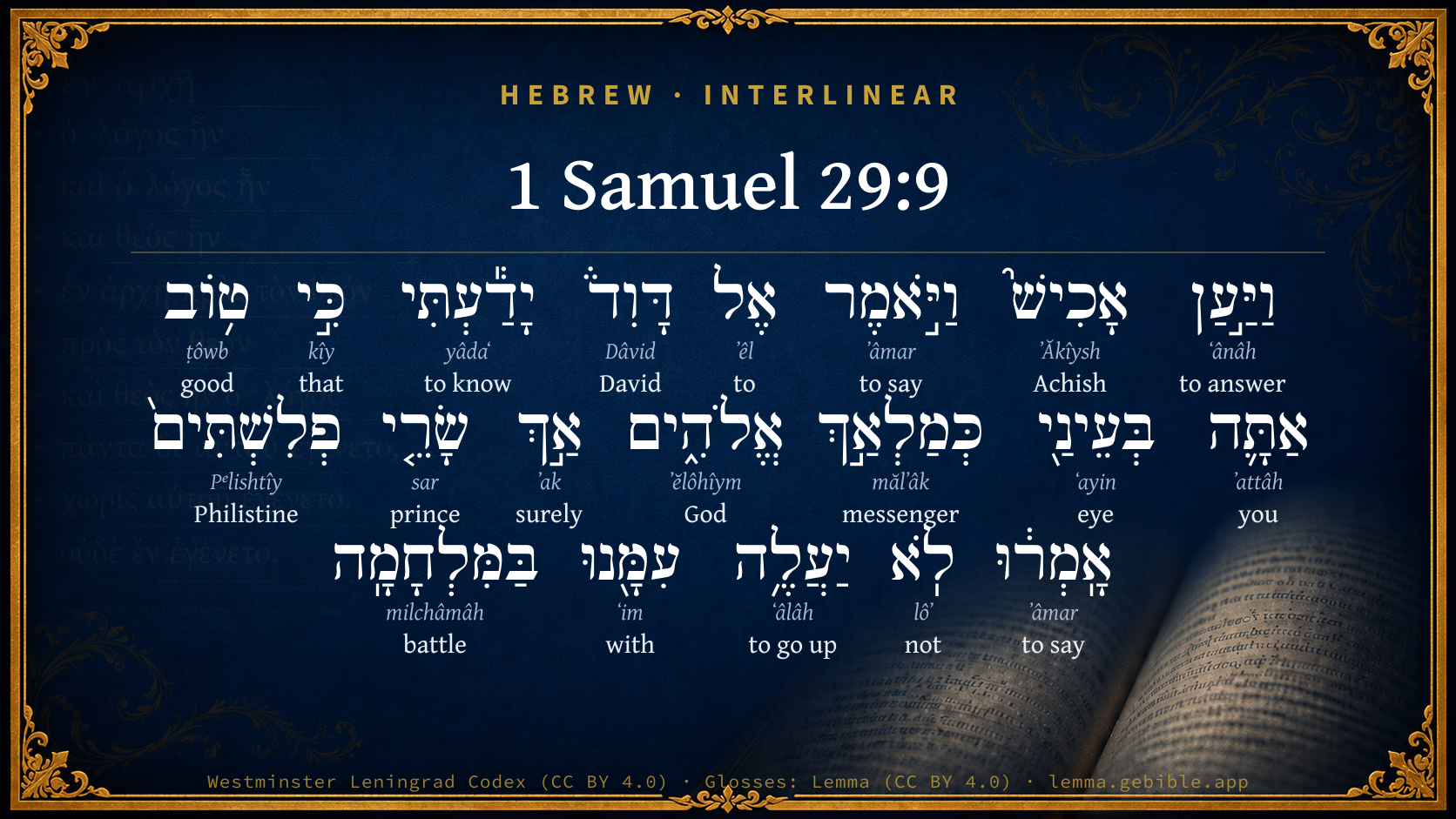
1 Samuel 29:9

Hebrew (Westminster Leningrad Codex) 1 Samuel 29:9 appears in the Hebrew Old Testament. The text above is from the Westminster Leningrad Codex. Each word links to its Strong’s number, a concise gloss, and parsing drawn from the Open Scriptures Hebrew Bible morphology. Click any word for its full Brown-Driver-Briggs (BDB) entry.
Download image
Cite this verse

1 Samuel 29:9 (World English Bible). Public Domain. Lemma interlinear Bible study tool, https://lemma.gebible.app/v/1-samuel/29/9.

Show BibTeX & RIS
BibTeX
RIS
English Translation
Achish answered David, I know that you are good in my sight, as an angel of God: notwithstanding the princes of the Philistines have said, He shall not go up with us to the battle.
World English Bible · Public Domain
Download a study sheet

One document with this verse’s original text, its word-by-word gloss line, the meaning frame, cross-references with their text, attributed commentary, and full source and license credits — printable, and it pastes into notes with its structure intact.

This verse Autodidact and up

Study sheet (.html) Plain text (.txt)

A passage Seminary Student

Up to 50 verses in one chapter. A passage sheet keeps up to 6 commentary sources and 12 cross-references per verse, in the order this page ranks them, and says so on the sheet whenever that leaves anything out. Ask for a single verse and you get the Autodidact verse sheet above.

Everything on this page stays free to read, with no account — the sheet is a download of what is already on screen, not access to it.

Want to remove ads? Support Godless Engineer
Compare translations 3

The same verse in 3 English versions, stacked beneath the original-language interlinear above. Click any original word for its lexicon entry.

Each is an independent rendering of the whole verse — the interlinear is not word-aligned to these translations.

Highlighted words mark where these versions differ — a whole-verse word diff, not a word-by-word alignment.

  • World English Bible Public Domain
    Achish answered David, I know that you are good in my sight, as an angel of God: notwithstanding the princes of the Philistines have said, He shall not go up with us to the battle.
  • King James Version Public Domain
    And Achish answered and said to David, I know that thou art good in my sight, as an angel of God: notwithstanding the princes of the Philistines have said, He shall not go up with us to the battle.
  • unfoldingWord Literal Text CC BY-SA 4.0
    And Achish answered and said to David, “I know that you good in my eyes like an angel of God. Nevertheless, the lords of the Philistines have said, ‘He shall not go up with us into the battle.’

unfoldingWord Literal Text — © unfoldingWord, licensed CC BY-SA 4.0. Word-aligned USFM3 via Door43 (git.door43.org/unfoldingWord/en_ult).

Versions to compare (up to 4)

3 of 4 selected

Show all 18 translations

Every available English version of this verse, each an independent rendering of the whole verse.

  • World English Bible Public Domain
    Achish answered David, I know that you are good in my sight, as an angel of God: notwithstanding the princes of the Philistines have said, He shall not go up with us to the battle.
  • Berean Standard Bible Public Domain
    Achish replied, “I know that you are as pleasing in my sight as an angel of God. But the commanders of the Philistines have said, ‘He must not go into battle with us.’
  • Majority Standard Bible Public Domain
    Achish replied, “I know that you are as pleasing in my sight as an angel of God. But the commanders of the Philistines have said, ‘He must not go into battle with us.’
  • King James Version Public Domain
    And Achish answered and said to David, I know that thou art good in my sight, as an angel of God: notwithstanding the princes of the Philistines have said, He shall not go up with us to the battle.
  • American Standard Version (1901) Public Domain
    And Achish answered and said to David, I know that thou art good in my sight, as an angel of God: notwithstanding the princes of the Philistines have said, He shall not go up with us to the battle.
  • Revised Version (1885) Public Domain
    And Achish answered and said to David, I know that thou art good in my sight, as an angel of God: notwithstanding the princes of the Philistines have said, He shall not go up with us to the battle.
  • Geneva Bible (1599) Public Domain
    Achish then answered, and said to Dauid, I knowe thou pleasest mee, as an Angell of God: but the princes of the Philistims haue saide, Let him not goe vp with vs to battell.
  • Douay-Rheims (1899) Public Domain
    And Achis answering said to David: I know that thou art good in my sight, as an angel of God: but the princes of the Philistines have said: He shall not go up with us to the battle.
  • Young's Literal Translation Public Domain
    And Achish answereth and saith unto David, `I have known that thou `art' good in mine eyes as a messenger of God; only, the princes of the Philistines have said, He doth not go up with us into battle;
  • Literal Standard Version CC BY-SA 4.0
    And Achish answers and says to David, “I have known that you [are] good in my eyes as a messenger of God; only, the princes of the Philistines have said, He does not go up with us into battle;
  • Unlocked Literal Bible CC BY-SA 4.0
    Achish answered and said to David, “I know that you are as blameless in my sight as an angel of God; nevertheless, the princes of the Philistines have said, 'He must not go up with us to the battle.'
  • unfoldingWord Literal Text CC BY-SA 4.0
    And Achish answered and said to David, “I know that you good in my eyes like an angel of God. Nevertheless, the lords of the Philistines have said, ‘He shall not go up with us into the battle.’
  • Darby Bible Public Domain
    And Achish answered and said to David, I know that thou art acceptable to me, as an angel of God; nevertheless the princes of the Philistines have said, He shall not go up with us to the battle.
  • World Messianic Bible Public Domain
    Achish answered David, “I know that you are good in my sight, as an angel of God. Notwithstanding, the princes of the Philistines have said, ‘He shall not go up with us to the battle.’
  • Webster's Bible Public Domain
    And Achish answered and said to David, I know that thou art good in my sight, as an angel of God: notwithstanding, the princes of the Philistines have said, He shall not go up with us to the battle.
  • Free Bible Version CC BY-SA 4.0
    “As far as I'm concerned, you're as good as an angel of God,” Achish replied. “But the Philistine commanders have stated, ‘He can't go into battle with us.’
  • Bible in Basic English Public Domain
    And Achish in answer said, It is true that in my eyes you are good, like an angel of God: but still, the rulers of the Philistines have said, He is not to go up with us to the fight.
  • JPS Tanakh (1917) Public Domain
    And Achish answered and said to David: 'I know that thou art good in my sight, as an angel of God; notwithstanding the princes of the Philistines have said: He shall not go up with us to the battle.

Literal Standard Version (2020), Covenant Press — licensed CC BY-SA 4.0. Text via the HelloAO Bible API (eBible.org). Unlocked Literal Bible (unfoldingWord) — licensed CC BY-SA 4.0. Text via the HelloAO Bible API (eBible.org). unfoldingWord Literal Text — © unfoldingWord, licensed CC BY-SA 4.0. Word-aligned USFM3 via Door43 (git.door43.org/unfoldingWord/en_ult). Free Bible Version, Dr. Jonathan Gallagher — licensed CC BY-SA 4.0. Text via the HelloAO Bible API (eBible.org).

Word by word

More ways to search: Search by grammar → Find every occurrence → Compare this word →

Practice this passage: Drill this verse → Learn its vocabulary →

אָכִישׁ֮
ʼĂkîysh
H397
“Achish”
Noun, Proper
Part of Speech
Noun
Type
Proper
Full BDB Definition

Origin: of uncertain derivation

TWOT: None

Achish = "I will blacken (or terrify)" or " only a man" - Philistine king of Gath
  1. וַיַּ֣עַן ʻânâh H6030 “and · to answer” Conjunction + Verb, Qal, Sequential Imperfect, 3rd Person, Masculine, Singular
  2. וַיֹּ֣אמֶר ʼâmar H559 “and · to say” Conjunction + Verb, Qal, Sequential Imperfect, 3rd Person, Masculine, Singular
  3. אֶל ʼêl H413 “to” Preposition
  4. דָּוִד֒ Dâvid H1732 “David” Noun, Proper
  5. יָדַ֕עְתִּי yâdaʻ H3045 “to know” Verb, Qal, Perfect, 1st Person, Common, Singular
  6. כִּ֣י kîy H3588 “that” Conjunction
  7. ט֥וֹב ṭôwb H2896 “good” Adjective, Adjective, Masculine, Singular, Absolute
  8. אַתָּ֛ה ʼattâh H859 “you” Pronoun, Personal, 2nd Person, Masculine, Singular
  9. בְּעֵינַ֖י ʻayin H5869 “in/at · eyes · my” Preposition + Noun, Common, Both, Dual, Construct + Suffix, Personal, 1st Person, Common, Singular
  10. כְּמַלְאַ֣ךְ mălʼâk H4397 “like/as · messenger of” Preposition + Noun, Common, Masculine, Singular, Construct
  11. אֱלֹהִ֑ים ʼĕlôhîym H430 “God(s)” Noun, Common, Masculine, Plural, Absolute
  12. אַ֣ךְ ʼak H389 “surely” Particle, Accusative
  13. שָׂרֵ֤י sar H8269 “princes of” Noun, Common, Masculine, Plural, Construct
  14. פְלִשְׁתִּים֙ Pᵉlishtîy H6430 “Philistines” Noun, Gentilic, Masculine, Plural, Absolute
  15. אָֽמְר֔וּ ʼâmar H559 “to say” Verb, Qal, Perfect, 3rd Person, Common, Plural
  16. לֹֽא lôʼ H3808 “not” Particle, Negative
  17. יַעֲלֶ֥ה ʻâlâh H5927 “to go up” Verb, Qal, Imperfect, 3rd Person, Masculine, Singular
  18. עִמָּ֖נוּ ʻim H5973 “with · us” Preposition + Suffix, Personal, 1st Person, Common, Plural
  19. בַּמִּלְחָמָֽה milchâmâh H4421 “in/at the · battle” Preposition, Determined + Noun, Common, Feminine, Singular, Absolute

About this verse

These counts appear in no published source. They are computed here, from the morphology-tagged text and Lemma’s own curated glosses. What Lemma adds →

20
words
19
distinct lemmas
Historical
section

Notable vocabulary

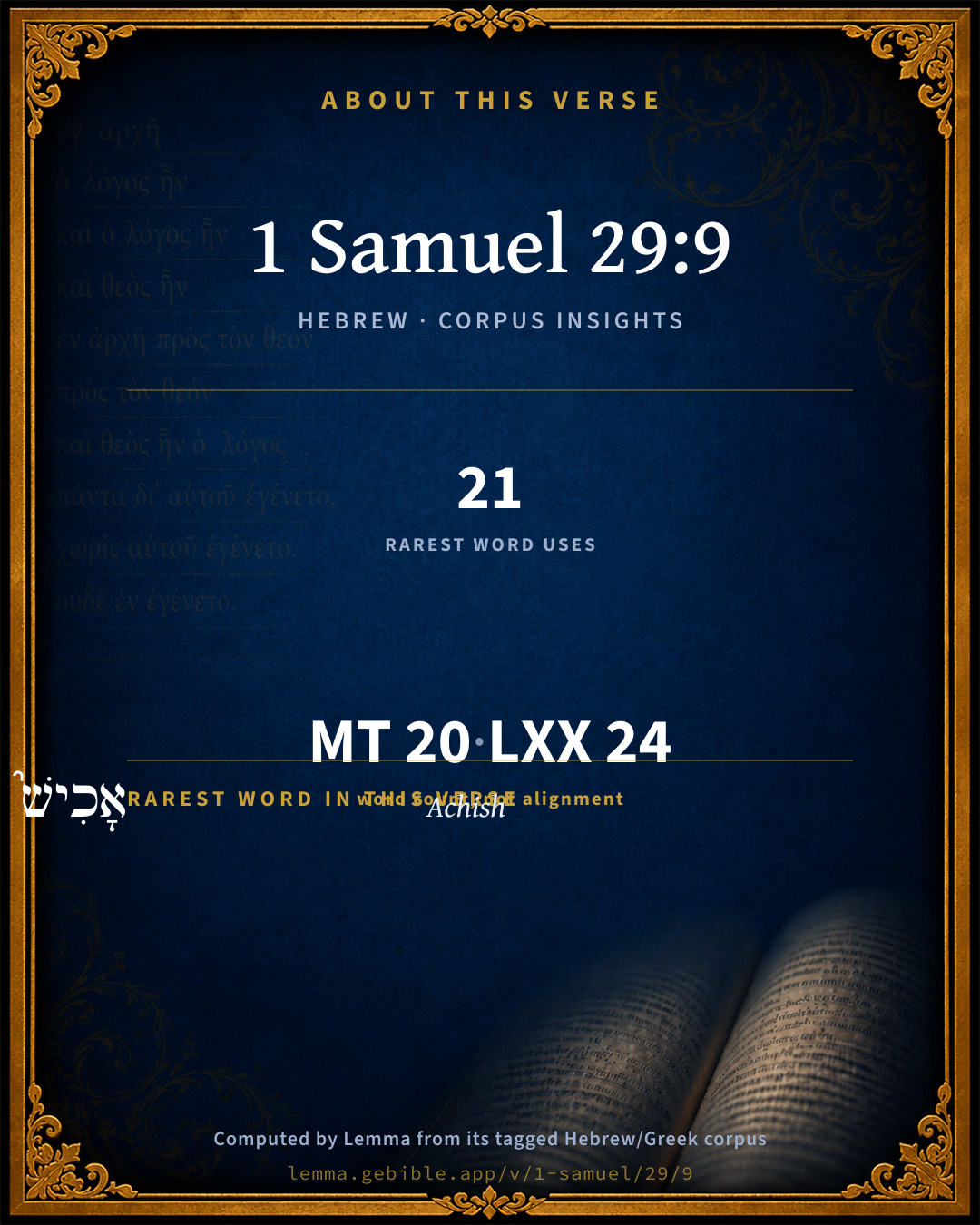
The rarest word here is אָכִישׁ֮ Achish H397 — appearing just 21 times in the whole Hebrew Bible.

Shared distinctive vocabulary

אָכִישׁ֮ Achish H397 occurs in 20 verses of the Hebrew Bible. Also found in:

Grammatical profile

  • 5 verbs
  • 8 nouns
  • 1 adjective
  • 1 pronoun
  • 2 prepositions
  • 1 conjunction
  • 2 particles

Verb forms

  • וַיַּ֣עַן Qal · Sequential Imperfect
  • וַיֹּ֣אמֶר Qal · Sequential Imperfect
  • יָדַ֕עְתִּי Qal · Perfect
  • אָֽמְר֔וּ Qal · Perfect
  • יַעֲלֶ֥ה Qal · Imperfect

Repetition

A word recurs within this verse — often emphatic in Hebrew:

  • וַיֹּ֣אמֶר to say H559 ×2

Hebrew & Septuagint length

In English translation the verse runs 35 words from the Hebrew and 29 from the Septuagint (LXX English) — closely comparable.

A rough comparison of the two English renderings, which tokenize alike — not a word-level alignment.

Word counts can differ between the Hebrew and the Greek without any difference in meaning — e.g. the Hebrew direct-object marker אֵת has no separate Greek word, and Greek often adds the article ὁ.

In the original languages it is 20 Hebrew tokens and 24 Greek tokens — but the two are counted differently (Hebrew bundles its prefixes and suffixes into one token; the Greek is in lemma form), so that isn’t a like-for-like length.

Cross-references

5

Topical passages linked to 1 Samuel 29:9 in the Treasury of Scripture Knowledge — connected by theme and wording, ordered by reader-vote popularity; previews shown in the World English Bible.

  • 2 Samuel 14:17 Then your handmaid said, Please let the word of my lord the king be comfortable; for as an angel of God, so is my lord the king to discern good and bad: and Yahweh your God be with you.
  • 2 Samuel 14:20 to change the face of the matter has your servant Joab done this thing: and my lord is wise, according to the wisdom of an angel of God, to know all things that are in the earth.
  • 2 Samuel 19:27 He has slandered your servant to my lord the king; but my lord the king is as an angel of God: do therefore what is good in your eyes.
  • Galatians 4:14 That which was a temptation to you in my flesh, you didn't despise nor reject; but you received me as an angel of God, even as Christ Jesus.
  • 1 Samuel 29:4 But the princes of the Philistines were angry with him; and the princes of the Philistines said to him, Make the man return, that he may go back to his place where you have appointed him, and let him not go down with us to battle, lest in the battle he become an adversary to us: for with what should this [fellow] reconcile himself to his lord? should it not be with the heads of these men?

Cross-references courtesy of OpenBible.info (CC BY 4.0).

Hebrew and Greek witnesses Masoretic Hebrew ↔ Greek Septuagint

The same verse in the two great witnesses to the Old Testament, shown verse-for-verse.

These are two independent witnesses, not word-aligned to each other, and the Septuagint is shown in lemma (dictionary) form.

Hebrew 1 Samuel 29:9 Masoretic · Westminster Leningrad Codex

וַיַּ֣עַן אָכִישׁ֮ וַיֹּ֣אמֶר אֶל דָּוִד֒ יָדַ֕עְתִּי כִּ֣י ט֥וֹב אַתָּ֛ה בְּעֵינַ֖י כְּמַלְאַ֣ךְ אֱלֹהִ֑ים אַ֣ךְ שָׂרֵ֤י פְלִשְׁתִּים֙ אָֽמְר֔וּ לֹֽא יַעֲלֶ֥ה עִמָּ֖נוּ בַּמִּלְחָמָֽה

Achish answered David, I know that you are good in my sight, as an angel of God: notwithstanding the princes of the Philistines have said, He shall not go up with us to the battle.

World English Bible · Public Domain

Greek LXX 1 Samuel 29:9 Septuagint · lemma form

καί ἀποκρίνω αγχους πρός δαυίδ οἶδα ὅτι ἀγαθός σύ ἐν ὀφθαλμός ἐγώ ἀλλά ὁ σατράπης ὁ ἀλλόφυλος λέγω οὐ ἥκω μετά ἐγώ εἰς πόλεμος

And Anchus answered David, I know that you are good in my eyes, but the lords of the Philistines say, He shall not come with us to the war.

LXX2012 (modern English Septuagint) · Public Domain

Hebrew: Westminster Leningrad Codex (CC BY 4.0). Greek: Septuagint (public domain); English from LXX2012 (modern English Septuagint) (Public Domain). How the Septuagint differs from the Hebrew →

Targum (Aramaic paraphrase)

1

The Targum is the ancient Jewish Aramaic paraphrase of the Hebrew Scriptures — an interpretive translation, not the Hebrew text itself. Onkelos (literal) and Pseudo-Jonathan (expansive) render the Torah, and Jonathan the Prophets. Coverage is partial: where no permissively-licensed English translation exists for a verse, only the Aramaic is shown. This is verse-level text, not a word-by-word alignment to the Hebrew.

  1. Targum Jonathan Prophets (Joshua–Malachi)
    וַאֲתֵיב אָכִישׁ וַאֲמַר לְדָוִד יְדַעְנָא אֲרֵי תַקִין אַתְּ בְּעֵינַי כְּמַלְאָכָא דַייָ בְּרַם רַבְרְבֵי פְלִשְׁתָּאֵי אֲמַרוּ לָא יִסַק עִמָנָא בִּקְרָבָא:

    (no public-domain English translation for this verse)

    Targum Jonathan — Aramaic: “Mikraot Gedolot” (public domain). English: “Sefaria Community Translation” (CC0 1.0 (public-domain dedication)); “London "Chaldee Paraphrase," 1871” (public domain). Text via Sefaria.

Commentary

Notes on 1 Samuel 29:9 from classic Christian and Jewish commentators (each source and its license shown beneath its notes). The classic Christian expositions comment on the surrounding passage and are grouped to its opening verse, so a note may address several verses; the Jewish commentaries on the Tanakh (Rashi and others) are per-verse, so they appear only where the commentator wrote on this verse.

Lemma curates 59 commentaries, every one of them public domain or Creative Commons licensed, each selected and text-cleaned for this edition rather than reprinted as found. About our sources →

Trapp's Complete Commentary

John Trapp

1Sa 29:9 And Achish answered and said to David, I know that thou [art] good in my sight, as an angel of God: notwithstanding the princes of the Philistines have said, He shall not go up with us to the battle.

Ver. 9. Thou art good in my sight, as an angel of God.] Thou art both pious and prosperous; secunde fluunt omnia ubicunque ades. {a} See Gen 33:19 2Sa 14:17. Chrysostom calleth some eminent Christians of his time earthly angels; and Dr Taylor blessed the Lord that ever he came acquainted with that angel of God, John Bradford. The heathens were not without some blind notions of God and his angels; whom Plato maketh to be caeli motores; and Plutarch, messengers betwixt God and men, Iussa divina ferentes ad homines, et hominum vota ad deos; but excellent persons every way.

Notwithstanding the princes of the Philistines have said.] He rehearseth not all, nor the worst of the princes’ words; to teach us, saith Osiander, that when we do report a tale from another man’s mouth, we should make not the worst, but the best of it.

{a} Jun.

John Trapp, A Commentary or Exposition upon All the Books of the Old and New Testament (1647–1656) — public domain. Text from a community e-Sword module.

Joseph Benson's Commentary

1Sa 29:9. Achish said, Thou art good in my sight as an angel of God — In whom nothing is blame-worthy. The heathen acknowledged good spirits, which also they worshipped as an inferior sort of deities, who were messengers and ministers to the supreme God; Achish had learned the title of angels from the Israelites his neighbours, and especially from David’s conversation.

Joseph Benson's Commentary on the Old and New Testaments (1811–1818) — public domain. Text from a community e-Sword module.

Jamieson, Fausset & Brown

Robert Jamieson, A. R. Fausset & David Brown

notwithstanding the princes of the Philistines have said--The Philistine government had constitutional checks--or at least the king was not an absolute sovereign; but his authority was limited--his proceedings liable to be controlled by "the powerful barons of that rude and early period--much as the kings of Europe in the Middle Ages were by the proud and lawless aristocracy which surrounded them" [CHALMERS].

Next: 1 Samuel Chapter 30

Jamieson, Fausset & Brown — Commentary Critical and Explanatory on the Whole Bible (1871) — public domain (CC PDM 1.0). Text via the HelloAO Bible API.

Adam Clarke's Commentary

Verse 9. As an angel of God] There is some reason to think that Achish had actually embraced or was favourably disposed towards the Jewish religion. He speaks here of the angels of God, as a Jew might be expected to speak; and in 1Sa 29:6 he appeals to, and swears by Jehovah; which, perhaps, no Philistine ever did. It is possible that he might have learned many important truths from David, during the time he sojourned with him.

Adam Clarke's Commentary on the Bible (1810–1826) — public domain. Text from a community e-Sword/MySword module.

Ellicott's Commentary for English Readers

(9) As an angel of God.—Again a simile, which Achish most likely borrowed from Hebrew thought, and made use of in his graceful courtesy as likely to be acceptable to David.

A Bible Commentary for English Readers, edited by Charles John Ellicott (1878–1897) — public domain. Text from a community e-Sword module.

The Cambridge Bible for Schools and Colleges

gen. ed. J. J. S. Perowne

9. I know that, &c.] Better, I know it, for, &c.

as an angel of God] Cp. 2Sa_14:17; 2Sa_14:20; 2Sa_19:27. The Sept. (B) omits the words.

The Cambridge Bible for Schools and Colleges (gen. ed. J. J. S. Perowne; Cambridge University Press, 1878–1918) — public domain. Text from a community e-Sword module.

John Gill's Exposition

And Achish answered and said unto David,.... In reply to the questions:

I know that thou art good in my sight as an angel of God: for his great wisdom, and graceful behaviour, and inoffensive carriage:

notwithstanding the princes of the Philistines have said, he shall not go up with us to the battle; though Achish had so good an opinion of him, and had declared it in council, yet an order had passed there that he should not go to battle with them; there were but five of them, and Achish was one of the five, so that there were four to one for the dismissing him; and Achish, though a king, was obliged to submit.

John Gill's Exposition of the Whole Bible (1746–1763) — public domain (CC PDM 1.0). Text via the HelloAO Bible API.

Haydock's Catholic Bible Commentary

Angel of God, equally incapable of any meanness. The pagans admitted the existence of good and of evil spirits. (Sanctius) This exaggerated compliment occurs, Genesis xxxiii. 10., 2 Kings xiv. 17., and xix. 27.

George Leo Haydock (1774–1849), Haydock's Catholic Family Bible and Commentary, 1859 edition — public domain. Excludes Psalms (Douay-Rheims chapter numbering differs from Protestant) and Deuterocanonical books (Catholic canon only).

Matthew Poole's English Annotations

As an angel of God, in whom nothing is blameworthy. Or it may be used to express David’s great wisdom (as well as integrity); as 2Sa 14:17; 19:27. The heathens acknowledged good spirits, which also they worshipped as an inferior sort of deities, who were messengers and ministers to the supreme God; only Achish had learned the title of angels from the Israelites his neighbours, and especially from David’s conversation.

Matthew Poole's English Annotations on the Holy Bible (1683–1685) — public domain. Text from a community e-Sword/MySword module.

The Pulpit Commentary

I know that, etc. Rather, "I know it, for thou art good in my sight," i.e. 1 know all that thou wouldst say as to thy trustworthiness, and assent to it. As an angel of God. Ie. as a messenger of God, as one set to me by God.

The Pulpit Commentary (1880–1919), ed. H.D.M. Spence-Jones & Joseph S. Exell — public domain. Text from a community e-Sword module.

John Wesley's Explanatory Notes

Angel of God - In whom nothing is blame-worthy. The Heathens acknowledged good spirits, which also they worshipped as an inferior sort of deities, who were messengers and ministers to the supreme God; Achish had learned the title of angels, from the Israelites his neighbours, and especially from David's conversation.

John Wesley, Explanatory Notes Upon the Whole Bible (1754–1765) — public domain. Text via the GEBible commentary corpus.

Scofield Reference Notes

C. I. Scofield

angel

(See Scofield "Heb 1:4").

The Scofield Reference Bible (1917 edition), notes by C. I. Scofield — public domain. Text from a community e-Sword module.

Lesson kit

Teaching starters — assembled from the data on this page, not authored interpretation. Every prompt links to the verse data it draws on. Edit before teaching.

1 Samuel, in the Historical, opens this verse with 20 words (19 distinct Hebrew lemmas). Its most distinctive word is ʼĂkîysh (“Achish”). A historical commentator’s framing appears above. Read the whole chapter for the surrounding context.

Discussion questions

  1. The word ʼĂkîysh carries the sense “Achish.” How does it shape the verse?
  2. 1 Samuel 21:10 shares the word «Achish» with this verse. How do the two illuminate each other?
  3. “to say” occurs 2× in this one verse. What is the effect of the repetition?
  4. The translations on this page render this verse differently — a whole-verse word diff, not a word-by-word alignment. What might account for the different wordings?
  5. The verb «וַיַּ֣עַן» is Qal Sequential Imperfect. How does its form color the action?
  6. Reading how Trapp's Complete Commentary and Joseph Benson's Commentary read this verse, where do the two commentators agree and where do they part?

Things to notice

Reading settings

Reading text

Shown beneath each verse's original-language words.

Old Testament
Old Testament edition

Read the OT as the Masoretic Hebrew (MT) or the Greek Septuagint (LXX).

English shown for the Greek Septuagint (in the Hebrew ↔ Greek comparison).

Comparing translations? Open the Compare panel on any verse page to stack up to four side by side.