
2 Kings 6:33

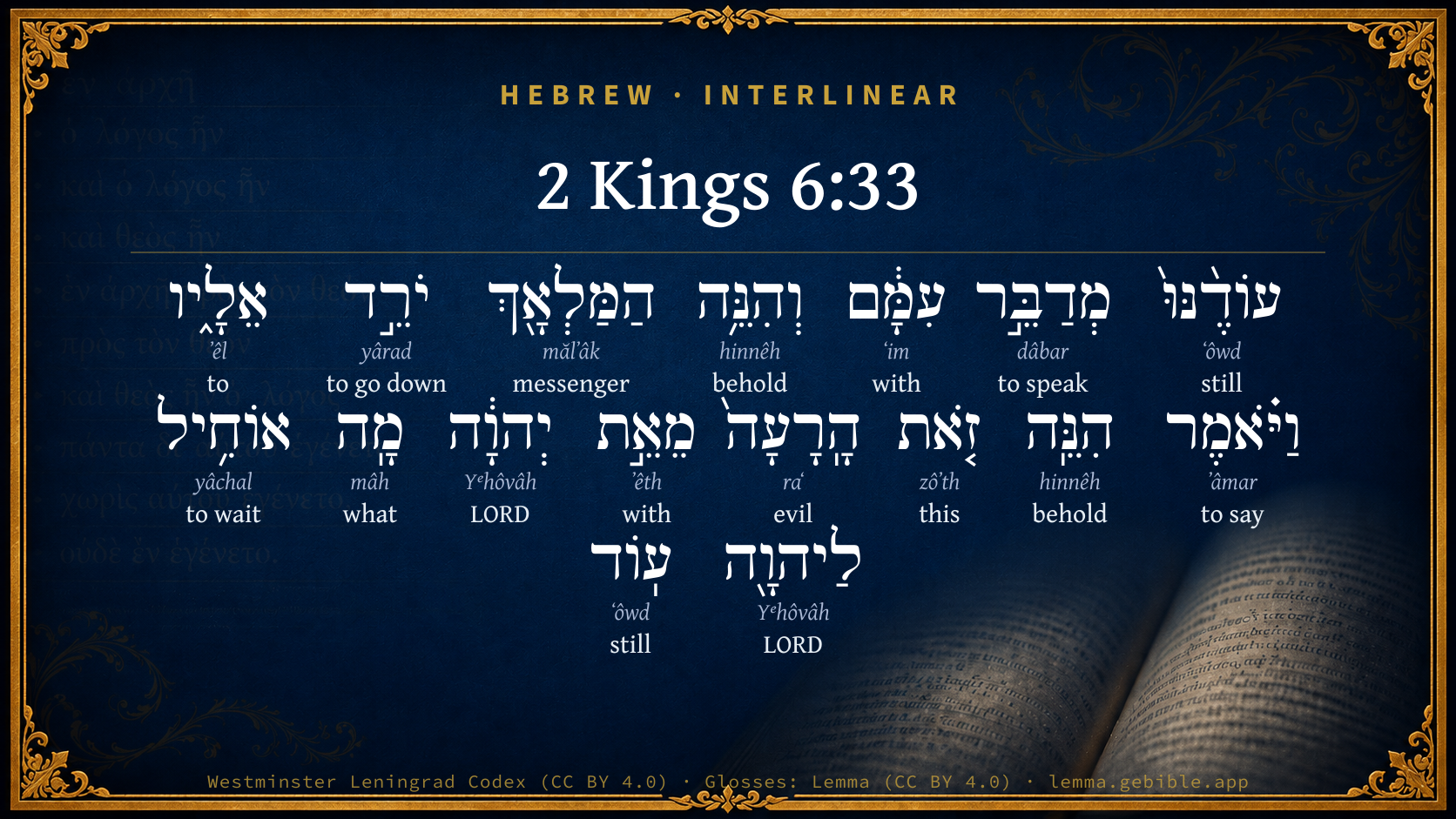
Hebrew (Westminster Leningrad Codex) 2 Kings 6:33 appears in the Hebrew Old Testament. The text above is from the Westminster Leningrad Codex. Each word links to its Strong’s number, a concise gloss, and parsing drawn from the Open Scriptures Hebrew Bible morphology. Click any word for its full Brown-Driver-Briggs (BDB) entry.
Download image
Cite this verse

2 Kings 6:33 (World English Bible). Public Domain. Lemma interlinear Bible study tool, https://lemma.gebible.app/v/2-kings/6/33.

Show BibTeX & RIS
BibTeX
RIS
English Translation
While he was yet talking with them, behold, the messenger came down to him: and he said, Behold, this evil is of Yahweh; why should I wait for Yahweh any longer?
World English Bible · Public Domain
Download a study sheet

One document with this verse’s original text, its word-by-word gloss line, the meaning frame, cross-references with their text, attributed commentary, and full source and license credits — printable, and it pastes into notes with its structure intact.

This verse Autodidact and up

Study sheet (.html) Plain text (.txt)

A passage Seminary Student

Up to 50 verses in one chapter. A passage sheet keeps up to 6 commentary sources and 12 cross-references per verse, in the order this page ranks them, and says so on the sheet whenever that leaves anything out. Ask for a single verse and you get the Autodidact verse sheet above.

Everything on this page stays free to read, with no account — the sheet is a download of what is already on screen, not access to it.

Want to remove ads? Support Godless Engineer
Compare translations 3

The same verse in 3 English versions, stacked beneath the original-language interlinear above. Click any original word for its lexicon entry.

Each is an independent rendering of the whole verse — the interlinear is not word-aligned to these translations.

Highlighted words mark where these versions differ — a whole-verse word diff, not a word-by-word alignment.

  • World English Bible Public Domain
    While he was yet talking with them, behold, the messenger came down to him: and he said, Behold, this evil is of Yahweh; why should I wait for Yahweh any longer?
  • King James Version Public Domain
    And while he yet talked with them, behold, the messenger came down unto him: and he said, Behold, this evil is of the LORD; what should I wait for the LORD any longer?
  • unfoldingWord Literal Text CC BY-SA 4.0
    He was still speaking with them, and behold, the messenger was coming down to him. And he said, “Behold, this calamity from Yahweh. Why should I wait for Yahweh any longer?”

unfoldingWord Literal Text — © unfoldingWord, licensed CC BY-SA 4.0. Word-aligned USFM3 via Door43 (git.door43.org/unfoldingWord/en_ult).

Versions to compare (up to 4)

3 of 4 selected

Show all 18 translations

Every available English version of this verse, each an independent rendering of the whole verse.

  • World English Bible Public Domain
    While he was yet talking with them, behold, the messenger came down to him: and he said, Behold, this evil is of Yahweh; why should I wait for Yahweh any longer?
  • Berean Standard Bible Public Domain
    While Elisha was still speaking with them, the messenger came down to him. And the king said, “This calamity is from the LORD. Why should I wait for the LORD any longer?”
  • Majority Standard Bible Public Domain
    While Elisha was still speaking with them, the messenger came down to him. And the king said, “This calamity is from the LORD. Why should I wait for the LORD any longer?”
  • King James Version Public Domain
    And while he yet talked with them, behold, the messenger came down unto him: and he said, Behold, this evil is of the LORD; what should I wait for the LORD any longer?
  • American Standard Version (1901) Public Domain
    And while he was yet talking with them, behold, the messenger came down unto him: and he said, Behold, this evil is of Jehovah; why should I wait for Jehovah any longer?
  • Revised Version (1885) Public Domain
    And while he yet talked with them, behold, the messenger came down unto him: and he said, Behold, this evil is of the LORD; why should I wait for the LORD any longer?
  • Geneva Bible (1599) Public Domain
    While he yet talked with them, beholde, the messenger came downe vnto him, and saide, Behold, this euill commeth of the Lord: should I attende on the Lord any longer?
  • Douay-Rheims (1899) Public Domain
    While he was yet speaking to them, the messenger appeared who was coming to him. And he said: Behold, so great an evil is from the Lord: what shall I look for more from the Lord?
  • Young's Literal Translation Public Domain
    He is yet speaking with them, and lo, the messenger is coming down unto him, and he saith, `Lo, this `is' the evil from Jehovah: what -- do I wait for Jehovah any more?'
  • Literal Standard Version CC BY-SA 4.0
    He is yet speaking with them, and behold, the messenger is coming down to him, and he says, “Behold, this [is] the calamity from YHWH; why do I wait for YHWH anymore?”
  • Unlocked Literal Bible CC BY-SA 4.0
    While he was still talking with them, behold, the messenger came down to him. The king had said, “Behold, this trouble comes from Yahweh. Why should I wait for Yahweh any longer?”
  • unfoldingWord Literal Text CC BY-SA 4.0
    He was still speaking with them, and behold, the messenger was coming down to him. And he said, “Behold, this calamity from Yahweh. Why should I wait for Yahweh any longer?”
  • Darby Bible Public Domain
    And while he yet talked with them, behold, the messenger came down to him. And [the king] said, Behold, this evil is of Jehovah: why should I wait for Jehovah any longer?
  • World Messianic Bible Public Domain
    While he was still talking with them, behold, the messenger came down to him. Then he said, “Behold, this evil is from the LORD. Why should I wait for the LORD any longer?”
  • Webster's Bible Public Domain
    And while he yet talked with them, behold, the messenger came down to him: and he said, Behold, this evil is from the LORD; what should I wait for the LORD any longer?
  • Free Bible Version CC BY-SA 4.0
    While Elisha was still speaking with them, the messenger arrived. The king said, “This disaster is from the Lord. Why should I wait for the Lord any longer?”
  • Bible in Basic English Public Domain
    While he was still talking to them, the king came down and said, This evil is from the Lord; why am I to go on waiting any longer for the Lord?
  • JPS Tanakh (1917) Public Domain
    And while he yet talked with them, behold, the messenger came down unto him; and the king said: 'Behold, this evil is of the LORD; why should I wait for the LORD any longer?'

Literal Standard Version (2020), Covenant Press — licensed CC BY-SA 4.0. Text via the HelloAO Bible API (eBible.org). Unlocked Literal Bible (unfoldingWord) — licensed CC BY-SA 4.0. Text via the HelloAO Bible API (eBible.org). unfoldingWord Literal Text — © unfoldingWord, licensed CC BY-SA 4.0. Word-aligned USFM3 via Door43 (git.door43.org/unfoldingWord/en_ult). Free Bible Version, Dr. Jonathan Gallagher — licensed CC BY-SA 4.0. Text via the HelloAO Bible API (eBible.org).

Word by word

More ways to search: Search by grammar → Find every occurrence → Compare this word →

Practice this passage: Drill this verse → Learn its vocabulary →

אוֹחִ֥יל
yâchal
H3176
“to wait”
Verb, Hiphil, Imperfect, 1st Person, Common, Singular
Part of Speech
Verb
Stem
Hiphil
Form
Imperfect
Person
1st Person
Gender
Common
Number
Singular
Full BDB Definition

Origin: a primitive root

TWOT: 859

to wait, hope, expect - (Niphal) to wait - (Piel) - to wait, await, tarry - to wait for, hope for - (Hiphil) to wait, tarry, wait for, hope for
  1. עוֹדֶ֨נּוּ֙ ʻôwd H5750 “still · his” Adverb + Suffix, Personal, 3rd Person, Masculine, Singular
  2. מְדַבֵּ֣ר dâbar H1696 “speaking” Verb, Piel, Participle Active, Masculine, Singular, Absolute
  3. עִמָּ֔ם ʻim H5973 “with · them” Preposition + Suffix, Personal, 3rd Person, Masculine, Plural
  4. וְהִנֵּ֥ה hinnêh H2009 “and · behold” Conjunction + Particle, Demonstrative
  5. הַמַּלְאָ֖ךְ mălʼâk H4397 “the · messenger” Particle, Definite Article + Noun, Common, Masculine, Singular, Absolute
  6. יֹרֵ֣ד yârad H3381 “going down” Verb, Qal, Participle Active, Masculine, Singular, Absolute
  7. אֵלָ֑יו ʼêl H413 “to · him” Preposition + Suffix, Personal, 3rd Person, Masculine, Singular
  8. וַיֹּ֗אמֶר ʼâmar H559 “and · to say” Conjunction + Verb, Qal, Sequential Imperfect, 3rd Person, Masculine, Singular
  9. הִנֵּֽה hinnêh H2009 “behold” Particle, Demonstrative
  10. זֹ֤את zôʼth H2063 “this” Pronoun, Demonstrative, Feminine, Singular
  11. הָֽרָעָה֙ raʻ H7451 “the · evil” Particle, Definite Article + Noun, Common, Feminine, Singular, Absolute
  12. מֵאֵ֣ת ʼêth H854 “from · with” Preposition + Preposition
  13. יְהוָ֔ה Yᵉhôvâh H3068 “LORD” Noun, Proper
  14. מָֽה mâh H4100 “what” Particle, Interrogative
  15. לַיהוָ֖ה Yᵉhôvâh H3068 “to/for · LORD” Preposition + Noun, Proper
  16. עֽוֹד ʻôwd H5750 “still” Adverb

About this verse

These counts appear in no published source. They are computed here, from the morphology-tagged text and Lemma’s own curated glosses. What Lemma adds →

17
words
14
distinct lemmas
Historical
section

Shared distinctive vocabulary

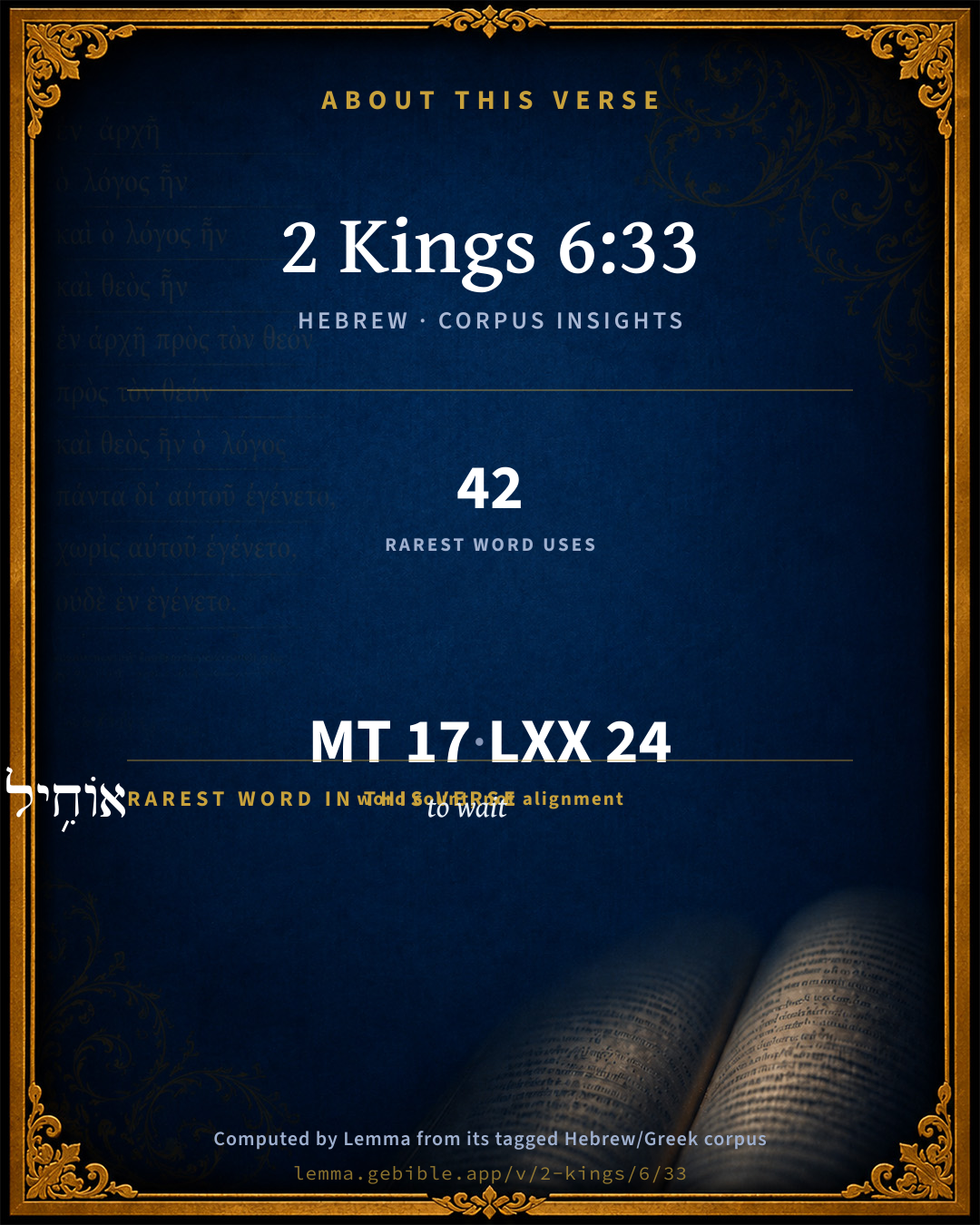
אוֹחִ֥יל to wait H3176 occurs in 41 verses of the Hebrew Bible. Also found in:

Grammatical profile

  • 4 verbs
  • 4 nouns
  • 1 pronoun
  • 3 prepositions
  • 2 adverbs
  • 3 particles

Verb forms

  • מְדַבֵּ֣ר Piel · Participle Active
  • יֹרֵ֣ד Qal · Participle Active
  • וַיֹּ֗אמֶר Qal · Sequential Imperfect
  • אוֹחִ֥יל Hiphil · Imperfect

Repetition

Words recur within this verse — often emphatic in Hebrew:

  • עוֹדֶ֨נּוּ֙ still H5750 ×2
  • וְהִנֵּ֥ה behold H2009 ×2
  • יְהוָ֔ה LORD H3068 ×2

Hebrew & Septuagint length

In English translation the verse runs 31 words from the Hebrew and 32 from the Septuagint (LXX English) — closely comparable.

A rough comparison of the two English renderings, which tokenize alike — not a word-level alignment.

Word counts can differ between the Hebrew and the Greek without any difference in meaning — e.g. the Hebrew direct-object marker אֵת has no separate Greek word, and Greek often adds the article ὁ.

In the original languages it is 17 Hebrew tokens and 24 Greek tokens — but the two are counted differently (Hebrew bundles its prefixes and suffixes into one token; the Greek is in lemma form), so that isn’t a like-for-like length.

Cross-references

26

Topical passages linked to 2 Kings 6:33 in the Treasury of Scripture Knowledge — connected by theme and wording, ordered by reader-vote popularity; previews shown in the World English Bible.

  • Job 2:9 Then his wife said to him, "Do you still maintain your integrity? Renounce God, and die."
  • Isaiah 8:21 They shall pass through it, sore distressed and hungry; and it shall happen that when they shall be hungry, they shall fret themselves, and curse by their king and by their God, and turn their faces upward:
  • Genesis 4:13 Cain said to Yahweh, "My punishment is greater than I can bear.
  • Exodus 16:6–8 Moses and Aaron said to all the children of Israel, "At evening, then you shall know that Yahweh has brought you out from the land of Egypt;
  • 1 Samuel 28:6–8 When Saul inquired of Yahweh, Yahweh didn't answer him, neither by dreams, nor by Urim, nor by prophets.
  • 1 Samuel 31:4 Then said Saul to his armor bearer, Draw your sword, and thrust me through therewith, lest these uncircumcised come and thrust me through, and abuse me. But his armor bearer would not; for he was sore afraid. Therefore Saul took his sword, and fell on it.
  • Job 1:11 But put forth your hand now, and touch all that he has, and he will renounce you to your face."
  • Job 1:21 He said, "Naked I came out of my mother's womb, and naked shall I return there. Yahweh gave, and Yahweh has taken away. Blessed be the name of Yahweh."
  • Job 2:5 But put forth your hand now, and touch his bone and his flesh, and he will renounce you to your face."
  • Psalms 27:14 Wait for Yahweh. Be strong, and let your heart take courage. Yes, wait for Yahweh.
  • Psalms 37:7 Rest in Yahweh, and wait patiently for him. Don't fret because of him who prospers in his way, Because of the man who makes wicked plots happen.
  • Psalms 37:9 For evildoers shall be cut off, But those who wait for Yahweh shall inherit the land.
  • Psalms 62:5 My soul, wait in silence for God alone, For my expectation is from him.
  • Proverbs 19:3 The foolishness of man subverts his way; His heart rages against Yahweh.
  • Isaiah 8:17 I will wait for Yahweh, who hides his face from the house of Jacob, and I will look for him.
  • Isaiah 26:3 You will keep [him] in perfect peace, [whose] mind [is] stayed [on you]; because he trusts in you.
  • Isaiah 50:10 Who is among you who fears Yahweh, who obeys the voice of his servant? He who walks in darkness, and has no light, let him trust in the name of Yahweh, and rely on his God.
  • Jeremiah 2:25 Withhold your foot from being unshod, and your throat from thirst: but you said, It is in vain; no, for I have loved strangers, and after them will I go.
  • Lamentations 3:25–26 Yahweh is good to those who wait for him, to the soul that seeks him.
  • Habakkuk 2:3 For the vision is yet for the appointed time, and it hurries toward the end, and won't prove false. Though it takes time, wait for it; because it will surely come. It won't delay.
  • Matthew 27:4–5 saying, "I have sinned in that I betrayed innocent blood." But they said, "What is that to us? You see to it."
  • Luke 18:1 He also spoke a parable to them that they must always pray, and not give up,
  • 2 Corinthians 2:7 so that on the contrary you should rather forgive him and comfort him, lest by any means such a one should be swallowed up with his excessive sorrow.
  • 2 Corinthians 2:11 that no advantage may be gained over us by Satan; for we are not ignorant of his schemes.
  • Revelation 16:9–11 People were scorched with great heat, and people blasphemed the name of God who has the power over these plagues. They didn't repent and give him glory.
  • Ezekiel 33:10 You, son of man, tell the house of Israel: Thus you speak, saying, Our transgressions and our sins are on us, and we pine away in them; how then can we live?

Cross-references courtesy of OpenBible.info (CC BY 4.0).

Hebrew and Greek witnesses Masoretic Hebrew ↔ Greek Septuagint

The same verse in the two great witnesses to the Old Testament, shown verse-for-verse.

These are two independent witnesses, not word-aligned to each other, and the Septuagint is shown in lemma (dictionary) form.

Hebrew 2 Kings 6:33 Masoretic · Westminster Leningrad Codex

עוֹדֶ֨נּוּ֙ מְדַבֵּ֣ר עִמָּ֔ם וְהִנֵּ֥ה הַמַּלְאָ֖ךְ יֹרֵ֣ד אֵלָ֑יו וַיֹּ֗אמֶר הִנֵּֽה זֹ֤את הָֽרָעָה֙ מֵאֵ֣ת יְהוָ֔ה מָֽה אוֹחִ֥יל לַיהוָ֖ה עֽוֹד

While he was yet talking with them, behold, the messenger came down to him: and he said, Behold, this evil is of Yahweh; why should I wait for Yahweh any longer?

World English Bible · Public Domain

Greek LXX 2 Kings 6:33 Septuagint · lemma form

ἔτι αὐτός λαλέω μετά αὐτός καί ἰδού ἄγγελος καταβαίνω πρός αὐτός καί εἶπον ἰδού οὗτος ὁ κακία παρά κύριος τίς ὑπομένω ὁ κύριος ἔτι

While he was yet speaking with them, behold, a messenger came to him: and he said, Behold, this evil is of the Lord; why should I wait for the Lord any longer?

LXX2012 (modern English Septuagint) · Public Domain

Hebrew: Westminster Leningrad Codex (CC BY 4.0). Greek: Septuagint (public domain); English from LXX2012 (modern English Septuagint) (Public Domain). How the Septuagint differs from the Hebrew →

Targum (Aramaic paraphrase)

1

The Targum is the ancient Jewish Aramaic paraphrase of the Hebrew Scriptures — an interpretive translation, not the Hebrew text itself. Onkelos (literal) and Pseudo-Jonathan (expansive) render the Torah, and Jonathan the Prophets. Coverage is partial: where no permissively-licensed English translation exists for a verse, only the Aramaic is shown. This is verse-level text, not a word-by-word alignment to the Hebrew.

  1. Targum Jonathan Prophets (Joshua–Malachi)
    עַד דְהוּא מְמַלֵיל עִמְהוֹן וְהָא אִזְגַדָא נָחִית לְוָתֵיהּ וַאֲמַר הָא דָא בִישְׁתָּא מִן קֳדָם יְיָ מָא אֲצַלֵי קֳדָם יְיָ עוֹד:

    (no public-domain English translation for this verse)

    Targum Jonathan — Aramaic: “Mikraot Gedolot” (public domain). English: “Sefaria Community Translation” (CC0 1.0 (public-domain dedication)); “London "Chaldee Paraphrase," 1871” (public domain). Text via Sefaria.

Commentary

Notes on 2 Kings 6:33 from classic Christian and Jewish commentators (each source and its license shown beneath its notes). The classic Christian expositions comment on the surrounding passage and are grouped to its opening verse, so a note may address several verses; the Jewish commentaries on the Tanakh (Rashi and others) are per-verse, so they appear only where the commentator wrote on this verse.

Lemma curates 59 commentaries, every one of them public domain or Creative Commons licensed, each selected and text-cleaned for this edition rather than reprinted as found. About our sources →

Trapp's Complete Commentary

John Trapp

2Ki 6:33 And while he yet talked with them, behold, the messenger came down unto him: and he said, Behold, this evil [is] of the LORD; what should I wait for the LORD any longer?

Ver. 33. Behold, this evil is of the Lord.] He hath brought us to the lowest ebb, and done us as much mischief as is possible; an impious and blasphemous charge of injustice and hard dealing.

What should I wait for the Lord?] q.d., Wait as wait will: I will yield up all, and make for myself as good terms as I can. See Pro 19:3.

John Trapp, A Commentary or Exposition upon All the Books of the Old and New Testament (1647–1656) — public domain. Text from a community e-Sword module.

Joseph Benson's Commentary

2Ki 6:33. While he yet talked with them, the messenger came — Namely, to the door, where we are to understand he was stopped that he could not come at the prophet till the king came. And he said, Behold, this evil, &c. — Either the messenger said this in the king’s name and words, or rather the king himself, who, though not here named, may be presumed to be present, both by the prophet’s prediction of his speedy coming, and by the presence of the lord, on whose hand the king leaned, 2Ki 7:2. This evil — This dreadful famine, which is now so extreme, that women are forced to eat their own children; is of the Lord — He hath inflicted it, and, for aught I see, he will not remove it. All penal evil is of the Lord as the first cause and sovereign judge: and this we ought to apply to particular cases: if all evil, then this evil which we are groaning under. Whoever are the instruments, God is the principal agent. What should I wait for the Lord any longer? — Thou biddest me wait upon God for help; but I perceive I may wait long enough before deliverance comes: I am weary with waiting, I can wait no longer.

Joseph Benson's Commentary on the Old and New Testaments (1811–1818) — public domain. Text from a community e-Sword module.

Tyndale Open Study Notes

Tyndale Open Resources

6:33 And the king said: Literally And he said. The messenger might have been delivering the king’s words verbatim. • Because the misery of the siege appeared to be from the Lord, Joram felt that further prayer for rescue was useless.

Tyndale Open Study Notes — © Tyndale Open Resources, licensed CC BY-SA 4.0. Text via the HelloAO Bible API.

Geneva Bible (1599)

Geneva Bible translators

So the wicked fall into a rage and desperation, if they find not sudden remedy against their afflictions.

Geneva Bible (1599) marginal notes — public domain. Text via Bolls.life.

Adam Clarke's Commentary

Verse 33. Behold, this evil is of the Lord] It is difficult to know whether it be the prophet, the messenger, or the king, that says these words. It might be the answer of the prophet from within to the messenger who was without, and who sought for admission, and gave his reason; to whom Elisha might have replied: "I am not the cause of these calamities; they are from the Lord; I have been praying for their removal; but why should I pray to the Lord any longer, for the time of your deliverance is at hand?" And then Elisha said, - see the following chapter, where the removal of the calamity is foretold in the most explicit manner; and indeed the chapter is unhappily divided from this. The seventh chapter should have begun with 2Kgs 6:24 of this chapter, as, by the present division, the story is unnaturally interrupted.

How natural is it for men to lay the cause of their suffering on any thing or person but themselves! Ahab's iniquity was sufficient to have brought down God's displeasure on a whole nation; and yet he takes no blame to himself, but lays all on the prophet, who was the only salt that preserved the whole nation from corruption. How few take their sins to themselves! and till they do this, they cannot be true penitents; nor can they expect God's wrath to be averted till they feel themselves the chief of sinners.

Adam Clarke's Commentary on the Bible (1810–1826) — public domain. Text from a community e-Sword/MySword module.

Ellicott's Commentary for English Readers

(33) Yet talked.—Was still speaking.

The messenger.—Ewalïs correction, “the king” (melek for maâk), is certainly right. In the rapid progress of the story, the arrival and momentary exclusion of the messenger is understood. The approach of the king may have been seen from the upper part of Elisha’s house.

Came down.—Was coming down, to the prophet’s house, from the ramparts. (Comp. 2Ki_5:24.)

And he said.—That is, the king said.

Behold, this evil is of the Lord.—Rather, Behold, such (this) is the distress from Jehovah. Things have come to this pitch by the will of Jehovah.

What (rather, why) should I wait for the Lord any longer?—As I have hitherto done, at your persuasion. Why should I not now surrender to the Syrians, and slay the prophet who has so long deluded me with vain hopes?

A Bible Commentary for English Readers, edited by Charles John Ellicott (1878–1897) — public domain. Text from a community e-Sword module.

The Cambridge Bible for Schools and Colleges

gen. ed. J. J. S. Perowne

33. while he yet talked with them] He had hardly explained his knowledge and his wish before action became necessary. The messenger arrived, and we must understand that the king also arrived immediately afterwards, and so the execution of Elisha was stayed, and Jehoram was shewn to be in some degree penitent for his hasty threat.

and he said] The words which follow must be the words of the king. He has reached Elisha’s house and countermanded his first order. Now his thought is of what shall be done next. The people are at the direst extremity, and God, who has allowed this evil to come upon the nation, gives His prophet no message of relief. In this conviction he is of the mind that Samaria shall be surrendered. Hence his language, ‘This evil is of the Lord’ and He allows it to continue, ‘why should I wait for the Lord any longer?’

The Cambridge Bible for Schools and Colleges (gen. ed. J. J. S. Perowne; Cambridge University Press, 1878–1918) — public domain. Text from a community e-Sword module.

Albert Barnes' Notes on the Bible

The messenger - It has been proposed to change “messenger” into “king,” the two words being in Hebrew nearly alike, and the speech with which the chapter ends being considered only suitable in the mouth of the king, whose presence is indicated in 2Ki 7:2, 2Ki 7:17. Others think that the words “and the king after him” have fallen out of the text.

Came down - The messenger came down from off the wall to the level of the streets.

Behold this evil ... - Jehoram bursts into the prophet’s presence with a justification of the sentence 2Ki 6:31 he has pronounced against him. “Behold this evil - this siege with all its horrors - is from Yahweh - from Yahweh, Whose prophet thou art. Why should I wait for Yahweh - temporize with Him - keep as it were, on terms with Him by suffering thee to live - any longer? What hast thou to say in arrest of judgment?”

Albert Barnes' Notes on the Bible (1834–1885) — public domain. Text from a community e-Sword/MySword module.

Haydock's Catholic Bible Commentary

And he, Joram, (Menochius, &c.) after (Haydock) his messenger. (Estius) (Piscator) --- What, &c. All is desperate; (Calmet) our miseries cannot increase. (Menochius) --- I have nothing now to fear or to hope for. (Salien)

George Leo Haydock (1774–1849), Haydock's Catholic Family Bible and Commentary, 1859 edition — public domain. Excludes Psalms (Douay-Rheims chapter numbering differs from Protestant) and Deuterocanonical books (Catholic canon only).

Matthew Poole's English Annotations

Unto him, to wit, to the door, where also we are to understand that he was held fast, that he could not come at the prophet till the king came, as the prophet had commanded them to do.

He said; either, first, The messenger, in the king’s name and words. Or, secondly, The king himself, who, though not here named, may be presumed to be present, both by the prophet’s prediction of his speedy coming, and by the presence of the lord on whose hand the king leaned, 2Ki 7:2. This evil; this dreadful famine, which is now so extreme that women are forced to eat their own children.

Is of the Lord; he hath inflicted it, and (for aught that I see) he will not remove it. Thus he lays all the blame upon God, not, as he ought, upon his own and his mother’s wickedness, which provoked God, who doth not willingly afflict, to send this heavy judgment upon him.

What should I wait for the Lord any longer? thou biddest me wait upon God for help; but I perceive I may wait long enough before deliverance comes; I am weary with waiting, I can wait no longer.

Matthew Poole's English Annotations on the Holy Bible (1683–1685) — public domain. Text from a community e-Sword/MySword module.

Whedon's Commentary on the Bible

Daniel D. Whedon

33. While he yet talked with them — While Elisha was yet in the act of telling the elders to fasten the door and keep the messenger out.

And he said — Who said? It seems at first difficult to determine whether the words that follow are the words of the prophet, the messenger, or the king.

But on closer study they seem best to suit the mouth of the king, and the obscurity of the passage must be attributed to the brevity of the narrative.

This evil is of the Lord — These words of the king are a part of his countermand of the order to behead Elisha, and a reason for it. He is convinced that the famine is a Divine judgment on the nation for his sins.

What should I wait for the Lord — Rather, Why should I wait, etc. These words are virtually a prayer for the Lord to come and remove the famine. The passage may be thus paraphrased: I acknowledge that this evil is a punishment for my sins; the Lord thus chastens me sorely. But now, when all this people are brought to such an extremity of woe, why should I wait longer for the Lord to interpose and deliver his people from their sufferings?

Daniel D. Whedon (gen. ed.), Commentary on the Old and New Testaments (1874–1909) — public domain. Text from a community e-Sword module.

The Pulpit Commentary

And while he yet talked with themi.e. , while Elisha yet talked with the elders, endeavoring probably to persuade them to stop the messengerbehold, the messenger came down unto him: and he said. The narrative is very compressed and elliptical. Some suppose words to have fallen out (as wyrja after wyla); but this is unnecessary. The reader is expected to supply missing links, and to understand that all happened as Elisha had predicted and enjoined that the messenger came, that the elders stopped him, and that the king shortly arrived. The king was, of course, admitted, and, being admitted, took the word, and said, Behold, this evil is of the Lord; what rather, why should I wait for the Lord any longer? Jehoram had, apparently, to some extent repented of his hasty message, and had hurried after his messenger, to give Elisha one further chance of life. We must understand that they had been in communication previously on the subject of the siege, and that Elisha had encouraged the king to "wait for" an interposition of Jehovah. The king now urges that the time for waiting is over; matters are at the last gasp; "this evil" this terrible suffering which can no longer be endured of the Lord," has come from him, is continued by him, and is not relieved. What use is there in his "waiting" any longer? Why should he not break with Jehovah, behead the lying prophet, and surrender the town? What has Elisha to say in reply?

The Pulpit Commentary (1880–1919), ed. H.D.M. Spence-Jones & Joseph S. Exell — public domain. Text from a community e-Sword module.

John Wesley's Explanatory Notes

He said - Or, the king, who, though not here named, may be presumed to be present, both by the prophet's prediction of his speedy coming, and by the presence of the Lord, on whose hand the king leaned, chap. vii, 2. This evil - This dreadful famine, which is now so extreme, that women are forced to eat their own children. The Lord - Hath inflicted it, and (for ought I see) he will not remove it. All penal evil is of the Lord, as the first cause and sovereign judge. And this we ought to apply to particular cases: if all evil, then this evil which we are groaning under. Whoever are the instruments, God is the principal agent. What should I, &c. - Thou bidst me wait upon God for help: but I perceive I may wait long enough before deliverance comes: I am weary with waiting, I can wait no longer.

John Wesley, Explanatory Notes Upon the Whole Bible (1754–1765) — public domain. Text via the GEBible commentary corpus.

Rashi

Rabbi Shlomo Yitzchaki (Rashi)

He said. The king.

“Behold, this tragedy is from Adonoy.” This is one of the curses that He cursed through Moshe, “And you will eat the flesh of your womb, etc., in the siege and in the distress, etc.”

What more can I hope for from Adonoy? To save, it will surely not avail.

Rashi on the Tanakh — English translations: “The Judaica Press complete Tanach with Rashi, translated by A. J. Rosenberg” (CC BY 4.0); “Pentateuch with Rashi's commentary by M. Rosenbaum and A.M. Silbermann, 1929-1934” (public domain); “The Metsudah Tanach series, Lakewood, N.J” (CC BY 4.0); and “The Book of Joshua, Metsudah Publications, 1997” (CC BY 4.0). Text via Sefaria.

Lesson kit

Teaching starters — assembled from the data on this page, not authored interpretation. Every prompt links to the verse data it draws on. Edit before teaching.

2 Kings, in the Historical, opens this verse with 17 words (14 distinct Hebrew lemmas). Its most distinctive word is yâchal (“to wait”). A historical commentator’s framing appears above. Read the whole chapter for the surrounding context.

Discussion questions

  1. The word yâchal carries the sense “to wait.” How does it shape the verse?
  2. Genesis 8:12 shares the word «to wait» with this verse. How do the two illuminate each other?
  3. “still” occurs 2× in this one verse. What is the effect of the repetition?
  4. These translations render this verse differently. What is at stake in choosing one wording over another?
  5. The verb «מְדַבֵּ֣ר» is Piel Participle Active. How does its form color the action?
  6. Reading how Trapp's Complete Commentary and Joseph Benson's Commentary read this verse, where do the two commentators agree and where do they part?

Things to notice

Reading settings

Reading text

Shown beneath each verse's original-language words.

Old Testament
Old Testament edition

Read the OT as the Masoretic Hebrew (MT) or the Greek Septuagint (LXX).

English shown for the Greek Septuagint (in the Hebrew ↔ Greek comparison).

Comparing translations? Open the Compare panel on any verse page to stack up to four side by side.