
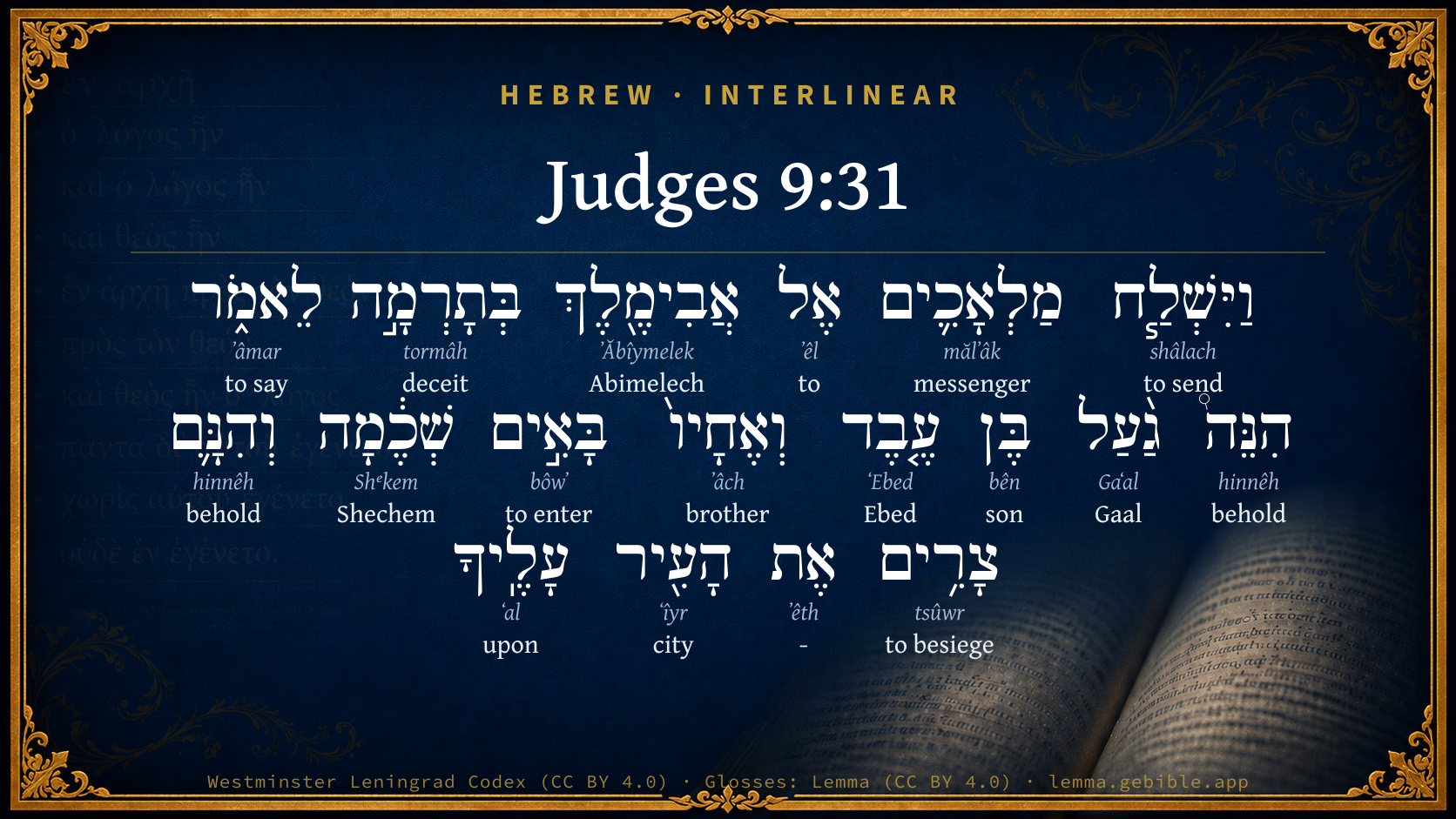
Judges 9:31

Hebrew (Westminster Leningrad Codex) Judges 9:31 appears in the Hebrew Old Testament. The text above is from the Westminster Leningrad Codex. Each word links to its Strong’s number, a concise gloss, and parsing drawn from the Open Scriptures Hebrew Bible morphology. Click any word for its full Brown-Driver-Briggs (BDB) entry.
Download image
Cite this verse

Judges 9:31 (World English Bible). Public Domain. Lemma interlinear Bible study tool, https://lemma.gebible.app/v/judges/9/31.

Show BibTeX & RIS
BibTeX
RIS
English Translation
He sent messengers to Abimelech craftily, saying, Behold, Gaal the son of Ebed and his brothers are come to Shechem; and, behold, they constrain the city [to take part] against you.
World English Bible · Public Domain
Highlights
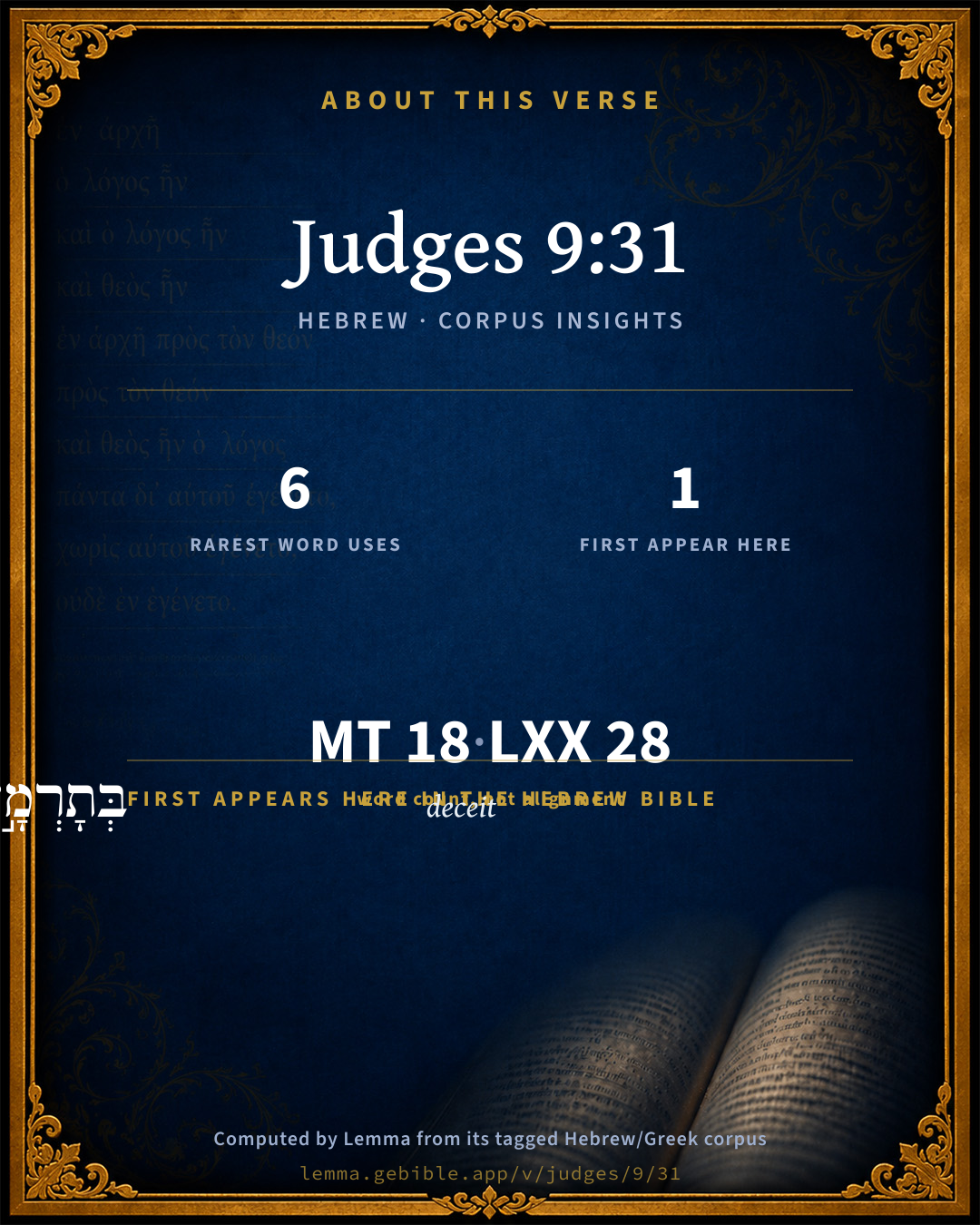
  • 1 first appearance in the Hebrew Bible
Full analysis ↓
Download a study sheet

One document with this verse’s original text, its word-by-word gloss line, the meaning frame, cross-references with their text, attributed commentary, and full source and license credits — printable, and it pastes into notes with its structure intact.

This verse Autodidact and up

Study sheet (.html) Plain text (.txt)

A passage Seminary Student

Up to 50 verses in one chapter. A passage sheet keeps up to 6 commentary sources and 12 cross-references per verse, in the order this page ranks them, and says so on the sheet whenever that leaves anything out. Ask for a single verse and you get the Autodidact verse sheet above.

Everything on this page stays free to read, with no account — the sheet is a download of what is already on screen, not access to it.

Want to remove ads? Support Godless Engineer
Compare translations 3

The same verse in 3 English versions, stacked beneath the original-language interlinear above. Click any original word for its lexicon entry.

Each is an independent rendering of the whole verse — the interlinear is not word-aligned to these translations.

Highlighted words mark where these versions differ — a whole-verse word diff, not a word-by-word alignment.

  • World English Bible Public Domain
    He sent messengers to Abimelech craftily, saying, Behold, Gaal the son of Ebed and his brothers are come to Shechem; and, behold, they constrain the city [to take part] against you.
  • King James Version Public Domain
    And he sent messengers unto Abimelech privily, saying, Behold, Gaal the son of Ebed and his brethren be come to Shechem; and, behold, they fortify the city against thee.
  • unfoldingWord Literal Text CC BY-SA 4.0
    And he sent messengers to Abimelech in deceit, saying, “Behold, Gaal, the son of Ebed, and his brothers come to Shechem, and behold, inciting the city against you.

unfoldingWord Literal Text — © unfoldingWord, licensed CC BY-SA 4.0. Word-aligned USFM3 via Door43 (git.door43.org/unfoldingWord/en_ult).

Versions to compare (up to 4)

3 of 4 selected

Show all 18 translations

Every available English version of this verse, each an independent rendering of the whole verse.

  • World English Bible Public Domain
    He sent messengers to Abimelech craftily, saying, Behold, Gaal the son of Ebed and his brothers are come to Shechem; and, behold, they constrain the city [to take part] against you.
  • Berean Standard Bible Public Domain
    So he covertly sent messengers to Abimelech to say, “Look, Gaal son of Ebed and his brothers have come to Shechem and are stirring up the city against you.
  • Majority Standard Bible Public Domain
    So he covertly sent messengers to Abimelech to say, “Look, Gaal son of Ebed and his brothers have come to Shechem and are stirring up the city against you.
  • King James Version Public Domain
    And he sent messengers unto Abimelech privily, saying, Behold, Gaal the son of Ebed and his brethren be come to Shechem; and, behold, they fortify the city against thee.
  • American Standard Version (1901) Public Domain
    And he sent messengers unto Abimelech craftily, saying, Behold, Gaal the son of Ebed and his brethren are come to Shechem; and, behold, they constrain the city `to take part' against thee.
  • Revised Version (1885) Public Domain
    And he sent messengers unto Abimelech craftily, saying, Behold, Gaal the son of Ebed and his brethren are come to Shechem; and, behold, they constrain the city to take part against thee.
  • Geneva Bible (1599) Public Domain
    Therefore he sent messengers vnto Abimelech priuily, saying, Beholde, Gaal the sonne of Ebed and his brethren be come to Shechem, and beholde, they fortifie the citie against thee.
  • Douay-Rheims (1899) Public Domain
    And sent messengers privately to Abimelech, saying: Behold Gaal the son of Obed is come into Sichem with his brethren, and endeavoureth to set the city against thee.
  • Young's Literal Translation Public Domain
    and he sendeth messengers unto Abimelech deceitfully, saying, `Lo, Gaal son of Ebed and his brethren are coming into Shechem, and lo, they are fortifying the city against thee;
  • Literal Standard Version CC BY-SA 4.0
    and he sends messengers to Abimelech deceitfully, saying, “Behold, Gaal son of Ebed and his brothers are coming into Shechem, and behold, they are fortifying the city against you;
  • Unlocked Literal Bible CC BY-SA 4.0
    He sent messengers to Abimelech in order to deceive, saying, “See, Gaal son of Ebed and his relatives are coming to Shechem, and they are stirring up the city against you.
  • unfoldingWord Literal Text CC BY-SA 4.0
    And he sent messengers to Abimelech in deceit, saying, “Behold, Gaal, the son of Ebed, and his brothers come to Shechem, and behold, inciting the city against you.
  • Darby Bible Public Domain
    And he sent messengers to Abim'elech at Aru'mah, saying, "Behold, Ga'al the son of Ebed and his kinsmen have come to Shechem, and they are stirring up the city against you.
  • World Messianic Bible Public Domain
    He sent messengers to Abimelech craftily, saying, “Behold, Gaal the son of Ebed and his brothers have come to Shechem; and behold, they incite the city against you.
  • Webster's Bible Public Domain
    And he sent messengers to Abimelech privately, saying, Behold, Gaal the son of Ebed, and his brethren, are come to Shechem; and behold, they fortify the city against thee.
  • Free Bible Version CC BY-SA 4.0
    He secretly sent messengers to Abimelech to tell him, “Look, Gaal, son of Ebed, and his relatives have arrived in Shechem, and they are stirring up the town to rebel against you.
  • Bible in Basic English Public Domain
    And he sent to Abimelech at Arumah, saying, See, Gaal, the son of Ebed, and his brothers have come to Shechem, and they are working up the town against you.
  • JPS Tanakh (1917) Public Domain
    And he sent messengers unto Abimelech in Tormah, saying: 'Behold, Gaal the son of Ebed and his brethren are come to Shechem; and, behold, they will incite the city against thee.

Literal Standard Version (2020), Covenant Press — licensed CC BY-SA 4.0. Text via the HelloAO Bible API (eBible.org). Unlocked Literal Bible (unfoldingWord) — licensed CC BY-SA 4.0. Text via the HelloAO Bible API (eBible.org). unfoldingWord Literal Text — © unfoldingWord, licensed CC BY-SA 4.0. Word-aligned USFM3 via Door43 (git.door43.org/unfoldingWord/en_ult). Free Bible Version, Dr. Jonathan Gallagher — licensed CC BY-SA 4.0. Text via the HelloAO Bible API (eBible.org).

Word by word

More ways to search: Search by grammar → Find every occurrence → Compare this word →

Practice this passage: Drill this verse → Learn its vocabulary →

עֶ֤בֶד
ʻEbed
H5651
“Ebed”
Noun, Proper
Part of Speech
Noun
Type
Proper
Full BDB Definition

Origin: the same as H5650

TWOT: None

Ebed = "servant" - father of Gaal in the time of the judges - son of Jonathan and one of the sons of Adin who returned from exile with Ezra
  1. וַיִּשְׁלַ֧ח shâlach H7971 “and · to send” Conjunction + Verb, Qal, Sequential Imperfect, 3rd Person, Masculine, Singular
  2. מַלְאָכִ֛ים mălʼâk H4397 “messengers” Noun, Common, Masculine, Plural, Absolute
  3. אֶל ʼêl H413 “to” Preposition
  4. אֲבִימֶ֖לֶךְ ʼĂbîymelek H40 “Abimelech” Noun, Proper
  5. בְּתָרְמָ֣ה tormâh H8649 “in/at · deceit” Preposition + Noun, Proper
  6. לֵאמֹ֑ר ʼâmar H559 “to say” Preposition + Verb, Qal, Infinitive Construct
  7. הִנֵּה֩ hinnêh H2009 “behold” Particle, Demonstrative
  8. גַ֨עַל Gaʻal H1603 “Gaal” Noun, Proper
  9. בֶּן bên H1121 “son of” Noun, Common, Masculine, Singular, Construct
  10. וְאֶחָיו֙ ʼâch H251 “and · brothers · his” Conjunction + Noun, Common, Masculine, Plural, Construct + Suffix, Personal, 3rd Person, Masculine, Singular
  11. בָּאִ֣ים bôwʼ H935 “entering” Verb, Qal, Participle Active, Masculine, Plural, Absolute
  12. שְׁכֶ֔מָה Shᵉkem H7927 “Shechem · toward” Noun, Proper + Suffix, Demonstrative
  13. וְהִנָּ֛ם hinnêh H2009 “and · behold · them” Conjunction + Particle, Demonstrative + Suffix, Personal, 3rd Person, Masculine, Plural
  14. צָרִ֥ים tsûwr H6696 “besieging” Verb, Qal, Participle Active, Masculine, Plural, Absolute
  15. אֶת ʼêth H853 “-” Particle, Direct Object
  16. הָעִ֖יר ʻîyr H5892 “the · city” Particle, Definite Article + Noun, Common, Feminine, Singular, Absolute
  17. עָלֶֽיךָ ʻal H5921 “upon · you” Preposition + Suffix, Personal, 2nd Person, Masculine, Singular

About this verse

These counts appear in no published source. They are computed here, from the morphology-tagged text and Lemma’s own curated glosses. What Lemma adds →

18
words
17
distinct lemmas
Historical
section

Notable vocabulary

The rarest word here is עֶ֤בֶד Ebed H5651 — appearing just 6 times in the whole Hebrew Bible.

First appearance in Scripture

This word makes its first canonical appearance in the Hebrew Bible here:

  • בְּתָרְמָ֣ה deceit H8649

Shared distinctive vocabulary

עֶ֤בֶד Ebed H5651 occurs in 6 verses of the Hebrew Bible. Also found in:

Grammatical profile

  • 4 verbs
  • 9 nouns
  • 2 prepositions
  • 3 particles

Verb forms

  • וַיִּשְׁלַ֧ח Qal · Sequential Imperfect
  • לֵאמֹ֑ר Qal · Infinitive Construct
  • בָּאִ֣ים Qal · Participle Active
  • צָרִ֥ים Qal · Participle Active

Repetition

A word recurs within this verse — often emphatic in Hebrew:

  • הִנֵּה֩ behold H2009 ×2

Hebrew & Septuagint length

In English translation the verse runs 31 words from the Hebrew and 30 from the Septuagint (LXX English) — closely comparable.

A rough comparison of the two English renderings, which tokenize alike — not a word-level alignment.

Word counts can differ between the Hebrew and the Greek without any difference in meaning — e.g. the Hebrew direct-object marker אֵת has no separate Greek word, and Greek often adds the article ὁ.

In the original languages it is 18 Hebrew tokens and 28 Greek tokens — but the two are counted differently (Hebrew bundles its prefixes and suffixes into one token; the Greek is in lemma form), so that isn’t a like-for-like length.

Hebrew and Greek witnesses Masoretic Hebrew ↔ Greek Septuagint

The same verse in the two great witnesses to the Old Testament, shown verse-for-verse.

These are two independent witnesses, not word-aligned to each other, and the Septuagint is shown in lemma (dictionary) form.

Hebrew Judges 9:31 Masoretic · Westminster Leningrad Codex

וַיִּשְׁלַ֧ח מַלְאָכִ֛ים אֶל אֲבִימֶ֖לֶךְ בְּתָרְמָ֣ה לֵאמֹ֑ר הִנֵּה֩ גַ֨עַל בֶּן עֶ֤בֶד וְאֶחָיו֙ בָּאִ֣ים שְׁכֶ֔מָה וְהִנָּ֛ם צָרִ֥ים אֶת הָעִ֖יר עָלֶֽיךָ

He sent messengers to Abimelech craftily, saying, Behold, Gaal the son of Ebed and his brothers are come to Shechem; and, behold, they constrain the city [to take part] against you.

World English Bible · Public Domain

Greek LXX Judges 9:31 Septuagint · lemma form

καί ἀποστέλλω ἄγγελος πρός αβιμελεχ ἐν κρυφῇ λέγω ἰδού γααλ υἱός ιωβηλ καί ὁ ἀδελφός αὐτός ἔρχομαι εἰς συχεμ καί ἰδού αὐτός περι καταἧμαι ὁ πόλις ἐπί σύ

And he sent messengers to Abimelech secretly, saying, Behold, Gaal the son of Jobel and his brethren are come to Sychem; and behold, they have besieged the city against you.

LXX2012 (modern English Septuagint) · Public Domain

On this verse, Lange's Commentary on the Holy Scriptures discusses the Septuagint’s reading. Read the note in Commentary ↓

Hebrew: Westminster Leningrad Codex (CC BY 4.0). Greek: Septuagint (public domain); English from LXX2012 (modern English Septuagint) (Public Domain). How the Septuagint differs from the Hebrew →

Targum (Aramaic paraphrase)

1

The Targum is the ancient Jewish Aramaic paraphrase of the Hebrew Scriptures — an interpretive translation, not the Hebrew text itself. Onkelos (literal) and Pseudo-Jonathan (expansive) render the Torah, and Jonathan the Prophets. Coverage is partial: where no permissively-licensed English translation exists for a verse, only the Aramaic is shown. This is verse-level text, not a word-by-word alignment to the Hebrew.

  1. Targum Jonathan Prophets (Joshua–Malachi)
    וּשְׁלַח אִזְגַדִין לְוַת אֲבִימֶלֶךְ בְּרָז לְמֵימָר הָא גַעַל בַּר עֶבֶד וַאֲחוֹהִי אָתָן לִשְׁכֶם וְהָא אִנוּן צָיְרִין יַת קַרְתָּא עֲלָךְ:

    (no public-domain English translation for this verse)

    Targum Jonathan — Aramaic: “Mikraot Gedolot” (public domain). English: “Sefaria Community Translation” (CC0 1.0 (public-domain dedication)); “London "Chaldee Paraphrase," 1871” (public domain). Text via Sefaria.

Commentary

Notes on Judges 9:31 from classic Christian and Jewish commentators (each source and its license shown beneath its notes). The classic Christian expositions comment on the surrounding passage and are grouped to its opening verse, so a note may address several verses; the Jewish commentaries on the Tanakh (Rashi and others) are per-verse, so they appear only where the commentator wrote on this verse.

Lemma curates 59 commentaries, every one of them public domain or Creative Commons licensed, each selected and text-cleaned for this edition rather than reprinted as found. About our sources →

Trapp's Complete Commentary

John Trapp

Jdg 9:31 And he sent messengers unto Abimelech privily, saying, Behold, Gaal the son of Ebed and his brethren be come to Shechem; and, behold, they fortify the city against thee.

Ver. 31. Behold, Gaal … and, behold, they fortify.] Abimelech was but a usurper, yet Gaal, his prefect or lieutenant, sticketh to him. So did John, Duke of Norfolk, to Richard III, though the night before Bosworth-field he had this distich fastened to his tent-door -

“Jocky of Norfolk, be not too bold:

For Dicky, thy master, is bought and sold.”

- Hollinsh.

So Sir Ralph Percy, slain upon Hegely moor, in Northumberland, by the Lord Mountacute, General for Edward IV, would in nowise depart the field, though defeated; but in dying said, "I have saved the bird in my breast," meaning his oath to King Henry VI. {a}

{a} Speed, 869.

John Trapp, A Commentary or Exposition upon All the Books of the Old and New Testament (1647–1656) — public domain. Text from a community e-Sword module.

Lange's Commentary on the Holy Scriptures

Abimelech appears before Shechem. Gaal’s defeat and expulsion.

Jdg_9:31-41

31And he sent messengers unto Abimelech privily, saying, Behold, Gaal the son of Ebed, and his brethren, be come to Shechem; and behold, they fortify [excite] the city against thee. 32Now therefore up by night, thou, and the people that is with thee, and lie in wait in the field: 33And it shall be, that in the morning, as soon as the sun is up, thou shalt rise early, and set [move] upon the city; and behold, when [omit: when] he and the people that is with him [will] come out against [to] thee, [and] then mayest [shalt] thou do to them as thou shalt find occasion. 34And Abimelech rose up, and all the people that were with him, by night, and they laid wait against [near] Shechem in four companies. 35And Gaal the son of Ebed went out, and stood in the entering [at the entrance] of the gate of the city: and [lo!] Abimelech rose up, and the people that were with him, from lying in wait 36[from their place of ambush]. And when [omit: when] Gaal saw the people, [and] he said to Zebul, Behold, there come people down from the top [tops] of the mountains. And Zebul said unto him, Thou seest the shadow of the mountains as if they were men. 37And Gaal spake again, and said, See, there [also] come people down by the middle [from the height] of the land, and another [one] company come along by the plain of Meonenim [cometh from the way of the Magicians’ Grove]. 38Then said Zebul unto him, Where is now thy mouth, wherewith thou saidst, Who is Abimelech, that we should serve him? is not this the people that thou hast despised? go out, I pray now, and fight with them. 39And Gaal went out before [at the head of]the men [lords] of Shechem, and fought with Abimelech. 40And Abimelech chased him, and he fled before him, and many were overthrown and wounded 41[many fell slain], even unto the entering [entrance] of the gate. And Abimelech dwelt [remained] at Arumah: and Zebul thrust out Gaal and his brethren, that they should not dwell in Shechem.

EXEGETICAL AND DOCTRINAL

Jdg_9:31. And he sent secretly, בְּתָרְמָה. Although the form תָּרְמָה (cf. תַּרְמִית) is an unusual one, the connection suggests, not the name of a place, but the fact that Zebul, though “prefect of the city,” concealed his measure from the citizens. The messengers whom he sent must have gone “secretly” (as the Sept. and Targum translate), since Gaal had not learned of their going (Jdg_9:36). How were such intercourse, as Jdg_9:36 implies, possible between Zebul and Gaal, if Zebul’s coöperation with Abimelech against Gaal had been publicly known? Nor is Zebul to be regarded as one of Abimelech’s generals, but as a Shechemite magistrate, who is incensed because Gaal plots his own overthrow. It may be confidently assumed that if תָּרְמָה were the name of a place, Jdg_9:34 would read: “And Abimelech rose up, מִתָּרְמָה, from Tormah.” תָּרְמָה, however, conveys not only the idea of secrecy, but of secrecy combined with deceit, secret deceit; and such was certainly the character of Zebul’s Acts 20 It is also to be noticed that in his message Zebul does not accuse the city, but only Gaal as exciting the city against Abimelech. As magistrate, he does not wish to bring the wrath of Abimelech upon the city, but only upon his rival. Very graphic is the expression צָרִים, commonly used of besiegers. Gaal and his brethren, says Zebul, press the city like besiegers, to induce it to rise against thee. Their expulsion is therefore all that is necessary. But since this is not the whole truth—for Shechem, as we have seen, first elected Gaal because it had already offended against Abimelech—it is evident that Zebul s policy of exciting Abimelech against Gaal only, is dictated by regard to his own interests.

Jdg_9:32-41. And move upon the city. The place of Abimelech’s abode is not given; but he was in the midst of his army. He must have been some distance from Shechem, since he needed a part of the night (Jdg_9:32) to get within easy reach of it. He is to place himself in ambush, so as not to be prematurely observed. Abimelech follows the counsel. In the morning, Gaal and Zebul naturally betake themselves to the gate of the city: Gaal, because it had become his business to watch over Shechem; Zebul, because of his office as magistrate. Gaal, who has no misgivings—for he has slept away the effects of the wine—sees troops descending from the mountains. Zebul thinks it yet too soon to tell him the truth; he will give Abimelech time first to bring up all his forces; and therefore deceives and at the same time mocks Gaal by saying, “It is the shadow of the mountains that thou seest.” Immediately, however, a body of troops is seen advancing whose identity as such cannot be mistaken. By the “tops of the mountains” we are to understand the more distant mountains; by the “height (טַבּוּר) of the land”,; a nearer hill, in the immediate vicinity of the city (the “navel” of the land); and by the “Elon Meonenim,” a dusky forest (“Magicians’ Grove”), against the near horizon. From all these points commanding the avenues to the city troops of soldiers advanced, to the consternation of Gaal and the surprise of the citizens. Now Zebul throws off his mask, and reminds Gaal of his previous audacity. The latter is compelled to try his fortunes in battle. At the head of the “lords of Shechem,” he marches out against Abimelech. But he is far from being a match for him. He is utterly unable to stand his ground. A terrible rout begins. Gaal saves himself through the open gate; but the road, up to the very threshold of the gate, is covered with the slain. His boasting has a miserable end. His authority is gone. Zebul, who previously did not dare insist on his expulsion, now carries it through. He persuades the timid and terrified Shechemites that they will thus allay the anger of Abimelech. He believes it himself; for he has, carefully thrown the whole blame on Gaal. Abimelech’s conduct seems to favor this persuasion; for he does not prosecute the attack, but retires to Arumah.21 But what a delusion! The banished Gaal is the only one who escapes destruction.

HOMILETICAL AND PRACTICAL

[Bp. Hall: Never any man was so ill, as not to have some favorers: Abimelech hath a Zebul in the midst of Shechem. Lightly all treasons are betrayed, even with some of their own.—Henry: Proud and haughty people are often made, in a little time, to dread those whom they had most despised. Justly are the insolent thus insulted over.—The same: Most people judge of men’s fitness for business by their success, and he that does not speed well, is concluded not to do well. Gaal’s interest in Shechem is soon at an end, nor do we ever hear of him any more.—Tr.]

Footnotes:

[20][Keil “בְּתָּרְמָה: either with deceit (תָּרְמָה, from רָמָה), i. e. exercising deceit, inasmuch as he had listened quietly and apparently with approbation to the speech of Gaal; or, in Tormah,—noting a locality,—in which case תָּרְמָה would be an error of transcription for אֲרוּמָה = ארמד (ver 41). The LXX. and the Targum take the word as a common noun: έν κρφῇ, secretly; so Raschi, and most of the older expositors, while R. Kimchi. the Elder, decides for its being a nom. propr. No certain decision can be arrived at.”—Tr.]

[21]The site of Arumah cannot be definitely determined. The probability, however, is that it was somewhere on the hills, not in the immediate vicinity of Shechem, but yet near enough for the sudden assault on Shechem which followed.

Lange's Commentary on the Holy Scriptures (Critical, Doctrinal, and Homiletical), ed. John Peter Lange, English translation edited by Philip Schaff (1864–1880) — public domain. Text from a community e-Sword module.

Geneva Bible (1599)

Geneva Bible translators

Hebrew, craftily.

Geneva Bible (1599) marginal notes — public domain. Text via Bolls.life.

Adam Clarke's Commentary

Verse 31. They fortify the city against thee.] Under pretence of repairing the walls and towers, they were actually putting the place in a state of defence, intending to seize on the government as soon as they should find Abimelech coming against them. Fortifying the city may mean seducing the inhabitants from their loyalty to Abimelech.

Adam Clarke's Commentary on the Bible (1810–1826) — public domain. Text from a community e-Sword/MySword module.

Ellicott's Commentary for English Readers

(31) Privily.—The Hebrew is betormah, which may mean “to Tormah,” or Arumah, where Abimelech was living (Jdg_9:41). The word occurs nowhere else, and the versions differ (LXX., in secret; Cod. B, with gifts; Cod. A reading batherumah). Whether “craftily” be the right rendering or not, it is clear that the message was a secret one, for Zebul dissembled his anger until he was strong enough to throw off the mask.

They fortify.—Rather, perhaps, they tyrannise over the city because of thee.

A Bible Commentary for English Readers, edited by Charles John Ellicott (1878–1897) — public domain. Text from a community e-Sword module.

The Cambridge Bible for Schools and Colleges

gen. ed. J. J. S. Perowne

31. craftily] The form of the Hebr. word is suspicious and the meaning unsuitable; read in Arumah, mentioned as Abimelech’s dwelling-place in Jdg_9:41.

they constrain the city] An attempt to translate the unusual construction of the Hebr. verb, which means besiege (so Verss.). But the text is at fault; perhaps we should read they are stirring up.

The Cambridge Bible for Schools and Colleges (gen. ed. J. J. S. Perowne; Cambridge University Press, 1878–1918) — public domain. Text from a community e-Sword module.

John Gill's Exposition

Now therefore up by night,.... The night following, that no time might be lost:

and the people that is with thee; the troops he had with him; not only such he had for his own guards, but what he had been raising, having intelligence before this of the revolt of the Shechemites from him:

and lie in wait in the fields; he thought it most advisable for him to march with the forces he had, from the place where he was in the night, and less liable to be discovered, and remain in the fields of Shechem till morning, and then come upon Shechemites before they were aware, and surprise them.

John Gill's Exposition of the Whole Bible (1746–1763) — public domain (CC PDM 1.0). Text via the HelloAO Bible API.

Albert Barnes' Notes on the Bible

Privily - See the margin. The word is probably the name of a place in “Tormah”, some think the same as “Arumah” Jdg 9:41. Zebul was faithful to Abimelech, but dissembled his sentiments, from being too weak to oppose Gaal, until Abimelech came with his army Jdg 9:38.

Albert Barnes' Notes on the Bible (1834–1885) — public domain. Text from a community e-Sword/MySword module.

Haydock's Catholic Bible Commentary

Thee. Hebrew, "they besiege (Calmet) or fortify the city." (Haydock) --- The partizans of Gaal attacked those who were still favourable to Abimelech, and fortified themselves as much as possible, in those parts which they had already seized. (Vatable; Drusius) --- Or as tsarim means "enemies," we may as well translate, "lo, the enemies are in (or with) the city against thee." (Calmet)

George Leo Haydock (1774–1849), Haydock's Catholic Family Bible and Commentary, 1859 edition — public domain. Excludes Psalms (Douay-Rheims chapter numbering differs from Protestant) and Deuterocanonical books (Catholic canon only).

Matthew Poole's English Annotations

Privily, so as Gaal and his confederates might not know it. Or, in Tormah; or, who was in Tormah; for some make it the name of the place where Abimelech was, which is called with some variation Arumah, Jdg 9:41.

They fortify the city against thee; they besiege or guard the city of Shechem, so as none may go out to thee, nor come in from thee.

Matthew Poole's English Annotations on the Holy Bible (1683–1685) — public domain. Text from a community e-Sword/MySword module.

Whedon's Commentary on the Bible

Daniel D. Whedon

31. Sent messengers unto Abimelech — Who was dwelling at Arumah. Jdg_9:41.

Privily — Literally, in deceit; that is, so as to deceive and blind Gaal, who might have been led to infer from his silence that Zebul would not oppose him in his war with the king.

They fortify the city against thee — Rather. according to Gesenius and Keil, they urge on, or stir up, the city against thee.

Daniel D. Whedon (gen. ed.), Commentary on the Old and New Testaments (1874–1909) — public domain. Text from a community e-Sword module.

Rashi

Rabbi Shlomo Yitzchaki (Rashi)

Clandestinely. As in "cunningly," "in deceit," meaning secretively, stealthily.

Rashi on the Tanakh — English translations: “The Judaica Press complete Tanach with Rashi, translated by A. J. Rosenberg” (CC BY 4.0); “Pentateuch with Rashi's commentary by M. Rosenbaum and A.M. Silbermann, 1929-1934” (public domain); “The Metsudah Tanach series, Lakewood, N.J” (CC BY 4.0); and “The Book of Joshua, Metsudah Publications, 1997” (CC BY 4.0). Text via Sefaria.

Lesson kit

Teaching starters — assembled from the data on this page, not authored interpretation. Every prompt links to the verse data it draws on. Edit before teaching.

Judges, in the Historical, opens this verse with 18 words (17 distinct Hebrew lemmas). Its most distinctive word is ʻEbed (“Ebed”). A historical commentator’s framing appears above. Read the whole chapter for the surrounding context.

Discussion questions

  1. What does “Ebed” (ʻEbed) contribute to the verse as a whole?
  2. This is the first place “deceit” appears in Scripture (first appears here). What does its debut here establish?
  3. How does Judges 9:26, which shares the word «Ebed», read alongside this verse?
  4. What does the repetition of “behold” (2× in this one verse) do in this verse?
  5. These translations render this verse differently; the difference is in the English rendering, not the original. What questions does that raise?
  6. «וַיִּשְׁלַ֧ח» is a Qal Sequential Imperfect verb. How does that grammatical form shape the action described?
  7. Compare how Trapp's Complete Commentary and Lange's Commentary on the Holy Scriptures read this verse. Where do they agree or differ?

Things to notice

Reading settings

Reading text

Shown beneath each verse's original-language words.

Old Testament
Old Testament edition

Read the OT as the Masoretic Hebrew (MT) or the Greek Septuagint (LXX).

English shown for the Greek Septuagint (in the Hebrew ↔ Greek comparison).

Comparing translations? Open the Compare panel on any verse page to stack up to four side by side.