
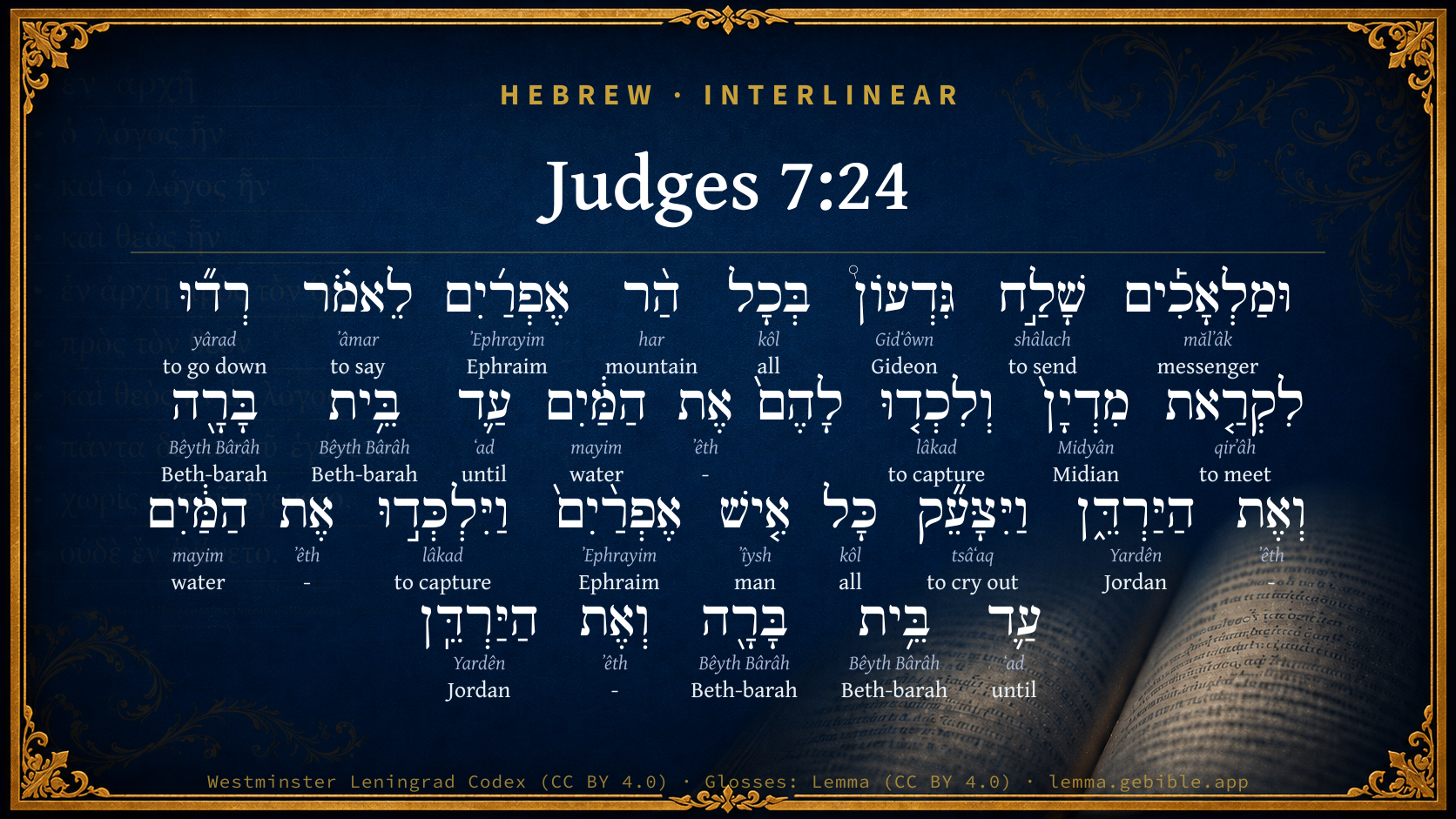
Judges 7:24

Hebrew (Westminster Leningrad Codex) Judges 7:24 appears in the Hebrew Old Testament. The text above is from the Westminster Leningrad Codex. Each word links to its Strong’s number, a concise gloss, and parsing drawn from the Open Scriptures Hebrew Bible morphology. Click any word for its full Brown-Driver-Briggs (BDB) entry.
Download image
Cite this verse

Judges 7:24 (World English Bible). Public Domain. Lemma interlinear Bible study tool, https://lemma.gebible.app/v/judges/7/24.

Show BibTeX & RIS
BibTeX
RIS
English Translation
Gideon sent messengers throughout all the hill-country of Ephraim, saying, Come down against Midian, and take before them the waters, as far as Beth Barah, even the Jordan. So all the men of Ephraim were gathered together, and took the waters as far as Beth Barah, even the Jordan.
World English Bible · Public Domain
Highlights
  • 1 first appearance in the Hebrew Bible
Full analysis ↓
Download a study sheet

One document with this verse’s original text, its word-by-word gloss line, the meaning frame, cross-references with their text, attributed commentary, and full source and license credits — printable, and it pastes into notes with its structure intact.

This verse Autodidact and up

Study sheet (.html) Plain text (.txt)

A passage Seminary Student

Up to 50 verses in one chapter. A passage sheet keeps up to 6 commentary sources and 12 cross-references per verse, in the order this page ranks them, and says so on the sheet whenever that leaves anything out. Ask for a single verse and you get the Autodidact verse sheet above.

Everything on this page stays free to read, with no account — the sheet is a download of what is already on screen, not access to it.

Want to remove ads? Support Godless Engineer
Compare translations 3

The same verse in 3 English versions, stacked beneath the original-language interlinear above. Click any original word for its lexicon entry.

Each is an independent rendering of the whole verse — the interlinear is not word-aligned to these translations.

Highlighted words mark where these versions differ — a whole-verse word diff, not a word-by-word alignment.

  • World English Bible Public Domain
    Gideon sent messengers throughout all the hill-country of Ephraim, saying, Come down against Midian, and take before them the waters, as far as Beth Barah, even the Jordan. So all the men of Ephraim were gathered together, and took the waters as far as Beth Barah, even the Jordan.
  • King James Version Public Domain
    And Gideon sent messengers throughout all mount Ephraim, saying, come down against the Midianites, and take before them the waters unto Bethbarah and Jordan. Then all the men of Ephraim gathered themselves together, and took the waters unto Bethbarah and Jordan.
  • unfoldingWord Literal Text CC BY-SA 4.0
    And Gideon sent messengers through all of the hill country of Ephraim, saying, “Come down to meet Midian and capture before them the waters unto Beth Barah and the Jordan.” So every man of Ephraim was summoned, and they captured the waters unto Beth Barah and the Jordan.

unfoldingWord Literal Text — © unfoldingWord, licensed CC BY-SA 4.0. Word-aligned USFM3 via Door43 (git.door43.org/unfoldingWord/en_ult).

Versions to compare (up to 4)

3 of 4 selected

Show all 18 translations

Every available English version of this verse, each an independent rendering of the whole verse.

  • World English Bible Public Domain
    Gideon sent messengers throughout all the hill-country of Ephraim, saying, Come down against Midian, and take before them the waters, as far as Beth Barah, even the Jordan. So all the men of Ephraim were gathered together, and took the waters as far as Beth Barah, even the Jordan.
  • Berean Standard Bible Public Domain
    Gideon sent messengers throughout the hill country of Ephraim to say, “Come down against the Midianites and seize the waters of the Jordan ahead of them as far as Beth-barah.” So all the men of Ephraim were called out, and they captured the waters of the Jordan as far as Beth-barah.
  • Majority Standard Bible Public Domain
    Gideon sent messengers throughout the hill country of Ephraim to say, “Come down against the Midianites and seize the waters of the Jordan ahead of them as far as Beth-barah.” So all the men of Ephraim were called out, and they captured the waters of the Jordan as far as Beth-barah.
  • King James Version Public Domain
    And Gideon sent messengers throughout all mount Ephraim, saying, come down against the Midianites, and take before them the waters unto Bethbarah and Jordan. Then all the men of Ephraim gathered themselves together, and took the waters unto Bethbarah and Jordan.
  • American Standard Version (1901) Public Domain
    And Gideon sent messengers throughout all the hill-country of Ephraim, saying, Come down against Midian, and take before them the waters, as far as Beth-barah, even the Jordan. So all the men of Ephraim were gathered together, and took the waters as far as Beth-barah, even the Jordan.
  • Revised Version (1885) Public Domain
    And Gideon sent messengers throughout all the hill country of Ephraim, saying, Come down against Midian, and take before them the waters, as far as Beth-barah, even Jordan. So all the men of Ephraim were gathered together, and took the waters as far as Beth-barah, even Jordan.
  • Geneva Bible (1599) Public Domain
    And Gideon sent messengers vnto all mount Ephraim, saying, Come downe against the Midianites, and take before them the waters vnto Beth-barah, and Iorden. Then all the men of Ephraim gathered together and tooke the waters vnto Beth-barah, and Iorden.
  • Douay-Rheims (1899) Public Domain
    And Gedeon sent messengers into all mount Ephraim, saying: Come down to meet Madian, and take the waters before them to Bethbera and the Jordan. And all Ephraim shouted, and took the waters before them and the Jordan as far as Bethbera.
  • Young's Literal Translation Public Domain
    And messengers hath sent Gideon into all the hill-country of Ephraim, saying, `Come down to meet Midian, and capture before them the waters unto Beth-Barah, and the Jordan;' and every man of Ephraim is called, and they capture the waters unto Beth-Barah, and the Jordan,
  • Literal Standard Version CC BY-SA 4.0
    And Gideon has sent messengers into all the hill-country of Ephraim, saying, “Come down to meet Midian, and capture the waters from them as far as Beth-Barah, and the Jordan”; and every man of Ephraim is called, and they capture the waters as far as Beth-Barah, and the Jordan,
  • Unlocked Literal Bible CC BY-SA 4.0
    Gideon sent messengers throughout all the hill country of Ephraim, saying, “Go down against Midian and take control of the Jordan River, as far as Beth Barah, to stop them.” So all the men of Ephraim gathered together and took control of the waters, as far as Beth Barah and the Jordan River.
  • unfoldingWord Literal Text CC BY-SA 4.0
    And Gideon sent messengers through all of the hill country of Ephraim, saying, “Come down to meet Midian and capture before them the waters unto Beth Barah and the Jordan.” So every man of Ephraim was summoned, and they captured the waters unto Beth Barah and the Jordan.
  • Darby Bible Public Domain
    And Gideon sent messengers throughout all the hill country of E'phraim, saying, "Come down against the Mid'ianites and seize the waters against them, as far as Beth-bar'ah, and also the Jordan." So all the men of E'phraim were called out, and they seized the waters as far as Beth-bar'ah, and also the Jordan.
  • World Messianic Bible Public Domain
    Gideon sent messengers throughout all the hill country of Ephraim, saying, “Come down against Midian and take the waters before them as far as Beth Barah, even the Jordan!” So all the men of Ephraim were gathered together and took the waters as far as Beth Barah, even the Jordan.
  • Webster's Bible Public Domain
    And Gideon sent messengers throughout all mount Ephraim, saying, Come down against the Midianites, and take before them the waters to Beth-barah and Jordan. Then all the men of Ephraim assembled, and took the waters to Beth-barah and Jordan.
  • Free Bible Version CC BY-SA 4.0
    Gideon sent messengers through all the hill country of Ephraim saying, “Come and attack the Midianites, and take control of the Jordan fords ahead of them as far as Beth-barah.” So all the men of Ephraim were summoned, and they took control of the Jordan fords as far as Beth-barah.
  • Bible in Basic English Public Domain
    Then Gideon sent through all the hill-country of Ephraim saying, Come down against Midian, and keep the ways across Jordan before they come. So all the men of Ephraim, massing themselves together, kept the ways across Jordan.
  • JPS Tanakh (1917) Public Domain
    And Gideon sent messengers throughout all the hill-country of Ephraim, saying: 'Come down against Midian, and take before them the waters, as far as Beth-barah, and also the Jordan.' So all the men of Ephraim were gathered together, and took the waters as far as Beth-barah, and also the Jordan.

Literal Standard Version (2020), Covenant Press — licensed CC BY-SA 4.0. Text via the HelloAO Bible API (eBible.org). Unlocked Literal Bible (unfoldingWord) — licensed CC BY-SA 4.0. Text via the HelloAO Bible API (eBible.org). unfoldingWord Literal Text — © unfoldingWord, licensed CC BY-SA 4.0. Word-aligned USFM3 via Door43 (git.door43.org/unfoldingWord/en_ult). Free Bible Version, Dr. Jonathan Gallagher — licensed CC BY-SA 4.0. Text via the HelloAO Bible API (eBible.org).

Word by word

More ways to search: Search by grammar → Find every occurrence → Compare this word →

Practice this passage: Drill this verse → Learn its vocabulary →

בֵּ֥ית
Bêyth Bârâh
H1012
“Beth-barah”
Noun, Proper
Part of Speech
Noun
Type
Proper
Full BDB Definition

Origin: probably from H1004 and H5679

TWOT: None

Beth-barah = "house of (the) ford" - a place on the Jordan
  1. וּמַלְאָכִ֡ים mălʼâk H4397 “and · messengers” Conjunction + Noun, Common, Masculine, Plural, Absolute
  2. שָׁלַ֣ח shâlach H7971 “to send” Verb, Qal, Perfect, 3rd Person, Masculine, Singular
  3. גִּדְעוֹן֩ Gidʻôwn H1439 “Gideon” Noun, Proper
  4. בְּכָל kôl H3605 “in/at · all of” Preposition + Noun, Common, Masculine, Singular, Construct
  5. הַ֨ר har H2022 “mountain of” Noun, Common, Masculine, Singular, Construct
  6. אֶפְרַ֜יִם ʼEphrayim H669 “Ephraim” Noun, Proper
  7. לֵאמֹ֗ר ʼâmar H559 “to say” Preposition + Verb, Qal, Infinitive Construct
  8. רְד֞וּ yârad H3381 “go down” Verb, Qal, Imperative, 2nd Person, Masculine, Plural
  9. לִקְרַ֤את qirʼâh H7125 “to meet” Preposition + Verb, Qal, Infinitive Construct
  10. מִדְיָן֙ Midyân H4080 “Midian” Noun, Proper
  11. וְלִכְד֤וּ lâkad H3920 “and · capture” Conjunction + Verb, Qal, Imperative, 2nd Person, Masculine, Plural
  12. אֶת ʼêth H853 “-” Particle, Direct Object
  13. הַמַּ֔יִם mayim H4325 “the · water(s)” Particle, Definite Article + Noun, Common, Masculine, Plural, Absolute
  14. עַ֛ד ʻad H5704 “until” Preposition
  15. בָּרָ֖ה Bêyth Bârâh H1012 “Beth-barah” Noun, Proper
  16. וְאֶת ʼêth H853 “and · -” Conjunction + Particle, Direct Object
  17. הַיַּרְדֵּ֑ן Yardên H3383 “the · Jordan” Particle, Definite Article + Noun, Proper
  18. וַיִּצָּעֵ֞ק tsâʻaq H6817 “and · to cry out” Conjunction + Verb, Niphal, Sequential Imperfect, 3rd Person, Masculine, Singular
  19. כָּל kôl H3605 “all of” Noun, Common, Masculine, Singular, Construct
  20. אִ֤ישׁ ʼîysh H376 “man of” Noun, Common, Masculine, Singular, Construct
  21. אֶפְרַ֨יִם֙ ʼEphrayim H669 “Ephraim” Noun, Proper
  22. וַיִּלְכְּד֣וּ lâkad H3920 “and · to capture” Conjunction + Verb, Qal, Sequential Imperfect, 3rd Person, Masculine, Plural
  23. אֶת ʼêth H853 “-” Particle, Direct Object
  24. הַמַּ֔יִם mayim H4325 “the · water(s)” Particle, Definite Article + Noun, Common, Masculine, Plural, Absolute
  25. עַ֛ד ʻad H5704 “until” Preposition
  26. בֵּ֥ית Bêyth Bârâh H1012 “Beth-barah” Noun, Proper
  27. בָּרָ֖ה Bêyth Bârâh H1012 “Beth-barah” Noun, Proper
  28. וְאֶת ʼêth H853 “and · -” Conjunction + Particle, Direct Object
  29. הַיַּרְדֵּֽן Yardên H3383 “the · Jordan” Particle, Definite Article + Noun, Proper

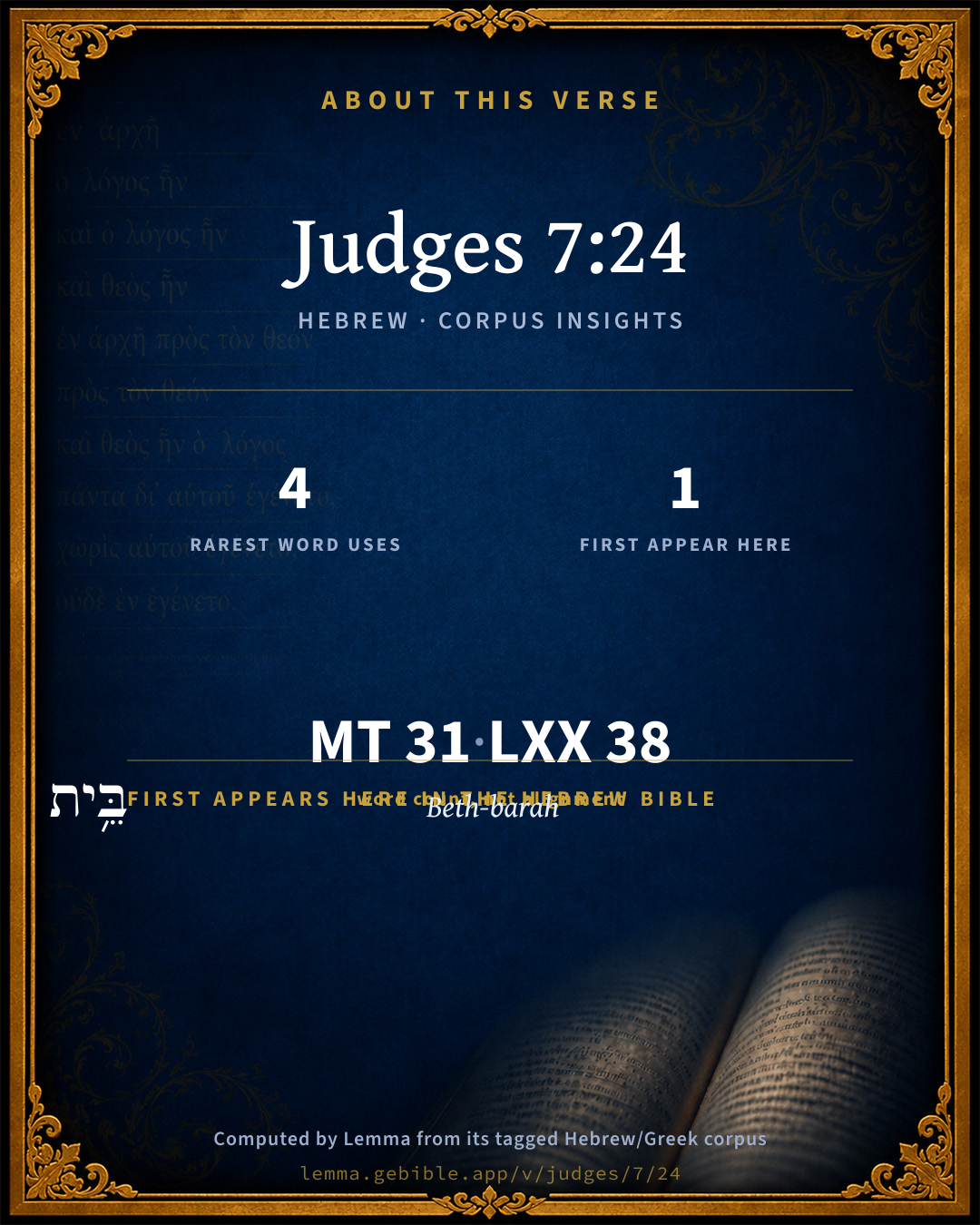
About this verse

These counts appear in no published source. They are computed here, from the morphology-tagged text and Lemma’s own curated glosses. What Lemma adds →

31
words
18
distinct lemmas
Historical
section

Notable vocabulary

The rarest word here is בֵּ֥ית Beth-barah H1012 — appearing just 4 times in the whole Hebrew Bible.

First appearance in Scripture

This word makes its first canonical appearance in the Hebrew Bible here:

  • בֵּ֥ית Beth-barah H1012

Grammatical profile

  • 7 verbs
  • 17 nouns
  • 3 prepositions
  • 4 particles

Verb forms

  • שָׁלַ֣ח Qal · Perfect
  • לֵאמֹ֗ר Qal · Infinitive Construct
  • רְד֞וּ Qal · Imperative
  • לִקְרַ֤את Qal · Infinitive Construct
  • וְלִכְד֤וּ Qal · Imperative
  • וַיִּצָּעֵ֞ק Niphal · Sequential Imperfect
  • וַיִּלְכְּד֣וּ Qal · Sequential Imperfect

Repetition

Words recur within this verse — often emphatic in Hebrew:

  • בֵּ֥ית Beth-barah H1012 ×4
  • בְּכָל all H3605 ×2
  • אֶפְרַ֜יִם Ephraim H669 ×2
  • וְלִכְד֤וּ to capture H3920 ×2
  • הַמַּ֔יִם water H4325 ×2
  • עַ֛ד until H5704 ×2
  • הַיַּרְדֵּ֑ן Jordan H3383 ×2

Hebrew & Septuagint length

In English translation the verse runs 49 words from the Hebrew and 44 from the Septuagint (LXX English) — closely comparable.

A rough comparison of the two English renderings, which tokenize alike — not a word-level alignment.

Word counts can differ between the Hebrew and the Greek without any difference in meaning — e.g. the Hebrew direct-object marker אֵת has no separate Greek word, and Greek often adds the article ὁ.

In the original languages it is 31 Hebrew tokens and 38 Greek tokens — but the two are counted differently (Hebrew bundles its prefixes and suffixes into one token; the Greek is in lemma form), so that isn’t a like-for-like length.

Cross-references

5

Topical passages linked to Judges 7:24 in the Treasury of Scripture Knowledge — connected by theme and wording, ordered by reader-vote popularity; previews shown in the World English Bible.

  • Judges 3:27–28 It happened, when he had come, that he blew a trumpet in the hill-country of Ephraim; and the children of Israel went down with him from the hill-country, and he before them.
  • Judges 12:5 The Gileadites took the fords of the Jordan against the Ephraimites. It was so, that when [any of] the fugitives of Ephraim said, Let me go over, the men of Gilead said to him, Are you an Ephraimite? If he said, No;
  • John 1:28 These things were done in Bethany beyond the Jordan, where John was baptizing.
  • Romans 15:30 Now I beg you, brothers, by our Lord Jesus Christ, and by the love of the Spirit, that you strive together with me in your prayers to God for me,
  • Philippians 1:27 Only let your manner of life be worthy of the Gospel of Christ, that, whether I come and see you or am absent, I may hear of your state, that you stand firm in one spirit, with one soul striving for the faith of the Gospel;

Cross-references courtesy of OpenBible.info (CC BY 4.0).

Hebrew and Greek witnesses Masoretic Hebrew ↔ Greek Septuagint

The same verse in the two great witnesses to the Old Testament, shown verse-for-verse.

These are two independent witnesses, not word-aligned to each other, and the Septuagint is shown in lemma (dictionary) form.

Hebrew Judges 7:24 Masoretic · Westminster Leningrad Codex

וּמַלְאָכִ֡ים שָׁלַ֣ח גִּדְעוֹן֩ בְּכָל הַ֨ר אֶפְרַ֜יִם לֵאמֹ֗ר רְד֞וּ לִקְרַ֤את מִדְיָן֙ וְלִכְד֤וּ לָהֶם֙ אֶת הַמַּ֔יִם עַ֛ד בֵּ֥ית בָּרָ֖ה וְאֶת הַיַּרְדֵּ֑ן וַיִּצָּעֵ֞ק כָּל אִ֤ישׁ אֶפְרַ֨יִם֙ וַיִּלְכְּד֣וּ אֶת הַמַּ֔יִם עַ֛ד בֵּ֥ית בָּרָ֖ה וְאֶת הַיַּרְדֵּֽן

Gideon sent messengers throughout all the hill-country of Ephraim, saying, Come down against Midian, and take before them the waters, as far as Beth Barah, even the Jordan. So all the men of Ephraim were gathered together, and took the waters as far as Beth Barah, even the Jordan.

World English Bible · Public Domain

Greek LXX Judges 7:24 Septuagint · lemma form

καί ἄγγελος ἀποστέλλω γεδεων ἐν πᾶς ὄρος ἐφράιμ λέγω καταβαίνω εἰς συνάντησις μαδιαμ καί καταλαμβάνω ἑαυτοῦ ὁ ὕδωρ ἕως βαιθηρα καί ὁ ἰορδάνης καί βοάω πᾶς ἀνήρ ἐφράιμ καί προ καταλαμβάνω ὁ ὕδωρ ἕως βαιθηρα καί ὁ ἰορδάνης

And Gedeon sent messengers into all mount Ephraim, saying, Come down to meet Madiam, and take to yourselves the water as far as Baethera and Jordan: and every man of Ephraim cried out, and they took the water before hand to Baethera and Jordan.

LXX2012 (modern English Septuagint) · Public Domain

Hebrew: Westminster Leningrad Codex (CC BY 4.0). Greek: Septuagint (public domain); English from LXX2012 (modern English Septuagint) (Public Domain). How the Septuagint differs from the Hebrew →

Targum (Aramaic paraphrase)

1

The Targum is the ancient Jewish Aramaic paraphrase of the Hebrew Scriptures — an interpretive translation, not the Hebrew text itself. Onkelos (literal) and Pseudo-Jonathan (expansive) render the Torah, and Jonathan the Prophets. Coverage is partial: where no permissively-licensed English translation exists for a verse, only the Aramaic is shown. This is verse-level text, not a word-by-word alignment to the Hebrew.

  1. Targum Jonathan Prophets (Joshua–Malachi)
    וְאִזְגַדִין שְׁלַח גִדְעוֹן בְּכָל טוּרָא דְבֵית אֶפְרַיִם לְמֵימָר חוּתוּ לָקֳדָמוּת מִדְיָנָאֵי וַאֲחָדוּ עֲלֵיהוֹן יַת מִגִיזָתָא עַד בֵּית בָּרָה וְיַת יַרְדְנָא וְאִתְכְּנִישׁ כָּל אֱנָשׁ אֶפְרַיִם וַאֲחָדוּ יַת מְגִיזָתָא עַד בֵּית בָּרָה וְיַת יַרְדָנָא:

    (no public-domain English translation for this verse)

    Targum Jonathan — Aramaic: “Mikraot Gedolot” (public domain). English: “Sefaria Community Translation” (CC0 1.0 (public-domain dedication)); “London "Chaldee Paraphrase," 1871” (public domain). Text via Sefaria.

Commentary

Notes on Judges 7:24 from classic Christian and Jewish commentators (each source and its license shown beneath its notes). The classic Christian expositions comment on the surrounding passage and are grouped to its opening verse, so a note may address several verses; the Jewish commentaries on the Tanakh (Rashi and others) are per-verse, so they appear only where the commentator wrote on this verse.

Lemma curates 59 commentaries, every one of them public domain or Creative Commons licensed, each selected and text-cleaned for this edition rather than reprinted as found. About our sources →

Trapp's Complete Commentary

John Trapp

Jdg 7:24 And Gideon sent messengers throughout all mount Ephraim, saying, Come down against the Midianites, and take before them the waters unto Bethbarah and Jordan. Then all the men of Ephraim gathered themselves together, and took the waters unto Bethbarah and Jordan.

Ver. 24. And Gideon sent messengers.] As not willing to engross the glory of the victory to himself alone; which yet many in this case would have done. At the battle of Belgrade, where Mohammed the great Turk was defeated and driven out of the field, the chief doers were Capistranus the Pope’s legate, and Hunniades the general of the army. Both these wrote the history of that day’s work: and yet neither of them made any mention at all of the other; but each ascribed to himself the glory of the whole action: whereupon Aeneas Silvins crieth out, Ingens dulcedo gloriae: facilius contemnenda dicitur quam contemnitur. Glory is sweet, and not easily slighted.

John Trapp, A Commentary or Exposition upon All the Books of the Old and New Testament (1647–1656) — public domain. Text from a community e-Sword module.

Geneva Bible (1599)

Geneva Bible translators

Meaning, the passages or the fords, that they should not escape.

Geneva Bible (1599) marginal notes — public domain. Text via Bolls.life.

Jamieson, Fausset & Brown

Robert Jamieson, A. R. Fausset & David Brown

Gideon sent messengers throughout all mount Ephraim--The Ephraimites lay on the south and could render seasonable aid.

Come . . . take before them the waters unto Beth-barah--(See on Jdg 3:28). These were the northern fords of the Jordan, to the east-northeast of wady Maleh.

the men of Ephraim gathered themselves together . . . unto Beth-barah--A new conflict ensued, in which two secondary chiefs were seized and slain on the spots where they were respectively taken. The spots were named after these chiefs, Oreb, "the Raven," and Zeeb, "the Wolf"--appropriate designations of Arab leaders.

Next: Judges Chapter 8

Jamieson, Fausset & Brown — Commentary Critical and Explanatory on the Whole Bible (1871) — public domain (CC PDM 1.0). Text via the HelloAO Bible API.

Adam Clarke's Commentary

Verse 24. Take before them the waters unto Beth-barah] This is probably the same place as that mentioned Joh 1:28, where the Hebrews forded Jordan under the direction of Joshua. To this place the Midianites directed their flight that they might escape into their own country; and here, being met by the Ephraimites, they appear to have been totally overthrown, and their two generals taken.

Adam Clarke's Commentary on the Bible (1810–1826) — public domain. Text from a community e-Sword/MySword module.

Ellicott's Commentary for English Readers

(24) Throughout all mount Ephraim.—He had not ventured to summon these haughty clansmen before his victory was assured.

Take before them the waters.—i.e., “intercept their flight unto Beth-barah and Jordan.” The “waters” are probably the marshes formed by streams which flow from the watershed of the hills of Ephraim into the Jordan.

Beth-barah.—“House of the waste,” not, as Jerome says, “of the well.” It can hardly be the Bethabara (house of the passage) of Joh_1:28, which seems to be too far south.

A Bible Commentary for English Readers, edited by Charles John Ellicott (1878–1897) — public domain. Text from a community e-Sword module.

The Cambridge Bible for Schools and Colleges

gen. ed. J. J. S. Perowne

24. Gideon sends a message (cf. Jdg_6:35) to the Ephraimites in the country S. of the battlefield, urging them to seize the fords, and so to meet the Midianites as they come flying down the Jordan valley. Cf. Jdg_3:27 f., Jdg_12:5 f.

the waters, as far as Beth-barah, and also Jordan (marg.)] As the text stands, the waters are distinguished from Jordan; hence Moore suggests that the waters refer to the Wadi Fâr‘a, a perennial stream which empties itself into the Jordan near the ford of Dâmiyeh; but the stream is not large enough to offer any serious obstacle, it would not be worth holding: the waters most naturally mean those of the Jordan; and also Jordan will then be either a gloss added to explain the waters, or a mistake for upon the Jordan, as the Peshitto reads; ‘upon’ = ‘on the bank of,’ as in Jdg_5:19, Num_22:5, Deu_3:12, etc. Beth-barah has not been discovered; the context implies that it lay S. of the Ephraimite country near the Jordan. The Verss. give the pronunciation Beth-bçrah, as if meaning ‘house of the well.’

The Cambridge Bible for Schools and Colleges (gen. ed. J. J. S. Perowne; Cambridge University Press, 1878–1918) — public domain. Text from a community e-Sword module.

John Gill's Exposition

And Gideon sent messengers throughout all Mount Ephraim,.... To raise the inhabitants of it, who lay nearer Jordan, to which the Midianites would make, in order to intercept them in their flight; or however get possession of the fords of Jordan before them, and hinder their passage over it:

saying, come down against the Midianites; for though he had routed them, and they were fled before him, yet he had not men enough with him to destroy them; and besides, as they had their camels to ride on, and he and his men only on foot, they could not come up with them:

and take before them the waters unto Bethbarah and Jordan; namely, all the fords and passages over Jordan, reaching from the lake of Gennesaret to Bethbarah, the same with Bethabara, Joh 1:28 which was a passage over Jordan; or these waters were, as Kimchi thinks, distinct from those of Jordan; and were waters that lay in the way of the flight of the Midianites, before they came to Bethbarah, their passage over Jordan; and Jarchi thinks they were waters, which divided between Syria and the land of Canaan, which is not likely; others think the waters are the same with Jordan, and render the words, "take the waters" --even Jordan (o); gain the passes over that before them, and so prevent their escape to their own land:

then all the men of Ephraim; that is, great numbers of them, whose hearts were inclined to, and whose situation lay best for this service:

gathered themselves together; in a body, at some place of rendezvous appointed:

and took the waters unto Bethbarah and Jordan; took possession of all the passes, and guarded them, as Gideon directed.

(o) "Nempe Jordanis aquas", Junius & Tremellius; "nempe Jordanem", Piscator.

John Gill's Exposition of the Whole Bible (1746–1763) — public domain (CC PDM 1.0). Text via the HelloAO Bible API.

Albert Barnes' Notes on the Bible

The waters - The streams which run from the mountain district of Ephraim into the Jordan in the district of Beth-shan, forming great pools and marshes, which the Midianites fleeing south would have to cross before they could reach the Jordan fords.

All the men of Ephraim - They had taken no previous part in the rising against Midian: nor had Gideon, of the smaller tribe of Manasseh, presumed before to summon his more powerful and arrogant brethren of the great tribe of Ephraim (see Jos 17:14-18).

Albert Barnes' Notes on the Bible (1834–1885) — public domain. Text from a community e-Sword/MySword module.

Haydock's Catholic Bible Commentary

Bethbera, "the house of corn." (Serarius) --- Many take it to be Bethabera, "the house of passage," or the ford of the Jordan. The river was fordable on camels at any time. But in summer, people might cross the Jordan in many places on foot. (Calmet)

George Leo Haydock (1774–1849), Haydock's Catholic Family Bible and Commentary, 1859 edition — public domain. Excludes Psalms (Douay-Rheims chapter numbering differs from Protestant) and Deuterocanonical books (Catholic canon only).

Matthew Poole's English Annotations

Take before them the waters unto Beth-barah, i.e. the passes over those waters to which they are like to come.

And Jordan; the fords of Jordan, which river they must pass over into their own country.

Matthew Poole's English Annotations on the Holy Bible (1683–1685) — public domain. Text from a community e-Sword/MySword module.

Whedon's Commentary on the Bible

Daniel D. Whedon

24. Sent messengers throughout all mount Ephraim — The Ephraimites had not been summoned to the war, (compare Jdg_8:1,) but are now called upon to intercept the flight of the foe.

The waters unto Beth-barah — The various mountain torrents and water-courses which the Midianites would have to cross in order to reach Beth-barah and the fords of the Jordan. Others understand the waters of the Jordan at Beth-barah. The site of Beth-barah is unknown.

Daniel D. Whedon (gen. ed.), Commentary on the Old and New Testaments (1874–1909) — public domain. Text from a community e-Sword module.

John Wesley's Explanatory Notes

The waters - That is, the passes over those waters to which they are like to come. Jordan - The fords of Jordan, which they must pass over into their own country.

John Wesley, Explanatory Notes Upon the Whole Bible (1754–1765) — public domain. Text via the GEBible commentary corpus.

Keil & Delitzsch

C. F. Keil & F. Delitzsch

In order to cut off the retreat of the enemy who was flying to the Jordan, Gideon sent messengers into the whole of the mountains of Ephraim with this appeal to the Ephraimites, "Come down (from your mountains into the lowlands of the Jordan) to meet Midian, and take the waters from them to Bethbarah and the Jordan," sc., by taking possession of this district (see Jdg 3:28). "The waters," mentioned before the Jordan and distinguished from it, must have been streams across which the flying foe would have to cross to reach the Jordan, namely, the different brooks and rivers, such as Wady Maleh, Fyadh, Jamel, Tubs, etc., which flowed down from the eastern side of the mountains of Ephraim into the Jordan, and ran through the Ghor to Bethbarah. The situation of Bethbarah is unknown. Even Eusebius could say nothing definite concerning the place; and the conjecture that it is the same as Bethabara, which has been regarded ever since the time of Origen as the place mentioned in Joh 1:28 where John baptized, throws no light upon the subject, as the situation of Bethabara is also unknown, to say nothing of the fact that the identity of the two names is very questionable. The Ephraimites responded to this appeal and took possession of the waters mentioned, before the Midianites, who could only move slowly with their flocks and herds, were able to reach the Jordan. They then captured two of the princes of the Midianites and put them to death: one of them, Oreb, i.e., the raven, at the rock Oreb; the other, Zeeb, i.e., the wolf, at the wine-press of Zeeb. Nothing further is known about these two places. The rock of Oreb is only mentioned again in Isa 10:26, when the prophet alludes to this celebrated victory. So much, however, is evident from the verse before us, viz., that the Midianites were beaten by the Ephraimites at both places, and that the two princes fell there, and the places received their names from that circumstance. They were not situated in the land to the east of the Jordan, as Gesenius (on Isa 10:26), Rosenmller, and others infer from the fact that the Ephraimites brought the heads of Oreb and Zeeb to Gideon ליּרדּן מעבר (Jdg 7:25), but on the western side of the Jordan, where the Ephraimites had taken possession of the waters and the Jordan in front of the Midianites. ליּרדּן מעבר does not mean "from the other side of the Jordan," but simply "on the other side of (beyond) the Jordan," as in Jos 13:32; Jos 18:7; Kg1 14:15; and the statement here is not that the Ephraimites brought the heads from the other side to Gideon on the west of the river, but that they brought them to Gideon when he was in the land to the east of the Jordan. This explanation of the words is required by the context, as well as by the foregoing remark, "they pursued Midian," according to which the Ephraimites continued the pursuit of the Midianites after slaying these princes, and also by the complaint brought against Gideon by the Ephraimites, which is not mentioned till afterwards (Jdg 8:1.), that he had not summoned them to the war. It is true, this is given before the account of Gideon's crossing over the Jordan (Jdg 8:4), but in order of time it did not take place till afterwards, and, as Bertheau has correctly shown, the historical sequence is somewhat anticipated.

Keil & Delitzsch — Biblical Commentary on the Old Testament (1861–1891) — public domain (CC PDM 1.0). Text via the HelloAO Bible API. (Old Testament only.)

unfoldingWord translationNotes

Door43 World Missions Community

Beth Barah

This is the name of a town. (See: How to Translate Names)

took control of the waters, as far as Beth Barah and the Jordan River

"took control of the area of the Jordan River as far south as Beth Barah"

at the rock of Oreb ... at the winepress of Zeeb

The places were given these names after the Israelites killed Oreb and Zeeb there. (See: Assumed Knowledge and Implicit Information)

Oreb ... Zeeb

These are names of men. (See: How to Translate Names)

translationWords

Gideon

messenger

Ephraim

Midian

Jordan River

water

prince

winepress

unfoldingWord translationNotes — © Distant Shores Media and the Door43 World Missions Community, licensed CC BY-SA 4.0. Source: git.door43.org/Door43/en_tn.

Rashi

Rabbi Shlomo Yitzchaki (Rashi)

Capture the waters which intervene between Aram and Canaanite territory.

And the Yardein which also intervened.

Rashi on the Tanakh — English translations: “The Judaica Press complete Tanach with Rashi, translated by A. J. Rosenberg” (CC BY 4.0); “Pentateuch with Rashi's commentary by M. Rosenbaum and A.M. Silbermann, 1929-1934” (public domain); “The Metsudah Tanach series, Lakewood, N.J” (CC BY 4.0); and “The Book of Joshua, Metsudah Publications, 1997” (CC BY 4.0). Text via Sefaria.

Lesson kit

Teaching starters — assembled from the data on this page, not authored interpretation. Every prompt links to the verse data it draws on. Edit before teaching.

Judges, in the Historical, opens this verse with 31 words (18 distinct Hebrew lemmas). Its most distinctive word is Bêyth Bârâh (“Beth-barah”). A historical commentator’s framing appears above. Read the whole chapter for the surrounding context.

Discussion questions

  1. What does “Beth-barah” (Bêyth Bârâh) contribute to the verse as a whole?
  2. This is the first place “Beth-barah” appears in Scripture (first appears here). What does its debut here establish?
  3. How does Judges 3:27–28, which shares this passage’s theme, read alongside this verse?
  4. What does the repetition of “Beth-barah” (4× in this one verse) do in this verse?
  5. These translations render this verse differently; the difference is in the English rendering, not the original. What questions does that raise?
  6. «שָׁלַ֣ח» is a Qal Perfect verb. How does that grammatical form shape the action described?
  7. Compare how Trapp's Complete Commentary and Geneva Bible (1599) read this verse. Where do they agree or differ?

Things to notice

Reading settings

Reading text

Shown beneath each verse's original-language words.

Old Testament
Old Testament edition

Read the OT as the Masoretic Hebrew (MT) or the Greek Septuagint (LXX).

English shown for the Greek Septuagint (in the Hebrew ↔ Greek comparison).

Comparing translations? Open the Compare panel on any verse page to stack up to four side by side.