2 Samuel 19:27

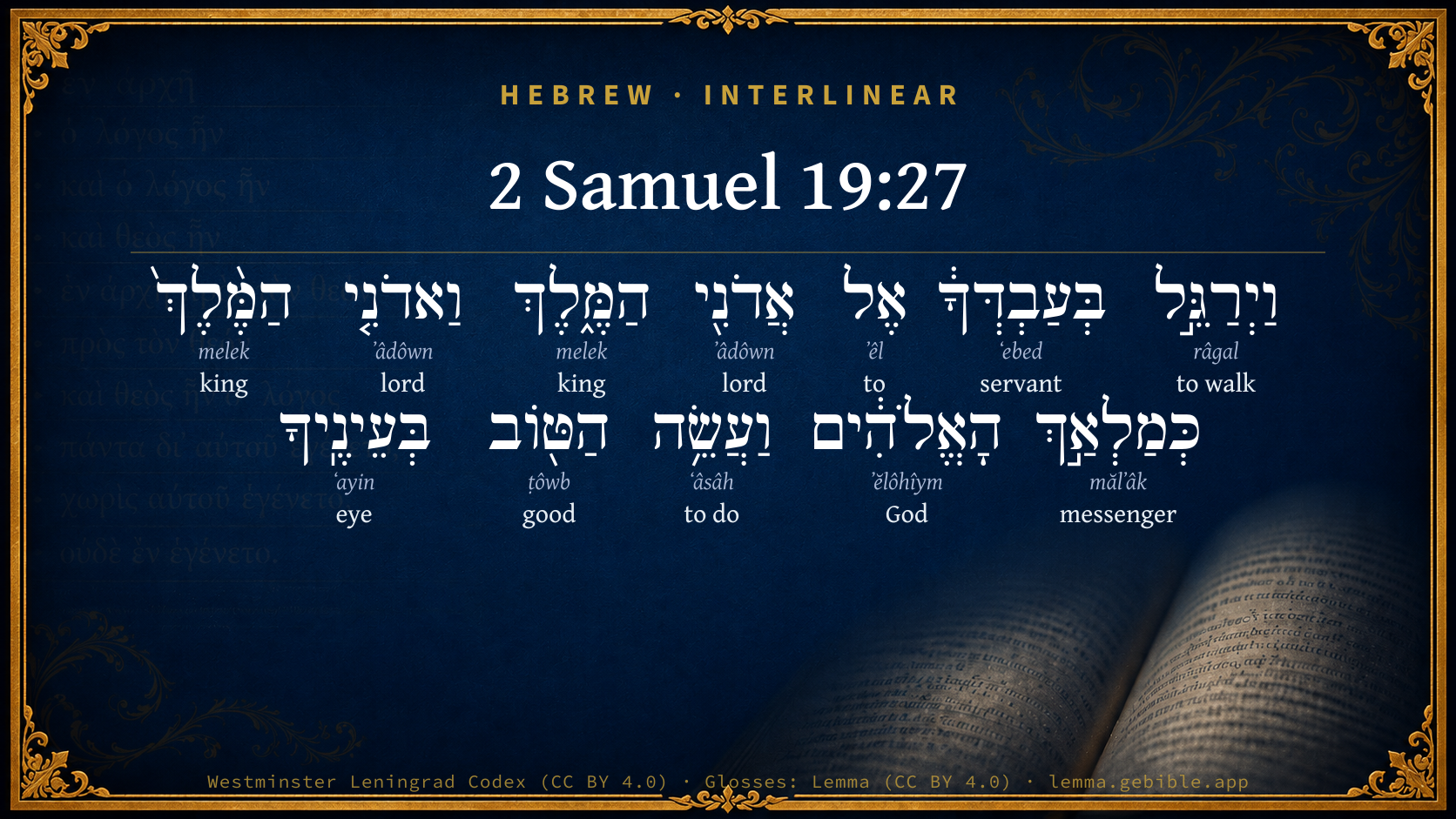
Hebrew (Westminster Leningrad Codex) 2 Samuel 19:27 appears in the Hebrew Old Testament. The text above is from the Westminster Leningrad Codex. Each word links to its Strong’s number, a concise gloss, and parsing drawn from the Open Scriptures Hebrew Bible morphology. Click any word for its full Brown-Driver-Briggs (BDB) entry.
Download image
Cite this verse

2 Samuel 19:27 (World English Bible). Public Domain. Lemma interlinear Bible study tool, https://lemma.gebible.app/v/2-samuel/19/27.

Show BibTeX & RIS
BibTeX
RIS
English Translation
He has slandered your servant to my lord the king; but my lord the king is as an angel of God: do therefore what is good in your eyes.
World English Bible · Public Domain
Download a study sheet

One document with this verse’s original text, its word-by-word gloss line, the meaning frame, cross-references with their text, attributed commentary, and full source and license credits — printable, and it pastes into notes with its structure intact.

This verse Autodidact and up

Study sheet (.html) Plain text (.txt)

A passage Seminary Student

Up to 50 verses in one chapter. A passage sheet keeps up to 6 commentary sources and 12 cross-references per verse, in the order this page ranks them, and says so on the sheet whenever that leaves anything out. Ask for a single verse and you get the Autodidact verse sheet above.

Everything on this page stays free to read, with no account — the sheet is a download of what is already on screen, not access to it.

Want to remove ads? Support Godless Engineer
Compare translations 3

The same verse in 3 English versions, stacked beneath the original-language interlinear above. Click any original word for its lexicon entry.

Each is an independent rendering of the whole verse — the interlinear is not word-aligned to these translations.

Highlighted words mark where these versions differ — a whole-verse word diff, not a word-by-word alignment.

  • World English Bible Public Domain
    He has slandered your servant to my lord the king; but my lord the king is as an angel of God: do therefore what is good in your eyes.
  • King James Version Public Domain
    And he hath slandered thy servant unto my lord the king; but my lord the king is as an angel of God: do therefore what is good in thine eyes.
  • unfoldingWord Literal Text CC BY-SA 4.0
    And he slandered your servant to my lord the king. But my lord the king like an angel of God, so do the good in your eyes.

unfoldingWord Literal Text — © unfoldingWord, licensed CC BY-SA 4.0. Word-aligned USFM3 via Door43 (git.door43.org/unfoldingWord/en_ult).

Versions to compare (up to 4)

3 of 4 selected

Show all 18 translations

Every available English version of this verse, each an independent rendering of the whole verse.

  • World English Bible Public Domain
    He has slandered your servant to my lord the king; but my lord the king is as an angel of God: do therefore what is good in your eyes.
  • Berean Standard Bible Public Domain
    and he has slandered your servant to my lord the king. Yet my lord the king is like the angel of God, so do what is good in your eyes.
  • Majority Standard Bible Public Domain
    and he has slandered your servant to my lord the king. Yet my lord the king is like the angel of God, so do what is good in your eyes.
  • King James Version Public Domain
    And he hath slandered thy servant unto my lord the king; but my lord the king is as an angel of God: do therefore what is good in thine eyes.
  • American Standard Version (1901) Public Domain
    And he hath slandered thy servant unto my lord the king; but my lord the king is as an angel of God: do therefore what is good in thine eyes.
  • Revised Version (1885) Public Domain
    And he hath slandered thy servant unto my lord the king; but my lord the king is as an angel of God: do therefore what is good in thine eyes.
  • Geneva Bible (1599) Public Domain
    And he hath accused thy seruant vnto my lorde the king: but my lorde the king is as an Angel of God: doe therefore thy pleasure.
  • Douay-Rheims (1899) Public Domain
    Moreover he hath also accused me thy servant to thee, my lord the king: but thou my lord the king art as an angel of God, do what pleaseth thee.
  • Young's Literal Translation Public Domain
    and he uttereth slander against thy servant unto my lord the king, and my lord the king `is' as a messenger of God; and do thou that which is good in thine eyes,
  • Literal Standard Version CC BY-SA 4.0
    and he utters slander against your servant to my lord the king, and my lord the king [is] as a messenger of God; and do that which is good in your eyes,
  • Unlocked Literal Bible CC BY-SA 4.0
    My servant Ziba has slandered me, your servant, to my master the king. But my master the king is like an angel of God. Therefore, do what is good in your eyes.
  • unfoldingWord Literal Text CC BY-SA 4.0
    And he slandered your servant to my lord the king. But my lord the king like an angel of God, so do the good in your eyes.
  • Darby Bible Public Domain
    And he has slandered thy servant to my lord the king; but my lord the king is as an angel of God; do therefore what is good in thy sight.
  • World Messianic Bible Public Domain
    He has slandered your servant to my lord the king, but my lord the king is as an angel of God. Therefore do what is good in your eyes.
  • Webster's Bible Public Domain
    And he hath slandered thy servant to my lord the king; but my lord the king is as an angel of God: do therefore what is good in thy eyes.
  • Free Bible Version CC BY-SA 4.0
    Ziba has misrepresented me, your servant, to Your Majesty. However, Your Majesty is like an angel of God, so do what you think best.
  • Bible in Basic English Public Domain
    He has given you a false account of me: but my lord the king is like the angel of God: do then whatever seems good to you.
  • JPS Tanakh (1917) Public Domain
    (19-28) And he hath slandered thy servant unto my lord the king; but my lord the king is as an angel of God; do therefore what is good in thine eyes.

Literal Standard Version (2020), Covenant Press — licensed CC BY-SA 4.0. Text via the HelloAO Bible API (eBible.org). Unlocked Literal Bible (unfoldingWord) — licensed CC BY-SA 4.0. Text via the HelloAO Bible API (eBible.org). unfoldingWord Literal Text — © unfoldingWord, licensed CC BY-SA 4.0. Word-aligned USFM3 via Door43 (git.door43.org/unfoldingWord/en_ult). Free Bible Version, Dr. Jonathan Gallagher — licensed CC BY-SA 4.0. Text via the HelloAO Bible API (eBible.org).

Word by word

More ways to search: Search by grammar → Find every occurrence → Compare this word →

Practice this passage: Drill this verse → Learn its vocabulary →

וַיְרַגֵּ֣ל
râgal
H7270
“and · to walk”
Conjunction + Verb, Piel, Sequential Imperfect, 3rd Person, Masculine, Singular
Part of Speech
Conjunction + Verb
Stem
Piel
Form
Sequential Imperfect
Person
3rd Person
Gender
Masculine
Number
Singular
Full BDB Definition

Origin: a primitive root

TWOT: 2113

to go on foot, spy out, foot it, go about, walk along, move the feet - (Qal) to be a tale-bearer, slander, go about - (Piel) - to slander - to go about as explorer, spy - (Tiphel) to teach to walk
  1. בְּעַבְדְּךָ֔ ʻebed H5650 “in/at · servant · your” Preposition + Noun, Common, Masculine, Singular, Construct + Suffix, Personal, 2nd Person, Masculine, Singular
  2. אֶל ʼêl H413 “to” Preposition
  3. אֲדֹנִ֖י ʼâdôwn H113 “lord · my” Noun, Common, Masculine, Singular, Construct + Suffix, Personal, 1st Person, Common, Singular
  4. הַמֶּ֑לֶךְ melek H4428 “the · king” Particle, Definite Article + Noun, Common, Masculine, Singular, Absolute
  5. וַאדֹנִ֤י ʼâdôwn H113 “and · lord · my” Conjunction + Noun, Common, Masculine, Singular, Construct + Suffix, Personal, 1st Person, Common, Singular
  6. הַמֶּ֨לֶךְ֙ melek H4428 “the · king” Particle, Definite Article + Noun, Common, Masculine, Singular, Absolute
  7. כְּמַלְאַ֣ךְ mălʼâk H4397 “like/as · messenger of” Preposition + Noun, Common, Masculine, Singular, Construct
  8. הָאֱלֹהִ֔ים ʼĕlôhîym H430 “the · God(s)” Particle, Definite Article + Noun, Common, Masculine, Plural, Absolute
  9. וַעֲשֵׂ֥ה ʻâsâh H6213 “and · do” Conjunction + Verb, Qal, Imperative, 2nd Person, Masculine, Singular
  10. הַטּ֖וֹב ṭôwb H2896 “the · good” Particle, Definite Article + Adjective, Adjective, Masculine, Singular, Absolute
  11. בְּעֵינֶֽיךָ ʻayin H5869 “in/at · eyes · your” Preposition + Noun, Common, Both, Dual, Construct + Suffix, Personal, 2nd Person, Masculine, Singular

About this verse

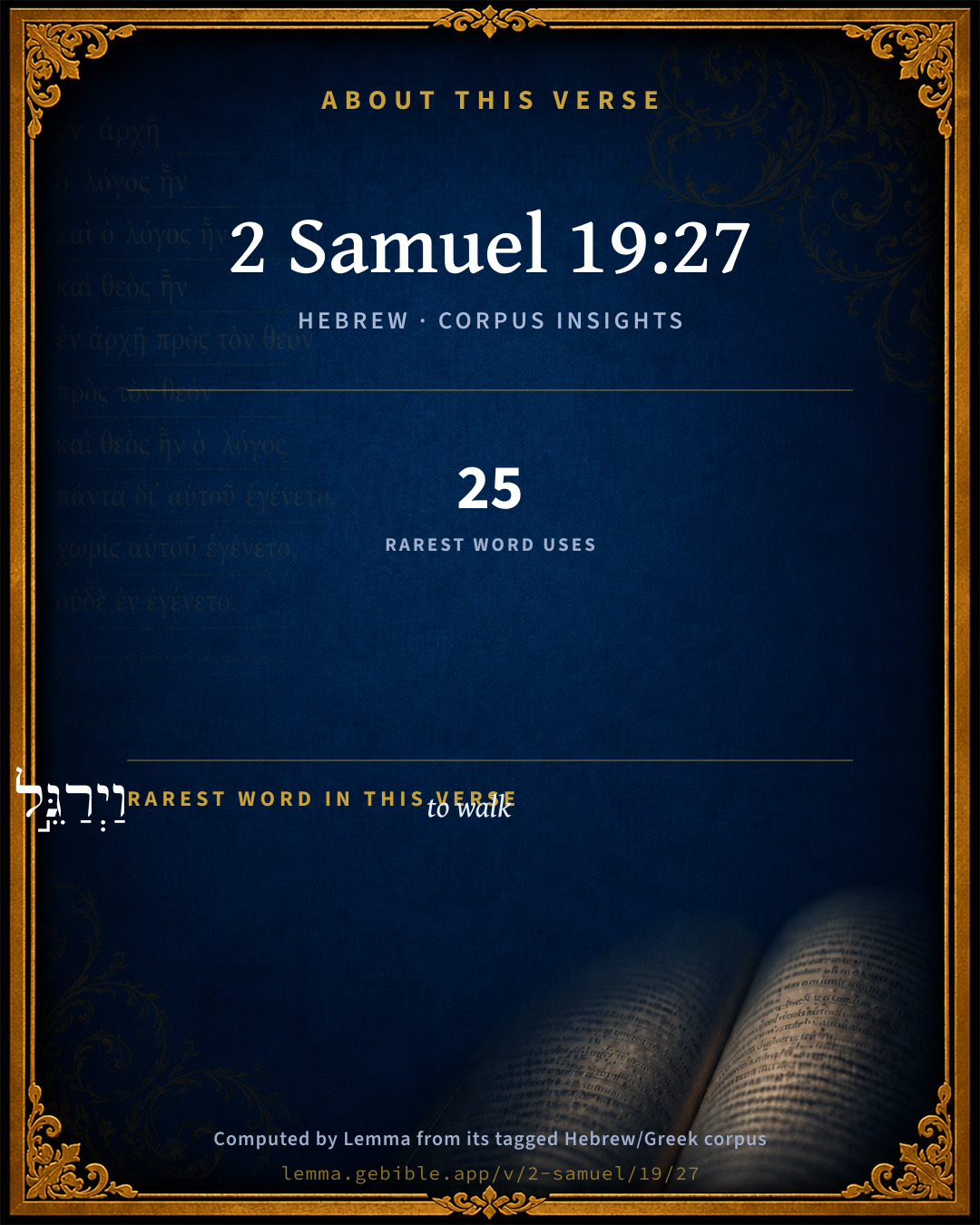
These counts appear in no published source. They are computed here, from the morphology-tagged text and Lemma’s own curated glosses. What Lemma adds →

12
words
10
distinct lemmas
Historical
section

Notable vocabulary

The rarest word here is וַיְרַגֵּ֣ל to walk H7270 — appearing just 25 times in the whole Hebrew Bible.

Shared distinctive vocabulary

וַיְרַגֵּ֣ל to walk H7270 occurs in 24 verses of the Hebrew Bible. Also found in:

Grammatical profile

  • 2 verbs
  • 8 nouns
  • 1 adjective
  • 1 preposition

Verb forms

  • וַיְרַגֵּ֣ל Piel · Sequential Imperfect
  • וַעֲשֵׂ֥ה Qal · Imperative

Repetition

Words recur within this verse — often emphatic in Hebrew:

  • אֲדֹנִ֖י lord H113 ×2
  • הַמֶּ֑לֶךְ king H4428 ×2

Hebrew & Septuagint length

In English translation the verse runs 29 words from the Hebrew and 34 from the Septuagint (LXX English) — closely comparable.

A rough comparison of the two English renderings, which tokenize alike — not a word-level alignment.

Word counts can differ between the Hebrew and the Greek without any difference in meaning — e.g. the Hebrew direct-object marker אֵת has no separate Greek word, and Greek often adds the article ὁ.

Cross-references

8

Topical passages linked to 2 Samuel 19:27 in the Treasury of Scripture Knowledge — connected by theme and wording, ordered by reader-vote popularity; previews shown in the World English Bible.

  • 2 Samuel 14:17 Then your handmaid said, Please let the word of my lord the king be comfortable; for as an angel of God, so is my lord the king to discern good and bad: and Yahweh your God be with you.
  • 2 Samuel 14:20 to change the face of the matter has your servant Joab done this thing: and my lord is wise, according to the wisdom of an angel of God, to know all things that are in the earth.
  • 1 Samuel 29:9 Achish answered David, I know that you are good in my sight, as an angel of God: notwithstanding the princes of the Philistines have said, He shall not go up with us to the battle.
  • 2 Samuel 16:3 The king said, Where is your master's son? Ziba said to the king, Behold, he abides at Jerusalem; for he said, Today will the house of Israel restore me the kingdom of my father.
  • Jeremiah 9:4 Take you heed everyone of his neighbor, and don't you trust in any brother; for every brother will utterly supplant, and every neighbor will go about with slanders.
  • Exodus 20:16 "You shall not give false testimony against your neighbor.
  • Psalms 15:3 He who doesn't slander with his tongue, Nor does evil to his friend, Nor casts slurs against his fellow man;
  • Psalms 101:5 I will silence whoever secretly slanders his neighbor. I won't tolerate one who is haughty and conceited.

Cross-references courtesy of OpenBible.info (CC BY 4.0).

Hebrew and Greek witnesses Masoretic Hebrew ↔ Greek Septuagint

The same verse in the two great witnesses to the Old Testament, shown verse-for-verse.

These are two independent witnesses, not word-aligned to each other, and the Septuagint is shown in lemma (dictionary) form.

Hebrew 2 Samuel 19:27 Masoretic · Westminster Leningrad Codex

וַיְרַגֵּ֣ל בְּעַבְדְּךָ֔ אֶל אֲדֹנִ֖י הַמֶּ֑לֶךְ וַאדֹנִ֤י הַמֶּ֨לֶךְ֙ כְּמַלְאַ֣ךְ הָאֱלֹהִ֔ים וַעֲשֵׂ֥ה הַטּ֖וֹב בְּעֵינֶֽיךָ

He has slandered your servant to my lord the king; but my lord the king is as an angel of God: do therefore what is good in your eyes.

World English Bible · Public Domain

Greek LXX 2 Samuel 19:27 Septuagint · lemma form

καί εἶπον πρός αὐτός μεμφιβοσθε κύριος ἐγώ βασιλεύς ὁ δοῦλος ἐγώ παραλογίζομαι ἐγώ ὅτι εἶπον ὁ παῖς σύ αὐτός ἐπισάσσω ἐγώ ὁ ὄνος καί ἐπιβαίνω ἐπί αὐτός καί πορεύομαι μετά ὁ βασιλεύς ὅτι χωλός ὁ δοῦλος σύ

And he has dealt deceitfully with your servant to my lord the king: but my lord the king is as an angel of God, and do you that which is good in your eyes.

LXX2012 (modern English Septuagint) · Public Domain

Hebrew: Westminster Leningrad Codex (CC BY 4.0). Greek: Septuagint (public domain); English from LXX2012 (modern English Septuagint) (Public Domain). How the Septuagint differs from the Hebrew →

Targum (Aramaic paraphrase)

1

The Targum is the ancient Jewish Aramaic paraphrase of the Hebrew Scriptures — an interpretive translation, not the Hebrew text itself. Onkelos (literal) and Pseudo-Jonathan (expansive) render the Torah, and Jonathan the Prophets. Coverage is partial: where no permissively-licensed English translation exists for a verse, only the Aramaic is shown. This is verse-level text, not a word-by-word alignment to the Hebrew.

  1. Targum Jonathan Prophets (Joshua–Malachi)
    וַאֲמַר רִבּוֹנִי מַלְכָּא עַבְדִי שְׁקַר כִּי אֲרֵי אֲמַר עַבְדָךְ אֶחֱשׁוֹק לִי חֲמָרָא וְאֶרְכּוּב עֲלָהּ וְאֵיהַךְ עִם מַלְכָּא אֲרֵי חַגִיר עַבְדָךְ:

    (no public-domain English translation for this verse)

    Targum Jonathan — Aramaic: “Mikraot Gedolot” (public domain). English: “Sefaria Community Translation” (CC0 1.0 (public-domain dedication)); “London "Chaldee Paraphrase," 1871” (public domain). Text via Sefaria.

Commentary

Notes on 2 Samuel 19:27 from classic Christian and Jewish commentators (each source and its license shown beneath its notes). The classic Christian expositions comment on the surrounding passage and are grouped to its opening verse, so a note may address several verses; the Jewish commentaries on the Tanakh (Rashi and others) are per-verse, so they appear only where the commentator wrote on this verse.

Lemma curates 59 commentaries, every one of them public domain or Creative Commons licensed, each selected and text-cleaned for this edition rather than reprinted as found. About our sources →

Trapp's Complete Commentary

John Trapp

2Sa 19:27 And he hath slandered thy servant unto my lord the king; but my lord the king [is] as an angel of God: do therefore [what is] good in thine eyes.

Ver. 27. And he hath slandered thy servant.] Traduxit, detulit per criminationem falsam. The slanderer’s tonic, as sharp as the quills of a porcupine, woundeth the good name of another; this is an unexpressible injury; for, Postea nullus eris. afterward you will be nothing.

John Trapp, A Commentary or Exposition upon All the Books of the Old and New Testament (1647–1656) — public domain. Text from a community e-Sword module.

Tyndale Open Study Notes

Tyndale Open Resources

19:27-28 like an angel of God: See study note on 14:17. • I could expect only death . . . What more can I ask? If Mephibosheth had wanted to betray David, it would have been a profound show of ingratitude for all that David had done for him.

Tyndale Open Study Notes — © Tyndale Open Resources, licensed CC BY-SA 4.0. Text via the HelloAO Bible API.

Geneva Bible (1599)

Geneva Bible translators

Able for his wisdom to judge in all matters.

Geneva Bible (1599) marginal notes — public domain. Text via Bolls.life.

Adam Clarke's Commentary

Verse 27. The king is as an angel of God] As if he had said, I state my case plainly and without guile; thou art too wise not to penetrate the motives from which both myself and servant have acted. I shall make no appeal; with whatsoever thou determinest I shall rest contented.

Adam Clarke's Commentary on the Bible (1810–1826) — public domain. Text from a community e-Sword/MySword module.

The Cambridge Bible for Schools and Colleges

gen. ed. J. J. S. Perowne

27. as an angel of God] To discern the truth, and decide justly. Cp. ch. 2Sa_14:17; 2Sa_14:20.

The Cambridge Bible for Schools and Colleges (gen. ed. J. J. S. Perowne; Cambridge University Press, 1878–1918) — public domain. Text from a community e-Sword module.

John Gill's Exposition

And he hath slandered thy servant unto my lord the king,.... By suggesting that he stayed at Jerusalem with a view to the kingdom, hoping that the quarrel between David and Absalom would issue in the restoration of it to his father's family; which was a mere calumny, he having had no such thought, nor was there any foundation for it:

but my lord the king is an angel of God; for understanding and wisdom, to discern the falsehood of such suggestions:

do therefore what is good in thine eyes; condemn him or acquit him; reject him or receive him into favour; he entirely submitted himself to him, to do with him as seemed good in his sight.

John Gill's Exposition of the Whole Bible (1746–1763) — public domain (CC PDM 1.0). Text via the HelloAO Bible API.

Haydock's Catholic Bible Commentary

God. It is not necessary for me to say any more in my defence. Thou art convinced of my innocence; and the accusation was in itself improbable, as I could never expect to be better treated by another king. I am resigned to abide by thy decision. (Haydock) --- I cannot complain. (Calmet)

George Leo Haydock (1774–1849), Haydock's Catholic Family Bible and Commentary, 1859 edition — public domain. Excludes Psalms (Douay-Rheims chapter numbering differs from Protestant) and Deuterocanonical books (Catholic canon only).

Matthew Poole's English Annotations

As an angel of God, to distinguish between true reports and calumnies: See Poole on "2Sa 14:20".

Matthew Poole's English Annotations on the Holy Bible (1683–1685) — public domain. Text from a community e-Sword/MySword module.

Whedon's Commentary on the Bible

Daniel D. Whedon

27. The king is as an angel — Wise to discern, and righteous to decide a case of wrong. But David’s action did not justify his tribute of confidence.

Daniel D. Whedon (gen. ed.), Commentary on the Old and New Testaments (1874–1909) — public domain. Text from a community e-Sword module.

John Wesley's Explanatory Notes

Angel - To distinguish between true reports and calumnies; See note on "chap. xiv, 20".

John Wesley, Explanatory Notes Upon the Whole Bible (1754–1765) — public domain. Text via the GEBible commentary corpus.

Scofield Reference Notes

C. I. Scofield

angel

(See Scofield "Heb 1:4").

The Scofield Reference Bible (1917 edition), notes by C. I. Scofield — public domain. Text from a community e-Sword module.

Rashi

Rabbi Shlomo Yitzchaki (Rashi)

Because your servant is lame. And I can not walk on foot.

Rashi on the Tanakh — English translations: “The Judaica Press complete Tanach with Rashi, translated by A. J. Rosenberg” (CC BY 4.0); “Pentateuch with Rashi's commentary by M. Rosenbaum and A.M. Silbermann, 1929-1934” (public domain); “The Metsudah Tanach series, Lakewood, N.J” (CC BY 4.0); and “The Book of Joshua, Metsudah Publications, 1997” (CC BY 4.0). Text via Sefaria.

Lesson kit

Teaching starters — assembled from the data on this page, not authored interpretation. Every prompt links to the verse data it draws on. Edit before teaching.

2 Samuel, in the Historical, opens this verse with 12 words (10 distinct Hebrew lemmas). Its most distinctive word is râgal (“to walk”). A historical commentator’s framing appears above. Read the whole chapter for the surrounding context.

Discussion questions

  1. The word râgal carries the sense “to walk.” How does it shape the verse?
  2. Genesis 42:9 shares the word «to walk» with this verse. How do the two illuminate each other?
  3. “lord” occurs 2× in this one verse. What is the effect of the repetition?
  4. These translations render this verse differently; the difference is in the English rendering, not the original. What questions does that raise?
  5. The verb «וַיְרַגֵּ֣ל» is Piel Sequential Imperfect. How does its form color the action?
  6. Reading how Trapp's Complete Commentary and Tyndale Open Study Notes read this verse, where do the two commentators agree and where do they part?

Things to notice

Reading settings

Reading text

Shown beneath each verse's original-language words.

Old Testament
Old Testament edition

Read the OT as the Masoretic Hebrew (MT) or the Greek Septuagint (LXX).

English shown for the Greek Septuagint (in the Hebrew ↔ Greek comparison).

Comparing translations? Open the Compare panel on any verse page to stack up to four side by side.