
Judges 11:19

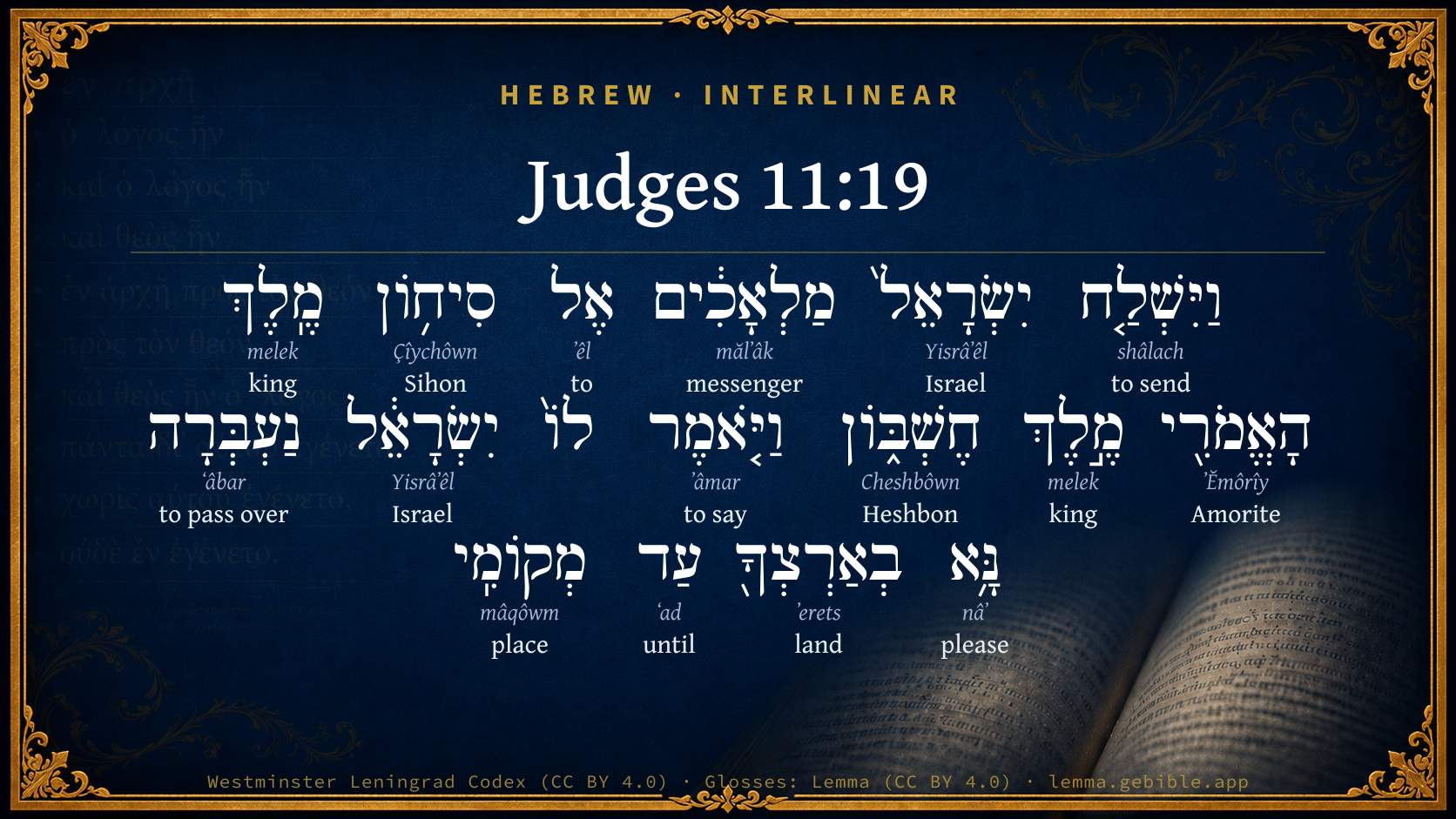
Hebrew (Westminster Leningrad Codex) Judges 11:19 appears in the Hebrew Old Testament. The text above is from the Westminster Leningrad Codex. Each word links to its Strong’s number, a concise gloss, and parsing drawn from the Open Scriptures Hebrew Bible morphology. Click any word for its full Brown-Driver-Briggs (BDB) entry.
Download image
Cite this verse

Judges 11:19 (World English Bible). Public Domain. Lemma interlinear Bible study tool, https://lemma.gebible.app/v/judges/11/19.

Show BibTeX & RIS
BibTeX
RIS
English Translation
Israel sent messengers to Sihon king of the Amorites, the king of Heshbon; and Israel said to him, Let us pass, we pray you, through your land to my place.
World English Bible · Public Domain
Download a study sheet

One document with this verse’s original text, its word-by-word gloss line, the meaning frame, cross-references with their text, attributed commentary, and full source and license credits — printable, and it pastes into notes with its structure intact.

This verse Autodidact and up

Study sheet (.html) Plain text (.txt)

A passage Seminary Student

Up to 50 verses in one chapter. A passage sheet keeps up to 6 commentary sources and 12 cross-references per verse, in the order this page ranks them, and says so on the sheet whenever that leaves anything out. Ask for a single verse and you get the Autodidact verse sheet above.

Everything on this page stays free to read, with no account — the sheet is a download of what is already on screen, not access to it.

Want to remove ads? Support Godless Engineer
Compare translations 3

The same verse in 3 English versions, stacked beneath the original-language interlinear above. Click any original word for its lexicon entry.

Each is an independent rendering of the whole verse — the interlinear is not word-aligned to these translations.

Highlighted words mark where these versions differ — a whole-verse word diff, not a word-by-word alignment.

  • World English Bible Public Domain
    Israel sent messengers to Sihon king of the Amorites, the king of Heshbon; and Israel said to him, Let us pass, we pray you, through your land to my place.
  • King James Version Public Domain
    And Israel sent messengers unto Sihon king of the Amorites, the king of Heshbon; and Israel said unto him, Let us pass, we pray thee, through thy land into my place.
  • unfoldingWord Literal Text CC BY-SA 4.0
    Then Israel sent messengers to Sihon, the king of the Amorite, the king of Heshbon, and Israel said to him, “Please, may we pass through your land to my place?”

unfoldingWord Literal Text — © unfoldingWord, licensed CC BY-SA 4.0. Word-aligned USFM3 via Door43 (git.door43.org/unfoldingWord/en_ult).

Versions to compare (up to 4)

3 of 4 selected

Show all 18 translations

Every available English version of this verse, each an independent rendering of the whole verse.

  • World English Bible Public Domain
    Israel sent messengers to Sihon king of the Amorites, the king of Heshbon; and Israel said to him, Let us pass, we pray you, through your land to my place.
  • Berean Standard Bible Public Domain
    And Israel sent messengers to Sihon king of the Amorites, who ruled in Heshbon, and said to him, ‘Please let us pass through your land into our own place.’
  • Majority Standard Bible Public Domain
    And Israel sent messengers to Sihon king of the Amorites, who ruled in Heshbon, and said to him, ‘Please let us pass through your land into our own place.’
  • King James Version Public Domain
    And Israel sent messengers unto Sihon king of the Amorites, the king of Heshbon; and Israel said unto him, Let us pass, we pray thee, through thy land into my place.
  • American Standard Version (1901) Public Domain
    And Israel sent messengers unto Sihon king of the Amorites, the king of Heshbon; and Israel said unto him, Let us pass, we pray thee, through thy land unto my place.
  • Revised Version (1885) Public Domain
    And Israel sent messengers unto Sihon king of the Amorites, the king of Heshbon; and Israel said unto him, Let us pass, we pray thee, through thy land unto my place.
  • Geneva Bible (1599) Public Domain
    Also Israel sent messengers vnto Sihon, King of the Amorites, the King of Heshbon, and Israel said vnto him, Let vs passe, we pray thee, by thy lande vnto our place.
  • Douay-Rheims (1899) Public Domain
    So Israel sent messengers to Sehon king of the Amorrhites, who dwelt in Hesebon, and they said to him: Suffer me to pass through thy land to the river.
  • Young's Literal Translation Public Domain
    `And Israel sendeth messengers unto Sihon, king of the Amorite, king of Heshbon, and Israel saith to him, Let us pass over, we pray thee, through thy land, unto my place,
  • Literal Standard Version CC BY-SA 4.0
    And Israel sends messengers to Sihon, king of the Amorite, king of Heshbon, and Israel says to him, Please let us pass over through your land, to my place,
  • Unlocked Literal Bible CC BY-SA 4.0
    Israel sent messengers to Sihon, king of the Amorites, who ruled in Heshbon; Israel said to him, 'Please, let us pass through your land to the place that is ours.'
  • unfoldingWord Literal Text CC BY-SA 4.0
    Then Israel sent messengers to Sihon, the king of the Amorite, the king of Heshbon, and Israel said to him, “Please, may we pass through your land to my place?”
  • Darby Bible Public Domain
    Israel then sent messengers to Sihon king of the Amorites, king of Heshbon; and Israel said to him, 'Let us pass, we pray, through your land to our country.'
  • World Messianic Bible Public Domain
    Israel sent messengers to Sihon king of the Amorites, the king of Heshbon; and Israel said to him, ‘Please let us pass through your land to my place.’
  • Webster's Bible Public Domain
    And Israel sent messengers to Sihon king of the Amorites, the king of Heshbon; and Israel said to him, Let us pass, we pray thee, through thy land to my place.
  • Free Bible Version CC BY-SA 4.0
    Then the Israelites sent messengers to Sihon, king of the Amorites, who ruled from Heshbon, and asked him, ‘Please let us pass through your land to our own country.’
  • Bible in Basic English Public Domain
    And Israel sent men to Sihon, king of the Amorites, the king of Heshbon; and Israel said to him, Let me now go through your land to my place.
  • JPS Tanakh (1917) Public Domain
    And Israel sent messengers unto Sihon king of the Amorites, the king of Heshbon; and Israel said unto him: Let us pass, we pray thee, through thy land unto my place.

Literal Standard Version (2020), Covenant Press — licensed CC BY-SA 4.0. Text via the HelloAO Bible API (eBible.org). Unlocked Literal Bible (unfoldingWord) — licensed CC BY-SA 4.0. Text via the HelloAO Bible API (eBible.org). unfoldingWord Literal Text — © unfoldingWord, licensed CC BY-SA 4.0. Word-aligned USFM3 via Door43 (git.door43.org/unfoldingWord/en_ult). Free Bible Version, Dr. Jonathan Gallagher — licensed CC BY-SA 4.0. Text via the HelloAO Bible API (eBible.org).

Word by word

More ways to search: Search by grammar → Find every occurrence → Compare this word →

Practice this passage: Drill this verse → Learn its vocabulary →

סִיח֥וֹן
Çîychôwn
H5511
“Sihon”
Noun, Proper
Part of Speech
Noun
Type
Proper
Full BDB Definition

Origin: from the same as H5477

TWOT: None

Sihon = "warrior" - king of the Amorites at the time of the conquest and defeated by Moses in Transjordan
  1. וַיִּשְׁלַ֤ח shâlach H7971 “and · to send” Conjunction + Verb, Qal, Sequential Imperfect, 3rd Person, Masculine, Singular
  2. יִשְׂרָאֵל֙ Yisrâʼêl H3478 “Israel” Noun, Proper
  3. מַלְאָכִ֔ים mălʼâk H4397 “messengers” Noun, Common, Masculine, Plural, Absolute
  4. אֶל ʼêl H413 “to” Preposition
  5. מֶֽלֶךְ melek H4428 “king of” Noun, Common, Masculine, Singular, Construct
  6. הָאֱמֹרִ֖י ʼĔmôrîy H567 “the · Amorite” Particle, Definite Article + Noun, Gentilic, Masculine, Singular, Absolute
  7. מֶ֣לֶךְ melek H4428 “king of” Noun, Common, Masculine, Singular, Construct
  8. חֶשְׁבּ֑וֹן Cheshbôwn H2809 “Heshbon” Noun, Proper
  9. וַיֹּ֤אמֶר ʼâmar H559 “and · to say” Conjunction + Verb, Qal, Sequential Imperfect, 3rd Person, Masculine, Singular
  10. יִשְׂרָאֵ֔ל Yisrâʼêl H3478 “Israel” Noun, Proper
  11. נַעְבְּרָה ʻâbar H5674 “to pass over” Verb, Qal, Cohortative, 1st Person, Common, Plural
  12. נָּ֥א nâʼ H4994 “please” Particle, Interjection
  13. בְאַרְצְךָ֖ ʼerets H776 “in/at · land · your” Preposition + Noun, Common, Both, Singular, Construct + Suffix, Personal, 2nd Person, Masculine, Singular
  14. עַד ʻad H5704 “until” Preposition
  15. מְקוֹמִֽי mâqôwm H4725 “place · my” Noun, Common, Masculine, Singular, Construct + Suffix, Personal, 1st Person, Common, Singular

About this verse

These counts appear in no published source. They are computed here, from the morphology-tagged text and Lemma’s own curated glosses. What Lemma adds →

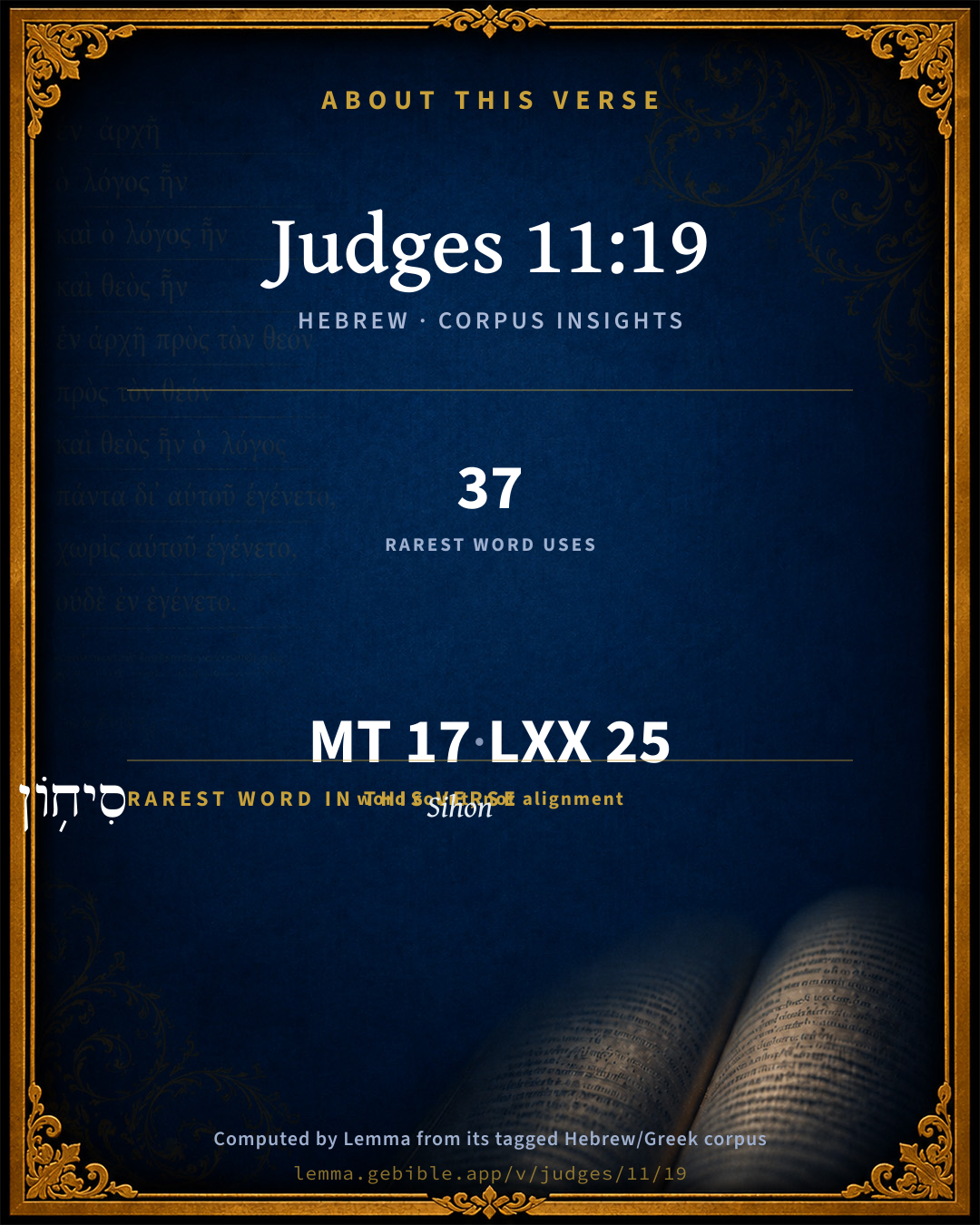
17
words
14
distinct lemmas
Historical
section

Shared distinctive vocabulary

סִיח֥וֹן Sihon H5511 occurs in 34 verses of the Hebrew Bible. Also found in:

Grammatical profile

  • 3 verbs
  • 10 nouns
  • 3 prepositions
  • 1 particle

Verb forms

  • וַיִּשְׁלַ֤ח Qal · Sequential Imperfect
  • וַיֹּ֤אמֶר Qal · Sequential Imperfect
  • נַעְבְּרָה Qal · Cohortative

Repetition

Words recur within this verse — often emphatic in Hebrew:

  • יִשְׂרָאֵל֙ Israel H3478 ×2
  • מֶֽלֶךְ king H4428 ×2

Hebrew & Septuagint length

In English translation the verse runs 30 words from the Hebrew and 30 from the Septuagint (LXX English) — the same length.

A rough comparison of the two English renderings, which tokenize alike — not a word-level alignment.

Word counts can differ between the Hebrew and the Greek without any difference in meaning — e.g. the Hebrew direct-object marker אֵת has no separate Greek word, and Greek often adds the article ὁ.

In the original languages it is 17 Hebrew tokens and 25 Greek tokens — but the two are counted differently (Hebrew bundles its prefixes and suffixes into one token; the Greek is in lemma form), so that isn’t a like-for-like length.

Cross-references

4

Topical passages linked to Judges 11:19 in the Treasury of Scripture Knowledge — connected by theme and wording, ordered by reader-vote popularity; previews shown in the World English Bible.

  • Numbers 21:21–35 Israel sent messengers to Sihon king of the Amorites, saying,
  • Deuteronomy 2:26–36 I sent messengers out of the wilderness of Kedemoth to Sihon king of Heshbon with words of peace, saying,
  • Deuteronomy 3:1–17 Then we turned, and went up the way to Bashan: and Og the king of Bashan came out against us, he and all his people, to battle at Edrei.
  • Joshua 13:8–12 With him the Reubenites and the Gadites received their inheritance, which Moses gave them, beyond the Jordan eastward, even as Moses the servant of Yahweh gave them:

Cross-references courtesy of OpenBible.info (CC BY 4.0).

Hebrew and Greek witnesses Masoretic Hebrew ↔ Greek Septuagint

The same verse in the two great witnesses to the Old Testament, shown verse-for-verse.

These are two independent witnesses, not word-aligned to each other, and the Septuagint is shown in lemma (dictionary) form.

Hebrew Judges 11:19 Masoretic · Westminster Leningrad Codex

וַיִּשְׁלַ֤ח יִשְׂרָאֵל֙ מַלְאָכִ֔ים אֶל סִיח֥וֹן מֶֽלֶךְ הָאֱמֹרִ֖י מֶ֣לֶךְ חֶשְׁבּ֑וֹן וַיֹּ֤אמֶר לוֹ֙ יִשְׂרָאֵ֔ל נַעְבְּרָה נָּ֥א בְאַרְצְךָ֖ עַד מְקוֹמִֽי

Israel sent messengers to Sihon king of the Amorites, the king of Heshbon; and Israel said to him, Let us pass, we pray you, through your land to my place.

World English Bible · Public Domain

Greek LXX Judges 11:19 Septuagint · lemma form

καί ἀποστέλλω ἰσραήλ ἄγγελος πρός σηων βασιλεύς ὁ ἀμορραῖος βασιλεύς εσεβων καί εἶπον αὐτός ἰσραήλ παραἔρχομαι δή ἐν ὁ γῆ σύ ἕως ὁ τόπος ἐγώ

And Israel sent messengers to Seon king of the Amorite, king of Esbon, and Israel said to him, Let us pass, we pray you, by your land to our place.

LXX2012 (modern English Septuagint) · Public Domain

Hebrew: Westminster Leningrad Codex (CC BY 4.0). Greek: Septuagint (public domain); English from LXX2012 (modern English Septuagint) (Public Domain). How the Septuagint differs from the Hebrew →

Targum (Aramaic paraphrase)

1

The Targum is the ancient Jewish Aramaic paraphrase of the Hebrew Scriptures — an interpretive translation, not the Hebrew text itself. Onkelos (literal) and Pseudo-Jonathan (expansive) render the Torah, and Jonathan the Prophets. Coverage is partial: where no permissively-licensed English translation exists for a verse, only the Aramaic is shown. This is verse-level text, not a word-by-word alignment to the Hebrew.

  1. Targum Jonathan Prophets (Joshua–Malachi)
    וּשְׁלַח יִשְׂרָאֵל אִזְגַדִין לְוַת סִיחוֹן מַלְכָּא דֶאֱמוֹרָאָה מַלְכָּא דְחֶשְׁבּוֹן וַאֲמַר לֵיהּ יִשְׂרָאֵל נֶעְבַּר כְּעַן בְּאַרְעָךְ עַד אַתְרִי:

    (no public-domain English translation for this verse)

    Targum Jonathan — Aramaic: “Mikraot Gedolot” (public domain). English: “Sefaria Community Translation” (CC0 1.0 (public-domain dedication)); “London "Chaldee Paraphrase," 1871” (public domain). Text via Sefaria.

Commentary

Notes on Judges 11:19 from classic Christian and Jewish commentators (each source and its license shown beneath its notes). The classic Christian expositions comment on the surrounding passage and are grouped to its opening verse, so a note may address several verses; the Jewish commentaries on the Tanakh (Rashi and others) are per-verse, so they appear only where the commentator wrote on this verse.

Lemma curates 59 commentaries, every one of them public domain or Creative Commons licensed, each selected and text-cleaned for this edition rather than reprinted as found. About our sources →

Trapp's Complete Commentary

John Trapp

Jdg 11:19 And Israel sent messengers unto Sihon king of the Amorites, the king of Heshbon; and Israel said unto him, Let us pass, we pray thee, through thy land into my place.

Ver. 19. Let us pass, we pray thee, through thy land.] This he not only denied to do, but came out with all his forces to fight with them. John, king of Navarre, did none of all this: but because, being himself a Frenchman, and having the greatest part of his patrimony in France, he would not suffer the Spaniard, whom the Pope then favoured against Louis, king of France, to lead his army through the middle of his country into Aquitane; and because he would not deliver up to the Spaniard three of his strongest forts to be garrisoned against the French king, &c., he was presently proclaimed a schismatic, a heretic, a traitor to the see apostolic, deprived of his kingdom, his posterity disinherited, and his enemy put into possession of all. {a}

{a} Guicciardin.

John Trapp, A Commentary or Exposition upon All the Books of the Old and New Testament (1647–1656) — public domain. Text from a community e-Sword module.

Joseph Benson's Commentary

Jdg 11:19-22. Let us pass through thy land unto my place — That is, unto the land of Canaan, which the Lord hath given me. But Sihon fought against Israel — He not only refused, after the example of his neighbours, to grant the Israelites a passage through his country, which they could not insist upon as their absolute right, but raised all his forces, and proudly marched to drive them away from his borders. So that, as Jephthah intends to signify, Sihon was the aggressor, and the Israelites were compelled to fight in their own defence. They possessed all the coasts — Or borders, together with all the land included within those borders. From the wilderness — Namely, the desert of Arabia; unto Jordan.

Joseph Benson's Commentary on the Old and New Testaments (1811–1818) — public domain. Text from a community e-Sword module.

Geneva Bible (1599)

Geneva Bible translators

Or, country.

Geneva Bible (1599) marginal notes — public domain. Text via Bolls.life.

Ellicott's Commentary for English Readers

(19) Unto Sihon.—Num_21:21; Deu_2:26-29 (where see the Commentary).

The King of Heshbon.—He was king of the Aniorites by birth, but king of Heshbon only by conquest. The town was assigned to Reuben (Num_32:37).

Into my place.—The conquest of the territories of Reuben, Gad, and half-Manasseh had not entered into the original plan of Israel, but had been providentially determined by the hostility of Sihon and Og (Deu_2:29). The Vulg. renders it “unto the river (usque ad fluvium).

A Bible Commentary for English Readers, edited by Charles John Ellicott (1878–1897) — public domain. Text from a community e-Sword module.

The Cambridge Bible for Schools and Colleges

gen. ed. J. J. S. Perowne

19. Again abbreviated from JE’s narrative, Num_21:21-24, which is further expanded in Deu_2:26-37.

Sihon … the king of Heshbon] So frequently, e.g. Num_21:26, Deu_2:24; Deu_2:26; Deu_2:30; Deu_3:6; Deu_29:7, Jos_12:5 etc. The site of Sihon’s capital is now represented by Ḥesbân (nearly 3000 ft.), finely placed among the mountains, 16 m. N.E. of the upper end of the Dead Sea, and overlooking Mt Nebo, which Isaiah 5 m. to the S.W. In later times Heshbon is referred to as a Moabite city, Isa_15:4; Isa_16:8 f., Jer_48:2; Jer_48:34; Jer_48:45; Jer_49:3; it was assigned to Reuben by the Israelites, Jos_13:17 P.

The Cambridge Bible for Schools and Colleges (gen. ed. J. J. S. Perowne; Cambridge University Press, 1878–1918) — public domain. Text from a community e-Sword module.

John Gill's Exposition

But Sihon trusted not Israel to pass through, his coast,.... For fear they should seize upon his dominions, and retain them; and the more fearful he might be, as he knew that his people were one of the seven nations of the Canaanites, whose land they were going to possess, and whom they were to destroy:

but Sihon gathered all his people together; in some certain place, and armed them, and went out in an hostile manner against Israel in the wilderness, to attack them; whereby it appears that he was the aggressor, and therefore Israel was not to be blamed, as not for fending themselves, so neither for seizing and possessing his country when they had conquered him:

and pitched in Jahaz, and fought against Israel; there was a battle between them at the place mentioned, and the victory was on Israel's side, see Num 21:23.

John Gill's Exposition of the Whole Bible (1746–1763) — public domain (CC PDM 1.0). Text via the HelloAO Bible API.

Matthew Poole's English Annotations

i.e. Unto the land of Canaan, which God hath given to me.

Matthew Poole's English Annotations on the Holy Bible (1683–1685) — public domain. Text from a community e-Sword/MySword module.

The Pulpit Commentary

And Israel, etc. The text here follows Num_21:21-24 almost verbatim; but the expression, "the king of Heshbon," is from Deu_2:24, Deu_2:26, Deu_2:30.

The Pulpit Commentary (1880–1919), ed. H.D.M. Spence-Jones & Joseph S. Exell — public domain. Text from a community e-Sword module.

John Wesley's Explanatory Notes

My place - That is, unto the land of Canaan, which God hath given me.

John Wesley, Explanatory Notes Upon the Whole Bible (1754–1765) — public domain. Text via the GEBible commentary corpus.

unfoldingWord translationNotes

Door43 World Missions Community

General Information:

Jephthah's messengers continue to speak.

Israel sent messengers to Sihon

The messengers were sent by the leaders of Israel. AT: "When the leaders of Israel sent messengers" (See: Synecdoche)

Sihon

This is the name of a person. (See: How to Translate Names)

Heshbon ... Jahaz

These are the names of cities. (See: How to Translate Names)

But Sihon did not trust Israel to pass through his territory

Sihon did not trust the people of Israel to pass through his land peacefully. The full meaning of this statement can be made explicit. AT: "But Sihon did not trust the people of Israel to pass through his territory peacefully" (See: Assumed Knowledge and Implicit Information)

there he fought

The word "he" refers to Sihon and represents himself and his army. AT: "there they fought" or "there his army fought" (See: Synecdoche)

translationWords

Amorite

trust

unfoldingWord translationNotes — © Distant Shores Media and the Door43 World Missions Community, licensed CC BY-SA 4.0. Source: git.door43.org/Door43/en_tn.

Lesson kit

Teaching starters — assembled from the data on this page, not authored interpretation. Every prompt links to the verse data it draws on. Edit before teaching.

Judges, in the Historical, opens this verse with 17 words (14 distinct Hebrew lemmas). Its most distinctive word is Çîychôwn (“Sihon”). A historical commentator’s framing appears above. Read the whole chapter for the surrounding context.

Discussion questions

  1. How does “Sihon” (Çîychôwn) shape what this verse is saying?
  2. Numbers 21:21 shares the word «Sihon» with this verse. How do the two illuminate each other?
  3. “Israel” occurs 2× in this one verse. What is the effect of the repetition?
  4. The translations on this page render this verse differently — a whole-verse word diff, not a word-by-word alignment. What might account for the different wordings?
  5. The verb «וַיִּשְׁלַ֤ח» is Qal Sequential Imperfect. How does its form color the action?
  6. Reading how Trapp's Complete Commentary and Joseph Benson's Commentary read this verse, where do the two commentators agree and where do they part?

Things to notice

Reading settings

Reading text

Shown beneath each verse's original-language words.

Old Testament
Old Testament edition

Read the OT as the Masoretic Hebrew (MT) or the Greek Septuagint (LXX).

English shown for the Greek Septuagint (in the Hebrew ↔ Greek comparison).

Comparing translations? Open the Compare panel on any verse page to stack up to four side by side.