
2 Samuel 14:17

Hebrew (Westminster Leningrad Codex) 2 Samuel 14:17 appears in the Hebrew Old Testament. The text above is from the Westminster Leningrad Codex. Each word links to its Strong’s number, a concise gloss, and parsing drawn from the Open Scriptures Hebrew Bible morphology. Click any word for its full Brown-Driver-Briggs (BDB) entry.
Download image
Cite this verse

2 Samuel 14:17 (World English Bible). Public Domain. Lemma interlinear Bible study tool, https://lemma.gebible.app/v/2-samuel/14/17.

Show BibTeX & RIS
BibTeX
RIS
English Translation
Then your handmaid said, Please let the word of my lord the king be comfortable; for as an angel of God, so is my lord the king to discern good and bad: and Yahweh your God be with you.
World English Bible · Public Domain
Download a study sheet

One document with this verse’s original text, its word-by-word gloss line, the meaning frame, cross-references with their text, attributed commentary, and full source and license credits — printable, and it pastes into notes with its structure intact.

This verse Autodidact and up

Study sheet (.html) Plain text (.txt)

A passage Seminary Student

Up to 50 verses in one chapter. A passage sheet keeps up to 6 commentary sources and 12 cross-references per verse, in the order this page ranks them, and says so on the sheet whenever that leaves anything out. Ask for a single verse and you get the Autodidact verse sheet above.

Everything on this page stays free to read, with no account — the sheet is a download of what is already on screen, not access to it.

Want to remove ads? Support Godless Engineer
Compare translations 3

The same verse in 3 English versions, stacked beneath the original-language interlinear above. Click any original word for its lexicon entry.

Each is an independent rendering of the whole verse — the interlinear is not word-aligned to these translations.

Highlighted words mark where these versions differ — a whole-verse word diff, not a word-by-word alignment.

  • World English Bible Public Domain
    Then your handmaid said, Please let the word of my lord the king be comfortable; for as an angel of God, so is my lord the king to discern good and bad: and Yahweh your God be with you.
  • King James Version Public Domain
    Then thine handmaid said, The word of my lord the king shall now be comfortable: for as an angel of God, so is my lord the king to discern good and bad: therefore the LORD thy God will be with thee.
  • unfoldingWord Literal Text CC BY-SA 4.0
    Then your maidservant said, ‘Now the word of my lord the king will be for rest, because like an angel of God, so my lord the king, to understand good and evil. And may Yahweh your God be with you!’”

unfoldingWord Literal Text — © unfoldingWord, licensed CC BY-SA 4.0. Word-aligned USFM3 via Door43 (git.door43.org/unfoldingWord/en_ult).

Versions to compare (up to 4)

3 of 4 selected

Show all 18 translations

Every available English version of this verse, each an independent rendering of the whole verse.

  • World English Bible Public Domain
    Then your handmaid said, Please let the word of my lord the king be comfortable; for as an angel of God, so is my lord the king to discern good and bad: and Yahweh your God be with you.
  • Berean Standard Bible Public Domain
    And now your servant says, ‘May the word of my lord the king bring me rest, for my lord the king is able to discern good and evil, just like the angel of God. May the LORD your God be with you.’”
  • Majority Standard Bible Public Domain
    And now your servant says, ‘May the word of my lord the king bring me rest, for my lord the king is able to discern good and evil, just like the angel of God. May the LORD your God be with you.’”
  • King James Version Public Domain
    Then thine handmaid said, The word of my lord the king shall now be comfortable: for as an angel of God, so is my lord the king to discern good and bad: therefore the LORD thy God will be with thee.
  • American Standard Version (1901) Public Domain
    Then thy handmaid said, Let, I pray thee, the word of my lord the king be comfortable; for as an angel of God, so is my lord the king to discern good and bad: and Jehovah thy God be with thee.
  • Revised Version (1885) Public Domain
    Then thine handmaid said, Let, I pray thee, the word of my lord the king be comfortable: for as an angel of God, so is my lord the king to discern good and bad: and the LORD thy God be with thee.
  • Geneva Bible (1599) Public Domain
    Therefore thine handmaid sayd, The word of my lord the King shall now be comfortable: for my lorde the King is euen as an Angel of God in hearing of good and bad: therefore the Lord thy God be with thee.
  • Douay-Rheims (1899) Public Domain
    Then let thy handmaid say, that the word of the Lord the king be made as a sacrifice. For even as an angel of God, so is my lord the king, that he is neither moved with blessing nor cursing: wherefore the Lord thy God is also with thee.
  • Young's Literal Translation Public Domain
    and thy maid-servant saith, Let, I pray thee, the word of my lord the king be for ease; for as a messenger of God so `is' my lord the king, to understand the good and the evil; and Jehovah thy God is with thee.'
  • Literal Standard Version CC BY-SA 4.0
    and your maidservant says, Please let the word of my lord the king be for ease; for as a messenger of God so [is] my lord the king, to understand the good and the evil; and your God YHWH is with you.”
  • Unlocked Literal Bible CC BY-SA 4.0
    Then your servant prayed, 'Yahweh, please let the word of my master the king give me relief, for as an angel of God, so is my master the king in telling good from evil.' May Yahweh your God be with you.”
  • unfoldingWord Literal Text CC BY-SA 4.0
    Then your maidservant said, ‘Now the word of my lord the king will be for rest, because like an angel of God, so my lord the king, to understand good and evil. And may Yahweh your God be with you!’”
  • Darby Bible Public Domain
    And thy bondmaid said, Let the word of my lord the king now be comfortable; for as an angel of God, so is my lord the king to discern good and bad; and Jehovah thy God will be with thee.
  • World Messianic Bible Public Domain
    Then your servant said, ‘Please let the word of my lord the king bring rest; for as an angel of God, so is my lord the king to discern good and bad. May the LORD, your God, be with you.’”
  • Webster's Bible Public Domain
    Then thy handmaid said, The word of my lord the king, will now be comfortable: for as an angel of God, so is my lord the king to discern good and bad: therefore the LORD thy God will be with thee.
  • Free Bible Version CC BY-SA 4.0
    I thought: May what Your Majesty says bring me peace, for Your Majesty is able to tell the difference between good and evil, just like an angel of God. May the Lord your God be with you!”
  • Bible in Basic English Public Domain
    Then your servant said, May the word of my lord the king give me peace! for my lord the king is as the angel of God in his hearing of good and bad: and may the Lord your God be with you!
  • JPS Tanakh (1917) Public Domain
    Then thy handmaid said: Let, I pray thee, the word of my lord the king be for my comfort; for as an angel of God, so is my lord the king to discern good and bad; and the LORD thy God be with thee.'

Literal Standard Version (2020), Covenant Press — licensed CC BY-SA 4.0. Text via the HelloAO Bible API (eBible.org). Unlocked Literal Bible (unfoldingWord) — licensed CC BY-SA 4.0. Text via the HelloAO Bible API (eBible.org). unfoldingWord Literal Text — © unfoldingWord, licensed CC BY-SA 4.0. Word-aligned USFM3 via Door43 (git.door43.org/unfoldingWord/en_ult). Free Bible Version, Dr. Jonathan Gallagher — licensed CC BY-SA 4.0. Text via the HelloAO Bible API (eBible.org).

Word by word

More ways to search: Search by grammar → Find every occurrence → Compare this word →

Practice this passage: Drill this verse → Learn its vocabulary →

לִמְנוּחָ֑ה
mᵉnûwchâh
H4496
“to/for · rest”
Preposition + Noun, Common, Both, Singular, Absolute
Part of Speech
Preposition + Noun
Type
Common
Gender
Both
Number
Singular
State
Absolute
Full BDB Definition

Origin: from H4495

TWOT: 1323f

resting place, rest - resting place - rest, quietness
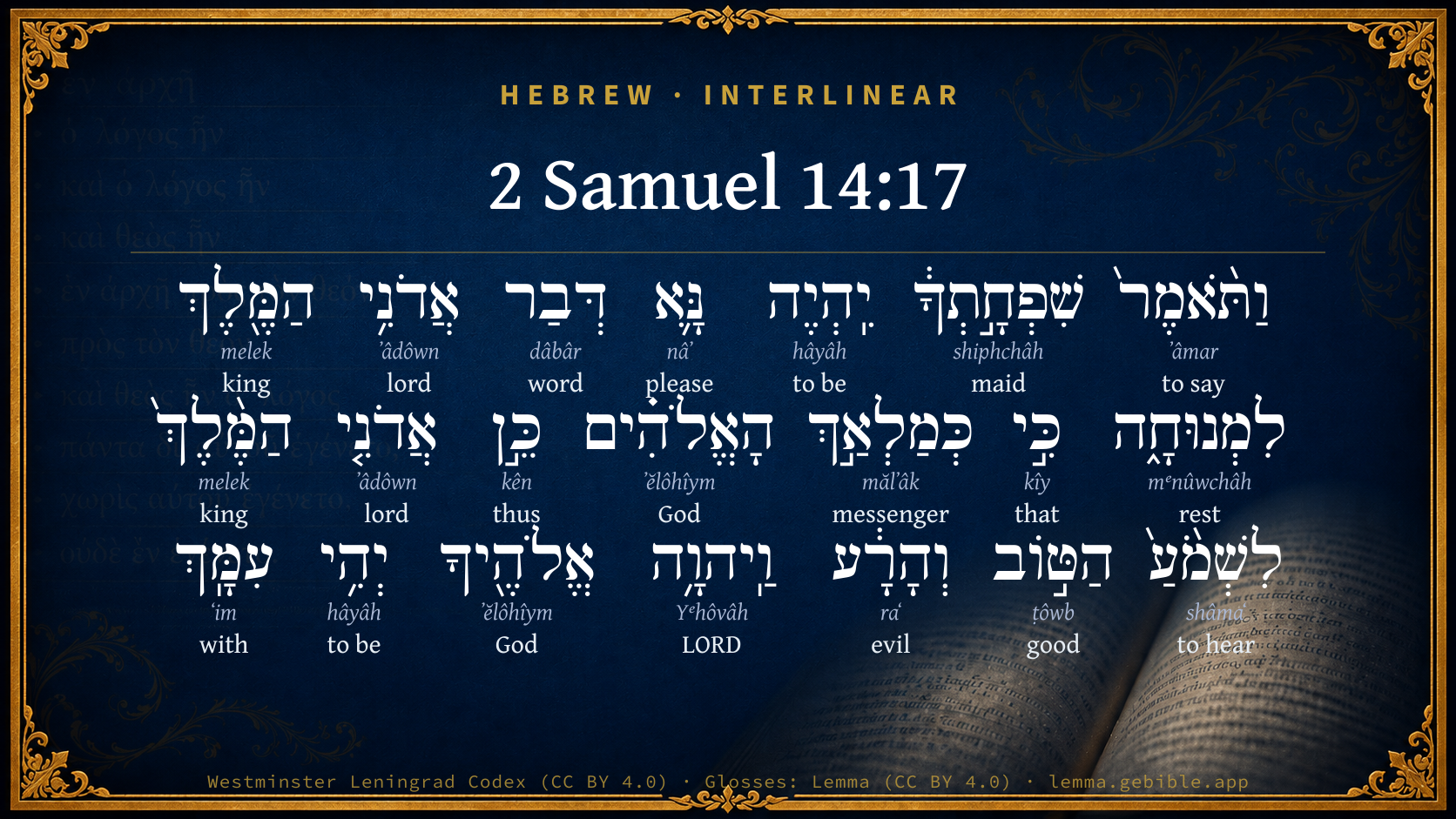
  1. וַתֹּ֨אמֶר֙ ʼâmar H559 “and · to say” Conjunction + Verb, Qal, Sequential Imperfect, 3rd Person, Feminine, Singular
  2. שִׁפְחָ֣תְךָ֔ shiphchâh H8198 “maid · your” Noun, Common, Feminine, Singular, Construct + Suffix, Personal, 2nd Person, Masculine, Singular
  3. יִֽהְיֶה hâyâh H1961 “to be” Verb, Qal, Jussive, 3rd Person, Masculine, Singular
  4. נָּ֛א nâʼ H4994 “please” Particle, Interjection
  5. דְּבַר dâbâr H1697 “word of” Noun, Common, Masculine, Singular, Construct
  6. אֲדֹנִ֥י ʼâdôwn H113 “lord · my” Noun, Common, Masculine, Singular, Construct + Suffix, Personal, 1st Person, Common, Singular
  7. הַמֶּ֖לֶךְ melek H4428 “the · king” Particle, Definite Article + Noun, Common, Masculine, Singular, Absolute
  8. כִּ֣י kîy H3588 “that” Conjunction
  9. כְּמַלְאַ֣ךְ mălʼâk H4397 “like/as · messenger of” Preposition + Noun, Common, Masculine, Singular, Construct
  10. הָאֱלֹהִ֗ים ʼĕlôhîym H430 “the · God(s)” Particle, Definite Article + Noun, Common, Masculine, Plural, Absolute
  11. כֵּ֣ן kên H3651 “thus” Particle, Demonstrative
  12. אֲדֹנִ֤י ʼâdôwn H113 “lord · my” Noun, Common, Masculine, Singular, Construct + Suffix, Personal, 1st Person, Common, Singular
  13. הַמֶּ֨לֶךְ֙ melek H4428 “the · king” Particle, Definite Article + Noun, Common, Masculine, Singular, Absolute
  14. לִשְׁמֹ֨עַ֙ shâmaʻ H8085 “to hear” Preposition + Verb, Qal, Infinitive Construct
  15. הַטּ֣וֹב ṭôwb H2896 “the · good” Particle, Definite Article + Adjective, Adjective, Masculine, Singular, Absolute
  16. וְהָרָ֔ע raʻ H7451 “and · the · evil” Conjunction + Particle, Definite Article + Adjective, Adjective, Masculine, Singular, Absolute
  17. וַֽיהוָ֥ה Yᵉhôvâh H3068 “and · LORD” Conjunction + Noun, Proper
  18. אֱלֹהֶ֖יךָ ʼĕlôhîym H430 “God(s) · your” Noun, Common, Masculine, Plural, Construct + Suffix, Personal, 2nd Person, Masculine, Singular
  19. יְהִ֥י hâyâh H1961 “to be” Verb, Qal, Jussive, 3rd Person, Masculine, Singular
  20. עִמָּֽךְ ʻim H5973 “with · you” Preposition + Suffix, Personal, 2nd Person, Feminine, Singular

About this verse

These counts appear in no published source. They are computed here, from the morphology-tagged text and Lemma’s own curated glosses. What Lemma adds →

21
words
17
distinct lemmas
Historical
section

Notable vocabulary

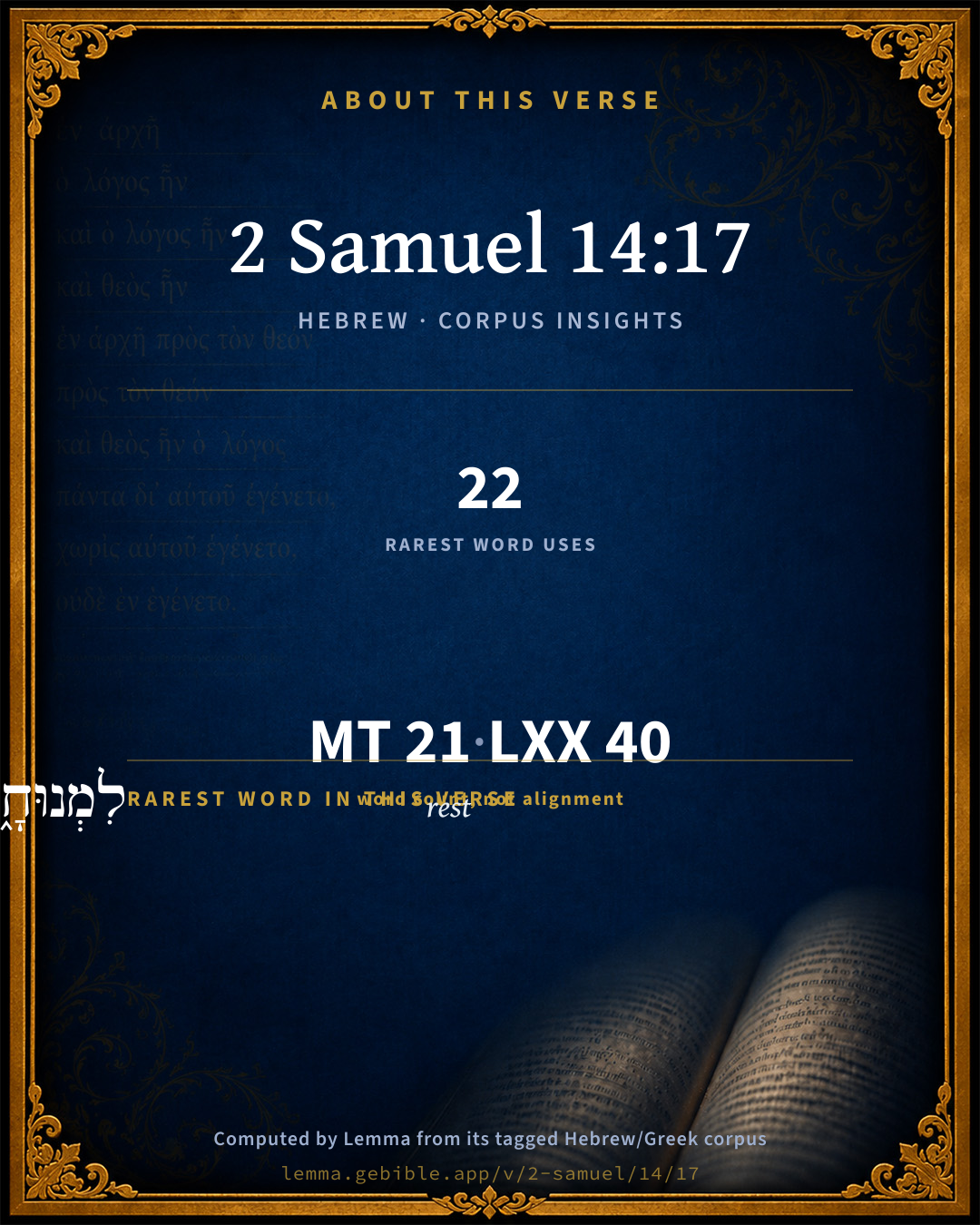
The rarest word here is לִמְנוּחָ֑ה rest H4496 — appearing just 22 times in the whole Hebrew Bible.

Shared distinctive vocabulary

לִמְנוּחָ֑ה rest H4496 occurs in 22 verses of the Hebrew Bible. Also found in:

Grammatical profile

  • 4 verbs
  • 11 nouns
  • 2 adjectives
  • 1 preposition
  • 1 conjunction
  • 2 particles

Verb forms

  • וַתֹּ֨אמֶר֙ Qal · Sequential Imperfect
  • יִֽהְיֶה Qal · Jussive
  • לִשְׁמֹ֨עַ֙ Qal · Infinitive Construct
  • יְהִ֥י Qal · Jussive

Repetition

Words recur within this verse — often emphatic in Hebrew:

  • יִֽהְיֶה to be H1961 ×2
  • אֲדֹנִ֥י lord H113 ×2
  • הַמֶּ֖לֶךְ king H4428 ×2
  • הָאֱלֹהִ֗ים God H430 ×2

Hebrew & Septuagint length

In English translation the verse runs 39 words from the Hebrew and 42 from the Septuagint (LXX English) — closely comparable.

A rough comparison of the two English renderings, which tokenize alike — not a word-level alignment.

Word counts can differ between the Hebrew and the Greek without any difference in meaning — e.g. the Hebrew direct-object marker אֵת has no separate Greek word, and Greek often adds the article ὁ.

In the original languages it is 21 Hebrew tokens and 40 Greek tokens — but the two are counted differently (Hebrew bundles its prefixes and suffixes into one token; the Greek is in lemma form), so that isn’t a like-for-like length.

Cross-references

10

Topical passages linked to 2 Samuel 14:17 in the Treasury of Scripture Knowledge — connected by theme and wording, ordered by reader-vote popularity; previews shown in the World English Bible.

  • 1 Samuel 29:9 Achish answered David, I know that you are good in my sight, as an angel of God: notwithstanding the princes of the Philistines have said, He shall not go up with us to the battle.
  • 2 Samuel 19:27 He has slandered your servant to my lord the king; but my lord the king is as an angel of God: do therefore what is good in your eyes.
  • 2 Samuel 14:20 to change the face of the matter has your servant Joab done this thing: and my lord is wise, according to the wisdom of an angel of God, to know all things that are in the earth.
  • 1 Kings 3:9 Give your servant therefore an understanding heart to judge your people, that I may discern between good and evil; for who is able to judge this your great people?
  • Hebrews 5:14 But solid food is for those who are full grown, who by reason of use have their senses exercised to discern good and evil.
  • Job 6:30 Is there injustice on my tongue? Can't my taste discern mischievous things?
  • Proverbs 27:21 The crucible is for silver, And the furnace for gold; But man is refined by his praise.
  • Proverbs 29:5 A man who flatters his neighbor, Spreads a net for his feet.
  • 1 Corinthians 2:14–15 Now the natural man doesn't receive the things of God's Spirit, for they are foolishness to him, and he can't know them, because they are spiritually discerned.
  • 1 Kings 3:28 All Israel heard of the judgment which the king had judged; and they feared the king: for they saw that the wisdom of God was in him, to do justice.

Cross-references courtesy of OpenBible.info (CC BY 4.0).

Hebrew and Greek witnesses Masoretic Hebrew ↔ Greek Septuagint

The same verse in the two great witnesses to the Old Testament, shown verse-for-verse.

These are two independent witnesses, not word-aligned to each other, and the Septuagint is shown in lemma (dictionary) form.

Hebrew 2 Samuel 14:17 Masoretic · Westminster Leningrad Codex

וַתֹּ֨אמֶר֙ שִׁפְחָ֣תְךָ֔ יִֽהְיֶה נָּ֛א דְּבַר אֲדֹנִ֥י הַמֶּ֖לֶךְ לִמְנוּחָ֑ה כִּ֣י כְּמַלְאַ֣ךְ הָאֱלֹהִ֗ים כֵּ֣ן אֲדֹנִ֤י הַמֶּ֨לֶךְ֙ לִשְׁמֹ֨עַ֙ הַטּ֣וֹב וְהָרָ֔ע וַֽיהוָ֥ה אֱלֹהֶ֖יךָ יְהִ֥י עִמָּֽךְ

Then your handmaid said, Please let the word of my lord the king be comfortable; for as an angel of God, so is my lord the king to discern good and bad: and Yahweh your God be with you.

World English Bible · Public Domain

Greek LXX 2 Samuel 14:17 Septuagint · lemma form

καί εἶπον ὁ γυνή εἰμί δή ὁ λόγος ὁ κύριος ἐγώ ὁ βασιλεύς εἰς θυσία ὅτι καθώς ἄγγελος θεός οὕτως ὁ κύριος ἐγώ ὁ βασιλεύς ὁ ἀκούω ὁ ἀγαθός καί ὁ πονηρός καί κύριος ὁ θεός σύ εἰμί μετά σύ

And the woman said, If now the word of my lord the king be gracious, —well: for as an angel of God, so is my lord the king, to hear good and evil: and the Lord your God shall be with you.

LXX2012 (modern English Septuagint) · Public Domain

Hebrew: Westminster Leningrad Codex (CC BY 4.0). Greek: Septuagint (public domain); English from LXX2012 (modern English Septuagint) (Public Domain). How the Septuagint differs from the Hebrew →

Targum (Aramaic paraphrase)

1

The Targum is the ancient Jewish Aramaic paraphrase of the Hebrew Scriptures — an interpretive translation, not the Hebrew text itself. Onkelos (literal) and Pseudo-Jonathan (expansive) render the Torah, and Jonathan the Prophets. Coverage is partial: where no permissively-licensed English translation exists for a verse, only the Aramaic is shown. This is verse-level text, not a word-by-word alignment to the Hebrew.

  1. Targum Jonathan Prophets (Joshua–Malachi)
    וַאֲמַרַת אַמְתָךְ יְהֵי כְעַן פִּתְגָמָא דְרִבּוֹנִי מַלְכָּא לְנִיחָא אֲרֵי כְּמַלְאָכָא דַייָ כֵּן רִבּוֹנִי מַלְכָּא לְמִשְׁמַע טַב וּבִישׁ וּמֵימְרָא דַייָ אֱלָהָךְ יְהֵי בְסַעֲדָךְ:

    (no public-domain English translation for this verse)

    Targum Jonathan — Aramaic: “Mikraot Gedolot” (public domain). English: “Sefaria Community Translation” (CC0 1.0 (public-domain dedication)); “London "Chaldee Paraphrase," 1871” (public domain). Text via Sefaria.

Commentary

Notes on 2 Samuel 14:17 from classic Christian and Jewish commentators (each source and its license shown beneath its notes). The classic Christian expositions comment on the surrounding passage and are grouped to its opening verse, so a note may address several verses; the Jewish commentaries on the Tanakh (Rashi and others) are per-verse, so they appear only where the commentator wrote on this verse.

Lemma curates 59 commentaries, every one of them public domain or Creative Commons licensed, each selected and text-cleaned for this edition rather than reprinted as found. About our sources →

Trapp's Complete Commentary

John Trapp

2Sa 14:17 Then thine handmaid said, The word of my lord the king shall now be comfortable: for as an angel of God, so [is] my lord the king to discern good and bad: therefore the LORD thy God will be with thee.

Ver. 17. The word of my lord the king shall now be comfortable.] As binding upon the arguments aforegoing, I am bold to believe, and dare say as much.

For as an angel of God, &c.] Both for dexterity and integrity. This is her last argument a laude Davidis, from the high price she set upon David, and the excessive praise she giveth him, the better to insinuate. She knew that ηδιστον ακουσμα εταινος, a man’s own commendation is the sweetest hearing, {a} and the way to curry favour.

{a} Xenophon.

John Trapp, A Commentary or Exposition upon All the Books of the Old and New Testament (1647–1656) — public domain. Text from a community e-Sword module.

Joseph Benson's Commentary

2Sa 14:17. The word of my lord the king shall now be comfortable — Upon reflection, she grew confident that the king’s answer would be according to her heart’s desire. For as an angel of God is my lord the king — In wisdom, justice, and goodness. To discern good and bad — To distinguish between reasonable and unreasonable petitions, and to know what is good and what evil, and understand every matter that comes before him. Therefore the Lord thy God will be with thee — To direct thee to judge aright, and show mercy: or, because thou art so wise and gracious to those who in strict justice deserve punishment. God will own and stand by thee in this thy act of grace: or, God will prosper thee in thy enterprises.

Joseph Benson's Commentary on the Old and New Testaments (1811–1818) — public domain. Text from a community e-Sword module.

Tyndale Open Study Notes

Tyndale Open Resources

14:17 you are like an angel of God: This flattering expression is not used for anyone else in the Bible but appears four times to describe David (see also 14:20; 19:27; 1 Sam 29:9). The woman was expressing confidence that David would act with God-given wisdom and justice.

Tyndale Open Study Notes — © Tyndale Open Resources, licensed CC BY-SA 4.0. Text via the HelloAO Bible API.

Geneva Bible (1599)

Geneva Bible translators

Hebrew, rest.

Is of great wisdom to discern right from wrong.

Geneva Bible (1599) marginal notes — public domain. Text via Bolls.life.

Ellicott's Commentary for English Readers

(17) An angel of God.—Comp. 2Sa_14:20; 2Sa_19:27; 1Sa_29:9.

A Bible Commentary for English Readers, edited by Charles John Ellicott (1878–1897) — public domain. Text from a community e-Sword module.

The Cambridge Bible for Schools and Colleges

gen. ed. J. J. S. Perowne

17. Then thine handmaid said] Sept. “And the woman said:” which suits the context better.

shall now be comfortable] Lit. Let the word … be for rest: give me security from my enemies.

as an angel of God] Cp. 2Sa_14:20; ch. 2Sa_19:27; and 1Sa_29:9.

to discern good and bad] To hear the good and the evil: to listen patiently to all manner of petitions, and decide justly upon them.

therefore the Lord thy God will be with thee] The words are a prayer or blessing: and Jehovah thy God be with thee.

The Cambridge Bible for Schools and Colleges (gen. ed. J. J. S. Perowne; Cambridge University Press, 1878–1918) — public domain. Text from a community e-Sword module.

John Gill's Exposition

Then thine handmaid said, the word of my lord the king shall now be comfortable,.... Or, "for rest" (q); what will give ease and satisfaction not only to her, but to all the people of Israel, when they shall hear of the king's intention and resolution to bring back Absalom:

for as an angel of God, so is my lord the king; as they are very wise, knowing, and understanding creatures, so was David:

to discern good and bad; to hear both the one and the other, and to discern the difference between them, and choose and pursue what is right, as in all other things, so in the present case:

therefore the Lord thy God shall be with thee; as to counsel and advise, so to assist in performance, and to prosper and succeed; the Targum is,"the Word of the Lord thy God shall be for thine help.''

(q) "ad requiem", Pagninus, Montanus; "ad tranquillitatem", Tigurine version; "ad quietem", Vatablus, Junius & Tremellius, Piscator.

John Gill's Exposition of the Whole Bible (1746–1763) — public domain (CC PDM 1.0). Text via the HelloAO Bible API.

Albert Barnes' Notes on the Bible

As an angel of God - Rather, as “the” Angel of God; and therefore whatever David decided would be right.

Albert Barnes' Notes on the Bible (1834–1885) — public domain. Text from a community e-Sword/MySword module.

Haydock's Catholic Bible Commentary

Sacrifice; perfect and inviolable. (Tirinus) --- Cursing, provided he be in the right. (Menochius) --- Hebrew, "the king to discern (hear) good and bad;" of consummate wisdom; (ver. 20.; Haydock) so that no one can impose upon him.

George Leo Haydock (1774–1849), Haydock's Catholic Family Bible and Commentary, 1859 edition — public domain. Excludes Psalms (Douay-Rheims chapter numbering differs from Protestant) and Deuterocanonical books (Catholic canon only).

Matthew Poole's English Annotations

The word of my lord the king shall now be comfortable; I doubt not the king will give a gracious and satisfactory answer to my petition.

As an angel of God, to wit, in wisdom, and justice, and goodness.

To discern good and bad; to hear and judge of causes and requests, whether they be just, and good, and fit to be granted, as mine is; or unrighteous, and unreasonable, and fit to be rejected. So she intimates her confidence in the justice of her cause, and thereby confirms the king in his purpose and promise to grant her request, and withal arms the king against the suggestions of them who should advise him to a rigorous execution of God’s law against Absalom, and be ready to censure him for restoring Absalom, and this for want of that angelical wisdom which the king had, who wisely considered many things far above their reach.

Therefore; because thou art so wise, and just, and pitiful, and gracious to those who in strict justice deserve punishment.

The Lord thy God will be with thee; God will own and stand by thee in this thy act of grace; or, God will prosper thee in thy enterprises; or, at least, not be offended with thee.

Matthew Poole's English Annotations on the Holy Bible (1683–1685) — public domain. Text from a community e-Sword/MySword module.

Whedon's Commentary on the Bible

Daniel D. Whedon

17. To discern good and bad — Rather, to hear good and bad. The king shows his kindness by listening to every just complaint, and giving comfort to the aggrieved by his decisions.

Daniel D. Whedon (gen. ed.), Commentary on the Old and New Testaments (1874–1909) — public domain. Text from a community e-Sword module.

The Pulpit Commentary

An all-comprehensive blessing.

Lord thy God be with thee" (Revised Version). The "wise woman," in closing her address to David and taking leave, as she thought, of him, pronounces this blessing upon him. It was a usual form of salutation amongst the Israelites; and, like our similar forms ("Adieu," equivalent to "to God I commend thee;" "Good-bye," equivalent, perhaps, to "God be with thee"), was doubtless often employed without thought or feeling as to its significance. But in its full meaning it is the best blessing we can pronounce on our friends, the most comprehensive prayer we can offer for them. "The Lord Jesus be with thy spirit" (2Ti_4:22) is a similar benediction.

I IT IS A PRAYER OF TRUE FRIENDSHIP. We can desire nothing more or better for our friends than what these words express. For consider:

1. What is included in God being "with" men. Not simply his nearness, but:

(1) His favour. His presence as a Friend with friends. Not merely as he is near to all men, the Upholder of their being and the Source of whatever they enjoy; but as he is near to those who are reconciled to him, whom he has forgiven and received into his spiritual family, who love him and delight in his love.

(2) His constant help. To defend, uphold, guide, supply with all needed and real good, temporal and spiritual; to impart to them wisdom, holiness, strength, and happiness.

(3) His converse with them. The manifestation of his presence and loving kindness; so that they discern his nearness, are conscious of his love and care and cooperation.

2. Whose friendship is thus invoked. That of "Jehovah thy God." The living God, the Eternal, the Almighty, the All-wise, the All-good, etc. Better to have him with us than all the world, all the universe. In fact, if God is with us, all things are really with us (see Rom_8:28, Rom_8:31-39; 1Pe_3:13)

II IT IS A PRAYER NATURAL TO A PIOUS MAN. Springing from his personal experience of the blessedness of those who have God with them, and his desire that all, and especially those in whom he feels the deepest interest, should be partakers of the same blessedness.

III IT IS A PRAYER ESPECIALLY SUITABLE TO BE OFFERED ON CERTAIN OCCASIONS. To express feelings of friendship, gratitude, benevolence, affection:

(1) To benefactors, whose kindness we feel we cannot requite. "I cannot repay you, but God can. May he be with you!

(2) To needy persons, whose necessities we feel we cannot meet. Whether the need be temporal or spiritual. The poor, the sick, the perplexed; friends engaged in difficult enterprises or going into perilous circumstances; such as are leaving home or country; friends from whom we are parting, not knowing what may befall them or us.

(3) To dying friends, or those near us when we die." I die, but God shall be with you". (Gen_48:21) It is a prayer that gives comfort and peace to him who presents it, quieting the tumult excited by the combination of strong desire with conscious helplessness.

IV IT IS A PRAYER WHICH WILL BE FULFILLED TO THE RIGHTEOUS. The unrighteous can only secure the blessing for themselves by becoming righteous, (see 2Ch_15:2) through repentance and faith in Immanuel (equivalent to "God with us"). G.W.

The Pulpit Commentary (1880–1919), ed. H.D.M. Spence-Jones & Joseph S. Exell — public domain. Text from a community e-Sword module.

John Wesley's Explanatory Notes

Angel - In wisdom, and justice, and goodness. Therefore - Because thou art so wise and gracious to those who in strict justice deserve punishment, God will own and stand by thee in this thy act of grace: or God will prosper thee in thy enterprizes.

John Wesley, Explanatory Notes Upon the Whole Bible (1754–1765) — public domain. Text via the GEBible commentary corpus.

Rashi

Rabbi Shlomo Yitzchaki (Rashi)

Your handmaiden says. Now that the king has ordered [remedial action] concerning me, his word should provide relief for my son because he will not back away from his kind decision because my master, the king is like an angel of God and anger and hatred will not change his kind decision.

Rashi on the Tanakh — English translations: “The Judaica Press complete Tanach with Rashi, translated by A. J. Rosenberg” (CC BY 4.0); “Pentateuch with Rashi's commentary by M. Rosenbaum and A.M. Silbermann, 1929-1934” (public domain); “The Metsudah Tanach series, Lakewood, N.J” (CC BY 4.0); and “The Book of Joshua, Metsudah Publications, 1997” (CC BY 4.0). Text via Sefaria.

Lesson kit

Teaching starters — assembled from the data on this page, not authored interpretation. Every prompt links to the verse data it draws on. Edit before teaching.

2 Samuel, in the Historical, opens this verse with 21 words (17 distinct Hebrew lemmas). Its most distinctive word is mᵉnûwchâh (“rest”). A historical commentator’s framing appears above. Read the whole chapter for the surrounding context.

Discussion questions

  1. How does “rest” (mᵉnûwchâh) shape what this verse is saying?
  2. Genesis 49:15 shares the word «rest» with this verse. How do the two illuminate each other?
  3. “to be” occurs 2× in this one verse. What is the effect of the repetition?
  4. These translations render this verse differently. What is at stake in choosing one wording over another?
  5. The verb «וַתֹּ֨אמֶר֙» is Qal Sequential Imperfect. How does its form color the action?
  6. Reading how Trapp's Complete Commentary and Joseph Benson's Commentary read this verse, where do the two commentators agree and where do they part?

Things to notice

Reading settings

Reading text

Shown beneath each verse's original-language words.

Old Testament
Old Testament edition

Read the OT as the Masoretic Hebrew (MT) or the Greek Septuagint (LXX).

English shown for the Greek Septuagint (in the Hebrew ↔ Greek comparison).

Comparing translations? Open the Compare panel on any verse page to stack up to four side by side.