
Zechariah 12:8

Hebrew (Westminster Leningrad Codex) Zechariah 12:8 appears in the Hebrew Old Testament. The text above is from the Westminster Leningrad Codex. Each word links to its Strong’s number, a concise gloss, and parsing drawn from the Open Scriptures Hebrew Bible morphology. Click any word for its full Brown-Driver-Briggs (BDB) entry.
Download image
Cite this verse

Zechariah 12:8 (World English Bible). Public Domain. Lemma interlinear Bible study tool, https://lemma.gebible.app/v/zechariah/12/8.

Show BibTeX & RIS
BibTeX
RIS
English Translation
In that day Yahweh will defend the inhabitants of Jerusalem. He who is feeble among them at that day will be like David, and the house of David will be like God, like the angel of Yahweh before them.
World English Bible · Public Domain
Download a study sheet

One document with this verse’s original text, its word-by-word gloss line, the meaning frame, cross-references with their text, attributed commentary, and full source and license credits — printable, and it pastes into notes with its structure intact.

This verse Autodidact and up

Study sheet (.html) Plain text (.txt)

A passage Seminary Student

Up to 50 verses in one chapter. A passage sheet keeps up to 6 commentary sources and 12 cross-references per verse, in the order this page ranks them, and says so on the sheet whenever that leaves anything out. Ask for a single verse and you get the Autodidact verse sheet above.

Everything on this page stays free to read, with no account — the sheet is a download of what is already on screen, not access to it.

Want to remove ads? Support Godless Engineer
Compare translations 3

The same verse in 3 English versions, stacked beneath the original-language interlinear above. Click any original word for its lexicon entry.

Each is an independent rendering of the whole verse — the interlinear is not word-aligned to these translations.

Highlighted words mark where these versions differ — a whole-verse word diff, not a word-by-word alignment.

  • World English Bible Public Domain
    In that day Yahweh will defend the inhabitants of Jerusalem. He who is feeble among them at that day will be like David, and the house of David will be like God, like the angel of Yahweh before them.
  • King James Version Public Domain
    In that day shall the LORD defend the inhabitants of Jerusalem; and he that is feeble among them at that day shall be as David; and the house of David shall be as God, as the angel of the LORD before them.
  • unfoldingWord Literal Text CC BY-SA 4.0
    On that day Yahweh will be the defender of the inhabitants of Jerusalem, and on that day those who are weak among them will be like David, while the house of David like God, like the angel of Yahweh in front of them.

unfoldingWord Literal Text — © unfoldingWord, licensed CC BY-SA 4.0. Word-aligned USFM3 via Door43 (git.door43.org/unfoldingWord/en_ult).

Versions to compare (up to 4)

3 of 4 selected

Show all 18 translations

Every available English version of this verse, each an independent rendering of the whole verse.

  • World English Bible Public Domain
    In that day Yahweh will defend the inhabitants of Jerusalem. He who is feeble among them at that day will be like David, and the house of David will be like God, like the angel of Yahweh before them.
  • Berean Standard Bible Public Domain
    On that day the LORD will defend the people of Jerusalem, so that the weakest among them will be like David, and the house of David will be like God, like the angel of the LORD going before them.
  • Majority Standard Bible Public Domain
    On that day the LORD will defend the people of Jerusalem, so that the weakest among them will be like David, and the house of David will be like God, like the angel of the LORD going before them.
  • King James Version Public Domain
    In that day shall the LORD defend the inhabitants of Jerusalem; and he that is feeble among them at that day shall be as David; and the house of David shall be as God, as the angel of the LORD before them.
  • American Standard Version (1901) Public Domain
    In that day shall Jehovah defend the inhabitants of Jerusalem: and he that is feeble among them at that day shall be as David; and the house of David shall be as God, as the angel of Jehovah before them.
  • Revised Version (1885) Public Domain
    In that day shall the LORD defend the inhabitants of Jerusalem; and he that is feeble among them at that day shall be as David; and the house of David shall be as God, as the angel of the LORD before them.
  • Geneva Bible (1599) Public Domain
    In that day shall the Lord defende the inhabitants of Ierusalem, and he that is feeble among them, in that day shall be as Dauid: and the house of Dauid shall be as Gods house, and as the Angel of the Lord before them.
  • Douay-Rheims (1899) Public Domain
    In that day shall the Lord protect the inhabitants of Jerusalem, and he that hath offended among them in that day shall be as David: and the house of David, as that of God, as an angel of the Lord in their sight.
  • Young's Literal Translation Public Domain
    In that day cover over doth Jehovah the inhabitant of Jerusalem, And the stumbling among them hath been in that day as David, And the house of David as God -- As a messenger of Jehovah -- before them.
  • Literal Standard Version CC BY-SA 4.0
    In that day YHWH covers over the inhabitant of Jerusalem, || And the stumbling among them has been in that day as David, || And the house of David as God—As the Messenger of YHWH—before them.
  • Unlocked Literal Bible CC BY-SA 4.0
    On that day Yahweh will be the defender of the inhabitants of Jerusalem, and on that day those who are weak among them will be like David, while the house of David will be like God, like the angel of Yahweh in front of them.
  • unfoldingWord Literal Text CC BY-SA 4.0
    On that day Yahweh will be the defender of the inhabitants of Jerusalem, and on that day those who are weak among them will be like David, while the house of David like God, like the angel of Yahweh in front of them.
  • Darby Bible Public Domain
    In that day will Jehovah defend the inhabitants of Jerusalem; and he that stumbleth among them at that day shall be as David; and the house of David as God, as the Angel of Jehovah before them.
  • World Messianic Bible Public Domain
    In that day the LORD will defend the inhabitants of Jerusalem. He who is feeble among them at that day will be like David, and David’s house will be like God, like the LORD’s angel before them.
  • Webster's Bible Public Domain
    In that day will the LORD defend the inhabitants of Jerusalem; and he that is feeble among them at that day shall be as David; and the house of David shall be as God, as the angel of the LORD before them.
  • Free Bible Version CC BY-SA 4.0
    On that day the Lord will place a shield around the people of Jerusalem so that even the clumsiest of them will be as skilled a warrior as David, and the house of David will be like God, like the angel of the Lord who leads them.
  • Bible in Basic English Public Domain
    In that day the Lord will be a cover over the people of Jerusalem; and he who is feeble among them in that day will be as strong as David, and the family of David will be as God, as the angel of the Lord before them.
  • JPS Tanakh (1917) Public Domain
    In that day shall the LORD defend the inhabitants of Jerusalem; and he that stumbleth among them at that day shall be as David; and the house of David shall be as a godlike being, as the angel of the LORD before them.

Literal Standard Version (2020), Covenant Press — licensed CC BY-SA 4.0. Text via the HelloAO Bible API (eBible.org). Unlocked Literal Bible (unfoldingWord) — licensed CC BY-SA 4.0. Text via the HelloAO Bible API (eBible.org). unfoldingWord Literal Text — © unfoldingWord, licensed CC BY-SA 4.0. Word-aligned USFM3 via Door43 (git.door43.org/unfoldingWord/en_ult). Free Bible Version, Dr. Jonathan Gallagher — licensed CC BY-SA 4.0. Text via the HelloAO Bible API (eBible.org).

Word by word

More ways to search: Search by grammar → Find every occurrence → Compare this word →

Practice this passage: Drill this verse → Learn its vocabulary →

יָגֵ֤ן
gânan
H1598
“to defend”
Verb, Qal, Imperfect, 3rd Person, Masculine, Singular
Part of Speech
Verb
Stem
Qal
Form
Imperfect
Person
3rd Person
Gender
Masculine
Number
Singular
Full BDB Definition

Origin: a primitive root

TWOT: 367

to defend, cover, surround - (Qal) to defend - (Hiphil) to defend
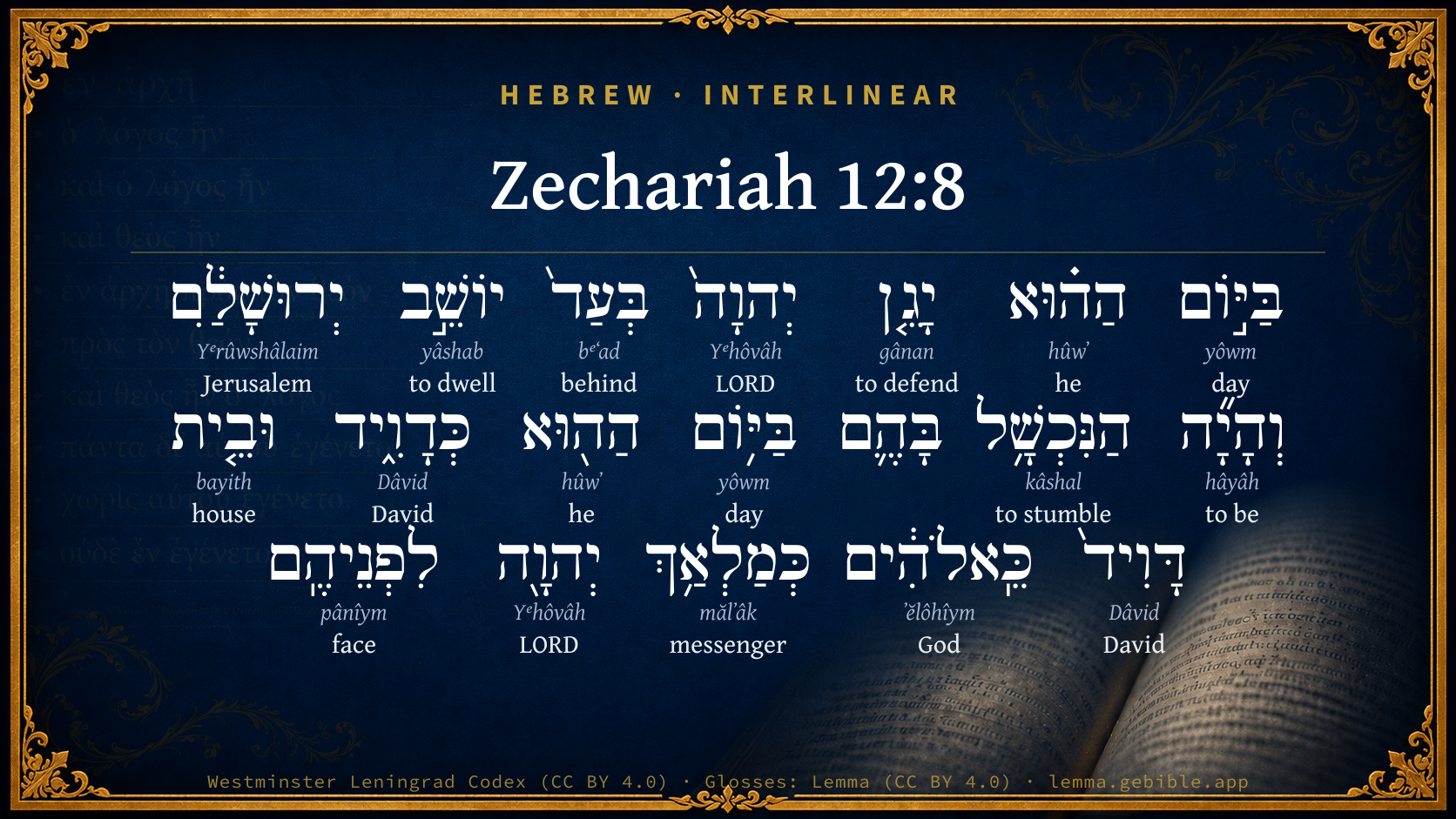
  1. בַּיּ֣וֹם yôwm H3117 “in/at the · day” Preposition, Determined + Noun, Common, Masculine, Singular, Absolute
  2. הַה֗וּא hûwʼ H1931 “the · he” Particle, Definite Article + Pronoun, Personal, 3rd Person, Masculine, Singular
  3. יְהוָה֙ Yᵉhôvâh H3068 “LORD” Noun, Proper
  4. בְּעַד֙ bᵉʻad H1157 “behind” Preposition
  5. יוֹשֵׁ֣ב yâshab H3427 “dwelling” Verb, Qal, Participle Active, Masculine, Singular, Construct
  6. יְרוּשָׁלִַ֔ם Yᵉrûwshâlaim H3389 “Jerusalem” Noun, Proper
  7. וְהָיָ֞ה hâyâh H1961 “and · to be” Conjunction + Verb, Qal, Sequential Perfect, 3rd Person, Masculine, Singular
  8. הַנִּכְשָׁ֥ל kâshal H3782 “the · stumbled” Particle, Definite Article + Verb, Niphal, Participle Passive, Masculine, Singular, Absolute
  9. בַּיּ֥וֹם yôwm H3117 “in/at the · day” Preposition, Determined + Noun, Common, Masculine, Singular, Absolute
  10. הַה֖וּא hûwʼ H1931 “the · he” Particle, Definite Article + Pronoun, Personal, 3rd Person, Masculine, Singular
  11. כְּדָוִ֑יד Dâvid H1732 “like/as · David” Preposition + Noun, Proper
  12. וּבֵ֤ית bayith H1004 “and · house of” Conjunction + Noun, Common, Masculine, Singular, Construct
  13. דָּוִיד֙ Dâvid H1732 “David” Noun, Proper
  14. כֵּֽאלֹהִ֔ים ʼĕlôhîym H430 “like/as · God(s)” Preposition + Noun, Common, Masculine, Plural, Absolute
  15. כְּמַלְאַ֥ךְ mălʼâk H4397 “like/as · messenger of” Preposition + Noun, Common, Masculine, Singular, Construct
  16. יְהוָ֖ה Yᵉhôvâh H3068 “LORD” Noun, Proper
  17. לִפְנֵיהֶֽם pânîym H6440 “to/for · face(s) · their” Preposition + Noun, Common, Both, Plural, Construct + Suffix, Personal, 3rd Person, Masculine, Plural

About this verse

These counts appear in no published source. They are computed here, from the morphology-tagged text and Lemma’s own curated glosses. What Lemma adds →

19
words
14
distinct lemmas
Prophets
section

Notable vocabulary

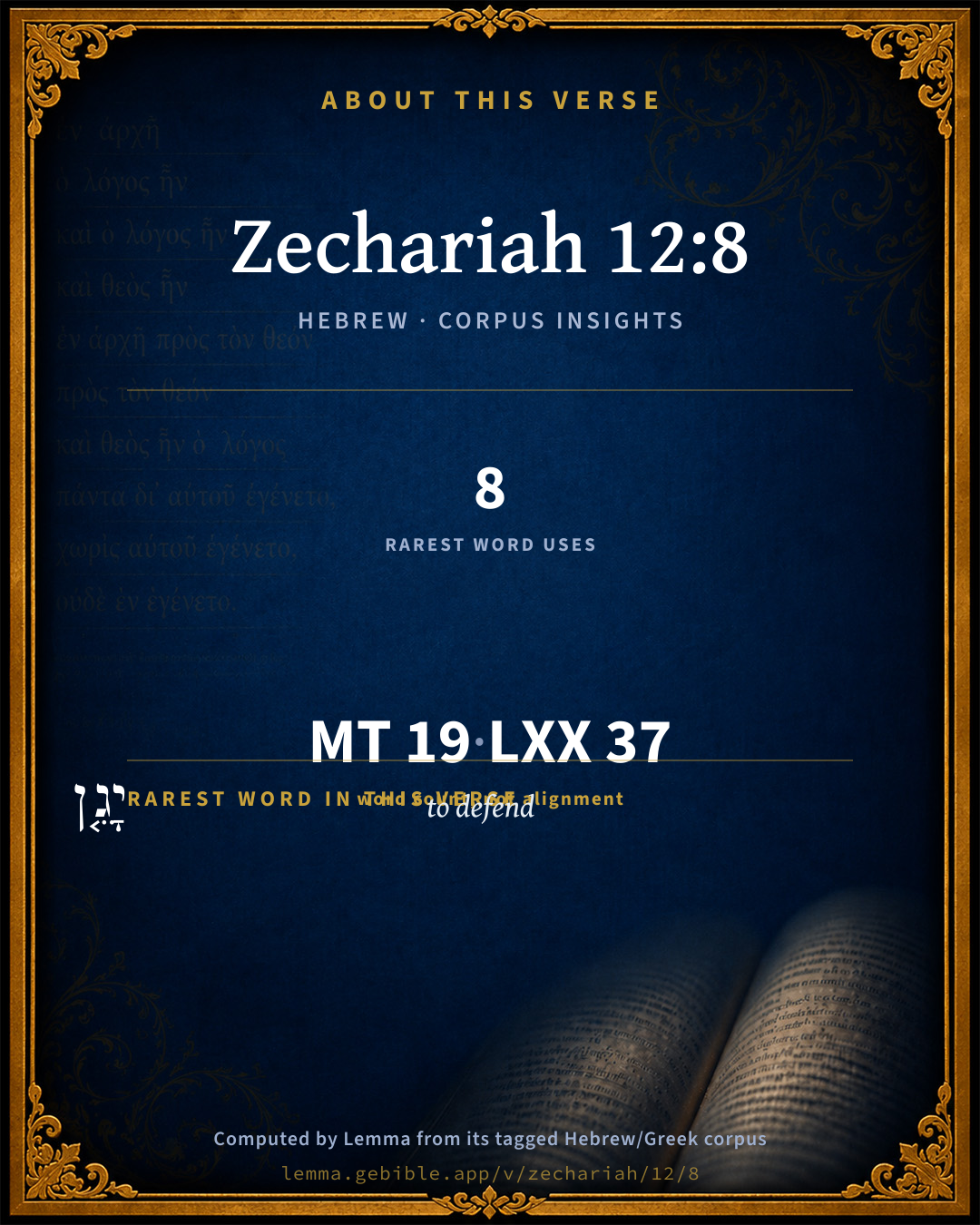
The rarest word here is יָגֵ֤ן to defend H1598 — appearing just 8 times in the whole Hebrew Bible.

Shared distinctive vocabulary

יָגֵ֤ן to defend H1598 occurs in 7 verses of the Hebrew Bible. Also found in:

Grammatical profile

  • 4 verbs
  • 11 nouns
  • 2 pronouns
  • 2 prepositions

Verb forms

  • יָגֵ֤ן Qal · Imperfect
  • יוֹשֵׁ֣ב Qal · Participle Active
  • וְהָיָ֞ה Qal · Sequential Perfect
  • הַנִּכְשָׁ֥ל Niphal · Participle Passive

Repetition

Words recur within this verse — often emphatic in Hebrew:

  • בַּיּ֣וֹם day H3117 ×2
  • יְהוָה֙ LORD H3068 ×2
  • כְּדָוִ֑יד David H1732 ×2
  • הַה֗וּא he H1931 ×2

Hebrew & Septuagint length

In English translation the verse runs 39 words from the Hebrew and 49 from the Septuagint (LXX English) — closely comparable.

A rough comparison of the two English renderings, which tokenize alike — not a word-level alignment.

Word counts can differ between the Hebrew and the Greek without any difference in meaning — e.g. the Hebrew direct-object marker אֵת has no separate Greek word, and Greek often adds the article ὁ.

In the original languages it is 19 Hebrew tokens and 37 Greek tokens — but the two are counted differently (Hebrew bundles its prefixes and suffixes into one token; the Greek is in lemma form), so that isn’t a like-for-like length.

Cross-references

44

Topical passages linked to Zechariah 12:8 in the Treasury of Scripture Knowledge — connected by theme and wording, ordered by reader-vote popularity; previews shown in the World English Bible.

  • Micah 5:2–4 But you, Bethlehem Ephrathah, Being small among the clans of Judah, Out of you one will come forth to me that is to be ruler in Israel; Whose goings forth are from of old, from everlasting.
  • Joel 3:10 Beat your plowshares into swords, And your pruning hooks into spears. Let the weak say, "I am strong."
  • Joel 3:16–17 Yahweh will roar from Zion, And thunder from Jerusalem; And the heavens and the earth will shake; But Yahweh will be a refuge to his people, And a stronghold to the children of Israel.
  • Micah 7:8 Don't rejoice against me, my enemy. When I fall, I will arise. When I sit in darkness, Yahweh will be a light to me.
  • Micah 7:16 The nations will see and be ashamed of all their might. They will lay their hand on their mouth. Their ears will be deaf.
  • Zechariah 2:5 For I,' says Yahweh, 'will be to her a wall of fire around it, and I will be the glory in the midst of her.
  • Zechariah 9:8 I will encamp around my house against the army, That none pass through or return; And no oppressor will pass through them any more: For now I have seen with my eyes.
  • Exodus 23:20–21 "Behold, I send an angel before you, to keep you by the way, and to bring you into the place which I have prepared.
  • Psalms 2:6–7 "Yet I have set my king on my holy hill of Zion."
  • Psalms 45:6–7 Your throne, God, is forever and ever. A scepter of equity is the scepter of your kingdom.
  • Psalms 82:6 I said, "You are gods, All of you are sons of the Most High.
  • Psalms 110:1–2 Yahweh says to my Lord, "Sit at my right hand, Until I make your enemies your footstool for your feet."
  • Hosea 3:5 Afterward the children of Israel shall return, and seek Yahweh their God, and David their king, and shall come with trembling to Yahweh and to his blessings in the last days.
  • Zechariah 3:1–2 He showed me Joshua the high priest standing before the angel of Yahweh, and Satan standing at his right hand to be his adversary.
  • Zechariah 9:15–16 Yahweh of Hosts will defend them; And they will destroy and overcome with sling-stones; And they will drink, and roar as through wine; And they will be filled like bowls, Like the corners of the altar.
  • Malachi 3:1 "Behold, I send my messenger, and he will prepare the way before me; and the Lord, whom you seek, will suddenly come to his temple; and the messenger of the covenant, whom you desire, behold, he comes!" says Yahweh of hosts.
  • Revelation 22:13 I am the Alpha and the Omega, the First and the Last, the Beginning and the End.
  • Genesis 22:15–17 The angel of Yahweh called to Abraham a second time out of the sky,
  • Genesis 48:15–16 He blessed Joseph, and said, "The God before whom my fathers Abraham and Isaac did walk, the God who has fed me all my life long to this day,
  • Joshua 5:13–14 It happened, when Joshua was by Jericho, that he lifted up his eyes and looked, and, behold, there stood a man over against him with his sword drawn in his hand: and Joshua went to him, and said to him, Are you for us, or for our adversaries?
  • 2 Samuel 14:17–20 Then your handmaid said, Please let the word of my lord the king be comfortable; for as an angel of God, so is my lord the king to discern good and bad: and Yahweh your God be with you.
  • Isaiah 7:13–14 He said, "Listen now, house of David: Is it not enough for you to try the patience of men, that you will try the patience of my God also?
  • Isaiah 9:6–7 For to us a child is born, to us a son is given; and the government shall be on his shoulder: and his name shall be called Wonderful, Counselor, Mighty God, Everlasting Father, Prince of Peace.
  • Isaiah 30:26 Moreover the light of the moon shall be as the light of the sun, and the light of the sun shall be sevenfold, as the light of seven days, in the day that Yahweh binds up the hurt of his people, and heals the stroke of their wound.
  • Isaiah 49:7 Thus says Yahweh, the Redeemer of Israel, [and] his Holy One, to him whom man despises, to him whom the nation abhors, to a servant of rulers: Kings shall see and arise; princes, and they shall worship; because of Yahweh who is faithful, [even] the Holy One of Israel, who has chosen you.
  • Isaiah 53:3 He was despised, and rejected by men; a man of suffering, and acquainted with disease: and as one from whom men hide their face he was despised; and we didn't respect him.
  • Isaiah 63:9 In all their affliction he was afflicted, and the angel of his presence saved them: in his love and in his pity he redeemed them; and he bore them, and carried them all the days of old.
  • Jeremiah 23:5–6 Behold, the days come, says Yahweh, that I will raise to David a righteous Branch, and he shall reign as king and deal wisely, and shall execute justice and righteousness in the land.
  • Jeremiah 27:10 for they prophesy a lie to you, to remove you far from your land, and that I should drive you out, and you should perish.
  • Jeremiah 30:19–22 Out of them shall proceed thanksgiving and the voice of those who make merry: and I will multiply them, and they shall not be few; I will also glorify them, and they shall not be small.
  • Jeremiah 33:15–16 In those days, and at that time, will I cause a Branch of righteousness to grow up to David; and he shall execute justice and righteousness in the land.
  • Ezekiel 34:23–24 I will set up one shepherd over them, and he shall feed them, even my servant David; he shall feed them, and he shall be their shepherd.
  • Ezekiel 37:24–26 My servant David shall be king over them; and they all shall have one shepherd: they shall also walk in my ordinances, and observe my statutes, and do them.
  • Hosea 12:3 In the womb he took his brother by the heel; And in his manhood he had power with God.
  • Micah 5:8 The remnant of Jacob will be among the nations, In the midst of many peoples, Like a lion among the animals of the forest, Like a young lion among the flocks of sheep; Who, if he goes through, treads down and tears in pieces, And there is no one to deliver.
  • Matthew 1:23 "Behold, the virgin shall be with child, And shall bring forth a son. They shall call his name Immanuel;" Which is, being interpreted, "God with us."
  • John 17:21–23 that they may all be one; even as you, Father, are in me, and I in you, that they also may be one in us; that the world may believe that you sent me.
  • Acts 7:30–35 "When forty years were fulfilled, an angel of the Lord appeared to him in the wilderness of Mount Sinai, in a flame of fire in a bush.
  • Romans 1:3–4 concerning his Son, who was born of the seed of David according to the flesh,
  • Romans 9:5 of whom are the fathers, and from whom is Christ as concerning the flesh, who is over all, God, blessed forever. Amen.
  • 1 Timothy 3:16 Without controversy, the mystery of godliness is great: God was revealed in the flesh, Justified in the spirit, Seen by angels, Preached among the nations, Believed on in the world, And received up in glory.
  • Hebrews 11:34 quenched the power of fire, escaped the edge of the sword, from weakness were made strong, grew mighty in war, and turned to flight armies of aliens.
  • Revelation 22:16 I, Jesus, have sent my angel to testify these things to you for the assemblies. I am the root and the offspring of David; the Bright and Morning Star."
  • Hosea 1:7 But I will have mercy on the house of Judah, and will save them by Yahweh their God, and will not save them by bow, nor by sword, nor by battle, by horses, nor by horsemen."

Cross-references courtesy of OpenBible.info (CC BY 4.0).

Hebrew and Greek witnesses Masoretic Hebrew ↔ Greek Septuagint

The same verse in the two great witnesses to the Old Testament, shown verse-for-verse.

These are two independent witnesses, not word-aligned to each other, and the Septuagint is shown in lemma (dictionary) form.

Hebrew Zechariah 12:8 Masoretic · Westminster Leningrad Codex

בַּיּ֣וֹם הַה֗וּא יָגֵ֤ן יְהוָה֙ בְּעַד֙ יוֹשֵׁ֣ב יְרוּשָׁלִַ֔ם וְהָיָ֞ה הַנִּכְשָׁ֥ל בָּהֶ֛ם בַּיּ֥וֹם הַה֖וּא כְּדָוִ֑יד וּבֵ֤ית דָּוִיד֙ כֵּֽאלֹהִ֔ים כְּמַלְאַ֥ךְ יְהוָ֖ה לִפְנֵיהֶֽם

In that day Yahweh will defend the inhabitants of Jerusalem. He who is feeble among them at that day will be like David, and the house of David will be like God, like the angel of Yahweh before them.

World English Bible · Public Domain

Greek LXX Zechariah 12:8 Septuagint · lemma form

καί εἰμί ἐν ὁ ἡμέρα ἐκεῖνος ὑπερἀσπίζω κύριος ὑπέρ ὁ καταοἰκέω ἰερουσαλήμ καί εἰμί ὁ ἀσθενέω ἐν αὐτός ἐν ἐκεῖνος ὁ ἡμέρα ὡς οἶκος δαυίδ ὁ δέ οἶκος δαυίδ ὡς οἶκος θεός ὡς ἄγγελος κύριος ἐνώπιον αὐτός

And it shall come to pass in that day, that the Lord shall defend the inhabitants of Jerusalem; and the weak one among them in that day shall be as David, and the house of David as the house of God, as the angel of the Lord before them.

LXX2012 (modern English Septuagint) · Public Domain

On this verse, Haydock's Catholic Bible Commentary discusses the Septuagint’s reading. Read the note in Commentary ↓

Hebrew: Westminster Leningrad Codex (CC BY 4.0). Greek: Septuagint (public domain); English from LXX2012 (modern English Septuagint) (Public Domain). How the Septuagint differs from the Hebrew →

Targum (Aramaic paraphrase)

1

The Targum is the ancient Jewish Aramaic paraphrase of the Hebrew Scriptures — an interpretive translation, not the Hebrew text itself. Onkelos (literal) and Pseudo-Jonathan (expansive) render the Torah, and Jonathan the Prophets. Coverage is partial: where no permissively-licensed English translation exists for a verse, only the Aramaic is shown. This is verse-level text, not a word-by-word alignment to the Hebrew.

  1. Targum Jonathan Prophets (Joshua–Malachi)
    בְּעִדָנָא הַהִיא יְרַחֵים יְיָ עַל יַתְבֵי יְרוּשְׁלֵם וִיהֵי דְחַלָשׁ בְּהוֹן בְּעִדָנָא הַהִיא כְדָוִיד וּבֵית דָוִיד כְּרַבְרְבִין יִצְלְחוּן בְּמַלְאֲכָא דַייָ קָדָמֵיהוֹן:

    (no public-domain English translation for this verse)

    Targum Jonathan — Aramaic: “Mikraot Gedolot” (public domain). English: “Sefaria Community Translation” (CC0 1.0 (public-domain dedication)); “London "Chaldee Paraphrase," 1871” (public domain). Text via Sefaria.

Commentary

Notes on Zechariah 12:8 from classic Christian and Jewish commentators (each source and its license shown beneath its notes). The classic Christian expositions comment on the surrounding passage and are grouped to its opening verse, so a note may address several verses; the Jewish commentaries on the Tanakh (Rashi and others) are per-verse, so they appear only where the commentator wrote on this verse.

Lemma curates 59 commentaries, every one of them public domain or Creative Commons licensed, each selected and text-cleaned for this edition rather than reprinted as found. About our sources →

Trapp's Complete Commentary

John Trapp

Zec 12:8 In that day shall the LORD defend the inhabitants of Jerusalem; and he that is feeble among them at that day shall be as David; and the house of David [shall be] as God, as the angel of the LORD before them.

Ver. 8. In that day shall the Lord defend, &c.] Prosequitur eandem sententiam, saith Calvin. He proceeds in the former argument to assure the feeble Jews (as Sanballat, that proud haughty scorner, called them, Neh 4:2 Pro 21:24) of safety and protection. God will bless the righteous; with favour will he compass them as with a shield, Psa 5:12. Now there is no coming at the body but through the shield, if well handled; no coming at the saints but through God’s own sides, as I may say. He beareth his people as on eagles’ wings, Exo 19:4 Deu 32:11. Now the eagle carries her young upon her wings (and not between her talons, as other birds do), so that they cannot be shot but through the body of the old one. Oh the dignity and safety of a saint! Well might Moses sing, "Happy art thou, O Israel: who is like unto thee, O people saved by the Lord, the shield of thy help, and who is the sword of thy excellency! and thine enemies shall be found liars unto thee; and thou shalt tread upon their high places," Deu 33:29. Let all that would be safe indeed, as in a tower of brass or town of war, labour to be found written among the living in Jerusalem, Isa 4:3, to be of the Church of the firstborn which are enrolled in heaven, Heb 12:23, like as in Jerusalem were records kept of the names of all the citizens, Psa 48:3. Get under God’s wing, and nothing can annoy thee. As if he be angry, where shall a man shelter? Brass and iron can fence him against a bullet or a sword; but if he be cast into a furnace of fire, it would help to torment him; if into a pit of water, to sink him. Now "our God is a consuming fire," Heb 12:29, and his breath a stream of brimstone, Isa 30:33. To run from him to other refuge is but for a man to run his head into a barrel of gunpowder for a shelter against the force of a fire kindled over him.

And he that is feeble among them] So that he cannot stand, but stagger (as the word importeth), as did Miles Cobelite, a Christian soldier, sore wounded, so that he reeled like a drunken man, and fell down many times, for want of strength. This man, drawing nigh to Amurath, the third King of the Turks, as he was viewing the dead bodies after a bloody fight, making as if he would have craved his life of him, suddenly stabbed him in the bottom of his belly with a short dagger which he had under his soldier’s coat; of which wound that great king and conqueror presently died.

Shall be as David] Who was a mighty man of valour (as Hushai told Absalom, and bid him beware, 2Sa 17:8), and had such a band of worthies about him as were not to be matched, 2Sa 23:8. These had a house by themselves to dwell and exercise feats of arms; as Lyra gathereth out of Neh 3:16, where mention is made of the house of the mighty. The Maccabees, slighted as abjects, did greater exploits and got greater victories than David had done; and the condition of this poor people was to be shortly after (sc. under the preaching of Christ’s gospel) far better and happier than ever it had been under the rich and flourishing kingdom of David; for then they should be able to say, God’s grace is sufficient for me; his strength is made perfect in my weakness. I will glory in mine infirmities, that the power of Christ may rest upon me; for when I am weak, then I am strong. I can do all things, suffer all things, through Christ, that strengtheneth me. The weak shall say, I am strong, Joe 3:10. And, indeed, how can they be otherwise, that have a mighty strong God, Isa 9:6; a strong word, the Lord’s own arm, the power of God to salvation, Rom 1:16 Act 20:32; a strong spirit, 2Ti 1:7; strong consolations, Heb 6:18; strong armour, both offensive and defensive, Eph 6:18; and the name of the Lord as a strong tower, whereunto the righteous run and are safe, and where, waiting upon the Lord, they renew their strength, they mount up with wings as eagles, or rather as angels, Pro 18:10 Isa 40:31.

For the house of David shall be as God, as the angel of the Lord before them] i.e. As Christ, the angel of God’s presence, and that went before the people in the wilderness. Such were those of the blood royal, and that succeeded David in the government; but especially such were the apostles, Christ’s mighties, who should be endued with so many graces in majesty, authority, strength, and truth, that men should receive them, Cornelius-like, as so many angels of God, yea, even as Christ Jesus, Gal 4:14.

John Trapp, A Commentary or Exposition upon All the Books of the Old and New Testament (1647–1656) — public domain. Text from a community e-Sword module.

The Biblical Illustrator

Joseph S. Exell

Zec_12:8

In that day shall the Lord defend the inhabitants of Jerusalem

The security of the Church in the midst of dangers

There is not a greater miracle of preservation and security than that which is exhibited in the salvation of the Church in her present condition as surrounded by spiritual enemies.

I. The promise. In that day shall the Lord defend the inhabitants of Jerusalem.

1. The defended. Jerusalem denotes the whole Church of Christ. It signifies the Christian.

2. The time of their defence. In that day. This may relate to the dispensation of the Gospel of Christ, when the Lord Jesus should accomplish His work for the defence and salvation of our souls. It may refer to the time of our conversion.

3. The person defending. The Lord. The defence is not put into the hands of an angel, or archangel; it is in the hands of the Lord.

II. The pledge given. He that is feeble among them, at that day, shall be as David, The word feeble means that he cannot save himself from sin, Satan, or the world. As David. Look at the character of brave, strong, successful, beloved, elevated, hated, yet saved David.

III. The simile drawn. As God. Like unto God in spotlessness, in spiritual resemblance, in general disposition, in immoveableness.

IV. The example given. As the angel of the Lord. This can only mean Christ. We are beloved as Christ by the Father. Perfect as Christ--in Christ--before God. Powerful as Christ, since it is in the power of Christ we overcome. (T. Bagnall-Baker, M. A.)

The Biblical Illustrator, edited by Joseph S. Exell (c. 1880s–1900s) — public domain. Text from a community e-Sword module.

Joseph Benson's Commentary

Zec 12:8-9. In that day shall the Lord defend the inhabitants of Jerusalem — Not only Jerusalem itself from being taken and destroyed, but all the inhabitants of it from being in any way injured: he will not only be a wall of fire about the city to fortify it, but he will compass particular persons with his favour as with a shield. The mystical Jerusalem, the Christian Church, and particularly that of the converted Jews, seems to be chiefly intended. And he that is feeble among them shall be as David — The feeblest among them shall be men of war, bold and brave, skilful and strong: shall enterprise and accomplish great things, as David did, and become as serviceable to Jerusalem in guarding it as David himself was in founding and enlarging it, and as formidable as he was to the enemies of it. Observe, reader, God helps and defends his church and people by giving them courage and strength to defend and help themselves. He enables them to do their part, and then he is not wanting to do his. And the house of David shall be as God — Or, as angels, as the word אלהים, Elohim, is rendered, Psa 8:3. As the angel of the Lord before them — Or, at the head of them; as that angel (so some interpret it) which went before the people of Israel through the wilderness, Exo 23:20. God will increase the gifts and abilities, both of the people and princes, in proportion to the respective services for which they are designed. It was said of David, that he was as an angel of God, to discern good and bad, 2Sa 14:17; such shall now the house of David be. But this was to have its full accomplishment in Christ: now the house of David looked little and mean, and its glory was eclipsed, but in Christ the house of David was to shine more bright than ever. In him it was to become more blessed, and more a blessing than ever it had been. And l will seek to destroy all the nations, &c. — See notes on Zec 12:3-6.

Joseph Benson's Commentary on the Old and New Testaments (1811–1818) — public domain. Text from a community e-Sword module.

Keil & Delitzsch

C. F. Keil & F. Delitzsch

Zac 12:8. "On that day Jehovah will shelter the inhabitants of Jerusalem; and he that stumbleth among them will be as David on that day; and the house of David as God, as the angel of Jehovah before them. Zac 12:9. And it will come to pass on that day, I will seek to destroy all the nations that come against Jerusalem." In the conflict with the heathen nations, the Lord will endow the inhabitants of Jerusalem with marvellous strength with which to overcome all their foes. The population of Jerusalem is divided into two classes, the weak and the strong. The weak are designated as hannikhshâl, the stumbling one, who cannot stand firmly upon his feet (Sa1 2:4). These are to become like David, the bravest hero of Israel (cf. Sa1 17:34., Sa2 17:8). The strong ones, designated as the house, i.e., the household or family of David, are to be like Elohim, i.e., not angels, but God, the Deity, i.e., a superhuman being (cf. Psa 8:6), yea, like the angel of Jehovah, who goes before Israel (לפניהם), or the revealer of the invisible God, who is essentially the equal of Jehovah (see at Zac 1:8). The point of comparison lies in the power and strength, not in moral resemblance to God, as Kliefoth supposes, who takes Elohim as equivalent to Jehovah, and identifies it with the angel of Jehovah, as some of the earlier commentators have done, and places the graduation of Elohim into the angel of Jehovah in the appearance of God in human form, in which case, however, לפניהם has no meaning. This shows rather that the "angel of Jehovah" is simply referred to here in connection with his appearance in the history of Israel, when he went at the head of Israel and smote the Egyptians and all the enemies of Israel (Exo 23:20.; Jos 5:13.). This is evident from the antithesis in Zac 12:9. Whilst Jehovah endows the inhabitants of Jerusalem with supernatural strength, He will seek to destroy all the nations which attack Jerusalem. Biqqēsh, followed by an infinitive with Lamed, to strive after anything, as in Zac 6:7. בּוא על applied to the advance of the enemy against a city (= עלה על, Isa 7:1).

Keil & Delitzsch — Biblical Commentary on the Old Testament (1861–1891) — public domain (CC PDM 1.0). Text via the HelloAO Bible API. (Old Testament only.)

The Expositor's Bible

9. FOUR RESULTS OF JERUSALEMS DELIVERANCE

Zec_12:8-14; Zec_13:1-6

Upon the deliverance of Jerusalem, by the help of the converted Judah, there follow four results, each introduced by the words that it happened "in that day". {Zec_12:8-9; Zec_13:1-2} First, the people of Jerusalem shall themselves be strengthened. Second, the hostile heathen shall be destroyed, but on the house of David and all Jerusalem the spirit of penitence shall be poured, and they will lament for the good shepherd whom they slew. Third, a fountain of sin and uncleanness shall be opened. Fourth, the idols, the unclean spirit, and prophecy, now so degraded, shall all be abolished. The connection of these oracles with the preceding is obvious, as well as with the oracle describing the murder of the good shepherd. {Zec_13:7-9} When we see how this is presupposed by Zec_12:9 ff., we feel more than ever that its right place is between chapters 11 and 12. There are no historical allusions. But again the language gives evidence of a late date. And throughout the passage there is a repetition of formal phrases which recalls the Priestly Code and the general style of the post-exilic age. Notice that no king is mentioned, although there are several points at which, had he existed, he must have been introduced.

1. The first of the four effects of Jerusalem's deliverance from the heathen is the promotion of her weaklings to the strength of her heroes, and of her heroes to divine rank. {Zec_12:8} In that day Jehovah will protect the inhabitants of Jerusalem, and the lame among them shall in that day be like David himself, and the house of David like God, like the Angel of Jehovah before them.

2. The second paragraph of this series very remarkably emphasizes that upon her deliverance Jerusalem shall not give way to rejoicing, but to penitent lamentation for the murder of him whom she has pierced-the good shepherd whom her people have rejected and slain. This is one of the few ethical strains which run through these apocalyptic chapters. It forms their highest interest for us. Jerusalems mourning is compared to that for "Hadad-Rimmon in the valley" or "plain of Megiddo." This is the classic "battlefield of the land," and the theatre upon which Apocalypse has placed the last contest between the hosts of God and the hosts of evil. In Israels history it had been the ground not only of triumph but of tears. The greatest tragedy of that history, the defeat and death of the righteous Josiah, took place there; {2Ch_35:22 ff.} and since the earliest Jewish interpreters the "mourning of Hadad-Rimmon in the valley of Megiddo" has been referred to the mourning for Josiah. Jerome identifies Hadad-Rimmon with Rummani, a village on the plain still extant, close to Megiddo. But the lamentation for Josiah was at Jerusalem; and it cannot be proved that Hadad-Rimmon is a place-name. It may rather be the name of the object of the mourning, and as Hadad was a divine name among Phoenicians and Arameans, and Rimmon the pomegranate was a sacred tree, a number of critics have supposed this to be a title of Adonis, and the mourning like that excessive grief which Ezekiel tells us was yearly celebrated for Tammuz. {Eze_8:14} This, however, is not fully proved. Observe, further, that while the reading Hadad-Rimmon is by no means past doubt, the sanguine blossoms and fruit of the pomegranate, "red-ripe at the heart," would naturally lead to its association with the slaughtered Adonis.

"And it shall come to pass in that day that I will seek to destroy all the nations who have come in upon Jerusalem. And I will pour upon the house of David and upon all the inhabitants of Jerusalem the spirit of grace and of supplication, and they shall look to whom they have pierced; and they shall lament for him, as with lamentation for an only son, and bitterly grieve for him, as with grief for a first-born In that day lamentation shall be as great in Jerusalem as the lamentation for Hadad-Rimmon in the valley of Megiddo. And the land shall mourn, every family by itself: the family of the house of David by itself, and their wives by themselves; the family of the house of Nathan by itself, and their wives by themselves; the family of the house of Levi by itself, and their wives by themselves; the family of Shimei by itself, and their wives by themselves; all the families who are left, every family by itself, and their wives by themselves."

3. The third result of Jerusalems deliverance from the heathen shall be the opening of a fountain of cleansing. This purging of her sin follows fitly upon her penitence just described.

"In that day a fountain shall be opened for the house of David, and for the inhabitants of Jerusalem, for sin and for uncleanness." {Cf. Eze_36:25; Eze_47:1}

4. The fourth consequence is the removal of idolatry, of the unclean spirit, and of the degraded prophets from her midst. The last is especially remarkable: for it is not merely false prophets, as distinguished from true, who shall be removed; but prophecy in general. If is singular that in almost its latest passage the prophecy of Israel should return to the line of| its earliest representative, Amos, who refused to call himself prophet. As in his day, the prophets had become mere professional and mercenary oracle-mongers, abjured to the point of death by their own ashamed and wearied relatives.

"And it shall be in that day-oracle of Jehovah of Hosts-I will cut off the names of the idols from the land, and they shall not be remembered any more. And also the prophets and the unclean spirit will I expel from the land. And it shall come to pass, if any man prophesy again, then shall his father and mother who begat him say to him, Thou shalt not live, for thou speakest falsehood in the name of Jehovah; and his father and mother who begat him shall stab him for his prophesying. And it shall be in that day that the prophets shall be ashamed of their visions when they prophesy, and shall not wear the leather cloak in order to lie. And he will say, No prophet am I! A tiller of the ground I am, for the ground is my possession from my youth up. And they shall say to him, What are these wounds in thy hands? and he shall say, What I was wounded with in the house of my lovers!"

William Robertson Nicoll, ed., The Expositor's Bible (London: Hodder & Stoughton, 1887–1910) — public domain. 65 of 66 books (1 Corinthians is not separately keyed, as that volume carries no machine-parseable verse references); section-level commentary keyed to the opening verse. Introductory and overview sections not keyed to a specific passage are excluded.

Tyndale Open Study Notes

Tyndale Open Resources

12:8 The angel of the Lord is here equated with God, represented as a Divine Warrior, rescuer, and protector (see 1:11; 3:1; Exod 14:19; 15:3; Isa 59:15-20; 63:1-6). By divine enabling, the weak will be imbued with God’s power.

Tyndale Open Study Notes — © Tyndale Open Resources, licensed CC BY-SA 4.0. Text via the HelloAO Bible API.

Jamieson, Fausset & Brown

Robert Jamieson, A. R. Fausset & David Brown

Jerusalem, however, also shall be specially strengthened against the foe.

feeble . . . shall be as David--to the Jew, the highest type of strength and glory on earth (Sa2 17:8; Sa2 18:3; Joe 3:10).

angel of the Lord before them--the divine angel that went "before them" through the desert, the highest type of strength and glory in heaven (Exo 23:20; Exo 32:34). "The house of David" is the "prince," and his family sprung from David (Eze 45:7, Eze 45:9). David's house was then in a comparatively weak state.

Jamieson, Fausset & Brown — Commentary Critical and Explanatory on the Whole Bible (1871) — public domain (CC PDM 1.0). Text via the HelloAO Bible API.

Adam Clarke's Commentary

Verse 8. He that is feeble among them - shall be as David] Here is a marked difference between Judaism and Christianity. So clear, full, and efficient shall be the salvation of believers under the Gospel, that the feeblest among them shall be as strong, as full of courage, and as successful as David when he went against Goliath. The least in the kingdom of heaven was greater than John the Baptist.

And the house of David - as the angel of the Lord] The family, the Church of the true David, the Lord Jesus, shall be as the angel of the Lord; shall stand in the Divine presence like Gabriel; for Christ hath said, "Blessed are the pure in heart, for they shall see God." So "we all, with open face beholding as in a glass the glory of the Lord, are changed from glory into glory, as by the Spirit of the Lord." Thus the house of David, the true Christians, shall here walk with, after, and before God.

Adam Clarke's Commentary on the Bible (1810–1826) — public domain. Text from a community e-Sword/MySword module.

John Calvin's Commentaries

He goes on with the same subject; and he says that God would be like a shield to protect the Jews. For though the verb יגן, igen, is used here, yet as it is derived from מגן, megen, which means a shield, that metaphor is to be understood here, — even that the Jews, though without power and without warlike instruments, would yet be safe under the protection of God, for he being their shield would be sufficient. And God is here indirectly opposed to all kinds of fortresses which men too anxiously seek, and on which they vainly depend. The Prophet then no doubt claims here for God a power, which in opposition to the whole world, and when no other help appears, would be found sufficient to subdue all enemies and to save his people. Jehovah then shall be, he says, a shield

But there seems to be here something inconsistent; for he had said before that the Jews would be safe wherever they lived, though they did not dwell at Jerusalem; but now he confines this promise to the citizens of Jerusalem. The answer to this is plain: We observed yesterday, that the piety of those was commended who had preferred to undergo many and grievous trials in returning home, and then to expose themselves to many dangers, rather than to continue in exile, as in that case they wholly separated themselves from the temple. Now since this was the object of the Prophet, it is no wonder that he one while names the inhabitants of Jerusalem, and that at another time he includes generally all the Jews. And by saying in the last verse, that the citizens of Jerusalem were not to glory against the country people, scattered in the villages, he intended, in adopting this way of speaking, to humble the citizens of Jerusalem, but not to exclude them from the promise made to all: as God then was to be the defender of all, the Prophet returns again to Jerusalem. For as God had chosen there his sanctuary, it is not to be wondered that the place was precious in his sight. But it was yet necessary to take away all pride from the Jews, that they might not, as it has been said, trust in earthly aids and supports. This is the meaning, when he says, the protection of God shall be on the inhabitants of Jerusalem

He now adds — The feeble among them shall be like David. Some give a refined explanation — that as David, who was not trained up for war, and was by no means strong, being, almost a boy, yet slew the proud giant Goliath, so the feeble among the Jews, as they think, will, by God’s power, be made victorious over their enemies. But this seems forced. The Prophet, then, I have no doubt, connects the whole together, and considers David as a king; for when David slew Goliath, he was yet a boy, remarkable for no velour. After he attained the kingdom, he became more eminent, we know, in every way, than all the kings of the earth. It is then this eminence which the Prophet has in view, when he says that the least and the most despised among them would be like David; as though he had said — “They shall all be endued with royal and heroic velour, not only the common people, but even those who seemed to be like women, and who possessed nothing that was manly; they would yet excel as David in heroic velour.”

It then follows — And the whole house of David shall be as angels; that is, the royal posterity shall be remarkable for angelic velour. And it was necessary to add this, that the faithful might not think that the house of David, from which salvation was to be expected, would be reduced to nothing. For whatever had been promised to them might have vanished, were not that promise to stand firm, on which was founded the salvation of the whole people —

“Thy house shall remain for ever.” (Psalm 89:37.)

Now as Zechariah seemed to have cast down and wholly overthrown the royal house, it might have occurred to the minds of the faithful, “whence then shall arise our salvation? for it is certain that without Christ we are wholly lost.” Now Christ was not to come forth, except from the house of David. The Prophet then does here opportunely declare, that the royal house would be most eminent, as though all the men belonging to it were angels. He puts down the word אלהים, aleim, which also means God; but he adds in the same sentence — As the angel of Jehovah before their face The Prophet compares here, no doubt, the posterity of David to the angel, who had been the leader of the people and the minister of redemption. That angel we conclude was Christ; for though God then appointed many angels to his people, yet Christ, as it is well known, was their prince and head. The Prophet then bids the Jews here to look for the perpetual aid of God, since in the royal house were not only angels, but even the very leader of the fathers, who had exercised the ineffable power of God in redeeming the people.

We now then perceive the design of the Prophet: The import of the whole is, that God would so undertake the defense and protection of his people, as to be of himself sufficient, without any other aid; and also that the minister of salvation would be in the royal house itself; for as formerly, when their fathers were led out of Egypt, God had exercised his power through an angel, so now he had set over them a Mediator. And in accordance with this meaning he adds, לפניהם, lepeniem, “before their face.” He bids the faithful to attend to the royal house, which was then deprived of all dignity, so that it had no power to help. Nothing indeed was then seen in the posterity of David but what was degrading, and even contemptible; and yet the Prophet bids them to expect salvation from that house, which was so brought down as to possess nothing worthy of being noticed.

We may now ask, when was this prophecy fulfilled? Zechariah does indeed predict great things; but in reviewing all histories, nothing of a corresponding character is to be found. It must nevertheless be observed, that this blessed and happy state ass promised to the Jews, because from them Christ was to arise, and also because Jerusalem was to be the mother of all Churches; for from thence the law was to go forth, and from thence God had determined to send forth the royal scepter, that the son of David might rule over the whole world. Since the case was so, we may now easily understand how the condition of that miserable people would become happier and more glorious than under the rich and flourishing kingdom of David; for Christ would at length come, in whom complete happiness was to be found.

We may now also add this — that though few of the Jews embraced the favor of Christ, and the rest fell away, and thus gave place to the Gentiles, yet however small was the portion of the faithful, still the Prophet does not speak here hyperbolically, for the thing itself is what ought to be regarded; and that the Jews did not enjoy this blessed state, was owing to their own ingratitude; but this detracts nothing from the felicity described here by Zechariah. Let us proceed -

John Calvin's Commentaries (1540-1563) — public domain. Text from the Calvin Translation Society English edition (1840s-50s) via the Christian Classics Ethereal Library (ccel.org). Calvin's coverage is partial (roughly two-thirds of the Bible); uncommented books and verses are honest gaps, never fabricated. The 19th-century editor's footnotes and remarks are omitted so the notes are faithfully Calvin's own voice.

Ellicott's Commentary for English Readers

(8) In that day an almost supernatural power will be given to Jerusalem through God’s favour, so that the weakest (comp. Psa_105:37) inhabitant will be a hero like David (see 1Sa_8:18), and the house of David will be “as God,” or rather, as supernatural beings, even “as the angel of the Lord before them.” (Comp. Exo_23:20, et seq.; Jos_5:13, et seq.) The first part of this promise was signally fulfilled in the fact that the aged Mattathias was the initiator of that glorious struggle for liberty, which was afterwards carried on by his sons (the Maccabees).

A Bible Commentary for English Readers, edited by Charles John Ellicott (1878–1897) — public domain. Text from a community e-Sword module.

The Cambridge Bible for Schools and Colleges

gen. ed. J. J. S. Perowne

8. he that is feeble … as David] But this foremost action on the part of Judah shall not argue any pusillanimity on the part of the inhabitants of Jerusalem. To them too shall the protection of Jehovah extend. Even the weak among them (comp. 1Sa_2:4, where the word here rendered “feeble” is put in contrast to a hero or mighty man) shall be valiant as David.

the house of David] While the inhabitants of Jerusalem at large shall be thus strengthened and ennobled, the royal house (comp. Isa_7:13) shall maintain its supremacy.

as the angel, &c.] Comp. Exo_14:19; Exo_23:20; Act_7:38.

The Cambridge Bible for Schools and Colleges (gen. ed. J. J. S. Perowne; Cambridge University Press, 1878–1918) — public domain. Text from a community e-Sword module.

John Gill's Exposition

In that day shall the Lord defend the inhabitants of Jerusalem,.... As with a shield against their enemies; and such is the Lord to all his people; he is their shield to protect them; he keeps and guards them by his power; he encompasses them about with his favour, as with a shield; and gives unto them the shield of salvation; all which will eminently appear to be the case of the Jews at this time:

and he that is feeble among them at that day shall be as David; they that have the most fearful hearts, and feeble minds, shall be as courageous, as valiant, and as victorious as David; and they that are the weakest, in a spiritual sense, in the grace and in the doctrine of faith, and in that part of it, respecting the use of things indifferent, who are ready to be "offended, stumble, and fall" (d); for the spiritual reign, which will at this time take place, will not be a state of perfection; even those will be like David, beloved of the Lord, kings as well as priests unto God, and as strong in faith as he:

and the house of David shall be as God; the stronger sort of believers among them, such as are strong in the Lord, in the grace of faith, and in the doctrines of the Gospel; they shall have much of God with them, great grace upon them, and be like unto him in goodness, truth, and holiness: or they shall be like "Elohim", the angels, as this word is rendered, Psa 8:5 for knowledge, purity, and readiness to do the will of God; and it follows:

as the Angel of the Lord before them; that is, as Christ, who is the Angel of the covenant, and of the divine Presence; and in whom the name of the Lord is; who is at the head of his people, and goes before them, as their Leader and Commander, and the Captain of salvation, Mic 2:13 whose image they bear, and into which they are changed from glory to glory by the spirit of God; and which will now be very clearly discerned upon the saints in the latter day glory. Kimchi and Ben Melech, by "the house of David", understand the King Messiah (e), who was to be of the seed of David; and so does Cocceius, who takes the "as" to be a note, not of similitude, but of truth, he being truly God, and the Angel of Jehovah. The Targum is,

"the house of David shall be like great men or princes that shall prosper, as the Angel of God before them.''

(d) "lapsabundus, ad lapsum propensus, proprie qui facile offendit", Drusius; "corruens", Montanus; "collapsus", Burkius. (e) R. Isaac Chizzuk Emunah, par. 1. c. 36. p. 307.

John Gill's Exposition of the Whole Bible (1746–1763) — public domain (CC PDM 1.0). Text via the HelloAO Bible API.

Albert Barnes' Notes on the Bible

In that day the Lord shall defend the inhabitants of Jerusalem; and he that is feeble, rather, he theft stumbleth among them, shall be as David - The result of the care and the defense of God is here wholly spiritual, “the strengthening of such as do stand, and the raising up of such as fall.” It is not simply one feeble, but one “stumbling” and ready to fall, who becomes as David, the great instance of one who fell, yet was raised. Daniel says of a like trial-time, “And some of those of understanding shall stumble, to try them and to purge and to make them white, to the time of the end” Dan 11:35. Ribera: “Such care will God have of protecting the sons of the Church, when it shall be infested with persecutions, that he who shall have fallen through human infirmity, either deceived by heretics or overcome by fear of tortures, shall arise the more fervent and cautious, and with many tears shall make amends for his sins to God, as did David. “He who stumbled shall be as David,” because the sinner returneth’ to repentance. This is not said of all times, nor of all (for many have stumbled, who never rose) but chiefly of the first times of the Church and of people of great sanctity, such as were many then.”

And the house of David shall be as God - They who stumbled became really like David; but he, though mighty and a great saint of God, though he once fell, was man. How then could the house of David be really like God? Only fully in Him, who, “being in the form of God, thought it not robbery to be equal with God” Phi 2:6; who said, “He who hath seen Me, hath seen My Father also” Joh 14:9; “I and the Father are one” Joh 10:30. And this the prophet brings out by adding, “as the Angel of the Lord before them,” that is, that one Angel of the Lord, in whom His very Presence and His Name was; who went before them, to guide them (see “Daniel the prophet” pp. 519-523). Else, having said, “like God,” it had been to lessen what he had just said, to add, “like the Angel of the Lord.” Our Lord prayed for those who are truly His, “As Thou, Father, art in Me and I in Thee, that they may be one in Us; that they may be one as We are one, I in them, and Thou in Me, that they may be perfect in one” Joh 17:21-23; and Paul saith, “Christ is formed in us” Gal 4:19; “Christ dwelleth in our hearts by faith” Eph 3:17; “Christ liveth in me” Gal 2:20; “Christ is in you” Rom 8:10; “Christ is our life” Col 3:4; “Christ is all and in all” Col 3:11; “we grow into Him which is the Head, even Christ” Eph 4:15; “we are in Christ” Rom 16:7; 2Co 5:17; Gal 1:22; and Peter, we are “partakers of the divine nature” 2Pe 1:4; and John, “As He is, so are we in this world” 1Jo 4:17. Then in a degree the glory of Christ passeth over to those who dwell in Him, and in whom He dwells by the Spirit, as Paul says; “Ye received me, as an angel of God, as Christ Jesus” Gal 4:14.

Albert Barnes' Notes on the Bible (1834–1885) — public domain. Text from a community e-Sword/MySword module.

Haydock's Catholic Bible Commentary

Hath. Septuagint, "is weak." --- Offended. Such shall repent and be pardoned, like David. (Haydock) --- They shall imitate his valour. The posterity of David shall no more cause the people to go stray. --- Of God. He seems to allude to Christ’s birth. David’s offspring shall not ascend the throne; but their virtue shall be conspicuous; they shall give birth to Jesus, Mary, and Joseph. (Calmet)

George Leo Haydock (1774–1849), Haydock's Catholic Family Bible and Commentary, 1859 edition — public domain. Excludes Psalms (Douay-Rheims chapter numbering differs from Protestant) and Deuterocanonical books (Catholic canon only).

Matthew Poole's English Annotations

In that day: see Zec 12:3.

Shall the Lord defend the inhabitants of Jerusalem: as he had defended and saved Judah, anti the tents thereof, so will he also defend Jerusalem and its inhabitants against all their enemies, during the Persian, Grecian, and beginnings of the Roman empire, during which days many wars were raised against the Jews; but most visible was this, when the Maccabees succeeded so far, as to restore religion, and cleanse the temple.

He that is feeble, reeleth through weakness,

shall be as David: a mighty man of valour was David; so these, through faith, of weak became strong, as Heb 11:34.

The house of David shall be as God; those of the royal line shall be, for prudence and prowess in the conduct of the armies of Israel, most excellent, expressed here in a hyperbole.

As God; or, as angels, so Elohim is translated Psa 8:3; and so I find the French reads it, cornme des anges. Nay, like the Angel of the Lord, which is head of principalities; like Christ, who is Captain of our salvation. In these exploits and in this deliverance of the church they were types, and so must have somewhat in them which may be sufficient to resemble them to him.

Before them: these excellent ones of the royal line were to be leaders and commanders in these wars, and in their conduct they should show prudence and valour like that of an angel, rather than that of an ordinary man.

Matthew Poole's English Annotations on the Holy Bible (1683–1685) — public domain. Text from a community e-Sword/MySword module.

Whedon's Commentary on the Bible

Daniel D. Whedon

8. In that day — When Jerusalem is made a cup of reeling (Zec_12:2).

Defend the inhabitants of Jerusalem — Though Judah will be saved first, Jerusalem also will be delivered; not through the direct interference of Jehovah alone (4), nor through the bravery of Judah (6), but through the efforts of her own inhabitants, who will be endowed with marvelous strength which will make them irresistible.

He that is feeble — Literally, he that stumbleth; one who is unable to stand without assistance (1Sa_2:4).

As David — The typical hero of Israel (1Sa_17:34 ff.; compare Psa_18:32 ff.). The feeble in Jerusalem will become like him.

House of David — As in Zec_12:7. Here it may include all leaders who in strength and courage resemble David, the Davids. As God —These heroes will be endowed with supernatural strength and power; there is no thought of moral excellence.

As the angel of Jehovah before them — The angel of Jehovah is Jehovah manifesting himself in the history of Israel (see on Zec_1:11), especially in leading the armies to victory, when their own strength would fail (Exo_23:20 ff.; Jdg_6:11 ff.). This angel possessed superhuman strength, for he could accomplish that which without him the whole nation could not do. With similar superhuman power the present chieftains will be endowed.

Daniel D. Whedon (gen. ed.), Commentary on the Old and New Testaments (1874–1909) — public domain. Text from a community e-Sword module.

The Pulpit Commentary

He that is feeble (literally, that stumbleth) among them... shall be as David. God shall endue the inhabitants of Jerusalem with marvellous strength and courage, so that the weakest among them shall be a hero such as David, who killed the lion and bear and overcame the giant. (comp. Psa_18:32) The house of David shall be as God (Elohim). The chiefs of the theocracy shall be endowed with supernatural might, the expression, "as God," being explained in the next clause. Septuagint, wv oikov Yeou , "as the house of God," as if it were of the heavenly family. The translators seem to have thought the genuine expression too unqualified. As the angel of the Lord before them. Even as the angel of the Lord, who led the Israelites in all their wanderings. (comp. Exo_14:19 Exo_23:20 Exo_32:34 Jos_5:13) We see in this description an intimation of the graces and endowments bestowed upon every faithful member of the Church of Christ.

True greatness.

I NOT INHERITED, BUT PERSONAL.

II NOT IN CIRCUMSTANCES, BUT CHARACTER.

III NOT IN SELF-AGGRANDIZEMENT, BUT IN SOCIAL USEFULNESS.

IV NOT BOUND BY HUMAN WEAKNESS, BUT RISING TO THE GLORY OF DIVINE STRENGTH.

V NOT RESTRICTED TO INDIVIDUALS, BUT THE COMMON POSSESSION OF THE GOOD

VI NOT LIMITED TO EARTH, BUT LEADING TO THE HONOURS OF ETERNITY. F.

The Pulpit Commentary (1880–1919), ed. H.D.M. Spence-Jones & Joseph S. Exell — public domain. Text from a community e-Sword module.

John Wesley's Explanatory Notes

As David - A mighty man of valour. The house of David - Those of the royal line shall be for prudence, and prowess in the conduct of the armies of Israel, most excellent; exprest here in an hyperbole. As the angel - Nay, like the angel of the Lord, like Christ who is captain of our salvation.

John Wesley, Explanatory Notes Upon the Whole Bible (1754–1765) — public domain. Text via the GEBible commentary corpus.

Scofield Reference Notes

C. I. Scofield

David

Kingdom in Old Testament, Summary:

I. Dominion over the earth before the call of Abraham

(1) Dominion over creation was given to the first man and woman (Gen 1:26); (Gen 1:28). Through the fall this dominion was lost, Satan becoming "prince of this world"; (Mat 4:8-10); (Joh 14:30).

(2) After the flood, the principle of human government was established under the covenant with Noah

(See Scofield Gen 9:1).

Biblically this is still the charter of all Gentile government.

II. The Theocracy in Israel. The call of Abraham involved, with much else, the creation of a distinctive people through whom great purposes of God toward the race might be worked out.

(see "Israel" (Gen 12:1-3); (Rom 11:26).

Among these purposes is the establishment of a universal kingdom. The order of the development of Divine rule in Israel is:

(1) The mediatorship of Moses (Exo 3:1-10); (Exo 19:9); (Exo 24:12).

(2) The leadership of Joshua (Jos 1:1-5).

(3) The institution of Judges (Jdg 2:16-18).

(4) The popular rejection of the Theocracy, and choice of a king -- Saul, (1Sa 8:1-7); (1Sa 9:12-17).

III. The Davidic kingdom

(1) The divine choice of David (1Sa 16:1-13).

(2) The giving of the Davidic Covenant (2Sa 7:8-16); (Psa 89:3); (Psa 89:4); (Psa 89:20); (Psa 89:21); (Psa 89:28-37).

(3) The exposition of the David Covenant by the prophets (Isa 1:25); (Isa 1:26); (Zec 12:6-8).

See margin reference, "Kingdom" and references.

(See Scofield Isa 1:25)

The kingdom as described by the prophets is:

a) Davidic, to be established under an heir of David, who is to be born of a virgin, therefore truly man, but also "Immanuel," "the mighty God, the everlasting Father, the Prince of Peace" (Isa 7:13); (Isa 7:14); (Isa 9:6); (Isa 9:7); (Isa 11:1); (Jer 23:5); (Eze 34:23); (Eze 37:24); (Hos 3:4); (Hos 3:5).

b) A kingdom heavenly in origin, principle, and authority (Dan 2:34); (Dan 2:35); (Dan 2:44); (Dan 2:45) but set up on the earth, with Jerusalem as the capital; (Isa 2:2-4); (Isa 4:3); (Isa 4:5); (Isa 24:23); (Isa 33:20); (Isa 62:1-7); (Jer 23:5); (Jer 31:38-40); (Joe 3:1); (Joe 3:16); (Joe 3:17).

c) The kingdom is to be established first over regathered, restored, and converted Israel, and then to become universal (Psa 2:6-8); (Psa 22:1-31); (Psa 22:1-10); (Isa 1:2); (Isa 1:3); (Isa 11:1); (Isa 11:10-16); (Isa 11:12); (Jer 23:5-8); (Jer 30:7-11); (Eze 20:33-40); (Eze 37:21-25); (Zec 9:10); (Zec 14:16-19).

d) The moral characteristics of the kingdom are to be righteousness and peace. The meek, not the proud, will inherit the earth; longevity will be greatly increased; the knowledge of the Lord will be universal; beast ferocity will be removed; absolute equity will be enforced; and outbreaking sin visited with instant judgment; while the enormous majority of earth’s inhabitants will be saved (Isa 11:4); (Isa 11:6-9); (Isa 65:20); (Psa 2:9); (Isa 26:9); (Zec 14:16-21). The New Testament (Rev 20:1-5); adds a detail of immense significance -- the removal of Satan from the scene. It is impossible to conceive to what heights of spiritual, intellectual, and physical perfection humanity will attain in this, its coming age of righteousness and peace. (Isa 11:4-9); (Psa 72:1-10).

e) The kingdom is to be established by power, not persuasion, and is to follow divine judgment upon the Gentile world-powers (Psa 2:4-9); (Isa 9:7); (Dan 2:35); (Dan 2:44); (Dan 2:45); (Dan 7:26); (Dan 7:27); (Zec 14:1-19) (See Scofield Zec 6:11).

f) The restoration of Israel and the establishment of the kingdom are connected with an advent of the Lord, yet future (Deu 30:3-5); (Psa 2:1-9); (Zec 14:4).

g) The chastisement reserved for disobedience in the house of David (2Sa 7:14); (Psa 89:30-33) fell in the captivities and world-wide dispersion, since which time, though a remnant returned under prince Zerubbabel, Jerusalem has been under the overlordship of Gentile. But the Davidic Covenant has not been abrogated (Psa 89:33-37) but is yet to be fulfilled. (Act 15:14-17).

angel

(See Scofield Heb 1:4).

The Scofield Reference Bible (1917 edition), notes by C. I. Scofield — public domain. Text from a community e-Sword module.

Rashi

Rabbi Shlomo Yitzchaki (Rashi)

and the weakest among them Heb. הַנִּכְשָׁל

like angels Jonathan renders: like great ones, like angels.

like the angel of the Lord before them They will prosper like the angel of the Lord before them.

Rashi on the Tanakh — English translations: “The Judaica Press complete Tanach with Rashi, translated by A. J. Rosenberg” (CC BY 4.0); “Pentateuch with Rashi's commentary by M. Rosenbaum and A.M. Silbermann, 1929-1934” (public domain); “The Metsudah Tanach series, Lakewood, N.J” (CC BY 4.0); and “The Book of Joshua, Metsudah Publications, 1997” (CC BY 4.0). Text via Sefaria.

Lesson kit

Teaching starters — assembled from the data on this page, not authored interpretation. Every prompt links to the verse data it draws on. Edit before teaching.

Zechariah, in the Prophets, opens this verse with 19 words (14 distinct Hebrew lemmas). Its most distinctive word is gânan (“to defend”). A historical commentator’s framing appears above. Read the whole chapter for the surrounding context.

Discussion questions

  1. The word gânan carries the sense “to defend.” How does it shape the verse?
  2. 2 Kings 19:34 shares the word «to defend» with this verse. How do the two illuminate each other?
  3. “day” occurs 2× in this one verse. What is the effect of the repetition?
  4. The translations on this page render this verse differently — a whole-verse word diff, not a word-by-word alignment. What might account for the different wordings?
  5. The verb «יָגֵ֤ן» is Qal Imperfect. How does its form color the action?
  6. Reading how Trapp's Complete Commentary and The Biblical Illustrator read this verse, where do the two commentators agree and where do they part?

Things to notice

Reading settings

Reading text

Shown beneath each verse's original-language words.

Old Testament
Old Testament edition

Read the OT as the Masoretic Hebrew (MT) or the Greek Septuagint (LXX).

English shown for the Greek Septuagint (in the Hebrew ↔ Greek comparison).

Comparing translations? Open the Compare panel on any verse page to stack up to four side by side.