
2 Samuel 14:20

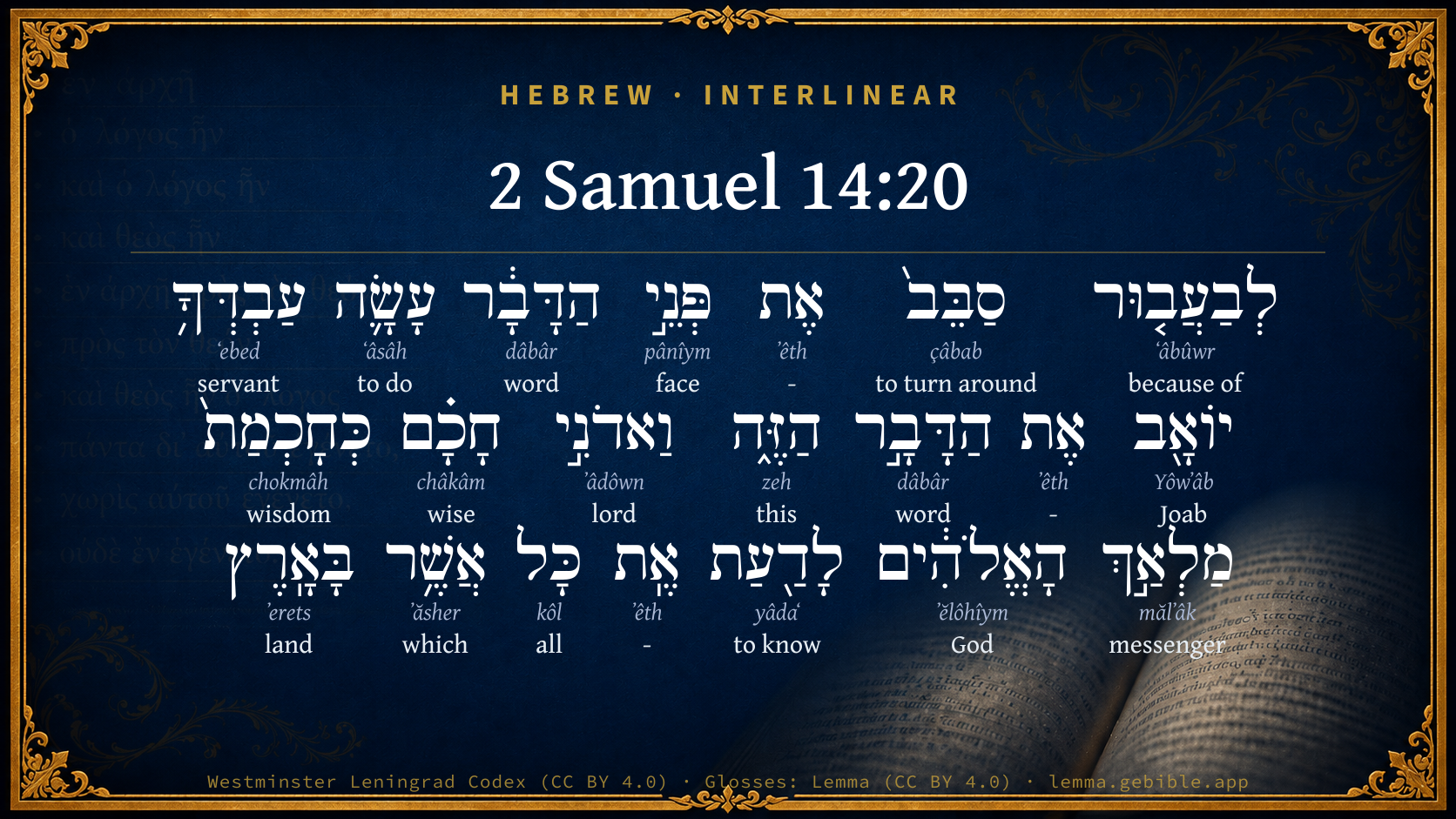
Hebrew (Westminster Leningrad Codex) 2 Samuel 14:20 appears in the Hebrew Old Testament. The text above is from the Westminster Leningrad Codex. Each word links to its Strong’s number, a concise gloss, and parsing drawn from the Open Scriptures Hebrew Bible morphology. Click any word for its full Brown-Driver-Briggs (BDB) entry.
Download image
Cite this verse

2 Samuel 14:20 (World English Bible). Public Domain. Lemma interlinear Bible study tool, https://lemma.gebible.app/v/2-samuel/14/20.

Show BibTeX & RIS
BibTeX
RIS
English Translation
to change the face of the matter has your servant Joab done this thing: and my lord is wise, according to the wisdom of an angel of God, to know all things that are in the earth.
World English Bible · Public Domain
Download a study sheet

One document with this verse’s original text, its word-by-word gloss line, the meaning frame, cross-references with their text, attributed commentary, and full source and license credits — printable, and it pastes into notes with its structure intact.

This verse Autodidact and up

Study sheet (.html) Plain text (.txt)

A passage Seminary Student

Up to 50 verses in one chapter. A passage sheet keeps up to 6 commentary sources and 12 cross-references per verse, in the order this page ranks them, and says so on the sheet whenever that leaves anything out. Ask for a single verse and you get the Autodidact verse sheet above.

Everything on this page stays free to read, with no account — the sheet is a download of what is already on screen, not access to it.

Want to remove ads? Support Godless Engineer
Compare translations 3

The same verse in 3 English versions, stacked beneath the original-language interlinear above. Click any original word for its lexicon entry.

Each is an independent rendering of the whole verse — the interlinear is not word-aligned to these translations.

Highlighted words mark where these versions differ — a whole-verse word diff, not a word-by-word alignment.

  • World English Bible Public Domain
    to change the face of the matter has your servant Joab done this thing: and my lord is wise, according to the wisdom of an angel of God, to know all things that are in the earth.
  • King James Version Public Domain
    To fetch about this form of speech hath thy servant Joab done this thing: and my lord is wise, according to the wisdom of an angel of God, to know all things that are in the earth.
  • unfoldingWord Literal Text CC BY-SA 4.0
    In order to turn the face of the matter, your servant Joab did this thing. But my master wise like the wisdom of an angel of God, to know everything that in the land.”

unfoldingWord Literal Text — © unfoldingWord, licensed CC BY-SA 4.0. Word-aligned USFM3 via Door43 (git.door43.org/unfoldingWord/en_ult).

Versions to compare (up to 4)

3 of 4 selected

Show all 18 translations

Every available English version of this verse, each an independent rendering of the whole verse.

  • World English Bible Public Domain
    to change the face of the matter has your servant Joab done this thing: and my lord is wise, according to the wisdom of an angel of God, to know all things that are in the earth.
  • Berean Standard Bible Public Domain
    Joab your servant has done this to bring about this change of affairs, but my lord has wisdom like the wisdom of the angel of God, to know everything that happens in the land.”
  • Majority Standard Bible Public Domain
    Joab your servant has done this to bring about this change of affairs, but my lord has wisdom like the wisdom of the angel of God, to know everything that happens in the land.”
  • King James Version Public Domain
    To fetch about this form of speech hath thy servant Joab done this thing: and my lord is wise, according to the wisdom of an angel of God, to know all things that are in the earth.
  • American Standard Version (1901) Public Domain
    to change the face of the matter hath thy servant Joab done this thing: and my lord is wise, according to the wisdom of an angel of God, to know all things that are in the earth.
  • Revised Version (1885) Public Domain
    to change the face of the matter hath thy servant Joab done this thing: and my lord is wise, according to the wisdom of an angel of God, to know all things that are in the earth.
  • Geneva Bible (1599) Public Domain
    For to the intent that I should chage the forme of speach, thy seruant Ioab hath done this thing: but my lord is wise according to the wisdome of an Angel of God to vnderstande all things that are in the earth.
  • Douay-Rheims (1899) Public Domain
    That I should come about with this form of speech, thy servant Joab, commanded this: but thou, my lord, O king, art wise, according to the wisdom of ail angel of God, to understand all things upon earth.
  • Young's Literal Translation Public Domain
    in order to bring round the appearance of the thing hath thy servant Joab done this thing, and my lord `is' wise, according to the wisdom of a messenger of God, to know all that `is' in the land.'
  • Literal Standard Version CC BY-SA 4.0
    Your servant Joab has done this thing in order to bring around the appearance of the thing, and my lord [is] wise, according to the wisdom of a messenger of God, to know all that [is] in the land.”
  • Unlocked Literal Bible CC BY-SA 4.0
    Your servant Joab has done this to change the course of what is happening. My master is wise, like the wisdom of an angel of God, and he knows everything that is happening in the land.”
  • unfoldingWord Literal Text CC BY-SA 4.0
    In order to turn the face of the matter, your servant Joab did this thing. But my master wise like the wisdom of an angel of God, to know everything that in the land.”
  • Darby Bible Public Domain
    in order to turn the appearance of the thing has thy servant Joab done this thing; but my lord is wise, according to the wisdom of an angel of God, to know all that is in the earth.
  • World Messianic Bible Public Domain
    Your servant Joab has done this thing to change the face of the matter. My lord is wise, according to the wisdom of an angel of God, to know all things that are in the earth.”
  • Webster's Bible Public Domain
    To bring about this form of speech hath thy servant Joab done this thing: and my lord is wise, according to the wisdom of an angel of God, to know all things that are on the earth.
  • Free Bible Version CC BY-SA 4.0
    He did so to show the other side of the situation, but Your Majesty is as wise as an angel of God, and you know everything that happens in this country.”
  • Bible in Basic English Public Domain
    This he did, hoping that the face of this business might be changed: and my lord is wise, with the wisdom of the angel of God, having knowledge of everything on earth.
  • JPS Tanakh (1917) Public Domain
    to change the face of the matter hath thy servant Joab done this thing; and my lord is wise, according to the wisdom of an angel of God, to know all things that are in the earth.'

Literal Standard Version (2020), Covenant Press — licensed CC BY-SA 4.0. Text via the HelloAO Bible API (eBible.org). Unlocked Literal Bible (unfoldingWord) — licensed CC BY-SA 4.0. Text via the HelloAO Bible API (eBible.org). unfoldingWord Literal Text — © unfoldingWord, licensed CC BY-SA 4.0. Word-aligned USFM3 via Door43 (git.door43.org/unfoldingWord/en_ult). Free Bible Version, Dr. Jonathan Gallagher — licensed CC BY-SA 4.0. Text via the HelloAO Bible API (eBible.org).

Word by word

More ways to search: Search by grammar → Find every occurrence → Compare this word →

Practice this passage: Drill this verse → Learn its vocabulary →

לְבַעֲב֤וּר
ʻâbûwr
H5668
“to/for · in/at · because of”
Preposition + Preposition + Preposition
Part of Speech
Preposition + Preposition + Preposition
Full BDB Definition

Origin: pass part of H5674

TWOT: 1556g

for the sake of, on account of, because of, in order to (preposition) - in order that (conjunction)
  1. סַבֵּב֙ çâbab H5437 “to turn around” Verb, Piel, Infinitive Construct
  2. אֶת ʼêth H853 “-” Particle, Direct Object
  3. פְּנֵ֣י pânîym H6440 “face(s) of” Noun, Common, Both, Plural, Construct
  4. הַדָּבָ֔ר dâbâr H1697 “the · word” Particle, Definite Article + Noun, Common, Masculine, Singular, Absolute
  5. עָשָׂ֛ה ʻâsâh H6213 “to do” Verb, Qal, Perfect, 3rd Person, Masculine, Singular
  6. עַבְדְּךָ֥ ʻebed H5650 “servant · your” Noun, Common, Masculine, Singular, Construct + Suffix, Personal, 2nd Person, Masculine, Singular
  7. יוֹאָ֖ב Yôwʼâb H3097 “Joab” Noun, Proper
  8. אֶת ʼêth H853 “-” Particle, Direct Object
  9. הַדָּבָ֣ר dâbâr H1697 “the · word” Particle, Definite Article + Noun, Common, Masculine, Singular, Absolute
  10. הַזֶּ֑ה zeh H2088 “the · this” Particle, Definite Article + Pronoun, Demonstrative, Masculine, Singular
  11. וַאדֹנִ֣י ʼâdôwn H113 “and · lord · my” Conjunction + Noun, Common, Masculine, Singular, Construct + Suffix, Personal, 1st Person, Common, Singular
  12. חָכָ֗ם châkâm H2450 “wise” Adjective, Adjective, Masculine, Singular, Absolute
  13. כְּחָכְמַת֙ chokmâh H2451 “like/as · wisdom of” Preposition + Noun, Common, Feminine, Singular, Construct
  14. מַלְאַ֣ךְ mălʼâk H4397 “messenger of” Noun, Common, Masculine, Singular, Construct
  15. הָאֱלֹהִ֔ים ʼĕlôhîym H430 “the · God(s)” Particle, Definite Article + Noun, Common, Masculine, Plural, Absolute
  16. לָדַ֖עַת yâdaʻ H3045 “to know” Preposition + Verb, Qal, Infinitive Construct
  17. אֶֽת ʼêth H853 “-” Particle, Direct Object
  18. כָּל kôl H3605 “all of” Noun, Common, Masculine, Singular, Construct
  19. אֲשֶׁ֥ר ʼăsher H834 “which” Particle, Relative
  20. בָּאָֽרֶץ ʼerets H776 “in/at the · land” Preposition, Determined + Noun, Common, Both, Singular, Absolute

About this verse

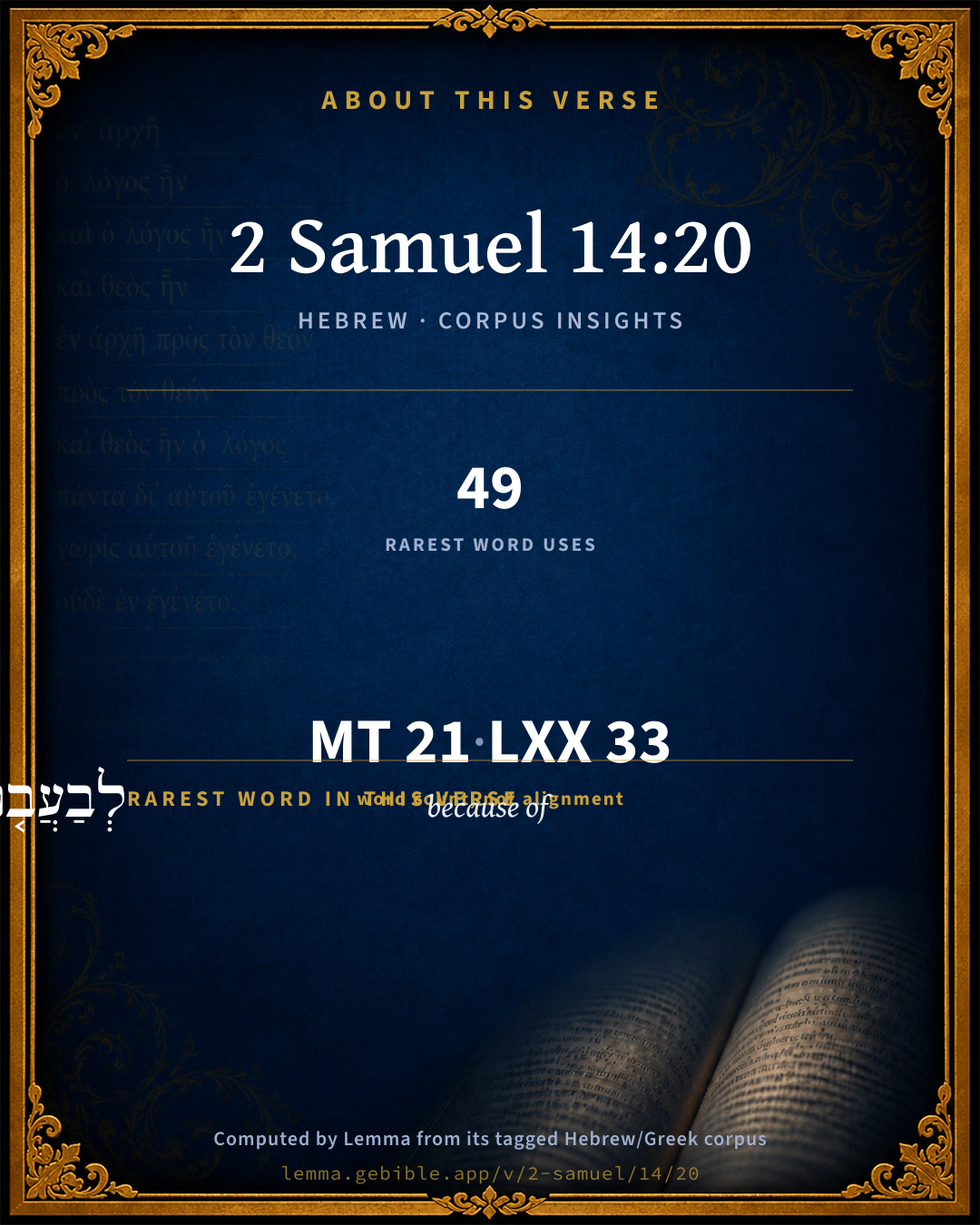
These counts appear in no published source. They are computed here, from the morphology-tagged text and Lemma’s own curated glosses. What Lemma adds →

21
words
18
distinct lemmas
Historical
section

Shared distinctive vocabulary

לְבַעֲב֤וּר because of H5668 occurs in 47 verses of the Hebrew Bible. Also found in:

Grammatical profile

  • 3 verbs
  • 11 nouns
  • 1 adjective
  • 1 pronoun
  • 1 preposition
  • 4 particles

Verb forms

  • סַבֵּב֙ Piel · Infinitive Construct
  • עָשָׂ֛ה Qal · Perfect
  • לָדַ֖עַת Qal · Infinitive Construct

Repetition

A word recurs within this verse — often emphatic in Hebrew:

  • הַדָּבָ֔ר word H1697 ×2

Hebrew & Septuagint length

In English translation the verse runs 37 words from the Hebrew and 43 from the Septuagint (LXX English) — closely comparable.

A rough comparison of the two English renderings, which tokenize alike — not a word-level alignment.

Word counts can differ between the Hebrew and the Greek without any difference in meaning — e.g. the Hebrew direct-object marker אֵת has no separate Greek word, and Greek often adds the article ὁ.

In the original languages it is 21 Hebrew tokens and 33 Greek tokens — but the two are counted differently (Hebrew bundles its prefixes and suffixes into one token; the Greek is in lemma form), so that isn’t a like-for-like length.

Cross-references

9

Topical passages linked to 2 Samuel 14:20 in the Treasury of Scripture Knowledge — connected by theme and wording, ordered by reader-vote popularity; previews shown in the World English Bible.

  • 2 Samuel 14:17 Then your handmaid said, Please let the word of my lord the king be comfortable; for as an angel of God, so is my lord the king to discern good and bad: and Yahweh your God be with you.
  • 2 Samuel 19:27 He has slandered your servant to my lord the king; but my lord the king is as an angel of God: do therefore what is good in your eyes.
  • Genesis 3:5 for God knows that in the day you eat it, your eyes will be opened, and you will be like God, knowing good and evil."
  • 2 Samuel 5:23 When David inquired of Yahweh, he said, You shall not go up: make a circuit behind them, and come on them over against the mulberry trees.
  • Job 32:21–22 Please don't let me respect any man's person, Neither will I give flattering titles to any man.
  • Job 38:16–41 "Have you entered into the springs of the sea? Or have you walked in the recesses of the deep?
  • Proverbs 26:28 A lying tongue hates those it hurts; And a flattering mouth works ruin.
  • Proverbs 29:5 A man who flatters his neighbor, Spreads a net for his feet.
  • 1 Corinthians 8:1–2 Now concerning things sacrificed to idols: We know that we all have knowledge. Knowledge puffs up, but love builds up.

Cross-references courtesy of OpenBible.info (CC BY 4.0).

Hebrew and Greek witnesses Masoretic Hebrew ↔ Greek Septuagint

The same verse in the two great witnesses to the Old Testament, shown verse-for-verse.

These are two independent witnesses, not word-aligned to each other, and the Septuagint is shown in lemma (dictionary) form.

Hebrew 2 Samuel 14:20 Masoretic · Westminster Leningrad Codex

לְבַעֲב֤וּר סַבֵּב֙ אֶת פְּנֵ֣י הַדָּבָ֔ר עָשָׂ֛ה עַבְדְּךָ֥ יוֹאָ֖ב אֶת הַדָּבָ֣ר הַזֶּ֑ה וַאדֹנִ֣י חָכָ֗ם כְּחָכְמַת֙ מַלְאַ֣ךְ הָאֱלֹהִ֔ים לָדַ֖עַת אֶֽת כָּל אֲשֶׁ֥ר בָּאָֽרֶץ

to change the face of the matter has your servant Joab done this thing: and my lord is wise, according to the wisdom of an angel of God, to know all things that are in the earth.

World English Bible · Public Domain

Greek LXX 2 Samuel 14:20 Septuagint · lemma form

ἕνεκεν ὁ περιἔρχομαι ὁ πρόσωπον ὁ ῥῆμα οὗτος ποιέω ὁ δοῦλος σύ ιωαβ ὁ λόγος οὗτος καί ὁ κύριος ἐγώ σοφός καθώς σοφία ἄγγελος ὁ θεός ὁ γιγνώσκω πᾶς ὁ ἐν ὁ γῆ

In order that this form of speech might come about it was that your servant Joab has framed this matter: and my lord is wise as is the wisdom of an angel of God, to know all things that are in the earth.

LXX2012 (modern English Septuagint) · Public Domain

Hebrew: Westminster Leningrad Codex (CC BY 4.0). Greek: Septuagint (public domain); English from LXX2012 (modern English Septuagint) (Public Domain). How the Septuagint differs from the Hebrew →

Targum (Aramaic paraphrase)

1

The Targum is the ancient Jewish Aramaic paraphrase of the Hebrew Scriptures — an interpretive translation, not the Hebrew text itself. Onkelos (literal) and Pseudo-Jonathan (expansive) render the Torah, and Jonathan the Prophets. Coverage is partial: where no permissively-licensed English translation exists for a verse, only the Aramaic is shown. This is verse-level text, not a word-by-word alignment to the Hebrew.

  1. Targum Jonathan Prophets (Joshua–Malachi)
    בְּדִיל לְאַקָפָא יַת אַפֵּי פִתְגָמָא עֲבַד עַבְדָךְ יוֹאָב יַת פִּתְגָמָא הָדֵין וְרִבּוֹנִי חַכִּים כְּחָכְמַת מַלְאָכָא דַייָ לְמִידַע יַת כָּל דִי בְאַרְעָא:

    (no public-domain English translation for this verse)

    Targum Jonathan — Aramaic: “Mikraot Gedolot” (public domain). English: “Sefaria Community Translation” (CC0 1.0 (public-domain dedication)); “London "Chaldee Paraphrase," 1871” (public domain). Text via Sefaria.

Commentary

Notes on 2 Samuel 14:20 from classic Christian and Jewish commentators (each source and its license shown beneath its notes). The classic Christian expositions comment on the surrounding passage and are grouped to its opening verse, so a note may address several verses; the Jewish commentaries on the Tanakh (Rashi and others) are per-verse, so they appear only where the commentator wrote on this verse.

Lemma curates 59 commentaries, every one of them public domain or Creative Commons licensed, each selected and text-cleaned for this edition rather than reprinted as found. About our sources →

Trapp's Complete Commentary

John Trapp

2Sa 14:20 To fetch about this form of speech hath thy servant Joab done this thing: and my lord [is] wise, according to the wisdom of an angel of God, to know all [things] that [are] in the earth.

Ver. 20. To fetch about this form of speech.] Ut rei faciem inverterem: that I might tell thee a story of my son, but transfer it to thine as much alike; that I might deliver myself parable wise, a thing in those days very usual.

To know all things that are in the earth.] Pανσοφος και παντα ανθρωπεια επισταμενος, as one said of Homer, that he knew all that was within the circumference of human knowledge. See 2Sa 14:17.

John Trapp, A Commentary or Exposition upon All the Books of the Old and New Testament (1647–1656) — public domain. Text from a community e-Sword module.

Joseph Benson's Commentary

2Sa 14:20. To fetch about this form of speech — That is, to propose his and the people’s desire of Absalom’s restoration, in this parabolical manner. To know all things that are in the earth — Or, rather, in this land, in all thy kingdom; all the counsels and devices of thy subjects, and what is fit to be done in answer to their desires. She still persists in expressing her admiration of the king, that she might the more incline him to grant her request.

Joseph Benson's Commentary on the Old and New Testaments (1811–1818) — public domain. Text from a community e-Sword module.

Tyndale Open Study Notes

Tyndale Open Resources

14:20 as wise as an angel of God: This wise woman (14:2) knew it was good policy to flatter a king rather than risk insulting him.

Tyndale Open Study Notes — © Tyndale Open Resources, licensed CC BY-SA 4.0. Text via the HelloAO Bible API.

Geneva Bible (1599)

Geneva Bible translators

By speaking further in a parable then plainly.

Or, none can hide ought from the King.

Geneva Bible (1599) marginal notes — public domain. Text via Bolls.life.

Adam Clarke's Commentary

Verse 20. According to the wisdom of an angel of God] This is quite in the style of Asiatic flattery. A European is often addressed, "Saheb can do every thing; we can do nothing; none can prevent the execution of Saheb's commands; Saheb is God." See WARD.

Adam Clarke's Commentary on the Bible (1810–1826) — public domain. Text from a community e-Sword/MySword module.

The Cambridge Bible for Schools and Colleges

gen. ed. J. J. S. Perowne

20. to fetch about this form of speech] Rather, in order to bring round the face of the business: that is, to alter the aspect of Absalom’s relations to his father.

The Cambridge Bible for Schools and Colleges (gen. ed. J. J. S. Perowne; Cambridge University Press, 1878–1918) — public domain. Text from a community e-Sword module.

John Gill's Exposition

To fetch about this form of speech hath thy servant Joab done this thing,.... Feigned a story in such form and manner as had been delivered to the king, that it might be accommodated and applied to the case of Absalom, and to transfer it in a figure to the king, to use the apostle's phrase, Co1 4:8,

and my lord is wise, according to the wisdom of an angel of God; as not only to understand the design of this fable or parable, but of such sagacity and penetration as to find out the author of it; and even

to know all things that are in the earth; either in the whole world, or rather in the land of Israel; and it is to be understood not of all actions natural and moral done by men in it, which would be to ascribe omniscience to him; but of all political things, all things respecting civil government; that he had such a spirit of discerning of men and things, that nothing could be said or done, or scheme formed, but he got intelligence of it, and insight into it; and which was carrying the compliment to a great height.

John Gill's Exposition of the Whole Bible (1746–1763) — public domain (CC PDM 1.0). Text via the HelloAO Bible API.

Matthew Poole's English Annotations

To fetch about this form of speech, i.e. to propose mine, and his, and the people’s desire of Absalom’s restitution in this parabolical manner, in mine and my son’s person.

In the earth, or, in this land, in all thy kingdom; all the counsels and devices of thy subjects which have any relation to thee or thy affairs.

Matthew Poole's English Annotations on the Holy Bible (1683–1685) — public domain. Text from a community e-Sword/MySword module.

The Pulpit Commentary

To fetch about this form of speech; correctly, as in the Revised Version, to change the face of the matter hath thy servant Joab, etc. The matter was that referred to in ver. 15, which the king now understands to refer to Absalom. For in the earth, translate in the land. The Hebrew has no means of distinguishing the wider and narrower significations of the word; but while the king would be flattered by the supposition that he knew all that happened in his dominions, the assertion that he knew all that was done in all the world was too broad and general to be agreeable. The Authorized Version has been misled by the thought of what an angel might know; but while it was a compliment to ascribe to the king an angel"s intelligence in his own sphere, it would have been bad taste and unmeaning to ascribe to him omniscience. Nay, it is an assumption without proof that even an angel knows "all things that are in the earth.

Flattery.

lord is wise, according to the wisdom of an angel of God," etc. Commendation is often proper and beneficial. (2Sa_2:5-7) But flattery (false, partial, or extravagant praise) is always improper and pernicious. This language was not mere Oriental compliment, but a flattering speech, intended to make the king pleased with himself in doing what he was urged to do.

1. It is agreeable to most persons when skilfully administered. "Flattery and the flatterer are pleasant; since the flatterer is a seeming admirer and a seeming friend" (Aristotle, "Rhetoric").

When I tell him he hates flatterers, He says he does; being then most flattered. (Shakespeare.)

"We believe that we hate flattery, when all which we hate is the awkwardness of the flatterer" (La Rochefoucault).

1. It assumes various forms, and is usually obsequious and disingenuous; is direct or indirect; is shown in praising personal qualities, advantages, achievements, etc., giving "flattering titles", (Job 32) "good Master", (Mar_10:17 12:14) "my Lord," etc. Making or suggesting favourable comparisons, it may be, by detracting from the good name of others. (2Sa_4:8) It is sometimes sincere; but "people generally despise where they flatter and cringe to those they would gladly surpass.

2. It is commonly designed by those who employ it to serve some interest of their own (ver. 22). Hence it is so frequently used to gain the favour of kings, and such as possess authority, influence, or wealth. (Jud_1:16) When Alexander the Great was hit with an arrow in the siege of an Indian city, and the wound would not heal, he said to his flatterers, "You say that I am Jupiter"s "son, but this wound cries that I am but man.

3. It blinds those who listen to it to their defects, ministers to their vanity, and fills them with perilous self-complacency, "It"s the death of virtue.

4. It also induces them to pursue erroneous and sinful courses, which they might otherwise have avoided. "A man that flattereth his neighbour spreadeth a net for his feet". (Pro_29:5 Pro_26:28) "Ah! how good might many men have been who are now exceedingly bad had they not sold their ears to flatterers! Flatterers are soul murderers. Flattery is the very spring and mother of all impiety. It put our first parent on tasting the forbidden fruit. It put Absalom upon dethroning his father. It blows the trumpet and draws poor souls into rebellion against God, as Sheba drew Israel to rebel against David. It makes men call evil good and good evil, darkness light and light darkness" (T. Brooks).

5. It is only less culpable in those who listen to it than in those who employ it. They are willing captives. "As a wolf resembles a dog, so doth a flatterer a friend. Take heed, therefore, that, instead of guardian dogs, you do not incautiously admit ravening wolves" (Epictetus).

6. Its folly and guilt are sometimes discovered too late; when its ruinous consequences cannot be repaired D. (2Sa_15:13; Psa_12:3; Act_12:23)

The Pulpit Commentary (1880–1919), ed. H.D.M. Spence-Jones & Joseph S. Exell — public domain. Text from a community e-Sword module.

John Wesley's Explanatory Notes

To fetch - That is, to propose his, and the peoples desire of Absalom's restitution in this parabolical manner. In the earth - Or, in this land, in all thy kingdom; all the counsels and devices of thy subjects.

John Wesley, Explanatory Notes Upon the Whole Bible (1754–1765) — public domain. Text via the GEBible commentary corpus.

Scofield Reference Notes

C. I. Scofield

angel (See Scofield "Heb 1:4").

The Scofield Reference Bible (1917 edition), notes by C. I. Scofield — public domain. Text from a community e-Sword module.

Rashi

Rabbi Shlomo Yitzchaki (Rashi)

In order to skirt around. To skirt around [the issue] until the matter concerning the king's son comes to light.

[But] my master is wise. and you understood that this is coming from Yoav.

Rashi on the Tanakh — English translations: “The Judaica Press complete Tanach with Rashi, translated by A. J. Rosenberg” (CC BY 4.0); “Pentateuch with Rashi's commentary by M. Rosenbaum and A.M. Silbermann, 1929-1934” (public domain); “The Metsudah Tanach series, Lakewood, N.J” (CC BY 4.0); and “The Book of Joshua, Metsudah Publications, 1997” (CC BY 4.0). Text via Sefaria.

Lesson kit

Teaching starters — assembled from the data on this page, not authored interpretation. Every prompt links to the verse data it draws on. Edit before teaching.

2 Samuel, in the Historical, opens this verse with 21 words (18 distinct Hebrew lemmas). Its most distinctive word is ʻâbûwr (“because of”). A historical commentator’s framing appears above. Read the whole chapter for the surrounding context.

Discussion questions

  1. The word ʻâbûwr carries the sense “because of.” How does it shape the verse?
  2. Genesis 3:17 shares the word «because of» with this verse. How do the two illuminate each other?
  3. “word” occurs 2× in this one verse. What is the effect of the repetition?
  4. These translations render this verse differently; the difference is in the English rendering, not the original. What questions does that raise?
  5. The verb «סַבֵּב֙» is Piel Infinitive Construct. How does its form color the action?
  6. Reading how Trapp's Complete Commentary and Joseph Benson's Commentary read this verse, where do the two commentators agree and where do they part?

Things to notice

Reading settings

Reading text

Shown beneath each verse's original-language words.

Old Testament
Old Testament edition

Read the OT as the Masoretic Hebrew (MT) or the Greek Septuagint (LXX).

English shown for the Greek Septuagint (in the Hebrew ↔ Greek comparison).

Comparing translations? Open the Compare panel on any verse page to stack up to four side by side.