
1 Samuel 11:9

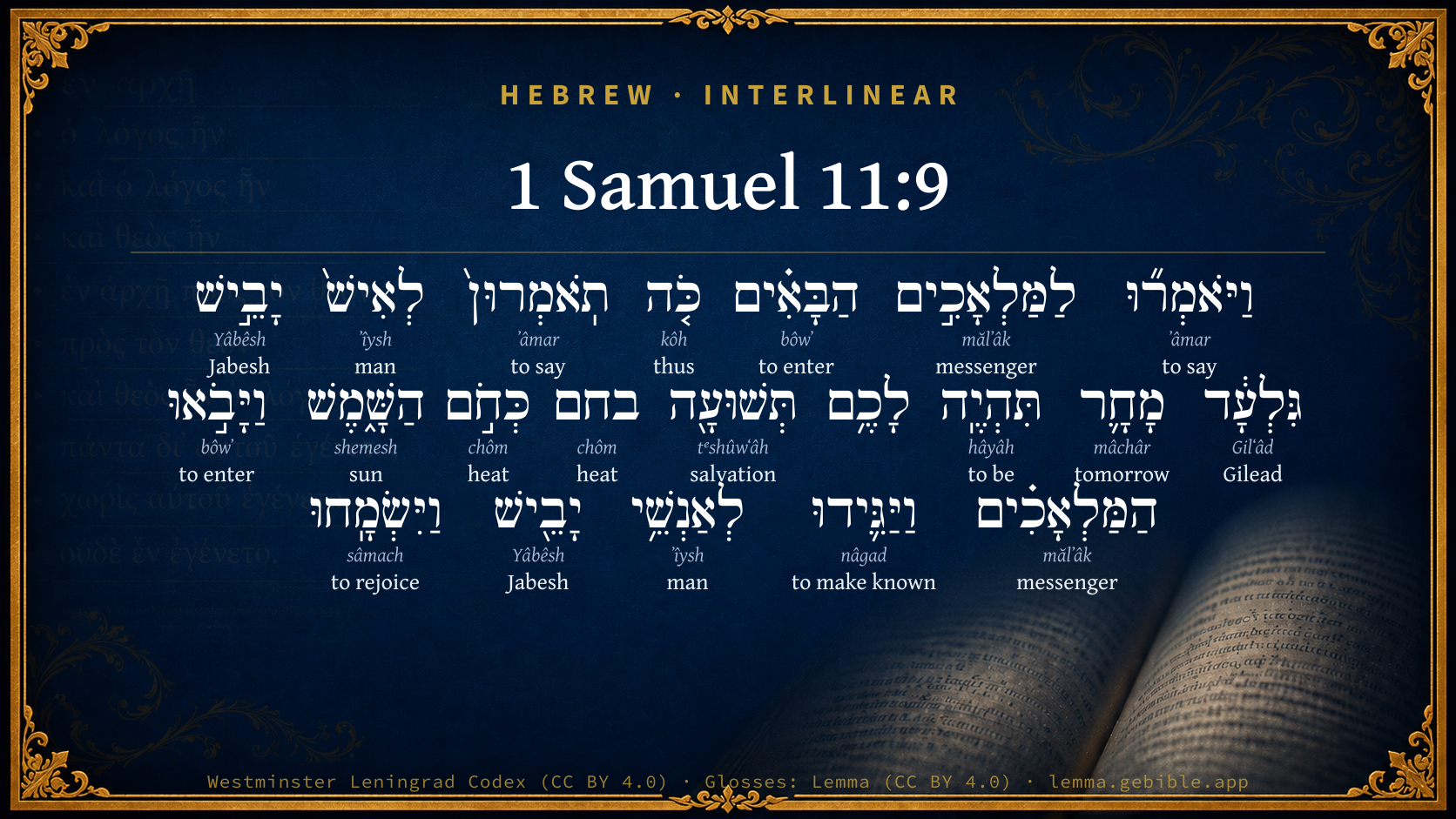
Hebrew (Westminster Leningrad Codex) 1 Samuel 11:9 appears in the Hebrew Old Testament. The text above is from the Westminster Leningrad Codex. Each word links to its Strong’s number, a concise gloss, and parsing drawn from the Open Scriptures Hebrew Bible morphology. Click any word for its full Brown-Driver-Briggs (BDB) entry.
Download image
Cite this verse

1 Samuel 11:9 (World English Bible). Public Domain. Lemma interlinear Bible study tool, https://lemma.gebible.app/v/1-samuel/11/9.

Show BibTeX & RIS
BibTeX
RIS
English Translation
They said to the messengers who came, Thus shall you tell the men of Jabesh Gilead, Tomorrow, by the time the sun is hot, you shall have deliverance. The messengers came and told the men of Jabesh; and they were glad.
World English Bible · Public Domain
Download a study sheet

One document with this verse’s original text, its word-by-word gloss line, the meaning frame, cross-references with their text, attributed commentary, and full source and license credits — printable, and it pastes into notes with its structure intact.

This verse Autodidact and up

Study sheet (.html) Plain text (.txt)

A passage Seminary Student

Up to 50 verses in one chapter. A passage sheet keeps up to 6 commentary sources and 12 cross-references per verse, in the order this page ranks them, and says so on the sheet whenever that leaves anything out. Ask for a single verse and you get the Autodidact verse sheet above.

Everything on this page stays free to read, with no account — the sheet is a download of what is already on screen, not access to it.

Want to remove ads? Support Godless Engineer
Compare translations 3

The same verse in 3 English versions, stacked beneath the original-language interlinear above. Click any original word for its lexicon entry.

Each is an independent rendering of the whole verse — the interlinear is not word-aligned to these translations.

Highlighted words mark where these versions differ — a whole-verse word diff, not a word-by-word alignment.

  • World English Bible Public Domain
    They said to the messengers who came, Thus shall you tell the men of Jabesh Gilead, Tomorrow, by the time the sun is hot, you shall have deliverance. The messengers came and told the men of Jabesh; and they were glad.
  • King James Version Public Domain
    And they said unto the messengers that came, Thus shall ye say unto the men of Jabeshgilead, To morrow, by that time the sun be hot, ye shall have help. And the messengers came and showed it to the men of Jabesh; and they were glad.
  • unfoldingWord Literal Text CC BY-SA 4.0
    And they said to the messengers having come, “Thus you shall say to the men of Jabesh Gilead, ‘Tomorrow deliverance will be for you, at the heat of the sun.’” And the messengers went and declared to the men of Jabesh, and they rejoiced.

unfoldingWord Literal Text — © unfoldingWord, licensed CC BY-SA 4.0. Word-aligned USFM3 via Door43 (git.door43.org/unfoldingWord/en_ult).

Versions to compare (up to 4)

3 of 4 selected

Show all 18 translations

Every available English version of this verse, each an independent rendering of the whole verse.

  • World English Bible Public Domain
    They said to the messengers who came, Thus shall you tell the men of Jabesh Gilead, Tomorrow, by the time the sun is hot, you shall have deliverance. The messengers came and told the men of Jabesh; and they were glad.
  • Berean Standard Bible Public Domain
    So they said to the messengers who had come, “Tell the men of Jabesh-gilead: ‘Deliverance will be yours tomorrow by the time the sun is hot.’” And when the messengers relayed this to the men of Jabesh, they rejoiced.
  • Majority Standard Bible Public Domain
    So they said to the messengers who had come, “Tell the men of Jabesh-gilead: ‘Deliverance will be yours tomorrow by the time the sun is hot.’” And when the messengers relayed this to the men of Jabesh, they rejoiced.
  • King James Version Public Domain
    And they said unto the messengers that came, Thus shall ye say unto the men of Jabeshgilead, To morrow, by that time the sun be hot, ye shall have help. And the messengers came and showed it to the men of Jabesh; and they were glad.
  • American Standard Version (1901) Public Domain
    And they said unto the messengers that came, Thus shall ye say unto the men of Jabesh-gilead, To-morrow, by the time the sun is hot, ye shall have deliverance. And the messengers came and told the men of Jabesh; and they were glad.
  • Revised Version (1885) Public Domain
    And they said unto the messengers that came, Thus shall ye say unto the men of Jabesh-gilead, Tomorrow, by the time the sun is hot, ye shall have deliverance. And the messengers came and told the men of Jabesh; and they were glad.
  • Geneva Bible (1599) Public Domain
    Then they saide vnto the messengers that came, So say vnto the men of Iabesh Gilead, To morowe by then the sunne be hote, ye shall haue helpe. And the messengers came and shewed it to the men of Iabesh, which were glad.
  • Douay-Rheims (1899) Public Domain
    And they said to the messengers that came: Thus shall you say to the men of Jabes Galaad: Tomorrow, when the sun shall be hot, you shall have relief. The messengers therefore came, and told the men of Jabes: and they were glad.
  • Young's Literal Translation Public Domain
    And they say to the messengers who are coming, `Thus do ye say to the men of Jabesh-Gilead: To-morrow ye have safety -- by the heat of the sun;' and the messengers come and declare to the men of Jabesh, and they rejoice;
  • Literal Standard Version CC BY-SA 4.0
    And they say to the messengers who are coming, “Thus you say to the men of Jabesh-Gilead: Tomorrow you have safety—by the heat of the sun”; and the messengers come and declare [it] to the men of Jabesh, and they rejoice;
  • Unlocked Literal Bible CC BY-SA 4.0
    They said to the messengers that came, “You will tell the men of Jabesh Gilead, 'Tomorrow, by the time the sun is hot, you will be rescued.'” So the messengers went and told the men of Jabesh, and they were glad.
  • unfoldingWord Literal Text CC BY-SA 4.0
    And they said to the messengers having come, “Thus you shall say to the men of Jabesh Gilead, ‘Tomorrow deliverance will be for you, at the heat of the sun.’” And the messengers went and declared to the men of Jabesh, and they rejoiced.
  • Darby Bible Public Domain
    And they said to the messengers that had come, Thus shall ye say to the men of Jabesh-Gilead: To-morrow ye shall have deliverance when the sun is hot. And the messengers came and informed the men of Jabesh-Gilead; and they were glad.
  • World Messianic Bible Public Domain
    They said to the messengers who came, “Tell the men of Jabesh Gilead, ‘Tomorrow, by the time the sun is hot, you will be rescued.’” The messengers came and told the men of Jabesh; and they were glad.
  • Webster's Bible Public Domain
    And they said to the messengers that came, thus shall ye say to the men of Jabesh-gilead, To-morrow by the time the sun is hot, ye shall have help. And the messengers came and showed it to the men of Jabesh; and they were glad.
  • Free Bible Version CC BY-SA 4.0
    They said to the messengers who came, “Tell the men of Jabesh-gilead, ‘Tomorrow you'll be rescued, by the time the sun is hot.’” The people of Jabesh were so happy when the messengers arrived and told them this.
  • Bible in Basic English Public Domain
    Then he said to the representatives who had come, Say to the men of Jabesh-gilead, Tomorrow, by the time the sun is high, you will be made safe. And the representatives came and gave the news to the men of Jabesh; and they were glad.
  • JPS Tanakh (1917) Public Domain
    And they said unto the messengers that came: 'Thus shall ye say unto the men of Jabesh-gilead: To-morrow, by the time the sun is hot, ye shall have deliverance.' And the messengers came and told the men of Jabesh; and they were glad.

Literal Standard Version (2020), Covenant Press — licensed CC BY-SA 4.0. Text via the HelloAO Bible API (eBible.org). Unlocked Literal Bible (unfoldingWord) — licensed CC BY-SA 4.0. Text via the HelloAO Bible API (eBible.org). unfoldingWord Literal Text — © unfoldingWord, licensed CC BY-SA 4.0. Word-aligned USFM3 via Door43 (git.door43.org/unfoldingWord/en_ult). Free Bible Version, Dr. Jonathan Gallagher — licensed CC BY-SA 4.0. Text via the HelloAO Bible API (eBible.org).

Word by word

More ways to search: Search by grammar → Find every occurrence → Compare this word →

Practice this passage: Drill this verse → Learn its vocabulary →

בחם
chôm
H2527
“in/at · heat of”
Preposition + Noun, Common, Masculine, Singular, Construct
Part of Speech
Preposition + Noun
Type
Common
Gender
Masculine
Number
Singular
State
Construct
Full BDB Definition

Origin: from H2552

TWOT: 677a

heat, hot
  1. וַיֹּאמְר֞וּ ʼâmar H559 “and · to say” Conjunction + Verb, Qal, Sequential Imperfect, 3rd Person, Masculine, Plural
  2. לַמַּלְאָכִ֣ים mălʼâk H4397 “to/for the · messengers” Preposition, Determined + Noun, Common, Masculine, Plural, Absolute
  3. הַבָּאִ֗ים bôwʼ H935 “the · entering” Particle, Definite Article + Verb, Qal, Participle Active, Masculine, Plural, Absolute
  4. כֹּ֤ה kôh H3541 “thus” Adverb
  5. תֹֽאמְרוּן֙ ʼâmar H559 “to say” Verb, Qal, Imperfect, 2nd Person, Masculine, Plural + Suffix, n
  6. לְאִישׁ֙ ʼîysh H376 “to/for · man of” Preposition + Noun, Common, Masculine, Singular, Construct
  7. יָבֵ֣ישׁ Yâbêsh H3003 “Jabesh” Noun, Proper
  8. גִּלְעָ֔ד Gilʻâd H1568 “Gilead” Noun, Proper
  9. מָחָ֛ר mâchâr H4279 “tomorrow” Noun, Common, Masculine, Singular, Absolute
  10. תִּהְיֶֽה hâyâh H1961 “to be” Verb, Qal, Imperfect, 3rd Person, Feminine, Singular
  11. תְּשׁוּעָ֖ה tᵉshûwʻâh H8668 “salvation” Noun, Common, Feminine, Singular, Absolute
  12. כְּחֹ֣ם chôm H2527 “like/as · heat of” Preposition + Noun, Common, Masculine, Singular, Construct
  13. הַשָּׁ֑מֶשׁ shemesh H8121 “the · sun” Particle, Definite Article + Noun, Common, Both, Singular, Absolute
  14. וַיָּבֹ֣אוּ bôwʼ H935 “and · to enter” Conjunction + Verb, Qal, Sequential Imperfect, 3rd Person, Masculine, Plural
  15. הַמַּלְאָכִ֗ים mălʼâk H4397 “the · messengers” Particle, Definite Article + Noun, Common, Masculine, Plural, Absolute
  16. וַיַּגִּ֛ידוּ nâgad H5046 “and · to make known” Conjunction + Verb, Hiphil, Sequential Imperfect, 3rd Person, Masculine, Plural
  17. לְאַנְשֵׁ֥י ʼîysh H376 “to/for · men of” Preposition + Noun, Common, Masculine, Plural, Construct
  18. יָבֵ֖ישׁ Yâbêsh H3003 “Jabesh” Noun, Proper
  19. וַיִּשְׂמָֽחוּ sâmach H8055 “and · to rejoice” Conjunction + Verb, Qal, Sequential Imperfect, 3rd Person, Masculine, Plural

About this verse

These counts appear in no published source. They are computed here, from the morphology-tagged text and Lemma’s own curated glosses. What Lemma adds →

21
words
14
distinct lemmas
Historical
section

Notable vocabulary

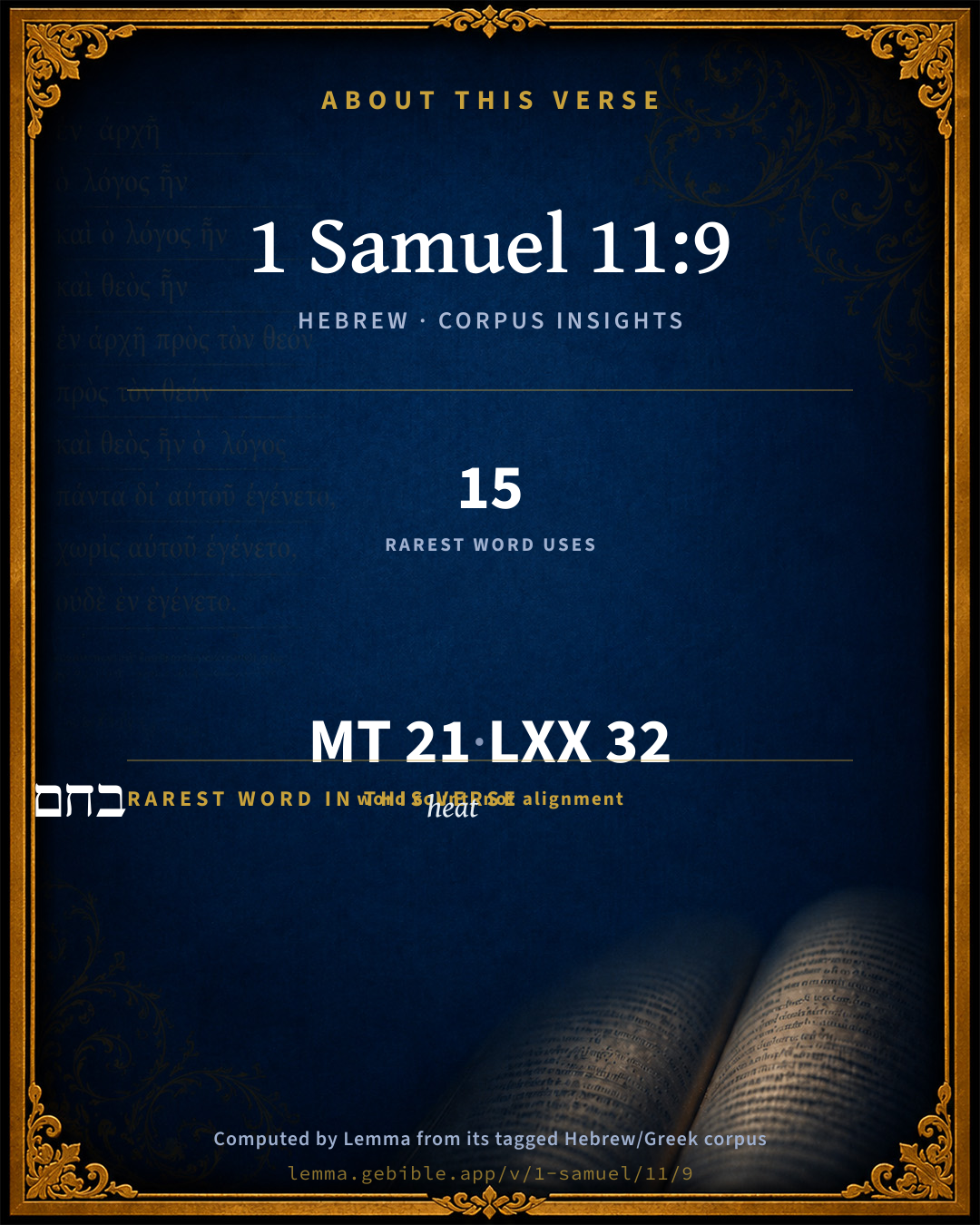
The rarest word here is בחם heat H2527 — appearing just 15 times in the whole Hebrew Bible.

Shared distinctive vocabulary

בחם heat H2527 occurs in 13 verses of the Hebrew Bible. Also found in:

Grammatical profile

  • 7 verbs
  • 12 nouns
  • 1 preposition
  • 1 adverb

Verb forms

  • וַיֹּאמְר֞וּ Qal · Sequential Imperfect
  • הַבָּאִ֗ים Qal · Participle Active
  • תֹֽאמְרוּן֙ Qal · Imperfect
  • תִּהְיֶֽה Qal · Imperfect
  • וַיָּבֹ֣אוּ Qal · Sequential Imperfect
  • וַיַּגִּ֛ידוּ Hiphil · Sequential Imperfect
  • וַיִּשְׂמָֽחוּ Qal · Sequential Imperfect

Repetition

Words recur within this verse — often emphatic in Hebrew:

  • וַיֹּאמְר֞וּ to say H559 ×2
  • לַמַּלְאָכִ֣ים messenger H4397 ×2
  • הַבָּאִ֗ים to enter H935 ×2
  • לְאִישׁ֙ man H376 ×2
  • יָבֵ֣ישׁ Jabesh H3003 ×2
  • בחם heat H2527 ×2

Hebrew & Septuagint length

In English translation the verse runs 41 words from the Hebrew and 43 from the Septuagint (LXX English) — closely comparable.

A rough comparison of the two English renderings, which tokenize alike — not a word-level alignment.

Word counts can differ between the Hebrew and the Greek without any difference in meaning — e.g. the Hebrew direct-object marker אֵת has no separate Greek word, and Greek often adds the article ὁ.

In the original languages it is 21 Hebrew tokens and 32 Greek tokens — but the two are counted differently (Hebrew bundles its prefixes and suffixes into one token; the Greek is in lemma form), so that isn’t a like-for-like length.

Cross-references

1

Topical passages linked to 1 Samuel 11:9 in the Treasury of Scripture Knowledge — connected by theme and wording, ordered by reader-vote popularity; previews shown in the World English Bible.

  • Psalms 18:17 He delivered me from my strong enemy, From those who hated me; for they were too mighty for me.

Cross-references courtesy of OpenBible.info (CC BY 4.0).

Hebrew and Greek witnesses Masoretic Hebrew ↔ Greek Septuagint

The same verse in the two great witnesses to the Old Testament, shown verse-for-verse.

These are two independent witnesses, not word-aligned to each other, and the Septuagint is shown in lemma (dictionary) form.

Hebrew 1 Samuel 11:9 Masoretic · Westminster Leningrad Codex

וַיֹּאמְר֞וּ לַמַּלְאָכִ֣ים הַבָּאִ֗ים כֹּ֤ה תֹֽאמְרוּן֙ לְאִישׁ֙ יָבֵ֣ישׁ גִּלְעָ֔ד מָחָ֛ר תִּהְיֶֽה לָכֶ֥ם תְּשׁוּעָ֖ה בחם כְּחֹ֣ם הַשָּׁ֑מֶשׁ וַיָּבֹ֣אוּ הַמַּלְאָכִ֗ים וַיַּגִּ֛ידוּ לְאַנְשֵׁ֥י יָבֵ֖ישׁ וַיִּשְׂמָֽחוּ

They said to the messengers who came, Thus shall you tell the men of Jabesh Gilead, Tomorrow, by the time the sun is hot, you shall have deliverance. The messengers came and told the men of Jabesh; and they were glad.

World English Bible · Public Domain

Greek LXX 1 Samuel 11:9 Septuagint · lemma form

καί εἶπον ὁ ἄγγελος ὁ ἔρχομαι ὅδε εἶπον ὁ ἀνήρ ιαβις αὔριον σύ ὁ σωτηρία διαθερμαίνω ὁ ἥλιος καί ἔρχομαι ὁ ἄγγελος εἰς ὁ πόλις καί ἀποἀγγέλλω ὁ ἀνήρ ιαβις καί εὐφραίνω

And he said to the messengers that came, Thus shall you⌃ say to the men of Jabis, To-morrow you⌃ shall have deliverance when the sun is hot; and the messengers came to the city, and told the men of Jabis, and they rejoiced.

LXX2012 (modern English Septuagint) · Public Domain

Hebrew: Westminster Leningrad Codex (CC BY 4.0). Greek: Septuagint (public domain); English from LXX2012 (modern English Septuagint) (Public Domain). How the Septuagint differs from the Hebrew →

Targum (Aramaic paraphrase)

1

The Targum is the ancient Jewish Aramaic paraphrase of the Hebrew Scriptures — an interpretive translation, not the Hebrew text itself. Onkelos (literal) and Pseudo-Jonathan (expansive) render the Torah, and Jonathan the Prophets. Coverage is partial: where no permissively-licensed English translation exists for a verse, only the Aramaic is shown. This is verse-level text, not a word-by-word alignment to the Hebrew.

  1. Targum Jonathan Prophets (Joshua–Malachi)
    וַאֲמַרוּ לְאִזְגַדַיָא דַאֲתוֹ כְּדֵין תֵּימְרוּן לֶאֱנָשׁ יָבֵשׁ גִלְעָד מְחַר תְּהִי לְכוֹן פּוּרְקָנָא בְּמֵיחַם שִׁמְשָׁא וַאֲתוֹ אִזְגַדַיָא וְחַוִיאוּ לֶאֱנָשֵׁי יָבֵשׁ וַחֲדִיאוּ:

    (no public-domain English translation for this verse)

    Targum Jonathan — Aramaic: “Mikraot Gedolot” (public domain). English: “Sefaria Community Translation” (CC0 1.0 (public-domain dedication)); “London "Chaldee Paraphrase," 1871” (public domain). Text via Sefaria.

Commentary

Notes on 1 Samuel 11:9 from classic Christian and Jewish commentators (each source and its license shown beneath its notes). The classic Christian expositions comment on the surrounding passage and are grouped to its opening verse, so a note may address several verses; the Jewish commentaries on the Tanakh (Rashi and others) are per-verse, so they appear only where the commentator wrote on this verse.

Lemma curates 59 commentaries, every one of them public domain or Creative Commons licensed, each selected and text-cleaned for this edition rather than reprinted as found. About our sources →

Trapp's Complete Commentary

John Trapp

1Sa 11:9 And they said unto the messengers that came, Thus shall ye say unto the men of Jabeshgilead, To morrow, by [that time] the sun be hot, ye shall have help. And the messengers came and shewed [it] to the men of Jabesh; and they were glad.

Ver. 9. Tomorrow, by that time the sun be hot.] Not tertio die, the next day after tomorrow, as Josephus and Comestor have it, who will needs mend Magnificat.

John Trapp, A Commentary or Exposition upon All the Books of the Old and New Testament (1647–1656) — public domain. Text from a community e-Sword module.

Geneva Bible (1599)

Geneva Bible translators

Meaning, Saul and Samuel.

Geneva Bible (1599) marginal notes — public domain. Text via Bolls.life.

Ellicott's Commentary for English Readers

(9) To morrow, by that time the sun be hot.—That is, about noon the army of rescue will be at hand. The distance from Bezek to Jabesh was not much over twenty miles.

A Bible Commentary for English Readers, edited by Charles John Ellicott (1878–1897) — public domain. Text from a community e-Sword module.

The Cambridge Bible for Schools and Colleges

gen. ed. J. J. S. Perowne

9. ye shall have help] Or, deliverance. The same word is translated “salvation” in 1Sa_11:13, and the cognate verb “save” in 1Sa_11:3.

The Cambridge Bible for Schools and Colleges (gen. ed. J. J. S. Perowne; Cambridge University Press, 1878–1918) — public domain. Text from a community e-Sword module.

John Gill's Exposition

Therefore the men of Jabesh said,.... To Nahash the Ammonite:

tomorrow we will come out unto you; meaning if they had no help, which they were well assured they should have; but this condition they expressed not, which they were not obliged to, but left him to conclude they had no hope of any, the messengers being returned, and the next being the last of the seven days' respite; and by this artifice the Ammonites were secure, and not at all upon their guard against an approaching enemy:

and ye shall do with us all that seemeth good unto you; make shows of them, pluck out their eyes, or put them to death, or do what they would with them.

John Gill's Exposition of the Whole Bible (1746–1763) — public domain (CC PDM 1.0). Text via the HelloAO Bible API.

Albert Barnes' Notes on the Bible

The distance from Bezek to Jabesh-Gilead would perhaps be about twenty miles.

Albert Barnes' Notes on the Bible (1834–1885) — public domain. Text from a community e-Sword/MySword module.

Haydock's Catholic Bible Commentary

Hot. Josephus says, Saul "being seized with the divine spirit, ordered them to inform the citizens of Jabes, that he would come to their assistance on the third day, and rout the enemy before the sun arose." But the message of which the Scripture here speaks, (Haydock) was sent from Bezec. Saul, in effect, came upon the Ammonites unawares before it was light, gained a complete victory, (Calmet) and then pursued the fugitives till noon.

George Leo Haydock (1774–1849), Haydock's Catholic Family Bible and Commentary, 1859 edition — public domain. Excludes Psalms (Douay-Rheims chapter numbering differs from Protestant) and Deuterocanonical books (Catholic canon only).

Matthew Poole's English Annotations

To-morrow, to wit, the day after your departure hence, or return home; for it seems probable that some few days had been spent in the gathering and disposing of the forces, and bringing them towards those parts.

Matthew Poole's English Annotations on the Holy Bible (1683–1685) — public domain. Text from a community e-Sword/MySword module.

Whedon's Commentary on the Bible

Daniel D. Whedon

9. They said unto the messengers that came — These messengers were the ones that came from Jabesh to Gibeah. They had repaired to Bezek to wait to see the result of Saul’s call for the people to assemble there.

Tomorrow, by that time the sun be hot — That is, about noon.

Whether this “morrow” was the last day of the seven granted by Nahash to the elders of Jabesh cannot be certainly decided by any thing here recorded. But on the supposition that it was, the question has been raised: Was a period of seven days sufficient time for all these things to be done? It would require at least a day for the messengers to reach Gibeah, and it would seem at first sight that a week would be barely sufficient to notify the tribes, much less to get together an army of three hundred and thirty thousand men in readiness for battle. Indeed, with our modern ideas and methods of raising and marshalling an army, it would be utterly impossible for the most experienced general to get together, without any previous arrangement, so large an army in so short a time. But we must divest our minds of our modern notions of warfare, and remember that in ancient Israel every able-bodied man was made familiar from his childhood with the implements of war. A bow, a sword or a spear, and a shield, or simply a sling, were the weapons most commonly used. From 1Sa_13:22, it appears that swords and spears were scarce among the people, but at such a time the sling was probably regarded as a much more serviceable weapon. Compare the feat of David, 1Sa_17:49, and the statement of Jdg_20:16, that the little tribe of Benjamin had seven hundred chosen men, each of whom could sling stones at a hair-breadth and not miss. Accordingly, when summoned out to battle, every man would provide his own weapons and his own food, and hasten at once to the place of rendezvous. No great length of time would be necessary, under such circumstances, for the mustering of an army. A man notified in the morning, might equip himself and travel forty or fifty miles before night, and in circumstances of great peril he would probably travel in the night time also. Jos_10:9. Then we must not imagine that the roads of Palestine were, at that time, in the ruined and neglected state in which the modern traveller finds them: nor should we obscure the subject by the supposition that the summons of Saul was carried through the coasts of Israel by a few slow-footed travellers. Doubtless every town had one or more swift-footed runners, who, like Asahel, (2Sa_2:18,) were as light of foot as the wild roe; and as the tidings reached one town, swift messengers would fly forth in different directions; and the alarm might spread still more rapidly by the erection of ensigns on the tops of the high hills. Such tidings, of course, would spread by night as well as by day, and thirty or forty hours would be sufficient to send the call of the king through all the coasts of Israel. Saul probably sent forth ten swift runners, (for it is hardly likely that the tribes on the east of the Jordan were summoned,) each bearing a piece of the slaughtered oxen to the chief city of each tribe; and from such central city of every tribe the call rapidly flew to all the surrounding country. Attention to all these circumstances will show that a vast army might, without great difficulty, be mustered in a few days.

Daniel D. Whedon (gen. ed.), Commentary on the Old and New Testaments (1874–1909) — public domain. Text from a community e-Sword module.

The Pulpit Commentary

Tomorrow, by that time the sun be hot. As Bezek is about twenty miles distant from Jabesh-Gilead, Saul would probably march most of the way that evening, and then, halting for food and sleep, would continue his advance early the next morning.

The Pulpit Commentary (1880–1919), ed. H.D.M. Spence-Jones & Joseph S. Exell — public domain. Text from a community e-Sword module.

Kretzmann's Popular Commentary

Paul E. Kretzmann

The Utter Overthrow of the Ammonites

v. 9. And they, the men representing the army of Israel, said unto the messengers that came, Thus shall ye say unto the men of Jabesh-gilead, Tomorrow, by that time the sun be hot, before noon, ye shall have help, in being delivered from the power of their arrogant enemies. And the messengers came and showed it to the men of Jabesh, gave them the joyful information; and they were glad.

v. 10. Therefore the men of Jabesh said, employing a stratagem which was to make the Ammonites overconfident, Tomorrow we will come out unto you, and ye shall do with us all that seemeth good unto you, for this sounded as though they would surrender themselves unconditionally, not having been able to interest the rest of Israel.

v. 11. And it was so on the morrow that Saul put the people in three companies, three attacking divisions; and they came into the midst of the host in the morning watch, between three o’clock and dawn, when the night is darkest, and slew the Ammonites, who were caught and overpowered by surprise, until the heat of the day; and it came to pass that they which remained were scattered, so that two of them were not left together. It was an utter rout, a complete overthrow of the invading army.

v. 12. And the people said unto Samuel, when they had returned from their pursuit of the scattered enemies and were once more encamped, Who is he that said, Shall Saul reign over us? Bring the men that we may put them to death. By virtue of his prophetic power, Samuel was to name the children of Belial, 1Sa 10:27, who had sneered at Saul. The people were so enthusiastic over the victory gained under the leadership of Saul that they were ready to deal very summarily with men whom they regarded as traitors.

v. 13. And Saul said, There shall not a man be put to death this day; for today the Lord hath wrought salvation in Israel. This was not only tactful and magnanimous, but showed true piety of heart, which would not permit the sacred joy of the day of victory to be marred by bloodshed, since the victory of the foe was for him nothing but a saving act of God Himself. It was an utterance of royal generosity toward his personal enemies, whose hearts he wanted to win; it was a victory over himself.

v. 14. Then said Samuel to the people, Come and let us go to Gilgal, and renew the kingdom there, by a solemn confirmation and open acknowledgment of the election as it took place in Mizpeh.

v. 15. And all the people went to Gilgal; and there they made Saul king before the Lord in Gilgal, the entire nation, as one man, rendering him the homage which made him ruler over Israel in fact as well as in name; and there they sacrificed sacrifices of peace-offerings, with which were connected joyful sacrificial meals, before the Lord; and there Saul and all the men of Israel rejoiced greatly. So both the happy relation between the covenant God and Israel and the union of the tribes, welded together to form a perfect unit, was here celebrated. For a Christian it is self-evident that for everything which he has managed to perform by the strength and power of God he gives all honor to Jehovah alone.

Paul E. Kretzmann, Popular Commentary of the Bible (1921–1924) — public domain. Text from a community e-Sword module.

unfoldingWord translationNotes

Door43 World Missions Community

They said to the messengers

"They" refers to Samuel and Saul.

by the time the sun is hot

"before the hottest part of the day" or "before noon"

Jabesh Gilead ... Jabesh

These are the names of places. See how you translated them in 1 Samuel 11:01.

Nahash

This is the name of a king. See how you translated this name in 1 Samuel 11:01.

unfoldingWord translationNotes — © Distant Shores Media and the Door43 World Missions Community, licensed CC BY-SA 4.0. Source: git.door43.org/Door43/en_tn.

Lesson kit

Teaching starters — assembled from the data on this page, not authored interpretation. Every prompt links to the verse data it draws on. Edit before teaching.

1 Samuel, in the Historical, opens this verse with 21 words (14 distinct Hebrew lemmas). Its most distinctive word is chôm (“heat”). A historical commentator’s framing appears above. Read the whole chapter for the surrounding context.

Discussion questions

  1. How does “heat” (chôm) shape what this verse is saying?
  2. How does Genesis 8:22, which shares the word «heat», read alongside this verse?
  3. What does the repetition of “to say” (2× in this one verse) do in this verse?
  4. These translations render this verse differently. What is at stake in choosing one wording over another?
  5. «וַיֹּאמְר֞וּ» is a Qal Sequential Imperfect verb. How does that grammatical form shape the action described?
  6. Compare how Trapp's Complete Commentary and Geneva Bible (1599) read this verse. Where do they agree or differ?

Things to notice

Reading settings

Reading text

Shown beneath each verse's original-language words.

Old Testament
Old Testament edition

Read the OT as the Masoretic Hebrew (MT) or the Greek Septuagint (LXX).

English shown for the Greek Septuagint (in the Hebrew ↔ Greek comparison).

Comparing translations? Open the Compare panel on any verse page to stack up to four side by side.