
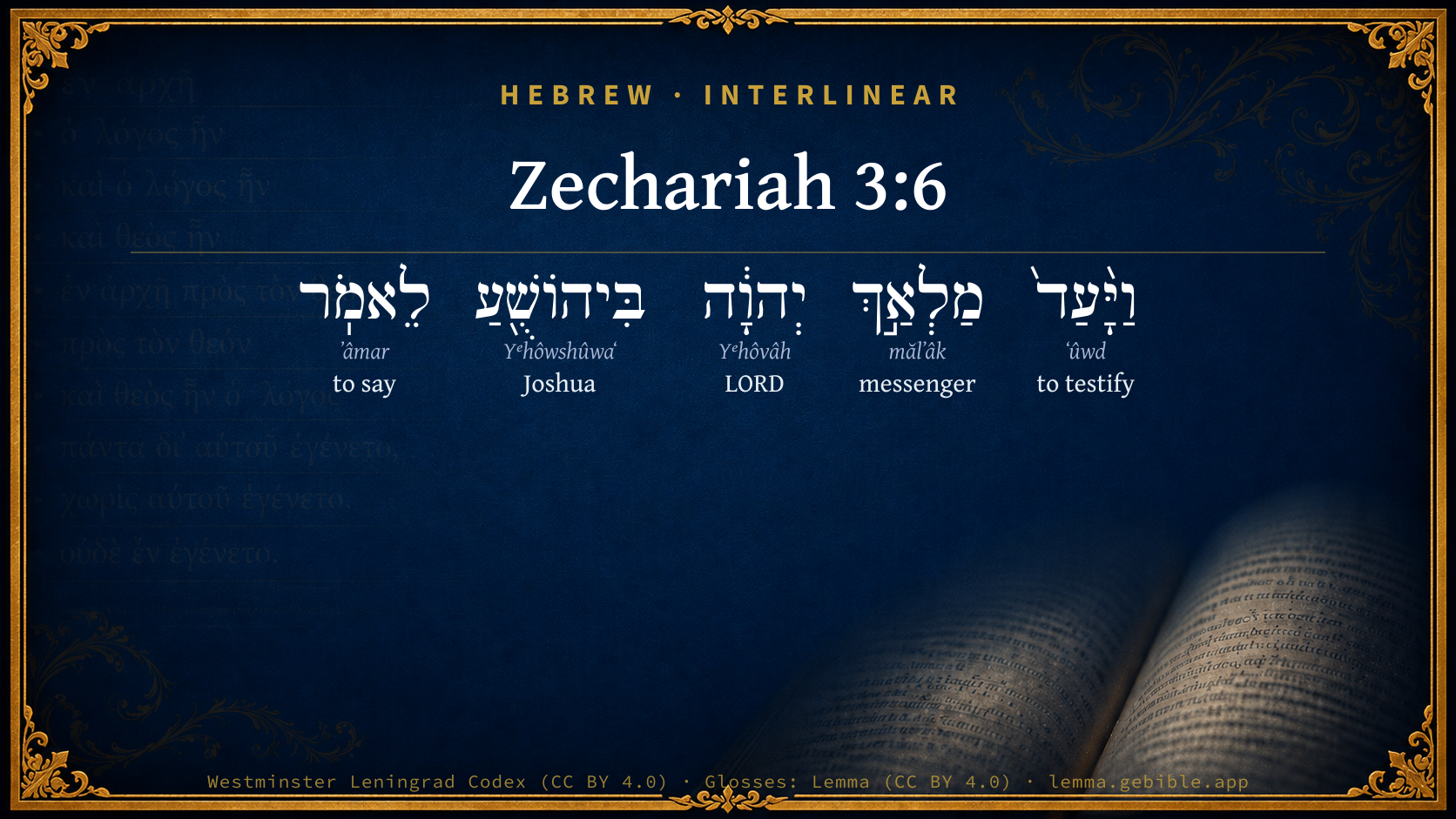
Zechariah 3:6

Hebrew (Westminster Leningrad Codex) Zechariah 3:6 appears in the Hebrew Old Testament. The text above is from the Westminster Leningrad Codex. Each word links to its Strong’s number, a concise gloss, and parsing drawn from the Open Scriptures Hebrew Bible morphology. Click any word for its full Brown-Driver-Briggs (BDB) entry.
Download image
Cite this verse

Zechariah 3:6 (World English Bible). Public Domain. Lemma interlinear Bible study tool, https://lemma.gebible.app/v/zechariah/3/6.

Show BibTeX & RIS
BibTeX
RIS
English Translation
The angel of Yahweh protested to Joshua, saying,
World English Bible · Public Domain
Download a study sheet

One document with this verse’s original text, its word-by-word gloss line, the meaning frame, cross-references with their text, attributed commentary, and full source and license credits — printable, and it pastes into notes with its structure intact.

This verse Autodidact and up

Study sheet (.html) Plain text (.txt)

A passage Seminary Student

Up to 50 verses in one chapter. A passage sheet keeps up to 6 commentary sources and 12 cross-references per verse, in the order this page ranks them, and says so on the sheet whenever that leaves anything out. Ask for a single verse and you get the Autodidact verse sheet above.

Everything on this page stays free to read, with no account — the sheet is a download of what is already on screen, not access to it.

Want to remove ads? Support Godless Engineer
Compare translations 3

The same verse in 3 English versions, stacked beneath the original-language interlinear above. Click any original word for its lexicon entry.

Each is an independent rendering of the whole verse — the interlinear is not word-aligned to these translations.

Highlighted words mark where these versions differ — a whole-verse word diff, not a word-by-word alignment.

  • World English Bible Public Domain
    The angel of Yahweh protested to Joshua, saying,
  • King James Version Public Domain
    And the angel of the LORD protested unto Joshua, saying,
  • unfoldingWord Literal Text CC BY-SA 4.0
    And the angel of Yahweh solemnly charged Joshua, saying,

unfoldingWord Literal Text — © unfoldingWord, licensed CC BY-SA 4.0. Word-aligned USFM3 via Door43 (git.door43.org/unfoldingWord/en_ult).

Versions to compare (up to 4)

3 of 4 selected

Show all 18 translations

Every available English version of this verse, each an independent rendering of the whole verse.

  • World English Bible Public Domain
    The angel of Yahweh protested to Joshua, saying,
  • Berean Standard Bible Public Domain
    Then the angel of the LORD gave this charge to Joshua:
  • Majority Standard Bible Public Domain
    Then the angel of the LORD gave this charge to Joshua:
  • King James Version Public Domain
    And the angel of the LORD protested unto Joshua, saying,
  • American Standard Version (1901) Public Domain
    And the angel of Jehovah protested unto Joshua, saying,
  • Revised Version (1885) Public Domain
    And the angel of the LORD protested unto Joshua, saying,
  • Geneva Bible (1599) Public Domain
    And the Angel of the Lord testified vnto Iehoshua, saying,
  • Douay-Rheims (1899) Public Domain
    And the angel of the Lord protested to Jesus, saying:
  • Young's Literal Translation Public Domain
    and the messenger of Jehovah doth protest to Joshua, saying:
  • Literal Standard Version CC BY-SA 4.0
    and the Messenger of YHWH protests to Joshua, saying,
  • Unlocked Literal Bible CC BY-SA 4.0
    Next the angel of Yahweh solemnly commanded Joshua and said,
  • unfoldingWord Literal Text CC BY-SA 4.0
    And the angel of Yahweh solemnly charged Joshua, saying,
  • Darby Bible Public Domain
    And the Angel of Jehovah protested unto Joshua, saying,
  • World Messianic Bible Public Domain
    The LORD’s angel solemnly assured Joshua, saying,
  • Webster's Bible Public Domain
    And the angel of the LORD protested to Joshua, saying,
  • Free Bible Version CC BY-SA 4.0
    Then the angel of the Lord solemnly advised Joshua, saying,
  • Bible in Basic English Public Domain
    And the angel of the Lord made a statement to Joshua, and said,
  • JPS Tanakh (1917) Public Domain
    And the angel of the LORD forewarned Joshua, saying:

Literal Standard Version (2020), Covenant Press — licensed CC BY-SA 4.0. Text via the HelloAO Bible API (eBible.org). Unlocked Literal Bible (unfoldingWord) — licensed CC BY-SA 4.0. Text via the HelloAO Bible API (eBible.org). unfoldingWord Literal Text — © unfoldingWord, licensed CC BY-SA 4.0. Word-aligned USFM3 via Door43 (git.door43.org/unfoldingWord/en_ult). Free Bible Version, Dr. Jonathan Gallagher — licensed CC BY-SA 4.0. Text via the HelloAO Bible API (eBible.org).

Word by word

More ways to search: Search by grammar → Find every occurrence → Compare this word →

Practice this passage: Drill this verse → Learn its vocabulary →

וַיָּ֨עַד֙
ʻûwd
H5749
“and · to testify”
Conjunction + Verb, Hiphil, Sequential Imperfect, 3rd Person, Masculine, Singular
Part of Speech
Conjunction + Verb
Stem
Hiphil
Form
Sequential Imperfect
Person
3rd Person
Gender
Masculine
Number
Singular
Full BDB Definition

Origin: a primitive root

TWOT: 1576 , 1576d

to return, repeat, go about, do again - (Piel) to surround, go round and round - (Pilel) to restore, relieve - (Hithpalel) to be restored - to bear witness - (Qal) to bear witness, say again and again - (Hiphil) - to testify, bear witness - to cause to testify, take or call as witness, invoke - to protest, affirm solemnly, warn, exhort or enjoin solemnly, admonish, charge - (Hophal) to protest, give warning
  1. מַלְאַ֣ךְ mălʼâk H4397 “messenger of” Noun, Common, Masculine, Singular, Construct
  2. יְהוָ֔ה Yᵉhôvâh H3068 “LORD” Noun, Proper
  3. בִּיהוֹשֻׁ֖עַ Yᵉhôwshûwaʻ H3091 “in/at · Joshua” Preposition + Noun, Proper
  4. לֵאמֹֽר ʼâmar H559 “to say” Preposition + Verb, Qal, Infinitive Construct

About this verse

These counts appear in no published source. They are computed here, from the morphology-tagged text and Lemma’s own curated glosses. What Lemma adds →

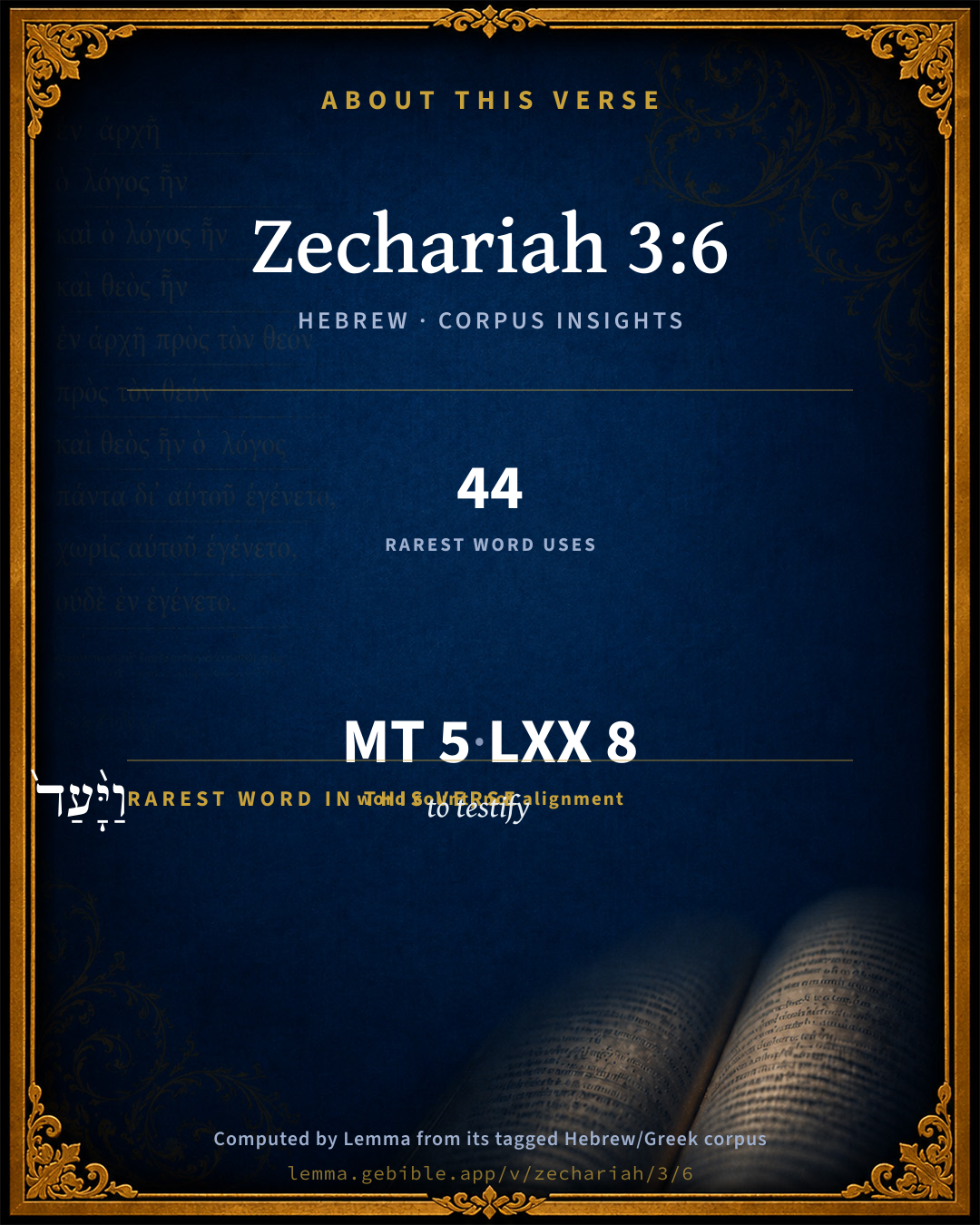
5
words
5
distinct lemmas
Prophets
section

Shared distinctive vocabulary

וַיָּ֨עַד֙ to testify H5749 occurs in 40 verses of the Hebrew Bible. Also found in:

Grammatical profile

  • 2 verbs
  • 3 nouns

Verb forms

  • וַיָּ֨עַד֙ Hiphil · Sequential Imperfect
  • לֵאמֹֽר Qal · Infinitive Construct

Hebrew & Septuagint length

In English translation the verse runs 8 words from the Hebrew and 30 from the Septuagint (LXX English) — the Septuagint runs noticeably longer here. See the side-by-side →

A rough comparison of the two English renderings, which tokenize alike — not a word-level alignment.

Word counts can differ between the Hebrew and the Greek without any difference in meaning — e.g. the Hebrew direct-object marker אֵת has no separate Greek word, and Greek often adds the article ὁ.

In the original languages it is 5 Hebrew tokens and 8 Greek tokens — but the two are counted differently (Hebrew bundles its prefixes and suffixes into one token; the Greek is in lemma form), so that isn’t a like-for-like length.

Cross-references

9

Topical passages linked to Zechariah 3:6 in the Treasury of Scripture Knowledge — connected by theme and wording, ordered by reader-vote popularity; previews shown in the World English Bible.

  • Exodus 23:20–21 "Behold, I send an angel before you, to keep you by the way, and to bring you into the place which I have prepared.
  • Jeremiah 11:7 For I earnestly protested to your fathers in the day that I brought them up out of the land of Egypt, even to this day, rising early and protesting, saying, Obey my voice.
  • Genesis 22:15–16 The angel of Yahweh called to Abraham a second time out of the sky,
  • Genesis 28:13–17 Behold, Yahweh stood above it, and said, "I am Yahweh, the God of Abraham your father, and the God of Isaac. The land whereon you lie, to you will I give it, and to your seed.
  • Genesis 48:15–16 He blessed Joseph, and said, "The God before whom my fathers Abraham and Isaac did walk, the God who has fed me all my life long to this day,
  • Isaiah 63:9 In all their affliction he was afflicted, and the angel of his presence saved them: in his love and in his pity he redeemed them; and he bore them, and carried them all the days of old.
  • Hosea 12:4 Indeed, he had power over the angel, and prevailed; He wept, and made supplication to him. He found him at Bethel, and there he spoke with us,
  • Zechariah 3:1 He showed me Joshua the high priest standing before the angel of Yahweh, and Satan standing at his right hand to be his adversary.
  • Acts 7:35–38 "This Moses, whom they refused, saying, 'Who made you a ruler and a judge?'--God has sent him as both a ruler and a deliverer by the hand of the angel who appeared to him in the bush.

Cross-references courtesy of OpenBible.info (CC BY 4.0).

Hebrew and Greek witnesses Masoretic Hebrew ↔ Greek Septuagint

The same verse in the two great witnesses to the Old Testament, shown verse-for-verse.

Here the Septuagint runs noticeably longer than the Hebrew — LXX2012 (modern English Septuagint) 30 words vs World English Bible 8. A rough length comparison of the two English translations, not a word-level alignment — read both below.

These are two independent witnesses, not word-aligned to each other, and the Septuagint is shown in lemma (dictionary) form.

Hebrew Zechariah 3:6 Masoretic · Westminster Leningrad Codex

וַיָּ֨עַד֙ מַלְאַ֣ךְ יְהוָ֔ה בִּיהוֹשֻׁ֖עַ לֵאמֹֽר

The angel of Yahweh protested to Joshua, saying,

World English Bible · Public Domain

Greek LXX Zechariah 3:6 Septuagint · lemma form

καί διαμαρτυρέω ὁ ἄγγελος κύριος πρός ἰησοῦς λέγω

and place a pure mitre upon his head. So they placed a pure mitre upon his head, and clothed him with garments: and the angel of the Lord stood by.

LXX2012 (modern English Septuagint) · Public Domain

On this verse, Keil & Delitzsch discusses the Septuagint’s reading. Read the note in Commentary ↓

Hebrew: Westminster Leningrad Codex (CC BY 4.0). Greek: Septuagint (public domain); English from LXX2012 (modern English Septuagint) (Public Domain). How the Septuagint differs from the Hebrew →

Targum (Aramaic paraphrase)

1

The Targum is the ancient Jewish Aramaic paraphrase of the Hebrew Scriptures — an interpretive translation, not the Hebrew text itself. Onkelos (literal) and Pseudo-Jonathan (expansive) render the Torah, and Jonathan the Prophets. Coverage is partial: where no permissively-licensed English translation exists for a verse, only the Aramaic is shown. This is verse-level text, not a word-by-word alignment to the Hebrew.

  1. Targum Jonathan Prophets (Joshua–Malachi)
    וְאַסְהֵיד מַלְאֲכָא דַייָ בִּיהוֹשֻׁעַ לְמֵימָר:

    (no public-domain English translation for this verse)

    Targum Jonathan — Aramaic: “Mikraot Gedolot” (public domain). English: “Sefaria Community Translation” (CC0 1.0 (public-domain dedication)); “London "Chaldee Paraphrase," 1871” (public domain). Text via Sefaria.

Commentary

Notes on Zechariah 3:6 from classic Christian and Jewish commentators (each source and its license shown beneath its notes). The classic Christian expositions comment on the surrounding passage and are grouped to its opening verse, so a note may address several verses; the Jewish commentaries on the Tanakh (Rashi and others) are per-verse, so they appear only where the commentator wrote on this verse.

Lemma curates 59 commentaries, every one of them public domain or Creative Commons licensed, each selected and text-cleaned for this edition rather than reprinted as found. About our sources →

Trapp's Complete Commentary

John Trapp

Zec 3:6 And the angel of the LORD protested unto Joshua, saying,

Ver. 6. And the angel of the Lord protested] Either with an oath or some deep asseveration, or both as 1Sa 25:26 "As the Lord liveth, and as thy soul liveth," &c. The former is an oath, the latter an asseveration or obtestation only, conjoined with that oath. Among the heathens Ex animo seu sententia was instead of an oath; and, rather than swear or say more, in a matter of no great moment, Chinias, the Pythagorean, would undergo a mulet of three talents. Others render it testified, or called witness upon his words, the angels and the prophet there present, for the more assurance. Thus, though Christ’s word be sufficient (for he is Amen, the faithful and true witness, Rev 3:14), yet, for his servants’ better settlement, he hath bound his promises to them with an oath, and taken heaven and earth to witness; which is dignatio stupenda, a wonderful condescension.

John Trapp, A Commentary or Exposition upon All the Books of the Old and New Testament (1647–1656) — public domain. Text from a community e-Sword module.

The Biblical Illustrator

Joseph S. Exell

Zec_3:6-7

The Angel of the Lord protested unto Joshua

A charge to young ministers

I.

What the great Head of the Church requires of you.

1. Personal piety. Walk in My ways. This phrase denotes the whole of practical and experimental godliness. There can be no true piety without a previous scriptural conversion, a moral, universal, spiritual change; a change of the principles, of the mind, of the affections, of the heart, of the conduct, and of the life, by the power of the Holy Ghost, and obtained by faith in Christ Jesus. Every unconverted minister is an intruder into the sacred office. The dignity of your office does not discharge you from all the obligations to personal holiness; but it binds those obligations upon you with superadded weight and force. Then he men of integrity. Cultivate a devotional spirit. Be clothed with humility. Be grave and serious. Be cheerful, but take care that cheerfulness noes not degenerate into levity. The piety of some ministers has serious blemishes, against which you will do well to guard yourselves. Such as envy, which is the vice of little minds. Or a disposition to retail slanders. In order to maintain your personal piety it will be necessary for you every day to renew your acts of dedication to God.

2. A faithful discharge of your ministerial and pastoral functions. Your office may be called the charge of the Lord, because you received it from Him, and are accountable to Him for the discharge of its functions. In order to keep this charge, you should well understand its nature. It is Christian theology, which you have to teach to mankind; and you cannot teach it to others unless you well understand it yourselves. It is the well-informed, well-instructed divine who alone can adorn the sacred profession and edify the Church of Jesus Christ. Avoid a controversial style of preaching, for that is generally unprofitable, and unpopular too. You should be faithful, zealous, and laborious preachers, ever randy to declare the whole counsel of God.

3. In this charge is implied the faithful performance of pastoral duties. The exercise of a pure discipline over the societies (Churches) entrusted to your care A Church without discipline is like a garden without a fence. The clue administration of pastoral advice and counsel is another of our duties.

II. The import of those promises made to you. Dignity and authority in the Church of God is here promised to faithful ministers. Continuance in office is another promise. And it is further promised that they shall at length be translated to nobler stations in the heavenly world, where they shall become companions of angels. Allow me to charge you then to give attention to all these things. I have not exhorted you to pursue unattainable objects; they are all well within your reach. Redeem the time. And be thou faithful unto death. (Edward Grindrod.)

Gods promise to Joshua

The design of Gods promises is to quicken us to diligence in the work which He hath given us to do.

I. What is required of Joshua; or how he was to behave. He was to walk in Gods ways, and keep His charge; which signifies a general care to be religious himself, and a faithful performance of the duties of his particular station.

II. What is promised to Joshua in consequence of so doing.

1. That he should be continued in his office.

2. At length he should be preferred to a nobler station, in which he should be the companion of angels.

It does not mean that angels should guard and preserve him in all his goings and undertakings. The most natural and easy sense of the words is, that they refer to a future state, and mean that Joshua should at length be joined to the angels in heaven. Most of the Jewish writers paraphrase thus, I will raise thee from the dead, and place thee among the seraphims. This is a most delightful and instructive idea of the heavenly world--walking among the angels. Heaven is the stated abode of these glorious, wise, and happy spirits, who are superior to men; therefore they are called the angels of God in heaven. God intends that all His faithful servants on earth should at length dwell and walk with them. Reflect what an honour and happiness this will be. Consider what excellent beings they are in themselves. And consider them as those who have been ministers of God to the world, the Church, and ourselves. Application--

(1) Reflect, for our caution, on the counterpart of this, or the future state of those who forsake the ways of God.

(2) Let us be excited to the duties required in the text, by the gracious promise contained in it. (Job Often.)

Cleansing, obedience, service

Let the Christian notice well Gods order in these verses. It is cleansing first, then obedience, next service. All through the Bible the cleansing is with a view to the other two; and if these two fail to be seen in the Christians character he will lose the first, for all practical purposes. A cleansed soul will be a holy soul. A cleansed soul will be an obedient one, and will love to serve. Then, Christian, work out your own salvation by putting no hindrance in the way of God working within you both to will and do. Live upon Christ, and let nothing come between your continued eating the flesh and drinking the blood of the Son of Man. This is living upon Christ; and if your soul lacks it your obedience and your service will cease. The measure of blessing to anothers soul will be the measure of Christ living in your own; and the measure of Christ living in you will be the measure of your love to Him, and your own personal assurance of His love to you. You must translate the generally acknowledged fact of His love into a living fact in your own experience. And remember that the measure in which you think about Christ, and in which your thoughts about Him have power over your personal character and your daily life, is the measure of your religion. This, and no more than this, is the extent to which you are a Christian. This, and no more than this, is the extent to which there will be any reality, any power, any real blessing in your service to others, or anything pleasing to God in your obedience. May God make you real--stamp Divine reality on everything within you, and in all your outward life! (F. Whirfield, M. A.)

A place of access

I will give thee a place of access. We owe this beautiful promise to the Revised Version (Zec_3:7), for in the Authorised Version the text has quite a meaningless rendering. I will give thee place to walk among these that stand by. The immediate reference of the promise is, of course, to Joshua, the high priest. It was his privilege and his duty, clothed in white linen, to enter the most holy place once a year, there to make atonement for the sins of the people. Instead, however, of this great office being fulfilled, the prophet sees Joshua clothed in filthy garments--the type of his own sins and of those people of his standing,--with Satan at his right hand to be his adversary. it appeared impossible that such a high priest, or such a nation, should ever be permitted to draw near the living God. Then comes the symbolic action of the prophetic vision. The filthy garments are taken away by command of God, from Joshua, and are replaced by rich apparel, the mitre of high priestly office is set on his head, and the promise is made--made both to him and to his people--I will give thee a place of access. In spite of Israels unworthiness and sin, God Himself would permit His people to draw near to Him. Such were the original scope and meaning of these words. I will give thee a place of access. How little we realise the great privilege of this great promise! To say that we can draw near to God is only to utter one of the commonest of all truisms; but familiar as the truth may be to us, let us never forget that there was a time when it would have been regarded as the strangest and most incredible of all truths. A Jew was never permitted in his own person to come near to God; he had to approach the Most High from a distance, and even the high priest himself was only allowed the privilege of a place of access once in each year. Such were the awful holiness and the ineffable majesty of the Most High, and such the terrible sin and guilt of man, that no human soul dared to draw near the consuming fire. God was a God far off and not nigh to a Jew. There was no place of access opened for all the world. We do not wonder, therefore, at the exaltation and rapture with which the author of the Epistle to the Hebrews dwells on what Christ had done, in opening a new and living way to God, even into the holy place, by His blood, and on the fact that His sacrifice for sin makes it now possible for the sinful and guilty with boldness to enter into the Holiest. It was the fulfilment of the promise of the text, I will give thee a place of access. And this is the astonishing privilege of every child of man today. Howsoever unworthy and sinful he may be, still through the blood of Jesus, he may freely draw near to God. He may stand in the presence of the Eternal. He may speak face to face with God, and hear God speak to him. In Christ Jesus, to use St. Pauls words, we that once were far off are made nigh by the blood of Christ. (G. W. Barrett.)

The Biblical Illustrator, edited by Joseph S. Exell (c. 1880s–1900s) — public domain. Text from a community e-Sword module.

Joseph Benson's Commentary

Zec 3:6-7. And the angel of the Lord protested — Solemnly declared; unto Joshua, If thou wilt walk in my ways — If thou wilt diligently observe the commandments of my law; and wilt keep my charge — The special charge and office of the high-priest. Then thou shalt also judge my house — Thou shalt, for a long time, be ruler in my temple, and exercise all the authority and jurisdiction which belongs to the high-priest’s office; and shalt also keep my courts — Not as a servant, but as the chief, on whom others wait, and at last thou shalt have a place among my angels: so many interpret the following clause. Some, however, render it, And I will appoint thee ministers among those that stand by; and by the ministers, Blayney understands, “not the angels attending upon God’s throne, but some of the subordinate priests who attended upon Joshua;” observing, “as it is promised to him that he should be reinstated in the honours of his high office, so it is also added, that he should be waited upon by those inferior priests, whose business it was to officiate in the service of the temple, under the authority of the high-priest. And the same persons are presently after designed, under the name of the companions of Joshua, that sat before him.”

Joseph Benson's Commentary on the Old and New Testaments (1811–1818) — public domain. Text from a community e-Sword module.

Whedon's Commentary on the Bible

Daniel D. Whedon

In Zec_3:6-10 is contained the address which the angel of Jehovah makes to Joshua — again not as a private individual but as the representative of the people — concerning his duties and privileges; at the same time he points to the coming of one who will completely remove sin from the land, and restore permanent peace and prosperity.

Protested — Affirmed solemnly and earnestly (Gen_43:3; Jer_11:7, where the same word is used).

Walk in my ways — The ways pointed out by Jehovah; in other words, if the conduct is in accord with the principles of Jehovah’s righteousness.

Keep my charge — The high-priestly office. The first refers primarily to uprightness in the private life, the second to the faithful performance of official duties.

Thou shalt also judge my house — With these words begins the apodosis. Commentators are not agreed on the interpretation of this clause. Some hold that house is used metaphorically for people (compare Hos_8:1; Hos_9:15), and that the promise means that the high priest will be the sole head of the community; he will take upon himself even those duties which in pre-exilic times were discharged by the king, and at present by Zerubbabel. A modified form of this interpretation understands the promise to imply only that the high priest is to “direct the people in all things respecting the law of God, and especially to judge those who ministered in the sanctuary.” If house is taken to mean people there is no justification for limiting the high priest’s authority to things religious. Others understand my house to refer to the temple, soon to be completed; in it the high priest will be supreme. In view of the fact that Zechariah gives such prominent place to Zerubbabel, and so to the family of David, it is not likely that he expected the supreme authority in secular affairs to pass entirely into the hands of Joshua or his descendants; therefore the second interpretation is to be preferred (see closing remarks on Zec_3:7). The next clause speaks of the performance of the common priestly duties.

Keep my courts — Perform properly the priestly duties, and keep out of the temple everything that is idolatrous and unclean.

I will give thee places to walk among these that stand by — R.V., “a place of access.” Another difficult clause. The meaning of the expression translated “place of access” or “places to walk” is uncertain. Some consider the Hebrew word an Aramaic form of the Hiphil participle of the verb to walk, with the transitive meaning leaders or the intransitive meaning walkers. This formation of the verb is found only in the Aramaic portions of Daniel (Dan_3:25; Dan_4:34), never in Hebrew; but if it is assumed here the transitive meaning is to be preferred. With this translation the promise means that Jehovah will provide for Joshua leaders or guards, who will protect and defend him from all dangers. These leaders are to be among these that stand by, that is, the angels. In this case out of or from among instead of among would be more suitable. This peculiarity creates a suspicion concerning the correctness of the translation and interpretation; besides, the promise seems to be vague and indefinite. It is preferable, therefore, to take the word as the plural of a noun meaning walk or place of access, the plural being used to express the thought that the high priest may come again and again. Joshua is to be permitted to walk among the heavenly host and thus to have free access to the throne of God, and this privilege is to be enjoyed not only after the resurrection (Targum), but in this life, whenever the high priest desires to bring his petitions and requests for the community to the throne of God.

In connection with these promises it should never be overlooked that they are made to the high priest as the representative of the people. Whatever is promised to him symbolizes a similar promise to the whole people, though it is also true that when the people are restored to fellowship with Jehovah the office of the high priest will be clothed with new splendor.

Zec_3:8-9 contain a more remarkable promise.

Hear — Addressed to the high priest alone. The address itself begins with “thou and thy fellows.”

Thy fellows that sit before thee — Not now, while Joshua is in the presence of the angel, but in the gatherings of the priests (compare 2Ki_4:38; 2Ki_6:1). These words form the subject, what follows is the predicate, a fact which is obscured in the English translation.

For — Hebrews ki does not introduce a causal clause, but should be rendered “indeed,” “truly” (G.-K., 148d).

They are men wondered at — R.V., “they are men that are a sign”; literally men of sign are they. A better rendering of the whole sentence would be, “thou and thy fellows that sit before thee are truly men of sign,” that is, men who in their persons and office foreshadow some future event. The event foreshadowed in this case is immediately stated.

I will bring forth — Better, I am about to bring forth; in the near future.

My servant — Any individual or group of individuals commissioned to carry out the divine purpose may be called Jehovah’s servant. In this sense the title is applied to the prophets (2Ki_9:7; Isa_20:3), to the Messianic king (Hag_2:23), to Israel as the Messianic nation (Isaiah 40-53), etc.

The Branch — In Hebrew without the article, “Branch”; margin, “Shoot,” or “Sprout,”

which shows that the word is to be understood as a proper name (compare Zec_6:12). The title is derived from such passages as Jer_23:5; Jer_33:15. In Isa_11:1, a different word is used; compare also Eze_34:23-24; Eze_37:24. It is a shoot that will sprout from the ruined dynasty of David; and Zec_6:12-13 (compare Zec_4:9), shows that the prophet has in mind Zerubbabel.

Zec_3:9 makes it clear that Zechariah expected the kingdom of God to be established and the Messianic king to appear in the near future, but in details the verse is exceedingly obscure.

For — Connects Zec_3:9 with Zec_3:8, especially with the verb “I am about to bring forth”; it introduces a statement which indicates that the fullness of time is at hand.

The stone that I have laid before Joshua — The words appear to be addressed to the high priest; therefore before Joshua is equivalent to before thee. Joshua is urged to look upon the stone that is already prepared. What is the stone? Many answers have been given to this question. Some say the foundation stone of the temple; some, the top stone (Zec_4:7); some, the precious stone adorning the high priest’s breastplate; some, the Messiah, some, an altar or a substitute for the ark as an instrument of propitiation; some, the temple itself; some, the people of Israel as the foundation of the new order of things; some, “the kingdom or people of God, outwardly insignificant when compared with the great mountain (Zec_4:7), which symbolizes the power of the world.” These are the most important interpretations suggested; all are more or less doubtful, probably not one offers the right interpretation. Standing by itself or in some other connection the word might, perhaps, mean any one of these, but in the present connection they are not suitable. The interpretation that fits most perfectly in the context is one first suggested by Wellhausen, who sees in the stone the precious stone for the diadem of “Branch,” who is the Messianic king (compare Zec_6:9 ff.). It is already placed before the high priest, ready for use when “Branch” appears, which may be at any time.

Upon one stone shall be seven eyes — A kind of parenthetical clause, describing the stone more fully. The numeral one is used to emphasize the peculiarity, equivalent to upon this single stone. If the above interpretation is correct, the eyes are the facets of the precious stone, which sparkle like eyes; seven might be understood literally, or, as in other passages, to indicate a “moderately large number” (Isa_4:1), so that the thought would be simply that it was completely covered with eyes.

I will — Or, I am about to.

Engrave the graving thereof — What the inscription will be is not stated, probably the name of “Branch,” that is, Zerubbabel (Zec_6:9 ff.; Hag_2:23). With this interpretation the connection between Zec_3:8 and Zec_3:9 becomes natural and complete.

The first result of the dawn of the Messianic age will be the complete removal of iniquity, the beginning of which is symbolized by the cleansing of the high priest (see on Zec_3:1).

That land — Better, this land, that is, Judah, now not limited to the old territory, but extending in all directions (Zec_2:11).

In one day — That is, speedily. The writer of the Epistle to the Hebrews identifies this one day with the day on which Jesus was crucified (Heb_7:27; Heb_9:12; Heb_10:10). 10. With the Messianic king on the throne and all iniquity removed, an era of peace and prosperity will commence. For the picture see on Joe_1:12; compare Mic_4:4.

Call — R.V., “invite”; to share the comforts.

Daniel D. Whedon (gen. ed.), Commentary on the Old and New Testaments (1874–1909) — public domain. Text from a community e-Sword module.

The Preacher's Complete Homiletical Commentary

Joseph S. Exell (gen. ed.)

CRITICAL NOTES.

Zec_3:6-10.] Here the symbolic act of reclothing is made the occasion of a prophetic address through the high priest to the nation. Protested] Testified, made a solemn declaration as one on oath (Gen_43:3; Deu_8:19). Walk] God’s promise was connected with their observance of his ordinances. Then] Certain privileges. Judge] Administer right, viz. “in relation to the duties devolving upon the high priest in the sanctuary as such: hence, right administration of the service in the holy place and Holy of Holies” [Keil]. The priestly family of Joshua would take a part in the future government of the nation. Places] Guides. Stand by] Angels. “The import of the promise is, that he and his successors in office should enjoy the care, direction, and aid of celestial spirits in the management of the national affairs” [Henderson].

Zec_3:8. Fellows] Thy associates in the priesthood. Wondered] Men of wonder, of sign or portent; typical men, foreshadowing future persons or events (cf. Isa_8:18; Eze_12:6). Branch] All expositors admit this to be the Messiah, the servant (Isa_42:1): the sprout from the stem of Jesse (Jer_23:5; Isa_2:1-2; Isa_53:2).

Zec_3:9. Stone] Foundation by God, the chief builder, which should be the object of his special care. Eyes] upon a thing denote vigilance and care (cf. Psa_32:8). Seven] denotes perfection; these not carved upon the stone [Calvin], but directed towards; fixed upon the covenant people (cf. Rev_5:6). Engrave] Lit. “I will open the opening of it.” What kind of ornaments it does not say, “but that they were cut out or engraven in the foundation-stone, the exigency of the place requires, except we regard the stone as here used by synecdoche for the whole temple, in which case reference will be had to the finishing off of the structure, the foundation of which had been laid in the presence of Joshua” [Henderson]. Land] of Israel with its inhabitants representative of the Christian Church. Remove] the punishment to which Jews had been exposed. Day] The day of national atonement celebrated after completion of the temple (Lev_23:27); typical of day of atonement by Christ (Heb_10:10-12; Heb_7:27).

Zec_3:10. Under] A proverbial description of a happy period (1Ki_4:25); an emblem of tranquil prosperity (Mic_4:4); of personal and social peace in the gospel; and of the blessed condition flowing from a purified Church.

HOMILETICS

GREAT PROMISES ON SPECIFIED CONDITIONS.—Zec_3:6-7

We have here three things promised, or engaged for—and the promise made to depend on certain conditions. It matters not which of the two we notice first; we may take them as they stand.

I. The specified conditions. The stipulations are these: “If thou wilt walk in my ways, and keep my charge” (marg., ordinance). These two conditions are closely connected.

1. Personal holiness. The former relates to personal character and conduct. He was to be found obedient to God’s precepts; exemplifying in his own character the sanctity and moral rectitude which it was part of the duty of the priest to inculcate on the people: “for the priest’s lips should keep knowledge, and they should seek the law at his mouth: for he is the messenger of the Lord of hosts.”

2. Official faithfulness. He was to keep the charge of Jehovah, i.e. faithfully to perform all official duties, punctually to attend to every enjoined function of his commission; keeping all the ordinances, as God had delivered them to Moses (Lev_8:35).

II. The great promises. Three things depended upon these conditions.

1. Thou shalt “judge my house.” The word house does not mean temple, but household. “The house of Jacob” is a designation of Israel, who were regarded and repeatedly spoken of as the family of Jehovah. “I am a father to Israel.” To judge his house, then, is the same thing as to rule his people. This, you think, did not pertain to the priesthood; but it is remarkable how it thus turned out, in regard to the priestly lineage in the family of Joshua. Not in the person of Joshua himself; but after Nehemiah’s death, a large portion of the management of the civil affairs of Judea was committed by the Syrian prefects into the hands of the high priest; and it was more fully realized in the time of the Maccabean high priests, in whom the civil and the sacred were eminently united. When these princely priests failed in the conditions here specified in the arrangements of providence, the glory departed.

2. Thou shalt “also keep my courts.” He was to continue to have the charge of God’s house, to minister in the holy place, and superintend the entire system of the sacerdotal and Levitical services. His continuance in this high and honourable office,—that is, in the way of succession in his lineage, depended on the conditions mentioned, of personal obedience and official fidelity. It is the same style of conditionality with that on which Jehovah promised to Israel generally, and took them into covenant: “Now, therefore, if ye will obey my voice indeed, and keep my covenant, then ye shall be a peculiar treasure unto me above all people: for all the earth is mine: and ye shall be unto me a kingdom of priests, and an holy nation.”

3. I will give thee “places to walk among these that stand by.” By “these that stand by” are meant, the attendant angels. The difficulty here is with the word rendered “places to walk” (marg., walks). The original in some degree is ambiguous. But from the conjugation of the verb to which as a participle it belongs, we are disposed to acquiesce in the judgment of Henderson, who makes it to signify, neither walks nor walkers, but those who guide or conduct in walking:—“I will give thee ministering guides among these that stand by.” No sense can correspond better than this with all that we learn from the previous history of the Jewish people from the call of Abraham onwards, respecting the ministration of angels. It is a promise, then, of the aid and direction of those who surround the Divine throne, “the ministerings spirits sent forth to minister to the heirs of salvation.” If the rendering “walks,” or “places to walk,” be retained (though we feel doubtful), then the promise will be a higher one still—namely, that of an association with angelic spirits from heaven [Adapted from Wardlaw].

MEN OF WONDER.—Zec_3:8

The Jewish economy was typical in its aim. Its sacerdotal institutions were “shadows of good things to come.” Hence, “Joshua and his fellows that sat before him”—inferior priests, who officially ministered to the high priest—are termed men of signs. They typified the Messiah here promised, and those whom the Messiah admits to share his priesthood (1Pe_2:5; Rev_5:10). These words might be taken—First, as a pledge to the desponding Jews that the priesthood would be preserved until Christ came. Secondly, as a reproof to the unbelieving multitude, who wonder at God’s people with incredulity (Psa_71:7; Isa_8:18). Apply the words to Christians.

I. They are a wonder to themselves. They are astonished at God’s love to them—amazed to think of his grace and goodness. Why are they called, while others refuse to come? They were chosen not because better than others, not on account of their foreseen repentance and faith. “I am a wonder to myself,” said one. “I am a miracle of grace,” said another. “By the grace of God, I am what I am.”

II. They are a wonder to their fellow-men. Believers are “to thousand eyes a mark and gaze.” They are not understood in their spirit, habits, and employments. To the wicked, they are a puzzle. They are often feared, despised, and persecuted. Their spiritual birth is a mystery of mercy, their life a constant reproof to the ungodly, and their death a triumph of grace. “I am as a wonder unto many.” “Behold I, and the children whom the Lord hath given me, are for signs and wonders in Israel, from the Lord of hosts.”

III. They are a wonder to angels. Angels take deep interest in redeemed men, and wonder at their characters and pursuits. As Jesus was “seen of angels,” so are his people. “Last” in the judgment of the world, they are deemed by heavenly hosts worthy of intense regard. “For we are made a spectacle (theatrical exhibition) unto the world, and to angels (good and bad), and to men” (1Co_4:9).

MY SERVANT, THE BRANCH.—Zec_3:9

Only one person is here typified by the Jewish high priests, and most commentators admit this person to be the Messiah, under the titles of the text.

I. My Servant.

1. Under this title was Christ predicted. This was the characteristic name of the Messiah. “Behold my servant, whom I uphold; mine elect, in whom my soul delighteth” (Isa_42:1; Isa_49:3; Isa_53:11; Eze_34:23).

2. Under this capacity he appeared on earth. “I am among you as one that serveth.” Thus honouring service, and dignifying the humblest calling. “Who made himself of no reputation, and took upon him the form of a servant, and was made in the likeness of men.”

3. In this capacity he rendered most eminent service. No one ever merited this title like him. He rendered a service most signal and gracious, which no one in the universe could perform beside. “Being formed in fashion as a man, he humbled himself, and became obedient unto death, even the death of the cross.”

II. The Branch. He is “the branch of the Lord” (Isa_4:2); “a righteous branch” (Jer_23:5); “the branch of righteousness” (Jer_23:15). He is the tender branch from the almost extinct royal line of David. Not “a limb, in the sense of one among many on the same tree, but a shoot which springs up from the root; and which, though small at first, becomes a tree of wonderful qualities” [Cowles]. This marks—

(1) His humble origin;

(2) gradual growth; and

(3) ultimate prosperity. In course of time the tender shoot would become the monarch of the forest, and under its mighty branches and beautiful foliage the nations of the earth would take shelter.

THE MISSION OF THE MESSIAH AND ITS RESULTS.—Zec_3:8-10

These words point to the author of the blessings promised—to him by whom sin was to be expiated, and the kingdom of God flourish. They set forth the mission of the “servant, the Branch,” and the results of that mission in the building of a more glorious temple than that of Solomon or Zerubabbel.

I. The method of his coming. He comes as a servant, and as the sprout.

1. As a branch. “According to which the Messiah is to spring up as a rod out of the stem of Jesse that has been hewn down, or as a root-shoot out of a dry ground. Tsemach, therefore, denotes the Messiah in his origin from the family of David, that has fallen into humiliation, as a sprout which will grow up from its original state of humiliation to exaltation and glory, and answers therefore to the train of thought in this passage, in which the deeply humiliated priesthood is exalted by the grace of the Lord into a type of the Messiah” [Keil].

2. A branch Divinely caused to grow. “I will bring forth my servant, the Branch.” God himself undertakes to bring him forth. He is God’s servant, and will have to do God’s work. He came from the bosom of the Father, and was upheld until he had done the will of the Father. “Thus speaketh the Lord of Hosts, saying, Behold the man whose name is the Branch; and he shall grow up out of his place, and he shall build the temple of the Lord.”

II. The nature of his work.

1. To prepare the kingdom of God. “I will engrave the graving thereof” (Zec_3:9), i.e. engrave it so as to prepare it for a beautiful and costly stone. “The preparation of this stone, i.e. the preparation of the kingdom of God, established in Israel by the powers of the Spirit of the Lord, is one feature in which the bringing in of the tsemach will show itself” [Keil].

2. To remove iniquity. “And I will remove the iniquity of that land.” The removal of punishment from the Jews was typical of the remission of sins by the atonement of Jesus Christ.

(1) From the Jews. From “that land”—multiform and aggravated as that was (Jer_50:20).

(2) From all nations. To the Jew first, then the Gentile (Act_3:26).

(3) “In one day.” The wiping away will not be imperfect and continually repeated; but once and for ever taken away. “By one offering he hath perfected for ever them that are sanctified” (Heb_10:12; Heb_9:26; Heb_7:27).

III. The results which flow from the completion of his work. When guilt is taken away, discontent and misery will be swept away; peace and prosperity will be enjoyed by a purified Church. We have a figure (Zec_3:10) for a state of repose—peace, security, personal and social. The peaceful influence of the gospel was felt from the first—individually, in the soul of each subject of it; socially, in the intercourse of all. Jew dwelt in peace with fellow-Jew; and even Gentiles were numbered among neighbours and brethren, who before were aliens and outcasts, “hated with perfect hatred.” The proclamation was to be, “Peace, peace to him that is far off, and to him that is nigh”—and the corresponding effect of it was, “He is our peace, who hath made both one, and hath broken down the middle wall of partition” [Wardlaw.] “They shall sit every man under his vine and under his fig-tree; and none shall make them afraid: for the mouth of the Lord of hosts hath spoken it.”

“No sound of war is heard—no thought of sin,

But one sole word, ‘Peace—Peace.’ ”

HOMILETIC HINTS AND OUTLINES

Zec_3:8. Sign men.

1. Wonderful in and restored to God and duty.

2. their experience. Delivered, pardoned, Wonderful in their manners. Despising pleasures which others esteem; pursuing paths which others term folly. “They think it strange that ye run not with them into the same excess of riot; speaking evil of you.”

3. Wonderful in their character. Redeemed and made holy—types of future converts, and of all priests unto God.

Zec_3:9. The stone. Taking it as the foundation-stone of the temple.

1. Its laying. By God, before Joshua 2. Its protection. “Upon one stone, seven eyes.” “The eye,” says Wardlaw, “is the natural hieroglyphic for knowledge; and seven, as every reader of the Bible is aware, is the number used to denote completeness, perfection. ‘seven eyes’ denote the perfection of observant knowledge: and as ‘the eyes of Jehovah’ mean Jehovah’s observation and knowledge, his ‘seven eyes’ express the perfection of both—omniscient observation”—(cf. chap. Zec_4:10). Hence this is a proof of—

(1) Providential care; and

(2) an encouragement to the Jews in work. Taking the stone with many as representing Christ, notice—

1. God declares that he lays (Heb.), that he gives a stone before Joshua, lit. before his face, to defend him, and in order that he may place it as the foundation and corner-stone of his building, which symbolized the Church, of which the corner-stone is Christ (Isa_28:16; Eph_2:20; 1Pe_2:6).

2. The stone is graven, like the precious stones in the breastplate of the high priest, with the names of the tribes upon them (Exo_28:21 : cf. original in 2Ti_2:19; and Rev_21:14).

3. The figure here is of eyes, emblems of light (cf. Mat_6:22; Eze_1:18; Rev_4:4-6). The stone is not a dark, lifeless stone, like other stones, but a living, seeing stone.

4. Those eyes are seven, signifying completeness, representing the sevenfold gifts of the Spirit with which the Messiah was anointed, animated, strengthened, and enlightened (Isa_11:2); indicating the perfection of the spiritual illumination and perpetual watchfulness of Christ [Words.]. The language is future: “I will engrave the graving (or the sculpture) thereof.” As the stone is a figure, so is the engraving that of hieroglyphic eyes, which may convey a twofold meaning. The first, certainly, that the eyes of Jehovah should be continually upon it, with intense and delighted interest; and upon the glorious spiritual structure that was to rest upon it, marking its progressive advancement to its final completion. The idea is the same as that expressed respecting the land of Canaan: “The eyes of the Lord thy God are always upon it, from the beginning of the year to the end.” The second, one which I express with hesitation, because not sure about the propriety of assigning two meanings to one hieroglyphic. I cannot forget that the stone represents a person, and that person Divine. Jesus Christ himself is the “chief corner-stone.” May not the engraving of the seven eyes, then, convey the additional idea of the Deity of him whom the stone represented—as himself the possessor of Divine omniscience; which could say—“All the churches shall know, that I am he that search th the reins and the hearts” [Wardlaw].

Seven eyes upon one stone. Observe the notice that Christ was to excite and engage. The eye of God was upon him. He had complacency in contemplating him in the redemption of his people. The eyes of angels were upon him. They announced and sang his birth, and ministered to him in the wilderness. The eye of Satan was upon him. He watched him through life, hoping to make a prey of him, as he had done of the first Adam. But he was the Lord of heaven, and found nothing in him. The eyes of men were upon him. Simeon saw him, blind Bartimæus followed him. Judas followed him closely for three years, and Pilate saw him judicially. The centurion watched his death, and all the people gathered at the sight. The disciples saw the Lord after his resurrection and were glad. Paul saw him at mid-day. How many millions and millions have seen him since, not with the eye of sense, but of faith! In another world he is all in all—he draws every eye and employs every tongue. We shall see him as he is [Jay].

Zec_3:10. The reign of the Messiah is distinguished by three things.

(1) Enjoyment. The very image of the vine and the fig-tree is delightful.

(2) Liberty. Slaves and captives did not sit under their vines and fig-trees, nor did proprietors in time of war.

(3) Benevolence. “Ye shall call every man,” &c. There is no selfishness, no envy. All are anxious that others should partake of their privileges [Jay].

ILLUSTRATIONS TO CHAPTER 3

Zec_3:7. Keep. Godliness is the highway to happiness; the good old way that hath ever been beaten by all those saints that now find rest to their souls [Trapp]. Consult duty, not events [Annesley]. Perish discretion when it interferes with duty [H. More].

“Devotion when lukewarm is undevout” [Young].

Zec_3:8. Men of signs. So were the primitive Christians. They were like so many pieces of immortality, dropped down from heaven, and tending thitherward—all full of God, and full of Christ, and full of heaven, and full of glory: and this world was nothing to them; trampled upon as a despicable, contemptible thing [Howe].

Zec_3:9. Stone. The excellence of the foundation is for the building that rests on it. And so, whatever gives Christ value, so to speak, in the sight of God and angels—as the union in him of the glories and virtues of the two natures, Divine and human; his filial zeal, and perfect obedience, and efficacious atonement, and priestly intercession, and royal might and majesty—all, all redounds to the honour and blessing of “them that are Christ’s” (1Co_15:23), through faith in his name [Dr. Lillie].

Iniquity. Christ, with his holy suffering, love, and perfect obedience, is the only one thing wherein God can have infinite pleasure, and for the sake of which he can look graciously on the race of men [Dr. Heubner].

Zec_3:10. Sit. Mankind have always clung to the hope of better times of the text. We give a passage from the famous Eclogue

(4) of Virgil.

“The last great age, foretold by sacred rhyme,

Renews its finished course; Saturnian times

Roll round again; and mighty years, begun

From their first orb, in radiant circles run.

The base, degenerate, iron offspring ends,

A golden progeny from heaven descends.…

See, labouring nature calls thee to sustain

The nodding frame of heaven and earth and main!

See, to their base restored earth, seas, and air,

And joyful ages from behind in crowding ranks appear. [Dryden’s Virgil.]

The Preacher's Complete Homiletical Commentary (gen. ed. Joseph S. Exell; Funk & Wagnalls, c. 1892) — public domain (pre-1929). A full-Bible homiletical/sermon-outline anthology covering 65 of 66 books (2 John is absent from the source module). Text from a community e-Sword module.

Keil & Delitzsch

C. F. Keil & F. Delitzsch

In these verses there follows a prophetic address, in which the angel of the Lord describes the symbolical action of the re-clothing of the high priest, according to its typical significance in relation to the continuance and the future of the kingdom of God. Zac 3:6. "And the angel of the Lord testified to Joshua, and said, Zac 3:7. Thus saith Jehovah of hosts, If thou shalt walk in my ways, and keep my charge, thou shalt both judge my house and keep my courts, and I will give thee ways among these standing here. Zac 3:8. Hear then, thou high priest Joshua, thou, and thy comrades who sit before thee: yea, men of wonder are they: for, behold, I bring my servant Zemach (Sprout). Zac 3:9. For behold the stone which I have laid before Joshua; upon one stone are seven eyes: behold I engrave its carving, is the saying of Jehovah of hosts, and I clear away the iniquity of this land in one day. Zac 3:10. In that day, is the saying of Jehovah of hosts, ye will invite one another under the vine and under the fig-tree." In Zac 3:7 not only is the high priest confirmed in his office, but the perpetuation and glorification of his official labours are promised. As Joshua appears in this vision as the supporter of the office, this promise does not apply to Joshua himself so much as to the office, the continuance of which is indeed bound up with the fidelity of those who sustain it. The promise in Zac 3:7 therefore begins by giving prominence to this condition: If thou wilt walk in my ways, etc. Walking in the ways of the Lord refers to the personal attitude of the priests towards the Lord, or to fidelity in their personal relation to God; and keeping the charge of Jehovah, to the faithful performance of their official duties (shâmar mishmartı̄, noticing what has to be observed in relation to Jehovah; see at Lev 8:35). The apodosis begins with וגם אתּה, and not with ונתתּי. This is required not only by the emphatic 'attâh, but also by the clauses commencing with vegam; whereas the circumstance, that the tense only changes with venâthattı̄, and that tâdı̄n and tishmōr are still imperfects, has its simple explanation in the fact, that on account of the gam, the verbs could not be linked together with Vav, and placed at the head of the clauses. Taken by themselves, the clauses vegam tâdı̄n and vegam tishmōr might express a duty of the high priest quite as well as a privilege. If they were taken as apodoses, they would express an obligation; but in that case they would appear somewhat superfluous, because the obligations of the high priest are fully explained in the two previous clauses. If, on the other hand, the apodosis commences with them, they contain, in the form of a promise, a privilege which is set before the high priest as awaiting him in the future - namely, the privilege of still further attending to the service of the house of God, which had been called in question by Satan's accusation. דּין את־בּיתי, to judge the house of God, i.e., to administer right in relation to the house of God, namely, in relation to the duties devolving upon the high priest in the sanctuary as such; hence the right administration of the service in the holy place and the holy of holies. This limitation is obvious from the parallel clause, to keep the courts, in which the care of the ordinary performance of worship in the courts, and the keeping of everything of an idolatrous nature from the house of God, are transferred to him. And to this a new and important promise is added in the last clause (ונהתּי וגו). The meaning of this depends upon the explanation given to the word מהלכים. Many commentators regard his as a Chaldaic form of the hiphil participle (after Dan 3:25; Dan 4:34), and take it either in the intransitive sense of "those walking" (lxx, Pesh., Vulg., Luth., Hofm., etc.), or in the transitive sense of those conducting the leaders (Ges., Hengst., etc.). But apart from the fact that the hiphil of הלך in Hebrew is always written either הוליך or היליך, and has never anything but a transitive meaning, this view is precluded by the בּין, for which we should expect מבּין or מן, since the meaning could only be, "I give thee walkers or leaders between those standing here," i.e., such as walk to and fro between those standing here (Hofmann), or, "I will give thee leaders among (from) these angels who are standing here" (Hengstenberg). In the former case, the high priest would receive a promise that he should always have angels to go to and fro between himself and Jehovah, to carry up his prayers, and bring down revelations from God, and supplies of help (Joh 1:51; Hofmann). This thought would be quite a suitable one; but it is not contained in the words, "since the angels, even if they walk between the standing angels and in the midst of them, do not go to and fro between Jehovah and Joshua" (Kliefoth). In the latter case the high priest would merely receive a general assurance of the assistance of superior angels; and for such a thought as this the expression would be an extremely marvellous one, and theבּין would be used incorrectly. We must therefore follow Calvin and others, who take מהלכין as a substantive, from a singular מהלך, formed after מחצב, מסמר, מזלג, or else as a plural of מהלך, to be pointed מהלכים (Ros., Hitzig, Kliefoth). The words then add to the promise, which ensured to the people the continuance of the priesthood and of the blessings which it conveyed, this new feature, that the high priest would also receive a free access to God, which had not yet been conferred upon him by his office. This points to a time when the restrictions of the Old Testament will be swept away. The further address, in Zac 3:8 and Zac 3:9, announces how God will bring about this new time or future.

To show the importance of what follows, Joshua is called upon to "hear." It is doubtful where what he is to hear commences; for the idea, that after the summons to attend, the successive, chain-like explanation of the reason for this summons passes imperceptibly into that to which he is to give heed, is hardly admissible, and has only been adopted because it was found difficult to discover the true commencement of the address. The earlier theologians (Chald., Jerome, Theod. Mops., Theodoret, and Calvin), and even Hitzig and Ewald, take כּי הנני מביא (for behold I will bring forth). But these words are evidently explanatory of אנשׁי מופת המּה (men of wonder, etc.). Nor can it commence with ūmashtı̄ (and I remove), as Hofmann supposes (Weiss. u. Erfll. i. 339), or with Zac 3:9, "for behold the stone," as he also maintains in his Schriftbeweis (ii. 1, pp. 292-3, 508-9). The first of these is precluded not only by the fact that the address would be cut far too short, but also by the cop. Vav before mashtı̄; and the second by the fact that the words, "for behold the stone," etc., in Zac 3:9, are unmistakeably a continuation and further explanation of the words, "for behold I will bring forth my servant Zemach," in Zac 3:9. The address begins with "thou and thy fellows," since the priests could not be called upon to hear, inasmuch as they were not present. Joshua's comrades who sit before him are the priests who sat in the priestly meetings in front of the high priest, the president of the assembly, so that yōshēbh liphnē corresponds to our "assessors." The following kı̄ introduces the substance of the address; and when the subject is placed at the head absolutely, it is used in the sense of an asseveration, "yea, truly" (cf. Gen 18:20; Psa 118:10-12; Psa 128:2; and Ewald, 330, b). 'Anshē mōphēth, men of miracle, or of a miraculous sign, as mōphēth, τὸ τέρας, portentum, miraculum, embraces the idea of אות, σημεῖον (cf. Isa 8:18), are men who attract attention to themselves by something striking, and are types of what is to come, so that mōphēth really corresponds to τύπος τῶν μελλόντων (see at Exo 4:21; Isa 8:18). המּה stands for אתּם, the words passing over from the second person to the third on the resuming of the subject, which is placed at the head absolutely, just as in Zep 2:12, and refers not only to רעיך, but to Joshua and his comrades. They are men of typical sign, but not simply on account of the office which they hold, viz., because their mediatorial priesthood points to the mediatorial office and atoning work of the Messiah, as most of the commentators assume. For "this applies, in the first place, not only to Joshua and his priests, but to the Old Testament priesthood generally; and secondly, there was nothing miraculous in this mediatorial work of the priesthood, which must have been the case if they were to be mōphēth. The miracle, which is to be seen in Joshua and his priests, consists rather in the fact that the priesthood of Israel is laden with guilt, but by the grace of God it has been absolved, and accepted by God again, as the deliverance from exile shows," and Joshua and his priests are therefore brands plucked by the omnipotence of grace from the fire of merited judgment (Kliefoth). This miracle of grace which has been wrought for them, points beyond itself to an incomparably greater and better act of the sin-absolving grace of God, which is still in the future.

This is the way in which the next clause, "for I bring my servant Zemach," which is explanatory of 'anshē mōphēth (men of miracle), attaches itself. The word Tsemach is used by Zechariah simply as a proper name of the Messiah; and the combination ‛abhdı̄ Tsemach (my servant Tsemach) is precisely the same as ‛abhdı̄ Dâvid (my servant David) in Eze 34:23-24; Eze 37:24, or "my servant Job" in Job 1:8; Job 2:3, etc. The objection raised by Koehler - namely, that if tsemach, as a more precise definition of ‛abhdı̄ (my servant), or as an announcement what servant of Jehovah is intended, were used as a proper name, it would either be construed with the article (הצּמח), or else we should have עבדּי צמח שׁמו as in Zac 6:12 - is quite groundless. For "if poets or prophets form new proper names at pleasure, such names, even when deprived of the article, easily assume the distinguishing sign of most proper names, like bâgōdâh and meshūbhâh in Jeremiah 3" (Ewald, 277, c). It is different with שׁמו in Zac 6:12; there shemō is needed for the sake of the sense, as in Sa1 1:1 and Job 1:1, and does not serve to designate the preceding word as a proper name, but simply to define the person spoken of more precisely by mentioning his name. Zechariah has formed the name Tsemach, Sprout, or Shoot, primarily from Jer 23:5 and Jer 33:15, where the promise is given that a righteous Sprout (tsemach tsaddı̄q), or a Sprout of righteousness, shall be raised up to Jacob. And Jeremiah took the figurative description of the great descendant of David, who will create righteousness upon the earth, as a tsemach which Jehovah will raise up, or cause to shoot up to David, from Isa 11:1-2; Isa 53:2, according to which the Messiah is to spring up as a rod out of the stem of Jesse that has been hewn down, or as a root-shoot out of dry ground. Tsemach, therefore, denotes the Messiah in His origin from the family of David that has fallen into humiliation, as a sprout which will grow up from its original state of humiliation to exaltation and glory, and answers therefore to the train of thought in this passage, in which the deeply humiliated priesthood is exalted by the grace of the Lord into a type of the Messiah. Whether the designation of the sprout as "my servant" is taken from Isa 52:13 and Isa 53:11 (cf. Isa 42:1; Isa 49:3), or formed after "my servant David" in Eze 34:24; Eze 37:24, is a point which cannot be decided, and is of no importance to the matter in hand. The circumstance that the removal of iniquity, which is the peculiar work of the Messiah, is mentioned in Eze 37:9, furnishes no satisfactory reason for deducing ‛abhdı̄ tsemach pre-eminently from Isa 53:1-12. For in Zac 3:9 the removal of iniquity is only mentioned in the second rank, in the explanation of Jehovah's purpose to bring His servant Tsemach. The first rank is assigned to the stone, which Jehovah has laid before Joshua, etc.

The answer to the question, what this stone signifies, or who is to be understood by it, depends upon the view we take of the words עינים ... על אבן. Most of the commentators admit that these words do not form a parenthesis (Hitzig, Ewald), but introduce a statement concerning הנּה האבן. Accordingly, הנּה האבן וגו is placed at the head absolutely, and resumed in על אבן אחת. This statement may mean, either upon one stone are seven eyes (visible or to be found), or seven eyes are directed upon one stone. For although, in the latter case, we should expect אל instead of על (according to Psa 33:18; Psa 34:16), שׂים עין על does occur in the sense of the exercise of loving care (Gen 44:21; Jer 39:12; Jer 40:4). But if the seven eyes were to be seen upon the stone, they could only be engraved or drawn upon it. And what follows, הנני מפתּח וגו, does not agree with this, inasmuch as, according to this, the engraving upon the stone had now first to take place instead of having been done already, since hinnēh followed by a participle never expresses what has already occurred, but always what is to take place in the future. For this reason we must decide that the seven eyes are directed towards the stone, or watch over it with protecting care. But this overthrows the view held by the expositors of the early church, and defended by Kliefoth, namely, that the stone signifies the Messiah, after Isa 28:16 and Psa 118:2, - a view with which the expression nâthattı̄, "given, laid before Joshua," can hardly be reconciled, even if this meant that Joshua was to see with his own eyes, as something actually present, that God was laying the foundation-stone. Still less can we think of the foundation-stone of the temple (Ros., Hitz.), since this had been laid long ago, and we cannot see for what purpose it was to be engraved; or of the stone which, according to the Rabbins, occupied the empty place of the ark of the covenant in the most holy place of the second temple (Hofmann); or of a precious stone in the breastplate of the high priest. The stone is the symbol of the kingdom of God, and is laid by Jehovah before Joshua, by God's transferring to him the regulation of His house and the keeping of His courts (before, liphnē, in a spiritual sense, as in Kg1 9:6, for example). The seven eyes, which watch with protecting care over this stone, are not a figurative representation of the all-embracing providence of God; but, in harmony with the seven eyes of the Lamb, which are the seven Spirits of God (Rev 5:6), and with the seven eyes of Jehovah (Zac 4:10), they are the sevenfold radiations of the Spirit of Jehovah (after Isa 11:2), which show themselves in vigorous action upon this stone, to prepare it for its destination. This preparation is called pittēăch pittuchâh in harmony with the figure of the stone (cf. Eze 28:9, Eze 28:11). "I will engrave the engraving thereof," i.e., engrave it so as to prepare it for a beautiful and costly stone. The preparation of this stone, i.e., the preparation of the kingdom of God established in Israel, by the powers of the Spirit of the Lord, is one feature in which the bringing of the tsemach will show itself. The other consists in the wiping away of the iniquity of this land. Mūsh is used here in a transitive sense, to cause to depart, to wipe away. הארץ ההיא (that land) is the land of Canaan or Judah, which will extend in the Messianic times over the whole earth. The definition of the time, beyōm 'echâd, cannot of course mean "on one and the same day," so as to affirm that the communication of the true nature to Israel, namely, of one well pleasing to God, and the removal of guilt from the land, would take place simultaneously (Hofmann, Koehler); but the expression "in one day" is substantially the same as ἐφάπαξ in Heb 7:27; Heb 9:12; Heb 10:10, and affirms that the wiping away of sin to be effected by the Messiah (tsemach) will not resemble that effected by the typical priesthood, which had to be continually repeated, but will be all finished at once. This one day is the day of Golgotha. Accordingly, the thought of this verse is the following: Jehovah will cause His servant Tsemach to come, because He will prepare His kingdom gloriously, and exterminate all the sins of His people and land at once. By the wiping away of all guilt and iniquity, not only of that which rests upon the land (Koehler), but also of that of the inhabitants of the land, i.e., of the whole nation, all the discontent and all the misery which flow from sin will be swept away, and a state of blessed peace will ensue for the purified church of God. This is the thought of the tenth verse, which is formed after Mic 4:4 and Kg1 5:5, and with which the vision closes. The next vision shows the glory of the purified church.

Keil & Delitzsch — Biblical Commentary on the Old Testament (1861–1891) — public domain (CC PDM 1.0). Text via the HelloAO Bible API. (Old Testament only.)

Tyndale Open Study Notes

Tyndale Open Resources

3:6-7 Restoration was contingent upon obedience to God (see also Deut 30:19-20).

Tyndale Open Study Notes — © Tyndale Open Resources, licensed CC BY-SA 4.0. Text via the HelloAO Bible API.

Jamieson, Fausset & Brown

Robert Jamieson, A. R. Fausset & David Brown

protested--proceeded solemnly to declare. A forensic term for an affirmation on oath (Heb 6:17-18). God thus solemnly states the end for which the priesthood is restored to the people, His own glory in their obedience and pure worship, and their consequent promotion to heavenly honor.

Jamieson, Fausset & Brown — Commentary Critical and Explanatory on the Whole Bible (1871) — public domain (CC PDM 1.0). Text via the HelloAO Bible API.

John Calvin's Commentaries

Here the Prophet shows for what purpose he gave Joshua his appropriate dress and splendor; and he teaches us, that it was not done simply as a favor to man, but because God purposed to protect the honor of his own worship. This is the reason why the angel exhorts Joshua; for it behaves us ever to consider for what end God deals so liberally with us and favors us with extraordinary gifts. All things ought to be referred to his glory and worship, otherwise every good thing he bestows on us is profaned. And this is especially to be regarded when we speak of his Church and its government; for we know how ready men are to turn what God gives to his Church to serve the purpose of their own tyranny.

It is God’s will that he should be attended to when he speaks by his servants and those whom he has appointed as teachers. But we see from the beginning of the world how ambitious and proud men under this pretense exercised great tyranny, and thus expelled God from his own government: nay, the vassals of Satan often arrogate to themselves a full and unlimited power over all the faithful, because God would have the priesthood honored, and approves of a right discipline in his Church. As then Satan has in all ages abused the high eulogies by which God commends his Church, this exhortations, now briefly given by the Prophet, ought always to be added; for it is not God’s will to extol men, that he himself might be as a private individual and give up his own place and degree, but that the whole excellency bestowed on the Church is intended for this purpose — that God may be purely worshipped, and that all, not only the people, but also the priest, may submit to his authority. Whatever glory then belongs to the Church, God would have it all to be subservient to his purpose, so that he alone may be the supreme and that rightly. We now then perceive the Prophet’s design.

And to give some weight to what is taught, he says, that the angel bore witness; for the word used is forensic or legal: one is said to bear witness to another, when he uses, so to speak, a solemn protestations. In short, bearing witness differs from a common declaration, as an oath, or an appeal to lawful authority, is interposed, so that the words are sacred. It was then the design of the holy spirit by this expression to render us more attentive, so that we may know that not a common thing is said, but that God interposes an oath, or some such thing, in order to secure more reverence to his order or command.

John Calvin's Commentaries (1540-1563) — public domain. Text from the Calvin Translation Society English edition (1840s-50s) via the Christian Classics Ethereal Library (ccel.org). Calvin's coverage is partial (roughly two-thirds of the Bible); uncommented books and verses are honest gaps, never fabricated. The 19th-century editor's footnotes and remarks are omitted so the notes are faithfully Calvin's own voice.

Ellicott's Commentary for English Readers

(6-10) The angel of the Lord now proclaims to Joshua a fourfold promise: (1) the confirmation of his official authority, and the elevation of his own spiritual nature; (2) the mission of the Saviour; (3) God’s providential care for the House, which was being rebuilt; (4) the peace and prosperity of the nation.

A Bible Commentary for English Readers, edited by Charles John Ellicott (1878–1897) — public domain. Text from a community e-Sword module.

The Cambridge Bible for Schools and Colleges

gen. ed. J. J. S. Perowne

6. protested] i.e. solemnly and earnestly affirmed. Comp. Gen_43:3; Jer_11:7; where the same Hebrew word is used.

The Cambridge Bible for Schools and Colleges (gen. ed. J. J. S. Perowne; Cambridge University Press, 1878–1918) — public domain. Text from a community e-Sword module.

John Gill's Exposition

And the Angel of the Lord protested unto Joshua, saying. He not only gave his word, but annexed his oath; he called as it were heaven and earth to witness; and this he did to confirm the faith of Joshua in the promises he was about to make, as well as in the blessings of grace bestowed upon him; as the pardon of his sins, the justification of his person, and acceptance with God.

And the Angel of the Lord protested unto Joshua, saying. He not only gave his word, but annexed his oath; he called as it were heaven and earth to witness; and this he did to confirm the faith of Joshua in the promises he was about to make, as well as in the blessings of grace bestowed upon him; as the pardon of his sins, the justification of his person, and acceptance with God.

Zechariah 3:7

zac 3:7

zac 3:7

zac 3:7Thus saith the Lord of hosts,.... For this Angel was no other than the Lord of armies in heaven and in earth:

If thou wilt walk in my ways; prescribed in the word of God, moral, ceremonial, and evangelical; in Christ the grand way, and indeed the only way of salvation; and in the paths of faith, truth, righteousness, and holiness; in the ways of God's commandments, which are pleasant, and attended with peace; such a walk and conversation, and such obedience, the grace of God teaches, and obliges to:

and if thou wilt keep my charge; the things he gave in charge, all his commands and ordinances, particularly such as belonged to the priestly office and Levitical service; see Num 3:7 all which might be expected after so many favours granted:

then thou shall also judge my house, and shalt also keep my courts: preside in the temple, be governor in it, and have the care of all the courts belonging to the people and the priests, and the advantages arising from thence. The meaning is, that whereas the office of the priesthood was in disuse through the captivity, and was become contemptible through the sins of the priests, it should now be restored to its former honour and glory: to have a place in the house of God, the church, is a great honour, and still more to be a governor and ruler in it:

and I will give thee places to walk among those that stand by; either among fellow priests, or fellow saints; or rather among the angels that stood before the Angel of the Lord, and ministered to him; signifying that he should enjoy their company, be like unto then, and join in service with them in heaven, in a future state: and "walking places" among them denote the pleasures of the heavenly state, as well, as the safety and glory of it; see Isa 57:2. The Targum very agreeably paraphrases the words thus,

"and in the resurrection or quickening of the dead, I will raise or quicken thee; and I will give thee feet walking among these seraphim.''

The allusion is to those walks that were in the temple, such as Christ walked in, Joh 10:23 and the pavement in Ezekiel's temple, Eze 40:17.

John Gill's Exposition of the Whole Bible (1746–1763) — public domain (CC PDM 1.0). Text via the HelloAO Bible API.

Albert Barnes' Notes on the Bible

And the angel of the Lord protested - Solemnly (etymologically, called God to witness) as in, “Did I not make thee swear by the Lord and protested unto thee” 1Ki 2:42, laying it as an obligation upon him. The charge is given to Joshua, and in him to all successive high priests, while Israel should continue to be God’s people, as the condition of their acceptance.

Albert Barnes' Notes on the Bible (1834–1885) — public domain. Text from a community e-Sword/MySword module.

Matthew Poole's English Annotations

The angel of the Lord, the Lord Christ,

protested; solemnly declared and averted it, gave him to know.

Matthew Poole's English Annotations on the Holy Bible (1683–1685) — public domain. Text from a community e-Sword/MySword module.

The Pulpit Commentary

Protested. Solemnly and earnestly admonished, adjured. Diemartirato (Septuaguit); Gen_43:3 2Ki_17:13. The Angel sets before Joshua his duties, and urges him to keep in the right way, promising to him and to the nation blessing and honour, and proceeding to prophesy of a great future.

Vers. 6-10. The priesthood eclipsed.

"And the angel of the Lord protested unto Joshua," etc. The ancient Jewish priesthood, as we saw in our last, being fully restored, what was to become of it in process of time? The answer to this was partly conditional, partly not so. If faithfully discharged by Joshua and his fellows and successors, that priesthood would be for many generations a thing of honour and blessing. In any case, it would ultimately be altogether eclipsed by another priesthood of a far more glorious kind. Such seems to be the full purport of the rest of this chapter. We may consider the conditional promise in the first place, and the unconditional in the second.

I THE CONDITIONAL PROMISE. (Vers. 6, 7) Under this head we may notice:

1. The marked solemnity of its manner. By whom made? The Angel-Jehovah. In what attitude? That of standing, as most impressive (see Pusey, in loc.). With what language? That of protestation, and protestation in God"s name.

2. Its twofold condition. Being, on the one hand, apparently personals" walking in God"s ways," and, on the other, apparently ministerial keeping God"s "charge" or ordinances. (compare "Take heed to thyself, and to the doctrine," of 1Ti_4:16; also Act_20:28)

3. Its threefold blessing. The preceding conditions beings observed, Joshua and those after him, representing the restored priesthood, should have the honour and privilege

(1) of administering justice, and so being a blessing to God"s people or "house"; (compare the semi-civil position occupied afterwards by Ezra the priest, Ezr_8:11, etc., specially vers. 25, 26; also Eze_10:4; also, in New Testament, by Caiaphas and others, and, in the history of Josephus, by Jaddua and others)

(2) of taking charge of God"s courts, and leading his worship and service a blessing this, indeed, as shown by such passages as 1Sa_2:28 Ps 134; also Psa_84:10 and Psa_27:4; and,

(3) as we understand it, of taking rank, after death, even with those holy angels who were then in attendance, and whose appointed place of honour and dignity was close to God"s throne. (see Zec_4:14 Zec_6:5 Luk_1:19 Mat_18:10)

II THE UNCONDITIONAL PROMISE. However things might turn out with this Joshua (or Jesus) and his successors regarding this restored Levitical priesthood, they were but "men of marvellous signs" (so Pusey and others). In other words, they were but types and figures of a far greater and holier "Jesus a Priest who was some day to be "brought forth." This Priest, while like these in some respects, was to differ from them in many others. For example besides being a Priest who was to be "brought forth" and to supersede these, he was also to be:

1. From a wholly different line; viz. that of "David" and Judah. (see Heb_7:13, Heb_7:14)

2. In a very different position. Not merely a Judge (see supra) as well as Priest, under Persian or other chief rulers, but a King. (compare what is said of the "Branch" in Jer_23:5; also Zec_6:12, Zec_6:13)

3. Of a far superior nature. Divine, i.e., as well as human. (compare, once again, what is said of the "Branch" in Jer 23, as "Jehovah our Righteousness;" also what is said here of the "stone" and the "seven eyes," Dan_2:34, Dan_2:35, Dan_2:44, 45 Zec_4:10 Rev_4:5; with Col_2:9)

4. Doing a far higher work; viz. partly because suffering in his own glorious Person (as shown by the "graving" engraven on this "Stone"), and not merely offering sacrifice; partly, also, because "removing iniquity" fully and once for all ("in one day"), and not merely partially and for a time; (Heb_10:11-14 Heb_9:13, Heb_9:14) and partly because, by so doing, he brought in perpetual peace. (comp. ver. 10 with Gen_14:18 Psa_85:10 Isa_32:17 Rom_5:1)

The whole passage, thus interpreted, serves to illustrate:

1. A peculiar feature of Holy Writ. We can hardly believe that the prophet himself understood all that we have now gathered from his words. This taught us about the Old Testament prophets generally in 1Pe_1:10, 1Pe_1:11, and almost necessarily implied, in fact, in the Divine inspiration of Scripture. Tills exemplified also in the case of bad men (Nu 22-24 Joh_11:51, Joh_11:52) when "carried away" (feromenoi , 2Pe_1:21) by the Spirit of God. Even in the case of demoniac inspiration (so to describe it), something like this is true, the speech of the man or woman possessed expressing more than they themselves can be supposed to mean or to know. (Mar_1:23, 25 Act_16:16, Act_16:17)

2. The great object of Holy Writ; viz. to testify of the "Branch," the "Day spring", (Luk_1:78, see margin) the "Lord our Righteousness". (comp. Joh_5:39 Luk_24:25-27 1Pe_1:11, as before; 1Ti_3:15) Always, as here, the Scriptures seem to hasten away from what is temporary and conditional to what is eternal and, in one sense, unconditional, viz. to those sufferings and subsequent glories of the Incarnate Word which the apostle seems to understand by that remarkable expression, "the sure mercies of David". (Isa_55:3 Act_13:34) So true is that which we find written in Act_10:43 and in the end of Rev_19:10.

Vers. 6, 7. "If" and "them;" or, the great things of God"s promises.

I THE GREAT IN CHARACTER. How described.

1. Obedience. Life regulated by the Divine will. "Walk in my ways.

2. Fidelity of service. Life devoted to God"s glory. So Moses. (Heb_3:5)

II THE GREAT IN HONOUR. Not place, or outward distinction, or arbitrary rewards. "Knighthoods and honours borne without desert are titles but of scorn" (Shakespeare). Three things.

1. Judge my house.

2. Keep my courts.

3. Walks among those that stand by.

Dignity. Power with God and power with man. Society of the noblest.

III THE GREAT IN BLESSEDNESS. Freedom of soul. Holy living. Harmonious development. Grandest fellowship. Immortal hope. The promises of God are gracious in character, elevating in purpose, faithful in fulfilment. F.

The Pulpit Commentary (1880–1919), ed. H.D.M. Spence-Jones & Joseph S. Exell — public domain. Text from a community e-Sword module.

John Wesley's Explanatory Notes

Protested - Solemnly declared.

John Wesley, Explanatory Notes Upon the Whole Bible (1754–1765) — public domain. Text via the GEBible commentary corpus.

Scofield Reference Notes

C. I. Scofield

angel

(See Scofield Heb 1:4).

The Scofield Reference Bible (1917 edition), notes by C. I. Scofield — public domain. Text from a community e-Sword module.

unfoldingWord translationNotes

Door43 World Missions Community

solemnly commanded Joshua

"commanded Joshua in a very serious manner"

If you will walk in my ways, and if you will keep my commandments

These two phrases mean basically the same thing. Yahweh speaks of obeying him as if the person were walking along Yahweh's paths. AT: "If you will obey me and keep my commandments" (See: Parallelism and Metaphor)

you will govern my house and guard my courts

Here the word "house" is a metonym for the temple, while the word "courts" refers to the courtyards around the temple. Together the phrases mean that Joshua will have authority over the whole temple complex. AT: "you will have authority over my temple and its courtyards" (See: Metonymy)

to go and come among these who stand before me

The phrase "to go and come among" is an idiom that means that Joshua will be a part of this group and have the same privilege as they do of access to Yahweh. AT: "to come before me as these who stand here do" (See: Idiom and Assumed Knowledge and Implicit Information)

translationWords

command

Yahweh of hosts

walk

house

court

unfoldingWord translationNotes — © Distant Shores Media and the Door43 World Missions Community, licensed CC BY-SA 4.0. Source: git.door43.org/Door43/en_tn.

Rashi

Rabbi Shlomo Yitzchaki (Rashi)

warned an expression of warning, as in (Deut. 31:28): “And I will warn them before the heaven and the earth.”

Rashi on the Tanakh — English translations: “The Judaica Press complete Tanach with Rashi, translated by A. J. Rosenberg” (CC BY 4.0); “Pentateuch with Rashi's commentary by M. Rosenbaum and A.M. Silbermann, 1929-1934” (public domain); “The Metsudah Tanach series, Lakewood, N.J” (CC BY 4.0); and “The Book of Joshua, Metsudah Publications, 1997” (CC BY 4.0). Text via Sefaria.

Lesson kit

Teaching starters — assembled from the data on this page, not authored interpretation. Every prompt links to the verse data it draws on. Edit before teaching.

Zechariah, in the Prophets, opens this verse with 5 words (5 distinct Hebrew lemmas). Its most distinctive word is ʻûwd (“to testify”). The Greek Septuagint runs longer here. A historical commentator’s framing appears above. Read the whole chapter for the surrounding context.

Discussion questions

  1. The word ʻûwd carries the sense “to testify.” How does it shape the verse?
  2. Genesis 43:3 shares the word «to testify» with this verse. How do the two illuminate each other?
  3. Compared with the Hebrew, the Septuagint runs longer here. What questions does that raise?
  4. The translations on this page render this verse differently — a whole-verse word diff, not a word-by-word alignment. What might account for the different wordings?
  5. The verb «וַיָּ֨עַד֙» is Hiphil Sequential Imperfect. How does its form color the action?
  6. Reading how Trapp's Complete Commentary and The Biblical Illustrator read this verse, where do the two commentators agree and where do they part?

Things to notice

Reading settings

Reading text

Shown beneath each verse's original-language words.

Old Testament
Old Testament edition

Read the OT as the Masoretic Hebrew (MT) or the Greek Septuagint (LXX).

English shown for the Greek Septuagint (in the Hebrew ↔ Greek comparison).

Comparing translations? Open the Compare panel on any verse page to stack up to four side by side.