
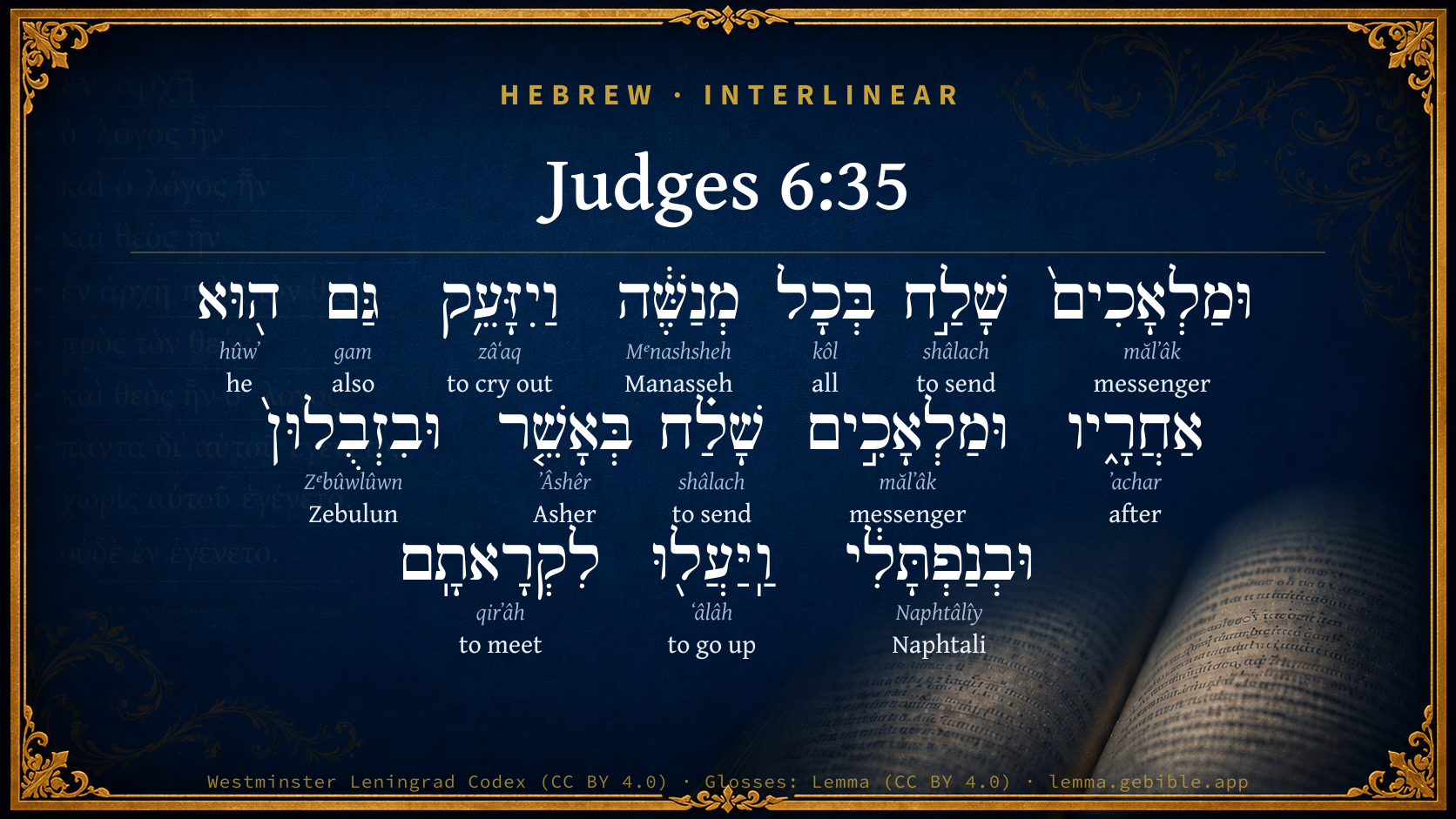
Judges 6:35

Hebrew (Westminster Leningrad Codex) Judges 6:35 appears in the Hebrew Old Testament. The text above is from the Westminster Leningrad Codex. Each word links to its Strong’s number, a concise gloss, and parsing drawn from the Open Scriptures Hebrew Bible morphology. Click any word for its full Brown-Driver-Briggs (BDB) entry.
Download image
Cite this verse

Judges 6:35 (World English Bible). Public Domain. Lemma interlinear Bible study tool, https://lemma.gebible.app/v/judges/6/35.

Show BibTeX & RIS
BibTeX
RIS
English Translation
He sent messengers throughout all Manasseh; and they also were gathered together after him: and he sent messengers to Asher, and to Zebulun, and to Naphtali; and they came up to meet them.
World English Bible · Public Domain
Download a study sheet

One document with this verse’s original text, its word-by-word gloss line, the meaning frame, cross-references with their text, attributed commentary, and full source and license credits — printable, and it pastes into notes with its structure intact.

This verse Autodidact and up

Study sheet (.html) Plain text (.txt)

A passage Seminary Student

Up to 50 verses in one chapter. A passage sheet keeps up to 6 commentary sources and 12 cross-references per verse, in the order this page ranks them, and says so on the sheet whenever that leaves anything out. Ask for a single verse and you get the Autodidact verse sheet above.

Everything on this page stays free to read, with no account — the sheet is a download of what is already on screen, not access to it.

Want to remove ads? Support Godless Engineer
Compare translations 3

The same verse in 3 English versions, stacked beneath the original-language interlinear above. Click any original word for its lexicon entry.

Each is an independent rendering of the whole verse — the interlinear is not word-aligned to these translations.

Highlighted words mark where these versions differ — a whole-verse word diff, not a word-by-word alignment.

  • World English Bible Public Domain
    He sent messengers throughout all Manasseh; and they also were gathered together after him: and he sent messengers to Asher, and to Zebulun, and to Naphtali; and they came up to meet them.
  • King James Version Public Domain
    And he sent messengers throughout all Manasseh; who also was gathered after him: and he sent messengers unto Asher, and unto Zebulun, and unto Naphtali; and they came up to meet them.
  • unfoldingWord Literal Text CC BY-SA 4.0
    And he sent messengers through all of Manasseh, and he summoned him also after him. And he sent messengers through Asher and through Zebulun and through Naphtali, and they went up to meet them.

unfoldingWord Literal Text — © unfoldingWord, licensed CC BY-SA 4.0. Word-aligned USFM3 via Door43 (git.door43.org/unfoldingWord/en_ult).

Versions to compare (up to 4)

3 of 4 selected

Show all 18 translations

Every available English version of this verse, each an independent rendering of the whole verse.

  • World English Bible Public Domain
    He sent messengers throughout all Manasseh; and they also were gathered together after him: and he sent messengers to Asher, and to Zebulun, and to Naphtali; and they came up to meet them.
  • Berean Standard Bible Public Domain
    Calling them to arms, Gideon sent messengers throughout Manasseh, as well as Asher, Zebulun, and Naphtali, so that they came up to meet him.
  • Majority Standard Bible Public Domain
    Calling them to arms, Gideon sent messengers throughout Manasseh, as well as Asher, Zebulun, and Naphtali, so that they came up to meet him.
  • King James Version Public Domain
    And he sent messengers throughout all Manasseh; who also was gathered after him: and he sent messengers unto Asher, and unto Zebulun, and unto Naphtali; and they came up to meet them.
  • American Standard Version (1901) Public Domain
    And he sent messengers throughout all Manasseh; and they also were gathered together after him: and he sent messengers unto Asher, and unto Zebulun, and unto Naphtali; and they came up to meet them.
  • Revised Version (1885) Public Domain
    And he sent messengers throughout all Manasseh; and they also were gathered together after him: and he sent messengers unto Asher, and unto Zebulun, and unto Naphtali; and they came up to meet them.
  • Geneva Bible (1599) Public Domain
    And he sent messengers thorowout al Manasseh, which also was ioyned with him, and he sent messengers vnto Asher, and to Zebulun and to Naphtali, and they came vp to meete them.
  • Douay-Rheims (1899) Public Domain
    But the spirit of the Lord came upon Gedeon, and be sounded the trumpet and called together the house of Abiezer, to follow him.
  • Young's Literal Translation Public Domain
    and messengers he hath sent into all Manasseh, and it also is called after him; and messengers he hath sent into Asher, and into Zebulun, and into Naphtali, and they come up to meet them.
  • Literal Standard Version CC BY-SA 4.0
    and he has sent messengers into all Manasseh, and it is also called after him; and he has sent messengers into Asher, and into Zebulun, and into Naphtali, and they come up to meet them.
  • Unlocked Literal Bible CC BY-SA 4.0
    He sent messengers all throughout Manasseh, and they too, were called out to follow him. He also sent messengers to Asher, Zebulun, and Naphtali, and they went up to meet him.
  • unfoldingWord Literal Text CC BY-SA 4.0
    And he sent messengers through all of Manasseh, and he summoned him also after him. And he sent messengers through Asher and through Zebulun and through Naphtali, and they went up to meet them.
  • Darby Bible Public Domain
    And he sent messengers throughout all Manas'seh; and they too were called out to follow him. And he sent messengers to Asher, Zeb'ulun, and Naph'tali; and they went up to meet them.
  • World Messianic Bible Public Domain
    He sent messengers throughout all Manasseh, and they also were gathered together to follow him. He sent messengers to Asher, to Zebulun, and to Naphtali; and they came up to meet them.
  • Webster's Bible Public Domain
    And he sent messengers throughout all Manasseh; who also was called after him: and he sent messengers to Asher, and to Zebulun, and to Naphtali; and they came up to meet them.
  • Free Bible Version CC BY-SA 4.0
    He sent messengers through the whole territory of Manasseh, calling them to join him, and also to Asher, Zebulun and Naphtali, so they also came and joined the others.
  • Bible in Basic English Public Domain
    And he sent through all Manasseh, and they came after him; and he sent to Asher and Zebulun and Naphtali, and they came up and were joined to the others.
  • JPS Tanakh (1917) Public Domain
    And he sent messengers throughout all Manasseh; and they also were gathered together after him; and he sent messengers unto Asher, and unto Zebulun, and unto Naphtali; and they came up to meet them.

Literal Standard Version (2020), Covenant Press — licensed CC BY-SA 4.0. Text via the HelloAO Bible API (eBible.org). Unlocked Literal Bible (unfoldingWord) — licensed CC BY-SA 4.0. Text via the HelloAO Bible API (eBible.org). unfoldingWord Literal Text — © unfoldingWord, licensed CC BY-SA 4.0. Word-aligned USFM3 via Door43 (git.door43.org/unfoldingWord/en_ult). Free Bible Version, Dr. Jonathan Gallagher — licensed CC BY-SA 4.0. Text via the HelloAO Bible API (eBible.org).

Word by word

More ways to search: Search by grammar → Find every occurrence → Compare this word →

Practice this passage: Drill this verse → Learn its vocabulary →

בְּאָשֵׁ֤ר
ʼÂshêr
H836
“in/at · Asher”
Preposition + Noun, Proper
Part of Speech
Preposition + Noun
Type
Proper
Full BDB Definition

Origin: from H833

TWOT: None

Asher = "happy" - son of Jacob and Zilpah - the tribe descended from Asher - a city east of Shechem in Manasseh
  1. וּמַלְאָכִים֙ mălʼâk H4397 “and · messengers” Conjunction + Noun, Common, Masculine, Plural, Absolute
  2. שָׁלַ֣ח shâlach H7971 “to send” Verb, Qal, Perfect, 3rd Person, Masculine, Singular
  3. בְּכָל kôl H3605 “in/at · all of” Preposition + Noun, Common, Masculine, Singular, Construct
  4. מְנַשֶּׁ֔ה Mᵉnashsheh H4519 “Manasseh” Noun, Proper
  5. וַיִזָּעֵ֥ק zâʻaq H2199 “and · to cry out” Conjunction + Verb, Niphal, Sequential Imperfect, 3rd Person, Masculine, Singular
  6. גַּם gam H1571 “also” Particle, Accusative
  7. ה֖וּא hûwʼ H1931 “he” Pronoun, Personal, 3rd Person, Masculine, Singular
  8. אַחֲרָ֑יו ʼachar H310 “after · him” Preposition + Suffix, Personal, 3rd Person, Masculine, Singular
  9. וּמַלְאָכִ֣ים mălʼâk H4397 “and · messengers” Conjunction + Noun, Common, Masculine, Plural, Absolute
  10. שָׁלַ֗ח shâlach H7971 “to send” Verb, Qal, Perfect, 3rd Person, Masculine, Singular
  11. וּבִזְבֻלוּן֙ Zᵉbûwlûwn H2074 “and · in/at · Zebulun” Conjunction + Preposition + Noun, Proper
  12. וּבְנַפְתָּלִ֔י Naphtâlîy H5321 “and · in/at · Naphtali” Conjunction + Preposition + Noun, Proper
  13. וַֽיַּעֲל֖וּ ʻâlâh H5927 “and · to go up” Conjunction + Verb, Qal, Sequential Imperfect, 3rd Person, Masculine, Plural
  14. לִקְרָאתָֽם qirʼâh H7125 “to meet · them” Preposition + Verb, Qal, Infinitive Construct + Suffix, Personal, 3rd Person, Masculine, Plural

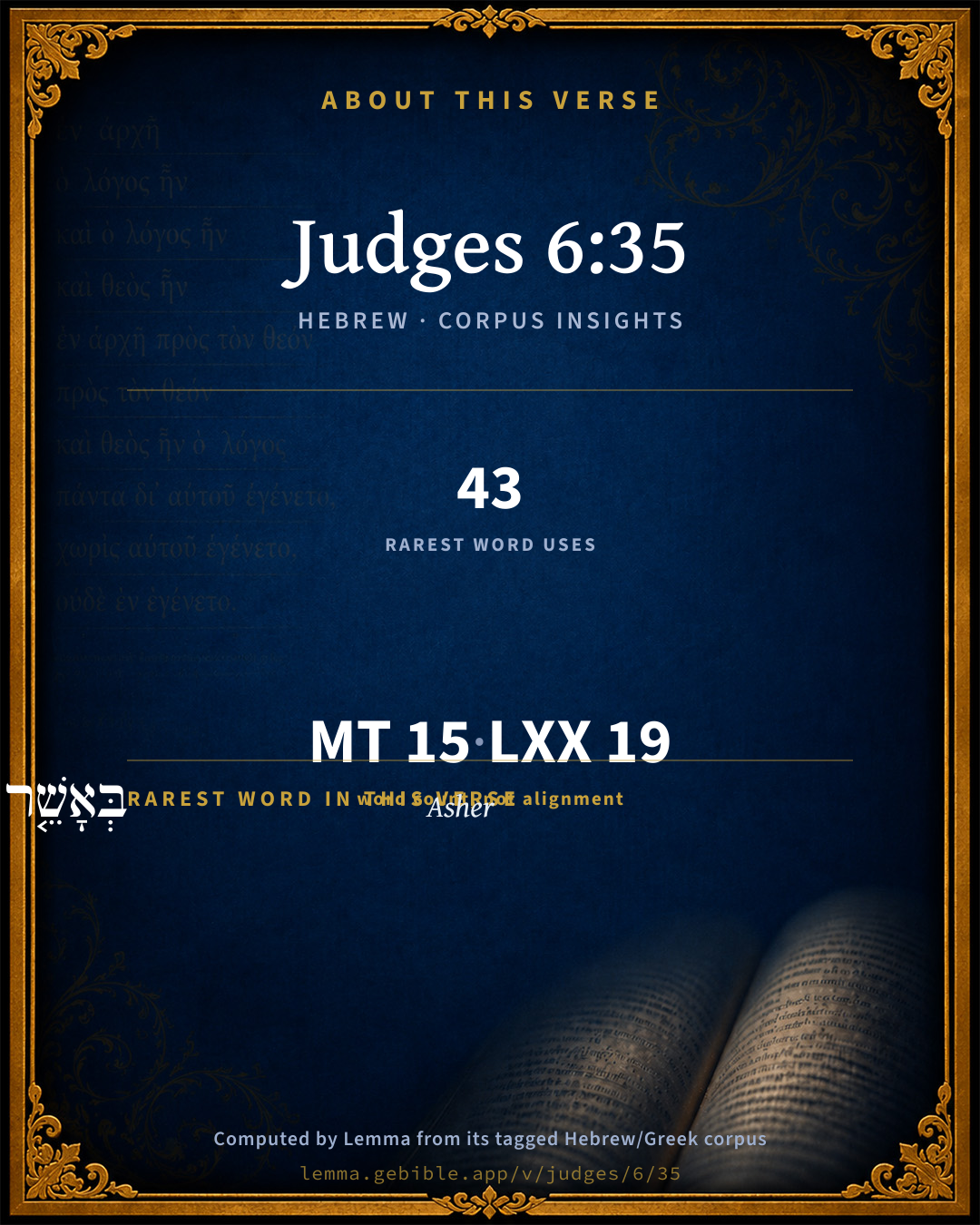
About this verse

These counts appear in no published source. They are computed here, from the morphology-tagged text and Lemma’s own curated glosses. What Lemma adds →

15
words
13
distinct lemmas
Historical
section

Shared distinctive vocabulary

בְּאָשֵׁ֤ר Asher H836 occurs in 41 verses of the Hebrew Bible. Also found in:

Grammatical profile

  • 5 verbs
  • 7 nouns
  • 1 pronoun
  • 1 preposition
  • 1 particle

Verb forms

  • שָׁלַ֣ח Qal · Perfect
  • וַיִזָּעֵ֥ק Niphal · Sequential Imperfect
  • שָׁלַ֗ח Qal · Perfect
  • וַֽיַּעֲל֖וּ Qal · Sequential Imperfect
  • לִקְרָאתָֽם Qal · Infinitive Construct

Repetition

Words recur within this verse — often emphatic in Hebrew:

  • וּמַלְאָכִים֙ messenger H4397 ×2
  • שָׁלַ֣ח to send H7971 ×2

Hebrew & Septuagint length

In English translation the verse runs 33 words from the Hebrew and 23 from the Septuagint (LXX English) — the Septuagint runs noticeably shorter here. See the side-by-side →

A rough comparison of the two English renderings, which tokenize alike — not a word-level alignment.

Word counts can differ between the Hebrew and the Greek without any difference in meaning — e.g. the Hebrew direct-object marker אֵת has no separate Greek word, and Greek often adds the article ὁ.

In the original languages it is 15 Hebrew tokens and 19 Greek tokens — but the two are counted differently (Hebrew bundles its prefixes and suffixes into one token; the Greek is in lemma form), so that isn’t a like-for-like length.

Cross-references

2

Topical passages linked to Judges 6:35 in the Treasury of Scripture Knowledge — connected by theme and wording, ordered by reader-vote popularity; previews shown in the World English Bible.

  • Judges 4:6 She sent and called Barak the son of Abinoam out of Kedesh-naphtali, and said to him, Hasn't Yahweh, the God of Israel, commanded, [saying], Go and draw to Mount Tabor, and take with you ten thousand men of the children of Naphtali and of the children of Zebulun?
  • 2 Chronicles 30:6–12 So the posts went with the letters from the king and his princes throughout all Israel and Judah, and according to the commandment of the king, saying, You children of Israel, turn again to Yahweh, the God of Abraham, Isaac, and Israel, that he may return to the remnant that have escaped of you out of the hand of the kings of Assyria.

Cross-references courtesy of OpenBible.info (CC BY 4.0).

Hebrew and Greek witnesses Masoretic Hebrew ↔ Greek Septuagint

The same verse in the two great witnesses to the Old Testament, shown verse-for-verse.

Here the Septuagint runs noticeably shorter than the Hebrew — LXX2012 (modern English Septuagint) 23 words vs World English Bible 33. A rough length comparison of the two English translations, not a word-level alignment — read both below.

These are two independent witnesses, not word-aligned to each other, and the Septuagint is shown in lemma (dictionary) form.

Hebrew Judges 6:35 Masoretic · Westminster Leningrad Codex

וּמַלְאָכִים֙ שָׁלַ֣ח בְּכָל מְנַשֶּׁ֔ה וַיִזָּעֵ֥ק גַּם ה֖וּא אַחֲרָ֑יו וּמַלְאָכִ֣ים שָׁלַ֗ח בְּאָשֵׁ֤ר וּבִזְבֻלוּן֙ וּבְנַפְתָּלִ֔י וַֽיַּעֲל֖וּ לִקְרָאתָֽם

He sent messengers throughout all Manasseh; and they also were gathered together after him: and he sent messengers to Asher, and to Zebulun, and to Naphtali; and they came up to meet them.

World English Bible · Public Domain

Greek LXX Judges 6:35 Septuagint · lemma form

καί ἄγγελος ἀποστέλλω εἰς πᾶς μανασσή καί ἐν ασηρ καί ἐν ζαβουλων καί νεφθαλι καί ἀναβαίνω εἰς συνάντησις αὐτός

And Gedeon sent messengers into all Manasse, and into Aser, and into Zabulon, and into Nephthali; and he went up to meet them.

LXX2012 (modern English Septuagint) · Public Domain

Hebrew: Westminster Leningrad Codex (CC BY 4.0). Greek: Septuagint (public domain); English from LXX2012 (modern English Septuagint) (Public Domain). How the Septuagint differs from the Hebrew →

Targum (Aramaic paraphrase)

1

The Targum is the ancient Jewish Aramaic paraphrase of the Hebrew Scriptures — an interpretive translation, not the Hebrew text itself. Onkelos (literal) and Pseudo-Jonathan (expansive) render the Torah, and Jonathan the Prophets. Coverage is partial: where no permissively-licensed English translation exists for a verse, only the Aramaic is shown. This is verse-level text, not a word-by-word alignment to the Hebrew.

  1. Targum Jonathan Prophets (Joshua–Malachi)
    וְאִזְגַדִין שָׁלַח בְּכָל תְּחוּם מְנַשֶׁה וְאִתְכְּנִישׁוּ אַף אִינוּן בַּתְרוֹהִי וְאִזְגַדִין שָׁלַח בְּשֵׁבֶט אָשֵׁר וּבְשֵׁבֶט זְבוּלֻן וּבְשֵׁבֶט נַפְתָּלִי וּסְלִיקוּ לָקֳדָמוּתְהוֹן:

    (no public-domain English translation for this verse)

    Targum Jonathan — Aramaic: “Mikraot Gedolot” (public domain). English: “Sefaria Community Translation” (CC0 1.0 (public-domain dedication)); “London "Chaldee Paraphrase," 1871” (public domain). Text via Sefaria.

Commentary

Notes on Judges 6:35 from classic Christian and Jewish commentators (each source and its license shown beneath its notes). The classic Christian expositions comment on the surrounding passage and are grouped to its opening verse, so a note may address several verses; the Jewish commentaries on the Tanakh (Rashi and others) are per-verse, so they appear only where the commentator wrote on this verse.

Lemma curates 59 commentaries, every one of them public domain or Creative Commons licensed, each selected and text-cleaned for this edition rather than reprinted as found. About our sources →

Trapp's Complete Commentary

John Trapp

Jdg 6:35 And he sent messengers throughout all Manasseh; who also was gathered after him: and he sent messengers unto Asher, and unto Zebulun, and unto Naphtali; and they came up to meet them.

Ver. 35. And they came up to meet them.] Asher was justly blamed by Deborah for their backwardness to fight against Sisera. Here they come with the first. Sarciamus et nos quod peccatum est. It is happy when people mend.

John Trapp, A Commentary or Exposition upon All the Books of the Old and New Testament (1647–1656) — public domain. Text from a community e-Sword module.

Joseph Benson's Commentary

Jdg 6:35. All Manasseh — On both sides of Jordan. Unto Asher, &c. — Because these tribes were nearest, and so could soonest join with him; and were nearest the enemy also, (Jdg 6:33,) and therefore were most sensible of the calamity, and would in all reason be most forward to rescue themselves from it.

Joseph Benson's Commentary on the Old and New Testaments (1811–1818) — public domain. Text from a community e-Sword module.

Ellicott's Commentary for English Readers

(35) Throughout all Manasseh.—The loyalty with which his own clan, the Abi-ezrites, rallied round him gave him a right to claim still wider support.

Asher.—This tribe, by faithfulness on this occasion, partly redeemed its honour from the tarnish attached of its former defection. This time Asher did not linger on the sands of Accho or the rocks of the Tyrian Ladder. Issachar, however, as before, “bowed his shoulder to the yoke.” Perhaps the fact that the Plain of Jezreel, the battle-field of Palestine, was in the domains of this tribe, though not far from the border of Manasseh (Jos_17:16), was unfavourable to their independence and strength. The fierce and haughty character of the tribe of Ephraim, and their jealousy of any leader who did not come from themselves, may have prevented Gideon from risking a rebuff by sending to them.

Zebulun, Naphtali.—These tribes again distinguished themselves, as in the campaign against Jabin (Jdg_5:18).

A Bible Commentary for English Readers, edited by Charles John Ellicott (1878–1897) — public domain. Text from a community e-Sword module.

The Cambridge Bible for Schools and Colleges

gen. ed. J. J. S. Perowne

35. In Jdg_7:23 these tribes, with the exception of Zebulun, gather together after the battle: here Gideon summons them before. It is difficult to reconcile the two statements. Some notice of a general muster is wanted to account for the large numbers with Gideon in Jdg_7:2-8; probably this was the reason why the verse was inserted here.

to meet them] i.e. the Midianites; the previous verb means they went up for war, as in Jdg_6:3, Jdg_1:1, Jdg_12:3 etc.

The Cambridge Bible for Schools and Colleges (gen. ed. J. J. S. Perowne; Cambridge University Press, 1878–1918) — public domain. Text from a community e-Sword module.

John Gill's Exposition

And Gideon said unto God,.... Not to a prophet of God who was there, of whom he asked the following signs to be done, as Ben Gersom, but to God in prayer, as Abarbinel:

if thou wilt save Israel by mine hand, as thou hast said; not that he doubted of it, but was willing to have a confirmation of his faith; and perhaps his view was more for the encouragement of those that were with him than himself, that he desired the following signs; and though he had had one before, that was to show that he was truly an angel that spoke to him, and not to ascertain the salvation that should be wrought by him; though that might be concluded from his being an angel that spoke to him, and assured him of it.

John Gill's Exposition of the Whole Bible (1746–1763) — public domain (CC PDM 1.0). Text via the HelloAO Bible API.

Albert Barnes' Notes on the Bible

His own tribe, Manasseh, and the three northern tribes of Asher, Zebulon, and Naphtali hastened to join him. Issachar was probably unable to do so, because the Midianites were encamped in the heart of their country. Asher no longer “abode in his breaches,” as in the time of Jabin Jdg 6:17, perhaps ashamed of their former backwardness, and stung by the rebuke of Deborah; perhaps, too, from feeling the Midianite yoke much more galling than that of Jabin.

Albert Barnes' Notes on the Bible (1834–1885) — public domain. Text from a community e-Sword/MySword module.

Haydock's Catholic Bible Commentary

Him. Hebrew, "them." (Menochius) --- The people readily obey the summons, though many of them had not got the better of their fears, chap. vii. 3. (Haydock)

George Leo Haydock (1774–1849), Haydock's Catholic Family Bible and Commentary, 1859 edition — public domain. Excludes Psalms (Douay-Rheims chapter numbering differs from Protestant) and Deuterocanonical books (Catholic canon only).

Matthew Poole's English Annotations

Throughout all Manasseh, on both sides of Jordan.

Unto Asher, Zebulun, and Naphtali; because these tribes were nearest to him, and so could soonest join with him; and were nearest the enemy also, Jdg 6:33, and therefore were most sensible of the calamity, and would in all reason be most forward to rescue themselves from it.

Matthew Poole's English Annotations on the Holy Bible (1683–1685) — public domain. Text from a community e-Sword/MySword module.

Whedon's Commentary on the Bible

Daniel D. Whedon

35. Manasseh… Asher… Zebulun… Naphtali — These tribes were near at hand, and could be easily summoned; but why other tribes were not also notified does not appear. Subsequently the Ephraimites were summoned to head off the flying Midianites, (Jdg_7:24,) but for all that took offence. Jdg_8:1.

They came up to meet them — That is, the men of Asher, Zebulun, and Naphtali came to meet the Manassites.

Daniel D. Whedon (gen. ed.), Commentary on the Old and New Testaments (1874–1909) — public domain. Text from a community e-Sword module.

The Pulpit Commentary

He sent messengers, etc. Manasseh, Asher, Zebulun, and Naphtali were the adjacent tribes Manasseh (i.e. the half tribe of Manasseh, west of Jordan) on the south, Asher on the west, and Zebulun and Naphtali on the north. Three of these were the very tribes who had fought under Barak, and it is pleasing to see Asher now joined with them instead of abiding in his breaches. This ready compliance with the call was the consequence of the Spirit of the Lord being upon Gideon. Came up. No doubt Gideon was eneamped upon one of the southern hills that overlooked the plain, probably Gilboa, just as Barak was on Mount Tabor. (see Jud 8:8-12) To meet them, i.e. Gideon and the Abi-ezrites.

The Pulpit Commentary (1880–1919), ed. H.D.M. Spence-Jones & Joseph S. Exell — public domain. Text from a community e-Sword module.

John Wesley's Explanatory Notes

All Manasseh - On Both sides of Jordan. Unto Asher, &c. - Because these tribes were nearest, and so could soonest join with him; and were nearest the enemy also, ver. 33, and therefore were most sensible of the calamity, and would in all reason be most forward to rescue themselves from it.

John Wesley, Explanatory Notes Upon the Whole Bible (1754–1765) — public domain. Text via the GEBible commentary corpus.

Lesson kit

Teaching starters — assembled from the data on this page, not authored interpretation. Every prompt links to the verse data it draws on. Edit before teaching.

Judges, in the Historical, opens this verse with 15 words (13 distinct Hebrew lemmas). Its most distinctive word is ʼÂshêr (“Asher”). The Greek Septuagint runs shorter here. A historical commentator’s framing appears above. Read the whole chapter for the surrounding context.

Discussion questions

  1. How does “Asher” (ʼÂshêr) shape what this verse is saying?
  2. Genesis 30:13 shares the word «Asher» with this verse. How do the two illuminate each other?
  3. “messenger” occurs 2× in this one verse. What is the effect of the repetition?
  4. Compared with the Hebrew, the Septuagint runs shorter here. What questions does that raise?
  5. These translations render this verse differently; the difference is in the English rendering, not the original. What questions does that raise?
  6. The verb «שָׁלַ֣ח» is Qal Perfect. How does its form color the action?
  7. Reading how Trapp's Complete Commentary and Joseph Benson's Commentary read this verse, where do the two commentators agree and where do they part?

Things to notice

Reading settings

Reading text

Shown beneath each verse's original-language words.

Old Testament
Old Testament edition

Read the OT as the Masoretic Hebrew (MT) or the Greek Septuagint (LXX).

English shown for the Greek Septuagint (in the Hebrew ↔ Greek comparison).

Comparing translations? Open the Compare panel on any verse page to stack up to four side by side.