Judges 6:20

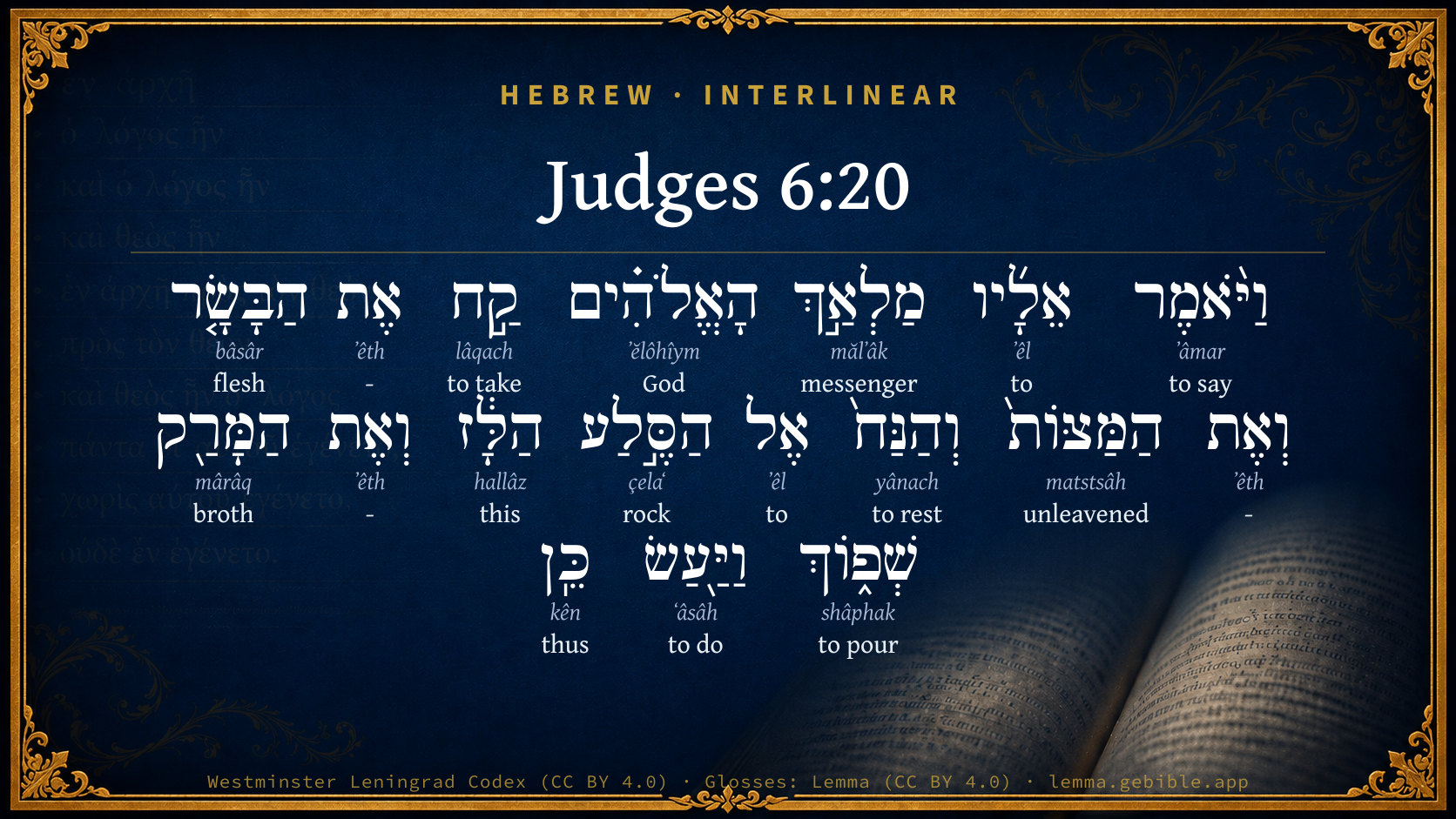
Hebrew (Westminster Leningrad Codex) Judges 6:20 appears in the Hebrew Old Testament. The text above is from the Westminster Leningrad Codex. Each word links to its Strong’s number, a concise gloss, and parsing drawn from the Open Scriptures Hebrew Bible morphology. Click any word for its full Brown-Driver-Briggs (BDB) entry.
Download image
Cite this verse

Judges 6:20 (World English Bible). Public Domain. Lemma interlinear Bible study tool, https://lemma.gebible.app/v/judges/6/20.

Show BibTeX & RIS
BibTeX
RIS
English Translation
The angel of God said to him, Take the flesh and the unleavened cakes, and lay them on this rock, and pour out the broth. He did so.
World English Bible · Public Domain
Highlights
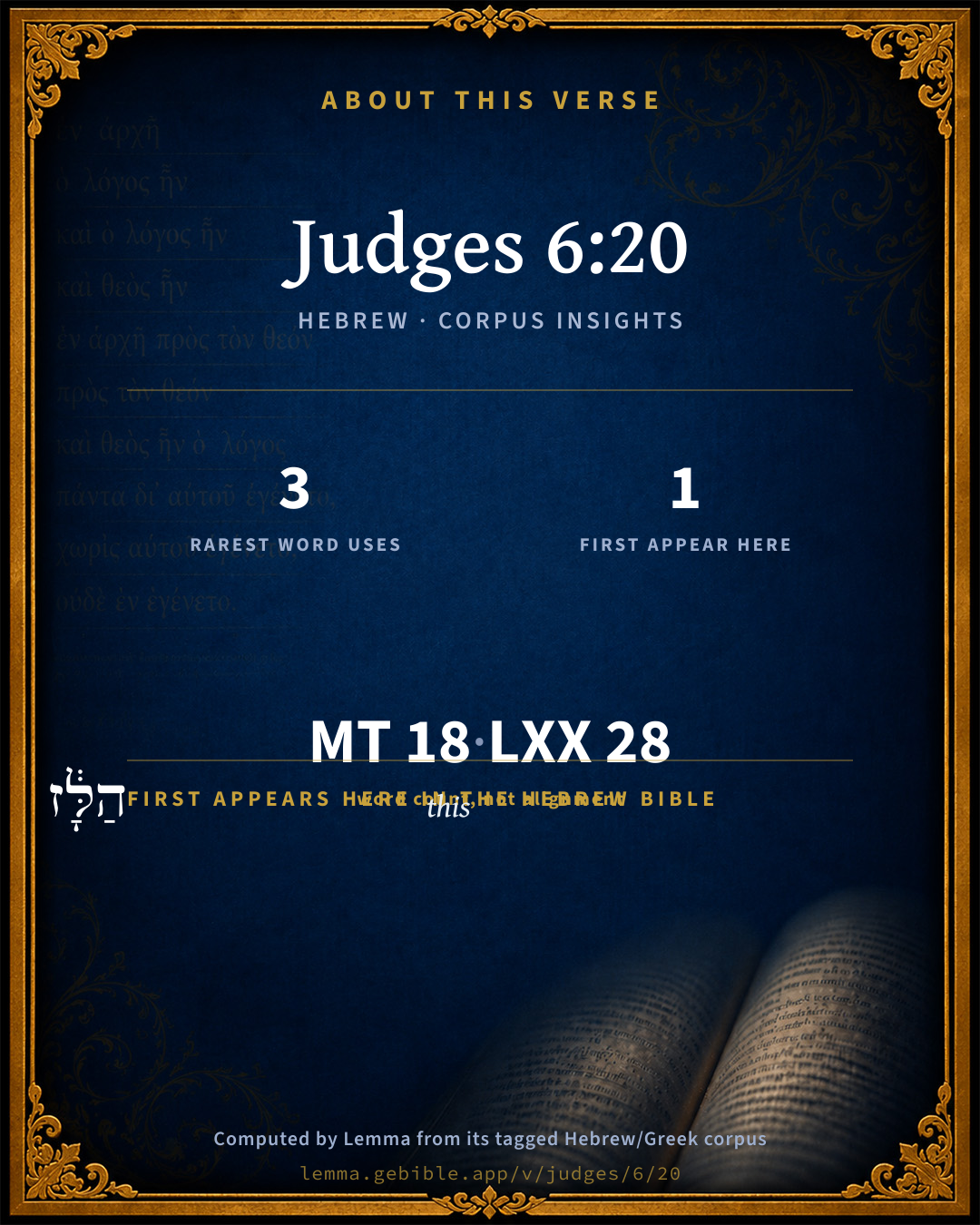
  • 1 first appearance in the Hebrew Bible
Full analysis ↓
Download a study sheet

One document with this verse’s original text, its word-by-word gloss line, the meaning frame, cross-references with their text, attributed commentary, and full source and license credits — printable, and it pastes into notes with its structure intact.

This verse Autodidact and up

Study sheet (.html) Plain text (.txt)

A passage Seminary Student

Up to 50 verses in one chapter. A passage sheet keeps up to 6 commentary sources and 12 cross-references per verse, in the order this page ranks them, and says so on the sheet whenever that leaves anything out. Ask for a single verse and you get the Autodidact verse sheet above.

Everything on this page stays free to read, with no account — the sheet is a download of what is already on screen, not access to it.

Want to remove ads? Support Godless Engineer
Compare translations 3

The same verse in 3 English versions, stacked beneath the original-language interlinear above. Click any original word for its lexicon entry.

Each is an independent rendering of the whole verse — the interlinear is not word-aligned to these translations.

Highlighted words mark where these versions differ — a whole-verse word diff, not a word-by-word alignment.

  • World English Bible Public Domain
    The angel of God said to him, Take the flesh and the unleavened cakes, and lay them on this rock, and pour out the broth. He did so.
  • King James Version Public Domain
    And the angel of God said unto him, Take the flesh and the unleavened cakes, and lay them upon this rock, and pour out the broth. And he did so.
  • unfoldingWord Literal Text CC BY-SA 4.0
    And the angel of God said to him, “Take the meat and the unleavened bread and place on this rock, and pour out the broth.” And he did so.

unfoldingWord Literal Text — © unfoldingWord, licensed CC BY-SA 4.0. Word-aligned USFM3 via Door43 (git.door43.org/unfoldingWord/en_ult).

Versions to compare (up to 4)

3 of 4 selected

Show all 18 translations

Every available English version of this verse, each an independent rendering of the whole verse.

  • World English Bible Public Domain
    The angel of God said to him, Take the flesh and the unleavened cakes, and lay them on this rock, and pour out the broth. He did so.
  • Berean Standard Bible Public Domain
    And the angel of God said to him, “Take the meat and the unleavened bread, lay them on this rock, and pour out the broth.” And Gideon did so.
  • Majority Standard Bible Public Domain
    And the angel of God said to him, “Take the meat and the unleavened bread, lay them on this rock, and pour out the broth.” And Gideon did so.
  • King James Version Public Domain
    And the angel of God said unto him, Take the flesh and the unleavened cakes, and lay them upon this rock, and pour out the broth. And he did so.
  • American Standard Version (1901) Public Domain
    And the angel of God said unto him, Take the flesh and the unleavened cakes, and lay them upon this rock, and pour out the broth. And he did so.
  • Revised Version (1885) Public Domain
    And the angel of God said unto him, Take the flesh and the unleavened cakes, and lay them upon this rock, and pour out the broth. And he did so.
  • Geneva Bible (1599) Public Domain
    And the Angell of God saide vnto him, Take the flesh and the vnleauened bread, and lay them vpon this stone, and powre out the broth: and he did so.
  • Douay-Rheims (1899) Public Domain
    So Gedeon went in, and boiled a kid, and made unleavened loaves of a measure of flour: and putting the flesh in a basket, and the broth of the flesh into a pot, he carried all under the oak, and presented to him.
  • Young's Literal Translation Public Domain
    And the messenger of God saith unto him, `Take the flesh and the unleavened things, and place on this rock -- and the broth pour out;' and he doth so.
  • Literal Standard Version CC BY-SA 4.0
    And the Messenger of God says to him, “Take the flesh and the unleavened things, and place [them] on this rock—and pour out the broth”; and he does so.
  • Unlocked Literal Bible CC BY-SA 4.0
    The angel of God said to him, “Take the meat and the unleavened bread and put them on this rock, and pour out the broth over them.” That is what Gideon did.
  • unfoldingWord Literal Text CC BY-SA 4.0
    And the angel of God said to him, “Take the meat and the unleavened bread and place on this rock, and pour out the broth.” And he did so.
  • Darby Bible Public Domain
    And the angel of God said to him, "Take the meat and the unleavened cakes, and put them on this rock, and pour the broth over them." And he did so.
  • World Messianic Bible Public Domain
    The angel of God said to him, “Take the meat and the unleavened cakes, and lay them on this rock, and pour out the broth.” He did so.
  • Webster's Bible Public Domain
    And the angel of God said to him, Take the flesh and the unleavened cakes, and lay them upon this rock, and pour out the broth. And he did so.
  • Free Bible Version CC BY-SA 4.0
    The angel of God told him, “Place the meat and the unleavened bread on this rock and pour the broth over them.” So Gideon did.
  • Bible in Basic English Public Domain
    And the angel of God said to him, Take the meat and the unleavened cakes and put them down on the rock over there, draining out the soup over them. And he did so.
  • JPS Tanakh (1917) Public Domain
    And the angel of God said unto him: 'Take the flesh and the unleavened cakes, and lay them upon this rock, and pour out the broth.' And he did so.

Literal Standard Version (2020), Covenant Press — licensed CC BY-SA 4.0. Text via the HelloAO Bible API (eBible.org). Unlocked Literal Bible (unfoldingWord) — licensed CC BY-SA 4.0. Text via the HelloAO Bible API (eBible.org). unfoldingWord Literal Text — © unfoldingWord, licensed CC BY-SA 4.0. Word-aligned USFM3 via Door43 (git.door43.org/unfoldingWord/en_ult). Free Bible Version, Dr. Jonathan Gallagher — licensed CC BY-SA 4.0. Text via the HelloAO Bible API (eBible.org).

Word by word

More ways to search: Search by grammar → Find every occurrence → Compare this word →

Practice this passage: Drill this verse → Learn its vocabulary →

הַמָּרַ֖ק
mârâq
H4839
“the · broth”
Particle, Definite Article + Noun, Common, Masculine, Singular, Absolute
Part of Speech
Particle + Noun
Type
Common
Gender
Masculine
Number
Singular
State
Absolute
Full BDB Definition

Origin: from H4838

TWOT: 1247a

broth, juice cooked from meat
  1. וַיֹּ֨אמֶר ʼâmar H559 “and · to say” Conjunction + Verb, Qal, Sequential Imperfect, 3rd Person, Masculine, Singular
  2. אֵלָ֜יו ʼêl H413 “to · him” Preposition + Suffix, Personal, 3rd Person, Masculine, Singular
  3. מַלְאַ֣ךְ mălʼâk H4397 “messenger of” Noun, Common, Masculine, Singular, Construct
  4. הָאֱלֹהִ֗ים ʼĕlôhîym H430 “the · God(s)” Particle, Definite Article + Noun, Common, Masculine, Plural, Absolute
  5. קַ֣ח lâqach H3947 “take” Verb, Qal, Imperative, 2nd Person, Masculine, Singular
  6. אֶת ʼêth H853 “-” Particle, Direct Object
  7. הַבָּשָׂ֤ר bâsâr H1320 “the · flesh” Particle, Definite Article + Noun, Common, Masculine, Singular, Absolute
  8. וְאֶת ʼêth H853 “and · -” Conjunction + Particle, Direct Object
  9. הַמַּצּוֹת֙ matstsâh H4682 “the · unleavened bread” Particle, Definite Article + Noun, Common, Feminine, Plural, Absolute
  10. וְהַנַּח֙ yânach H3240 “and · rest” Conjunction + Verb, Hiphil, Imperative, 2nd Person, Masculine, Singular
  11. אֶל ʼêl H413 “to” Preposition
  12. הַסֶּ֣לַע çelaʻ H5553 “the · rock” Particle, Definite Article + Noun, Common, Masculine, Singular, Absolute
  13. הַלָּ֔ז hallâz H1975 “this” Pronoun, Demonstrative, Common, Singular
  14. וְאֶת ʼêth H853 “and · -” Conjunction + Particle, Direct Object
  15. שְׁפ֑וֹךְ shâphak H8210 “pour” Verb, Qal, Imperative, 2nd Person, Masculine, Singular
  16. וַיַּ֖עַשׂ ʻâsâh H6213 “and · to do” Conjunction + Verb, Qal, Sequential Imperfect, 3rd Person, Masculine, Singular
  17. כֵּֽן kên H3651 “thus” Particle, Demonstrative

About this verse

These counts appear in no published source. They are computed here, from the morphology-tagged text and Lemma’s own curated glosses. What Lemma adds →

18
words
15
distinct lemmas
Historical
section

Notable vocabulary

The rarest word here is הַמָּרַ֖ק broth H4839 — appearing just 3 times in the whole Hebrew Bible.

First appearance in Scripture

This word makes its first canonical appearance in the Hebrew Bible here:

  • הַלָּ֔ז this H1975

Shared distinctive vocabulary

הַמָּרַ֖ק broth H4839 occurs in 3 verses of the Hebrew Bible. Also found in:

Grammatical profile

  • 5 verbs
  • 6 nouns
  • 1 pronoun
  • 2 prepositions
  • 4 particles

Verb forms

  • וַיֹּ֨אמֶר Qal · Sequential Imperfect
  • קַ֣ח Qal · Imperative
  • וְהַנַּח֙ Hiphil · Imperative
  • שְׁפ֑וֹךְ Qal · Imperative
  • וַיַּ֖עַשׂ Qal · Sequential Imperfect

Repetition

A word recurs within this verse — often emphatic in Hebrew:

  • אֵלָ֜יו to H413 ×2

Hebrew & Septuagint length

In English translation the verse runs 28 words from the Hebrew and 32 from the Septuagint (LXX English) — closely comparable.

A rough comparison of the two English renderings, which tokenize alike — not a word-level alignment.

Word counts can differ between the Hebrew and the Greek without any difference in meaning — e.g. the Hebrew direct-object marker אֵת has no separate Greek word, and Greek often adds the article ὁ.

In the original languages it is 18 Hebrew tokens and 28 Greek tokens — but the two are counted differently (Hebrew bundles its prefixes and suffixes into one token; the Greek is in lemma form), so that isn’t a like-for-like length.

Cross-references

2

Topical passages linked to Judges 6:20 in the Treasury of Scripture Knowledge — connected by theme and wording, ordered by reader-vote popularity; previews shown in the World English Bible.

  • Judges 13:19 So Manoah took the kid with the meal-offering, and offered it on the rock to Yahweh: and [the angel] did wondrously, and Manoah and his wife looked on.
  • 1 Kings 18:33–34 He put the wood in order, and cut the bull in pieces, and laid it on the wood. He said, Fill four jars with water, and pour it on the burnt offering, and on the wood.

Cross-references courtesy of OpenBible.info (CC BY 4.0).

Hebrew and Greek witnesses Masoretic Hebrew ↔ Greek Septuagint

The same verse in the two great witnesses to the Old Testament, shown verse-for-verse.

These are two independent witnesses, not word-aligned to each other, and the Septuagint is shown in lemma (dictionary) form.

Hebrew Judges 6:20 Masoretic · Westminster Leningrad Codex

וַיֹּ֨אמֶר אֵלָ֜יו מַלְאַ֣ךְ הָאֱלֹהִ֗ים קַ֣ח אֶת הַבָּשָׂ֤ר וְאֶת הַמַּצּוֹת֙ וְהַנַּח֙ אֶל הַסֶּ֣לַע הַלָּ֔ז וְאֶת הַמָּרַ֖ק שְׁפ֑וֹךְ וַיַּ֖עַשׂ כֵּֽן

The angel of God said to him, Take the flesh and the unleavened cakes, and lay them on this rock, and pour out the broth. He did so.

World English Bible · Public Domain

Greek LXX Judges 6:20 Septuagint · lemma form

καί εἶπον πρός αὐτός ὁ ἄγγελος ὁ θεός λαμβάνω ὁ κρέας καί ὁ ἄζυμος καί τίθημι πρός ὁ πέτρα ἐκεῖνος καί ὁ ζωμός ἔχω ἐκχέω καί ποιέω οὕτως

And the angel of God said to him, Take the flesh and the unleavened cakes, and put them on that rock, and pour out the broth close by: and he did so.

LXX2012 (modern English Septuagint) · Public Domain

Hebrew: Westminster Leningrad Codex (CC BY 4.0). Greek: Septuagint (public domain); English from LXX2012 (modern English Septuagint) (Public Domain). How the Septuagint differs from the Hebrew →

Targum (Aramaic paraphrase)

1

The Targum is the ancient Jewish Aramaic paraphrase of the Hebrew Scriptures — an interpretive translation, not the Hebrew text itself. Onkelos (literal) and Pseudo-Jonathan (expansive) render the Torah, and Jonathan the Prophets. Coverage is partial: where no permissively-licensed English translation exists for a verse, only the Aramaic is shown. This is verse-level text, not a word-by-word alignment to the Hebrew.

  1. Targum Jonathan Prophets (Joshua–Malachi)
    וַאֲמַר לֵיהּ מַלְאָכָא דַיְיָ סַב יַת בִּסְרָא וְיַת פַּטִירָא וְאָחֵית לְכֵיפָא דֵיכִי וְיַת תַּבְשִׁילָא שְׁפוֹךְ וַעֲבַד כֵּן:

    (no public-domain English translation for this verse)

    Targum Jonathan — Aramaic: “Mikraot Gedolot” (public domain). English: “Sefaria Community Translation” (CC0 1.0 (public-domain dedication)); “London "Chaldee Paraphrase," 1871” (public domain). Text via Sefaria.

Commentary

Notes on Judges 6:20 from classic Christian and Jewish commentators (each source and its license shown beneath its notes). The classic Christian expositions comment on the surrounding passage and are grouped to its opening verse, so a note may address several verses; the Jewish commentaries on the Tanakh (Rashi and others) are per-verse, so they appear only where the commentator wrote on this verse.

Lemma curates 59 commentaries, every one of them public domain or Creative Commons licensed, each selected and text-cleaned for this edition rather than reprinted as found. About our sources →

Trapp's Complete Commentary

John Trapp

Jdg 6:20 And the angel of God said unto him, Take the flesh and the unleavened cakes, and lay [them] upon this rock, and pour out the broth. And he did so.

Ver. 20. And lay them upon this rock.] Christ is called the Rock, {1Co 10:4} and that is a good rule given by the apostle in Col 3:17, - "Whatsoever ye do in word or deed, do all in the name of the Lord Jesus, giving thanks to God and the Father by him."

John Trapp, A Commentary or Exposition upon All the Books of the Old and New Testament (1647–1656) — public domain. Text from a community e-Sword module.

Joseph Benson's Commentary

Jdg 6:20. Lay them upon this rock — Undoubtedly it gave Gideon some surprise, to be commanded to dispose thus of the refreshments which he had so hospitably prepared; but as he had doubtless by this time conceived a high opinion of this unknown person, (though he had not discovered him to be an angel,) so he readily obeyed his command.

Joseph Benson's Commentary on the Old and New Testaments (1811–1818) — public domain. Text from a community e-Sword module.

Adam Clarke's Commentary

Verse 20. Take the flesh, &c.] The angel intended to make the flesh and bread an offering to God, and the broth a libation.

Adam Clarke's Commentary on the Bible (1810–1826) — public domain. Text from a community e-Sword/MySword module.

Ellicott's Commentary for English Readers

(20) The angel of God.—Here alone in the chapter called “the angel of Elohim” and not “of Jehovah.”

Upon this rock.—Rather, upon yonder crag. The living rock (Exo_20:22) served well as an altar.

Pour out the broth.—Comp. Gen_35:14; Exo_30:9; 1Ki_18:34. In the first of these instances the “drink offering” is used as a libation; in the last Elijah pours the sea-water on the sacrifice, to show the impossibility of any deception. In 2Ma_1:20-36 Nehemiah pours the “thick water,” called “Naphthai,” on the sacrifice, and when the sun shone “there was a great fire kindled, so that every man marvelled.”

A Bible Commentary for English Readers, edited by Charles John Ellicott (1878–1897) — public domain. Text from a community e-Sword module.

The Cambridge Bible for Schools and Colleges

gen. ed. J. J. S. Perowne

20. He is now told to set down the flesh and the cakes upon the rock, and to pour out the broth. The latter act was distinctly sacrificial, though broth is not used elsewhere for a libation. There is reason to think that this verse did not belong to the original form of the narrative; note the terms ‘messenger of God,’ ‘rock’ (a different word from ‘rock’ in Jdg_6:21). At the same time a sentence is required, in view of Jdg_6:21, stating that Gideon set down the meal.

The Cambridge Bible for Schools and Colleges (gen. ed. J. J. S. Perowne; Cambridge University Press, 1878–1918) — public domain. Text from a community e-Sword module.

John Gill's Exposition

Then the angel of the Lord put forth the end of the staff that was in his hand,.... With which he walked, appearing as a traveller, and which was one reason of Gideon's providing for his refreshment, before he proceeded on in his journey:

and touched the flesh and the unleavened cakes; did not strike the rock with it, as Moses did with his rod, to fetch out water for the Israelites, but touched the provisions brought him; not using it instead of a knife to separate any part of them, but for the working of a miracle, as follows:

and there rose up fire out of the rock; had he struck the rock with his staff, the miracle would not have appeared so great, because it might be thought there was an iron ferrule at the end of it, which striking on a flinty rock might cause fire; but it was the flesh and cakes only that were touched, and these also as having broth poured on them, and the rock likewise:

and consumed the flesh, and the unleavened cakes; though they had the broth poured on them, and were sodden with it; so that the miracle was similar to that wrought by Elijah on Mount Carmel, Kg1 18:33, and those who think that this angel was the man, the prophet before mentioned, and he Phinehas, and Phinehas Elijah, are confirmed in their opinion by this likeness; though there is no sufficient ground for it:

then the angel of the Lord departed out of his sight: not went on his journey, as he might seem, but vanished immediately; which circumstance plainly showed, and fully convinced Gideon, that he was not a man, but an angelic spirit, as well as the miracle wrought proved him to be more than a man; and so Gideon had what he desired, a sign that he might know who talked with him, and that what he talked of would certainly come to pass.

John Gill's Exposition of the Whole Bible (1746–1763) — public domain (CC PDM 1.0). Text via the HelloAO Bible API.

Albert Barnes' Notes on the Bible

Pour out the broth - Libations were a very ancient form of offering (compare Gen 35:14). The drink offerings of wine under the Levitical law were poured upon the altar Exo 30:9. The pouring of the broth upon the rock was evidently of the nature of a libation. It might also, like the water poured by Elijah upon his sacrifice, make the miracle of the fire that consumed the sacrifice more apparent. (Compare 1Ki 18:33.)

Albert Barnes' Notes on the Bible (1834–1885) — public domain. Text from a community e-Sword/MySword module.

Haydock's Catholic Bible Commentary

Thereon. Thus he would shew Gedeon that he had no need of food. He would exercise his obedience, and manifest a greater miracle, as the flesh and bread would be less apt to take fire, when the angel touched them, even though some might imagine that he caused a spark to come from the rock. For the like purpose, Elias ordered thrice four buckets of water to be poured on the bullock, which fire from heaven would miraculously consume, 3 Kings xviii. 34. (Haydock) --- This broth might serve to anoint the altar, (Exodus xl. 10.; Menochius) or answer instead of the usual libations. (A. Montan.)

George Leo Haydock (1774–1849), Haydock's Catholic Family Bible and Commentary, 1859 edition — public domain. Excludes Psalms (Douay-Rheims chapter numbering differs from Protestant) and Deuterocanonical books (Catholic canon only).

Whedon's Commentary on the Bible

Daniel D. Whedon

20. Angel of God — This expression is used here instead of Angel of Jehovah, as in Jdg_6:11. The reason for the change is not easy to explain. Cassel thinks it is because “the nature of the angel, as a divine being, here begins to declare itself,” and Elohim is used instead of Jehovah to indicate “how the angel in his individual appearance can contain in himself the power of God.”

Daniel D. Whedon (gen. ed.), Commentary on the Old and New Testaments (1874–1909) — public domain. Text from a community e-Sword module.

The Pulpit Commentary

Lay them upon this rock, as upon an altar, and pour out the broth, as a drink offering or a libation. (see Jud_1:13:19)

The Pulpit Commentary (1880–1919), ed. H.D.M. Spence-Jones & Joseph S. Exell — public domain. Text from a community e-Sword module.

Lesson kit

Teaching starters — assembled from the data on this page, not authored interpretation. Every prompt links to the verse data it draws on. Edit before teaching.

Judges, in the Historical, opens this verse with 18 words (15 distinct Hebrew lemmas). Its most distinctive word is mârâq (“broth”). A historical commentator’s framing appears above. Read the whole chapter for the surrounding context.

Discussion questions

  1. How does “broth” (mârâq) shape what this verse is saying?
  2. The word “this” first appears here in Scripture. What is being introduced at this debut?
  3. Judges 6:19 shares the word «broth» with this verse. How do the two illuminate each other?
  4. “to” occurs 2× in this one verse. What is the effect of the repetition?
  5. These translations render this verse differently. What is at stake in choosing one wording over another?
  6. The verb «וַיֹּ֨אמֶר» is Qal Sequential Imperfect. How does its form color the action?
  7. Reading how Trapp's Complete Commentary and Joseph Benson's Commentary read this verse, where do the two commentators agree and where do they part?

Things to notice

Reading settings

Reading text

Shown beneath each verse's original-language words.

Old Testament
Old Testament edition

Read the OT as the Masoretic Hebrew (MT) or the Greek Septuagint (LXX).

English shown for the Greek Septuagint (in the Hebrew ↔ Greek comparison).

Comparing translations? Open the Compare panel on any verse page to stack up to four side by side.