1 Kings 20:2

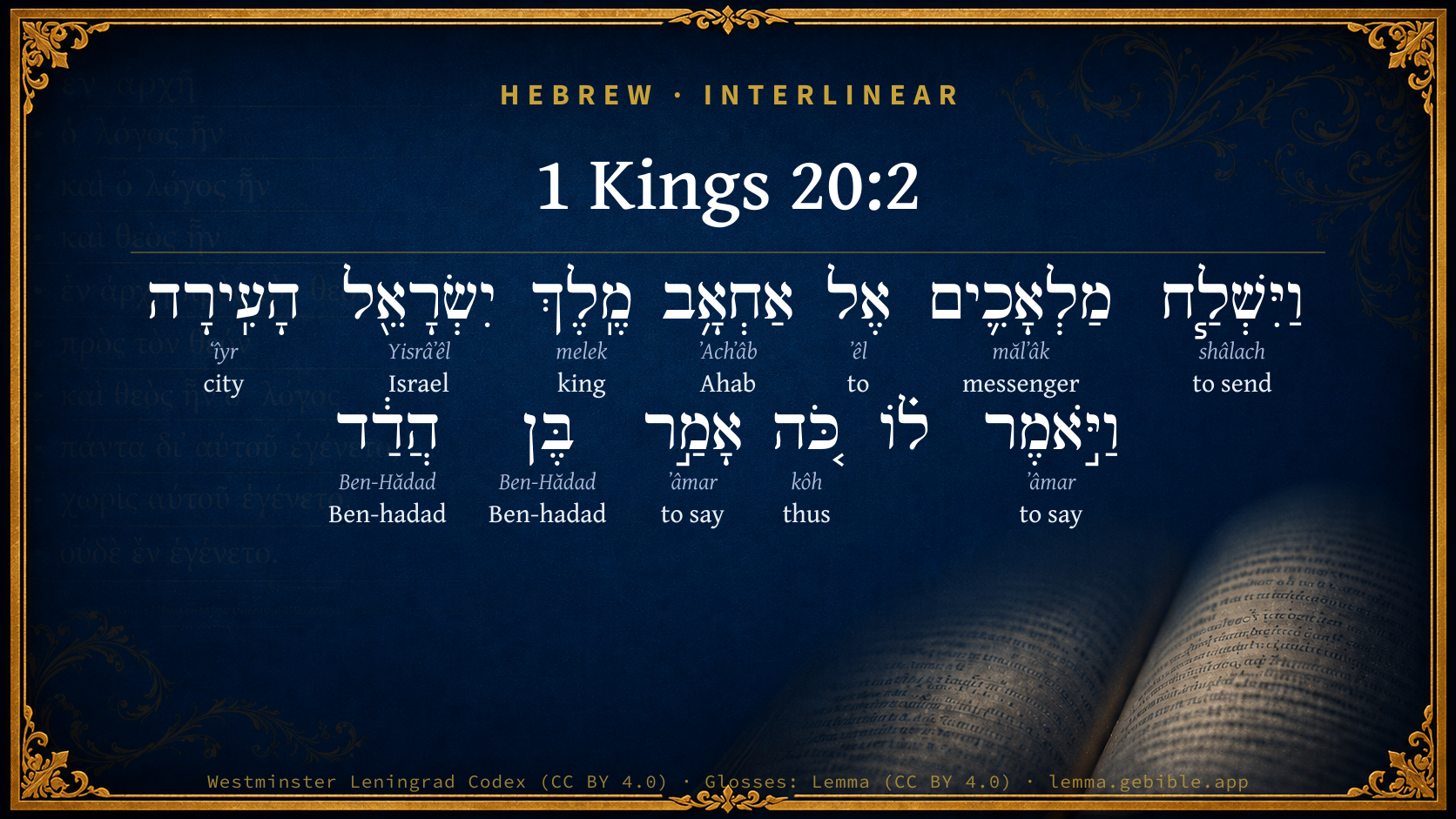
Hebrew (Westminster Leningrad Codex) 1 Kings 20:2 appears in the Hebrew Old Testament. The text above is from the Westminster Leningrad Codex. Each word links to its Strong’s number, a concise gloss, and parsing drawn from the Open Scriptures Hebrew Bible morphology. Click any word for its full Brown-Driver-Briggs (BDB) entry.
Download image
Cite this verse

1 Kings 20:2 (World English Bible). Public Domain. Lemma interlinear Bible study tool, https://lemma.gebible.app/v/1-kings/20/2.

Show BibTeX & RIS
BibTeX
RIS
English Translation
He sent messengers to Ahab king of Israel, into the city, and said to him, Thus says Ben Hadad,
World English Bible · Public Domain
Download a study sheet

One document with this verse’s original text, its word-by-word gloss line, the meaning frame, cross-references with their text, attributed commentary, and full source and license credits — printable, and it pastes into notes with its structure intact.

This verse Autodidact and up

Study sheet (.html) Plain text (.txt)

A passage Seminary Student

Up to 50 verses in one chapter. A passage sheet keeps up to 6 commentary sources and 12 cross-references per verse, in the order this page ranks them, and says so on the sheet whenever that leaves anything out. Ask for a single verse and you get the Autodidact verse sheet above.

Everything on this page stays free to read, with no account — the sheet is a download of what is already on screen, not access to it.

Want to remove ads? Support Godless Engineer
Compare translations 3

The same verse in 3 English versions, stacked beneath the original-language interlinear above. Click any original word for its lexicon entry.

Each is an independent rendering of the whole verse — the interlinear is not word-aligned to these translations.

Highlighted words mark where these versions differ — a whole-verse word diff, not a word-by-word alignment.

  • World English Bible Public Domain
    He sent messengers to Ahab king of Israel, into the city, and said to him, Thus says Ben Hadad,
  • King James Version Public Domain
    And he sent messengers to Ahab king of Israel into the city, and said unto him, Thus saith Benhadad,
  • unfoldingWord Literal Text CC BY-SA 4.0
    And he sent messengers to Ahab, the king of Israel, at the city,

unfoldingWord Literal Text — © unfoldingWord, licensed CC BY-SA 4.0. Word-aligned USFM3 via Door43 (git.door43.org/unfoldingWord/en_ult).

Versions to compare (up to 4)

3 of 4 selected

Show all 18 translations

Every available English version of this verse, each an independent rendering of the whole verse.

  • World English Bible Public Domain
    He sent messengers to Ahab king of Israel, into the city, and said to him, Thus says Ben Hadad,
  • Berean Standard Bible Public Domain
    Then he sent messengers into the city to Ahab king of Israel,
  • Majority Standard Bible Public Domain
    Then he sent messengers into the city to Ahab king of Israel,
  • King James Version Public Domain
    And he sent messengers to Ahab king of Israel into the city, and said unto him, Thus saith Benhadad,
  • American Standard Version (1901) Public Domain
    And he sent messengers to Ahab king of Israel, into the city, and said unto him, Thus saith Ben-hadad,
  • Revised Version (1885) Public Domain
    And he sent messengers to Ahab king of Israel, into the city, and said unto him, Thus saith Ben-hadad,
  • Geneva Bible (1599) Public Domain
    And he sent messengers to Ahab King of Israel, into the citie,
  • Douay-Rheims (1899) Public Domain
    And, sending messengers to Achab king of Israel into the city,
  • Young's Literal Translation Public Domain
    and sendeth messengers unto Ahab king of Israel, to the city,
  • Literal Standard Version CC BY-SA 4.0
    and sends messengers to Ahab king of Israel, to the city,
  • Unlocked Literal Bible CC BY-SA 4.0
    He sent messengers into the city to Ahab king of Israel, and said to him, “Ben Hadad says this:
  • unfoldingWord Literal Text CC BY-SA 4.0
    And he sent messengers to Ahab, the king of Israel, at the city,
  • Darby Bible Public Domain
    And he sent messengers to Ahab king of Israel into the city, and said to him, Thus says Ben-Hadad:
  • World Messianic Bible Public Domain
    He sent messengers into the city to Ahab king of Israel and said to him, “Ben Hadad says,
  • Webster's Bible Public Domain
    And he sent messengers to Ahab king of Israel into the city, and said to him, Thus saith Ben-hadad,
  • Free Bible Version CC BY-SA 4.0
    He sent messengers to Ahab, king of Israel, in the city to tell him, “This is what Ben-hadad says:
  • Bible in Basic English Public Domain
    And he sent representatives into the town to Ahab, king of Israel;
  • JPS Tanakh (1917) Public Domain
    And he sent messengers to Ahab king of Israel, into the city,

Literal Standard Version (2020), Covenant Press — licensed CC BY-SA 4.0. Text via the HelloAO Bible API (eBible.org). Unlocked Literal Bible (unfoldingWord) — licensed CC BY-SA 4.0. Text via the HelloAO Bible API (eBible.org). unfoldingWord Literal Text — © unfoldingWord, licensed CC BY-SA 4.0. Word-aligned USFM3 via Door43 (git.door43.org/unfoldingWord/en_ult). Free Bible Version, Dr. Jonathan Gallagher — licensed CC BY-SA 4.0. Text via the HelloAO Bible API (eBible.org).

Word by word

More ways to search: Search by grammar → Find every occurrence → Compare this word →

Practice this passage: Drill this verse → Learn its vocabulary →

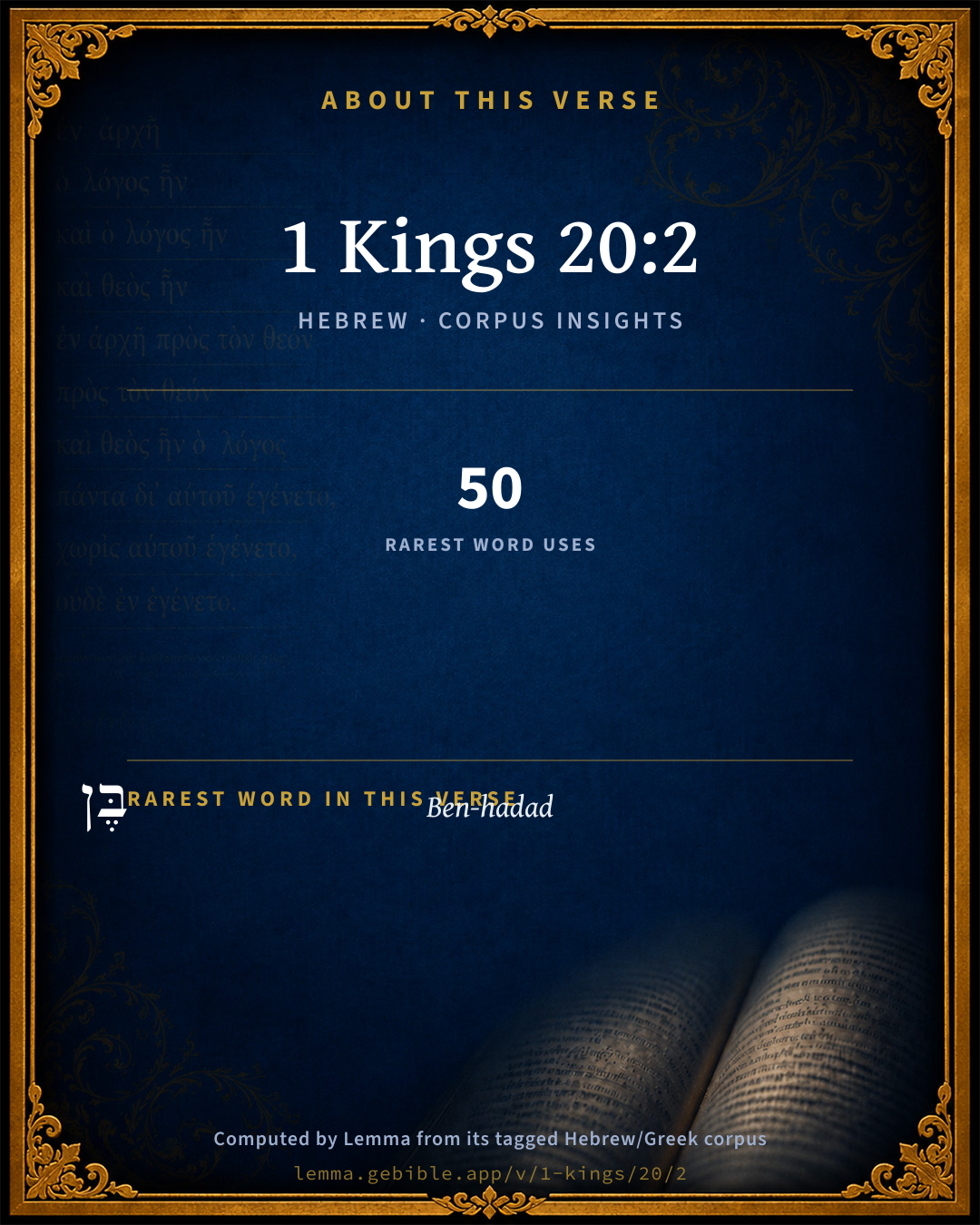
בֶּן
Ben-Hădad
H1130
“Ben-hadad”
Noun, Proper
Part of Speech
Noun
Type
Proper
Full BDB Definition

Origin: from H1121 and H1908

TWOT: None

Ben-hadad = "son of [the false god] Hadad" - the king of Syria, contemporary with Asa of Judah - the son of Hazael, also king of Syria
  1. וַיִּשְׁלַ֧ח shâlach H7971 “and · to send” Conjunction + Verb, Qal, Sequential Imperfect, 3rd Person, Masculine, Singular
  2. מַלְאָכִ֛ים mălʼâk H4397 “messengers” Noun, Common, Masculine, Plural, Absolute
  3. אֶל ʼêl H413 “to” Preposition
  4. אַחְאָ֥ב ʼAchʼâb H256 “Ahab” Noun, Proper
  5. מֶֽלֶךְ melek H4428 “king of” Noun, Common, Masculine, Singular, Construct
  6. יִשְׂרָאֵ֖ל Yisrâʼêl H3478 “Israel” Noun, Proper
  7. הָעִֽירָה ʻîyr H5892 “the · city · toward” Particle, Definite Article + Noun, Common, Feminine, Singular, Absolute + Suffix, Demonstrative
  8. וַיֹּ֣אמֶר ʼâmar H559 “and · to say” Conjunction + Verb, Qal, Sequential Imperfect, 3rd Person, Masculine, Singular
  9. כֹּ֚ה kôh H3541 “thus” Adverb
  10. אָמַ֣ר ʼâmar H559 “to say” Verb, Qal, Perfect, 3rd Person, Masculine, Singular
  11. הֲדַ֔ד Ben-Hădad H1130 “Ben-hadad” Noun, Proper

About this verse

These counts appear in no published source. They are computed here, from the morphology-tagged text and Lemma’s own curated glosses. What Lemma adds →

13
words
10
distinct lemmas
Historical
section

Shared distinctive vocabulary

בֶּן Ben-hadad H1130 occurs in 24 verses of the Hebrew Bible. Also found in:

Grammatical profile

  • 3 verbs
  • 7 nouns
  • 2 prepositions
  • 1 adverb

Verb forms

  • וַיִּשְׁלַ֧ח Qal · Sequential Imperfect
  • וַיֹּ֣אמֶר Qal · Sequential Imperfect
  • אָמַ֣ר Qal · Perfect

Repetition

Words recur within this verse — often emphatic in Hebrew:

  • וַיֹּ֣אמֶר to say H559 ×2
  • בֶּן Ben-hadad H1130 ×2

Hebrew & Septuagint length

In English translation the verse runs 19 words from the Hebrew and 62 from the Septuagint (LXX English) — the Septuagint runs noticeably longer here. See the side-by-side →

A rough comparison of the two English renderings, which tokenize alike — not a word-level alignment.

Word counts can differ between the Hebrew and the Greek without any difference in meaning — e.g. the Hebrew direct-object marker אֵת has no separate Greek word, and Greek often adds the article ὁ.

Cross-references

3

Topical passages linked to 1 Kings 20:2 in the Treasury of Scripture Knowledge — connected by theme and wording, ordered by reader-vote popularity; previews shown in the World English Bible.

  • 2 Kings 19:9 When he heard say of Tirhakah king of Ethiopia, Behold, he is come out to fight against you, he sent messengers again to Hezekiah, saying,
  • Isaiah 36:2–22 The king of Assyria sent Rabshakeh from Lachish to Jerusalem to king Hezekiah with a great army. He stood by the conduit of the upper pool in the highway of the fuller's field.
  • Isaiah 37:9–10 He heard say concerning Tirhakah king of Ethiopia, He is come out to fight against you. When he heard it, he sent messengers to Hezekiah, saying,

Cross-references courtesy of OpenBible.info (CC BY 4.0).

Hebrew and Greek witnesses Masoretic Hebrew ↔ Greek Septuagint

The same verse in the two great witnesses to the Old Testament, shown verse-for-verse.

Here the Septuagint runs noticeably longer than the Hebrew — LXX2012 (modern English Septuagint) 62 words vs World English Bible 19. A rough length comparison of the two English translations, not a word-level alignment — read both below.

These are two independent witnesses, not word-aligned to each other, and the Septuagint is shown in lemma (dictionary) form.

Hebrew 1 Kings 20:2 Masoretic · Westminster Leningrad Codex

וַיִּשְׁלַ֧ח מַלְאָכִ֛ים אֶל אַחְאָ֥ב מֶֽלֶךְ יִשְׂרָאֵ֖ל הָעִֽירָה וַיֹּ֣אמֶר ל֗וֹ כֹּ֚ה אָמַ֣ר בֶּן הֲדַ֔ד

He sent messengers to Ahab king of Israel, into the city, and said to him, Thus says Ben Hadad,

World English Bible · Public Domain

Greek LXX 1 Kings 20:2 Septuagint · lemma form

καί λαλέω αχααβ πρός ναβουθαι λέγω δίδωμι ἐγώ ὁ ἀμπελών σύ καί εἰμί ἐγώ εἰς κῆπος λάχανον ὅτι ἐγγίζω οὗτος ὁ οἶκος ἐγώ καί δίδωμι σύ ἀμπελών ἄλλος ἀγαθός ὑπέρ αὐτός εἰ δέ ἀρέσκω ἐνώπιον σύ δίδωμι σύ ἀργύριον ἀντάλλαγμα ὁ ἀμπελών σύ οὗτος καί εἰμί ἐγώ εἰς κῆπος λάχανον

And Achaab spoke to Nabuthai, saying, Give me your vineyard, and I will have it for a garden of herbs, for it is near my house: and I will give you another vineyard better than it; or if it please you, I will give you money, the price of this your vineyard, and I will have it for a garden of herbs.

LXX2012 (modern English Septuagint) · Public Domain

Hebrew: Westminster Leningrad Codex (CC BY 4.0). Greek: Septuagint (public domain); English from LXX2012 (modern English Septuagint) (Public Domain). How the Septuagint differs from the Hebrew →

Targum (Aramaic paraphrase)

1

The Targum is the ancient Jewish Aramaic paraphrase of the Hebrew Scriptures — an interpretive translation, not the Hebrew text itself. Onkelos (literal) and Pseudo-Jonathan (expansive) render the Torah, and Jonathan the Prophets. Coverage is partial: where no permissively-licensed English translation exists for a verse, only the Aramaic is shown. This is verse-level text, not a word-by-word alignment to the Hebrew.

  1. Targum Jonathan Prophets (Joshua–Malachi)
    וּשְׁלַח אַזְגַדִין לְוַת אַחְאָב מַלְכָּא דְיִשְׂרָאֵל לְקַרְתָּא:

    (no public-domain English translation for this verse)

    Targum Jonathan — Aramaic: “Mikraot Gedolot” (public domain). English: “Sefaria Community Translation” (CC0 1.0 (public-domain dedication)); “London "Chaldee Paraphrase," 1871” (public domain). Text via Sefaria.

Commentary

Notes on 1 Kings 20:2 from classic Christian and Jewish commentators (each source and its license shown beneath its notes). The classic Christian expositions comment on the surrounding passage and are grouped to its opening verse, so a note may address several verses; the Jewish commentaries on the Tanakh (Rashi and others) are per-verse, so they appear only where the commentator wrote on this verse.

Lemma curates 59 commentaries, every one of them public domain or Creative Commons licensed, each selected and text-cleaned for this edition rather than reprinted as found. About our sources →

Trapp's Complete Commentary

John Trapp

1Ki 20:2 And he sent messengers to Ahab king of Israel into the city, and said unto him, Thus saith Benhadad,

Ver. 2. And he sent messengers.] As presuming they should find that favour with Ahab which himself denied to Ahab’s messengers, whom he commanded to be taken alive, whatsoever their errand was. This was against the law of arms. {1Ki 20:18}

John Trapp, A Commentary or Exposition upon All the Books of the Old and New Testament (1647–1656) — public domain. Text from a community e-Sword module.

Tyndale Open Study Notes

Tyndale Open Resources

20:2-4 Ben-hadad’s first delegation of messengers brought his demand that Israel must agree to surrender both its treasures and people. Ahab capitulated, wanting peace at any cost. He would give up royal treasures and even his family rather than face bloody war with a powerful enemy.

Tyndale Open Study Notes — © Tyndale Open Resources, licensed CC BY-SA 4.0. Text via the HelloAO Bible API.

Jamieson, Fausset & Brown

Robert Jamieson, A. R. Fausset & David Brown

Thus said Ben-hadad, Thy silver and thy gold is mine--To this message sent him during the siege, Ahab returned a tame and submissive answer, probably thinking it meant no more than an exaction of tribute. But the demand was repeated with greater insolence; and yet, from the abject character of Ahab, there is reason to believe he would have yielded to this arrogant claim also, had not the voice of his subjects been raised against it. Ben-hadad's object in these and other boastful menaces was to intimidate Ahab. But the weak sovereign began to show a little more spirit, as appears in his abandoning "my lord the king" for the single "tell him," and giving him a dry but sarcastic hint to glory no more till the victory is won. Kindling into a rage at the cool defiance, Ben-hadad gave orders for the immediate sack of the city.

Jamieson, Fausset & Brown — Commentary Critical and Explanatory on the Whole Bible (1871) — public domain (CC PDM 1.0). Text via the HelloAO Bible API.

The Cambridge Bible for Schools and Colleges

gen. ed. J. J. S. Perowne

2. he sent messengers] Sending first, no doubt, as Josephus explains, a herald to ask that his ambassadors might be received to explain his demands.

The Cambridge Bible for Schools and Colleges (gen. ed. J. J. S. Perowne; Cambridge University Press, 1878–1918) — public domain. Text from a community e-Sword module.

John Gill's Exposition

And he sent messengers to Ahab king of Israel, into the city,.... Who there remained, and attempted not to go forth and meet him, and stop his progress, though he must have passed great part of his dominions to come to Samaria:

and said unto him, thus saith Benhadad; by them, his messengers, as follows.

John Gill's Exposition of the Whole Bible (1746–1763) — public domain (CC PDM 1.0). Text via the HelloAO Bible API.

Albert Barnes' Notes on the Bible

It may be supposed that a considerable time had passed in the siege, that the city had been reduced to an extremity, and that ambassadors had been sent by Ahab to ask terms of peace short of absolute surrender, before Ben-hadad would make such a demand. He would expect and intend his demand to be rejected, and this would have left him free to plunder the town, which was evidently what he desired and purposed.

Albert Barnes' Notes on the Bible (1834–1885) — public domain. Text from a community e-Sword/MySword module.

The Pulpit Commentary

And he sent messengers to Ahab king of Israel into Heb. to. It is not clear that they entered the city. They may have delivered their message to the king, or to his representatives at the gates or to the people on the walls (2Ki_18:18, 2Ki_18:27) the city, and said unto him, Thus saith Ben-hadad,

The Pulpit Commentary (1880–1919), ed. H.D.M. Spence-Jones & Joseph S. Exell — public domain. Text from a community e-Sword module.

Lesson kit

Teaching starters — assembled from the data on this page, not authored interpretation. Every prompt links to the verse data it draws on. Edit before teaching.

1 Kings, in the Historical, opens this verse with 13 words (10 distinct Hebrew lemmas). Its most distinctive word is Ben-Hădad (“Ben-hadad”). The Greek Septuagint runs longer here. A historical commentator’s framing appears above. Read the whole chapter for the surrounding context.

Discussion questions

  1. What does “Ben-hadad” (Ben-Hădad) contribute to the verse as a whole?
  2. How does 1 Kings 15:18, which shares the word «Ben-hadad», read alongside this verse?
  3. What does the repetition of “to say” (2× in this one verse) do in this verse?
  4. The Septuagint runs longer here than the Hebrew. What might account for the difference?
  5. These translations render this verse differently. What is at stake in choosing one wording over another?
  6. «וַיִּשְׁלַ֧ח» is a Qal Sequential Imperfect verb. How does that grammatical form shape the action described?
  7. Compare how Trapp's Complete Commentary and Tyndale Open Study Notes read this verse. Where do they agree or differ?

Things to notice

Reading settings

Reading text

Shown beneath each verse's original-language words.

Old Testament
Old Testament edition

Read the OT as the Masoretic Hebrew (MT) or the Greek Septuagint (LXX).

English shown for the Greek Septuagint (in the Hebrew ↔ Greek comparison).

Comparing translations? Open the Compare panel on any verse page to stack up to four side by side.