
Judges 11:17

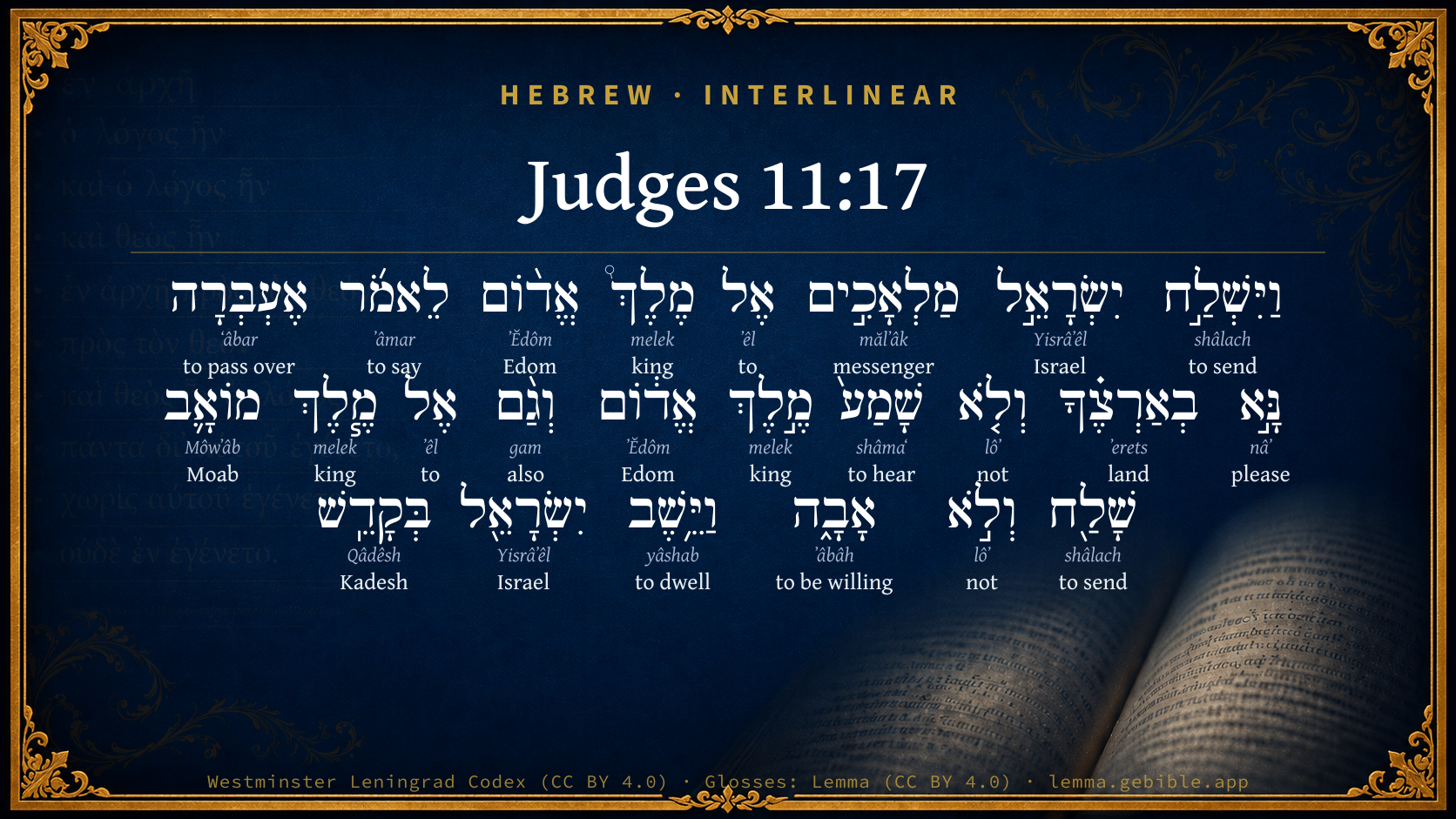
Hebrew (Westminster Leningrad Codex) Judges 11:17 appears in the Hebrew Old Testament. The text above is from the Westminster Leningrad Codex. Each word links to its Strong’s number, a concise gloss, and parsing drawn from the Open Scriptures Hebrew Bible morphology. Click any word for its full Brown-Driver-Briggs (BDB) entry.
Download image
Cite this verse

Judges 11:17 (World English Bible). Public Domain. Lemma interlinear Bible study tool, https://lemma.gebible.app/v/judges/11/17.

Show BibTeX & RIS
BibTeX
RIS
English Translation
then Israel sent messengers to the king of Edom, saying, Please let me pass through your land; but the king of Edom didn't listen. In the same way, he sent to the king of Moab; but he would not: and Israel abode in Kadesh.
World English Bible · Public Domain
Download a study sheet

One document with this verse’s original text, its word-by-word gloss line, the meaning frame, cross-references with their text, attributed commentary, and full source and license credits — printable, and it pastes into notes with its structure intact.

This verse Autodidact and up

Study sheet (.html) Plain text (.txt)

A passage Seminary Student

Up to 50 verses in one chapter. A passage sheet keeps up to 6 commentary sources and 12 cross-references per verse, in the order this page ranks them, and says so on the sheet whenever that leaves anything out. Ask for a single verse and you get the Autodidact verse sheet above.

Everything on this page stays free to read, with no account — the sheet is a download of what is already on screen, not access to it.

Want to remove ads? Support Godless Engineer
Compare translations 3

The same verse in 3 English versions, stacked beneath the original-language interlinear above. Click any original word for its lexicon entry.

Each is an independent rendering of the whole verse — the interlinear is not word-aligned to these translations.

Highlighted words mark where these versions differ — a whole-verse word diff, not a word-by-word alignment.

  • World English Bible Public Domain
    then Israel sent messengers to the king of Edom, saying, Please let me pass through your land; but the king of Edom didn't listen. In the same way, he sent to the king of Moab; but he would not: and Israel abode in Kadesh.
  • King James Version Public Domain
    Then Israel sent messengers unto the king of Edom, saying, Let me, I pray thee, pass through thy land: but the king of Edom would not hearken thereto. And in like manner they sent unto the king of Moab: but he would not consent: and Israel abode in Kadesh.
  • unfoldingWord Literal Text CC BY-SA 4.0
    Then Israel sent messengers to the king of Edom, saying, “Please may I pass through your land.” But the king of Edom did not listen. And he also sent to the king of Moab, but he did not consent. So Israel dwelled in Kadesh.

unfoldingWord Literal Text — © unfoldingWord, licensed CC BY-SA 4.0. Word-aligned USFM3 via Door43 (git.door43.org/unfoldingWord/en_ult).

Versions to compare (up to 4)

3 of 4 selected

Show all 18 translations

Every available English version of this verse, each an independent rendering of the whole verse.

  • World English Bible Public Domain
    then Israel sent messengers to the king of Edom, saying, Please let me pass through your land; but the king of Edom didn't listen. In the same way, he sent to the king of Moab; but he would not: and Israel abode in Kadesh.
  • Berean Standard Bible Public Domain
    Then Israel sent messengers to the king of Edom, saying, ‘Please let us pass through your land,’ but the king of Edom would not listen. They also sent messengers to the king of Moab, but he would not consent. So Israel stayed in Kadesh.
  • Majority Standard Bible Public Domain
    Then Israel sent messengers to the king of Edom, saying, ‘Please let us pass through your land,’ but the king of Edom would not listen. They also sent messengers to the king of Moab, but he would not consent. So Israel stayed in Kadesh.
  • King James Version Public Domain
    Then Israel sent messengers unto the king of Edom, saying, Let me, I pray thee, pass through thy land: but the king of Edom would not hearken thereto. And in like manner they sent unto the king of Moab: but he would not consent: and Israel abode in Kadesh.
  • American Standard Version (1901) Public Domain
    then Israel sent messengers unto the king of Edom, saying, Let me, I pray thee, pass through thy land; but the king of Edom hearkened not. And in like manner he sent unto the king of Moab; but he would not: and Israel abode in Kadesh.
  • Revised Version (1885) Public Domain
    then Israel sent messengers unto the king of Edom, saying, Let me, I pray thee, pass through thy land: but the king of Edom hearkened not. And in like manner he sent unto the king of Moab: but he would not: and Israel abode in Kadesh.
  • Geneva Bible (1599) Public Domain
    And Israel sent messengers vnto the king of Edom, saying, Let me, I pray thee, goe thorowe thy lande: but the King of Edom woulde not consent: and also they sent vnto the King of Moab, but he would not: therefore Israel abode in Kadesh.
  • Douay-Rheims (1899) Public Domain
    And he sent messengers to the king of Edom, saying: Suffer me to pass through thy land. But he would not condescend to his request. He sent also to the king of Moab, who likewise refused to give him passage. He abode therefore in Cades,
  • Young's Literal Translation Public Domain
    and Israel sendeth messengers unto the king of Edom, saying, Let me pass over, I pray thee, through thy land, and the king of Edom hearkened not; and also unto the king of Moab hath `Israel' sent, and he hath not been willing; and Israel abideth in Kadesh,
  • Literal Standard Version CC BY-SA 4.0
    and Israel sends messengers to the king of Edom, saying, Please let me pass over through your land, and the king of Edom did not listen; and [Israel] has also sent to the king of Moab, and he has not been willing; and Israel abides in Kadesh,
  • Unlocked Literal Bible CC BY-SA 4.0
    When Israel sent messengers to the king of Edom, saying, 'Please let us pass through your land,' the king of Edom would not listen. They also sent messengers to the king of Moab, but he refused. So Israel stayed at Kadesh.
  • unfoldingWord Literal Text CC BY-SA 4.0
    Then Israel sent messengers to the king of Edom, saying, “Please may I pass through your land.” But the king of Edom did not listen. And he also sent to the king of Moab, but he did not consent. So Israel dwelled in Kadesh.
  • Darby Bible Public Domain
    Israel then sent messengers to the king of Edom, saying, 'Let us pass, we pray, through your land'; but the king of Edom would not listen. And they sent also to the king of Moab, but he would not consent. So Israel remained at Kadesh.
  • World Messianic Bible Public Domain
    then Israel sent messengers to the king of Edom, saying, ‘Please let me pass through your land;’ but the king of Edom didn’t listen. In the same way, he sent to the king of Moab, but he refused; so Israel stayed in Kadesh.
  • Webster's Bible Public Domain
    Then Israel sent messengers to the king of Edom, saying, Let me, I pray thee, pass through thy land: but the king of Edom would not hearken to it. And in like manner they sent to the king of Moab; but he would not consent. And Israel abode in Kadesh.
  • Free Bible Version CC BY-SA 4.0
    They sent messengers to the king of Edom, saying, ‘Please let us pass through your country,’ but the king of Edom refused to listen. They also sent the same request to the king of Moab, and he refused too. So they remained at Kadesh.
  • Bible in Basic English Public Domain
    Then Israel sent men to the king of Edom saying, Let me now go through your land; but the king of Edom did not give ear to them. And in the same way he sent to the king of Moab, but he would not; so Israel went on living in Kadesh.
  • JPS Tanakh (1917) Public Domain
    then Israel sent messengers unto the king of Edom, saying: Let me, I pray thee, pass through thy land; but the king of Edom hearkened not. And in like manner he sent unto the king of Moab; but he would not; and Israel abode in Kadesh.

Literal Standard Version (2020), Covenant Press — licensed CC BY-SA 4.0. Text via the HelloAO Bible API (eBible.org). Unlocked Literal Bible (unfoldingWord) — licensed CC BY-SA 4.0. Text via the HelloAO Bible API (eBible.org). unfoldingWord Literal Text — © unfoldingWord, licensed CC BY-SA 4.0. Word-aligned USFM3 via Door43 (git.door43.org/unfoldingWord/en_ult). Free Bible Version, Dr. Jonathan Gallagher — licensed CC BY-SA 4.0. Text via the HelloAO Bible API (eBible.org).

Word by word

More ways to search: Search by grammar → Find every occurrence → Compare this word →

Practice this passage: Drill this verse → Learn its vocabulary →

בְּקָדֵֽשׁ
Qâdêsh
H6946
“in/at · Kadesh”
Preposition + Noun, Proper
Part of Speech
Preposition + Noun
Type
Proper
Full BDB Definition

Origin: the same as H6945

TWOT: 1990e

Kadesh = "holy" - a city in the extreme south of Judah - same as 'Kedesh' and 'Kadesh-barnea'
  1. וַיִּשְׁלַ֣ח shâlach H7971 “and · to send” Conjunction + Verb, Qal, Sequential Imperfect, 3rd Person, Masculine, Singular
  2. יִשְׂרָאֵ֣ל Yisrâʼêl H3478 “Israel” Noun, Proper
  3. מַלְאָכִ֣ים mălʼâk H4397 “messengers” Noun, Common, Masculine, Plural, Absolute
  4. אֶל ʼêl H413 “to” Preposition
  5. מֶלֶךְ֩ melek H4428 “king of” Noun, Common, Masculine, Singular, Construct
  6. אֱד֨וֹם ʼĔdôm H123 “Edom” Noun, Proper
  7. לֵאמֹ֜ר ʼâmar H559 “to say” Preposition + Verb, Qal, Infinitive Construct
  8. אֶעְבְּרָה ʻâbar H5674 “to pass over” Verb, Qal, Cohortative, 1st Person, Common, Singular
  9. נָּ֣א nâʼ H4994 “please” Particle, Interjection
  10. בְאַרְצֶ֗ךָ ʼerets H776 “in/at · land · your” Preposition + Noun, Common, Both, Singular, Construct + Suffix, Personal, 2nd Person, Masculine, Singular
  11. וְלֹ֤א lôʼ H3808 “and · not” Conjunction + Particle, Negative
  12. שָׁמַע֙ shâmaʻ H8085 “to hear” Verb, Qal, Perfect, 3rd Person, Masculine, Singular
  13. מֶ֣לֶךְ melek H4428 “king of” Noun, Common, Masculine, Singular, Construct
  14. אֱד֔וֹם ʼĔdôm H123 “Edom” Noun, Proper
  15. וְגַ֨ם gam H1571 “and · also” Conjunction + Particle, Accusative
  16. אֶל ʼêl H413 “to” Preposition
  17. מֶ֧לֶךְ melek H4428 “king of” Noun, Common, Masculine, Singular, Construct
  18. מוֹאָ֛ב Môwʼâb H4124 “Moab” Noun, Proper
  19. שָׁלַ֖ח shâlach H7971 “to send” Verb, Qal, Perfect, 3rd Person, Masculine, Singular
  20. וְלֹ֣א lôʼ H3808 “and · not” Conjunction + Particle, Negative
  21. אָבָ֑ה ʼâbâh H14 “to be willing” Verb, Qal, Perfect, 3rd Person, Masculine, Singular
  22. וַיֵּ֥שֶׁב yâshab H3427 “and · to dwell” Conjunction + Verb, Qal, Sequential Imperfect, 3rd Person, Masculine, Singular
  23. יִשְׂרָאֵ֖ל Yisrâʼêl H3478 “Israel” Noun, Proper

About this verse

These counts appear in no published source. They are computed here, from the morphology-tagged text and Lemma’s own curated glosses. What Lemma adds →

24
words
17
distinct lemmas
Historical
section

Notable vocabulary

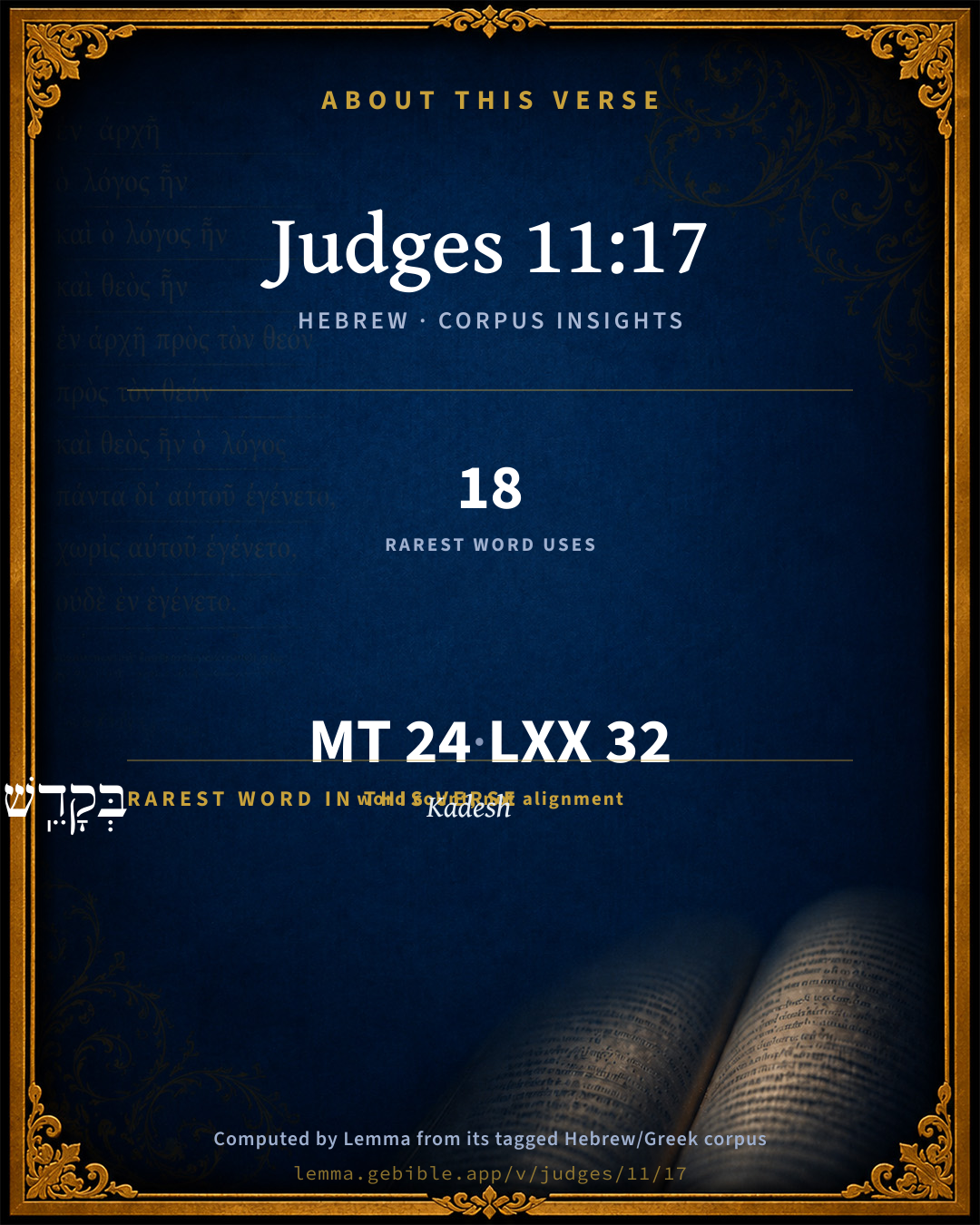
The rarest word here is בְּקָדֵֽשׁ Kadesh H6946 — appearing just 18 times in the whole Hebrew Bible.

Shared distinctive vocabulary

בְּקָדֵֽשׁ Kadesh H6946 occurs in 18 verses of the Hebrew Bible. Also found in:

Grammatical profile

  • 7 verbs
  • 11 nouns
  • 2 prepositions
  • 4 particles

Verb forms

  • וַיִּשְׁלַ֣ח Qal · Sequential Imperfect
  • לֵאמֹ֜ר Qal · Infinitive Construct
  • אֶעְבְּרָה Qal · Cohortative
  • שָׁמַע֙ Qal · Perfect
  • שָׁלַ֖ח Qal · Perfect
  • אָבָ֑ה Qal · Perfect
  • וַיֵּ֥שֶׁב Qal · Sequential Imperfect

Repetition

Words recur within this verse — often emphatic in Hebrew:

  • מֶלֶךְ֩ king H4428 ×3
  • וַיִּשְׁלַ֣ח to send H7971 ×2
  • יִשְׂרָאֵ֣ל Israel H3478 ×2
  • אֱד֨וֹם Edom H123 ×2
  • אֶל to H413 ×2
  • וְלֹ֤א not H3808 ×2

Hebrew & Septuagint length

In English translation the verse runs 44 words from the Hebrew and 46 from the Septuagint (LXX English) — closely comparable.

A rough comparison of the two English renderings, which tokenize alike — not a word-level alignment.

Word counts can differ between the Hebrew and the Greek without any difference in meaning — e.g. the Hebrew direct-object marker אֵת has no separate Greek word, and Greek often adds the article ὁ.

In the original languages it is 24 Hebrew tokens and 32 Greek tokens — but the two are counted differently (Hebrew bundles its prefixes and suffixes into one token; the Greek is in lemma form), so that isn’t a like-for-like length.

Cross-references

5

Topical passages linked to Judges 11:17 in the Treasury of Scripture Knowledge — connected by theme and wording, ordered by reader-vote popularity; previews shown in the World English Bible.

  • Numbers 20:1 The children of Israel, even the whole congregation, came into the wilderness of Zin in the first month: and the people abode in Kadesh; and Miriam died there, and was buried there.
  • Numbers 20:14–21 Moses sent messengers from Kadesh to the king of Edom, Thus says your brother Israel, You know all the travail that has happened to us:
  • Deuteronomy 2:4–9 Command you the people, saying, You are to pass through the border of your brothers the children of Esau, who dwell in Seir; and they will be afraid of you: take good heed to yourselves therefore;
  • Deuteronomy 2:29 as the children of Esau who dwell in Seir, and the Moabites who dwell in Ar, did to me; until I shall pass over the Jordan into the land which Yahweh our God gives us.
  • Joshua 24:9 Then Balak the son of Zippor, king of Moab, arose and fought against Israel: and he sent and called Balaam the son of Beor to curse you;

Cross-references courtesy of OpenBible.info (CC BY 4.0).

Hebrew and Greek witnesses Masoretic Hebrew ↔ Greek Septuagint

The same verse in the two great witnesses to the Old Testament, shown verse-for-verse.

These are two independent witnesses, not word-aligned to each other, and the Septuagint is shown in lemma (dictionary) form.

Hebrew Judges 11:17 Masoretic · Westminster Leningrad Codex

וַיִּשְׁלַ֣ח יִשְׂרָאֵ֣ל מַלְאָכִ֣ים אֶל מֶלֶךְ֩ אֱד֨וֹם לֵאמֹ֜ר אֶעְבְּרָה נָּ֣א בְאַרְצֶ֗ךָ וְלֹ֤א שָׁמַע֙ מֶ֣לֶךְ אֱד֔וֹם וְגַ֨ם אֶל מֶ֧לֶךְ מוֹאָ֛ב שָׁלַ֖ח וְלֹ֣א אָבָ֑ה וַיֵּ֥שֶׁב יִשְׂרָאֵ֖ל בְּקָדֵֽשׁ

then Israel sent messengers to the king of Edom, saying, Please let me pass through your land; but the king of Edom didn't listen. In the same way, he sent to the king of Moab; but he would not: and Israel abode in Kadesh.

World English Bible · Public Domain

Greek LXX Judges 11:17 Septuagint · lemma form

καί ἀποστέλλω ἰσραήλ ἄγγελος πρός βασιλεύς εδωμ λέγω παραἔρχομαι δή ἐν ὁ γῆ σύ καί οὐ ἀκούω βασιλεύς εδωμ καί πρός βασιλεύς μωαβ ἀποστέλλω καί οὐ εὐδοκέω καί καταἵζω ἰσραήλ ἐν καδης

And Israel sent messengers to the king of Edom, saying, I will pass, if it please you, by your land: and the king of Edom complied not: and Israel also sent to the king of Moab, and he did not consent; and Israel sojourned in Cades.

LXX2012 (modern English Septuagint) · Public Domain

Hebrew: Westminster Leningrad Codex (CC BY 4.0). Greek: Septuagint (public domain); English from LXX2012 (modern English Septuagint) (Public Domain). How the Septuagint differs from the Hebrew →

Targum (Aramaic paraphrase)

1

The Targum is the ancient Jewish Aramaic paraphrase of the Hebrew Scriptures — an interpretive translation, not the Hebrew text itself. Onkelos (literal) and Pseudo-Jonathan (expansive) render the Torah, and Jonathan the Prophets. Coverage is partial: where no permissively-licensed English translation exists for a verse, only the Aramaic is shown. This is verse-level text, not a word-by-word alignment to the Hebrew.

  1. Targum Jonathan Prophets (Joshua–Malachi)
    וּשְׁלַח יִשְׂרָאֵל אִזְגַדִין לְוַת מַלְכָּא דֶאֱדוֹם לְמֵימָר אֶעְבָּר כְּעַן בְּאַרְעָךְ וְלָא שְׁמַע מַלְכָּא דְאֱדוֹם וְאַף לְוַת מַלְכָּא דְמוֹאָב שְׁלַח וְלָא קַבֵּל וִיתֵיב יִשְׂרָאֵל בִּרְקָם:

    (no public-domain English translation for this verse)

    Targum Jonathan — Aramaic: “Mikraot Gedolot” (public domain). English: “Sefaria Community Translation” (CC0 1.0 (public-domain dedication)); “London "Chaldee Paraphrase," 1871” (public domain). Text via Sefaria.

Commentary

Notes on Judges 11:17 from classic Christian and Jewish commentators (each source and its license shown beneath its notes). The classic Christian expositions comment on the surrounding passage and are grouped to its opening verse, so a note may address several verses; the Jewish commentaries on the Tanakh (Rashi and others) are per-verse, so they appear only where the commentator wrote on this verse.

Lemma curates 59 commentaries, every one of them public domain or Creative Commons licensed, each selected and text-cleaned for this edition rather than reprinted as found. About our sources →

Trapp's Complete Commentary

John Trapp

Jdg 11:17 Then Israel sent messengers unto the king of Edom, saying, Let me, I pray thee, pass through thy land: but the king of Edom would not hearken [thereto]. And in like manner they sent unto the king of Moab: but he would not [consent]: and Israel abode in Kadesh.

Ver. 17. Then Israel sent messengers.] Apologies in some cases are very necessary - if not vocal, yet real - to stop an open mouth, and clear up our innocency.

John Trapp, A Commentary or Exposition upon All the Books of the Old and New Testament (1647–1656) — public domain. Text from a community e-Sword module.

Ellicott's Commentary for English Readers

(17) Unto the king of Edom.—As narrated in Num_20:14, seq. Even if Jephthah had no written documents before him to which he could refer, the events which he recounts were not so distant as to have been forgotten.

Unto the king of Moab.—This is not recorded in the Pentateuch, but the Israelites did not enter the territory of Moab (Deu_2:9; Deu_2:36). The Arnon bounded Moab from the Amorites (Num_21:13), and Israel encamped upon its banks.

Abode in Kadesh.—“Many days” (Deu_2:1). Probably they were encamped at Kadesh during a great part of the forty years (Deu_2:14).

A Bible Commentary for English Readers, edited by Charles John Ellicott (1878–1897) — public domain. Text from a community e-Sword module.

The Cambridge Bible for Schools and Colleges

gen. ed. J. J. S. Perowne

17. Abbreviated from Num_20:14-18 JE. Edom lay to the S. and S.E. of Palestine. There is no mention elsewhere of the embassy to Moab.

Let me, I pray thee] The nation as a whole is personified, a not uncommon idiom; cf. Jdg_11:12, Jdg_20:23, Num_20:18 etc. In Jdg_11:19, Num_20:17; Num_20:19 the plur. and sing, interchange.

The Cambridge Bible for Schools and Colleges (gen. ed. J. J. S. Perowne; Cambridge University Press, 1878–1918) — public domain. Text from a community e-Sword module.

John Gill's Exposition

Then they went along the wilderness,.... The wilderness of Paran, which lay along the borders of Edom; they went, according to Jarchi, from the west to the east on the south border of Edom and Moab:

and compassed the land of Edom, and the land of Moab; all the south of the land of Edom, and all the south of the land of Moab; towards the sunrising, as in Num 21:11.

and pitched on the other side of Arnon; the river Arnon, which, according to Jarchi, was at the east end of the land of Moab, where began the country of Sihon and Og:

but came not within the border of Moab; so far were they from attempting to take away any part of that land from the king of it, though ill treated by him:

for Arnon was the border of Moab; which divided between Moab and the Amorites, Num 21:13.

John Gill's Exposition of the Whole Bible (1746–1763) — public domain (CC PDM 1.0). Text via the HelloAO Bible API.

Haydock's Catholic Bible Commentary

Moab. This is not specified by Moses, but he sufficiently insinuates that he had done it, Deuteronomy ii. 8, 9. (Calmet)

George Leo Haydock (1774–1849), Haydock's Catholic Family Bible and Commentary, 1859 edition — public domain. Excludes Psalms (Douay-Rheims chapter numbering differs from Protestant) and Deuterocanonical books (Catholic canon only).

Matthew Poole's English Annotations

Peaceably, and did not revenge their unkindness and inhumanity, as they could have done.

Matthew Poole's English Annotations on the Holy Bible (1683–1685) — public domain. Text from a community e-Sword/MySword module.

Whedon's Commentary on the Bible

Daniel D. Whedon

17. In like manner they sent unto the king of Moab — This fact is not recorded in the Pentateuch along with the other facts here mentioned, for it was a matter of comparatively little moment with Moses to record the refusal of Moab after he had mentioned that of Edom, but it was important for the purpose of Jephthah’s argument.

Some have wondered why so much is here said about Moab in a message to the king of Ammon; but it should be noticed that as Jephthah, who really represented only the eastern tribes of Israel, speaks as the representative of all Israel, so the king of Ammon represents the children of Lot.

Daniel D. Whedon (gen. ed.), Commentary on the Old and New Testaments (1874–1909) — public domain. Text from a community e-Sword module.

The Pulpit Commentary

Then Israel sent messengers unto the king of Edom, saying, Let me, I Pray thee, pass through thy land. (country in A.V Num_20:17) The words in italics are found in Num_20:14, Num_20:17. And Israel abode in Kadesh. These words are in Num_20:1; see also Deu_1:46. The king of Edom would not hearken. This is related in substance in Num_20:18-21. And in like manner they sent unto the king of Moab. There is no mention of this in the Mosaic narrative. The knowledge of it must have been preserved either by tradition or in some other now lost writings; perhaps in the Book of the Wars of the. (Num_21:14) It is in itself very probable that such a message should have been sent to the king of Moab, whose territories Israel was forbidden to meddle with. (Deu_2:9, Deu_2:19)

The Pulpit Commentary (1880–1919), ed. H.D.M. Spence-Jones & Joseph S. Exell — public domain. Text from a community e-Sword module.

John Wesley's Explanatory Notes

Abode - Peaceably, and did not revenge their unkindness as they could have done.

John Wesley, Explanatory Notes Upon the Whole Bible (1754–1765) — public domain. Text via the GEBible commentary corpus.

unfoldingWord translationNotes

Door43 World Missions Community

General Information:

Jephthah's messengers continue to speak.

When Israel sent messengers

The messengers were sent by the leaders of Israel. AT: "When the leaders of Israel sent messengers" (See: Synecdoche)

pass through

"go through" or "cross"

would not listen

This phrase is an idiom that means to "refuse." AT: "refused" or "denied their request" (See: Idiom)

They also sent messengers to the king of Moab

The reason that Israel sent messengers to the king of Moab can be made explicit. AT: "They also send messengers to the king of Moab with the same request" (See: Assumed Knowledge and Implicit Information)

but he refused

The king of Moab refused Israel's request to pass through Moab. The full meaning of this statement can be made clear. AT: "but he also refused and would not let them pass through the land of Moab" (See: Assumed Knowledge and Implicit Information)

Arnon

This is the name of a river. See how you translated this in Judges 11:13.

translationWords

Israel

messenger

king

Edom

Moab

Kadesh

unfoldingWord translationNotes — © Distant Shores Media and the Door43 World Missions Community, licensed CC BY-SA 4.0. Source: git.door43.org/Door43/en_tn.

Rashi

Rabbi Shlomo Yitzchaki (Rashi)

Please allow me to traverse your country. From south to north, in order to enter the land of Canaan.

To the king of Moav as well. Whose country bordered the extremity of the land of Edom, east of Edom, and south of Eretz Yisroel.

And he refused. Moshe alludes to this in the Torah, "As perpetrated against me by the Bnei Eisov residing at Sair, and the Moavites residing at Ar." Just as Edom refused them permission to pass, so did Moav refuse them permission to pass.

Rashi on the Tanakh — English translations: “The Judaica Press complete Tanach with Rashi, translated by A. J. Rosenberg” (CC BY 4.0); “Pentateuch with Rashi's commentary by M. Rosenbaum and A.M. Silbermann, 1929-1934” (public domain); “The Metsudah Tanach series, Lakewood, N.J” (CC BY 4.0); and “The Book of Joshua, Metsudah Publications, 1997” (CC BY 4.0). Text via Sefaria.

Lesson kit

Teaching starters — assembled from the data on this page, not authored interpretation. Every prompt links to the verse data it draws on. Edit before teaching.

Judges, in the Historical, opens this verse with 24 words (17 distinct Hebrew lemmas). Its most distinctive word is Qâdêsh (“Kadesh”). A historical commentator’s framing appears above. Read the whole chapter for the surrounding context.

Discussion questions

  1. The word Qâdêsh carries the sense “Kadesh.” How does it shape the verse?
  2. Genesis 14:7 shares the word «Kadesh» with this verse. How do the two illuminate each other?
  3. “king” occurs 3× in this one verse. What is the effect of the repetition?
  4. The translations on this page render this verse differently — a whole-verse word diff, not a word-by-word alignment. What might account for the different wordings?
  5. The verb «וַיִּשְׁלַ֣ח» is Qal Sequential Imperfect. How does its form color the action?
  6. Reading how Trapp's Complete Commentary and Ellicott's Commentary for English Readers read this verse, where do the two commentators agree and where do they part?

Things to notice

Reading settings

Reading text

Shown beneath each verse's original-language words.

Old Testament
Old Testament edition

Read the OT as the Masoretic Hebrew (MT) or the Greek Septuagint (LXX).

English shown for the Greek Septuagint (in the Hebrew ↔ Greek comparison).

Comparing translations? Open the Compare panel on any verse page to stack up to four side by side.