
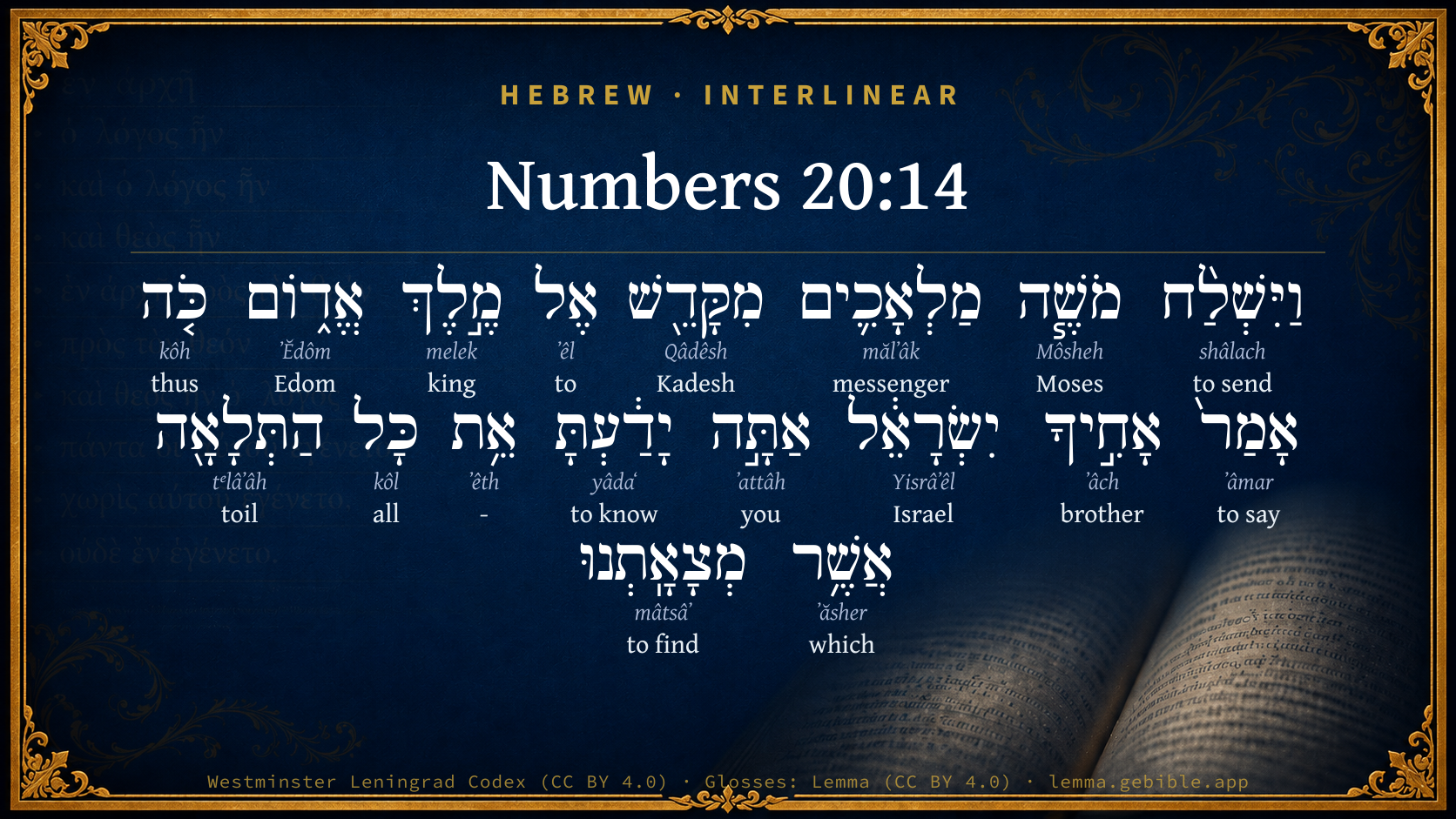
Numbers 20:14

Hebrew (Westminster Leningrad Codex) Numbers 20:14 appears in the Hebrew Old Testament. The text above is from the Westminster Leningrad Codex. Each word links to its Strong’s number, a concise gloss, and parsing drawn from the Open Scriptures Hebrew Bible morphology. Click any word for its full Brown-Driver-Briggs (BDB) entry.
Download image
Cite this verse

Numbers 20:14 (World English Bible). Public Domain. Lemma interlinear Bible study tool, https://lemma.gebible.app/v/numbers/20/14.

Show BibTeX & RIS
BibTeX
RIS
English Translation
Moses sent messengers from Kadesh to the king of Edom, Thus says your brother Israel, You know all the travail that has happened to us:
World English Bible · Public Domain
Download a study sheet

One document with this verse’s original text, its word-by-word gloss line, the meaning frame, cross-references with their text, attributed commentary, and full source and license credits — printable, and it pastes into notes with its structure intact.

This verse Autodidact and up

Study sheet (.html) Plain text (.txt)

A passage Seminary Student

Up to 50 verses in one chapter. A passage sheet keeps up to 6 commentary sources and 12 cross-references per verse, in the order this page ranks them, and says so on the sheet whenever that leaves anything out. Ask for a single verse and you get the Autodidact verse sheet above.

Everything on this page stays free to read, with no account — the sheet is a download of what is already on screen, not access to it.

Want to remove ads? Support Godless Engineer
Compare translations 3

The same verse in 3 English versions, stacked beneath the original-language interlinear above. Click any original word for its lexicon entry.

Each is an independent rendering of the whole verse — the interlinear is not word-aligned to these translations.

Highlighted words mark where these versions differ — a whole-verse word diff, not a word-by-word alignment.

  • World English Bible Public Domain
    Moses sent messengers from Kadesh to the king of Edom, Thus says your brother Israel, You know all the travail that has happened to us:
  • King James Version Public Domain
    And Moses sent messengers from Kadesh unto the king of Edom, Thus saith thy brother Israel, Thou knowest all the travail that hath befallen us:
  • unfoldingWord Literal Text CC BY-SA 4.0
    And Moses sent messengers from Kadesh to the king of Edom: “Thus says your brother Israel: ‘You, you know all of the hardship that has found us.

unfoldingWord Literal Text — © unfoldingWord, licensed CC BY-SA 4.0. Word-aligned USFM3 via Door43 (git.door43.org/unfoldingWord/en_ult).

Versions to compare (up to 4)

3 of 4 selected

Show all 18 translations

Every available English version of this verse, each an independent rendering of the whole verse.

  • World English Bible Public Domain
    Moses sent messengers from Kadesh to the king of Edom, Thus says your brother Israel, You know all the travail that has happened to us:
  • Berean Standard Bible Public Domain
    From Kadesh, Moses sent messengers to tell the king of Edom, “This is what your brother Israel says: You know all the hardship that has befallen us,
  • Majority Standard Bible Public Domain
    From Kadesh, Moses sent messengers to tell the king of Edom, “This is what your brother Israel says: You know all the hardship that has befallen us,
  • King James Version Public Domain
    And Moses sent messengers from Kadesh unto the king of Edom, Thus saith thy brother Israel, Thou knowest all the travail that hath befallen us:
  • American Standard Version (1901) Public Domain
    And Moses sent messengers from Kadesh unto the king of Edom, Thus saith thy brother Israel, Thou knowest all the travail that hath befallen us:
  • Revised Version (1885) Public Domain
    And Moses sent messengers from Kadesh unto the king of Edom, Thus saith thy brother Israel, Thou knowest all the travail that hath befallen us:
  • Geneva Bible (1599) Public Domain
    Then Moses sent messengers from Kadesh vnto the king of Edom, saying, Thus sayth thy brother Israel, Thou knowest all the trauaile that we haue had,
  • Douay-Rheims (1899) Public Domain
    In the mean time Moses sent messengers from Cades to the king of Edom, to say: Thus saith thy brother Israel: Thou knowest all the labour that hath come upon us:
  • Young's Literal Translation Public Domain
    And Moses sendeth messengers from Kadesh unto the king of Edom, `Thus said thy brother Israel, Thou -- thou hast known all the travail which hath found us;
  • Literal Standard Version CC BY-SA 4.0
    And Moses sends messengers from Kadesh to the king of Edom, “Thus said your brother Israel: You have known all the travail which has found us,
  • Unlocked Literal Bible CC BY-SA 4.0
    Moses sent messengers from Kadesh to the king of Edom: Your brother Israel says this: “You know all the difficulties that have happened to us.
  • unfoldingWord Literal Text CC BY-SA 4.0
    And Moses sent messengers from Kadesh to the king of Edom: “Thus says your brother Israel: ‘You, you know all of the hardship that has found us.
  • Darby Bible Public Domain
    And Moses sent messengers from Kadesh to the king of Edom, Thus says thy brother Israel: Thou knowest all the trouble that hath befallen us,
  • World Messianic Bible Public Domain
    Moses sent messengers from Kadesh to the king of Edom, saying: “Your brother Israel says: You know all the travail that has happened to us;
  • Webster's Bible Public Domain
    And Moses sent messengers from Kadesh to the king of Edom, Thus saith thy brother Israel, Thou knowest all the travail that hath befallen us:
  • Free Bible Version CC BY-SA 4.0
    Moses sent messengers from Kadesh to the king of Edom, telling him, “This is what your brother Israel says. You know all about the difficulties we've faced.
  • Bible in Basic English Public Domain
    Then Moses sent men from Kadesh to the king of Edom to say to him, Your brother Israel says, You have knowledge of all the things we have been through;
  • JPS Tanakh (1917) Public Domain
    And Moses sent messengers from Kadesh unto the king of Edom: 'Thus saith thy brother Israel: Thou knowest all the travail that hath befallen us;

Literal Standard Version (2020), Covenant Press — licensed CC BY-SA 4.0. Text via the HelloAO Bible API (eBible.org). Unlocked Literal Bible (unfoldingWord) — licensed CC BY-SA 4.0. Text via the HelloAO Bible API (eBible.org). unfoldingWord Literal Text — © unfoldingWord, licensed CC BY-SA 4.0. Word-aligned USFM3 via Door43 (git.door43.org/unfoldingWord/en_ult). Free Bible Version, Dr. Jonathan Gallagher — licensed CC BY-SA 4.0. Text via the HelloAO Bible API (eBible.org).

Word by word

More ways to search: Search by grammar → Find every occurrence → Compare this word →

Practice this passage: Drill this verse → Learn its vocabulary →

הַתְּלָאָ֖ה
tᵉlâʼâh
H8513
“the · toil”
Particle, Definite Article + Noun, Common, Feminine, Singular, Absolute
Part of Speech
Particle + Noun
Type
Common
Gender
Feminine
Number
Singular
State
Absolute
Full BDB Definition

Origin: from H3811

TWOT: 1066a

toil, hardship, distress, weariness
  1. וַיִּשְׁלַ֨ח shâlach H7971 “and · to send” Conjunction + Verb, Qal, Sequential Imperfect, 3rd Person, Masculine, Singular
  2. מֹשֶׁ֧ה Môsheh H4872 “Moses” Noun, Proper
  3. מַלְאָכִ֛ים mălʼâk H4397 “messengers” Noun, Common, Masculine, Plural, Absolute
  4. מִקָּדֵ֖שׁ Qâdêsh H6946 “from · Kadesh” Preposition + Noun, Proper
  5. אֶל ʼêl H413 “to” Preposition
  6. מֶ֣לֶךְ melek H4428 “king of” Noun, Common, Masculine, Singular, Construct
  7. אֱד֑וֹם ʼĔdôm H123 “Edom” Noun, Proper
  8. כֹּ֤ה kôh H3541 “thus” Adverb
  9. אָמַר֙ ʼâmar H559 “to say” Verb, Qal, Perfect, 3rd Person, Masculine, Singular
  10. אָחִ֣יךָ ʼâch H251 “brother · your” Noun, Common, Masculine, Singular, Construct + Suffix, Personal, 2nd Person, Masculine, Singular
  11. יִשְׂרָאֵ֔ל Yisrâʼêl H3478 “Israel” Noun, Proper
  12. אַתָּ֣ה ʼattâh H859 “you” Pronoun, Personal, 2nd Person, Masculine, Singular
  13. יָדַ֔עְתָּ yâdaʻ H3045 “to know” Verb, Qal, Perfect, 2nd Person, Masculine, Singular
  14. אֵ֥ת ʼêth H853 “-” Particle, Direct Object
  15. כָּל kôl H3605 “all of” Noun, Common, Masculine, Singular, Construct
  16. אֲשֶׁ֥ר ʼăsher H834 “which” Particle, Relative
  17. מְצָאָֽתְנוּ mâtsâʼ H4672 “to find · us” Verb, Qal, Perfect, 3rd Person, Feminine, Singular + Suffix, Personal, 1st Person, Common, Plural

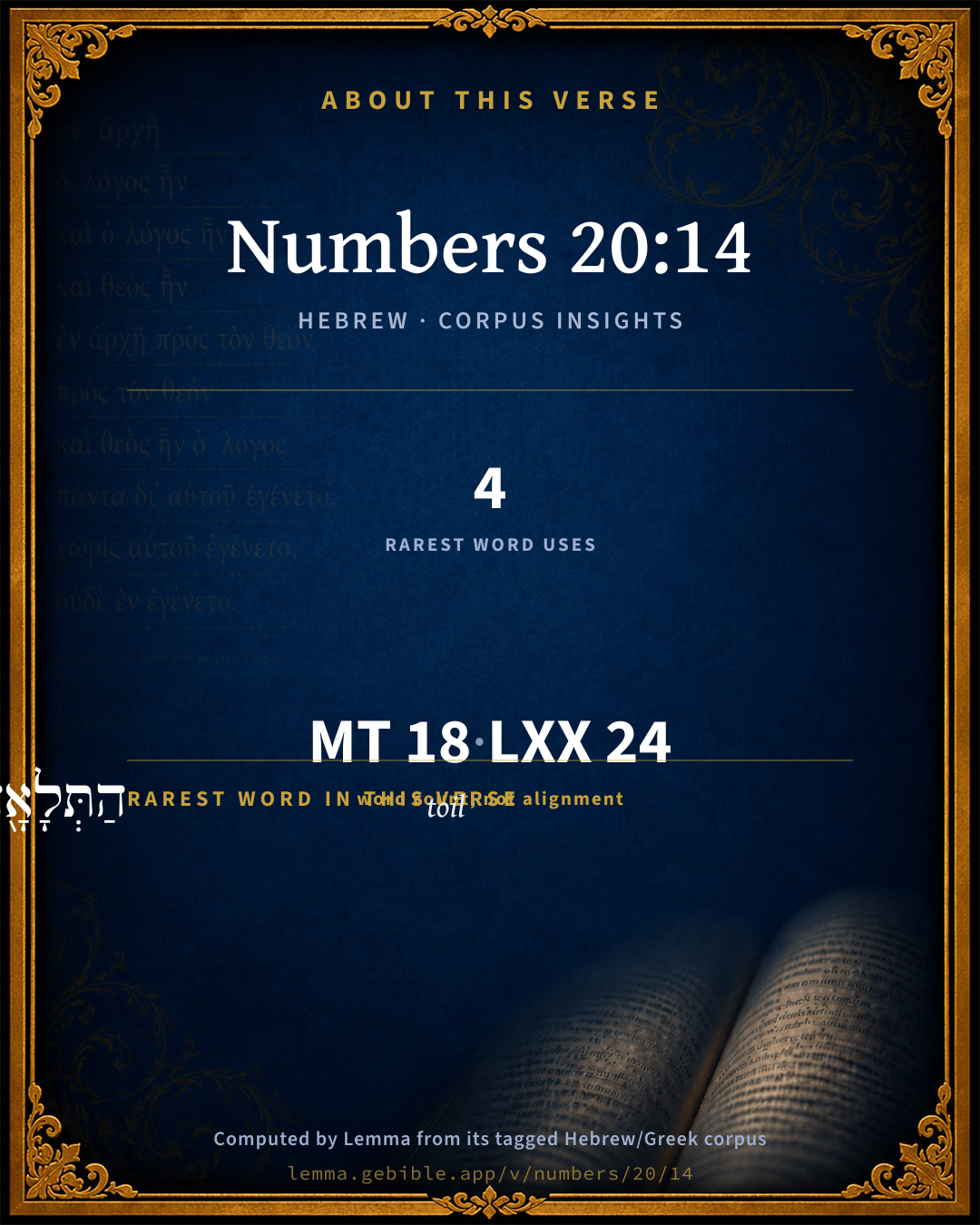
About this verse

These counts appear in no published source. They are computed here, from the morphology-tagged text and Lemma’s own curated glosses. What Lemma adds →

18
words
18
distinct lemmas
Pentateuch
section

Notable vocabulary

The rarest word here is הַתְּלָאָ֖ה toil H8513 — appearing just 4 times in the whole Hebrew Bible.

Shared distinctive vocabulary

הַתְּלָאָ֖ה toil H8513 occurs in 4 verses of the Hebrew Bible. Also found in:

Grammatical profile

  • 4 verbs
  • 9 nouns
  • 1 pronoun
  • 1 preposition
  • 1 adverb
  • 2 particles

Verb forms

  • וַיִּשְׁלַ֨ח Qal · Sequential Imperfect
  • אָמַר֙ Qal · Perfect
  • יָדַ֔עְתָּ Qal · Perfect
  • מְצָאָֽתְנוּ Qal · Perfect

Hebrew & Septuagint length

In English translation the verse runs 25 words from the Hebrew and 27 from the Septuagint (LXX English) — closely comparable.

A rough comparison of the two English renderings, which tokenize alike — not a word-level alignment.

Word counts can differ between the Hebrew and the Greek without any difference in meaning — e.g. the Hebrew direct-object marker אֵת has no separate Greek word, and Greek often adds the article ὁ.

In the original languages it is 18 Hebrew tokens and 24 Greek tokens — but the two are counted differently (Hebrew bundles its prefixes and suffixes into one token; the Greek is in lemma form), so that isn’t a like-for-like length.

Cross-references

9

Topical passages linked to Numbers 20:14 in the Treasury of Scripture Knowledge — connected by theme and wording, ordered by reader-vote popularity; previews shown in the World English Bible.

  • Judges 11:16–17 but when they came up from Egypt, and Israel went through the wilderness to the Red Sea, and came to Kadesh;
  • Deuteronomy 23:7 You shall not abhor an Edomite; for he is your brother: you shall not abhor an Egyptian, because you lived as a foreigner in his land.
  • Genesis 32:3–4 Jacob sent messengers in front of him to Esau, his brother, to the land of Seir, the field of Edom.
  • Genesis 36:31–39 These are the kings who reigned in the land of Edom, before any king reigned over the children of Israel.
  • Deuteronomy 2:4–25 Command you the people, saying, You are to pass through the border of your brothers the children of Esau, who dwell in Seir; and they will be afraid of you: take good heed to yourselves therefore;
  • Joshua 9:9 They said to him, From a very far country your servants are come because of the name of Yahweh your God: for we have heard the fame of him, and all that he did in Egypt,
  • Obadiah 1:10–12 For the violence done to your brother Jacob, shame will cover you, and you will be cut off forever.
  • Malachi 1:2 "I have loved you," says Yahweh. Yet you say, "How have you loved us?" "Wasn't Esau Jacob's brother?" says Yahweh, "Yet I loved Jacob;
  • Exodus 18:8 Moses told his father-in-law all that Yahweh had done to Pharaoh and to the Egyptians for Israel's sake, all the hardships that had come on them on the way, and how Yahweh delivered them.

Cross-references courtesy of OpenBible.info (CC BY 4.0).

Hebrew and Greek witnesses Masoretic Hebrew ↔ Greek Septuagint

The same verse in the two great witnesses to the Old Testament, shown verse-for-verse.

These are two independent witnesses, not word-aligned to each other, and the Septuagint is shown in lemma (dictionary) form.

Hebrew Numbers 20:14 Masoretic · Westminster Leningrad Codex

וַיִּשְׁלַ֨ח מֹשֶׁ֧ה מַלְאָכִ֛ים מִקָּדֵ֖שׁ אֶל מֶ֣לֶךְ אֱד֑וֹם כֹּ֤ה אָמַר֙ אָחִ֣יךָ יִשְׂרָאֵ֔ל אַתָּ֣ה יָדַ֔עְתָּ אֵ֥ת כָּל הַתְּלָאָ֖ה אֲשֶׁ֥ר מְצָאָֽתְנוּ

Moses sent messengers from Kadesh to the king of Edom, Thus says your brother Israel, You know all the travail that has happened to us:

World English Bible · Public Domain

Greek LXX Numbers 20:14 Septuagint · lemma form

καί ἀποστέλλω μωυσῆς ἄγγελος ἐκ καδης πρός βασιλεύς εδωμ λέγω ὅδε λέγω ὁ ἀδελφός σύ ἰσραήλ σύ ἐπίσταμαι πᾶς ὁ μόχθος ὁ εὑρίσκω ἐγώ

And Moses sent messengers from Cades to the king of Edom, saying, Thus says your brother Israel; You know all the distress that has come upon us.

LXX2012 (modern English Septuagint) · Public Domain

Hebrew: Westminster Leningrad Codex (CC BY 4.0). Greek: Septuagint (public domain); English from LXX2012 (modern English Septuagint) (Public Domain). How the Septuagint differs from the Hebrew →

Targum (Aramaic paraphrase)

2

The Targum is the ancient Jewish Aramaic paraphrase of the Hebrew Scriptures — an interpretive translation, not the Hebrew text itself. Onkelos (literal) and Pseudo-Jonathan (expansive) render the Torah, and Jonathan the Prophets. Coverage is partial: where no permissively-licensed English translation exists for a verse, only the Aramaic is shown. This is verse-level text, not a word-by-word alignment to the Hebrew.

  1. Targum Onkelos Torah (Genesis–Deuteronomy)
    וּשְׁלַח משֶׁה אִזְגַדִין מֵרְקָם לְוַת מַלְכָּא דֶאֱדוֹם כִּדְנַן אֲמַר אָחוּךְ יִשְׂרָאֵל אַתְּ יְדַעְתְּ יָת כָּל עָקְתָא דִי אַשְׁכַּחְתָּנָא

    (no public-domain English translation for this verse)

    Targum Onkelos — Aramaic: “Onkelos Genesis” (public domain); “Onkelos Exodus” (public domain); “Onkelos Leviticus” (public domain); “Onkelos Numbers” (public domain); “Onkelos Deuteronomy” (public domain). English: “Sefaria Community Translation” (CC0 1.0 (public-domain dedication)); “J.W. Etheridge. The Targums of Onkelos and Jonathan Ben Uzziel on the Pentateuch. London: Longmans, Green, 1862” (public domain). Text via Sefaria.

  2. Targum Pseudo-Jonathan Torah (Genesis–Deuteronomy)
    וְשָׁדַר משֶׁה אִזְגַדִין מֵרְקָם לְוַת מַלְכָּא דֶאֱדוֹם לְמֵימָר כִּדְנַן אָמַר אָחוּךְ יִשְרָאֵל אַנְתְּ יַדְעַת יַת כָּל אַנִיקֵי דְאַשְׁכַּחְתָּנָא

    Then Mosheh sent messengers from Rekem unto the king of Edom, saying, Thus saith thy brother Israel. Thou hast known all the trouble that hath found us;

    Targum Pseudo-Jonathan — Aramaic: “Targum Jonathan on Genesis” (public domain); “Targum Jonathan on Exodus” (public domain); “Targum Jonathan on Leviticus” (public domain); “Targum Jonathan on Numbers” (public domain); “Targum Jonathan on Deuteronomy” (public domain). English: “The Targum of Jonathan ben Uzziel, trans. J. W. Etheridge, London, 1862” (public domain). Text via Sefaria.

Commentary

Notes on Numbers 20:14 from classic Christian and Jewish commentators (each source and its license shown beneath its notes). The classic Christian expositions comment on the surrounding passage and are grouped to its opening verse, so a note may address several verses; the Jewish commentaries on the Tanakh (Rashi and others) are per-verse, so they appear only where the commentator wrote on this verse.

Lemma curates 59 commentaries, every one of them public domain or Creative Commons licensed, each selected and text-cleaned for this edition rather than reprinted as found. About our sources →

Matthew Henry's Commentary

We have here the application made by Israel to the Edomites. The nearest way to Canaan from the place where Israel now lay encamped was through the country of Edom. Now,

I. Moses sends ambassadors to treat with the king of Edom for leave to pass through his country, and gives them instructions what to say, Num 20:14-17. 1. They are to claim kindred with the Edomites: Thus saith thy brother Israel. Both nations descended from Abraham and Isaac, their common ancestors; Esau and Jacob, the two fathers of their respective nations, were twin-brothers; and therefore, for relation-sake, they might reasonably expect this kindness from them; nor needed the Edomites to fear that their brother Israel had any ill design upon them, or would take any advantages against them. 2. They are to give a short account of the history and present state of Israel, which, they take it for granted, the Edomites were no strangers to. And in this there was a double plea: - (1.) Israel had been abused by the Egyptians, and therefore ought to be pitied and succoured by their relations: "The Egyptians vexed us and our fathers, but we may hope our brethren the Edomites will not be so vexatious." (2.) Israel had been wonderfully saved by the Lord, and therefore ought to be countenanced and favoured (Num 20:16): "We cried unto the Lord, and he sent an angel, the angel of his presence, the angel of the covenant, the eternal Word, who had brought us forth out of Egypt, and led us hither." It was therefore the interest of the Edomites to ingratiate themselves with a people that had so great an interest in heaven and were so much its favourites, and it was at their peril if they offered them any injury. It is our wisdom and duty to be kind to those whom God is pleased to own, and to take his people for our people. Come in, thou blessed of the Lord. 3. They are humbly to beg a passport through their country. Though God himself, in the pillar of cloud and fire, was Israel's guide, in following which they might have justified their passing through any man's ground against all the world, yet God would have this respect paid to the Edomites, to show that no man's property ought to be invaded under colour of religion. Dominion is founded in providence, not in grace. Thus when Christ was to pass through a village of the Samaritans, to whom his coming was likely to be offensive, he sent messengers before his face to ask leave, Luk 9:52. Those that would receive kindness must not disdain to request it. 4. They are to give security for the good behaviour of the Israelites in this march, that they would keep in the king's high road, that they would commit no trespass upon any man's property, either in ground or water, that they would not so much as make use of a well without paying for it, and that they would make all convenient speed, as fast as they could well go on their feet, Num 20:17, Num 20:19. Nothing could be offered more fair and neighbourly.

II. The ambassadors returned with a denial, Num 20:18. Edom, that is, the king of Edom, as protector of his country, said, Thou shalt not pass by me; and, when the ambassadors urged it further, he repeated the denial (Num 20:20) and threatened, if they offered to enter his country, it should be at their peril; he raised his trained bands to oppose them. Thus Edom refused to give Israel passage. This was owing, 1. To their jealousy of the Israelites; they feared they should receive promises. And truly, had this numerous army been under any other discipline and command than that of the righteous God himself, who would no more suffer them to do wrong than to take wrong, there might have been cause for this jealousy; but what could they fear from a nation that had statutes and judgments so righteous? 2. It was owing to the old enmity which Esau bore to Israel. If they had no reason to fear damage by them, yet they were not willing to show so much kindness to them. Esau hated Jacob because of the blessing, and now the hatred revived, when the blessing was ready to be inherited. God would hereby discover the ill-nature of the Edomites to their shame, and try the good-nature of the Israelites to their honour: they turned away from him, and did not take this occasion to quarrel with him. Note, We must not think it strange if the most reasonable requests be denied by unreasonable men, and if those be affronted by men whom God favours. I as a deaf man heard not. After this indignity which the Edomites offered to Israel God gave them a particular caution not to abhor an Edomite (Deu 23:7), though the Edomites had shown such an abhorrence of them, to teach us in such cases not to meditate revenge.

Matthew Henry's Commentary on the Whole Bible (1708–1710) — public domain (CC PDM 1.0). Text via the HelloAO Bible API.

Trapp's Complete Commentary

John Trapp

Num 20:14 And Moses sent messengers from Kadesh unto the king of Edom, Thus saith thy brother Israel, Thou knowest all the travail that hath befallen us:

Ver. 14. Thus saith thy brother.] "A brother is born for adversity"; {Pro 17:17} and good blood will not belie itself. But "a brother offended is harder to be won than a strong city; and their contentions are like the bars of a castle." {Pro 18:19}

John Trapp, A Commentary or Exposition upon All the Books of the Old and New Testament (1647–1656) — public domain. Text from a community e-Sword module.

The Biblical Illustrator

Joseph S. Exell

Num_20:14-21

Edom refused to give Israel passage through his border.

A reasonable request, and an ungenerous refusal:--

I. A reasonable request.

1. Reasonable in itself.

2. Urged by forcible reasons.

(1) The relationship existing between them, Thy brother Israel.

(2) The sufferings which the Israelites had endured.

(3) The mercies which God had shown to Israel. The blessings which God had bestowed upon them should have been viewed--

(a) As an indication that it was His will that others should aid them.

(b) As an example to encourage others to aid them.

(c) As an indication of His favour towards them, which suggested that it was to the interest of others to aid them. It is perilous to resist those whom God defends; it is prudent to further their designs, &c.

(4) Because Israel would guarantee Edom against any loss.

II. An ungenerous refusal. This refusal of the Edomites probably arose from--

1. Fear that if they complied with the request of the Israelites the result might be injurious to them.

2. Envy at the growing power of Israel.

3. Remembrance of the ancient injury inflicted by Jacob upon Esau.

(1) Learn that no alienation is so wide and bitter as that between brethren or other near relations.

(2) Where such alienation exists, let us seek to bring about reconciliation--a complete healing of the breach.

(3) Cultivate brotherly kindness.

(4) Respect the rights of others even when the assertion of those rights is carried to an extreme. Thus Edom refused to give Israel passage through his border; wherefore Israel turned away from him. (W. Jones.)

Retribution consummated

Who pleads? Israel. To whom is the plea addressed? To a brother. How did the word brother come into the narrative? It came historically. We have here Jacob and Esau. Edom is the name by which Esau was known. Wherever we find the term Edom, our minds may instantly associate with it the history of Esau, and an action of Divine sovereignty in relation to that history. Jacob supplanted Esau, ran away in the night-time, met his brother at some distance of time afterwards, the brothers fell upon one anothers necks, kissed each other, and seemed to sink the infinite outrage in grateful and perpetual oblivion. Nothing of the kind. Life cannot be managed thus; things do not lie between man and man only. Herein is the difference between crime and sin. So Jacob and Esau come face to face throughout the ages. The supplanter cannot sponge out his miserable cunning and selfish deceit and unpardonable fraud. Jacob the individual dies, Esau the individual dies: but Jacob and Esau, as representing a great controversy, can never die: to the end of the chapter Edom will encounter Israel with deep and lasting animosity. So Esau had his turn. We pitied the hairy man as he was driven away portionless, without a blessing, his great heart full of sin no doubt, quivering with agony, for which there was no adequate expression in words; but in so far as he has been wronged he will see satisfaction and himself be satisfied. The supplanted family had a land when the supplanters descendants had only a wilderness. This is the law of Providence. Events are not measured within the compasses of the little day. The cunning man or the strong man, the oppressor or the wrong-doer, may have his victory to-day, and may smile upon it, and regard it with complacency, and receive the incense of adulation from persons who only see between sunrise and sundown. But the heavens are against him; he has to encounter the eternities, long time after his victory shall wither, and in his descendants his humiliation shall be consummated. (J. Parker, D. D.)

The Biblical Illustrator, edited by Joseph S. Exell (c. 1880s–1900s) — public domain. Text from a community e-Sword module.

Joseph Benson's Commentary

Num 20:14. All the travail — All the wanderings and afflictions of our parents, and of us their children, which doubtless have come to thine ears.

Joseph Benson's Commentary on the Old and New Testaments (1811–1818) — public domain. Text from a community e-Sword module.

Whedon's Commentary on the Bible

Daniel D. Whedon

A PASSAGE THROUGH EDOM REQUESTED AND REFUSED, Num_20:14-21.

Here we have the first intimation that the original purpose of entering Canaan by the direct route had been abandoned for the circuitous way east of the Dead Sea. Jehovah commanded this flank movement against the enemy to be made, as we learn from Deu_2:1-6. The advantages of this movement were: (1) the encouragement of the people by their victories over their trans-Jordanic foes, who failing to unite were easily conquered in detail, and (2) the gaining of a foothold in the valley of the Jordan as a base of operations against western Palestine.

14. Moses sent messengers — There is no proof that this message was commanded by the Lord, though it may be inferred from Deu_2:1-6.

Edom — The territory formerly called Mount Seir. In later times it was known as Idumea. It extended southward as far as Elath, its only seaport, on the eastern arm of the Red Sea. On the east it was bounded by the great Arabian Desert, and on the north by the Dead Sea. Its western boundary is involved in the dispute relative to the location of Kadesh. See Num_20:16, note. A right of way was also requested of Moab, probably at the same time. See Jdg_11:17-18, note.

Thy brother Israel — Edom was a kindred nation. “The Lord would have the brotherly relation cheerfully acknowledged on the part of his people, as they both looked to a common ancestor in Isaac, and both inherited the rite of circumcision, which would naturally be a bond of fraternal connexion. By this fraternal appeal to Moab, Moses sought to obtain the king of Moab’s permission to pass through his territory. He acted herein in the spirit of the precept, “Thou shalt not abhor an Edomite, for he is thy brother.” Deuteronomy xxiii, 7. — Bush.

Travail — Distress. See Exo_18:8, note. The message assumes a perfect acquaintance thus far with the history of Israel on the part of Edom. This is not strange considering the nearness of Edom to Egypt, their commercial intercourse, and the marvels which had attended the outgoing of Israel from this house of bondage.

Daniel D. Whedon (gen. ed.), Commentary on the Old and New Testaments (1874–1909) — public domain. Text from a community e-Sword module.

Keil & Delitzsch

C. F. Keil & F. Delitzsch

Message of the Israelites to the King of Edom. - As Israel was about to start from Kadesh upon its march to Canaan, but wished to enter it from the east across the Jordan, and not from the south, where the steep and lofty mountain ranges presented obstacles which would have been difficult to overcome, if not quite insuperable, Moses sent messengers from Kadesh to the king of Edom, to solicit from the kindred nation a friendly and unimpeded passage through their land. He reminded the king of the relationship of Israel, of their being brought down to Egypt, of the oppression they had endured there, and their deliverance out of the land, and promised him that they would not pass through fields and vineyards, nor drink the water of their wells, but keep to the king's way, without turning to the right hand or the left, and thus would do no injury whatever to the land (Num 20:14-16).

(Note: We learn from Jdg 11:17, that Israel sent messengers from Kadesh to the king of Moab also, and with a similar commission, and that he also refused to grant the request for an unimpeded passage through his land. This message is passed over in silence here, because the refusal of the Moabites had no influence upon the further progress of the Israelites. "For if they could not pass through Edom, the permission of the Moabites would not help them at all. It was only eventualiter that they sought this permission." - Hengstenberg, Diss.)

By the "angel" who led Israel out of Egypt we are naturally to understand not the pillar of cloud and fire (Knobel), but the angel of the Lord, the visible revealer of the invisible God, whom the messengers describe indefinitely as "an angel," when addressing the Edomites. Kadesh is represented in Num 20:16 as a city on the border of the Edomitish territory. The reference is to Kadesh-Barnea (Num 32:8; Num 34:4; Deu 1:2, Deu 1:19; Deu 2:14; Deu 9:23; Jos 10:41; Jos 14:6-7; Jos 15:3). This city was no doubt situated quite in the neighbourhood of Ain Kudes, the well of Kadesh, discovered by Rowland. This well was called En-mishpat, the fountain of judgment, in Abraham's time (Gen 14:7); and the name Kadesh occurs first of all on the first arrival of the Israelites in that region, in the account of the events which took place there, as being the central point of the place of encampment, the "desert of Paran," or "desert of Zin" (cf. Num 13:26 with Num 13:21, and Num 12:16). And even on the second arrival of the congregation in that locality, it is not mentioned till after the desert of Zin (Num 20:1); whilst the full name Kadesh-Barnea is used by Moses for the first time in Num 32:8, when reminding the people of those mournful occurrences in Kadesh in Num 13 and 14. The conjecture is therefore a very natural one, that the place in question received the name of Kadesh first of all from that tragical occurrence (Num 14), or possibly from the murmuring of the congregation on account of the want of water, which led Moses and Aaron to sin, so that the Lord sanctified (יקדּשׁ) Himself upon them by a judgment, because they had not sanctified Him before the children of Israel (Num 20:12 and Num 20:13); that Barnea was the older or original name of the town, which was situated in the neighbourhood of the "water of strife," and that this name was afterwards united with Kadesh, and formed into a composite noun. If this conjecture is a correct one, the name Kadesh is used proleptically, not only in Gen 14:7, as a more precise definition of En-Mishpat, but also in Gen 16:14; Gen 20:1; and Num 13:26, and Num 20:1; and there is no lack of analogies for this. It is in this too that we are probably to seek for an explanation of the fact, that in the list of stations in Num 33 the name Kadesh does not occur in connection with the first arrival of the congregation in the desert of Zin, but only in connection with their second arrival (v. 36), and that the place of encampment on their first arrival is called Rithmah, and not Barnea, because the headquarters of the camp were in the Wady Retemath, not at the town of Barnea, which was farther on in the desert of Zin. The expression "town of the end of thy territory" is not to be understood as signifying that the town belonged to the Edomites, but simply affirms that it was situated on the border of the Edomitish territory. The supposition that Barnea was an Edomitish town is opposed by the circumstance that, in Num 34:4, and Jos 15:3, it is reckoned as part of the land of Canaan; that in Jos 10:41 it is mentioned as the southernmost town, where Joshua smote the Canaanites and conquered their land; and lastly, that in Jos 15:23 it is probably classed among the towns allotted to the tribe of Judah, from which it seems to follow that it must have belonged to the Amorites. "The end of the territory" of the king of Edom is to be distinguished from "the territory of the land of Edom" in Num 20:23. The land of Edom extended westwards only as far as the Arabah, the low-lying plain, which runs from the southern point of the Dead Sea to the head of the Elanitic Gulf. At that time, however, the Edomites had spread out beyond the Arabah, and taken possession of a portion of the desert of Paran belonging to the peninsula of Sinai, which was bounded on the north by the desert of Zin (see at Num 34:3). By their not drinking of the water of the wells (Num 20:17), we are to understand, according to Num 20:19, their not making use of the wells of the Edomites either by violence or without compensation. The "king's way" is the public high road, which was probably made at the cost of the state, and kept up for the king and his armies to travel upon, and is synonymous with the "sultan-road" (Derb es Sultan) or "emperor road," as the open, broad, old military roads are still called in the East (cf. Robinson, Pal. ii. 340; Seetzen, i. pp. 61, 132, ii. pp. 336, etc.).

This military road led, no doubt, as Leake has conjectured (Burckhardt, Syr. pp. 21, 22), through the broad Wady el Ghuweir, which not only forms a direct and easy passage to the level country through the very steep mountains that fall down into the Arabah, but also a convenient road through the land of Edom (Robinson, ii. pp. 552, 583, 610), and is celebrated for its splendid meadows, which are traceable to its many springs (Burckhardt, pp. 688, 689); for the broad Wady Murreh runs from the northern border of the mountain-land of Azazimeh, not only as far as the mountain of Moddera (Madurah), where it is divided, but in its southern half as far as the Arabah. This is very likely the "great route through broad wadys," which the Bedouins who accompanied Rowland assured him "was very good, and led direct to Mount Hor, but with which no European traveller was acquainted" (Ritter's Erdk. xiv. p. 1088). It probably opens into the Arabah at the Wady el Weibeh, opposite to the Wady Ghuweir.

Keil & Delitzsch — Biblical Commentary on the Old Testament (1861–1891) — public domain (CC PDM 1.0). Text via the HelloAO Bible API. (Old Testament only.)

Lange's Commentary on the Holy Scriptures

FOURTH DIVISION

FROM KADESH ONWARD FROM THE DEPARTURE TO THE SETTLEMENT IN THE PLAINS OF MOAB

Num_20:14 to Num_22:1

FIRST SECTION:

From Kadesh to Mount Hor (Num_20:14 to Num_21:3). The King of Edom. The refusal of the request for a passage. The death of Aaron at Mount Hor. The expedition against the king of Arad.

A.—THE KING OF EDOM. THE REFUSAL OF A PASSAGE

Num_20:14—Num_21:3

14And Moses sent messengers from Kadesh unto the king of Edom, Thus saith thy 15 brother Israel, Thou knowest all the travail that hath 12befallen us: How our fathers went down into Egypt, and we have dwelt in Egypt a long time; and the Egyptians vexed us, and our fathers: 16And when we cried unto the Lord, he heard our voice, and sent an angel, and hath brought us forth out of Egypt: and, behold, we are in Kadesh, a city in the uttermost of thy border. 17Let us pass, I pray thee, through thy country: we will not pass through the fields, or through the vineyards, neither will we drink of the water of the wells: we will go by the king’s high way, we will not turn to the right hand nor to the left, until we have passed thy borders. 18And Edom said unto him, Thou shalt not pass by me, lest I come out against thee with the sword. 19And the children of Israel said unto him, We will go by the high way: and if I and my cattle drink of thy water, then I will pay for it: I will only, without doing any thing else, go through on my feet. 20And he said, Thou shalt not go through. And Edom came out against him with much people, and with a strong hand. 21Thus Edom refused to give Israel passage through his border: wherefore Israel turned away from him.

B.—THE DEATH OF AARON AT MOUNT HOR. Num_20:22-29

22And the children of Israel, even the whole congregation, journeyed from Kadesh, 23and came unto mount Hor. And the Lord spake unto Moses and Aaron in mount Hor, by the coast of the land of Edom, saying, 24Aaron shall be gathered unto his people: for he shall not enter into the land which I have given unto the children 25of Israel, because ye rebelled against my word at the water of Meribah. Take Aaron and Eleazar his son, and bring them up unto mount Hor: 26And strip Aaron of his garments, and put them upon Eleazar his son: and Aaron shall be gathered unto his people, and shall die there. 27And Moses did as the Lord commanded: and they went up into mount Hor in the sight of all the congregation. 28And Moses stripped Aaron of his garments, and put them upon Eleazar his son; and Aaron died there in the top of the mount: and Moses and Eleazar came down from the mount. 29And when all the congregation saw that Aaron was dead, they mourned for Aaron thirty days, even all the house of Israel.

C.—THE EXPEDITION AGAINST THE KING OF ARAD. Num_21:1-3.

1And when king Arad the Canaanite, which dwelt in the south, heard tell that Israel came by the way of the spies; then he fought against Israel, and took some of them prisoners. 2And Israel vowed a vow unto the Lord, and said, If thou wilt indeed deliver this people into my hand, then I will utterly destroy their cities. 3And the Lord hearkened to the voice of Israel, and delivered up the Canaanites; and they utterly destroyed them and their cities: and he called the name of the place Hormah.

TEXTUAL AND GRAMMATICAL

Num_20:14. [The travail. De Wette: hardship. Bunsen: calamity, sorrow].

Num_20:15. [Heb., treat ill, afflict.—A. G.].

Num_20:19. בַּמְסִלָּה a raised road. Causeway used by the king for military purposes.

Num_20:19. [Surely it is nothing. See Exeget. Note, and comp. Gen_20:11.—A G.].

Num_20:20. Lange; mighty. E. V.: better.

Num_20:24. Lit. mouth.

Num_20:29. [Omit when; insert and before they.—A. G.].

Num_21:1. [Lange: The Canaanite, king of Arad.—A. G.].

Num_21:1. [Lange: Way of Atharim. But there are no traces of any place bearing this name. The etymology is in favor of the rendering in our version; and the allusion to the tracks in places of the spies would be natural to one writing to Hebrew readers.—A. G.]

Num_21:2. Put or bring them under a ban. Hence the name of the place Hormah: ban.

EXEGETICAL AND CRITICAL

A. The King of Edom, Num_20:14-21

Israel had made the fruitless effort to penetrate the south of Canaan from the northern part of the Arabian desert, and indeed directly from Kadesh-Barnea (Num_14:40 et seq.). They had, after their despondent outbreak and rebellion, and before the failure in their attempt, received direction to proceed by another way—by the way of the Red Sea, Num_14:25. The idea that avoiding the difficult southern border of Palestine, they should turn to the east, lay enclosed in this direction. But the idea was not fruitful, and the undertaking was delayed until near the close of the forty years. The literal interpretation of this passage, as also of the words Num_14:1, has led to those long lines upon the maps which were supposed to indicate the march of the Israelites from Kadesh-Barnea to the Red Sea, and then from the Red Sea back again to Kadesh, with the purpose of immediately returning again to the Red Sea. It is another thing entirely, if we suppose that from their settlement at Kadesh-Barnea, they migrated in all directions seeking pasturage for their herds.13 But now the lapse of time itself warns them to depart. Two routes lie open to them; the one direct through the land of the Edomites, the other long and circuitous, stretching around and eastward of Edom. Even the first route would have led them, at least in their departure, in the direction of the Red Sea, especially if they wished to pass at a distance from the capital, Petra. The land of the Edomites was the mountain region east of the Arabah (in its restricted meaning) or of the deep depression between the Dead Sea, and the Ailanitic gulf of the Red Sea, including also the Arabah itself. When Knobel says that it extends also some distance to the west of the Arabah, this could only have been true east of Kadesh-Barnea, for otherwise the Israelites would have had to pass through Edomitish territory, as they moved toward the Red Sea.14 Kadesh certainly (Num_20:16) lay upon the border of Edom. Mount Hor, too, (Num_20:23) to which they came first after their departure, was by the coasts or borders of Edom. But in the way to the Red Sea, they might pass almost entirely around the land of Edom, if a peaceable passage through it was refused them. Even then, however, they must have crossed the boundaries of Edom according to Deu_2:1. Israel was commanded to respect the tribal relationship with Edom, as also with Moab and Ammon (Deu_2:9 et seq.; comp. Jdg_11:17). Moses therefore sought by a warm and friendly message to secure from the king of Edom a free passage through his land. But in the face of every guarantee which he offered, he received only a harsh and surly reply. Further pacific proposals were followed by harsher threats, and a warlike armament against Israel trod, as it were, upon the heels of the returning messenger. This is the starting point in the history of the treacherous brother who appears a foe by the side of Israel down to the final destruction of Jerusalem. The passage in Judges already referred to, indicates that the message to Edom and Moab must have preceded by some time the departure for the Red Sea. [It is clear from Num_20:1 compared with Num_33:38, that the Israelites must have remained in Kadesh several months. The message was probably sent soon after the congregation had gathered; and the delay was occasioned by the refusal, and the necessary preparations for the long and circuitous march before them. It could not have arisen, as the Bible Com. suggests, from a purpose to invade Canaan again from this quarter when existing obstacles should be removed. The lesson of the thirty-eight years had not been lost, and they were not prepared to brave so difficult a position (see [Keil below) after the earlier and signal failure.—A. G.].

Num_20:14-16. We can scarcely agree with Keil that the steep lofty mountain range presented an obstacle, difficult to be overcome if not actually insurmountable, to an entrance into Canaan from the south. The Scriptures give a very different reason. [But the Scripture, while attributing the defeat of the Israelites to the fact that the Lord was not among them, nowhere says or implies that the natural obstacle did not exist.—A. G.]. The invasion from the east had this additional advantage, that it would divide the power of Canaan into two parts. As to the Angel, Knobel himself understands, but not the writer as he infers, by it the pillar of cloud and fire; the harmony of both ideas never occurred to him, in his eager hunt for contradictions.

Num_20:17. We will not pass through the fields or through the vineyards, i.e., not wander about in bye-paths [or rather will guard against any careless or straggling march]. The king’s road was the public highway, built and kept in repair probably at public expense, for the march of the king and his army, like the imperial or Sultan’s road, as the old broad, public army-roads are called in the east. The references are frequent in the books of travel. Seetzen I., pp. 61, 132. See also Knobel in loc. Comp. Robinson II., p. 556. According to an early conjecture, which Keil has adopted, the king’s road here led through the Wady El Ghuweir. [Robinson, Coleman, Bible Com. and others, hold the same view.—A. G.]. This road may seem too far to the north, although running directly eastwards from Kadesh. For the Edomitish kings see Gen_36:31-39.

Num_20:18-19. After the refusal and menace of the king, the Israelites explain more fully their purposes. The previous declaration we will not drink of the water of the wells, is now explained by the clause I will pay for it. רַק “surely, altogether”—it is of no consequence. They will pass along the high-road only on their feet. [The extreme scarcity of water seems to justify the practice of selling what is most free with us. The treasures gathered were guarded so jealously that sometimes they could not be obtained for money. Hence the natural promise here that they would pay for the water.—A. G.].

Num_20:20-21. The king follows up his threat by mustering an armed force and dispatching it to the border, so that the Israelites were compelled to change their course. Thus they come to mount Hor. [The description seems to imply that the Israelites had little doubt of the success of their message. The proposition was so reasonable, the guarantees were so full, the grounds upon which the request was urged were so strong, that they did not deem it necessary to wait for the return of the messenger. They seem to have Started without anticipating the churlish refusal, and only turned southward when they found the passage barred.—A. G.].

B. The death of Aaron upon mount Hor, Num_20:22-29. “Breaking up from Kadesh the Israelites passed through the Wady Murreh, which runs along the west of the Arabah, to mount Hor. This mountain standing on the boundary (Num_33:37) בִקְצֵה of the land of Edom was located by Joseph. (Ant. IV. 4, 7), and also by Eusebius and Jerome in the vicinity of Petra. Jerome, Or mons, in quo mortuus est Aaron, juxta civitatem Petram. According to modern travellers it is mount Harun, on the northwest side of Wady Musa (Petra). Robinson describes it, II., p. 508, as a cone irregularly truncated, having three ragged points or peaks of which that on the northeast is highest, and has upon it the wely or tomb of Aaron, from which the name of the mountain Harun, i.e., Aaron, is derived. There is no reason to doubt the correctness of this tradition. See Burckhardt’s Syria, p. 715; Ritter, Erdkunde XIV., p. 1127,” Keil. [Also Stanley, Sinai and Palestine, pp. 86, 87, and note.—A. G.]. Why Knobel doubts its correctness is not clearly seen from his arguments, especially as he holds that the “second Jehovistic document” requires that the Hebrews should have marched northeastward through the Wady Murreh and northern Edom (!). But more important considerations meet us. Had the Israelites marched to this mount Harun, they would have gone almost directly towards the army of Edom, directly towards the capital city Petra, and under these circumstances a battle could hardly have been avoided. They would then also, as if in defiance of Edom, have encamped for thirty days over against Petra. The text is plainly opposed to this: they evaded the challenge of Edom; they did not march in an easterly, but southeasterly direction. Besides, the mountain top to which the aged and wearied one was led, need not have been a very lofty one. According to Deu_10:6, Aaron died at Moserah, and was there buried. It might be inferred, from the immediate connection, that Aaron died here upon the way to Kadesh. But it is merely in passing, and as a reminiscence, that Aaron’s death is there referred to. The main thing is the statement that upon the upward journey [i.e., to Kadesh] the rights and positions of the Levites were precisely established, thus this mountain on the upward way became a Levitical mountain, and upon the mountain on the march back, Aaron the head of the Levites died and was buried. In the list of encampments this place is called Moserah, and we must not overlook the fact that it is only two days removed from Hor-Hagidgad. At all events Moserah lay in the direction of the Red Sea, and scarcely in the Edomitic Arabah, but upon its western side and in the desert. [There is clearly no contradiction in the statement that Aaron died at Moserah, and on mount Hor. The camp lay at Moserah probably at the base of mount Hor or upon its lower slopes, while Moses took Aaron and Eleazar his son and ascended the mountain where Aaron died. For the manner in which Aaron’s death is referred to in Deu_10:6, see note on that passage, and Curtis’s Levitical Priests, pp. 9, 10.—A. G.].

Num_20:22-24. Hor is not spoken of as a particular mountain, but as a mountain peak in a ridge. [הֹר הָהָר Hor the mountain, i.e., the summit of the mountain; which corresponds precisely to the description given by Stanley, Sinai and Palestine, p. 86. See also Num_34:7.—A. G.]. Aaron’s death is announced at Hor, and the ordinances in relation to it follow. Aaron shall be gathered to his people. He is reminded of his transgression at the waters of Meribah. His priestly garments shall be taken from him and put upon Eleazar his son. Thus Aaron dies upon mount Hor, and disappears from the history, vanishes into concealment, as Moses did afterward. Aaron died on the first day of the fifth month, in the fortieth year of the Exodus, 123 years old.

C. The Expedition against the King of Arad. Num_21:1-3. Israel cannot take its departure from the south of Canaan without recalling the disgraceful defeat it had suffered thirty-eight years before, when attempting to enter Canaan from that side. Then the Amalekites came down, and the Canaanites which dwelt in that hill, and smote them, and discomfited them, even unto Hormah.—Num_14:45. The thoughts of the people now turn back to this early history which the writer here speaks of as that which had already occurred. Once the Canaanite king of Arad heard that Israel came by the way of the spies. If we regard Atharim not as the name of a place, but as an appellative name, synonymous with hattarim, the spies (Keil), the notion of an army which had once followed the spies is obviously suggested. We find moreover the king of Arad in the very same region in which the Israelites had formerly been defeated by the Amalekites and Canaanites. Then Hormah was the limit of the overthrow, now it is the goal of the retaliation. Israel at that time made the vow: If thou wilt indeed deliver this people into my hand, then I will utterly destroy their cities.—At last the time of retribution has come. That they did not undertake the avenging expedition from Kadesh, but first from Moserah or Mount Hor, has its ground in the necessity of first removing their wives and children and herds from the scene of danger. Jehovah crowned their retaliatory expedition into the country of Arad with success. The particular and careful designation of the place of battle: he called the name of the place Hormah (destruction) shows that they did not destroy the cities of the entire kingdom, but spread terror along its southern boundary, while the complete conquest of the country was left for the subsequent campaigns of Joshua (Jos_11:12.). This successful expedition was the first victory for the new generation, foretokening their great conflict in Canaan, as the later retaliatory march against the Midianites (chap. 31.), was the second. The narrative moreover seems to be only of a preliminary and comparatively unimportant event.

The usual assumption that the attack by the king of Arad had not occurred until now is met by strong improbabilities. It is not in the first place a probable assumption that the new generation should figure in a defeat at their first appearance upon the stage; nor that this defeat should have occurred at Mount Hor; and still more is it unlikely that the stricken host should have remained long enough at Mount Hor to gather courage for an avenging expedition. Keil indeed obviates in part these objections by assuming that the attack had occurred before the Israelites had reached Hor. But it lies directly in the face of the narrative to suppose that the Israelites in their departure had turned back northwards, or to the north-east, and not southwards to the Red Sea. [The narrative seems to imply that the king of Arad, recalling the defeat of the Israelites thirty-eight years before, and thinking that a “fatal blow might be inflicted upon them, now fell suddenly upon them as they were breaking up from Kadesh, and when, in the confusion attending the march, they were unprepared, and took some of them prisoners.” There was no serious defeat of the Israelites. It was a mere successful raid upon them, which was punished and avenged as soon as they were encamped at Moserah, or perhaps before they reached that place.—A. G.] “Besides the allusion to Arad here and Num_33:40, it appears again Jos_12:14 as the seat of a Canaanitish king, Hormah. Comp. Jdg_1:16. According to Eusebius and Jerome, it lay about twenty Roman miles south from Hebron, and still exists in the ruins of Tell-Arad. Robinson, II., p. 473, saw it at a distance [see also Stanley, Sinai and Palestine, pp. 160,161.—A. G.].” Keil.

Hormah was earlier called Zephath, Jdg_1:17. In reply to the assumption that this expedition against Arad is only an account of the conquest of that city by Joshua. See Keil, p. 138. [Bible Commentary, p. 725. The order of events is clear. The Israelites here having avenged the unprovoked attack upon them and destroyed their cities, and named the place Hormah, departed on their march southwards to compass Edom. When they left, the Canaanites re-occupied the sites of their ruined cities and restored the earlier names. Joshua finds them in possession, completes their overthrow, and at the same time the “ban” under which Israel had placed them. “We have therefore in the passage before us the history of the actual origin of the name Hormah.”—A. G.]

DOCTRINAL AND ETHICAL

The new generation, new offences, new atonements. Defeats and victories

1. The departure of the new generation commences with an act of pious magnanimity, the message to Edom. It is surely a Christian principle that Christian nations should have a sacred regard for the ties of consanguinity in their relations and intercourse with other nations.

2. At the beginning of the circuitous march around the land of Edom, Aaron dies and is buried on Mount Hor. The solemn formal priestly burial has a close connection with the blessings of the world then, and for succeeding generations. On the contrary it was fitting that the death and the grave of the great prophet Moses should be kept from the public gaze, mantled in mystery and darkness.

3. The investiture of Eleazar has also a grand ceremonial character and significance. It is an impressive symbolical transaction—as the whole typical priesthood has this character. [Stanley, History of the Jewish Church. “The succession of the Priesthood, that link of continuity between the past and present, now first introduced into the Jewish Church, was made through that singular usage preserved even to the latest days of the Jewish hierarchy by the transference of the vestments of the dead High Priest to the living successor.”—A. G.]

4. Israel as the people of the law, having their Judaical and punitive character, cannot leave the south region without righting the injury they had suffered from the king of Arad. When the correcting and thus the removing of a moral wrong is at stake, even Christian politics has its strict, stern law.

HOMILETICAL HINTS

Pacific disposition towards Edom, his brother. Mount Hor, Aaron’s goal, Eleazar’s starting place. The deferred retribution which impended over the king of Arad.

Num_20:14-22. Peaceableness and contentiousness. Particular regard for kindred races. Going out of the way for the sake of peace, when enjoined and when not. [The request—its reasonableness, its guarantees; the grounds upon which it is urged. 1. The ties of kindred. 2. Their sufferings in Egypt. 3. The deliverance the Lord had given them.—A. G.]

Num_20:22-29. Mount Hor. Aaron’s virtues, the connection with Moses, and their common devotion to the people. The subordination of the elder brother to the younger; of the High Priest to the prophet; of the priestly offender, to the stern preacher of reproof. Aaron between the dead and the living. His gentleness and his boldness. Eleazar’s ordination following the disrobing of his father. The sorrow of the house of Israel over the death of its High Priest. A comparison of the celebrated mountains of the dead, Hor, Nebo, Golgotha. [Henry: “Aaron submits to the divine decree cheerfully. He is neither afraid nor ashamed to die. He has comfort in his death: he sees his son preferred, his office preserved.” Stanley. “Mount Hor offered a retrospect rather than a prospect. He surveyed the dreary mountains, barren platform and cheerless valley of the desert through which they had passed; the opposite of that wide and varied vista which opened before the first of the prophets.”—A. G.]

Num_21:1-3. The victory over Arad, or the trial of the young generation. [Their apparent discomfiture; their consequent consciousness of weakness; their acknowledgment of dependence on God, and cry to Him; and their complete triumph. All this finds its analogy in the spiritual life.—A. G.]

Footnotes:

[12]Marg. found us.

[13][The repetition of the words “the whole congregation,” Num_20:1; Num_20:25, seems to imply that the congregation had been partially broken up during the long years of the wandering. The tabernacle formed the centre around which all clustered, and to which smaller or larger portions of the congregation may have returned from time to time. But now the “whole congregation” was gathered. A call from their great leader, or a common impression that some great event was at hand, led the scattered hosts to seek the place where the Tabernacle, the Tent of Meeting was pitched. Modern travellers find the same thing true, with the great Bedouin tribes in our day; a central camp at which the chief resides and sections of the tribe scattered in all directions seeking sustenance for their large flocks and herds.—A. G.].

[14]For the Arabah see commentary on Joshua, Num_15:1-3. [Also Stanley, Sinai and Palestine, Appendix, p. 481. Konbel refers to Num_20:23, chap, Num_33:37; Jos_15:1-3, as sustaining his view. It might easily occur, too, that the Edomites could defend successfully the steep mountain passes, and yet not prevent the Israelites from crossing their territory which lay in the Arabah or on its western skirts.—A. G.].

Lange's Commentary on the Holy Scriptures (Critical, Doctrinal, and Homiletical), ed. John Peter Lange, English translation edited by Philip Schaff (1864–1880) — public domain. Text from a community e-Sword module.

Tyndale Open Study Notes

Tyndale Open Resources

20:14–21:35 Here the Israelites began their trek toward the Promised Land. Moving from Kadesh, they left the Sinai Peninsula behind and entered the area east of the Jordan (Transjordan), approaching the Promised Land from the east by a less direct point of entry (see 14:25; cp. Deut 2:2-6).

20:14-21 Israel tried unsuccessfully to establish peaceful relations with Edom, with which it had apparently had no dealings since Esau (Edom) and Jacob (Israel) buried their father, Isaac (Gen 35:29; 36:6-8; cp. Gen 32:28). Moses’ appeal resembles the formal diplomatic correspondence of that era. While contacts with the Canaanites and other people groups were marked by hostility, communication with Edom was polite because of kinship ties (cp. Deut 2:4; 23:7). Those ties, however, were apparently not strong enough to overcome the ancient tension between Jacob and Esau (Gen 27:41).

Tyndale Open Study Notes — © Tyndale Open Resources, licensed CC BY-SA 4.0. Text via the HelloAO Bible API.

Geneva Bible (1599)

Geneva Bible translators

Because Jacob or Israel was Esau’s brother, who was called Edom.

Geneva Bible (1599) marginal notes — public domain. Text via Bolls.life.

Jamieson, Fausset & Brown

Robert Jamieson, A. R. Fausset & David Brown

Moses sent messengers . . . to the king of Edom--The encampment at Kadesh was on the confines of the Edomite territory, through which the Israelites would have had an easy passage across the Arabah by Wady-el-Ghuweir, so that they could have continued their course around Moab, and approached Palestine from the east [ROBERTS]. The Edomites, being the descendants of Esau and tracing their line of descent from Abraham as their common stock, were recognized by the Israelites as brethren, and a very brotherly message was sent to them.

Jamieson, Fausset & Brown — Commentary Critical and Explanatory on the Whole Bible (1871) — public domain (CC PDM 1.0). Text via the HelloAO Bible API.

Adam Clarke's Commentary

Verse 14. Sent messengers - unto the king of Edom] Archbishop Usher supposes that the king now reigning in Edom was Hadar, mentioned Ge 36:39.

Thus saith thy brother Israel] The Edomites were the descendants of Edom or Esau, the brother of Jacob or Israel, from whom the Israelites were descended.

Adam Clarke's Commentary on the Bible (1810–1826) — public domain. Text from a community e-Sword/MySword module.

Ellicott's Commentary for English Readers

(14) And Moses sent messengers from Kadesh . . . —The date of the occurrence related in this and the following verses is not stated. It might be inferred frem Jdg_11:16-17 that the message to the Kings of Edom and Moab was sent soon after the exodus, and that it was in consequence of their refusal that the sojourn in Kadesh was prolonged: “And (or, So) Israel abode in Kadesh” (Jdg_11:17). The account, however, is too summary to admit of any certain inference in regard to time. No difficulty is involved in the fact that Edom is represented in Genesis 36 as being governed by dukes, or chiefs (alluphim), whilst in this place we read of a king. It is possible that the form of government may have been changed, or, as in the case of the rulers of Midian, the same persons who in one place are described as kings may, in another place, be described as dukes, duces, or leaders. Comp. Num_31:8, where the five rulers of Midian are described as kings, with Jos_13:21, where the same persons are described as princes or chiefs.

Thus saith thy brother Israel.—The Edomites, as the descendants of Esau, who received the name of Edom (Gen_25:30), were closely connected with the descendants of Jacob.

A Bible Commentary for English Readers, edited by Charles John Ellicott (1878–1897) — public domain. Text from a community e-Sword module.

The Cambridge Bible for Schools and Colleges

gen. ed. J. J. S. Perowne

14. thy brother Israel] Edom was a Semitic tribe, closely connected with Israel by blood. In Gen_25:21-26 Esau (= Edom) and Jacob (= Israel) are represented as twin brothers.

the travail] lit. ‘the weariness’; the hardships of the long weary journey.

14–21. Permission to pass through Edom refused.

The Edomites occupied territory to the south of the Dead Sea, westward as far as Kadesh (Num_20:16) and southward as far as the eastern arm of the Red Sea (Num_21:4). The Israelites having failed long before to enter Canaan from the south, did not attempt it again (see, however, n. on Num_21:1-3), but proposed to enter it from the east. And if they could pass straight through Edom, their route would be greatly shortened. Edom’s refusal forced them to work round the south of the hostile country, and then northwards along its eastern border.

The Cambridge Bible for Schools and Colleges (gen. ed. J. J. S. Perowne; Cambridge University Press, 1878–1918) — public domain. Text from a community e-Sword module.

John Gill's Exposition

How our fathers went down into Egypt,.... Jacob and his twelve sons, with their children:

and we have dwelt in Egypt a long time; even the space of four hundred and thirty years, Exo 12:40.

and the Egyptians vexed us and our fathers; used them ill, brought them into bondage, and made their lives bitter, laid heavy tasks and burdens upon them, as well as slew their male children, see Exo 1:7.

John Gill's Exposition of the Whole Bible (1746–1763) — public domain (CC PDM 1.0). Text via the HelloAO Bible API.

Albert Barnes' Notes on the Bible

Compare the marginal reference. It appears from comparing Num 20:1 with Num 33:38, that the host must have remained in Kadesh some three or four months. No doubt time was required for re-organization. In order to gain the banks of Jordan by the shortest route they had to march nearly due east from Kadesh, and pass through the heart of the Edomite mountains. These are lofty and precipitous, traversed by two or three narrow defiles. Hence, the necessity of the request in Num 20:17.

Thy brother - An appeal to the Edomites to remember and renew the old kindnesses of Jacob and Esau Gen. 33:1-17.

It appears from Jdg 11:17 that a similar request was addressed to the Moabites.

Albert Barnes' Notes on the Bible (1834–1885) — public domain. Text from a community e-Sword/MySword module.

Haydock's Catholic Bible Commentary

Cades, not far from Mount Hor, on the confines of Idumea, ver. 22, and Judges xi. 16. (Calmet)

George Leo Haydock (1774–1849), Haydock's Catholic Family Bible and Commentary, 1859 edition — public domain. Excludes Psalms (Douay-Rheims chapter numbering differs from Protestant) and Deuterocanonical books (Catholic canon only).

Matthew Poole's English Annotations

Moses sent messengers, by God’s direction, Deu 2:1-3

Thy brother; for was not Esau (who is Edom, Gen 36:1) Jacob’s brother? Mal 1:2. All the travel; all the wanderings and afflictions of our parents, and of us their children, which doubtless have come to thine ears.

Matthew Poole's English Annotations on the Holy Bible (1683–1685) — public domain. Text from a community e-Sword/MySword module.

The Pulpit Commentary

And Moses sent messengers from Kadesh unto the king of Edom. On the kings of Edom see on Gen_36:31. It would seem probable from Exo_15:15 that the government was at that time (forty years before the present date) still in the hands of "dukes," and that the change had but recently taken place. It is stated in Jud_1:11:17 that Moses sent messengers at this time with a like request to the king of Moab. We are not indeed obliged to suppose that Jephthah, living 300 years after, stated the facts correctly; but there is no particular reason to doubt it in this case. That no mention of it is made here would be sufficiently explained by the fact that the refusal of Edom made the answer of Moab of no practical moment. That Moses asked a passage through the territory of Edom implies that he had renounced the idea of invading Canaan from the south. This was not on account of any insuperable difficulties presented by the character of the country or of its inhabitants, for such did not exist; nor on account of any supposed presence of Egyptian troops in the south of Palestine: but simply on account of the fact that Israel had deliberately refused to take the straight road into their land, and were therefore condemned to follow a long and circuitous route ere they reached it on an altogether different side. The dangers and difficulties of the road they actually traversed were, humanly speaking, far greater than any they would have encountered in any other direction; but this was part of their necessary discipline. Thy brother Israel. This phrase recalled the history of Esau and Jacob, and of the brotherly kindness which the former had shown to the latter at a time when he had him in his power. (Ge 33) Thou knowest all the travel that hath befallen us. Moses assumed that Edom would take a fraternal interest in the fortunes of Israel. The parallel was singularly close between the position of Jacob when he met with Esau, and the present position of Israel; we may well suppose that Moses intended to make this felt without directly asserting it.

The Pulpit Commentary (1880–1919), ed. H.D.M. Spence-Jones & Joseph S. Exell — public domain. Text from a community e-Sword module.

John Wesley's Explanatory Notes

All the travel - All the wanderings and afflictions of our parents and of us their children, which doubtless have come to thine ears.

John Wesley, Explanatory Notes Upon the Whole Bible (1754–1765) — public domain. Text via the GEBible commentary corpus.

Kretzmann's Popular Commentary

Paul E. Kretzmann

The Refusal of the Edomites to Grant Israel Passage. —

v. 14. And Moses sent messengers from Kadesh unto the king of Edom, since the plan of entering into Canaan from the east made it necessary for the people to pass through the country inhabited by the descendants of Edom, Thus saith thy brother Israel, for the two nations were descended from brothers, Thou knowest all the travel (trouble) that hath befallen us, the long and arduous desert journey which had fallen to the lot of the children of Israel after all the vicissitudes of the land of Egypt;

v. 15. how our fathers went down into Egypt, and we have dwelt in Egypt a long time; and the Egyptians vexed us and our fathers;

v. 16. and when we cried unto the Lord, He heard our voice and sent an Angel, the Angel of the Lord in a special sense, the Son of God Himself, who was the Leader of the host of Israel, Exo 14:19; Exo 23:20; Exo 33:2, and hath brought us forth out of Egypt; and, behold, we are in Kadesh, a city in the uttermost of thy border;

v. 17. let us pass, I pray thee, through thy country; we will not pass through the fields or through the vineyards, in an irregular, careless, and straggling manner of marching, or in a way which permitted individual foraging, neither will we drink of the water of the wells, that is, take the water without paying for it; we will go by the king’s highway, the great public and military road, built and maintained at the expense of the nation; we will not turn to the right hand nor to the left, until we have passed through thy borders.

v. 18. And Edom, that is, the king of the Edomites, in the name of his people, said unto him, Thou shalt not pass by me, lest I come out against thee with the sword. To the very ungracious refusal is added the menacing threat, which emphasized the denial of the petition.

v. 19. And the children of Israel, through their representatives, said unto him, We will go by the highway; and if I and my cattle drink of thy water, then I will pay for it, the people of the country were not to suffer any inconvenience or loss by reason of this journey through their land; I will only, without doing anything else, go through on my feet; literally, "It isn’t anything, it isn’t really a serious matter for which I am asking, just a small favor, I merely want to pass through afoot. "

v. 20. And he said, Thou shalt not go through. The refusal of the king of Edom was definite and final. And Edom came out against him with much people, and with a strong hand; the king mobilized his army and made ready to attack Israel, as soon as the latter would cross his border.

v. 21. Thus Edom refused to give Israel passage through his border; wherefore Israel turned away from him. The Lord had them change their proposed itinerary, probably because He did not want to have the people become discouraged by war. The children of Edom are often represented in Scriptures as the enemies of the Lord’s people and as a type of the unbelievers of all times. The children of this world, in spite of their apparent attitude of friendliness so frequently shown, will do everything in their power to hinder the children of God from obtaining eternal salvation.

Paul E. Kretzmann, Popular Commentary of the Bible (1921–1924) — public domain. Text from a community e-Sword module.

unfoldingWord translationNotes

Door43 World Missions Community

Your brother Israel

Moses uses this phrase to emphasize that the Israelites and the Edomites are related because their ancestors, Jacob and Esau, were brothers.

When we called out to Yahweh

"When we prayed to Yahweh begging him to help us"

he heard our voice

Here "voice" represents their crying or what they said to him. AT: "he heard our cry" or "he heard what we asked for" (See: Metonymy)

Look

The word "look" here shows that they have stopped speaking about the past and are now speaking about their present situation.

translationWords

Moses

send

messenger

Kadesh

king

Edom

brother

Israel

know

Egypt

life

Yahweh

voice

angel

unfoldingWord translationNotes — © Distant Shores Media and the Door43 World Missions Community, licensed CC BY-SA 4.0. Source: git.door43.org/Door43/en_tn.

Rashi

Rabbi Shlomo Yitzchaki (Rashi)

אחיך ישראל THY BROTHER ISRAEL — What reason had he to mention here their brotherhood? But in effect he said to him: We are brothers, sons of Abraham to whom it was said, (Genesis 15:13) “know for a surety that thy seed shall be a stranger [in a land not theirs]”, and upon both of us, being of Abraham’s seed, was the duty of paying that debt (Midrash Tanchuma, Chukat 12).

אתה ידעת את כל התלאה THOU KNOWEST ALL THE TRAVAIL — It was on this account that your father separated himself from our father, as it is said, (Genesis 36:6), "And he (Esau) went to another land on account of Jacob, his brother” — on account of the bond which devolved upon both of them, and he cast the whole of it upon Jacob (Genesis Rabbah 82:13; cf. Rashi on Genesis 36.7.2).

Rashi on the Tanakh — English translations: “The Judaica Press complete Tanach with Rashi, translated by A. J. Rosenberg” (CC BY 4.0); “Pentateuch with Rashi's commentary by M. Rosenbaum and A.M. Silbermann, 1929-1934” (public domain); “The Metsudah Tanach series, Lakewood, N.J” (CC BY 4.0); and “The Book of Joshua, Metsudah Publications, 1997” (CC BY 4.0). Text via Sefaria.

Ramban (Nachmanides)

Rabbi Moshe ben Nachman (Ramban / Nachmanides)

AND MOSES SENT MESSENGERS FROM KADESH UNTO THE KING OF EDOM. Scripture did not mention the king’s name, because there was no necessity to do so. It did, however, mention Sihon and Og, the kings of the Amorites, by name, because they were famous for their strength, and they had a name among the nations; [therefore it stresses] that we should give thanks to Him, blessed be He, for having dealt wondrously with us, as it is said, To Him that smote great kings; for His mercy endureth for ever … Sihon king of the Amorites; for His mercy endureth for ever. And Og king of Bashan; for His mercy endureth for ever. And it is customary for Scripture to mention the names of the great kings whose lands we inherited, just as it mentioned in [the Book of] Joshua the five kings of the Amorites: Adoni-zedek king of Jerusalem, and Hoham king of Hebron, and Piram king of Jarmuth, and Japhia king of Lachish, and Debir king of Eglon., Verse 3. [It mentioned also] Jabin king of Hazor, 11:1. but the rest of the kings it mentioned only by number, 12:9-24. not by name [because they were not famous for their strength]. Scripture states [here], And ‘Edom’ said unto him [and it does not say: “and ‘the king’ of Edom said”], because the whole people agreed with their ruler in his refusal [to allow the Israelites to pass through their land].

Ramban (Nachmanides) on the Tanakh — English translation: “Commentary on the Torah by Ramban (Nachmanides). Translated and annotated by Charles B. Chavel. New York, Shilo Pub. House, 1971-1976” (CC BY 4.0). Text via Sefaria.

Lesson kit

Teaching starters — assembled from the data on this page, not authored interpretation. Every prompt links to the verse data it draws on. Edit before teaching.

Numbers, in the Pentateuch, opens this verse with 18 words (18 distinct Hebrew lemmas). Its most distinctive word is tᵉlâʼâh (“toil”). A historical commentator’s framing appears above. Read the whole chapter for the surrounding context.

Discussion questions

  1. What does “toil” (tᵉlâʼâh) contribute to the verse as a whole?
  2. How does Exodus 18:8, which shares the word «toil», read alongside this verse?
  3. These translations render this verse differently; the difference is in the English rendering, not the original. What questions does that raise?
  4. «וַיִּשְׁלַ֨ח» is a Qal Sequential Imperfect verb. How does that grammatical form shape the action described?
  5. Compare how Matthew Henry's Commentary and Trapp's Complete Commentary read this verse. Where do they agree or differ?

Things to notice

Reading settings

Reading text

Shown beneath each verse's original-language words.

Old Testament
Old Testament edition

Read the OT as the Masoretic Hebrew (MT) or the Greek Septuagint (LXX).

English shown for the Greek Septuagint (in the Hebrew ↔ Greek comparison).

Comparing translations? Open the Compare panel on any verse page to stack up to four side by side.