Isaiah 37:9

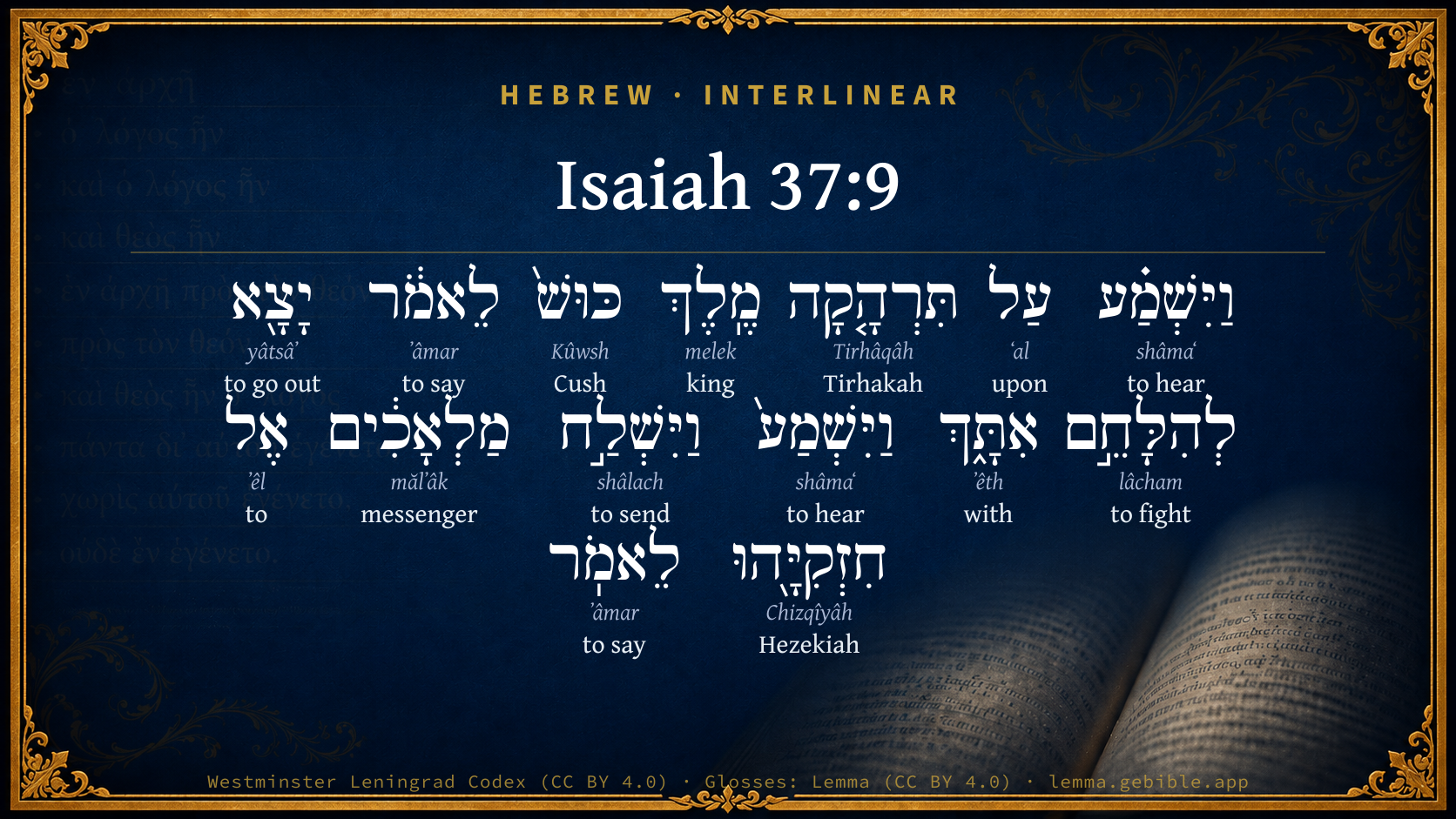
Hebrew (Westminster Leningrad Codex) Isaiah 37:9 appears in the Hebrew Old Testament. The text above is from the Westminster Leningrad Codex. Each word links to its Strong’s number, a concise gloss, and parsing drawn from the Open Scriptures Hebrew Bible morphology. Click any word for its full Brown-Driver-Briggs (BDB) entry.
Download image
Cite this verse

Isaiah 37:9 (World English Bible). Public Domain. Lemma interlinear Bible study tool, https://lemma.gebible.app/v/isaiah/37/9.

Show BibTeX & RIS
BibTeX
RIS
English Translation
He heard say concerning Tirhakah king of Ethiopia, He is come out to fight against you. When he heard it, he sent messengers to Hezekiah, saying,
World English Bible · Public Domain
Download a study sheet

One document with this verse’s original text, its word-by-word gloss line, the meaning frame, cross-references with their text, attributed commentary, and full source and license credits — printable, and it pastes into notes with its structure intact.

This verse Autodidact and up

Study sheet (.html) Plain text (.txt)

A passage Seminary Student

Up to 50 verses in one chapter. A passage sheet keeps up to 6 commentary sources and 12 cross-references per verse, in the order this page ranks them, and says so on the sheet whenever that leaves anything out. Ask for a single verse and you get the Autodidact verse sheet above.

Everything on this page stays free to read, with no account — the sheet is a download of what is already on screen, not access to it.

Want to remove ads? Support Godless Engineer
Compare translations 3

The same verse in 3 English versions, stacked beneath the original-language interlinear above. Click any original word for its lexicon entry.

Each is an independent rendering of the whole verse — the interlinear is not word-aligned to these translations.

Highlighted words mark where these versions differ — a whole-verse word diff, not a word-by-word alignment.

  • World English Bible Public Domain
    He heard say concerning Tirhakah king of Ethiopia, He is come out to fight against you. When he heard it, he sent messengers to Hezekiah, saying,
  • King James Version Public Domain
    And he heard say concerning Tirhakah king of Ethiopia, He is come forth to make war with thee. And when he heard it, he sent messengers to Hezekiah, saying,
  • unfoldingWord Literal Text CC BY-SA 4.0
    Then he heard concerning Tirhakah, the king of Cush, saying, “He has come out to fight with you.” And he heard, and he sent messengers to Hezekiah, saying,

unfoldingWord Literal Text — © unfoldingWord, licensed CC BY-SA 4.0. Word-aligned USFM3 via Door43 (git.door43.org/unfoldingWord/en_ult).

Versions to compare (up to 4)

3 of 4 selected

Show all 18 translations

Every available English version of this verse, each an independent rendering of the whole verse.

  • World English Bible Public Domain
    He heard say concerning Tirhakah king of Ethiopia, He is come out to fight against you. When he heard it, he sent messengers to Hezekiah, saying,
  • Berean Standard Bible Public Domain
    Now Sennacherib had been warned about Tirhakah king of Cush: “He has set out to fight against you.” On hearing this, Sennacherib sent messengers to Hezekiah, saying,
  • Majority Standard Bible Public Domain
    Now Sennacherib had been warned about Tirhakah king of Cush: “He has set out to fight against you.” On hearing this, Sennacherib sent messengers to Hezekiah, saying,
  • King James Version Public Domain
    And he heard say concerning Tirhakah king of Ethiopia, He is come forth to make war with thee. And when he heard it, he sent messengers to Hezekiah, saying,
  • American Standard Version (1901) Public Domain
    And he heard say concerning Tirhakah king of Ethiopia, He is come out to fight against thee. And when he heard it, he sent messengers to Hezekiah, saying,
  • Revised Version (1885) Public Domain
    And he heard say concerning Tirhakah king of Ethiopia, He is come out to fight against thee. And when he heard it, he sent messengers to Hezekiah, saying,
  • Geneva Bible (1599) Public Domain
    He heard also men say of Tirhakah, King of Ethiopia, Beholde, he is come out to fight against thee: and when he heard it, he sent other messengers to Hezekiah, saying,
  • Douay-Rheims (1899) Public Domain
    And he heard say about Tharaca the king of Ethiopia: He is come forth to fight against thee. And when he heard it, he sent messengers to Ezechias, saying:
  • Young's Literal Translation Public Domain
    And he heareth concerning Tirhakah king of Cush, saying, `He hath come out to fight with thee;' and he heareth, and sendeth messengers unto Hezekiah, saying,
  • Literal Standard Version CC BY-SA 4.0
    And he hears concerning Tirhakah king of Cush, saying, “He has come out to fight with you”; and he hears, and sends messengers to Hezekiah, saying,
  • Unlocked Literal Bible CC BY-SA 4.0
    Then Sennacherib heard that Tirhakah king of Cush and Egypt had mobilized to fight against him, so he sent messengers again to Hezekiah with a message:
  • unfoldingWord Literal Text CC BY-SA 4.0
    Then he heard concerning Tirhakah, the king of Cush, saying, “He has come out to fight with you.” And he heard, and he sent messengers to Hezekiah, saying,
  • Darby Bible Public Domain
    And he heard say of Tirhakah king of Ethiopia, He has come forth to make war with thee. And when he heard [it], he sent messengers to Hezekiah, saying,
  • World Messianic Bible Public Domain
    He heard news concerning Tirhakah king of Ethiopia, “He has come out to fight against you.” When he heard it, he sent messengers to Hezekiah, saying,
  • Webster's Bible Public Domain
    And he heard it said concerning Tirhakah king of Cush, He is come forth to make war with thee. And when he heard it, he sent messengers to Hezekiah, saying,
  • Free Bible Version CC BY-SA 4.0
    Sennacherib had received a message about Tirhakah, king of Ethiopia, that said, “Watch out! He is coming to attack you.” So Sennacherib sent messengers again to Hezekiah, saying,
  • Bible in Basic English Public Domain
    And when news came to him that Tirhakah, king of Ethiopia, had made an attack on him,... And he sent representatives to Hezekiah, king of Judah, saying,
  • JPS Tanakh (1917) Public Domain
    And he heard say concerning Tirhakah king of Ethiopia: 'He is come out to fight against thee.' And when he heard it, he sent messengers to Hezekiah, saying:

Literal Standard Version (2020), Covenant Press — licensed CC BY-SA 4.0. Text via the HelloAO Bible API (eBible.org). Unlocked Literal Bible (unfoldingWord) — licensed CC BY-SA 4.0. Text via the HelloAO Bible API (eBible.org). unfoldingWord Literal Text — © unfoldingWord, licensed CC BY-SA 4.0. Word-aligned USFM3 via Door43 (git.door43.org/unfoldingWord/en_ult). Free Bible Version, Dr. Jonathan Gallagher — licensed CC BY-SA 4.0. Text via the HelloAO Bible API (eBible.org).

Word by word

More ways to search: Search by grammar → Find every occurrence → Compare this word →

Practice this passage: Drill this verse → Learn its vocabulary →

תִּרְהָ֤קָה
Tirhâqâh
H8640
“Tirhakah”
Noun, Proper
Part of Speech
Noun
Type
Proper
Full BDB Definition

Origin: of foreign derivation

TWOT: None

Tirhakah = "he searched out the pious: he searched out the waiter" - king of Ethiopia and Egypt in the time of Sennacherib
  1. וַיִּשְׁמַ֗ע shâmaʻ H8085 “and · to hear” Conjunction + Verb, Qal, Sequential Imperfect, 3rd Person, Masculine, Singular
  2. עַל ʻal H5921 “upon” Preposition
  3. מֶֽלֶךְ melek H4428 “king of” Noun, Common, Masculine, Singular, Construct
  4. כּוּשׁ֙ Kûwsh H3568 “Cush” Noun, Proper
  5. לֵאמֹ֔ר ʼâmar H559 “to say” Preposition + Verb, Qal, Infinitive Construct
  6. יָצָ֖א yâtsâʼ H3318 “to go out” Verb, Qal, Perfect, 3rd Person, Masculine, Singular
  7. לְהִלָּחֵ֣ם lâcham H3898 “to fight” Preposition + Verb, Niphal, Infinitive Construct
  8. אִתָּ֑ךְ ʼêth H854 “with · you” Preposition + Suffix, Personal, 2nd Person, Feminine, Singular
  9. וַיִּשְׁמַע֙ shâmaʻ H8085 “and · to hear” Conjunction + Verb, Qal, Sequential Imperfect, 3rd Person, Masculine, Singular
  10. וַיִּשְׁלַ֣ח shâlach H7971 “and · to send” Conjunction + Verb, Qal, Sequential Imperfect, 3rd Person, Masculine, Singular
  11. מַלְאָכִ֔ים mălʼâk H4397 “messengers” Noun, Common, Masculine, Plural, Absolute
  12. אֶל ʼêl H413 “to” Preposition
  13. חִזְקִיָּ֖הוּ Chizqîyâh H2396 “Hezekiah” Noun, Proper
  14. לֵאמֹֽר ʼâmar H559 “to say” Preposition + Verb, Qal, Infinitive Construct

About this verse

These counts appear in no published source. They are computed here, from the morphology-tagged text and Lemma’s own curated glosses. What Lemma adds →

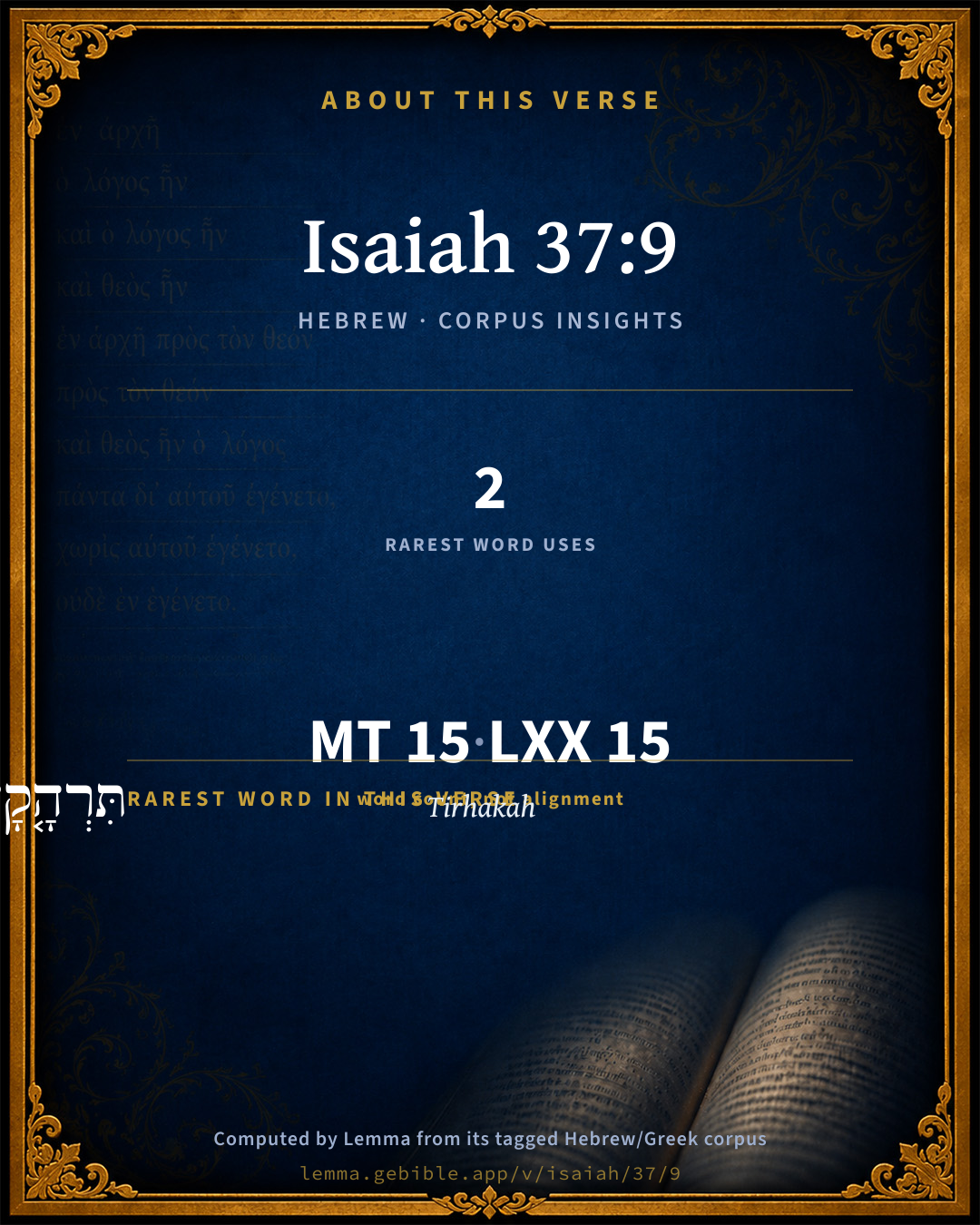
15
words
13
distinct lemmas
Prophets
section

Notable vocabulary

The rarest word here is תִּרְהָ֤קָה Tirhakah H8640 — appearing just 2 times in the whole Hebrew Bible.

Shared distinctive vocabulary

תִּרְהָ֤קָה Tirhakah H8640 occurs in 2 verses of the Hebrew Bible. Also found in:

Grammatical profile

  • 7 verbs
  • 5 nouns
  • 3 prepositions

Verb forms

  • וַיִּשְׁמַ֗ע Qal · Sequential Imperfect
  • לֵאמֹ֔ר Qal · Infinitive Construct
  • יָצָ֖א Qal · Perfect
  • לְהִלָּחֵ֣ם Niphal · Infinitive Construct
  • וַיִּשְׁמַע֙ Qal · Sequential Imperfect
  • וַיִּשְׁלַ֣ח Qal · Sequential Imperfect
  • לֵאמֹֽר Qal · Infinitive Construct

Repetition

Words recur within this verse — often emphatic in Hebrew:

  • וַיִּשְׁמַ֗ע to hear H8085 ×2
  • לֵאמֹ֔ר to say H559 ×2

Hebrew & Septuagint length

In English translation the verse runs 26 words from the Hebrew and 25 from the Septuagint (LXX English) — closely comparable.

A rough comparison of the two English renderings, which tokenize alike — not a word-level alignment.

Word counts can differ between the Hebrew and the Greek without any difference in meaning — e.g. the Hebrew direct-object marker אֵת has no separate Greek word, and Greek often adds the article ὁ.

In the original languages it is 15 Hebrew tokens and 15 Greek tokens — but the two are counted differently (Hebrew bundles its prefixes and suffixes into one token; the Greek is in lemma form), so that isn’t a like-for-like length.

Cross-references

4

Topical passages linked to Isaiah 37:9 in the Treasury of Scripture Knowledge — connected by theme and wording, ordered by reader-vote popularity; previews shown in the World English Bible.

  • 1 Samuel 23:27–28 But there came a messenger to Saul, saying, Haste you, and come; for the Philistines have made a raid on the land.
  • Isaiah 18:1 Ah, the land of the rustling of wings, which is beyond the rivers of Ethiopia;
  • Isaiah 20:5 They shall be dismayed and confounded, because of Ethiopia their expectation, and of Egypt their glory.
  • Isaiah 37:7 Behold, I will put a spirit in him, and he shall hear news, and shall return to his own land; and I will cause him to fall by the sword in his own land.

Cross-references courtesy of OpenBible.info (CC BY 4.0).

Hebrew and Greek witnesses Masoretic Hebrew ↔ Greek Septuagint

The same verse in the two great witnesses to the Old Testament, shown verse-for-verse.

These are two independent witnesses, not word-aligned to each other, and the Septuagint is shown in lemma (dictionary) form.

Hebrew Isaiah 37:9 Masoretic · Westminster Leningrad Codex

וַיִּשְׁמַ֗ע עַל תִּרְהָ֤קָה מֶֽלֶךְ כּוּשׁ֙ לֵאמֹ֔ר יָצָ֖א לְהִלָּחֵ֣ם אִתָּ֑ךְ וַיִּשְׁמַע֙ וַיִּשְׁלַ֣ח מַלְאָכִ֔ים אֶל חִזְקִיָּ֖הוּ לֵאמֹֽר

He heard say concerning Tirhakah king of Ethiopia, He is come out to fight against you. When he heard it, he sent messengers to Hezekiah, saying,

World English Bible · Public Domain

Greek LXX Isaiah 37:9 Septuagint · lemma form

ἐκἔρχομαι θαρακα βασιλεύς αἰθίοψ πολιορκέω αὐτός καί ἀκούω ἀποστρέφω καί ἀποστέλλω ἄγγελος πρός εζεκιας λέγω

And Tharaca king of the Ethiopians went forth to attack him. And when he heard it, he turned aside, and sent messengers to Ezekias, saying,

LXX2012 (modern English Septuagint) · Public Domain

On this verse, Adam Clarke's Commentary discusses the Septuagint’s reading. Read the note in Commentary ↓

Hebrew: Westminster Leningrad Codex (CC BY 4.0). Greek: Septuagint (public domain); English from LXX2012 (modern English Septuagint) (Public Domain). How the Septuagint differs from the Hebrew →

Targum (Aramaic paraphrase)

1

The Targum is the ancient Jewish Aramaic paraphrase of the Hebrew Scriptures — an interpretive translation, not the Hebrew text itself. Onkelos (literal) and Pseudo-Jonathan (expansive) render the Torah, and Jonathan the Prophets. Coverage is partial: where no permissively-licensed English translation exists for a verse, only the Aramaic is shown. This is verse-level text, not a word-by-word alignment to the Hebrew.

  1. Targum Jonathan Prophets (Joshua–Malachi)
    וּשְׁמַע עַל תִּרְהָקָה מַלְכָּא דְכוּשׁ לְמֵימָר נְפַק לְאַגָחָא קְרָבָא עִמָךְ וּשְׁמָע וּשְׁלַח אִזְגַדִין לְוַת חִזְקִיָה לְמֵימָר:

    And Sennacherib heard say concerning Tirhaka king of Ethiopia, he hath gone forth to wage war against thee. And when he heard it, he sent messengers to Hezekiah, saying,

    Targum Jonathan — Aramaic: “Mikraot Gedolot” (public domain). English: “Sefaria Community Translation” (CC0 1.0 (public-domain dedication)); “London "Chaldee Paraphrase," 1871” (public domain). Text via Sefaria.

Commentary

Notes on Isaiah 37:9 from classic Christian and Jewish commentators (each source and its license shown beneath its notes). The classic Christian expositions comment on the surrounding passage and are grouped to its opening verse, so a note may address several verses; the Jewish commentaries on the Tanakh (Rashi and others) are per-verse, so they appear only where the commentator wrote on this verse.

Lemma curates 59 commentaries, every one of them public domain or Creative Commons licensed, each selected and text-cleaned for this edition rather than reprinted as found. About our sources →

Tyndale Open Study Notes

Tyndale Open Resources

37:9 King Tirhakah of Ethiopia was then the ruler of Egypt.

Tyndale Open Study Notes — © Tyndale Open Resources, licensed CC BY-SA 4.0. Text via the HelloAO Bible API.

Jamieson, Fausset & Brown

Robert Jamieson, A. R. Fausset & David Brown

Tirhakah--(See on Isa 17:12; Isa 18:6). Egypt was in part governed by three successive Ethiopian monarchs, for forty or fifty years: Sabacho, Sevechus, and Tirhakah. Sevechus retired from Lower Egypt owing to the resistance of the priests, whereupon Sethos, a prince-priest, obtained supreme power with Tanis (Zoan in Scripture), or Memphis, as his capital. The Ethiopians retained Upper Egypt under Tirhakah, with Thebes as the capital. Tirhakah's fame as a conqueror rivalled that of Sesostris; he, and one at least, of the Pharaohs of Lower Egypt, were Hezekiah's allies against Assyria. The tidings of his approach made Sennacherib the more anxious to get possession of Jerusalem before his arrival.

sent-- Kg2 19:9 more fully expresses Sennacherib's eagerness by adding "again."

Jamieson, Fausset & Brown — Commentary Critical and Explanatory on the Whole Bible (1871) — public domain (CC PDM 1.0). Text via the HelloAO Bible API.

Adam Clarke's Commentary

Verse 9. He heard say concerning Tirhakah king of Ethiopia] When he heard that Tirhakah king of Ethiopia had come out against him, then he sent that blasphemous manifesto which is contained in Isa 37:10-13, to terrify Hezekiah into submission. How much was this like, in words and spirit, to the manifesto sent to the Parisians by the late Duke of Brunswick, from the plains of Champaigne, in 1792, which was the forerunner of the mighty torrents of human blood which was shed in the French revolution! And what a blast of God fell upon him and his army - nearly like that which fell on the army of Sennacherib!

He sent messengers - "He sent messengers again"] The word וישמע vaiyishma, "and he heard," which occurs the second time in this verse, is repeated by mistake from the beginning of the verse. It is omitted in an ancient MS. It is a mere tautology, and embarrasses the sense. The true reading instead of it is, וישב veyesheb, "and he returned," which the Septuagint read in this place, απεστρεψε, and which is preserved in the other copy, 2Kg 19:9: "He returned and sent," that is, according to the Hebrew idiom, "he sent again."

Adam Clarke's Commentary on the Bible (1810–1826) — public domain. Text from a community e-Sword/MySword module.

Ellicott's Commentary for English Readers

(9) Tirhakah.—The third of the twenty-fifth, or Ethiopian dynasty of kings, So, or Sabaco, with whom Hoshea, the last king of Israel, allied himself, being the first (2Ki_17:4). He is described in Assurbanipal’s inscriptions (Records of the Past, i. 60) as king of Mizr and Cush—i.e., Egypt and Ethiopia. The policy of Hezekiah’s counsellors had led them to court his alliance, as in Isaiah 30, 31. Now, however, the Egyptian army was at least mobilised. “Rahab” was no longer “sitting still” (Isa_30:7).

When he heard it.—The message is in substance a repetition of its predecessors, more defiant, perhaps, as if in answer to the threatened attack of Tirhakah’s armies, which Sennacherib could scarcely fail to connect with Hezekiah’s confident hope of deliverance.

A Bible Commentary for English Readers, edited by Charles John Ellicott (1878–1897) — public domain. Text from a community e-Sword module.

The Cambridge Bible for Schools and Colleges

gen. ed. J. J. S. Perowne

9. Tirhakah king of Ethiopia is named only here in the O.T. See General Introduction, p. xvi.

The Cambridge Bible for Schools and Colleges (gen. ed. J. J. S. Perowne; Cambridge University Press, 1878–1918) — public domain. Text from a community e-Sword module.

John Gill's Exposition

Thus shall ye speak to Hezekiah king of Judah, saying,.... This was the direction, and these the instructions he gave to his messengers, in which he gives Hezekiah the title of king, and owns him to be king of Judah; which was more than Rabshakeh his servant would do:

let not thy God, in whom thou trustest, deceive thee; than which, nothing could be more devilish and satanical, to represent the God of truth, that cannot lie, as a liar and deceiver: in this the king of Assyria outdid Rabshakeh himself; he had represented Hezekiah as an impostor and a deceiver of the people, and warns them against him as such; and here Sennacherib represents God himself as a deceiver, and cautions Hezekiah against trusting in him: nothing is more opposite to Satan and his instruments, than faith in God, and therefore they labour with all their might and main to weaken it; however, this testimony Hezekiah had from his enemy, that he was one that trusted in the Lord; and a greater character a man cannot well have:

saying, Jerusalem shall not be given into the hand of the king of Assyria; and so the Lord had said it; see Isa 38:6 and by some means or another Sennacherib had heard of it; and there was nothing he dreaded more than that Hezekiah should believe it, which would encourage him, he feared, to hold out the siege.

John Gill's Exposition of the Whole Bible (1746–1763) — public domain (CC PDM 1.0). Text via the HelloAO Bible API.

Albert Barnes' Notes on the Bible

And he heard say - The report or rumour referred to in Isa 37:7. In what way he heard this is not intimated. It is probable that the preparations which Tirhakah had made, were well known to the surrounding regions, and that he was already on his march against Sennacherib.

Tirhakah - This king, who, by Eusebius and by most ancient writers, is called Ταρακὸς Tarakos, was a celebrated conqueror, and had subdued Egypt to himself. He reigned over Egypt eighteen years. When Sennacherib marched into Egypt, Sevechus or Sethon was on the throne. Sennacherib having laid siege to Pelusium, Tirhakah came to the aid of the city, and, in consequence of his aid, Sennacherib was compelled to raise the siege and returned to Palestine, and laid siege to Lachish. Tirhakah succeeded Sevechus in Egypt, and was the third and last of the Ethiopian kings that reigned over that country. He probably took advantage of the distracted state that succeeded the death of Sevechus, and secured the crown for himself. This was, however, after the death of Sennacherib. The capital which he occupied was Thebes (see Prideaux’s “Connection,” vol. i. pp. 141, 145, 149. Ed. 1815). As he was celebrated as a conqueror, and as he had driven Sennacherib from Pelusium and from Egypt, we may see the cause of the alarm of Sennacherib when it was rumoured that he was about to follow him into Palestine, and to make war on him there.

He is come forth - He has made preparations, and is on his way.

He sent messengers ... - With letters or despatches Isa 37:14. Hezekiah was probably ignorant of the approach of Tirhakah, or at all events Sennacherib would suppose that he was ignorant of it; and as Sennacherib knew that there would be no hope that Hezekiah would yield if he knew that Tirhakah was approaching to make war on him, he seems to have resolved to anticipate the intelligence, and to see if it were possible to induce him to surrender. He, therefore, sent substantially the same message as before, and summoned him to capitulate.

Albert Barnes' Notes on the Bible (1834–1885) — public domain. Text from a community e-Sword/MySword module.

The Pulpit Commentary

Tirhakah, King of Ethopia. Tirhakah is among the most famous of the monarchs belonging to this period. The Greeks called him "Tearchon," the Assyrians "Tarku" or "Tarqu." His name, as represented on his own monuments, is "Tahark" or "Tahrak." According to the Egyptian remains, he had a reign of at least twenty-six years in Egypt from B.C. 693 to B.C. 667. He would seem, however, to have been King of Ethiopia, and lord paramount of the lower valley of the Nile, from about B.C. 700, Shabatok for some years ruling Egypt, or a portion of it, as his deputy (Rawlinson, "Hist. of Ancient Egypt," vol. 2. p. 450). Hezekiah"s negotiations had, it is probable, been with Tirhakah. (Isa_19:13 Isa_20:5 Isa_30:1-6) This monarch, having engaged to help him, now put his forces in motion, and began to descend the Nile valley to his relief. His movement rather provoked than alarmed Sennacherib, who, having defeated one Egyptian army in B.C. 701 ("Eponym Canon," pp. 133, 134), was confident of success against another. He sent messengers. It is not very clear what advantage Sennacherib expected from this second embassy. He had no fresh argument to bring forward, unless it were a suggestion that Hezekiah"s God was endeavouring to deceive him. In the main, vers. 10-13 are a mere expansion of Isa_36:18-20.

The Pulpit Commentary (1880–1919), ed. H.D.M. Spence-Jones & Joseph S. Exell — public domain. Text from a community e-Sword module.

J. A. Alexander on Isaiah

Joseph Addison Alexander

“And he (Sennacherib) heard say concerning Tirhakah king of Ethiopia, He is come forth to make war with thee; and he heard (it) and sent (or when he heard it he sent) messengers to Hezekiah, saying” (what follows in the next verse). For the meaning of the Hebrew name Cush, see the notes on Isa 18:1 and Isa 20:3. Tirhakah was one of the most famous conquerors of ancient times. Magasthenes, as quoted by Strabo, puts him between Sesostris and Nebuchadnezzar. He is also named by Manetho as one of the Ethiopian dynasty in Egypt. He was at this time either in close alliance with that country, or more probably in actual possession of Thebais or Upper Egypt. The fact that an Ethiopian dynasty did reign there, is attested by the ancient writers, and confirmed by still existing monuments. The Greek forms of the name vary but little from the Hebrew.

It is unnecessary to suppose that Tirhakah had crossed the desert to invade Syria, or that he was already on the frontier of Judah. The bare fact of his having left his own dominions, with the purpose of attacking Sennacherib, would be sufficient to alarm the latter, especially as his operations in the Holy Land had been so unsuccessful. He was naturally anxious therefore to induce Hezekiah to capitulate before the Ethiopians should arrive, perhaps before the Jews should hear of their approach. That he did not march upon Jerusalem himself, is very probably accounted for on the ground that his strength lay chiefly in cavalry, which could not be employed in the highlands, and that the poliorcetic part of warfare was little known to any ancient nation but the Romans, as Tacitus explicitly asserts. To this may be added the peculiar difficulty arising from the scarcity of water in the environs of Jerusalem, which has been an obstacle to all the armies that have ever besieged it. (See the notes on Isa 22:9-11).

Joseph Addison Alexander, The Prophecies of Isaiah (1846–1847; New York: Scribner, 1870–1878) — public domain. Text from a community e-Sword module.

Rashi

Rabbi Shlomo Yitzchaki (Rashi)

And he heard i.e., the king of Assyria.

about Tirhakah...saying Tirhakah went out to wage war against you.

And he heard, and he sent emissaries The second “and he heard” is not like the first “and he heard.” The first is an expression of hearing, and the second is an expression of accepting. He accepted the report of the messengers, and it appealed to him to give thought to withdraw from Jerusalem to fight first with Cush.

and he sent emissaries to Hezekiah to notify [him] that he was not withdrawing completely, but with the intention of returning.

Rashi on the Tanakh — English translations: “The Judaica Press complete Tanach with Rashi, translated by A. J. Rosenberg” (CC BY 4.0); “Pentateuch with Rashi's commentary by M. Rosenbaum and A.M. Silbermann, 1929-1934” (public domain); “The Metsudah Tanach series, Lakewood, N.J” (CC BY 4.0); and “The Book of Joshua, Metsudah Publications, 1997” (CC BY 4.0). Text via Sefaria.

Lesson kit

Teaching starters — assembled from the data on this page, not authored interpretation. Every prompt links to the verse data it draws on. Edit before teaching.

Isaiah, in the Prophets, opens this verse with 15 words (13 distinct Hebrew lemmas). Its most distinctive word is Tirhâqâh (“Tirhakah”). A historical commentator’s framing appears above. Read the whole chapter for the surrounding context.

Discussion questions

  1. How does “Tirhakah” (Tirhâqâh) shape what this verse is saying?
  2. 2 Kings 19:9 shares the word «Tirhakah» with this verse. How do the two illuminate each other?
  3. “to hear” occurs 2× in this one verse. What is the effect of the repetition?
  4. These translations render this verse differently; the difference is in the English rendering, not the original. What questions does that raise?
  5. The verb «וַיִּשְׁמַ֗ע» is Qal Sequential Imperfect. How does its form color the action?
  6. Reading how Tyndale Open Study Notes and Jamieson, Fausset & Brown read this verse, where do the two commentators agree and where do they part?

Things to notice

Reading settings

Reading text

Shown beneath each verse's original-language words.

Old Testament
Old Testament edition

Read the OT as the Masoretic Hebrew (MT) or the Greek Septuagint (LXX).

English shown for the Greek Septuagint (in the Hebrew ↔ Greek comparison).

Comparing translations? Open the Compare panel on any verse page to stack up to four side by side.