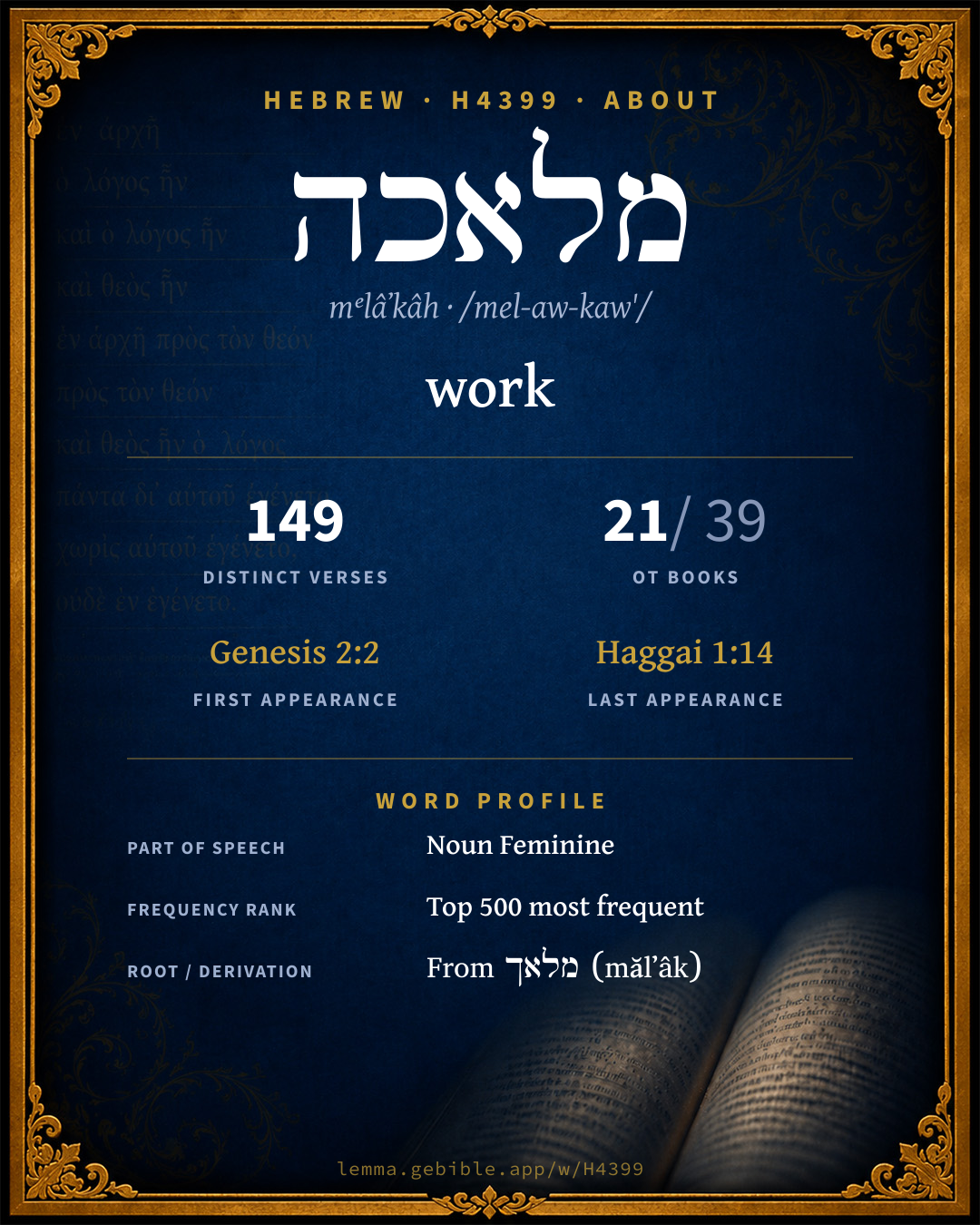
מְלָאכָה
work
also: occupation, business fuller range ↓
Full lexicon entry — Brown-Driver-Briggs (BDB)
From Brown-Driver-Briggs (BDB)
Where this word appears
See every Absolute-state word in the Hebrew Bible →
Grammar key — what these labels mean
Part of speech
- Noun
- A naming word — a person, place, thing, or idea.
Noun type
- Common
- A common noun — a general class of person, place, or thing (“king,” “city,” “water”), not a specific name.
State
- Absolute
- The independent form of a noun, not bound to a following word.
- Construct
- A noun bound to a following noun in a possessive / “of” relationship (the construct chain).
Gender
- Feminine
- Grammatically feminine.
Number
- Singular
- One.
- Plural
- More than one (in Hebrew, generally three or more).
Grammatical forms
- Noun, Common, Feminine, Singular, Absolute 104 times (62%)
- Noun, Common, Feminine, Singular, Construct 61 times (37%)
- Noun, Common, Feminine, Plural, Construct 2 times (1%)
Parsed forms decoded from the imported morphology (morphhb / Westminster Leningrad Codex — WLC text public domain, morphhb tagging CC BY 4.0), counted across 167 parsed occurrences — not distinct verses.
Every verse where H4399 appears — 149 distinct verses across 21 books. Click any verse to open its interlinear word-by-word view. Verse text shown in the World English Bible for context — . Each verse’s Hebrew form is shown with its reference; the English is not keyword-highlighted, since the data carries no word-level English alignment. Use “Compare translations” on any verse to read it across multiple English versions. This concordance covers the Hebrew Bible; Septuagint (Greek Old Testament) occurrences are not indexed here.
Genesis 4 verses
- Genesis 2:2 מְלַאכְתּ֖/וֹ מְלַאכְתּ֖/וֹ n c fs cs + sfx pers 3ms n c fs cs + sfx pers 3ms On the seventh day God finished his work which he had made; and he rested on the seventh day from all his work which he had made.
- Genesis 2:3 מְלַאכְתּ֔/וֹ n c fs cs + sfx pers 3ms God blessed the seventh day, and made it holy, because he rested in it from all his work which he had created and made.
- Genesis 33:14 הַ/מְּלָאכָ֤ה ptcl def.art + n c fs Please let my lord pass over before his servant: and I will lead on gently, according to the pace of the cattle that are before me and according to the pace of the children, until I come to my lord to Seir."
- Genesis 39:11 מְלַאכְתּ֑/וֹ n c fs cs + sfx pers 3ms It happened about this time, that he went into the house to do his work, and there were none of the men of the house inside.
Exodus 27 verses
- Exodus 12:16 מְלָאכָה֙ n c fs In the first day there shall be to you a holy convocation, and in the seventh day a holy convocation; no manner of work shall be done in them, except that which every man must eat, that only may be done by you.
- Exodus 20:9 מְלַאכְתֶּֽ/ךָ n c fs cs + sfx pers 2ms You shall labor six days, and do all your work,
- Exodus 20:10 מְלָאכָ֜ה n c fs but the seventh day is a Sabbath to Yahweh your God. You shall not do any work in it, you, nor your son, nor your daughter, your man-servant, nor your maid-servant, nor your cattle, nor your stranger who is within your gates;
- Exodus 22:8 בִּ/מְלֶ֥אכֶת prep + n c fs cs If the thief isn't found, then the master of the house shall come near to God, to find out if he hasn't put his hand to his neighbor's goods.
- Exodus 22:11 בִּ/מְלֶ֣אכֶת prep + n c fs cs the oath of Yahweh shall be between them both, whether he hasn't put his hand to his neighbor's goods; and the owner of it shall accept it, and he shall not make restitution.
- Exodus 31:3 מְלָאכָֽה n c fs and I have filled him with the Spirit of God, in wisdom, and in understanding, and in knowledge, and in all manner of workmanship,
- Exodus 31:5 מְלָאכָֽה n c fs and in cutting of stones for setting, and in carving of wood, to work in all manner of workmanship.
- Exodus 31:14 מְלָאכָ֔ה n c fs You shall keep the Sabbath therefore; for it is holy to you. Everyone who profanes it shall surely be put to death; for whoever does any work therein, that soul shall be cut off from among his people.
- Exodus 31:15 מְלָאכָה֒ מְלָאכָ֛ה n c fs n c fs Six days shall work be done, but on the seventh day is a Sabbath of solemn rest, holy to Yahweh. Whoever does any work on the Sabbath day shall surely be put to death.
- Exodus 35:2 מְלָאכָה֒ מְלָאכָ֖ה n c fs n c fs 'Six days shall work be done, but on the seventh day there shall be a holy day for you, a Sabbath of solemn rest to Yahweh: whoever does any work in it shall be put to death.
- Exodus 35:21 לִ/מְלֶ֨אכֶת prep + n c fs cs They came, everyone whose heart stirred him up, and everyone whom his spirit made willing, and brought Yahweh's offering, for the work of the tent of meeting, and for all of its service, and for the holy garments.
- Exodus 35:24 מְלֶ֥אכֶת n c fs cs Everyone who did offer an offering of silver and brass brought Yahweh's offering; and everyone, with whom was found acacia wood for any work of the service, brought it.
- Exodus 35:29 הַ/מְּלָאכָ֔ה ptcl def.art + n c fs The children of Israel brought a freewill offering to Yahweh; every man and woman, whose heart made them willing to bring for all the work, which Yahweh had commanded to be made by Moses.
- Exodus 35:31 מְלָאכָֽה n c fs He has filled him with the Spirit of God, in wisdom, in understanding, in knowledge, and in all manner of workmanship;
- Exodus 35:33 מְלֶ֥אכֶת n c fs cs in cutting of stones for setting, and in carving of wood, to work in all kinds of skillful workmanship.
- Exodus 35:35 מְלֶ֣אכֶת מְלָאכָ֔ה n c fs cs n c fs He has filled them with wisdom of heart, to work all manner of workmanship, of the engraver, of the skillful workman, and of the embroiderer, in blue, in purple, in scarlet, and in fine linen, and of the weaver, even of those who do any workmanship, and of those who make skillful works.
- Exodus 36:1 מְלֶ֖אכֶת n c fs cs "Bezalel and Oholiab shall work with every wise-hearted man, in whom Yahweh has put wisdom and understanding to know how to work all the work for the service of the sanctuary, according to all that Yahweh has commanded."
- Exodus 36:2 הַ/מְּלָאכָ֖ה ptcl def.art + n c fs Moses called Bezalel and Oholiab, and every wise-hearted man, in whose heart Yahweh had put wisdom, even everyone whose heart stirred him up to come to the work to do it:
- Exodus 36:3 לִ/מְלֶ֛אכֶת prep + n c fs cs and they received from Moses all the offering which the children of Israel had brought for the work of the service of the sanctuary, with which to make it. They brought yet to him freewill-offerings every morning.
- Exodus 36:4 מְלֶ֣אכֶת מִ/מְּלַאכְתּ֖/וֹ n c fs cs prep + n c fs cs + sfx pers 3ms All the wise men, who performed all the work of the sanctuary, each came from his work which they did.
- Exodus 36:5 לַ/מְּלָאכָ֔ה prep det + n c fs They spoke to Moses, saying, "The people bring much more than enough for the service of the work which Yahweh commanded to make."
- Exodus 36:6 מְלָאכָ֖ה n c fs Moses gave commandment, and they caused it to be proclaimed throughout the camp, saying, "Let neither man nor woman make anything else for the offering for the sanctuary." So the people were restrained from bringing.
- Exodus 36:7 וְ/הַ/מְּלָאכָ֗ה הַ/מְּלָאכָ֖ה conj + ptcl def.art + n c fs ptcl def.art + n c fs For the stuff they had was sufficient for all the work to make it, and too much.
- Exodus 36:8 הַ/מְּלָאכָ֛ה ptcl def.art + n c fs All the wise-hearted men among those who did the work made the tent with ten curtains; of fine twined linen, blue, purple, and scarlet, with cherubim, the work of the skillful workman, they made them.
- Exodus 38:24 לַ/מְּלָאכָ֔ה מְלֶ֣אכֶת prep det + n c fs n c fs cs All the gold that was used for the work in all the work of the sanctuary, even the gold of the offering, was twenty-nine talents, and seven hundred thirty shekels, after the shekel of the sanctuary.
- Exodus 39:43 הַ/מְּלָאכָ֗ה ptcl def.art + n c fs Moses saw all the work, and, behold, they had done it as Yahweh had commanded, even so had they done it: and Moses blessed them.
- Exodus 40:33 הַ/מְּלָאכָֽה ptcl def.art + n c fs He raised up the court around the tent and the altar, and set up the screen of the gate of the court. So Moses finished the work.
Leviticus 15 verses
- Leviticus 7:24 מְלָאכָ֑ה n c fs The fat of that which dies of itself, and the fat of that which is torn of animals, may be used for any other service, but you shall in no way eat of it.
- Leviticus 11:32 מְלָאכָ֖ה n c fs On whatever any of them falls when they are dead, it shall be unclean; whether it is any vessel of wood, or clothing, or skin, or sack, whatever vessel it is, with which any work is done, it must be put into water, and it shall be unclean until the evening; then it will be clean.
- Leviticus 13:48 מְלֶ֥אכֶת n c fs cs whether it is in warp, or woof; of linen, or of wool; whether in a skin, or in anything made of skin;
- Leviticus 13:51 לִ/מְלָאכָ֑ה prep + n c fs He shall examine the plague on the seventh day. If the plague has spread in the garment, either in the warp, or in the woof, or in the skin, whatever use the skin is used for, the plague is a destructive mildew. It is unclean.
- Leviticus 16:29 מְלָאכָה֙ n c fs "It shall be a statute to you forever: in the seventh month, on the tenth day of the month, you shall afflict your souls, and shall do no manner of work, the native-born, or the stranger who lives as a foreigner among you:
- Leviticus 23:3 מְלָאכָה֒ מְלָאכָ֖ה n c fs n c fs "'Six days shall work be done: but on the seventh day is a Sabbath of solemn rest, a holy convocation; you shall do no manner of work. It is a Sabbath to Yahweh in all your dwellings.
- Leviticus 23:7 מְלֶ֥אכֶת n c fs cs In the first day you shall have a holy convocation. You shall do no regular work.
- Leviticus 23:8 מְלֶ֥אכֶת n c fs cs But you shall offer an offering made by fire to Yahweh seven days. In the seventh day is a holy convocation: you shall do no regular work.'"
- Leviticus 23:21 מְלֶ֥אכֶת n c fs cs You shall make proclamation on the same day: there shall be a holy convocation to you; you shall do no regular work. This is a statute forever in all your dwellings throughout your generations.
- Leviticus 23:25 מְלֶ֥אכֶת n c fs cs You shall do no regular work; and you shall offer an offering made by fire to Yahweh.'"
- Leviticus 23:28 מְלָאכָה֙ n c fs You shall do no manner of work in that same day; for it is a day of atonement, to make atonement for you before Yahweh your God.
- Leviticus 23:30 מְלָאכָ֔ה n c fs Whoever it is who does any manner of work in that same day, that person I will destroy from among his people.
- Leviticus 23:31 מְלָאכָ֖ה n c fs You shall do no manner of work: it is a statute forever throughout your generations in all your dwellings.
- Leviticus 23:35 מְלֶ֥אכֶת n c fs cs On the first day shall be a holy convocation: you shall do no regular work.
- Leviticus 23:36 מְלֶ֥אכֶת n c fs cs Seven days you shall offer an offering made by fire to Yahweh. On the eighth day shall be a holy convocation to you; and you shall offer an offering made by fire to Yahweh. It is a solemn assembly; you shall do no regular work.
Numbers 8 verses
- Numbers 4:3 מְלָאכָ֖ה n c fs from thirty years old and upward even until fifty years old, all who enter into the service, to do the work in the Tent of Meeting.
- Numbers 28:18 מְלֶ֥אכֶת n c fs cs In the first day shall be a holy convocation: you shall do no servile work;
- Numbers 28:25 מְלֶ֥אכֶת n c fs cs On the seventh day you shall have a holy convocation: you shall do no servile work.
- Numbers 28:26 מְלֶ֥אכֶת n c fs cs Also in the day of the first fruits, when you offer a new meal-offering to Yahweh in your [feast of] weeks, you shall have a holy convocation; you shall do no servile work;
- Numbers 29:1 מְלֶ֥אכֶת n c fs cs In the seventh month, on the first day of the month, you shall have a holy convocation; you shall do no servile work: it is a day of blowing of trumpets to you.
- Numbers 29:7 מְלָאכָ֖ה n c fs On the tenth day of this seventh month you shall have a holy convocation; and you shall afflict your souls: you shall do no manner of work;
- Numbers 29:12 מְלֶ֥אכֶת n c fs cs On the fifteenth day of the seventh month you shall have a holy convocation; you shall do no servile work, and you shall keep a feast to Yahweh seven days:
- Numbers 29:35 מְלֶ֥אכֶת n c fs cs On the eighth day you shall have a solemn assembly: you shall do no servile work;
Deuteronomy 3 verses
- Deuteronomy 5:13 מְלַאכְתֶּֽ/ךָ n c fs cs + sfx pers 2ms Six days shall you labor, and do all your work;
- Deuteronomy 5:14 מְלָאכָ֡ה n c fs but the seventh day is a Sabbath to Yahweh your God: [in it] you shall not do any work, you, nor your son, nor your daughter, nor your man-servant, nor your maid-servant, nor your ox, nor your donkey, nor any of your cattle, nor your stranger who is within your gates; that your man-servant and your maid-servant may rest as well as you.
- Deuteronomy 16:8 מְלָאכָֽה n c fs Six days you shall eat unleavened bread; and on the seventh day shall be a solemn assembly to Yahweh your God; you shall do no work [therein].
Judges 1 verse
1 Samuel 2 verses
- 1 Samuel 8:16 לִ/מְלַאכְתּֽ/וֹ prep + n c fs cs + sfx pers 3ms He will take your men-servants, and your maid-servants, and your best young men, and your donkeys, and put them to his work.
- 1 Samuel 15:9 הַ/מְּלָאכָ֛ה ptcl def.art + n c fs But Saul and the people spared Agag, and the best of the sheep, and of the oxen, and of the fatlings, and the lambs, and all that was good, and wouldn't utterly destroy them: but everything that was vile and refuse, that they destroyed utterly.
1 Kings 7 verses
- 1 Kings 5:16 הַ/מְּלָאכָ֔ה בַּ/מְּלָאכָֽה ptcl def.art + n c fs prep det + n c fs besides Solomon's chief officers who were over the work, three thousand and three hundred, who bore rule over the people who labored in the work.
- 1 Kings 7:14 מְלָאכָ֖ה מְלַאכְתּֽ/וֹ n c fs n c fs cs + sfx pers 3ms He was the son of a widow of the tribe of Naphtali, and his father was a man of Tyre, a worker in brass; and he was filled with wisdom and understanding and skill, to work all works in brass. He came to king Solomon, and performed all his work.
- 1 Kings 7:22 מְלֶ֥אכֶת n c fs cs On the top of the pillars was lily-work: so was the work of the pillars finished.
- 1 Kings 7:40 הַ/מְּלָאכָ֔ה ptcl def.art + n c fs Hiram made the basins, and the shovels, and the basins. So Hiram made an end of doing all the work that he worked for king Solomon in the house of Yahweh:
- 1 Kings 7:51 הַ/מְּלָאכָ֔ה ptcl def.art + n c fs Thus all the work that king Solomon worked in the house of Yahweh was finished. Solomon brought in the things which David his father had dedicated, [even] the silver, and the gold, and the vessels, and put them in the treasuries of the house of Yahweh.
- 1 Kings 9:23 הַ/מְּלָאכָה֙ בַּ/מְּלָאכָֽה ptcl def.art + n c fs prep det + n c fs These were the chief officers who were over Solomon's work, five hundred fifty, who bore rule over the people who labored in the work.
- 1 Kings 11:28 מְלָאכָה֙ n c fs The man Jeroboam was a mighty man of valor; and Solomon saw the young man that he was industrious, and he gave him charge over all the labor of the house of Joseph.
2 Kings 5 verses
- 2 Kings 12:11 הַ/מְּלָאכָ֔ה ptcl def.art + n c fs They gave the money that was weighed out into the hands of those who did the work, who had the oversight of the house of Yahweh: and they paid it out to the carpenters and the builders, who worked on the house of Yahweh,
- 2 Kings 12:14 הַ/מְּלָאכָ֖ה ptcl def.art + n c fs for they gave that to those who did the work, and repaired therewith the house of Yahweh.
- 2 Kings 12:15 הַ/מְּלָאכָ֑ה ptcl def.art + n c fs Moreover they didn't demand an accounting from the men into whose hand they delivered the money to give to those who did the work; for they dealt faithfully.
- 2 Kings 22:5 הַ/מְּלָאכָ֔ה הַ/מְּלָאכָה֙ ptcl def.art + n c fs ptcl def.art + n c fs and let them deliver it into the hand of the workmen who have the oversight of the house of Yahweh; and let them give it to the workmen who are in the house of Yahweh, to repair the breaches of the house,
- 2 Kings 22:9 הַ/מְּלָאכָ֔ה ptcl def.art + n c fs Shaphan the scribe came to the king, and brought the king word again, and said, Your servants have emptied out the money that was found in the house, and have delivered it into the hand of the workmen who have the oversight of the house of Yahweh.
1 Chronicles 19 verses
- 1 Chronicles 4:23 בִּ/מְלַאכְתּ֖/וֹ prep + n c fs cs + sfx pers 3ms These were the potters, and the inhabitants of Netaim and Gederah: there they lived with the king for his work.
- 1 Chronicles 6:49 מְלֶ֖אכֶת n c fs cs But Aaron and his sons offered on the altar of burnt offering, and on the altar of incense, for all the work of the most holy place, and to make atonement for Israel, according to all that Moses the servant of God had commanded.
- 1 Chronicles 9:13 מְלֶ֖אכֶת n c fs cs and their brothers, heads of their fathers' houses, one thousand seven hundred sixty; very able men for the work of the service of the house of God.
- 1 Chronicles 9:19 מְלֶ֣אכֶת n c fs cs Shallum the son of Kore, the son of Ebiasaph, the son of Korah, and his brothers, of his father's house, the Korahites, were over the work of the service, keepers of the thresholds of the tent: and their fathers had been over the camp of Yahweh, keepers of the entry.
- 1 Chronicles 9:33 בַּ/מְּלָאכָֽה prep det + n c fs These are the singers, heads of fathers' [houses] of the Levites, [who lived] in the chambers [and were] free [from other service]; for they were employed in their work day and night.
- 1 Chronicles 22:15 מְלָאכָ֔ה מְלָאכָֽה n c fs n c fs There are also workmen with you in abundance, cutters and workers of stone and timber, and all kinds of men who are skillful in every kind of work:
- 1 Chronicles 23:4 מְלֶ֣אכֶת n c fs cs Of these, twenty-four thousand were to oversee the work of the house of Yahweh; and six thousand were officers and judges;
- 1 Chronicles 23:24 הַ/מְּלָאכָ֔ה ptcl def.art + n c fs These were the sons of Levi after their fathers' houses, even the heads of the fathers' [houses] of those of those who were counted, in the number of names by their polls, who did the work for the service of the house of Yahweh, from twenty years old and upward.
- 1 Chronicles 25:1 מְלָאכָ֖ה n c fs Moreover, David and the captains of the host set apart for the service certain of the sons of Asaph, and of Heman, and of Jeduthun, who should prophesy with harps, with psalteries, and with cymbals: and the number of those who did the work according to their service was:
- 1 Chronicles 26:29 לַ/מְּלָאכָ֤ה prep det + n c fs Of the Izharites, Chenaniah and his sons were for the outward business over Israel, for officers and judges.
- 1 Chronicles 26:30 מְלֶ֣אכֶת n c fs cs Of the Hebronites, Hashabiah and his brothers, men of valor, one thousand seven hundred, had the oversight of Israel beyond the Jordan westward, for all the business of Yahweh, and for the service of the king.
- 1 Chronicles 27:26 מְלֶ֣אכֶת n c fs cs Over those who did the work of the field for tillage of the ground was Ezri the son of Chelub:
- 1 Chronicles 28:13 מְלֶ֖אכֶת n c fs cs also for the divisions of the priests and the Levites, and for all the work of the service of the house of Yahweh, and for all the vessels of service in the house of Yahweh;
- 1 Chronicles 28:19 מַלְאֲכ֥וֹת n c fp cs All this, [said David], have I been made to understand in writing from the hand of Yahweh, even all the works of this pattern.
- 1 Chronicles 28:20 מְלֶ֖אכֶת n c fs cs David said to Solomon his son, Be strong and of good courage, and do it: don't be afraid, nor be dismayed; for Yahweh God, even my God, is with you; he will not fail you, nor forsake you, until all the work for the service of the house of Yahweh is finished.
- 1 Chronicles 28:21 מְלָאכָ֜ה n c fs Behold, there are the divisions of the priests and the Levites, for all the service of the house of God: and there shall be with you in all manner of work every willing man who has skill, for any manner of service: also the captains and all the people will be entirely at your command.
- 1 Chronicles 29:1 וְ/הַ/מְּלָאכָ֣ה conj + ptcl def.art + n c fs David the king said to all the assembly, Solomon my son, whom alone God has chosen, is yet young and tender, and the work is great; for the palace is not for man, but for Yahweh God.
- 1 Chronicles 29:5 מְלָאכָ֖ה n c fs of gold for the [things of] gold, and of silver for the [things of] silver, and for all manner of work [to be made] by the hands of artificers. Who then offers willingly to consecrate himself this day to Yahweh?
- 1 Chronicles 29:6 מְלֶ֥אכֶת n c fs cs Then the princes of the fathers' [houses], and the princes of the tribes of Israel, and the captains of thousands and of hundreds, with the rulers over the king's work, offered willingly;
2 Chronicles 14 verses
- 2 Chronicles 4:11 הַ/מְּלָאכָ֔ה ptcl def.art + n c fs Huram made the pots, and the shovels, and the basins. So Huram made an end of doing the work that he did for king Solomon in the house of God:
- 2 Chronicles 5:1 הַ/מְּלָאכָ֔ה ptcl def.art + n c fs Thus all the work that Solomon did for the house of Yahweh was finished. Solomon brought in the things that David his father had dedicated, even the silver, and the gold, and all the vessels, and put them in the treasuries of the house of God.
- 2 Chronicles 8:9 לִ/מְלַאכְתּ֑/וֹ prep + n c fs cs + sfx pers 3ms But of the children of Israel did Solomon make no servants for his work; but they were men of war, and chief of his captains, and rulers of his chariots and of his horsemen.
- 2 Chronicles 8:16 מְלֶ֣אכֶת n c fs cs Now all the work of Solomon was prepared to the day of the foundation of the house of Yahweh, and until it was finished. [So] the house of Yahweh was completed.
- 2 Chronicles 13:10 בַּ/מְלָֽאכֶת prep det + n c fs But as for us, Yahweh is our God, and we have not forsaken him; and [we have] priests ministering to Yahweh, the sons of Aaron, and the Levites in their work:
- 2 Chronicles 16:5 מְלַאכְתּֽ/וֹ n c fs cs + sfx pers 3ms It happened, when Baasha heard of it, that he left off building Ramah, and let his work cease.
- 2 Chronicles 17:13 וּ/מְלָאכָ֥ה conj + n c fs He had many works in the cities of Judah; and men of war, mighty men of valor, in Jerusalem.
- 2 Chronicles 24:12 מְלֶ֨אכֶת֙ n c fs cs The king and Jehoiada gave it to such as did the work of the service of the house of Yahweh; and they hired masons and carpenters to restore the house of Yahweh, and also such as worked iron and brass to repair the house of Yahweh.
- 2 Chronicles 24:13 הַ/מְּלָאכָ֔ה לַ/מְּלָאכָ֖ה ptcl def.art + n c fs prep det + n c fs So the workmen worked, and the work of repairing went forward in their hands, and they set up the house of God in its state, and strengthened it.
- 2 Chronicles 29:34 הַ/מְּלָאכָה֙ ptcl def.art + n c fs But the priests were too few, so that they could not flay all the burnt offerings: therefore their brothers the Levites helped them, until the work was ended, and until the priests had sanctified themselves; for the Levites were more upright in heart to sanctify themselves than the priests.
- 2 Chronicles 34:10 הַ/מְּלָאכָ֔ה הַ/מְּלָאכָ֗ה ptcl def.art + n c fs ptcl def.art + n c fs They delivered it into the hand of the workmen who had the oversight of the house of Yahweh; and the workmen who labored in the house of Yahweh gave it to mend and repair the house;
- 2 Chronicles 34:12 בַּ/מְּלָאכָ֗ה prep det + n c fs The men did the work faithfully: and the overseers of them were Jahath and Obadiah, the Levites, of the sons of Merari; and Zechariah and Meshullam, of the sons of the Kohathites, to set it forward; and [others of] the Levites, all who were skillful with instruments of music.
- 2 Chronicles 34:13 מְלָאכָ֔ה n c fs Also they were over the bearers of burdens, and set forward all who did the work in every manner of service: and of the Levites there were scribes, and officers, and porters.
- 2 Chronicles 34:17 הַ/מְּלָאכָֽה ptcl def.art + n c fs They have emptied out the money that was found in the house of Yahweh, and have delivered it into the hand of the overseers, and into the hand of the workmen.
Ezra 5 verses
- Ezra 2:69 הַ/מְּלָאכָה֒ ptcl def.art + n c fs they gave after their ability into the treasury of the work sixty-one thousand darics of gold, and five thousand minas of silver, and one hundred priests' garments.
- Ezra 3:8 מְלֶ֥אכֶת n c fs cs Now in the second year of their coming to the house of God at Jerusalem, in the second month, began Zerubbabel the son of Shealtiel, and Jeshua the son of Jozadak, and the rest of their brothers the priests and the Levites, and all those who were come out of the captivity to Jerusalem, and appointed the Levites, from twenty years old and upward, to have the oversight of the work of the house of Yahweh.
- Ezra 3:9 הַ/מְּלָאכָ֖ה ptcl def.art + n c fs Then stood Jeshua with his sons and his brothers, Kadmiel and his sons, the sons of Judah, together, to have the oversight of the workmen in the house of God: the sons of Henadad, with their sons and their brothers the Levites.
- Ezra 6:22 בִּ/מְלֶ֥אכֶת prep + n c fs cs and kept the feast of unleavened bread seven days with joy: for Yahweh had made them joyful, and had turned the heart of the king of Assyria to them, to strengthen their hands in the work of the house of God, the God of Israel.
- Ezra 10:13 וְ/הַ/מְּלָאכָ֗ה conj + ptcl def.art + n c fs But the people are many, and it is a time of much rain, and we are not able to stand outside: neither is this a work of one day or two; for we have greatly transgressed in this matter.
Nehemiah 20 verses
- Nehemiah 2:16 הַ/מְּלָאכָ֔ה ptcl def.art + n c fs The rulers didn't know where I went, or what I did; neither had I as yet told it to the Jews, nor to the priests, nor to the nobles, nor to the rulers, nor to the rest who did the work.
- Nehemiah 4:11 הַ/מְּלָאכָֽה ptcl def.art + n c fs Our adversaries said, They shall not know, neither see, until we come into the midst of them, and kill them, and cause the work to cease.
- Nehemiah 4:15 מְלַאכְתּֽ/וֹ n c fs cs + sfx pers 3ms It happened, when our enemies heard that it was known to us, and God had brought their counsel to nothing, that we returned all of us to the wall, everyone to his work.
- Nehemiah 4:16 בַּ/מְּלָאכָה֒ prep det + n c fs It happened from that time forth, that half of my servants worked in the work, and half of them held the spears, the shields, and the bows, and the coats of mail; and the rulers were behind all the house of Judah.
- Nehemiah 4:17 בַ/מְּלָאכָ֔ה prep det + n c fs They all built the wall and those who bore burdens loaded themselves; everyone with one of his hands worked in the work, and with the other held his weapon;
- Nehemiah 4:19 הַ/מְּלָאכָ֥ה ptcl def.art + n c fs I said to the nobles, and to the rulers and to the rest of the people, The work is great and large, and we are separated on the wall, one far from another:
- Nehemiah 4:21 בַּ/מְּלָאכָ֑ה prep det + n c fs So we worked in the work: and half of them held the spears from the rising of the morning until the stars appeared.
- Nehemiah 4:22 מְלָאכָֽה n c fs Likewise at the same time said I to the people, Let everyone with his servant lodge within Jerusalem, that in the night they may be a guard to us, and may labor in the day.
- Nehemiah 5:16 בִּ/מְלֶ֜אכֶת הַ/מְּלָאכָֽה prep + n c fs cs ptcl def.art + n c fs Yes, also I continued in the work of this wall, neither bought we any land: and all my servants were gathered there to the work.
- Nehemiah 6:3 מְלָאכָ֤ה הַ/מְּלָאכָה֙ n c fs ptcl def.art + n c fs I sent messengers to them, saying, I am doing a great work, so that I can't come down: why should the work cease, while I leave it, and come down to you?
- Nehemiah 6:9 הַ/מְּלָאכָ֖ה ptcl def.art + n c fs For they all would have made us afraid, saying, Their hands shall be weakened from the work, that it not be done. But now, [God], strengthen you my hands.
- Nehemiah 6:16 הַ/מְּלָאכָ֥ה ptcl def.art + n c fs It happened, when all our enemies heard [of it], that all the nations that were about us feared, and were much cast down in their own eyes; for they perceived that this work was worked of our God.
- Nehemiah 7:70 לַ/מְּלָאכָ֑ה prep det + n c fs Some from among the heads of fathers' [houses] gave to the work. The governor gave to the treasury one thousand darics of gold, fifty basins, and five hundred thirty priests' garments.
- Nehemiah 7:71 הַ/מְּלָאכָ֔ה ptcl def.art + n c fs Some of the heads of fathers' [houses] gave into the treasury of the work twenty thousand darics of gold, and two thousand two hundred minas of silver.
- Nehemiah 10:33 מְלֶ֥אכֶת n c fs cs for the show bread, and for the continual meal-offering, and for the continual burnt-offering, for the Sabbaths, for the new moons, for the set feasts, and for the holy things, and for the sin-offerings to make atonement for Israel, and for all the work of the house of our God.
- Nehemiah 11:12 הַ/מְּלָאכָה֙ ptcl def.art + n c fs and their brothers who did the work of the house, eight hundred twenty-two; and Adaiah the son of Jeroham, the son of Pelaliah, the son of Amzi, the son of Zechariah, the son of Pashhur, the son of Malchijah,
- Nehemiah 11:16 הַ/מְּלָאכָ֤ה ptcl def.art + n c fs and Shabbethai and Jozabad, of the chiefs of the Levites, who had the oversight of the outward business of the house of God;
- Nehemiah 11:22 מְלֶ֥אכֶת n c fs cs The overseer also of the Levites at Jerusalem was Uzzi the son of Bani, the son of Hashabiah, the son of Mattaniah, the son of Mica, of the sons of Asaph, the singers, over the business of the house of God.
- Nehemiah 13:10 הַ/מְּלָאכָֽה ptcl def.art + n c fs I perceived that the portions of the Levites had not been given them; so that the Levites and the singers, who did the work, were fled everyone to his field.
- Nehemiah 13:30 בִּ/מְלַאכְתּֽ/וֹ prep + n c fs cs + sfx pers 3ms Thus cleansed I them from all foreigners, and appointed charges for the priests and for the Levites, everyone in his work;
Esther 2 verses
- Esther 3:9 הַ/מְּלָאכָ֔ה ptcl def.art + n c fs If it please the king, let it be written that they be destroyed: and I will pay ten thousand talents of silver into the hands of those who have the charge of the [king's] business, to bring it into the king's treasuries.
- Esther 9:3 הַ/מְּלָאכָה֙ ptcl def.art + n c fs All the princes of the provinces, and the satraps, and the governors, and those who did the king's business, helped the Jews; because the fear of Mordecai was fallen on them.
Psalms 2 verses
Proverbs 3 verses
- Proverbs 18:9 בִ/מְלַאכְתּ֑/וֹ prep + n c fs cs + sfx pers 3ms One who is slack in his work Is brother to him who is a master of destruction.
- Proverbs 22:29 בִּ/מְלַאכְתּ֗/וֹ prep + n c fs cs + sfx pers 3ms Do you see a man skilled in his work? He will serve kings; He won't serve obscure men.
- Proverbs 24:27 מְלַאכְתֶּ֗/ךָ n c fs cs + sfx pers 2ms Prepare your work outside, And get your fields ready. Afterwards, build your house.
Jeremiah 5 verses
- Jeremiah 17:22 מְלָאכָ֖ה n c fs neither carry forth a burden out of your houses on the Sabbath day holy, neither do any work: but make the Sabbath day, as I commanded your fathers.
- Jeremiah 17:24 מְלָאכָֽה n c fs It shall happen, if you diligently listen to me, says Yahweh, to bring in no burden through the gates of this city on the Sabbath day, but to make the Sabbath day holy, to do no work therein;
- Jeremiah 18:3 מְלָאכָ֖ה n c fs Then I went down to the potter's house, and, behold, he was making a work on the wheels.
- Jeremiah 48:10 מְלֶ֥אכֶת n c fs cs Cursed be he who does the work of Yahweh negligently; and cursed be he who keeps back his sword from blood.
- Jeremiah 50:25 מְלָאכָ֣ה n c fs Yahweh has opened his armory, and has brought forth the weapons of his indignation; for the Lord, Yahweh of Hosts, has a work [to do] in the land of the Chaldeans.
Ezekiel 4 verses
- Ezekiel 15:3 לִ/מְלָאכָ֑ה prep + n c fs Shall wood be taken of it to make any work? or will men take a pin of it to hang any vessel thereon?
- Ezekiel 15:4 לִ/מְלָאכָֽה prep + n c fs Behold, it is cast into the fire for fuel; the fire has devoured both the ends of it, and the midst of it is burned: is it profitable for any work?
- Ezekiel 15:5 לִ/מְלָאכָ֑ה לִ/מְלָאכָֽה prep + n c fs prep + n c fs Behold, when it was whole, it was meet for no work: how much less, when the fire has devoured it, and it is burned, shall it yet be meet for any work!
- Ezekiel 28:13 מְלֶ֨אכֶת n c fs cs You were in Eden, the garden of God; every precious stone adorned you: ruby, topaz, emerald, chrysolite, onx, jasper, sapphire, turquoise, and beryl. Gold work of tambourines and of pipes was in you. In the day that you were created they were prepared.
Daniel 1 verse
Jonah 1 verse
Haggai 1 verse
About this entry
At a glance — auto-summarized from this page’s data, not written by a person. Every figure links to its source below. This summary describes the numbers; it doesn’t interpret them.
At its core, מלאכה (mᵉlâʼkâh) means “work.” Not a single-sense word: its full sense range also takes in “occupation” and “business”. It appears 149 verses across 21 books of the Hebrew Bible, among its common vocabulary. First canonically at Genesis 2:2, it enters the text early. It shares a root with מלאך, מלאך and מלאכות. Each statement above links to its evidence; the full detail follows below.
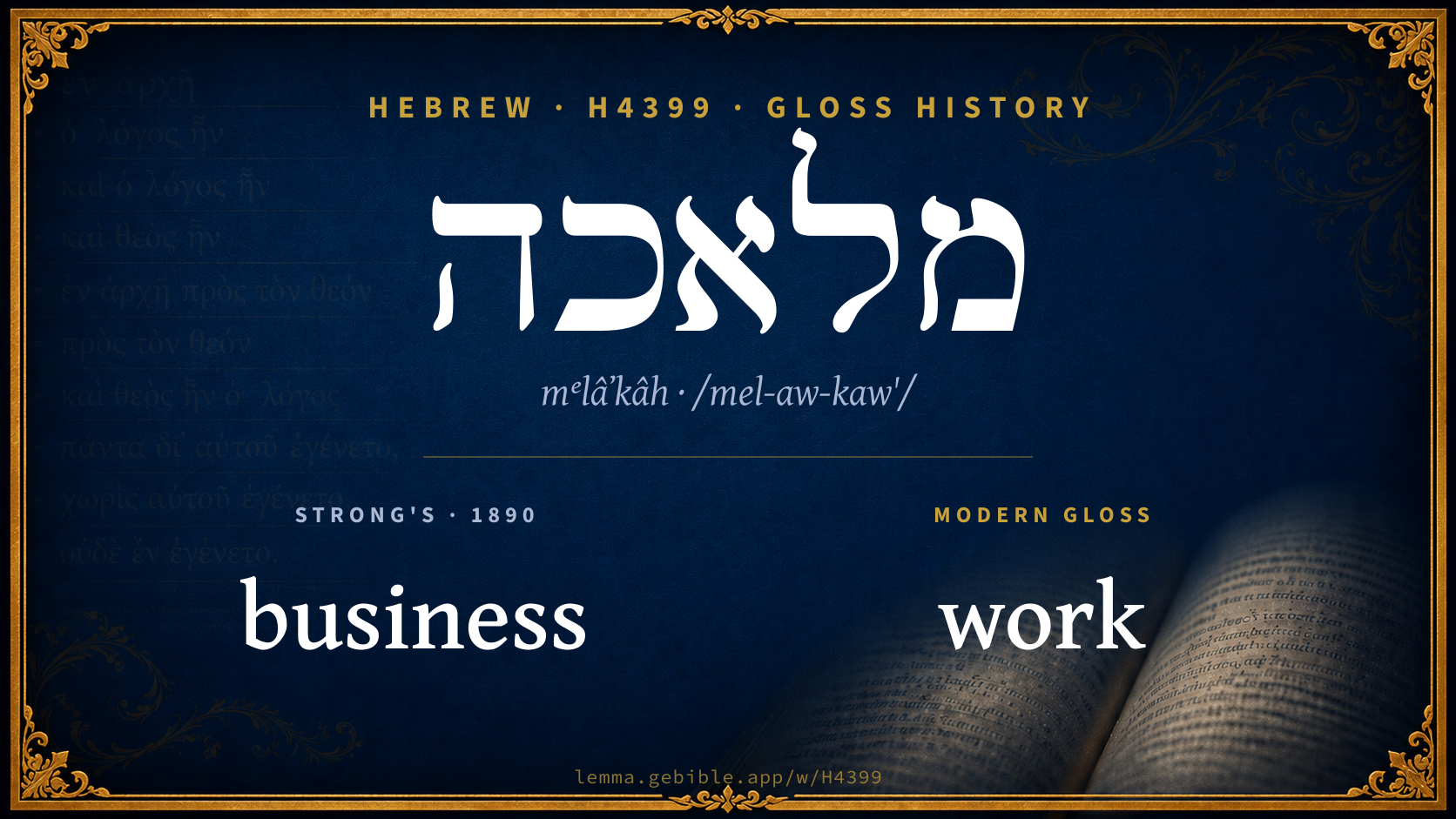
Gloss history
Strong's 1890 vs modern scholarship
About this word
Strong's H4399 catalogs a Hebrew word from the Hebrew Old Testament.
These counts are not copied from any lexicon or concordance. They are computed here, from the morphology-tagged Hebrew Old Testament. What Lemma adds →
- 149
- distinct verses
- The word appears in 149 distinct verses.
- 21 / 39
- OT books
- The word appears in 21 of 39 Old Testament books.
- #273
- by frequency
- Top 500 most frequent Hebrew words (rank 273 of 8,640 Hebrew words by occurrence).
View all 149 occurrences in the concordance →
Most concentrated in
- Exodus 27 verses 18%
- Nehemiah 20 verses 13%
- 1 Chronicles 19 verses 13%
By section of the Old Testament
By traditional corpus
Conventional, traditional groupings — biblical authorship is debated, so this is a traditional corpus grouping, not an authorship claim. Each share is this word’s portion of its verses in that division of the Hebrew canon. Each figure is a share of the word’s 149 distinct verses.
- Writings (Ketuvim) 66 verses · 44%
- Torah (Pentateuch) 57 verses · 38%
- Prophets (Nevi'im) 26 verses · 17%
How translations render this word
Counts come from each version’s own published word-to-Strong’s tagging or interlinear alignment — an approximate guide to how each version renders this word, not a word-level alignment the data otherwise carries. Because each total is that version’s own tagged count, the per-version totals vary from one another and need not match the appearance or distinct-verse counts above. These counts may also differ from a printed concordance because Lemma counts each distinctly tagged rendering and does not collapse phrase taggings into a single head-word total. This is a fixed set of word-tagged versions (KJV, ASV, BSB, ULT) and does not change with the reading translation you choose elsewhere. Each version’s license is shown beside its name below (and on Sources).
- King James Version: Work 75×, Any work 10×, Business 10×
- American Standard Version: Work 63×, All the work 11×, Any work 9×
- Berean Standard Bible: Work 80×, Regular work 10×, Any work 4×
- unfoldingWord Literal Text: Work 105×, Work of 38×, Craftsmanship 3×
King James Version Public Domain
Renders H4399 across 159 tagged occurrences — most commonly:
Plus 34 renderings that appear only once — usually multi-word phrases or single function words the recovered tagging swept in, not distinct renderings. Not rendered by a distinct English word in 8 further occurrences.
American Standard Version Public Domain
Renders H4399 across 158 tagged occurrences — most commonly:
Plus other, less common renderings. Plus 33 renderings that appear only once — usually multi-word phrases or single function words the recovered tagging swept in, not distinct renderings.
Berean Standard Bible Public Domain
Renders H4399 across 142 tagged occurrences — most commonly:
Plus other, less common renderings. Plus 23 renderings that appear only once — usually multi-word phrases or single function words the recovered tagging swept in, not distinct renderings. Not rendered by a distinct English word in 24 further occurrences.
unfoldingWord Literal Text CC BY-SA 4.0
Renders H4399 across 173 tagged occurrences — most commonly:
Plus 18 renderings that appear only once — usually multi-word phrases or single function words the recovered tagging swept in, not distinct renderings.
10 senses and sub-senses in the full BDB
What do BDB’s symbols mean?
BDB uses these scholarly abbreviations:
| Symbol | Meaning |
|---|---|
| 𝔊 | the Septuagint (the ancient Greek translation, LXX) |
| 𝔙 | the Vulgate (the Latin translation) |
| 𝔖 | the Syriac version (the Peshitta) |
| 𝔗 | the Targum (the Aramaic translation) |
| ψ | the Psalms |
| √ | root (the underlying root or stem) |
| ‖ | parallel passage (a synonymous or contrasted parallel) |
| † | the dagger: every passage where the word occurs is cited |
The 10 senses and sub-senses the full Brown-Driver-Briggs lexicon distinguishes for this word, in lexicon order (not ranked by frequency), with BDB’s own verbatim wording and sub-sense lettering. Shown in Hebrew script with BDB’s own scholarly abbreviations. The condensed entry is in the Lexicon Entry tab. See also the Forms in the corpus table below.
- 1. occupation, business, מַה מְּלַאכְתְּךָ what is thy occupation Jon 1:8; business of a steward Gn 39:11 (J); diligent in business Pr 22:29; slack in business 18:9. e.g. Jonah 1:8
- 2. property in which one is occupied, מ׳ רעהו his neighbour’s property Ex 22:7, 10 (E); possessions of herds and flocks Gn 33:14 (J), 1 S 15:9 (cf. מִקְנֶה); מ׳ רבה great property 2 Ch 17:13. e.g. Exodus 22:7
- 3. work as something done or made:
- a. of God in creation Gn 2:2(×2), 3 (P), in judgment Je 50:25, in general ψ 73:28. e.g. Genesis 2:2
- b. of men, מ׳ עור leather-work Lv 13:48, 51 (P), מ׳ השׂדה work in the field 1 Ch 27:26; in building Pr 24:27 +, the walls of Jerusalem Ne 4:5 +, making the tabernacle and its furniture Ex 36:2 +, the temple 1 K 5:30 +; work of the potter Je 18:3, of the seaman ψ 107:23, of the Levites 1 Ch 26:29, of priests in the sacrifices 2 Ch 29:34; †מְלָאכֶת (הָ)עֲבֹדָה phrase of P, Ex 35:24; 36:1, 3; Lv 23:7, 8, 21, 25, 35, 36; Nu 28:18, 25, 26; 29:1, 12, 35 also 1 Ch 9:13, 19; 28:13, 20; 2 Ch 24:12; המ׳ לעבדה 1 Ch 23:24; עבדה למ׳ Ex 36:5 (P); cf. the phrase עֹשֵׂה המ׳ workmen Ezr 3:9 Ne 2:16; עֹשִׂים במ׳ 1 K 5:30; 9:23 +; כל מ׳ any work forbidden on the Sabbath Ex 20:9, 10; Lv 23:3 (P) Dt 5:13, 14 Je 17: 22, 24; on holy convocations Ex 12:16; Lv 16:29; 23:28, 30; 31 Nu 29:7 (P). e.g. Leviticus 13:48
- 4. workmanship, כל מלאכה in every kind of workmanship, phrase of P: Ex 31:3, 5; 35:29, 31, 33, 35; and Chr: 1 Ch 22:15; 28:21; 29:5; 1 K 7:14. e.g. Exodus 31:3
- 5. service, use Lv 7:24; 11:32; 13:51; Ju 16:11; Ez 15:3; 28:13. e.g. Leviticus 7:24
- 6. public business:
- a. political 1 K 11:28; 1 Ch 29:6; Dn 8:27; Est 3:9; 9:3. e.g. 1 Kings 11:28
- b. religious, putting away foreign wives Ezr 10:13; מ׳ יהוה 1 Ch 26:30; ם הַקֹּדֶשׁ Ex 36:4; 38:24 (P), מ׳ קדשׁ הקדשׁים 1 Ch 6:34; מ׳ אהל מועד Ex 35:21 (P), מ׳ בית י׳ 1 Ch 23:4 Ezr 3:8; 6:22 Ne 10:34; 11:22. e.g. Ezra 10:13
Senses from the full Brown-Driver-Briggs lexicon (Brown, Driver, Briggs; Oxford 1906 — public domain), digitized via Sefaria, supplemented by the OpenScriptures HebrewLexicon (CC BY 4.0). Full attribution on Sources.
Word origin
n.f. occupation, work (for מַלְאָכָה; cf. Ph. מלאכת labour)—מ׳ Ex 12:16 + 102 times; מְלָ֑אכֶת 2 Ch 13:10; cstr. מְלֶאכֶת Ex 35:24 + 42 times; sf. מְלַאכְתְּךָ Jon 1:8; מְלַאכְתֶּ֑ךָ Ex 20:9 + 2 times; מְלַאכְתּוֹ Gn 2:2 + 13 times; pl. cstr. מַלְאֲכוֹת 1 Ch 28:19; sf. מַלְאֲכוֹתֶיךָ ψ 73:28;—
— Brown-Driver-Briggs (Oxford 1906, public domain), digitized via Sefaria, supplemented by the OpenScriptures HebrewLexicon (CC BY 4.0). See Sources.
Derived from מלאך (mălʼâk) (H4397) — messenger.
Jastrow Dictionary
A second Hebrew/Aramaic lexicon for comparison, covering Aramaic and post-biblical (Talmudic, Targumic, Midrashic) usage that the biblical-Hebrew BDB does not. Matched by lemma rather than by Strong’s number, so a lemma may carry more than one Jastrow headword (shown separately below), and the entries cover usage well beyond the Bible.
מְלָאכָה
- preced.) work, trade, vocation; task. Ab. I, 10 אהוב את המ׳ love trade, opp. to רבנות, office. Ned. 49ᵇ, v. גָּדוֹל. Ber. 17ᵃ אני מְלַאכְתִּי בעיר my work (study) is done in town, והוא מְלַאכְתּוֹ בשדה וכ׳ and his, in the field &c., v. גָּדַר. Ab. II, 14 בעל מְלַאכְתְּךָ thy employer (the Lord). Ib. 15 היום קצר והמ׳ מרובה the day (life) is short, and the task great. Ab. d’R. N. ch. XI ועשו בו מ׳ בשבת (not ועשה) and they made him work on the Sabbath. Sabb. VII, 1 אב מ׳, v. אָב; a. v. fr.—Pl. מְלָאכוֹת. Ib. עשה מ׳ הרבה וכ׳ he did several (forbidden) labors on several successive Sabbaths. Ib. 2, v. אָב; a. v. fr.
A Dictionary of the Targumim, the Talmud Babli and Yerushalmi, and the Midrashic Literature (Marcus Jastrow; London, Luzac, 1903) — Public Domain. Digitized via Sefaria. Digitized via Sefaria. Full attribution on Sources.
Forms in the corpus
The 63 distinct written forms H4399 takes in the Hebrew Bible, most frequent first — each parse links to that state’s occurrences in the concordance. Hebrew forms include their vowel points and cantillation, so a single lemma takes many written forms.
The 60 most common forms are shown; 3 rarer forms follow in the full concordance.
Same root — word family
Other BDB entries built from the same root as H4399, grouped by Strong’s listed origin. These share a root / origin per the lexicon — not necessarily a shared meaning. Each links to that word’s own entry.
Derives from
Shares the same root
Proper names from this root
People and places named from this root — a name, not an additional meaning of the word.
Compare all same-root words → Showing 4 of 5 — not the complete family. 1 of the same-root words is a proper name (a person or place). They share a root, not necessarily a meaning.
Septuagint verse parallels
This word appears in 123 verses that also exist in the Greek Old Testament (Septuagint), out of the 149 Hebrew verses it occurs in. You can read those verses in Greek by switching the Old Testament edition to the Septuagint.
Read these verses in the Septuagint
- Genesis 2:2
- Exodus 12:16
- Leviticus 7:24
- Numbers 4:3
- Deuteronomy 5:13
- Judges 16:11
- 1 Samuel 8:16
- 1 Kings 5:16
- 2 Kings 12:11
- 1 Chronicles 4:23
- 2 Chronicles 4:11
- Ezra 2:69
This is a verse-level parallel only — the same verses exist in both the Hebrew and Greek Old Testaments. No word-level Hebrew↔Greek correspondence is claimed: the data carries no such alignment, so no Greek word is shown as this Hebrew word’s translation. Coverage is not total — the Septuagint omits the deuterocanon and renumbers the Psalms, so some Hebrew verses have no direct Greek parallel.