1 Samuel 23:27

Hebrew (Westminster Leningrad Codex) 1 Samuel 23:27 appears in the Hebrew Old Testament. The text above is from the Westminster Leningrad Codex. Each word links to its Strong’s number, a concise gloss, and parsing drawn from the Open Scriptures Hebrew Bible morphology. Click any word for its full Brown-Driver-Briggs (BDB) entry.
Download image
Cite this verse

1 Samuel 23:27 (World English Bible). Public Domain. Lemma interlinear Bible study tool, https://lemma.gebible.app/v/1-samuel/23/27.

Show BibTeX & RIS
BibTeX
RIS
English Translation
But there came a messenger to Saul, saying, Haste you, and come; for the Philistines have made a raid on the land.
World English Bible · Public Domain
Download a study sheet

One document with this verse’s original text, its word-by-word gloss line, the meaning frame, cross-references with their text, attributed commentary, and full source and license credits — printable, and it pastes into notes with its structure intact.

This verse Autodidact and up

Study sheet (.html) Plain text (.txt)

A passage Seminary Student

Up to 50 verses in one chapter. A passage sheet keeps up to 6 commentary sources and 12 cross-references per verse, in the order this page ranks them, and says so on the sheet whenever that leaves anything out. Ask for a single verse and you get the Autodidact verse sheet above.

Everything on this page stays free to read, with no account — the sheet is a download of what is already on screen, not access to it.

Want to remove ads? Support Godless Engineer
Compare translations 3

The same verse in 3 English versions, stacked beneath the original-language interlinear above. Click any original word for its lexicon entry.

Each is an independent rendering of the whole verse — the interlinear is not word-aligned to these translations.

Highlighted words mark where these versions differ — a whole-verse word diff, not a word-by-word alignment.

  • World English Bible Public Domain
    But there came a messenger to Saul, saying, Haste you, and come; for the Philistines have made a raid on the land.
  • King James Version Public Domain
    But there came a messenger unto Saul, saying, Haste thee, and come; for the Philistines have invaded the land.
  • unfoldingWord Literal Text CC BY-SA 4.0
    And a messenger came to Saul, saying, “Hurry and go, for the Philistines have raided against the land.”

unfoldingWord Literal Text — © unfoldingWord, licensed CC BY-SA 4.0. Word-aligned USFM3 via Door43 (git.door43.org/unfoldingWord/en_ult).

Versions to compare (up to 4)

3 of 4 selected

Show all 18 translations

Every available English version of this verse, each an independent rendering of the whole verse.

  • World English Bible Public Domain
    But there came a messenger to Saul, saying, Haste you, and come; for the Philistines have made a raid on the land.
  • Berean Standard Bible Public Domain
    Then a messenger came to Saul, saying, “Come quickly, for the Philistines have raided the land!”
  • Majority Standard Bible Public Domain
    Then a messenger came to Saul, saying, “Come quickly, for the Philistines have raided the land!”
  • King James Version Public Domain
    But there came a messenger unto Saul, saying, Haste thee, and come; for the Philistines have invaded the land.
  • American Standard Version (1901) Public Domain
    But there came a messenger unto Saul, saying, Haste thee, and come; for the Philistines have made a raid upon the land.
  • Revised Version (1885) Public Domain
    But there came a messenger unto Saul, saying, Haste thee, and come; for the Philistines have made a raid upon the land.
  • Geneva Bible (1599) Public Domain
    But there came a messenger to Saul, saying, Haste thee, and come: for the Philistims haue inuaded the land.
  • Douay-Rheims (1899) Public Domain
    And a messenger came to Saul, saying: Make haste to come, for the Philistines have poured in themselves upon the land.
  • Young's Literal Translation Public Domain
    And a messenger hath come in unto Saul, saying, `Haste, and come, for the Philistines have pushed against the land.'
  • Literal Standard Version CC BY-SA 4.0
    And a messenger has come to Saul, saying, “Hurry, and come, for the Philistines have pushed against the land.”
  • Unlocked Literal Bible CC BY-SA 4.0
    a messenger came to Saul and said, “Hurry and come, for the Philistines have made a raid against the land.”
  • unfoldingWord Literal Text CC BY-SA 4.0
    And a messenger came to Saul, saying, “Hurry and go, for the Philistines have raided against the land.”
  • Darby Bible Public Domain
    But there came a messenger to Saul, saying, Haste thee and come; for the Philistines have made a raid against the land.
  • World Messianic Bible Public Domain
    But a messenger came to Saul, saying, “Hurry and come, for the Philistines have made a raid on the land!”
  • Webster's Bible Public Domain
    But there came a messenger to Saul, saying, Haste thee, and come; for the Philistines have invaded the land.
  • Free Bible Version CC BY-SA 4.0
    a messenger arrived to tell Saul, “Come at once! The Philistines have invaded the country!”
  • Bible in Basic English Public Domain
    But a man came to Saul saying, Be quick and come; for the Philistines have made an attack on the land.
  • JPS Tanakh (1917) Public Domain
    But there came a messenger unto Saul, saying: 'Haste thee, and come; for the Philistines have made a raid upon the land.'

Literal Standard Version (2020), Covenant Press — licensed CC BY-SA 4.0. Text via the HelloAO Bible API (eBible.org). Unlocked Literal Bible (unfoldingWord) — licensed CC BY-SA 4.0. Text via the HelloAO Bible API (eBible.org). unfoldingWord Literal Text — © unfoldingWord, licensed CC BY-SA 4.0. Word-aligned USFM3 via Door43 (git.door43.org/unfoldingWord/en_ult). Free Bible Version, Dr. Jonathan Gallagher — licensed CC BY-SA 4.0. Text via the HelloAO Bible API (eBible.org).

Word by word

More ways to search: Search by grammar → Find every occurrence → Compare this word →

Practice this passage: Drill this verse → Learn its vocabulary →

פָשְׁט֥וּ
pâshaṭ
H6584
“to strip”
Verb, Qal, Perfect, 3rd Person, Common, Plural
Part of Speech
Verb
Stem
Qal
Form
Perfect
Person
3rd Person
Gender
Common
Number
Plural
Full BDB Definition

Origin: a primitive root

TWOT: 1845

to strip, invade, strip off, make a dash, raid, spread out - (Qal) - to strip off, put off - to put off (one's shelter), make a dash - (Piel) to strip - (Hiphil) - to strip of - to strip off - to flay - (Hithpael) to strip oneself of
  1. וּמַלְאָ֣ךְ mălʼâk H4397 “and · messenger” Conjunction + Noun, Common, Masculine, Singular, Absolute
  2. בָּ֔א bôwʼ H935 “to enter” Verb, Qal, Perfect, 3rd Person, Masculine, Singular
  3. אֶל ʼêl H413 “to” Preposition
  4. שָׁא֖וּל Shâʼûwl H7586 “Saul” Noun, Proper
  5. לֵאמֹ֑ר ʼâmar H559 “to say” Preposition + Verb, Qal, Infinitive Construct
  6. מַהֲרָ֣ה mâhar H4116 “hasten · toward” Verb, Piel, Imperative, 2nd Person, Masculine, Singular + Suffix, Demonstrative
  7. וְלֵ֔כָה yâlak H3212 “and · walk · toward” Conjunction + Verb, Qal, Imperative, 2nd Person, Masculine, Singular + Suffix, Demonstrative
  8. כִּֽי kîy H3588 “that” Conjunction
  9. פְלִשְׁתִּ֖ים Pᵉlishtîy H6430 “Philistines” Noun, Gentilic, Masculine, Plural, Absolute
  10. עַל ʻal H5921 “upon” Preposition
  11. הָאָֽרֶץ ʼerets H776 “the · land” Particle, Definite Article + Noun, Common, Both, Singular, Absolute

About this verse

These counts appear in no published source. They are computed here, from the morphology-tagged text and Lemma’s own curated glosses. What Lemma adds →

12
words
12
distinct lemmas
Historical
section

Shared distinctive vocabulary

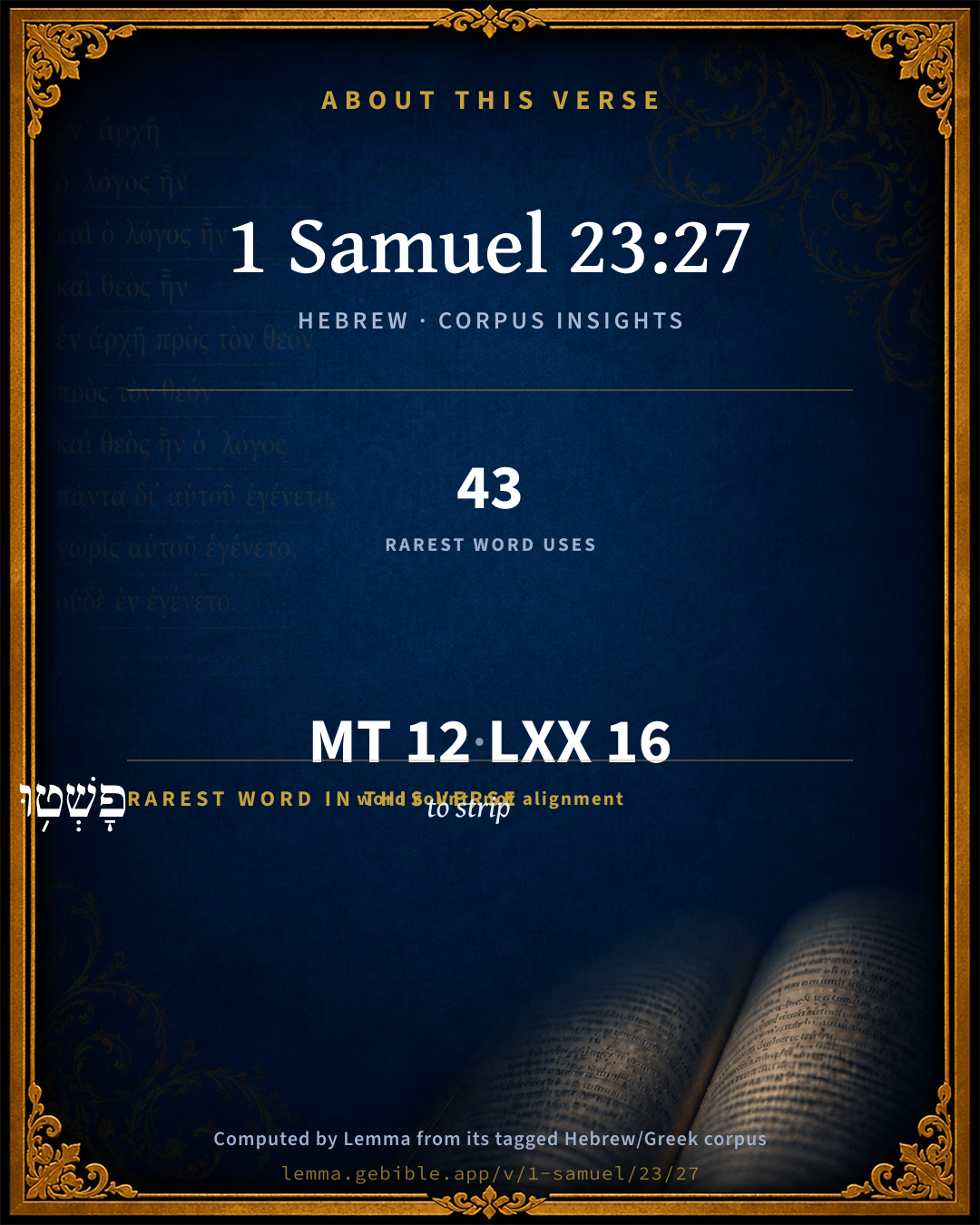
פָשְׁט֥וּ to strip H6584 occurs in 42 verses of the Hebrew Bible. Also found in:

Grammatical profile

  • 5 verbs
  • 4 nouns
  • 2 prepositions
  • 1 conjunction

Verb forms

  • בָּ֔א Qal · Perfect
  • לֵאמֹ֑ר Qal · Infinitive Construct
  • מַהֲרָ֣ה Piel · Imperative
  • וְלֵ֔כָה Qal · Imperative
  • פָשְׁט֥וּ Qal · Perfect

Hebrew & Septuagint length

In English translation the verse runs 22 words from the Hebrew and 20 from the Septuagint (LXX English) — closely comparable.

A rough comparison of the two English renderings, which tokenize alike — not a word-level alignment.

Word counts can differ between the Hebrew and the Greek without any difference in meaning — e.g. the Hebrew direct-object marker אֵת has no separate Greek word, and Greek often adds the article ὁ.

In the original languages it is 12 Hebrew tokens and 16 Greek tokens — but the two are counted differently (Hebrew bundles its prefixes and suffixes into one token; the Greek is in lemma form), so that isn’t a like-for-like length.

Cross-references

6

Topical passages linked to 1 Samuel 23:27 in the Treasury of Scripture Knowledge — connected by theme and wording, ordered by reader-vote popularity; previews shown in the World English Bible.

  • 2 Kings 19:9 When he heard say of Tirhakah king of Ethiopia, Behold, he is come out to fight against you, he sent messengers again to Hezekiah, saying,
  • Genesis 22:14 Abraham called the name of that place Yahweh-Jireh. As it is said to this day, "In Yahweh's mountain it will be provided.
  • Deuteronomy 32:36 For Yahweh will judge his people, Repent himself for his servants; When he sees that [their] power is gone, There is none [remaining], shut up or left at large.
  • 1 Chronicles 14:13 The Philistines yet again made a raid in the valley.
  • Psalms 116:3 The cords of death surrounded me, The pains of Sheol got a hold of me. I found trouble and sorrow.
  • Revelation 12:16 The earth helped the woman, and the earth opened its mouth and swallowed up the river which the dragon spewed out of his mouth.

Cross-references courtesy of OpenBible.info (CC BY 4.0).

Hebrew and Greek witnesses Masoretic Hebrew ↔ Greek Septuagint

The same verse in the two great witnesses to the Old Testament, shown verse-for-verse.

These are two independent witnesses, not word-aligned to each other, and the Septuagint is shown in lemma (dictionary) form.

Hebrew 1 Samuel 23:27 Masoretic · Westminster Leningrad Codex

וּמַלְאָ֣ךְ בָּ֔א אֶל שָׁא֖וּל לֵאמֹ֑ר מַהֲרָ֣ה וְלֵ֔כָה כִּֽי פָשְׁט֥וּ פְלִשְׁתִּ֖ים עַל הָאָֽרֶץ

But there came a messenger to Saul, saying, Haste you, and come; for the Philistines have made a raid on the land.

World English Bible · Public Domain

Greek LXX 1 Samuel 23:27 Septuagint · lemma form

καί ἄγγελος πρός σαούλ ἔρχομαι λέγω σπεύδω καί δεῦρο ὅτι ἐπιτίθημι ὁ ἀλλόφυλος ἐπί ὁ γῆ

And there came a messenger to Saul, saying, Haste you, and come here, for the Philistines have invaded the land.

LXX2012 (modern English Septuagint) · Public Domain

Hebrew: Westminster Leningrad Codex (CC BY 4.0). Greek: Septuagint (public domain); English from LXX2012 (modern English Septuagint) (Public Domain). How the Septuagint differs from the Hebrew →

Targum (Aramaic paraphrase)

1

The Targum is the ancient Jewish Aramaic paraphrase of the Hebrew Scriptures — an interpretive translation, not the Hebrew text itself. Onkelos (literal) and Pseudo-Jonathan (expansive) render the Torah, and Jonathan the Prophets. Coverage is partial: where no permissively-licensed English translation exists for a verse, only the Aramaic is shown. This is verse-level text, not a word-by-word alignment to the Hebrew.

  1. Targum Jonathan Prophets (Joshua–Malachi)
    וְאִזְגַדָא אֲתָא לְוַת שָׁאוּל לְמֵימָר אוֹחִי וֶאֱזֵל אֲרֵי אִתְנְגִידוּ פְלִשְׁתָּאֵי עַל אַרְעָא:

    (no public-domain English translation for this verse)

    Targum Jonathan — Aramaic: “Mikraot Gedolot” (public domain). English: “Sefaria Community Translation” (CC0 1.0 (public-domain dedication)); “London "Chaldee Paraphrase," 1871” (public domain). Text via Sefaria.

Commentary

Notes on 1 Samuel 23:27 from classic Christian and Jewish commentators (each source and its license shown beneath its notes). The classic Christian expositions comment on the surrounding passage and are grouped to its opening verse, so a note may address several verses; the Jewish commentaries on the Tanakh (Rashi and others) are per-verse, so they appear only where the commentator wrote on this verse.

Lemma curates 59 commentaries, every one of them public domain or Creative Commons licensed, each selected and text-cleaned for this edition rather than reprinted as found. About our sources →

Trapp's Complete Commentary

John Trapp

1Sa 23:27 But there came a messenger unto Saul, saying, Haste thee, and come; for the Philistines have invaded the land.

Ver. 27. But there came a messenger, &c.] Here was Deus ex machina, God appearing as out of an engine: where human help failed, divine came in. God sent from heaven and saved his poor servant "from the reproach of him that would have swallowed him up, Selah." {Psa 57:3} So he took off Sennacherib; {2Ki 19:8-9} and Julian, by the Parthian war; and Charles V from persecuting the Protestants, by the Turks breaking into Hungary; those dogs licked Lazarus’s sores. So one Justice Gilford, in Queen Mary’s days, going up the stairs to Mrs Roberts’s chamber, to compel her, willed she, nilled she, to go to Mass, was suddenly taken with his old disease the gout, and so tormented that he swore he would never trouble her anymore. {a}

{a} Act, and Mon., 1880.

John Trapp, A Commentary or Exposition upon All the Books of the Old and New Testament (1647–1656) — public domain. Text from a community e-Sword module.

Joseph Benson's Commentary

1Sa 23:27-28. There came a messenger unto Saul — See the providence of God! His wisdom is never at a loss for ways and means to preserve his people. Nothing could be more distressful, nothing more hopeless than the situation of David at this time. He was surrounded on all sides, and there seemed no way left for escape; but as we learn from the fifty-fourth Psalm, composed by him on this occasion, he addressed himself in prayer to his almighty Saviour, who soon showed him that he can deliver at all times, and in all circumstances, however dangerous and distressing. They called that place [סלע המהלקות] Sela-hammah-lekoth — That is, the rock of divisions. Because God, by this interposition of the Philistines invading the land just at this time, separated Saul from David, and in a manner pulled him away, when the latter was now almost within his reach.

Joseph Benson's Commentary on the Old and New Testaments (1811–1818) — public domain. Text from a community e-Sword module.

Geneva Bible (1599)

Geneva Bible translators

Thus the Lord can pull back the bridle of the tyrants and deliver his out of the lion’s mouth.

Geneva Bible (1599) marginal notes — public domain. Text via Bolls.life.

Adam Clarke's Commentary

Verse 27. There came a messenger] See the providence of God exerted for the salvation of David's life! David and his men are almost surrounded by Saul and his army, and on the point of being taken, when a messenger arrives and informs Saul that the Philistines had invaded the land! But behold the workings of Providence! God had already prepared the invasion of the land by the Philistines, and kept Saul ignorant how much David was in his power; but as his advanced guards and scouts must have discovered him in a very short time, the messenger arrives just at the point of time to prevent it. Here David was delivered by God, and in such a manner too as rendered the Divine interposition visible.

Adam Clarke's Commentary on the Bible (1810–1826) — public domain. Text from a community e-Sword/MySword module.

Ellicott's Commentary for English Readers

(27) The Philistines have invaded the land.—This, as Lange well observes, was “God’s plan to save David.” The Philistines had probably availed themselves of the opportunity which Saul’s withdrawal of his forces southward to surround the armed band of David had given them, and were invading in force the more northern provinces.

A Bible Commentary for English Readers, edited by Charles John Ellicott (1878–1897) — public domain. Text from a community e-Sword module.

The Cambridge Bible for Schools and Colleges

gen. ed. J. J. S. Perowne

27. there came a messenger, &c.] Man’s extremity is God’s opportunity. Cp. 2Ki_19:7; 2Ki_19:9.

The Cambridge Bible for Schools and Colleges (gen. ed. J. J. S. Perowne; Cambridge University Press, 1878–1918) — public domain. Text from a community e-Sword module.

John Gill's Exposition

But there came a messenger unto Saul,.... From his court, by order of his council there; though the Jews (t) say it was an angel from heaven; but be it which it will, it was certainly the providence of God that directed this affair, that a messenger should come to Saul just at that very time that David was like to fall into his hands:

saying, haste thee, and come, for the Philistines have invaded the land; were come into it, and spread themselves in it, as the word signifies, which expresses their numbers they had poured in, the force they came with, and the possessions they had already got; perhaps they had taken the advantage of Saul's departure in quest of David, to penetrate into the tribe of Benjamin, where his patrimony, residence, and court were, and which were liable to fall into their hands; and therefore his presence was immediately required, and haste was necessary.

(t) Midrash apud Yalkut in loc.

John Gill's Exposition of the Whole Bible (1746–1763) — public domain (CC PDM 1.0). Text via the HelloAO Bible API.

Matthew Poole's English Annotations

God stirring them up by his all-disposing providence to do it at this time for David’s rescue. Compare 2Ki 19:9.

Matthew Poole's English Annotations on the Holy Bible (1683–1685) — public domain. Text from a community e-Sword/MySword module.

Whedon's Commentary on the Bible

Daniel D. Whedon

27. There came a messenger — This was a signal working of Providence to deliver the son of Jesse from most imminent peril.

Daniel D. Whedon (gen. ed.), Commentary on the Old and New Testaments (1874–1909) — public domain. Text from a community e-Sword module.

John Wesley's Explanatory Notes

A messenger, &c. - The wisdom of God is never at a loss for ways, and means to preserve his people.

John Wesley, Explanatory Notes Upon the Whole Bible (1754–1765) — public domain. Text via the GEBible commentary corpus.

Rashi

Rabbi Shlomo Yitzchaki (Rashi)

A messenger came. A real angel [in the guise of a messenger], in order to save Dovid.

Rashi on the Tanakh — English translations: “The Judaica Press complete Tanach with Rashi, translated by A. J. Rosenberg” (CC BY 4.0); “Pentateuch with Rashi's commentary by M. Rosenbaum and A.M. Silbermann, 1929-1934” (public domain); “The Metsudah Tanach series, Lakewood, N.J” (CC BY 4.0); and “The Book of Joshua, Metsudah Publications, 1997” (CC BY 4.0). Text via Sefaria.

Lesson kit

Teaching starters — assembled from the data on this page, not authored interpretation. Every prompt links to the verse data it draws on. Edit before teaching.

1 Samuel, in the Historical, opens this verse with 12 words (12 distinct Hebrew lemmas). Its most distinctive word is pâshaṭ (“to strip”). A historical commentator’s framing appears above. Read the whole chapter for the surrounding context.

Discussion questions

  1. The word pâshaṭ carries the sense “to strip.” How does it shape the verse?
  2. Genesis 37:23 shares the word «to strip» with this verse. How do the two illuminate each other?
  3. These translations render this verse differently; the difference is in the English rendering, not the original. What questions does that raise?
  4. The verb «בָּ֔א» is Qal Perfect. How does its form color the action?
  5. Reading how Trapp's Complete Commentary and Joseph Benson's Commentary read this verse, where do the two commentators agree and where do they part?

Things to notice

Reading settings

Reading text

Shown beneath each verse's original-language words.

Old Testament
Old Testament edition

Read the OT as the Masoretic Hebrew (MT) or the Greek Septuagint (LXX).

English shown for the Greek Septuagint (in the Hebrew ↔ Greek comparison).

Comparing translations? Open the Compare panel on any verse page to stack up to four side by side.