
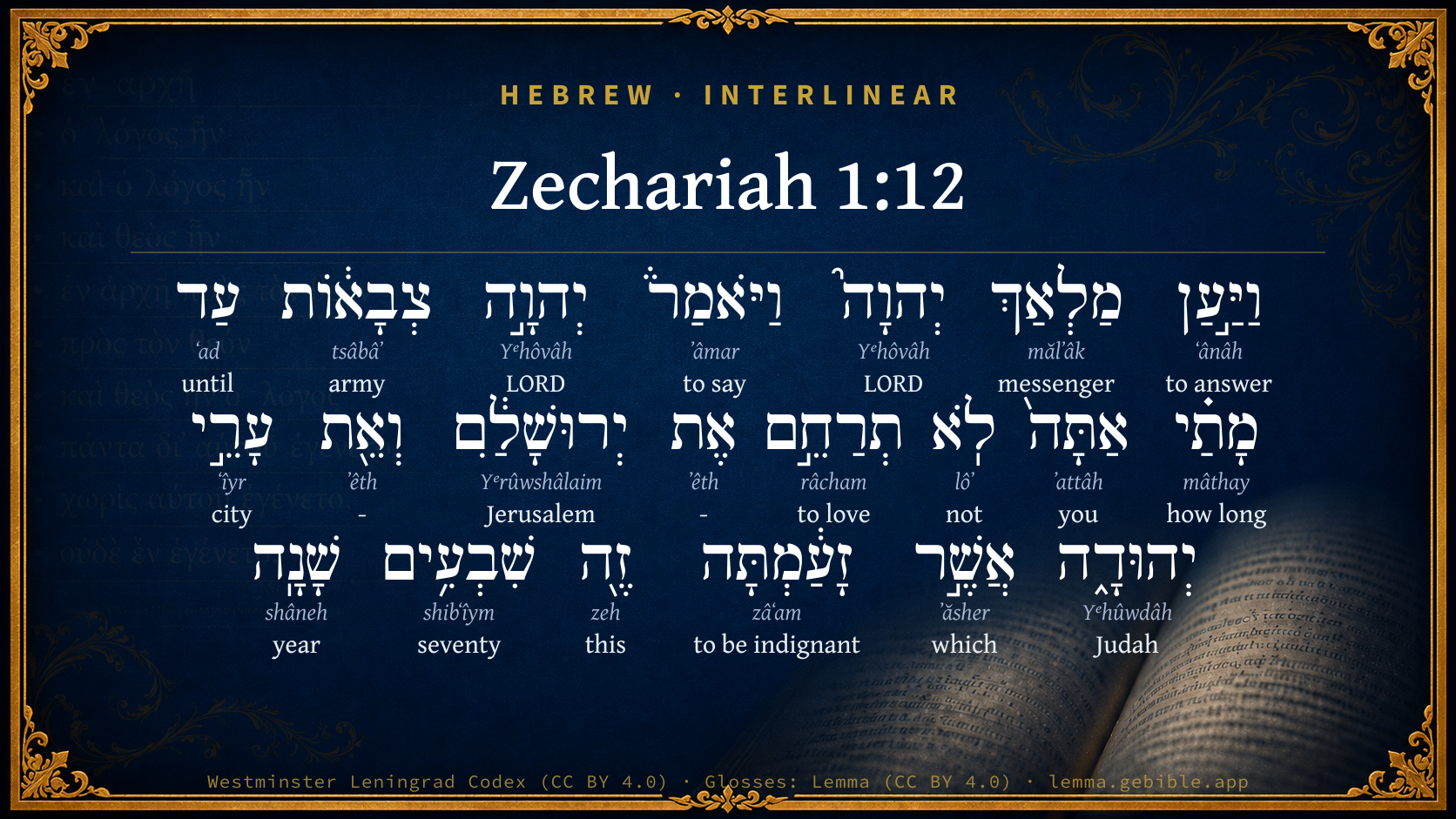
Zechariah 1:12

Hebrew (Westminster Leningrad Codex) Zechariah 1:12 appears in the Hebrew Old Testament. The text above is from the Westminster Leningrad Codex. Each word links to its Strong’s number, a concise gloss, and parsing drawn from the Open Scriptures Hebrew Bible morphology. Click any word for its full Brown-Driver-Briggs (BDB) entry.
Download image
Cite this verse

Zechariah 1:12 (World English Bible). Public Domain. Lemma interlinear Bible study tool, https://lemma.gebible.app/v/zechariah/1/12.

Show BibTeX & RIS
BibTeX
RIS
English Translation
Then the angel of Yahweh replied, "O Yahweh of Hosts, how long will you not have mercy on Jerusalem and on the cities of Judah, against which you have had indignation these seventy years?"
World English Bible · Public Domain
Download a study sheet

One document with this verse’s original text, its word-by-word gloss line, the meaning frame, cross-references with their text, attributed commentary, and full source and license credits — printable, and it pastes into notes with its structure intact.

This verse Autodidact and up

Study sheet (.html) Plain text (.txt)

A passage Seminary Student

Up to 50 verses in one chapter. A passage sheet keeps up to 6 commentary sources and 12 cross-references per verse, in the order this page ranks them, and says so on the sheet whenever that leaves anything out. Ask for a single verse and you get the Autodidact verse sheet above.

Everything on this page stays free to read, with no account — the sheet is a download of what is already on screen, not access to it.

Want to remove ads? Support Godless Engineer
Compare translations 3

The same verse in 3 English versions, stacked beneath the original-language interlinear above. Click any original word for its lexicon entry.

Each is an independent rendering of the whole verse — the interlinear is not word-aligned to these translations.

Highlighted words mark where these versions differ — a whole-verse word diff, not a word-by-word alignment.

  • World English Bible Public Domain
    Then the angel of Yahweh replied, "O Yahweh of Hosts, how long will you not have mercy on Jerusalem and on the cities of Judah, against which you have had indignation these seventy years?"
  • King James Version Public Domain
    Then the angel of the LORD answered and said, O LORD of hosts, how long wilt thou not have mercy on Jerusalem and on the cities of Judah, against which thou hast had indignation these threescore and ten years?
  • unfoldingWord Literal Text CC BY-SA 4.0
    And the angel of Yahweh answered and said, “Yahweh of Armies, until when will you not have compassion on Jerusalem and on the cities of Judah, with which you have been indignant these 70 years?”

unfoldingWord Literal Text — © unfoldingWord, licensed CC BY-SA 4.0. Word-aligned USFM3 via Door43 (git.door43.org/unfoldingWord/en_ult).

Versions to compare (up to 4)

3 of 4 selected

Show all 18 translations

Every available English version of this verse, each an independent rendering of the whole verse.

  • World English Bible Public Domain
    Then the angel of Yahweh replied, "O Yahweh of Hosts, how long will you not have mercy on Jerusalem and on the cities of Judah, against which you have had indignation these seventy years?"
  • Berean Standard Bible Public Domain
    Then the angel of the LORD said, “How long, O LORD of Hosts, will You withhold mercy from Jerusalem and the cities of Judah, with which You have been angry these seventy years?”
  • Majority Standard Bible Public Domain
    Then the angel of the LORD said, “How long, O LORD of Hosts, will You withhold mercy from Jerusalem and the cities of Judah, with which You have been angry these seventy years?”
  • King James Version Public Domain
    Then the angel of the LORD answered and said, O LORD of hosts, how long wilt thou not have mercy on Jerusalem and on the cities of Judah, against which thou hast had indignation these threescore and ten years?
  • American Standard Version (1901) Public Domain
    Then the angel of Jehovah answered and said, O Jehovah of hosts, how long wilt thou not have mercy on Jerusalem and on the cities of Judah, against which thou hast had indignation these threescore and ten years?
  • Revised Version (1885) Public Domain
    Then the angel of the LORD answered and said, O LORD of hosts, how long wilt thou not have mercy on Jerusalem and on the cities of Judah, against which thou hast had indignation these threescore and ten years?
  • Geneva Bible (1599) Public Domain
    Then the Angel of the Lord answered and sayd, O Lord of hostes, howe long wilt thou be vnmercifull to Ierusalem, and to the cities of Iudah, with whom thou hast bene displeased now these threescore and ten yeeres?
  • Douay-Rheims (1899) Public Domain
    And the angel of the Lord answered, and said: O Lord of hosts, how long wilt thou not have mercy on Jerusalem, and on the cities of Juda, with which thou hast been angry? this is now the seventieth year.
  • Young's Literal Translation Public Domain
    And the messenger of Jehovah answereth and saith, `Jehovah of Hosts! till when dost Thou not pity Jerusalem, and the cities of Judah, that Thou hast abhorred these seventy years?'
  • Literal Standard Version CC BY-SA 4.0
    And the Messenger of YHWH answers and says, “YHWH of Hosts! Until when do You not pity Jerusalem, and the cities of Judah, that You have abhorred these seventy years?”
  • Unlocked Literal Bible CC BY-SA 4.0
    Then the angel of Yahweh answered and said, “Yahweh of hosts, how long will you show no compassion to Jerusalem and to the cities of Judah, which you have been angry with these seventy years?”
  • unfoldingWord Literal Text CC BY-SA 4.0
    And the angel of Yahweh answered and said, “Yahweh of Armies, until when will you not have compassion on Jerusalem and on the cities of Judah, with which you have been indignant these 70 years?”
  • Darby Bible Public Domain
    And the angel of Jehovah answered and said, Jehovah of hosts, how long wilt thou not have mercy on Jerusalem and on the cities of Judah, against which thou hast had indignation these seventy years?
  • World Messianic Bible Public Domain
    Then the LORD’s angel replied, “O LORD of Hosts, how long will you not have mercy on Jerusalem and on the cities of Judah, against which you have had indignation these seventy years?”
  • Webster's Bible Public Domain
    Then the angel of the LORD answered and said, O LORD of hosts, how long wilt thou not have mercy on Jerusalem and on the cities of Judah, against which thou hast had indignation these seventy years.
  • Free Bible Version CC BY-SA 4.0
    Then the angel of the Lord said, “Lord Almighty, how long will it be before you have mercy on Jerusalem and the cities of Judah which you have been angry with for the past seventy years?”
  • Bible in Basic English Public Domain
    Then the angel of the Lord, answering, said, O Lord of armies, how long will it be before you have mercy on Jerusalem and on the towns of Judah against which your wrath has been burning for seventy years?
  • JPS Tanakh (1917) Public Domain
    Then the angel of the LORD spoke and said: 'O LORD of hosts, how long wilt Thou not have compassion on Jerusalem and on the cities of Judah, against which Thou hast had indignation these threescore and ten years?

Literal Standard Version (2020), Covenant Press — licensed CC BY-SA 4.0. Text via the HelloAO Bible API (eBible.org). Unlocked Literal Bible (unfoldingWord) — licensed CC BY-SA 4.0. Text via the HelloAO Bible API (eBible.org). unfoldingWord Literal Text — © unfoldingWord, licensed CC BY-SA 4.0. Word-aligned USFM3 via Door43 (git.door43.org/unfoldingWord/en_ult). Free Bible Version, Dr. Jonathan Gallagher — licensed CC BY-SA 4.0. Text via the HelloAO Bible API (eBible.org).

Word by word

More ways to search: Search by grammar → Find every occurrence → Compare this word →

Practice this passage: Drill this verse → Learn its vocabulary →

זָעַ֔מְתָּה
zâʻam
H2194
“to be indignant”
Verb, Qal, Perfect, 2nd Person, Masculine, Singular
Part of Speech
Verb
Stem
Qal
Form
Perfect
Person
2nd Person
Gender
Masculine
Number
Singular
Full BDB Definition

Origin: a primitive root

TWOT: 568

to denounce, express indignation, be indignant - (Qal) - to have indignation, be indignant, be angrily indignant, be defiant - to be abhorrent - to express indignation in speech, denounce, curse - (Niphal) to show indignation, show anger
  1. וַיַּ֣עַן ʻânâh H6030 “and · to answer” Conjunction + Verb, Qal, Sequential Imperfect, 3rd Person, Masculine, Singular
  2. מַלְאַךְ mălʼâk H4397 “messenger of” Noun, Common, Masculine, Singular, Construct
  3. יְהוָה֮ Yᵉhôvâh H3068 “LORD” Noun, Proper
  4. וַיֹּאמַר֒ ʼâmar H559 “and · to say” Conjunction + Verb, Qal, Sequential Imperfect, 3rd Person, Masculine, Singular
  5. יְהוָ֣ה Yᵉhôvâh H3068 “LORD” Noun, Proper
  6. צְבָא֔וֹת tsâbâʼ H6635 “armies” Noun, Common, Both, Plural, Absolute
  7. עַד ʻad H5704 “until” Preposition
  8. מָתַ֗י mâthay H4970 “how long” Particle, Interrogative
  9. אַתָּה֙ ʼattâh H859 “you” Pronoun, Personal, 2nd Person, Masculine, Singular
  10. לֹֽא lôʼ H3808 “not” Particle, Negative
  11. תְרַחֵ֣ם râcham H7355 “to love” Verb, Piel, Imperfect, 2nd Person, Masculine, Singular
  12. אֶת ʼêth H853 “-” Particle, Direct Object
  13. יְרוּשָׁלִַ֔ם Yᵉrûwshâlaim H3389 “Jerusalem” Noun, Proper
  14. וְאֵ֖ת ʼêth H853 “and · -” Conjunction + Particle, Direct Object
  15. עָרֵ֣י ʻîyr H5892 “cities of” Noun, Common, Feminine, Plural, Construct
  16. יְהוּדָ֑ה Yᵉhûwdâh H3063 “Judah” Noun, Proper
  17. אֲשֶׁ֣ר ʼăsher H834 “which” Particle, Relative
  18. זֶ֖ה zeh H2088 “this” Pronoun, Demonstrative, Masculine, Singular
  19. שִׁבְעִ֥ים shibʻîym H7657 “seventy” Adjective, Cardinal number, Both, Plural, Absolute
  20. שָׁנָֽה shâneh H8141 “year” Noun, Common, Feminine, Singular, Absolute

About this verse

These counts appear in no published source. They are computed here, from the morphology-tagged text and Lemma’s own curated glosses. What Lemma adds →

21
words
19
distinct lemmas
Prophets
section

Notable vocabulary

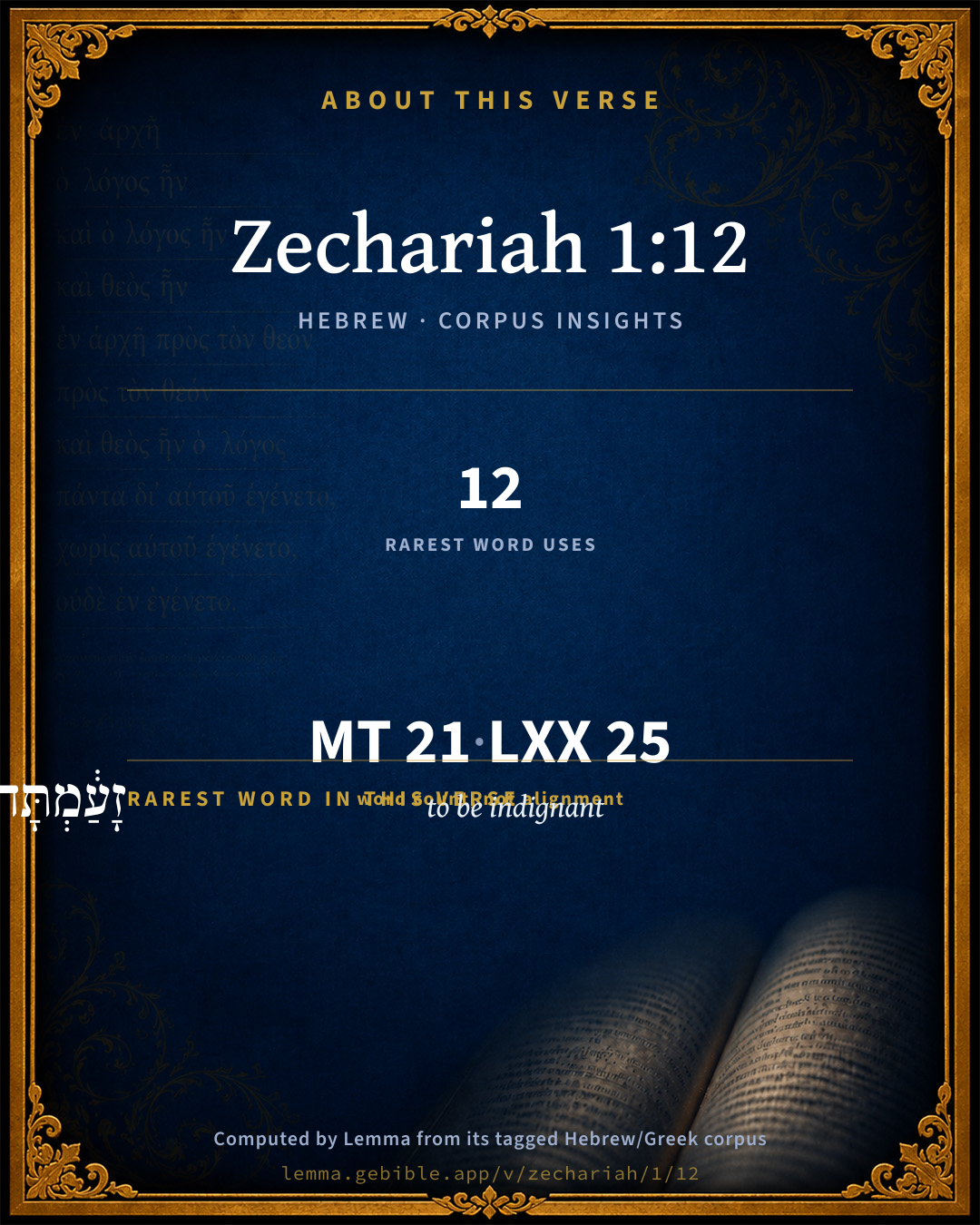
The rarest word here is זָעַ֔מְתָּה to be indignant H2194 — appearing just 12 times in the whole Hebrew Bible.

Shared distinctive vocabulary

זָעַ֔מְתָּה to be indignant H2194 occurs in 11 verses of the Hebrew Bible. Also found in:

Grammatical profile

  • 4 verbs
  • 8 nouns
  • 1 adjective
  • 2 pronouns
  • 1 preposition
  • 5 particles

Verb forms

  • וַיַּ֣עַן Qal · Sequential Imperfect
  • וַיֹּאמַר֒ Qal · Sequential Imperfect
  • תְרַחֵ֣ם Piel · Imperfect
  • זָעַ֔מְתָּה Qal · Perfect

Repetition

A word recurs within this verse — often emphatic in Hebrew:

  • יְהוָה֮ LORD H3068 ×2

Hebrew & Septuagint length

In English translation the verse runs 34 words from the Hebrew and 33 from the Septuagint (LXX English) — closely comparable.

A rough comparison of the two English renderings, which tokenize alike — not a word-level alignment.

Word counts can differ between the Hebrew and the Greek without any difference in meaning — e.g. the Hebrew direct-object marker אֵת has no separate Greek word, and Greek often adds the article ὁ.

In the original languages it is 21 Hebrew tokens and 25 Greek tokens — but the two are counted differently (Hebrew bundles its prefixes and suffixes into one token; the Greek is in lemma form), so that isn’t a like-for-like length.

Cross-references

15

Topical passages linked to Zechariah 1:12 in the Treasury of Scripture Knowledge — connected by theme and wording, ordered by reader-vote popularity; previews shown in the World English Bible.

  • Psalms 74:10 How long, God, shall the adversary reproach? Shall the enemy blaspheme your name forever?
  • Psalms 102:13 You will arise and have mercy on Zion; For it is time to have pity on her. Yes, the set time has come.
  • Jeremiah 29:10 For thus says Yahweh, After seventy years are accomplished for Babylon, I will visit you, and perform my good word toward you, in causing you to return to this place.
  • Daniel 9:2 in the first year of his reign I, Daniel, understood by the books the number of the years about which the word of Yahweh came to Jeremiah the prophet, for the accomplishing of the desolations of Jerusalem, even seventy years.
  • Zechariah 7:5 "Speak to all the people of the land, and to the priests, saying, 'When you fasted and mourned in the fifth and in the seventh month for these seventy years, did you at all fast to me, really to me?
  • Revelation 6:10 They cried with a loud voice, saying, "How long, Master, the holy and true, until you judge and avenge our blood on those who dwell on the earth?"
  • 2 Chronicles 36:21 to fulfill the word of Yahweh by the mouth of Jeremiah, until the land had enjoyed its Sabbaths: [for] as long as it lay desolate it kept Sabbath, to fulfill seventy years.
  • Zechariah 1:8 "I had a vision in the night, and, behold, a man riding on a red horse, and he stood among the myrtle trees that were in a ravine; and behind him there were red, brown, and white horses.
  • Hebrews 7:25 Therefore he is also able to save to the uttermost those who draw near to God through him, seeing he ever lives to make intercession for them.
  • Exodus 23:20–23 "Behold, I send an angel before you, to keep you by the way, and to bring you into the place which I have prepared.
  • Psalms 69:5 God, you know my foolishness. My sins aren't hidden from you.
  • Isaiah 63:9 In all their affliction he was afflicted, and the angel of his presence saved them: in his love and in his pity he redeemed them; and he bore them, and carried them all the days of old.
  • Isaiah 64:9–12 Don't be angry very sore, Yahweh, neither remember iniquity forever: see, look, we beg you, we are all your people.
  • Jeremiah 25:11–12 This whole land shall be a desolation, and an astonishment; and these nations shall serve the king of Babylon seventy years.
  • Zechariah 1:10–11 The man who stood among the myrtle trees answered, "They are the ones Yahweh has sent to go back and forth through the earth."

Cross-references courtesy of OpenBible.info (CC BY 4.0).

Hebrew and Greek witnesses Masoretic Hebrew ↔ Greek Septuagint

The same verse in the two great witnesses to the Old Testament, shown verse-for-verse.

These are two independent witnesses, not word-aligned to each other, and the Septuagint is shown in lemma (dictionary) form.

Hebrew Zechariah 1:12 Masoretic · Westminster Leningrad Codex

וַיַּ֣עַן מַלְאַךְ יְהוָה֮ וַיֹּאמַר֒ יְהוָ֣ה צְבָא֔וֹת עַד מָתַ֗י אַתָּה֙ לֹֽא תְרַחֵ֣ם אֶת יְרוּשָׁלִַ֔ם וְאֵ֖ת עָרֵ֣י יְהוּדָ֑ה אֲשֶׁ֣ר זָעַ֔מְתָּה זֶ֖ה שִׁבְעִ֥ים שָׁנָֽה

Then the angel of Yahweh replied, "O Yahweh of Hosts, how long will you not have mercy on Jerusalem and on the cities of Judah, against which you have had indignation these seventy years?"

World English Bible · Public Domain

Greek LXX Zechariah 1:12 Septuagint · lemma form

καί ἀποκρίνω ὁ ἄγγελος κύριος καί εἶπον κύριος παντοκράτωρ ἕως τίς οὐ μή ἐλεέω ὁ ἰερουσαλήμ καί ὁ πόλις ιουδα ὅς ὑπερὁράω οὗτος ἑβδομηκοστός ἔτος

Then the angel of the Lord answered and said, O Lord Almighty, how long will you have no mercy on Jerusalem, and the cities of Juda, which you have disregarded these seventy years?

LXX2012 (modern English Septuagint) · Public Domain

Hebrew: Westminster Leningrad Codex (CC BY 4.0). Greek: Septuagint (public domain); English from LXX2012 (modern English Septuagint) (Public Domain). How the Septuagint differs from the Hebrew →

Targum (Aramaic paraphrase)

1

The Targum is the ancient Jewish Aramaic paraphrase of the Hebrew Scriptures — an interpretive translation, not the Hebrew text itself. Onkelos (literal) and Pseudo-Jonathan (expansive) render the Torah, and Jonathan the Prophets. Coverage is partial: where no permissively-licensed English translation exists for a verse, only the Aramaic is shown. This is verse-level text, not a word-by-word alignment to the Hebrew.

  1. Targum Jonathan Prophets (Joshua–Malachi)
    וַאֲתִיב מַלְאֲכָא דַייָ וַאֲמַר יְיָ צְבָאוֹת עַד אֵימָתַי אַתְּ לָא תְרַחַם עַל יְרוּשְׁלֵם וְעַל קִרְוַיָא דְבֵית יְהוּדָה דְאַיְתֵיתָא עֲלֵיהוֹן לְוָט דְנַן שַׁבְעִין שְׁנִין:

    (no public-domain English translation for this verse)

    Targum Jonathan — Aramaic: “Mikraot Gedolot” (public domain). English: “Sefaria Community Translation” (CC0 1.0 (public-domain dedication)); “London "Chaldee Paraphrase," 1871” (public domain). Text via Sefaria.

Commentary

Notes on Zechariah 1:12 from classic Christian and Jewish commentators (each source and its license shown beneath its notes). The classic Christian expositions comment on the surrounding passage and are grouped to its opening verse, so a note may address several verses; the Jewish commentaries on the Tanakh (Rashi and others) are per-verse, so they appear only where the commentator wrote on this verse.

Lemma curates 59 commentaries, every one of them public domain or Creative Commons licensed, each selected and text-cleaned for this edition rather than reprinted as found. About our sources →

Trapp's Complete Commentary

John Trapp

Zec 1:12 Then the angel of the LORD answered and said, O LORD of hosts, how long wilt thou not have mercy on Jerusalem and on the cities of Judah, against which thou hast had indignation these threescore and ten years?

Ver. 12. Then the angel of the Lord] That advocate with the Father, Jesus, the just one, 1Jn 2:1, who appeareth to his afflicted people, and feelingly pleads for them, as being afflicted in all their afflictions, even the angel of his presence that saveth them, Isa 63:9. It much moved him to hear that God’s enemies were in better case than his people; and this puts him upon the following passionate expostulation.

O Lord of hosts, how long wilt thou not have mercy on Jerusalem, &c.] Usquequo Domine. Calvin had these words much in his mouth; thereby breathing out his holy desires in the behalf of the afflicted Churches, with whose sufferings he was more affected than with anything that befell himself. It is said of Melancthon that the miseries of the Church made him almost neglect the death of his dearest children; and put him upon many prayers and tears; which, like music upon the water, made a most melodious noise in the ears of God. When Luther in a certain epistle checked him, and chided him for his exceeding great care of the Church’s welfare, calling him pertinacissimam curarum hirudinem, &c., he meekly replied, Si nihil curarem, nihil orarem; If I should not care so, I should not pray so. God seemeth sometimes to have lost his mercy (as here, How long wilt thou be unmerciful to Jerusalem?), and then we must find it for him. He seems to have forgotten his people; we must remind him. He seems to sleep, delay; we must waken, quicken him, with "How long, Lord?" "Thou shalt arise, and have mercy upon Zion; for the time to favour her, yea, the set time, is come," saith Daniel, who is probably held to be the penman of that excellent Psalm {Psa 102:13 cf. Dan 9:2} and he speaks it with as much confidence as if he had been in God’s blessed bosom the while. This also he spake, not now by a spirit of prophecy, or special revelation; but by way of argumentation, or necessary demonstration: "For thy servants take pleasure in her stones, and favour the dust thereof"; they pity her, and melt over her, therefore thou, Lord, much more; since all their tenderness is but a spark of thy flame, a drop of thine ocean.

Against which thou hast had indignation, these threescore and ten years] There is much ado among interpreters about Jeremiah’s seventy years and Zechariah’s seventy years, whether one and the same, or different one from another. That of Scaliger is most unlikely, who reckoneth these years of the captivity from the first year of Xerxes with his father Darius, unto the fourth year of Darius Nothus. How much better our countryman, Lydiat (whom yet Scaliger so much scorned, saying, Quis est ille ex ultima Britannia Canis, qui Ios. Scaligerum audeat allatrare?), who concludes it to be 70 years from the last destruction of Jerusalem by the Chaldees to this second year of Darius Hystaspes, wherein Zechariah prophesied. That of a Lapide upon this text I cannot pass by, Moraliter idipsum dicamus, idipsum oremus et obsecremus pro Anglia. Let us say the same, pray the same, for England, Scotland, &c., that the angel here doth for Jerusalem; How long, Lord, wilt thou not have mercy upon England, where heresy hath prevailed now these hundred years and upwards? The English fugitives beyond seas write upon their college and church doors, in great golden letters, Iesu, Iesu, converte Angliam: Fiat, Fiat. Iesu, convert England: Amen, Amen. Why, yet this is somewhat better than that of Pererius, the Jesuit, upon Gen 15:16. If any man marvel, saith he, why England continueth to flourish, notwithstanding the overflow of heresy, and cruel persecution of Catholics (just execution of Catholics, he should have said), we answer, because their iniquity is not yet full (God grant it, Jer 28:6), Sed veniet tandem iniquitatis complementum. But the time is not far off; and forbearance is no quittance.

John Trapp, A Commentary or Exposition upon All the Books of the Old and New Testament (1647–1656) — public domain. Text from a community e-Sword module.

Joseph Benson's Commentary

Zec 1:12. Then the angel of the Lord said — “Christ the mediator,” as Bishop Hall explains it, “prayed for the salvation of his church, which was now troubled, when all the countries around were at rest.” But, as we find by the next verse that God’s answer to this petition was given to the angel interpreter, or the angel who talked with the prophet, this seems to determine that the petition was made by that angel. How long wilt thou not have mercy on Jerusalem — At this time Jerusalem lay without any walls or defence, and was not wholly rebuilt; and on the cities of Judah — These still lay wholly in ruins; against which thou hast had indignation these threescore and ten years — There are three ways of computing the seventy years of the captivity, taken notice of in Scripture. The first is, beginning from the fourth year of Jehoiakim to the first of Cyrus: this is Jeremiah’s account, Jer 25:1; Jer 25:11; which Daniel follows, Dan 9:2. Another may be computed from the besieging of Jerusalem in the ninth year of Zedekiah, in the tenth month, for which a solemn fast was kept by the Jews: compare 2Ki 25:1, with Zec 8:19. This computation ends with the second year of Darius, which is the reckoning Zechariah here follows. Or lastly, if we compute the beginning of the seventy years from the destruction of Jerusalem and the first temple, which came to pass in the eleventh year of the same reign, they will be accomplished in the fourth year of Darius, and this computation agrees with what is said Zec 7:1; Zec 7:5. The last two ways of reckoning the seventy years may be reduced to one, only by supposing, that the prophet, in this verse, sets down a complete for an incomplete number, and calls that space of time seventy years, which wanted but little of it: a way of speaking of which several instances may be produced.

Joseph Benson's Commentary on the Old and New Testaments (1811–1818) — public domain. Text from a community e-Sword module.

Geneva Bible (1599)

Geneva Bible translators

That is, Christ the mediator prayed for the salvation of his Church, which was now troubled, when all the countries about them were at rest.

Geneva Bible (1599) marginal notes — public domain. Text via Bolls.life.

Jamieson, Fausset & Brown

Robert Jamieson, A. R. Fausset & David Brown

Not only does Messiah stand among His people (the "myrtles," Zac 1:8), but intercedes for them with the Father ("Lord," or "Jehovah of hosts") effectively (Zac 1:13; Heb 7:25). Compare Psa 102:13-20; Isa 62:6-7, as to Judah's restoration in answer to prayer.

answered and said--said in continuation of the discourse: proceeded to say.

how long--Messiah's people pray similarly to their Head. Rev 6:10, "How long," &c. Heretofore it was vain to pray, but now that the divinely appointed "threescore and ten years" (Jer 25:11; Jer 29:10) are elapsed, it is time to pray to Thee for the fulfilment of Thy promise, seeing that Thy grace is not yet fully manifested, nor Thy promise fulfilled. God's promises are not to make us slothful, but to quicken our prayers. HENDERSON, dating the seventy years from the destruction of Jerusalem (588 B.C.), supposes two years of the seventy had yet to run (520 B.C.).

Jamieson, Fausset & Brown — Commentary Critical and Explanatory on the Whole Bible (1871) — public domain (CC PDM 1.0). Text via the HelloAO Bible API.

Adam Clarke's Commentary

Verse 12. Then the angel of the Lord] He who was among the myrtles-the Lord Jesus.

O Lord of hosts, how long] Jesus Christ was not only the "Lamb slain from the foundation of the world," but was always the sole Mediator and intercessor between God and man.

These threescore and ten years?] This cannot mean the duration of the captivity for that was nearly twenty years past. It must mean simply the time that had elapsed from the destruction of the temple to the time in which the angel spoke. As the temple was destroyed in the nineteenth year of Nebuchadnezzar, and this vision took place in the second year of Darius, the term of seventy years was completed, or nearly so, between these two periods.

Adam Clarke's Commentary on the Bible (1810–1826) — public domain. Text from a community e-Sword/MySword module.

John Calvin's Commentaries

The Prophet now shows that the angel who was his guide and teacher, became even a suppliant before God in behalf of the welfare of the Church. Hence the probable opinion is, that this angel was Christ the Mediator. For they who say that it was the Holy Spirit, who forms prayers in our hearts, seem to depart very far from the meaning of the Prophet: and it is nothing new, that Christ should exercise care over his Church. But if this view be disapproved, we may take any one of the angels to be meant. It is certain that it is enjoined them all to minister to the salvation of the faithful, according to what the Apostle says in the first chapter of the Hebrews Hebrews 1:1; and indeed the whole Scripture is full of evidences, which prove that angels are guardians to the godly, and watch over them; for the Lord, for whose service they are ever ready, thus employs them: and in this we also see the singular love of God towards us; for he employs his angels especially for this purpose, that he might show that our salvation is greatly valued by him.

There is then nothing wrong, if we say that any one of the angels prayed for the Church. But absurdly, and very foolishly do the Papists hence conclude, that dead saints are our advocates before God, or that they pray for us; for we never read that it is an office committed to the dead to intercede for us; nay, the duties of love, we know, are confined to the present life. When, therefore, the faithful remove from this world, having finished their course, they enter on a blessed life. Though then the case is different, yet the Papists foolishly pass from angels to the dead: for as it has been stated, the case of the faithful has been committed to angels, and they ever watch over the whole body, and over every member of it. It is then nothing strange that they offer prayers for the faithful; but it does not hence follow, that angels are to be invoked by us. Why does Scripture testify, that angels supplicate God for us? Is it that each of us may flee to them? By no means; but that being assured of God’s paternal love, we may entertain more hope and confidence; yea, that we may courageously fight, being certain of victory, since celestial hosts contend for us, according to what appears from many examples. For when the servant of Elisha saw not the chariots flying in the air, he became almost lost in despair; but his despair was instantly removed, when he saw so many angels ready at hand for help, (2 Kings 6:17;) so whenever God declares that angels are ministers for our safety, he means to animate our faith; at the same time he does not send us to angels; but this one thing is sufficient for us, that when God is propitious to us, all the angels have a care for our salvation. And we must further notice what is said by Christ,

“hereafter ye shall see angels ascending and descending,” (John 1:51,)

which means, that when we are joined to the head, there will thence proceed a sacred union between us and angels; for Christ, we know, is equally Lord over all. When, therefore, we are united to the body of Christ, it is certain that angels are united to us, but only through Christ. All this favor then depends on the one true Mediator. Far then is it from being the case, that Scripture represents angels as patrons to whom we may pray. The meaning then is what we have stated, when Zechariah says, that the angel thus prayed, O Jehovah of hosts, how long wilt thou not have mercy on Jerusalem and the cities of Judah?

The angel seems in this place to have indirectly blamed God for having too much delayed to bring help to his Church: but this mode of speaking, we know, frequently occurs in the prayers of the saints; they in a manner charged God with delay, that is, according to the perception of their flesh. But this is not inconsistent with the obedience of faith, since the faithful submit at length to the counsel of God. Hence, however familiarly they may often expostulate with God, when he seems to delay and to withhold his aid, they yet restrain themselves, and at length feel assured that what God has appointed is best. But they thus pour forth their cares and their sorrows into the bosom of God, in order to disburden themselves. The angel now adopts this form when he says, “How long wilt thou not show mercy?” It is not however the complaint of unreasonable fervor, as that of the ungodly, who in praying accuse God, rage against him, and quarrel with his judgments. The angel then was not moved by any turbulent feeling, nor were the saints, when they adopted this mode of praying; but they did what God allows us all to do; they thus disburndened their cares and sorrows.

We ought at the same time to notice the special import of the words, “how long,” עד-מתי, od-mati? The angel indeed afterwards explains himself, when he expressly mentions the term of seventy years. It was not then without design, or through a strong impulse of feeling, that the angel said, How long? but he had regard to a memorable prophecy, which was in the mouth of all the godly; for God had fixed seventy years for the exile of the people. Since the people knew that a time had been predetermined by God, he does net here supplicate God according to his own will, but only alleges the promise itself: and it is an usual thing with the saints to plead before God what he has promised to them. What indeed can better sustain our hope? and what can give us a greater encouragement in praying, than when we plead with God according to his promises? For God will have our prayers to be founded first on his gratuitous goodness, and then on the constancy of his faithfulness and truth. When therefore they thus address God, “O Lord, thou art true, and thou hast promised this to us; relying on thy word, we dare ask what otherwise we could not,” — they certainly do not exceed the limits as though they prescribed to God a law, but anxiously seek to obtain what had been freely offered. We have seen that the angel does not here complain of delay, but that he founded his plea on that remarkable prophecy, in which God had fixed the term of seventy years for his people.

The angel seems in this place to have indirectly blamed God for having too much delayed to bring help to his Church: but this mode of speaking, we know, frequently occurs in the prayers of the saints; they in a manner charged God with delay, that is, according to the perception of their flesh. But this is not inconsistent with the obedience of faith, since the faithful submit at length to the counsel of God. Hence, however familiarly they may often expostulate with God, when he seems to delay and to withhold his aid, they yet restrain themselves, and at length feel assured that what God has appointed is best. But they thus pour forth their cares and their sorrows into the bosom of God, in order to disburden themselves. The angel now adopts this form when he says, “How long wilt thou not show mercy?” It is not however the complaint of unreasonable fervor, as that of the ungodly, who in praying accuse God, rage against him, and quarrel with his judgments. The angel then was not moved by any turbulent feeling, nor were the saints, when they adopted this mode of praying; but they did what God allows us all to do; they thus disburdened their cares and sorrows.

I have said, that it is more suitable to the passage to say, that the cities had been despised by God: but if any prefers the other view, I will not contend; yet whosoever will minutely consider the intention of the Prophet, will, I think, readily assent to the idea, that the cities had been despised or rejected by God, because he gave them no sign of his mercy. It now follows —

John Calvin's Commentaries (1540-1563) — public domain. Text from the Calvin Translation Society English edition (1840s-50s) via the Christian Classics Ethereal Library (ccel.org). Calvin's coverage is partial (roughly two-thirds of the Bible); uncommented books and verses are honest gaps, never fabricated. The 19th-century editor's footnotes and remarks are omitted so the notes are faithfully Calvin's own voice.

Ellicott's Commentary for English Readers

(12) Consequently, the angel of the Lord intercedes for Jerusalem and the cities of Judah.

These threescore and ten years.—This is an old English expression. The Hebrew has one word—seventy—which is often used as a round number. From the taking of Jerusalem by Nebuchadnezzar (B.C. 605-6) to the date of the decree of Cyrus for the return of the Jews (B.C. 538) is sixty-eight years. These are the seventy years of captivity foretold by Jeremiah (Jer_25:11; Jer_29:10). But eighteen years had now elapsed since that decree of Cyrus. Consequently the angelic intercessor, in saying “how long . . . these seventy years,” can hardly have referred to the seventy years spoken of by Jeremiah, since the actual number of years was now eighty-eight. Therefore it is most probable that the reference is to the period of sixty-eight years between the second taking of Jerusalem by Nebuchadnezzar, when Zedekiah was removed in chains to Babylon (B.C. 588), and the year of this prophecy (B.C. 520).

A Bible Commentary for English Readers, edited by Charles John Ellicott (1878–1897) — public domain. Text from a community e-Sword module.

The Cambridge Bible for Schools and Colleges

gen. ed. J. J. S. Perowne

12. answered] The word does not necessarily mean replied to a question, but has here, as elsewhere, the more general signification of speaking in a manner corresponding, or “answering” to the circumstances described and the feelings called forth by them (comp. Job_3:2 (margin); Dan_2:26; Act_5:8). Pitying Zechariah and his countrymen in the disappointment, which the answer of the horsemen (Zec_1:11) could not fail to cause them, inasmuch as it told of rest and quiet, whereas the “shaking of all nations” was the predicted sign of returning favour to Zion (Hag_2:7; Hag_2:21-22), the Angel proceeds to speak “answerably” to this feeling, in the intercession which he now offers on their behalf. His sympathy and intercession make it probable, as Calvin remarks (though he offers the alternative of its being any angel you please), that this Angel of the Lord was “Christ the Mediator.”

these threescore and ten years] Comp. Jer_25:11; Ezr_1:1. The meaning is: Why art Thou still angry with us, when the appointed time of our punishment, the seventy years of our captivity, has expired?

The Cambridge Bible for Schools and Colleges (gen. ed. J. J. S. Perowne; Cambridge University Press, 1878–1918) — public domain. Text from a community e-Sword module.

John Gill's Exposition

Then the Angel of the Lord answered and said,.... The same that was among the myrtle trees in the bottom, Zac 1:8,

O Lord of hosts, how long wilt thou not have mercy on Jerusalem, and on the cities of Judah; which were fallen to ruin, and had lain waste for many years. These words are expressive of the intercession of Christ on the behalf of the people of the Jews, his professing people, both with respect to their temporal and spiritual good:

against which thou hast had indignation these threescore and ten years? the time of the Babylonish captivity, which lasted such a term of time, and which was a token of the divine displeasure with them; but to be reckoned, not from Jeconiah's captivity, to the deliverance from it by Cyrus, as it is reckoned, Jer 25:1 Dan 9:2 but from the taking of Jerusalem, and the destruction of the temple under Zedekiah, to the rebuilding of the temple under Darius Hystaspis, in whose second year Zechariah now prophesied, Zac 1:7, which was a space of seventy years.

John Gill's Exposition of the Whole Bible (1746–1763) — public domain (CC PDM 1.0). Text via the HelloAO Bible API.

Albert Barnes' Notes on the Bible

And the Angel of the Lord answered - the implied longing, by intercession with God. As the angel-interpreter in Job had “the office of no mere created angel, but one, anticipative of His, who came at once to redeem and justify,” so the Angel of the Lord, in whom God was, exercised at once a mediatorial office with God, typical of our Lord’s high priest’s prayer John 17, and acted as God.

These seventy years - The seventy years of the captivity, prophesied by Jeremiah Jer 25:11-12; Jer 29:10, were on the eve of their conclusion at the time of Daniel’s great prayer of intercession Dan 9:2; they ended with the capture of Babylon, and the edict of Cyrus, permitting the Jews to return 2Ch 36:22-23; Ezr 1:1. Yet there seems to have been a secondary fulfillment, from the destruction of the temple and city, in Zedekiah’s eleventh year 2Ki 25:2, 2Ki 25:8-9, 588 b.c. to the second year of Darius, 519 b.c. Such double fulfillments of prophecy are not like alternative fulfillments. They are a more intricate and fuller, not an easier fulfillment of it. Yet “these 70 years” do not necessitate such a double fulfillment. It might express only a reverent wonder, that the 70 years being accomplished, the complete restoration was not yet brought to pass. Cyril: “God having fixed the time of the captivity to the 70th year, it was necessary to be silent, so long as the time was not yet come to an end, that he might not seem to oppose the Lord’s will. But, when the time was now come to a close and the fear of offending was removed, he, knowing that the Lord cannot lie, entreats and ventures to enquire whether His anger has come to an end, as had those who sinned; or whether, fresh sins having accrued, there shall be a further delay, and their forlorn estate shall be yet further extended. They then who worship God have a good and not uncertain hope, that, if they should offend from infirmity, yet have they those who should entreat for them, not people only, but the holy angels themselves, who render God gracious and propitious, soothing His anger by their purity, and in a manner winning the grieved judge. Then the Angel entreated for the synagogue to the Jews; but we, who believe and have been sanctified in the Spirit 1Jo 2:1-2, “have an Advocate with the Father Jesus Christ the righteous, and He is the propitiation for our sins,” and as the inspired Paul writes, “God hath set Him forth as a propitiation through faith, freeing from sin those who come to Him” Rom 3:25.

Albert Barnes' Notes on the Bible (1834–1885) — public domain. Text from a community e-Sword/MySword module.

Haydock's Catholic Bible Commentary

The seventieth year; viz., from the beginning of the siege of Jerusalem, in the ninth year of king Sedecias, to the second year of king Darius. These seventy years of the desolation of Jerusalem and the cities of Juda, are different from the seventy years of captivity foretold by Jeremias; which began in the fourth year of Joakim, and ended in the first year of king Cyrus. (Challoner) --- Of these Daniel (ix.) speaks. The temple had also been destroyed now seventy years, (Worthington) and the angel prays, (Haydock) while the prophet begs that the people may be inspired to rebuild it. (Worthington) --- Michael takes occasion from the angels’ report, to beseech the Lord to perfect what had been so well begun. He speaks not expressly of the temple, as Aggeus had prevailed on the people to commence that edifice. They had excused themselves that the time was not come, as they probably dated from the burning of the temple; though its desolation began with the siege, thirty months before. See Jeremias xxv. 11., and xxix. 10. (Calmet)

George Leo Haydock (1774–1849), Haydock's Catholic Family Bible and Commentary, 1859 edition — public domain. Excludes Psalms (Douay-Rheims chapter numbering differs from Protestant) and Deuterocanonical books (Catholic canon only).

Matthew Poole's English Annotations

Then, when the surveying angels had made their report of the prosperity of the heathen, the angel of the Lord, the Angel, the Lord Christ, Mediator of the church, and Head of the church, answered and said; prays as one interceding.

O Lord of hosts: Christ speaks to his Father, speaks as one much affected with the state of his afflicted church.

How long wilt thou not have mercy? it is the expostulation that well befits a praying soul; it is not the inquiry of a discontented mind, but the request of one longing for mercy. So David, Psa 13:1,2; and the souls under the altar, Rev 6:10.

On Jerusalem, thy chosen mountain, heir of promises to be re-edified; and on Judah’s cities too, of whose rebuilding, peace, and prosperity thou hast, O Lord, spoken great things, Jer 30; Jer 31; Jer 32; Jer 33, and Eze 36; Eze 37, &c.

Thou hast had indignation; they have felt thine anger and hot displeasure, it was just, and is so still; but it is not to be perpetual. Thine anger hath smoked against the sheep of thy pasture.

These threescore and ten years; the term prefixed for the captivity is fully come, it is the seventieth year of their miserable captivity; now show mercy, build Zion, and glorify thyself in doing it, for the set time is come. It is now seventy years since thy temple was burnt, and Jerusalem sacked; and full eighty years since Jeconiah with many of thy people were carried captive into Babylon, and somewhat more since many were carried with Jehoiakim, from which to the second of Darius are much about eighty-eight or nine years.

Matthew Poole's English Annotations on the Holy Bible (1683–1685) — public domain. Text from a community e-Sword/MySword module.

Whedon's Commentary on the Bible

Daniel D. Whedon

12. The purpose of the vision is to remove this sense of disappointment and despondency by a solemn reaffirmation of the promises of the past (12-17). It is the angel of Jehovah (see on Zec_1:11) who intercedes with Jehovah for Jerusalem and Judah. The fact that the angel intercedes with Jehovah might be urged against the identification of the two (see above); but this representation, which is figurative, disproves the identification no more “than the intercessory prayer of Christ in John 17 is a disproof of his divinity.”

Answered — See on Zec_1:10. The “angel” understands the true significance of the report, and he inquires why Jehovah is withholding his favor, when the allotted time of his displeasure has come to an end.

Threescore and ten years — Undoubtedly a reference to Jer_25:12; Jer_29:10. The former passage was uttered in the fourth year of Jehoiakim, about 604 B.C.; seventy years from that date would bring us to about 534, a few years subsequent to the edict of Cyrus granting permission to the Jews to return from Babylon, and about fourteen years before the date of this vision. If this is the period meant the disappointment can be understood very easily. The pre-exilic prophets had connected the sublimest hopes with the return, but the years immediately following the return of 537 were years of depression and oppression. Many would ask and did ask, What has become of the promises of Jehovah? The angel simply voices the sentiment of the majority in the community. However, it is possible that the beginning of the seventy years should be placed at the destruction of the temple in 586; seventy years from that date would bring us to about 516. As the latter date approached, the people would inquire anxiously whether the promised exaltation would materialize. The former interpretation does justice to the primary reference, but the fact that seventy years from the destruction of the temple were about to expire may have intensified the expectation as well as the disappointment.

Daniel D. Whedon (gen. ed.), Commentary on the Old and New Testaments (1874–1909) — public domain. Text from a community e-Sword module.

The Pulpit Commentary

Answered. He answered the feeling in the prophet"s mind, the unexpressed longing of his heart. O Lord of hosts. The angel is the intercessor for the people. So Christ prays to the Father. (Joh 17) How long wilt thou not have mercy, etc.? He prays that the weary waiting for deliverance may speedily come to an end, and Jerusalem be restored, and Judaea be again inhabited by a happy population. These three score and ten years. The predicted seventy years of captivity (Jer_25:11 Jer_29:10) were past; it was time that the punishment should cease. There are two computations of this period. The first dates from the first capture of Jerusalem by Nebuchadnezzar, B.C. 606, when Judaea was made tributary to Babylon, (2Ki_24:1 2Ch_36:6 Dan_1:1, etc.) unto the return of the company of exiles under Zerubbabel, B.C. 536; the second dates from the final destruction of Jerusalem, B.C. 588, unto the second year of Darius, B.C. 519, when Zechariah saw these visions. However reckoned, the dark period was now over; might they not now expect the commotion among the nations which was to precede their own restitution?

Vers. 12-16. A vision of mercy.

"Then the angel of the Lord answered and said," etc. In the last portion (vers. 7-11) we saw Christ, or the Angel-Jehovah, presented to us as a King, exercising visitatorial powers. In the present we seem to read of him under those two other principal aspects in which he is revealed to his people, viz.

(1) as their great High Priest interceding for them with God; and

(2) as their great Teacher or Prophet instructing and comforting them in God"s name.

I INTERCESSION. We find this to be:

1. Exceedingly apposite. Much had already been done for the remnant of the Captivity; but much also remained. A mere handful, (some fifty thousand all told, Ezr_2:64, Ezr_2:65) compared with the many thousands of Israel, had been brought back; a few scattered centres of population only were to be found in the land, and Jerusalem itself was more like a city of the dead than of the living. (compare the description of it in Neh_7:4, many years afterwards) This state of things is exactly recognized in the Angel-Jehovah"s petition, "How long wilt thou not have mercy on Jerusalem and on the cities of Judah?" (For similar and, probably, nearly contemporaneous request for further mercy after much mercy received, comp. Psa_126:4)

2. Very judicious. See what this intercession allows, viz. the justice of God. "Thou hast had indignation;" and rightly, so it implies. (For similar confessions of God"s justice in pleading for mercy, comp. Gen_18:25 Jer_12:1) See also what this intercession relies on, viz. on the one hand, God"s character, as delighting to exercise mercy (so to speak) as soon as he can; and, on the other hand, on God"s faithfulness, as being Sure to confine his indignation strictly to the duration specified by him. "These three score and ten years". (see Jer_26:11, Jer_26:12)

3. Very effectual. This shown by the answer obtained, which consisted, on the one hand, of "good words" i.e. words promising good; and on the other hand, of "comfortable words," literally, words "sighing with," or full of sympathy, in the spirit of Rom_12:15 Isa_63:9; and so being all that could be wished for, both in matter and manner.

II INSTRUCTION. The Angel-Jehovah, having received this reply, then proceeds either personally or, as some think, through the instrumentality of some subordinate angel to instruct the prophet accordingly. In this we may notice:

1. His commission. The satisfactory answer just received by the Angel-Jehovah the prophet was now to make known in his turn: Cry thou. " He was also to tell it aloud, to proclaim it: "Cry" ( bis); comp. Gen_41:43 2Ch_32:18, where the same word is employed. And he was to do so being thus commissioned (this also is mentioned twice, vers. 14, 17) in God"s name.

2. His message. This corresponds, as might be expected, with the "words" of ver. 13. For example, it is a message

(1) of great sympathy; being one, we find, in which God identifies himself with the interests of his people (observe "my," in vers. 16, 17), and even speaks of himself as sharing to some extent in their anxieties and purely national jealousies and rivalries. It was no pleasure to him to see other nations at ease, and them in trouble, however deserved. No doubt he had been "displeased" with them; (Zec_1:1, Zec_1:2) but he was still more so with their foes (ver. 15). A message

(2) of great hope. Much good, in fact, had begun. Not only had the remnant returned to Jerusalem; God himself also had done so (ver. 16), and that "with mercies;" to stay amongst his people, and not merely to "visit" them. More good was to follow. The "house" now building was to be finished; the rest of the now desolate city to be marked out and finished; and the scattered cities of Judah to be so filled as to overflow ("spread abroad;" comp. Zec_2:2) on all sides. All this, however apparently unlikely, was, nevertheless (observe "yet" three times), being God"s settled purpose, to be accomplished; and the prophet also was to go on saying so until this was the case ("Cry yet," ver. 16).

Do we not see illustrated in all this, finally?

1. The perfection of the gospel. "Good words and comfortable words tidings of great joy so we see it to be. How full of sympathy! How full of hope! Its excellency culminating in this, perhaps, above all, that we have not only such a "Propitiation". (1Jn_2:2) but such a perpetual "Advocate" (1Jn_2:1) and Intercessor to plead it. (see also Heb_7:25 Luk_22:31, 32 13:8, 9 Act_7:55)

2. The certainty of the gospel. As to its essence and source, on the one hand. As in ver. 13, it is, in effect, the promise of God to his Son. (comp. Psa_2:7-9 Ps 110, passim) As to its conveyance to us, on the other; being, in effect, as in ver. 14, the message of Christ himself to us through those appointed by him. Compare the visions of Christ to Isaiah (Isa 6 Joh 12) and Daniel; (Dan_10:5, Dan_10:6, and references) also Joh_14:26 Joh_16:13, 14 Col_3:16, etc.

The Pulpit Commentary (1880–1919), ed. H.D.M. Spence-Jones & Joseph S. Exell — public domain. Text from a community e-Sword module.

John Wesley's Explanatory Notes

Angel of the Lord - The angel, the Lord Christ.

John Wesley, Explanatory Notes Upon the Whole Bible (1754–1765) — public domain. Text via the GEBible commentary corpus.

Scofield Reference Notes

C. I. Scofield

angel

(See Scofield Heb 1:4).

The Scofield Reference Bible (1917 edition), notes by C. I. Scofield — public domain. Text from a community e-Sword module.

unfoldingWord translationNotes

Door43 World Missions Community

to Jerusalem and to the cities of Judah

Here the words "Jerusalem" and "cities" refer to the people who live in those cities. AT: "to the people of Jerusalem and to the people of the cities of Judah" (See: Metonymy)

with good words, words of comfort

"with good, comforting words"

translationWords

angel

Yahweh

Yahweh of hosts

compassion

Jerusalem

Judah

suffer

word

unfoldingWord translationNotes — © Distant Shores Media and the Door43 World Missions Community, licensed CC BY-SA 4.0. Source: git.door43.org/Door43/en_tn.

Rashi

Rabbi Shlomo Yitzchaki (Rashi)

And the angel of the Lord replied The angel that was speaking to me.

Rashi on the Tanakh — English translations: “The Judaica Press complete Tanach with Rashi, translated by A. J. Rosenberg” (CC BY 4.0); “Pentateuch with Rashi's commentary by M. Rosenbaum and A.M. Silbermann, 1929-1934” (public domain); “The Metsudah Tanach series, Lakewood, N.J” (CC BY 4.0); and “The Book of Joshua, Metsudah Publications, 1997” (CC BY 4.0). Text via Sefaria.

Lesson kit

Teaching starters — assembled from the data on this page, not authored interpretation. Every prompt links to the verse data it draws on. Edit before teaching.

Zechariah, in the Prophets, opens this verse with 21 words (19 distinct Hebrew lemmas). Its most distinctive word is zâʻam (“to be indignant”). A historical commentator’s framing appears above. Read the whole chapter for the surrounding context.

Discussion questions

  1. How does “to be indignant” (zâʻam) shape what this verse is saying?
  2. How does Numbers 23:7, which shares the word «to be indignant», read alongside this verse?
  3. What does the repetition of “LORD” (2× in this one verse) do in this verse?
  4. These translations render this verse differently. What is at stake in choosing one wording over another?
  5. «וַיַּ֣עַן» is a Qal Sequential Imperfect verb. How does that grammatical form shape the action described?
  6. Compare how Trapp's Complete Commentary and Joseph Benson's Commentary read this verse. Where do they agree or differ?

Things to notice

Reading settings

Reading text

Shown beneath each verse's original-language words.

Old Testament
Old Testament edition

Read the OT as the Masoretic Hebrew (MT) or the Greek Septuagint (LXX).

English shown for the Greek Septuagint (in the Hebrew ↔ Greek comparison).

Comparing translations? Open the Compare panel on any verse page to stack up to four side by side.