
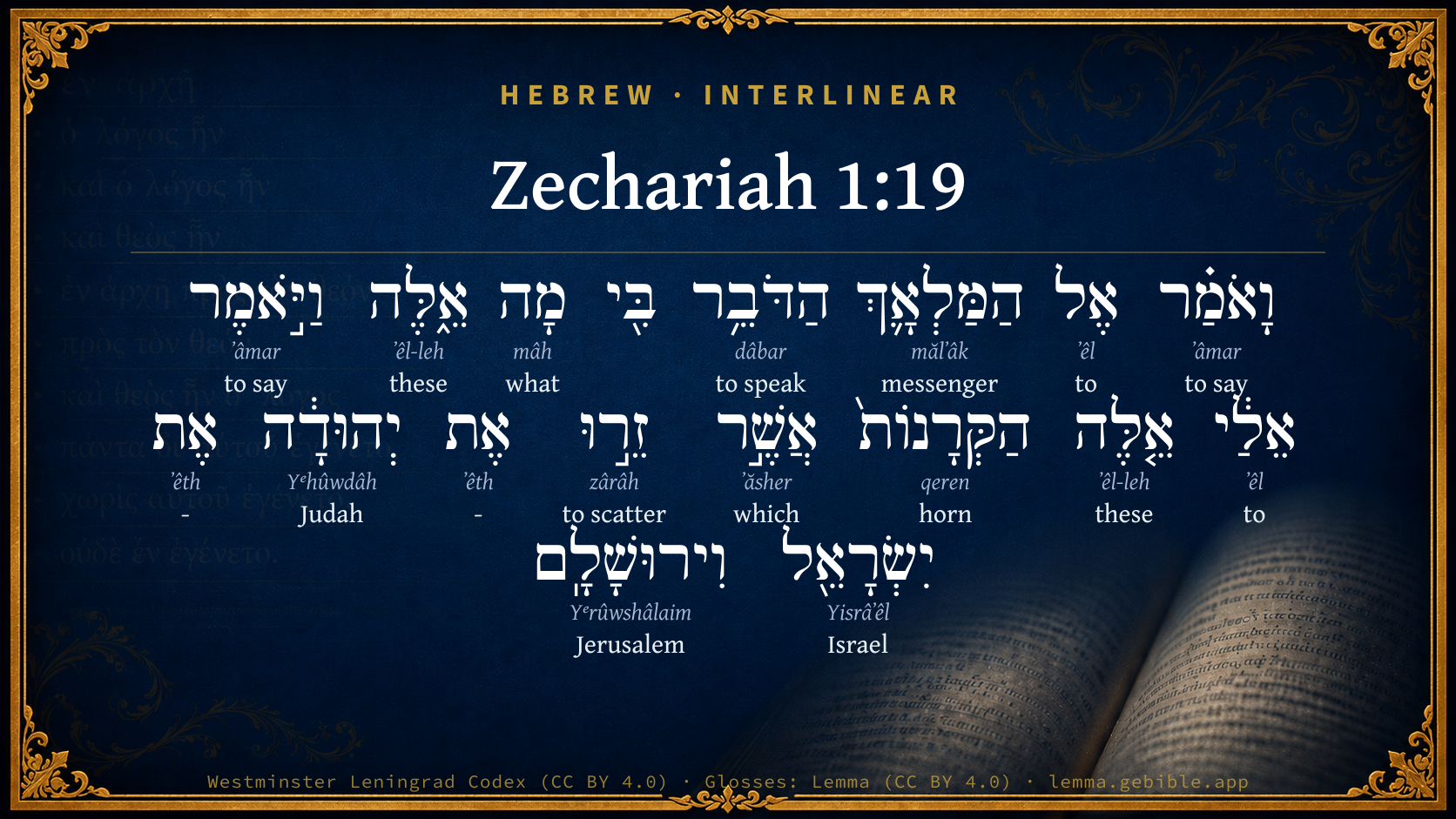
Zechariah 1:19

Hebrew (Westminster Leningrad Codex) Zechariah 1:19 appears in the Hebrew Old Testament. The text above is from the Westminster Leningrad Codex. Each word links to its Strong’s number, a concise gloss, and parsing drawn from the Open Scriptures Hebrew Bible morphology. Click any word for its full Brown-Driver-Briggs (BDB) entry.
Download image
Cite this verse

Zechariah 1:19 (World English Bible). Public Domain. Lemma interlinear Bible study tool, https://lemma.gebible.app/v/zechariah/1/19.

Show BibTeX & RIS
BibTeX
RIS
English Translation
I asked the angel who talked with me, "What are these?" He answered me, "These are the horns which have scattered Judah, Israel, and Jerusalem."
World English Bible · Public Domain
Download a study sheet

One document with this verse’s original text, its word-by-word gloss line, the meaning frame, cross-references with their text, attributed commentary, and full source and license credits — printable, and it pastes into notes with its structure intact.

This verse Autodidact and up

Study sheet (.html) Plain text (.txt)

A passage Seminary Student

Up to 50 verses in one chapter. A passage sheet keeps up to 6 commentary sources and 12 cross-references per verse, in the order this page ranks them, and says so on the sheet whenever that leaves anything out. Ask for a single verse and you get the Autodidact verse sheet above.

Everything on this page stays free to read, with no account — the sheet is a download of what is already on screen, not access to it.

Want to remove ads? Support Godless Engineer
Compare translations 3

The same verse in 3 English versions, stacked beneath the original-language interlinear above. Click any original word for its lexicon entry.

Each is an independent rendering of the whole verse — the interlinear is not word-aligned to these translations.

Highlighted words mark where these versions differ — a whole-verse word diff, not a word-by-word alignment.

  • World English Bible Public Domain
    I asked the angel who talked with me, "What are these?" He answered me, "These are the horns which have scattered Judah, Israel, and Jerusalem."
  • King James Version Public Domain
    And I said unto the angel that talked with me, What be these? And he answered me, These are the horns which have scattered Judah, Israel, and Jerusalem.
  • unfoldingWord Literal Text CC BY-SA 4.0
    And I said to the angel who was speaking with me, “What these?” And he said to me, “These the horns that scattered Judah, Israel, and Jerusalem.”

unfoldingWord Literal Text — © unfoldingWord, licensed CC BY-SA 4.0. Word-aligned USFM3 via Door43 (git.door43.org/unfoldingWord/en_ult).

Versions to compare (up to 4)

3 of 4 selected

Show all 16 translations

Every available English version of this verse, each an independent rendering of the whole verse.

  • World English Bible Public Domain
    I asked the angel who talked with me, "What are these?" He answered me, "These are the horns which have scattered Judah, Israel, and Jerusalem."
  • Berean Standard Bible Public Domain
    So I asked the angel who was speaking with me, “What are these?” And he told me, “These are the horns that have scattered Judah, Israel, and Jerusalem.”
  • Majority Standard Bible Public Domain
    So I asked the angel who was speaking with me, “What are these?” And he told me, “These are the horns that have scattered Judah, Israel, and Jerusalem.”
  • King James Version Public Domain
    And I said unto the angel that talked with me, What be these? And he answered me, These are the horns which have scattered Judah, Israel, and Jerusalem.
  • American Standard Version (1901) Public Domain
    And I said unto the angel that talked with me, What are these? And he answered me, These are the horns which have scattered Judah, Israel, and Jerusalem.
  • Revised Version (1885) Public Domain
    And I said unto the angel that talked with me, What be these? And he answered me, These are the horns which have scattered Judah, Israel, and Jerusalem.
  • Geneva Bible (1599) Public Domain
    And I said vnto the Angel that talked with me, What be these? And hee answered me, These are the hornes which haue scattered Iudah, Israel, and Ierusalem.
  • Douay-Rheims (1899) Public Domain
    And I said to the angel that spoke to me: What are these? And he said to me: These are the horns that have scattered Juda, and Israel, and Jerusalem.
  • Young's Literal Translation Public Domain
    And I say unto the messenger who is speaking with me, `What `are' these?' And he saith unto me, `These `are' the horns that have scattered Judah, Israel, and Jerusalem.'
  • Literal Standard Version CC BY-SA 4.0
    And I say to the messenger who is speaking with me, “What [are] these?” And he says to me, “These [are] the horns that have scattered Judah, Israel, and Jerusalem.”
  • Unlocked Literal Bible CC BY-SA 4.0
    I spoke to the angel who talked with me, “What are these?” He answered me, “These are the horns that have scattered Judah, Israel, and Jerusalem.”
  • unfoldingWord Literal Text CC BY-SA 4.0
    And I said to the angel who was speaking with me, “What these?” And he said to me, “These the horns that scattered Judah, Israel, and Jerusalem.”
  • Darby Bible Public Domain
    And I said unto the angel that talked with me, What are these? And he said to me, These are the horns which have scattered Judah, Israel, and Jerusalem.
  • World Messianic Bible Public Domain
    I asked the angel who talked with me, “What are these?” He answered me, “These are the horns which have scattered Judah, Israel, and Jerusalem.”
  • Free Bible Version CC BY-SA 4.0
    “What are these?” I asked the angel I was talking to. “These are the horns that scattered Judah, Israel, and Jerusalem,” he replied.
  • JPS Tanakh (1917) Public Domain
    (2-2) And I said unto the angel that spoke with me: 'What are these?' And he said unto me: 'These are the horns which have scattered Judah, Israel, and Jerusalem.'

Literal Standard Version (2020), Covenant Press — licensed CC BY-SA 4.0. Text via the HelloAO Bible API (eBible.org). Unlocked Literal Bible (unfoldingWord) — licensed CC BY-SA 4.0. Text via the HelloAO Bible API (eBible.org). unfoldingWord Literal Text — © unfoldingWord, licensed CC BY-SA 4.0. Word-aligned USFM3 via Door43 (git.door43.org/unfoldingWord/en_ult). Free Bible Version, Dr. Jonathan Gallagher — licensed CC BY-SA 4.0. Text via the HelloAO Bible API (eBible.org).

Word by word

More ways to search: Search by grammar → Find every occurrence → Compare this word →

Practice this passage: Drill this verse → Learn its vocabulary →

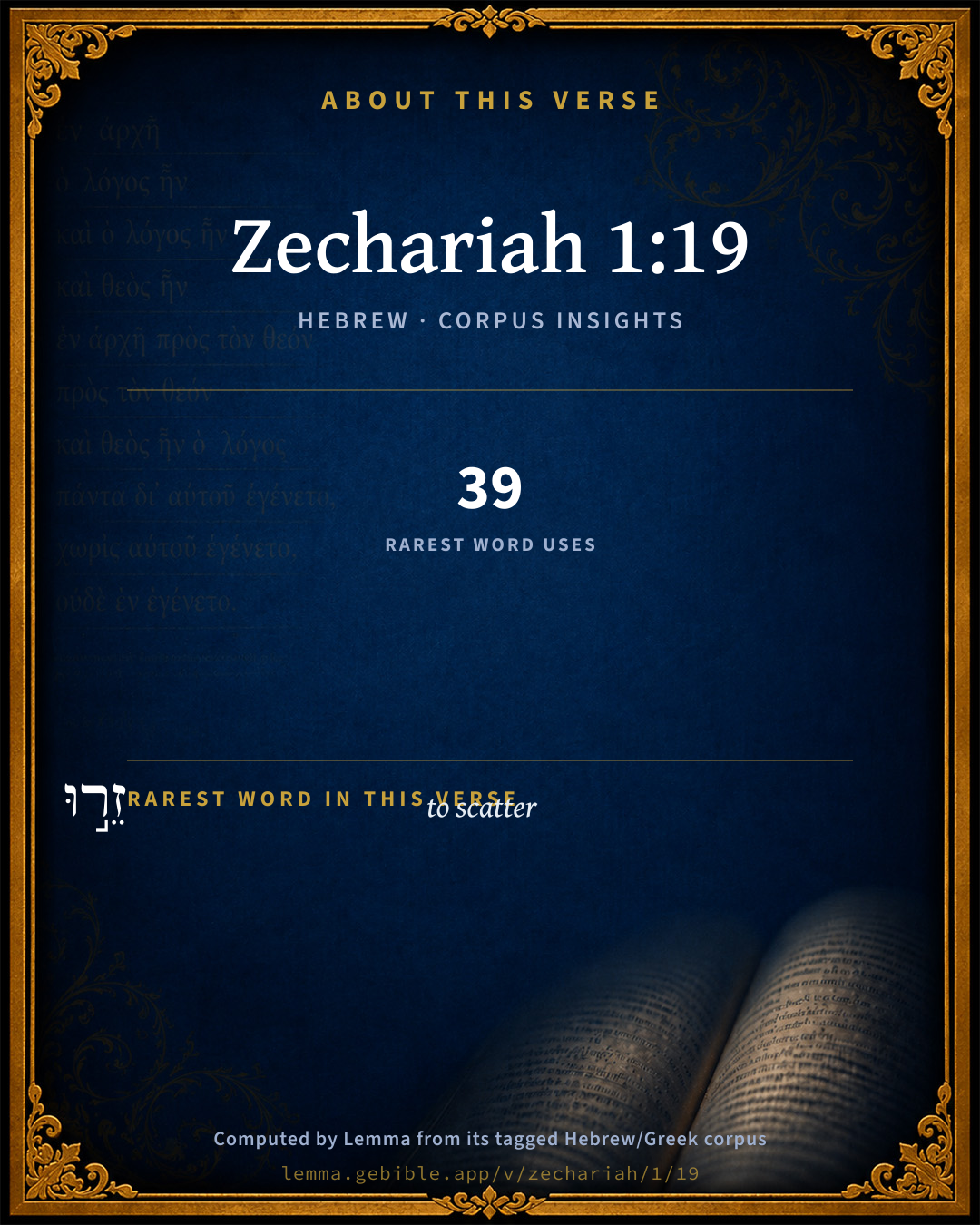
זֵר֣וּ
zârâh
H2219
“to scatter”
Verb, Piel, Perfect, 3rd Person, Common, Plural
Part of Speech
Verb
Stem
Piel
Form
Perfect
Person
3rd Person
Gender
Common
Number
Plural
Full BDB Definition

Origin: a primitive root [compare H2114 ]

TWOT: 579

to scatter, fan, cast away, winnow, disperse, compass, spread, be scattered, be dispersed - (Qal) - to scatter - to fan, winnow - (Niphal) to be scattered, be dispersed - (Piel) - to scatter, disperse (intensive of Qal) - to winnow, sift - (Pual) to be scattered, be spread out
  1. וָאֹמַ֗ר ʼâmar H559 “and · to say” Conjunction + Verb, Qal, Sequential Imperfect, 1st Person, Common, Singular
  2. אֶל ʼêl H413 “to” Preposition
  3. הַמַּלְאָ֛ךְ mălʼâk H4397 “the · messenger” Particle, Definite Article + Noun, Common, Masculine, Singular, Absolute
  4. הַדֹּבֵ֥ר dâbar H1696 “the · speaking” Particle, Definite Article + Verb, Qal, Participle Active, Masculine, Singular, Absolute
  5. מָה mâh H4100 “what” Particle, Interrogative
  6. אֵ֑לֶּה ʼêl-leh H428 “these” Pronoun, Demonstrative, Common, Plural
  7. וַיֹּ֣אמֶר ʼâmar H559 “and · to say” Conjunction + Verb, Qal, Sequential Imperfect, 3rd Person, Masculine, Singular
  8. אֵלַ֔י ʼêl H413 “to · me” Preposition + Suffix, Personal, 1st Person, Common, Singular
  9. אֵ֤לֶּה ʼêl-leh H428 “these” Pronoun, Demonstrative, Common, Plural
  10. הַקְּרָנוֹת֙ qeren H7161 “the · horns” Particle, Definite Article + Noun, Common, Both, Plural, Absolute
  11. אֲשֶׁ֣ר ʼăsher H834 “which” Particle, Relative
  12. אֶת ʼêth H853 “-” Particle, Direct Object
  13. יְהוּדָ֔ה Yᵉhûwdâh H3063 “Judah” Noun, Proper
  14. אֶת ʼêth H853 “-” Particle, Direct Object
  15. יִשְׂרָאֵ֖ל Yisrâʼêl H3478 “Israel” Noun, Proper
  16. וִירוּשָׁלָֽם Yᵉrûwshâlaim H3389 “and · Jerusalem” Conjunction + Noun, Proper

About this verse

These counts appear in no published source. They are computed here, from the morphology-tagged text and Lemma’s own curated glosses. What Lemma adds →

18
words
13
distinct lemmas
Prophets
section

Shared distinctive vocabulary

זֵר֣וּ to scatter H2219 occurs in 38 verses of the Hebrew Bible. Also found in:

Grammatical profile

  • 4 verbs
  • 5 nouns
  • 2 pronouns
  • 3 prepositions
  • 4 particles

Verb forms

  • וָאֹמַ֗ר Qal · Sequential Imperfect
  • הַדֹּבֵ֥ר Qal · Participle Active
  • וַיֹּ֣אמֶר Qal · Sequential Imperfect
  • זֵר֣וּ Piel · Perfect

Repetition

Words recur within this verse — often emphatic in Hebrew:

  • וָאֹמַ֗ר to say H559 ×2
  • אֶל to H413 ×2
  • אֵ֑לֶּה these H428 ×2

Hebrew & Septuagint length

In English translation the verse runs 25 words from the Hebrew and 33 from the Septuagint (LXX English) — closely comparable.

A rough comparison of the two English renderings, which tokenize alike — not a word-level alignment.

Word counts can differ between the Hebrew and the Greek without any difference in meaning — e.g. the Hebrew direct-object marker אֵת has no separate Greek word, and Greek often adds the article ὁ.

Cross-references

14

Topical passages linked to Zechariah 1:19 in the Treasury of Scripture Knowledge — connected by theme and wording, ordered by reader-vote popularity; previews shown in the World English Bible.

  • Ezra 4:4 Then the people of the land weakened the hands of the people of Judah, and troubled them in building,
  • Zechariah 1:21 Then I asked, "What are these coming to do?" He said, "These are the horns which scattered Judah, so that no man lifted up his head; but these have come to terrify them, to cast down the horns of the nations, which lifted up their horn against the land of Judah to scatter it."
  • Zechariah 2:2 Then I asked, "Where are you going?" He said to me, "To measure Jerusalem, to see what is its breadth and what is its length."
  • Zechariah 8:14 For thus says Yahweh of hosts: "As I thought to do evil to you, when your fathers provoked me to wrath," says Yahweh of Hosts, "and I didn't repent;
  • Ezra 4:1 Now when the adversaries of Judah and Benjamin heard that the children of the captivity were building a temple to Yahweh, the God of Israel;
  • Ezra 4:7 In the days of Artaxerxes wrote Bishlam, Mithredath, Tabeel, and the rest of his companions, to Artaxerxes king of Persia; and the writing of the letter was written in the Syrian [character], and set forth in the Syrian [language].
  • Jeremiah 50:17–18 Israel is a hunted sheep; the lions have driven him away: first, the king of Assyria devoured him; and now at last Nebuchadrezzar king of Babylon has broken his bones.
  • Zechariah 1:9 Then I asked, 'My lord, what are these?'" The angel who talked with me said to me, "I will show you what these are."
  • Habakkuk 3:14 You pierced the heads of his warriors with their own spears. They came as a whirlwind to scatter me, Gloating as if to devour the wretched in secret.
  • Revelation 7:13–14 One of the elders answered, saying to me, "These who are arrayed in white robes, who are they, and from where did they come?"
  • Ezra 5:3 At the same time came to them Tattenai, the governor beyond the River, and Shetharbozenai, and their companions, and said thus to them, Who gave you a decree to build this house, and to finish this wall?
  • Daniel 12:7 I heard the man clothed in linen, who was above the waters of the river, when he held up his right hand and his left hand to heaven, and swore by him who lives forever that it shall be for a time, times, and a half; and when they have made an end of breaking in pieces the power of the holy people, all these things shall be finished.
  • Amos 6:13 You who rejoice in a thing of nothing, who say, 'Haven't we taken for ourselves horns by our own strength?'
  • Zechariah 4:11–14 Then I asked him, "What are these two olive trees on the right side of the lampstand and on the left side of it?"

Cross-references courtesy of OpenBible.info (CC BY 4.0).

Hebrew and Greek witnesses Masoretic Hebrew ↔ Greek Septuagint

The same verse in the two great witnesses to the Old Testament, shown verse-for-verse.

These are two independent witnesses, not word-aligned to each other, and the Septuagint is shown in lemma (dictionary) form.

Hebrew Zechariah 1:19 Masoretic · Westminster Leningrad Codex

וָאֹמַ֗ר אֶל הַמַּלְאָ֛ךְ הַדֹּבֵ֥ר בִּ֖י מָה אֵ֑לֶּה וַיֹּ֣אמֶר אֵלַ֔י אֵ֤לֶּה הַקְּרָנוֹת֙ אֲשֶׁ֣ר זֵר֣וּ אֶת יְהוּדָ֔ה אֶת יִשְׂרָאֵ֖ל וִירוּשָׁלָֽם

I asked the angel who talked with me, "What are these?" He answered me, "These are the horns which have scattered Judah, Israel, and Jerusalem."

World English Bible · Public Domain

Greek LXX Zechariah 1:19 Septuagint · lemma form
And I said to the angel that spoke with me, What are these things, my lord? And he said to me, These are the horns that have scattered Juda, and Israel, and Jerusalem.

LXX2012 (modern English Septuagint) · Public Domain

On this verse, The Pulpit Commentary discusses the Septuagint’s reading. Read the note in Commentary ↓

Hebrew: Westminster Leningrad Codex (CC BY 4.0). Greek: Septuagint (public domain); English from LXX2012 (modern English Septuagint) (Public Domain). How the Septuagint differs from the Hebrew →

Commentary

Notes on Zechariah 1:19 from classic Christian and Jewish commentators (each source and its license shown beneath its notes). The classic Christian expositions comment on the surrounding passage and are grouped to its opening verse, so a note may address several verses; the Jewish commentaries on the Tanakh (Rashi and others) are per-verse, so they appear only where the commentator wrote on this verse.

Lemma curates 59 commentaries, every one of them public domain or Creative Commons licensed, each selected and text-cleaned for this edition rather than reprinted as found. About our sources →

Trapp's Complete Commentary

John Trapp

Zec 1:19 And I said unto the angel that talked with me, What [be] these? And he answered me, These [are] the horns which have scattered Judah, Israel, and Jerusalem.

Ver. 19. And I said unto the angel that talked with me, What be these?] Though the vision be dark and mysterious, yet the prophet despaireth not of a right understanding, neither doth he waywardly reject it with a Quod non vult intelligi, vult negligi; but wanting wisdom, he asketh it of God, as St James also adviseth us to do, Jas 1:5, and as David practised: "Teach me good judgment and knowledge," saith he, "give me understanding and I shall observe thy law." Thus Daniel prayed, and had an angel sent to inform him not once, but often, in friendly and familiar manner, Dan 9:21; Dan 10:11; Dan 11:2-3. So had Joseph, Cornelius, Paul, &c. And although angels are not so ready now, or appear not, at least, so visibly to tell us the mind of God; yet he will not be wanting to his willing servants; but in the use of means they shall be all taught of God; as David was by repairing to the sanctuary, Psa 73:13, and as the eunuch was by Philip, Act 8:26-30.

These are the horns which have scattered] Heb. tossed them up in the air, as furious beasts do with their horns, and sorely bruised them. Nam non modo dispersionem significat quae sit per modum ventilationis, sed etiam quae sit per modum allisionis et contritionis (Lud. de Dieu in Mat 22:44). See Hos 10:14; Hos 13:16.

John Trapp, A Commentary or Exposition upon All the Books of the Old and New Testament (1647–1656) — public domain. Text from a community e-Sword module.

Jamieson, Fausset & Brown

Robert Jamieson, A. R. Fausset & David Brown

Judah, Israel--Though some of the ten tribes of Israel returned with Judah from Babylon, the full return of the former, as of the latter, is here foretold and must be yet future.

Jamieson, Fausset & Brown — Commentary Critical and Explanatory on the Whole Bible (1871) — public domain (CC PDM 1.0). Text via the HelloAO Bible API.

Ellicott's Commentary for English Readers

(19) Scattered.—This word need not necessarily refer to dispersing into captivity, but may simply mean “endeavoured to destroy the national unity,” or “disintegrated.” Compare the Roman motto, “Divide et impera.”

Judah, Israel, and Jerusalem.—The expression “Israel and Jerusalem” is a closer definition of Judah, as in Mal_2:11. (For undoubted instances of the name Israel being used in reference to Judah after the separation of the Kingdoms, see 2Ch_12:1; 2Ch_15:17, seqq.)

A Bible Commentary for English Readers, edited by Charles John Ellicott (1878–1897) — public domain. Text from a community e-Sword module.

The Cambridge Bible for Schools and Colleges

gen. ed. J. J. S. Perowne

19. Judah, Israel and Jerusalem] The two tribes, the ten tribes, and the capital of the whole nation. So inclusive a description must be held to refer to the whole Jewish people, so that the vision predicts the overthrow of the oppressors of Israel as well as of Judah.

The Cambridge Bible for Schools and Colleges (gen. ed. J. J. S. Perowne; Cambridge University Press, 1878–1918) — public domain. Text from a community e-Sword module.

John Gill's Exposition

And I said unto the angel that talked with me,.... Zac 1:9,

What be these? that is, who do these horns signify? and what or whom do they represent?

and he answered me, These are the horns which have scattered Judah, Israel, and Jerusalem; which may design the distresses, vexations, and captivities of the people of Israel by their enemies, as by the Moabites, Ammonites, &c. in the times of the judges; and the captivity of the ten tribes of Israel by Shalmaneser; and of the two tribes of Benjamin and Judah, and of the destruction of Jerusalem, by Nebuchadnezzar; when they were ventilated or fanned, as the word (x) signifies, and so scattered abroad; see Jer 6:11 and also their troubles in the times of the Medes and Persians, under Cambyses, until this second year of Darius; and may likewise have reference prophetically to their after troubles and captivity by the Romans; and to Rome Pagan, which persecuted and scattered the churches of Christ and people of God in the several parts of the world; and the antichristian states, the persecutors of the same.

(x) "quae ventilaverunt", V. L. Pagninus, Montanus, Vatablus, Drusius, Cocceius.

John Gill's Exposition of the Whole Bible (1746–1763) — public domain (CC PDM 1.0). Text via the HelloAO Bible API.

Albert Barnes' Notes on the Bible

These are the horns which have scattered - o “The four horns which scattered Judah, Israel and Jerusalem, are four nations, Babylonians, Medes and Persians, Macedonians and Romans; as the Lord, on the prophet’s enquiry, explains here, and Daniel unfolds most fully Dan. 2; who in the vision of the image with golden head, silver breast, belly and thighs of brass, feet of iron and clay, explained it of these four nations, and again in another vision of four beasts Dan. 7, lion, bear, leopard and another unnamed dreadful beast, he pointed out the same nations under another figure. But that the Medes and Persians, after the victory of Cyrus, were one kingdom, no one will doubt, who reads secular and sacred literature. When this vision was beheld, the kingdom of the Babylonians had now passed away, that of the Medes and Persians was instant; that of Greeks and Macedonians and of the Romans was yet to come.

What the Babylonians, what the Medes and Persians, what the Greeks that is, the Macedonians, did to Judah, Israel and Jerusalem, a learned man acknowledgeth, especially under Antiochus, surnamed Epiphanes, to which the history of the Maccabees belongs. After the Coming of our Lord and Saviour, when Jerusalem was encompassed, Josephus, a native writer, tells most fully, what the Israelites endured, and the Gospel fore-announced. These horns dispersed Judah almost individually, so that, bowed down by the heavy weight of evils, no one of them raised his head.” Though these were successive in time, they are exhibited to Zechariah as one. One whole are the efforts against God’s Church; one whole are the instruments of God, whether angelic or human, in doing or suffering, to repel them. Zechariah then exhibits these hostile powers as past and gone, as each would be at the end, having put forth his passing might, and perishing. They scattered, each in its day, and disappeared; for the next displaced it.

The long schism being ended, Judah and Israel are again one; and Jerusalem, the place of God’s worship, belongs to Israel as well as to Judah.

The explanation of the number four, as symbolizing contemporaneous attacks from the four quarters of the heavens, fails in matter of fact, that, in these later times, the Jews suffered always from one power at a time. There was no such fourfold attack. In Zechariah’s time all around was Persian.

Osorius: “Those horns, broken by the angels’ ministry, portended that no guilt against the church of Christ should be unpunished. Never will there be wanting fierce enemies from east, west, north, or south, whom God will strengthen, in order by them to teach His own. But when He shall see His work finished, that is, when He shall have cleansed the stains of His own and brought back His Church to her former purity, He will punish those who so fiercely afflicted her.”

Spiritually, (Jerome), “those who destroy vices, build up virtues, and all the saints who, possessing these remedies, ever build up the Church, may be called ‘builders.’ Whence the Apostle says, “I, as a wise builder, laid the foundation” 1Co 3:10; and the Lord, when wroth, said that He would “take away from Jerusalem artificer and wise man” Isa 3:3. And the Lord Himself, Son of the Almighty God and of the Creator of all, is called “the son of the carpenter” Mat 13:55.

Albert Barnes' Notes on the Bible (1834–1885) — public domain. Text from a community e-Sword/MySword module.

Matthew Poole's English Annotations

The prophet prays for information from the Angel, from Christ, who is the best Teacher.

What be these? what may be the meaning of these horns, which I see, and know to be horns, and four in number?

These are the horns, powers, states, and kingdoms, which have from all sides pushed at, broken, and tossed my people, sorely bruised some and destroyed others: these horns are probably, on the north, the Syrians, Assyrians, and Babylonians; on the east, the Moabites and Ammonites; on the south, Edomites and Egyptians; on the west, the Philistines; all which had many a time spoiled the Jews.

Judah; the two tribes, which were the kingdom of Judah.

Israel; the ten tribes, carried away by Shalmaneser; or the relics of Israel, which adhered to the house of David.

Matthew Poole's English Annotations on the Holy Bible (1683–1685) — public domain. Text from a community e-Sword/MySword module.

The Pulpit Commentary

Which have scattered, etc. Some see here an allusion to the prophecy of Daniel concerning the Babylonians, Medo-Persians, Macedonians, and Romans. Against this view it is urged that the prophet is speaking of past events, not of a far distant future. Others Lake the four horns to represent Assyria, Egypt, Babylon, and Medo-Persia, all of which had scattered Israel. But it is well to lay no special stress on such explanations of symbolical language, which are at best mere conjectures, liable to be overthrown by a new theory. The word "scattered," which Jerome renders ventilaverunt, means properly, as Wright observes, "to winnow," to separate and scatter by means of the wind. The perfect tense of this verb must not be pressed so as to exclude all notion of coming events. The prophets see at one glance past and future, and combine in one expression far distant occurrences. Doubtless Zechariah"s vision has some relation to Daniel"s, and his description of the powers hostile to the Church of God runs on parallel lines with that of his predecessor. Whether be refers to the same four empires must be left in uncertainty. Judah, Israel, and Jerusalem. All the tribes and the capital. According to Ewald, Judah is named first as occupying the place of honour, even as Benjamin is named before Judah in Psa_68:27, because the capital city lay in its territory. Jerusalem was the centre of worship and government for all the people, the northern tribes being represented by Israel. the southern by Judah. Some critics cancel the word "Israel" here, and there is no doubt that it is often written for "Jerusalem" by mistake. (comp. Jer_23:6 where see Professor Cheyne"s note Jer_32:30, 32 51:49 Zep_3:14 Mal_2:11) Gratz supposes that in the present passage the scribe discovered his mistake, and wrote the right word "Jerusalem" after the wrong one "Israel," but leaving the latter still in the manuscript. Of course, there is no proof of this supposition. Some manuscripts of the Septuagint omit "Jerusalem" here.

The Pulpit Commentary (1880–1919), ed. H.D.M. Spence-Jones & Joseph S. Exell — public domain. Text from a community e-Sword module.

John Wesley's Explanatory Notes

The horns - Powers, states, and kingdoms, which have from all sides pushed at, broken and tossed my people. Judah - The two tribes. Israel - The ten tribes.

John Wesley, Explanatory Notes Upon the Whole Bible (1754–1765) — public domain. Text via the GEBible commentary corpus.

Scofield Reference Notes

C. I. Scofield

angel

(See Scofield "Heb 1:4")

The Scofield Reference Bible (1917 edition), notes by C. I. Scofield — public domain. Text from a community e-Sword module.

Lesson kit

Teaching starters — assembled from the data on this page, not authored interpretation. Every prompt links to the verse data it draws on. Edit before teaching.

Zechariah, in the Prophets, opens this verse with 18 words (13 distinct Hebrew lemmas). Its most distinctive word is zârâh (“to scatter”). A historical commentator’s framing appears above. Read the whole chapter for the surrounding context.

Discussion questions

  1. The word zârâh carries the sense “to scatter.” How does it shape the verse?
  2. Exodus 32:20 shares the word «to scatter» with this verse. How do the two illuminate each other?
  3. “to say” occurs 2× in this one verse. What is the effect of the repetition?
  4. The translations on this page render this verse differently — a whole-verse word diff, not a word-by-word alignment. What might account for the different wordings?
  5. The verb «וָאֹמַ֗ר» is Qal Sequential Imperfect. How does its form color the action?
  6. Reading how Trapp's Complete Commentary and Jamieson, Fausset & Brown read this verse, where do the two commentators agree and where do they part?

Things to notice

Reading settings

Reading text

Shown beneath each verse's original-language words.

Old Testament
Old Testament edition

Read the OT as the Masoretic Hebrew (MT) or the Greek Septuagint (LXX).

English shown for the Greek Septuagint (in the Hebrew ↔ Greek comparison).

Comparing translations? Open the Compare panel on any verse page to stack up to four side by side.