
Zechariah 6:4

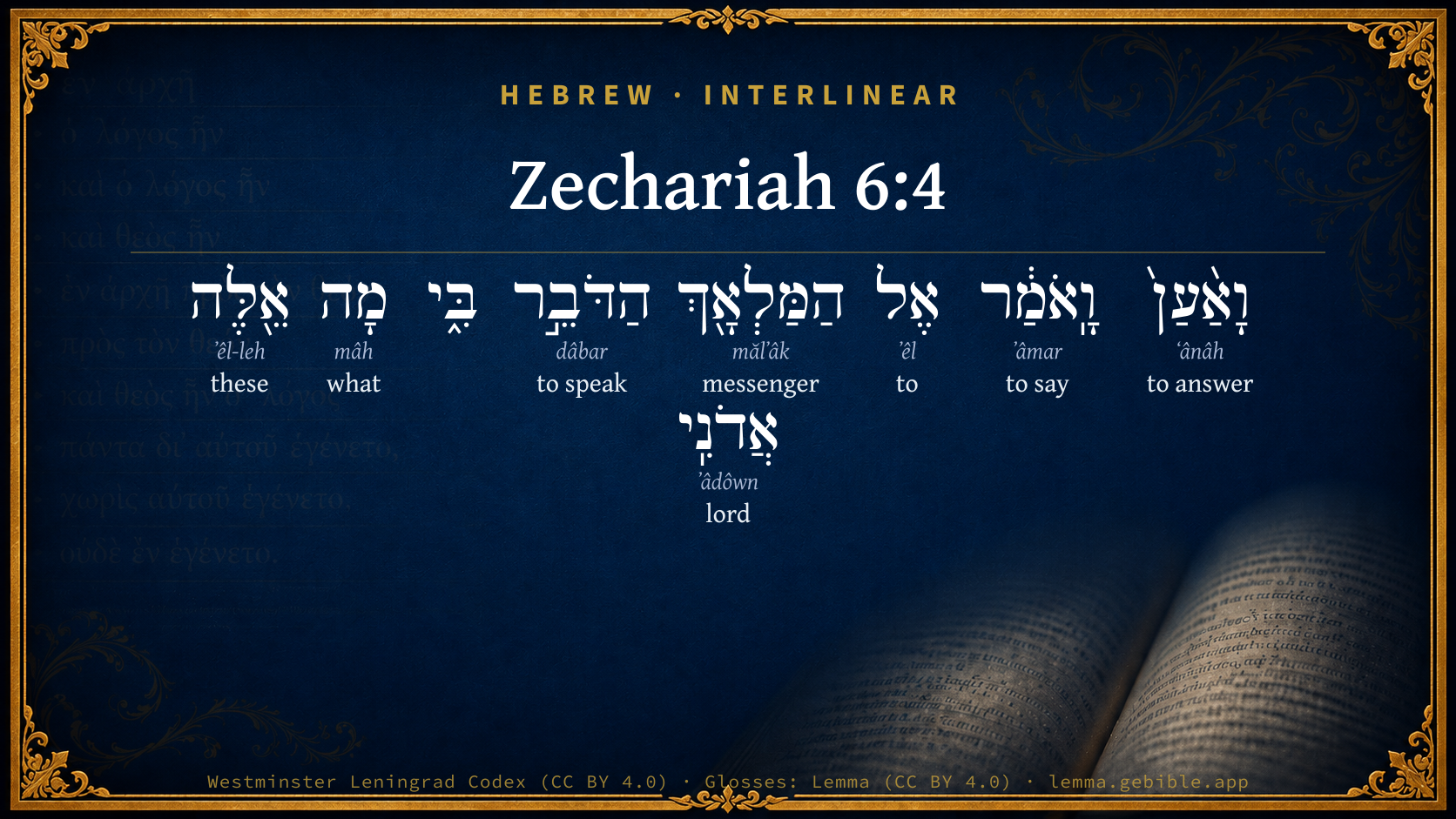
Hebrew (Westminster Leningrad Codex) Zechariah 6:4 appears in the Hebrew Old Testament. The text above is from the Westminster Leningrad Codex. Each word links to its Strong’s number, a concise gloss, and parsing drawn from the Open Scriptures Hebrew Bible morphology. Click any word for its full Brown-Driver-Briggs (BDB) entry.
Download image
Cite this verse

Zechariah 6:4 (World English Bible). Public Domain. Lemma interlinear Bible study tool, https://lemma.gebible.app/v/zechariah/6/4.

Show BibTeX & RIS
BibTeX
RIS
English Translation
Then I asked the angel who talked with me, "What are these, my lord?"
World English Bible · Public Domain
Download a study sheet

One document with this verse’s original text, its word-by-word gloss line, the meaning frame, cross-references with their text, attributed commentary, and full source and license credits — printable, and it pastes into notes with its structure intact.

This verse Autodidact and up

Study sheet (.html) Plain text (.txt)

A passage Seminary Student

Up to 50 verses in one chapter. A passage sheet keeps up to 6 commentary sources and 12 cross-references per verse, in the order this page ranks them, and says so on the sheet whenever that leaves anything out. Ask for a single verse and you get the Autodidact verse sheet above.

Everything on this page stays free to read, with no account — the sheet is a download of what is already on screen, not access to it.

Want to remove ads? Support Godless Engineer
Compare translations 3

The same verse in 3 English versions, stacked beneath the original-language interlinear above. Click any original word for its lexicon entry.

Each is an independent rendering of the whole verse — the interlinear is not word-aligned to these translations.

Highlighted words mark where these versions differ — a whole-verse word diff, not a word-by-word alignment.

  • World English Bible Public Domain
    Then I asked the angel who talked with me, "What are these, my lord?"
  • King James Version Public Domain
    Then I answered and said unto the angel that talked with me, What are these, my lord?
  • unfoldingWord Literal Text CC BY-SA 4.0
    And I answered and said to the angel who was speaking with me, “What are these, my lord?”

unfoldingWord Literal Text — © unfoldingWord, licensed CC BY-SA 4.0. Word-aligned USFM3 via Door43 (git.door43.org/unfoldingWord/en_ult).

Versions to compare (up to 4)

3 of 4 selected

Show all 18 translations

Every available English version of this verse, each an independent rendering of the whole verse.

  • World English Bible Public Domain
    Then I asked the angel who talked with me, "What are these, my lord?"
  • Berean Standard Bible Public Domain
    So I inquired of the angel who was speaking with me, “What are these, my lord?”
  • Majority Standard Bible Public Domain
    So I inquired of the angel who was speaking with me, “What are these, my lord?”
  • King James Version Public Domain
    Then I answered and said unto the angel that talked with me, What are these, my lord?
  • American Standard Version (1901) Public Domain
    Then I answered and said unto the angel that talked with me, What are these, my lord?
  • Revised Version (1885) Public Domain
    Then I answered and said unto the angel that talked with me, What are these, my lord?
  • Geneva Bible (1599) Public Domain
    Then I answered, and saide vnto the Angell that talked with mee, What are these, my Lord?
  • Douay-Rheims (1899) Public Domain
    And I answered, and said to the an- gel that spoke in me: What are these, my lord?
  • Young's Literal Translation Public Domain
    And I answer and say unto the messenger who is speaking with me, `What `are' these, my lord?'
  • Literal Standard Version CC BY-SA 4.0
    And I answer and say to the messenger who is speaking with me, “What [are] these, my lord?”
  • Unlocked Literal Bible CC BY-SA 4.0
    So I answered and said to the angel who talked with me, “What are these, my master?”
  • unfoldingWord Literal Text CC BY-SA 4.0
    And I answered and said to the angel who was speaking with me, “What are these, my lord?”
  • Darby Bible Public Domain
    And I spoke and said unto the angel that talked with me, What are these, my lord?
  • World Messianic Bible Public Domain
    Then I asked the angel who talked with me, “What are these, my lord?”
  • Webster's Bible Public Domain
    Then I answered and said to the angel that talked with me, What are these, my lord?
  • Free Bible Version CC BY-SA 4.0
    “My lord, what are these?” I asked the angel I was talking to.
  • Bible in Basic English Public Domain
    And I made answer and said to the angel who was talking to me, What are these, my lord?
  • JPS Tanakh (1917) Public Domain
    Then I answered and said unto the angel that spoke with me: 'What are these, my lord?'

Literal Standard Version (2020), Covenant Press — licensed CC BY-SA 4.0. Text via the HelloAO Bible API (eBible.org). Unlocked Literal Bible (unfoldingWord) — licensed CC BY-SA 4.0. Text via the HelloAO Bible API (eBible.org). unfoldingWord Literal Text — © unfoldingWord, licensed CC BY-SA 4.0. Word-aligned USFM3 via Door43 (git.door43.org/unfoldingWord/en_ult). Free Bible Version, Dr. Jonathan Gallagher — licensed CC BY-SA 4.0. Text via the HelloAO Bible API (eBible.org).

Word by word

More ways to search: Search by grammar → Find every occurrence → Compare this word →

Practice this passage: Drill this verse → Learn its vocabulary →

הַמַּלְאָ֖ךְ
mălʼâk
H4397
“the · messenger”
Particle, Definite Article + Noun, Common, Masculine, Singular, Absolute
Part of Speech
Particle + Noun
Type
Common
Gender
Masculine
Number
Singular
State
Absolute
Full BDB Definition

Origin: from an unused root meaning to despatch as a deputy

TWOT: 1068a

messenger, representative - messenger - angel - the theophanic angel
  1. וָאַ֨עַן֙ ʻânâh H6030 “and · to answer” Conjunction + Verb, Qal, Sequential Imperfect, 1st Person, Common, Singular
  2. וָֽאֹמַ֔ר ʼâmar H559 “and · to say” Conjunction + Verb, Qal, Sequential Imperfect, 1st Person, Common, Singular
  3. אֶל ʼêl H413 “to” Preposition
  4. הַדֹּבֵ֣ר dâbar H1696 “the · speaking” Particle, Definite Article + Verb, Qal, Participle Active, Masculine, Singular, Absolute
  5. מָה mâh H4100 “what” Particle, Interrogative
  6. אֵ֖לֶּה ʼêl-leh H428 “these” Pronoun, Demonstrative, Common, Plural
  7. אֲדֹנִֽי ʼâdôwn H113 “lord · my” Noun, Common, Masculine, Singular, Construct + Suffix, Personal, 1st Person, Common, Singular

About this verse

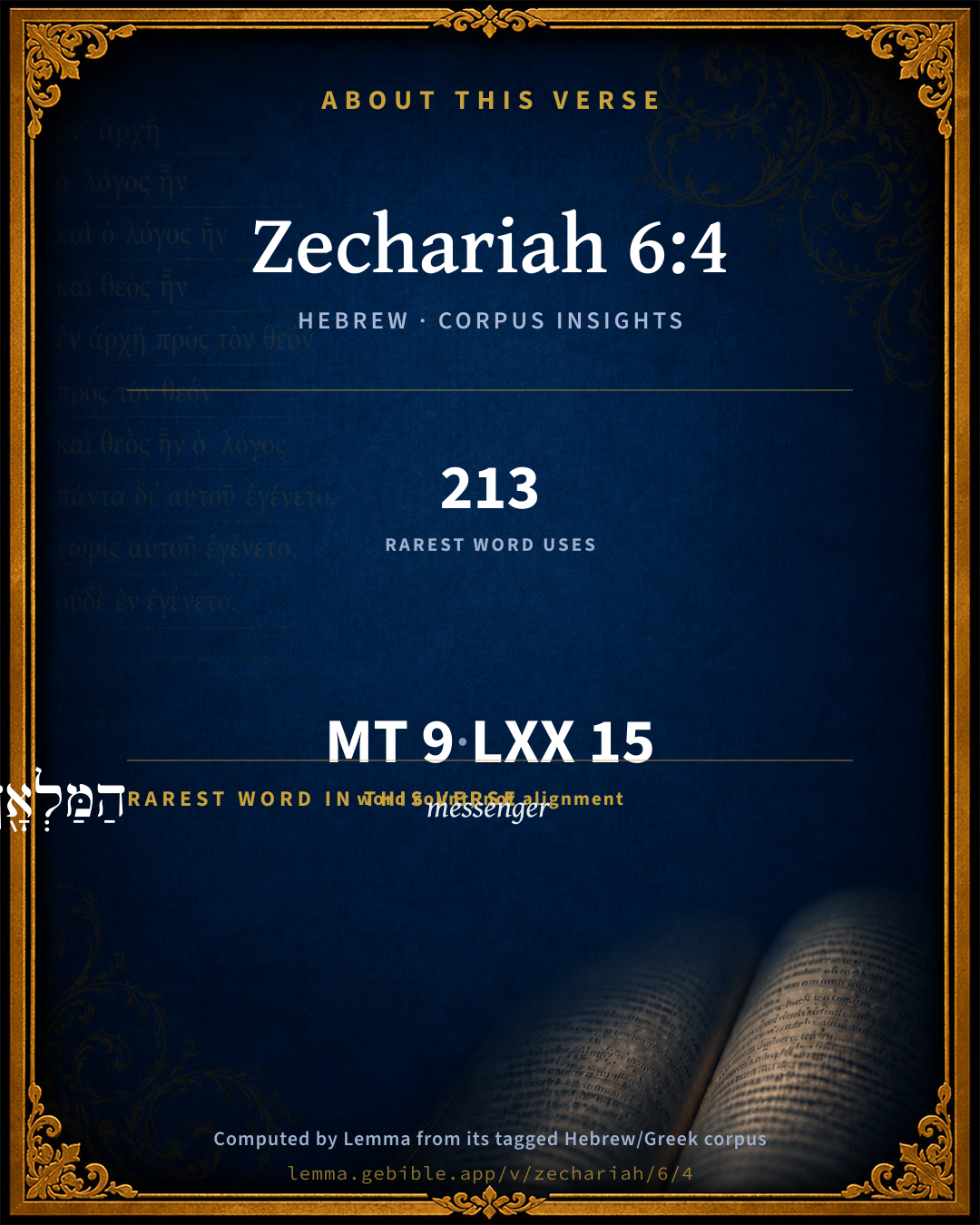
These counts appear in no published source. They are computed here, from the morphology-tagged text and Lemma’s own curated glosses. What Lemma adds →

9
words
8
distinct lemmas
Prophets
section

Grammatical profile

  • 3 verbs
  • 2 nouns
  • 1 pronoun
  • 2 prepositions
  • 1 particle

Verb forms

  • וָאַ֨עַן֙ Qal · Sequential Imperfect
  • וָֽאֹמַ֔ר Qal · Sequential Imperfect
  • הַדֹּבֵ֣ר Qal · Participle Active

Hebrew & Septuagint length

In English translation the verse runs 14 words from the Hebrew and 17 from the Septuagint (LXX English) — closely comparable.

A rough comparison of the two English renderings, which tokenize alike — not a word-level alignment.

Word counts can differ between the Hebrew and the Greek without any difference in meaning — e.g. the Hebrew direct-object marker אֵת has no separate Greek word, and Greek often adds the article ὁ.

In the original languages it is 9 Hebrew tokens and 15 Greek tokens — but the two are counted differently (Hebrew bundles its prefixes and suffixes into one token; the Greek is in lemma form), so that isn’t a like-for-like length.

Cross-references

4

Topical passages linked to Zechariah 6:4 in the Treasury of Scripture Knowledge — connected by theme and wording, ordered by reader-vote popularity; previews shown in the World English Bible.

  • Zechariah 1:9 Then I asked, 'My lord, what are these?'" The angel who talked with me said to me, "I will show you what these are."
  • Zechariah 1:19–21 I asked the angel who talked with me, "What are these?" He answered me, "These are the horns which have scattered Judah, Israel, and Jerusalem."
  • Zechariah 5:5–6 Then the angel who talked with me came forward, and said to me, "Lift up now your eyes, and see what is this that is appearing."
  • Zechariah 5:10 Then said I to the angel who talked with me, "Where are these carrying the ephah basket?"

Cross-references courtesy of OpenBible.info (CC BY 4.0).

Hebrew and Greek witnesses Masoretic Hebrew ↔ Greek Septuagint

The same verse in the two great witnesses to the Old Testament, shown verse-for-verse.

These are two independent witnesses, not word-aligned to each other, and the Septuagint is shown in lemma (dictionary) form.

Hebrew Zechariah 6:4 Masoretic · Westminster Leningrad Codex

וָאַ֨עַן֙ וָֽאֹמַ֔ר אֶל הַמַּלְאָ֖ךְ הַדֹּבֵ֣ר בִּ֑י מָה אֵ֖לֶּה אֲדֹנִֽי

Then I asked the angel who talked with me, "What are these, my lord?"

World English Bible · Public Domain

Greek LXX Zechariah 6:4 Septuagint · lemma form

καί ἀποκρίνω καί εἶπον πρός ὁ ἄγγελος ὁ λαλέω ἐν ἐγώ τίς εἰμί οὗτος κύριος

And I answered and said to the angel that talked with me, What are these, my Lord?

LXX2012 (modern English Septuagint) · Public Domain

Hebrew: Westminster Leningrad Codex (CC BY 4.0). Greek: Septuagint (public domain); English from LXX2012 (modern English Septuagint) (Public Domain). How the Septuagint differs from the Hebrew →

Targum (Aramaic paraphrase)

1

The Targum is the ancient Jewish Aramaic paraphrase of the Hebrew Scriptures — an interpretive translation, not the Hebrew text itself. Onkelos (literal) and Pseudo-Jonathan (expansive) render the Torah, and Jonathan the Prophets. Coverage is partial: where no permissively-licensed English translation exists for a verse, only the Aramaic is shown. This is verse-level text, not a word-by-word alignment to the Hebrew.

  1. Targum Jonathan Prophets (Joshua–Malachi)
    וַאֲתִיבֵית וַאֲמָרֵית לְמַלְאֲכָא דִמְמַלֵיל עִמִי מָה אִלֵין רִבּוֹנִי:

    (no public-domain English translation for this verse)

    Targum Jonathan — Aramaic: “Mikraot Gedolot” (public domain). English: “Sefaria Community Translation” (CC0 1.0 (public-domain dedication)); “London "Chaldee Paraphrase," 1871” (public domain). Text via Sefaria.

Commentary

Notes on Zechariah 6:4 from classic Christian and Jewish commentators (each source and its license shown beneath its notes). The classic Christian expositions comment on the surrounding passage and are grouped to its opening verse, so a note may address several verses; the Jewish commentaries on the Tanakh (Rashi and others) are per-verse, so they appear only where the commentator wrote on this verse.

Lemma curates 59 commentaries, every one of them public domain or Creative Commons licensed, each selected and text-cleaned for this edition rather than reprinted as found. About our sources →

Trapp's Complete Commentary

John Trapp

Zec 6:4 Then I answered and said unto the angel that talked with me, What [are] these, my lord?

Ver. 4. What are these, my lord?] Difficulty doth but whet desire in heroic spirits; the harder the vision the more earnest was the prophet’s inquisition: he was restless till better resolved; and therefore applieth himself again to his angel tutor, rather than Tutelar, whom, for honour’s sake, he called My lord; {See Trapp on "Zec 4:5"} and take notice of the truth of St Peter’s assertion concerning the prophetic scrutiny, {1Pe 1:11} with greatest sagacity and sedulity.

John Trapp, A Commentary or Exposition upon All the Books of the Old and New Testament (1647–1656) — public domain. Text from a community e-Sword module.

Jamieson, Fausset & Brown

Robert Jamieson, A. R. Fausset & David Brown

The prophet humbly and teachably seeks instruction from God, and therefore seeks not in vain.

Jamieson, Fausset & Brown — Commentary Critical and Explanatory on the Whole Bible (1871) — public domain (CC PDM 1.0). Text via the HelloAO Bible API.

John Calvin's Commentaries

The Prophet asks the angel again; and by his example we are taught to shake off every indifference, and to render ourselves both teachable and attentive to God if we desire to make progress in the knowledge of these predictions; for if Zechariah, who had separated himself from the world and raised up his eyes and his mind to heaven, stood in need of the teaching and guidance of the angel to instruct him, how much folly and arrogance is it in us to trust in ourselves and to despise the gift of interpretation. But as angels are not sent to us from heaven to explain to us the prophecies, let us avail ourselves of those helps which we know is offered to us by God. There is here prescribed to us both docility, and reverence, and attention. Let us also remember, that as soon as men submit themselves to God, the gift of revelation is prepared for them; for it is not in vain that God is often called the teacher of babes. Whosoever then shall be disposed to learn with real meekness and humility, shall not be disappointed of his desire; for we see here that the angel performed his part in teaching Zechariah.

John Calvin's Commentaries (1540-1563) — public domain. Text from the Calvin Translation Society English edition (1840s-50s) via the Christian Classics Ethereal Library (ccel.org). Calvin's coverage is partial (roughly two-thirds of the Bible); uncommented books and verses are honest gaps, never fabricated. The 19th-century editor's footnotes and remarks are omitted so the notes are faithfully Calvin's own voice.

John Gill's Exposition

Then I answered and said unto the angel that talked with me,.... After he had seen the chariots come out, and had observed the different colours of the horses in them:

what are these, my lord? that is, what do they signify? what is the meaning of this vision?

John Gill's Exposition of the Whole Bible (1746–1763) — public domain (CC PDM 1.0). Text via the HelloAO Bible API.

Matthew Poole's English Annotations

See Zec 1:19; 5:6.

Matthew Poole's English Annotations on the Holy Bible (1683–1685) — public domain. Text from a community e-Sword/MySword module.

Whedon's Commentary on the Bible

Daniel D. Whedon

4-7. The prophet, failing to understand the vision, appeals to his companion, who supplies the desired information.

The four spirits of the heavens — R.V., “the four winds” (compare Jer_49:36). If the R.V. translation is correct one symbol is explained by another which, because of its familiarity, would suggest more readily the significance of the first. The four winds would symbolize the messengers of judgment which are sent by Jehovah in every direction. They go forth from the presence of Jehovah, to whom they have presented themselves to make a report, or to receive their commission. Similarly, the spirits of A.V. would be the ministering spirits sent to execute the judgment. It is difficult to choose between the two translations. In every case the context must decide whether the Hebrew word should be translated spirit or wind; here either gives good sense. More satisfactory than either A.V. or R.V. is a translation first proposed by Wellhausen, “These are going forth to the four winds of heaven from standing before the Lord of all the earth.” With this translation the subject of “are going forth” is the “four chariots” of Zec_6:1. This translation is in perfect accord with the rules of Hebrew grammar (G.-K., 118d, f.); if it is adopted the peculiarity of explaining one symbol by another is removed, and the reply of the angel becomes one continuous explanation, reaching its climax in Zec_6:8.

The angel, after stating whence the chariots proceed, indicates in Zec_6:6-7 the commission of each. Again they are distinguished by the color of the horses, but the red horses of Zec_6:2 are absent; instead, the adjectives grizzled strong or grizzled and bay of Zec_6:3 are separated and applied to two different sets of horses. Since there can be no doubt that the chariots of Zec_6:2-3 are identical with those of Zec_6:6-7, the colors mentioned here must in some way correspond to those named in the other verses. The black and the white horses present no difficulty, but when they are disposed of two peculiarities remain, (1) the absence of the red horses, (2) the separation of the grizzled strong horses into two classes. Much ingenuity has been expended in attempts to remove these difficulties, but when all is said and done it is seen that the attempts are not successful. Two of the ancient versions, Peshitto and Aquila, present a solution; they read red instead of strong in Zec_6:7 (so margin R.V.), which restores the four colors, black, red, white, grizzled. The error arose first in Zec_6:7; from there a later writer inserted strong also in Zec_6:3.

The north country — Babylonia. North is used because the Assyrian and Babylonian armies were accustomed to invade Palestine from the north; in reality Babylonia was east of Judah (Zec_2:6; see also on Joe_2:20; compare Jer_1:14; Jer_4:6; Jer_6:1).

After them — If the present Hebrew text is correct the thought is that the white horses go to the aid of the black (see below). Babylon, as the strongest enemy and the one most guilty, will suffer the severest judgment.

The south country — The other long-time enemy of Judah, Egypt, was found there; but if Egypt is in the prophet’s mind it serves only as a type of all enemies in the south. The red (R.V., bay) also “went forth,” but it is not stated whither they went. The tense is the same as in Zec_6:6; therefore instead of “went forth” we should translate, as in Zec_6:6, “go forth,” for the opening words of Zec_6:7 are the continuation of Zec_6:6. After go forth a break should be made, for the succeeding words, “and sought to go… ,” refer not only to the red horses, but to the horses hitched to all four chariots. They had come forth from between the two mountains, and the angel had pointed out their destinations, but thus far Jehovah had not given the command to go. Now they begin to express their desire to go about their errands, and they receive permission to go.

Get you hence — Literally, Go ye. As soon as the command is given they proceed. The above appears to be the best interpretation of the present Hebrew text; but in view of the reference to the “four winds of heaven” (Zec_6:5) we would expect all four points of the compass to be indicated in connection with the chariots, instead of only two. It has been suggested, therefore, to change after them to toward the west country, a meaning which Ewald thinks may be gotten from the present Hebrew text, which reads literally, “toward behind them” (see on Joe_2:20). The red horses would be commissioned to go “toward the east country.” With these emendations 6, 7a would read, “The black horses which are therein (in the chariot) go forth into the north country; and the white go forth toward the west country; and the grizzled go forth toward the south country; and the red go forth toward the east country.”

Daniel D. Whedon (gen. ed.), Commentary on the Old and New Testaments (1874–1909) — public domain. Text from a community e-Sword module.

Scofield Reference Notes

C. I. Scofield

angel

(See Scofield "Heb 1:4")

The Scofield Reference Bible (1917 edition), notes by C. I. Scofield — public domain. Text from a community e-Sword module.

Lesson kit

Teaching starters — assembled from the data on this page, not authored interpretation. Every prompt links to the verse data it draws on. Edit before teaching.

Zechariah, in the Prophets, opens this verse with 9 words (8 distinct Hebrew lemmas). Its most distinctive word is mălʼâk (“messenger”). A historical commentator’s framing appears above. Read the whole chapter for the surrounding context.

Discussion questions

  1. How does “messenger” (mălʼâk) shape what this verse is saying?
  2. How does Zechariah 1:9, which shares this passage’s theme, read alongside this verse?
  3. These translations render this verse differently; the difference is in the English rendering, not the original. What questions does that raise?
  4. «וָאַ֨עַן֙» is a Qal Sequential Imperfect verb. How does that grammatical form shape the action described?
  5. Compare how Trapp's Complete Commentary and Jamieson, Fausset & Brown read this verse. Where do they agree or differ?

Things to notice

Reading settings

Reading text

Shown beneath each verse's original-language words.

Old Testament
Old Testament edition

Read the OT as the Masoretic Hebrew (MT) or the Greek Septuagint (LXX).

English shown for the Greek Septuagint (in the Hebrew ↔ Greek comparison).

Comparing translations? Open the Compare panel on any verse page to stack up to four side by side.