Judges 13:21

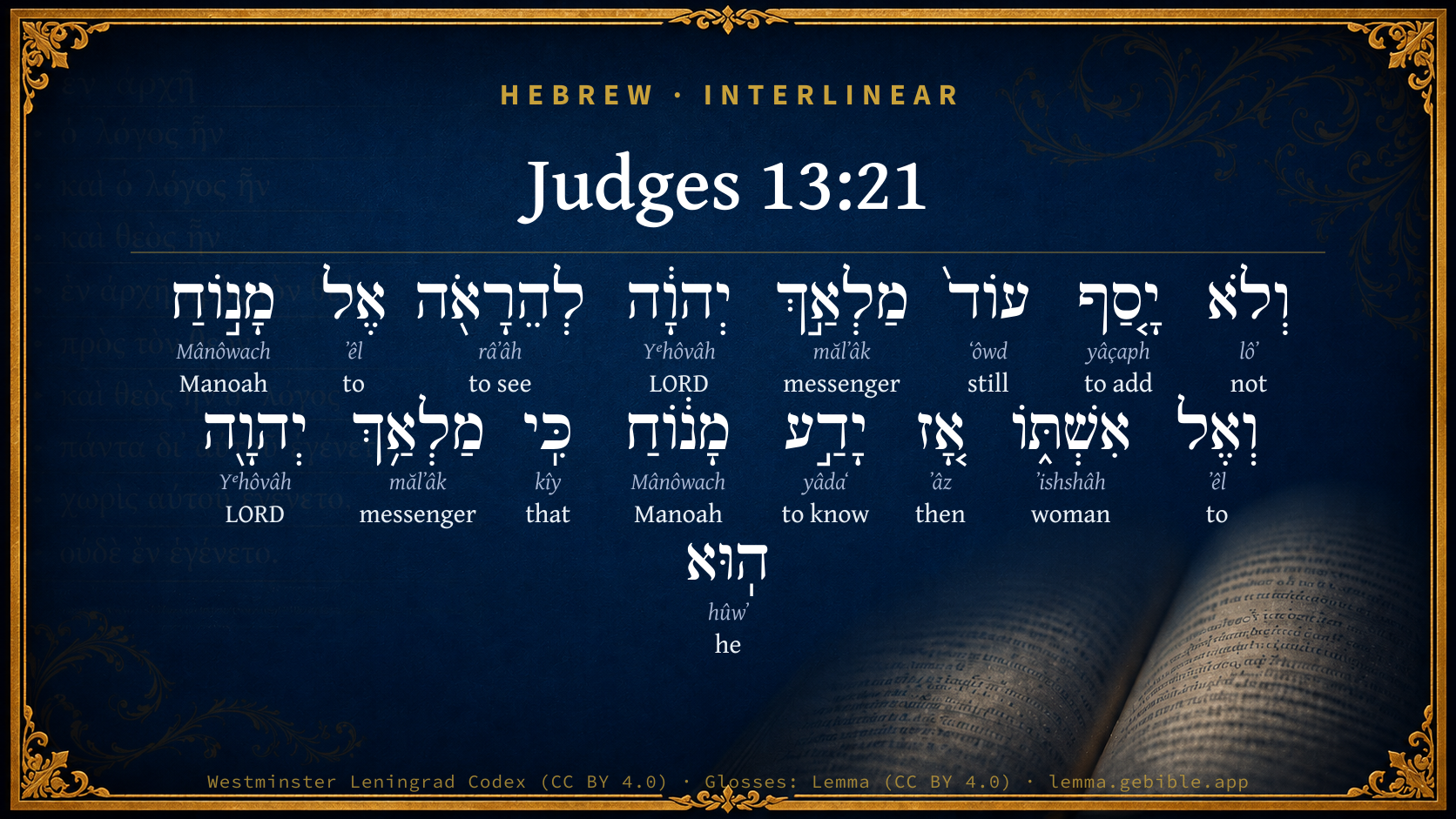
Hebrew (Westminster Leningrad Codex) Judges 13:21 appears in the Hebrew Old Testament. The text above is from the Westminster Leningrad Codex. Each word links to its Strong’s number, a concise gloss, and parsing drawn from the Open Scriptures Hebrew Bible morphology. Click any word for its full Brown-Driver-Briggs (BDB) entry.
Download image
Cite this verse

Judges 13:21 (World English Bible). Public Domain. Lemma interlinear Bible study tool, https://lemma.gebible.app/v/judges/13/21.

Show BibTeX & RIS
BibTeX
RIS
English Translation
But the angel of Yahweh did no more appear to Manoah or to his wife. Then Manoah knew that he was the angel of Yahweh.
World English Bible · Public Domain
Download a study sheet

One document with this verse’s original text, its word-by-word gloss line, the meaning frame, cross-references with their text, attributed commentary, and full source and license credits — printable, and it pastes into notes with its structure intact.

This verse Autodidact and up

Study sheet (.html) Plain text (.txt)

A passage Seminary Student

Up to 50 verses in one chapter. A passage sheet keeps up to 6 commentary sources and 12 cross-references per verse, in the order this page ranks them, and says so on the sheet whenever that leaves anything out. Ask for a single verse and you get the Autodidact verse sheet above.

Everything on this page stays free to read, with no account — the sheet is a download of what is already on screen, not access to it.

Want to remove ads? Support Godless Engineer
Compare translations 3

The same verse in 3 English versions, stacked beneath the original-language interlinear above. Click any original word for its lexicon entry.

Each is an independent rendering of the whole verse — the interlinear is not word-aligned to these translations.

Highlighted words mark where these versions differ — a whole-verse word diff, not a word-by-word alignment.

  • World English Bible Public Domain
    But the angel of Yahweh did no more appear to Manoah or to his wife. Then Manoah knew that he was the angel of Yahweh.
  • King James Version Public Domain
    But the angel of the LORD did no more appear to Manoah and to his wife. Then Manoah knew that he was an angel of the LORD.
  • unfoldingWord Literal Text CC BY-SA 4.0
    And the angel of Yahweh did not resume again to appear to Manoah and to his wife. Then Manoah knew that he the angel of Yahweh.

unfoldingWord Literal Text — © unfoldingWord, licensed CC BY-SA 4.0. Word-aligned USFM3 via Door43 (git.door43.org/unfoldingWord/en_ult).

Versions to compare (up to 4)

3 of 4 selected

Show all 18 translations

Every available English version of this verse, each an independent rendering of the whole verse.

  • World English Bible Public Domain
    But the angel of Yahweh did no more appear to Manoah or to his wife. Then Manoah knew that he was the angel of Yahweh.
  • Berean Standard Bible Public Domain
    And when the angel of the LORD did not appear again to Manoah and his wife, Manoah realized that it had been the angel of the LORD.
  • Majority Standard Bible Public Domain
    And when the angel of the LORD did not appear again to Manoah and his wife, Manoah realized that it had been the angel of the LORD.
  • King James Version Public Domain
    But the angel of the LORD did no more appear to Manoah and to his wife. Then Manoah knew that he was an angel of the LORD.
  • American Standard Version (1901) Public Domain
    But the angel of Jehovah did no more appear to Manoah or to his wife. Then Manoah knew that he was the angel of Jehovah.
  • Revised Version (1885) Public Domain
    But the angel of the LORD did no more appear to Manoah or to his wife. Then Manoah knew that he was the angel of the LORD.
  • Geneva Bible (1599) Public Domain
    (So the Angel of the Lord did no more appeare vnto Manoah and his wife.) Then Manoah knewe that it was an Angel of the Lord.
  • Douay-Rheims (1899) Public Domain
    And the angel of the Lord appeared to them no more. And forthwith Manue understood that it was an angel of the Lord,
  • Young's Literal Translation Public Domain
    and the messenger of Jehovah hath not added again to appear unto Manoah, and unto his wife, then hath Manoah known that He `is' a messenger of Jehovah.
  • Literal Standard Version CC BY-SA 4.0
    and the Messenger of YHWH has not added again to appear to Manoah, and to his wife, then Manoah has known that He [is] the Messenger of YHWH.
  • Unlocked Literal Bible CC BY-SA 4.0
    The angel of Yahweh did not appear again to Manoah or his wife. Then Manoah knew that he was the angel of Yahweh.
  • unfoldingWord Literal Text CC BY-SA 4.0
    And the angel of Yahweh did not resume again to appear to Manoah and to his wife. Then Manoah knew that he the angel of Yahweh.
  • Darby Bible Public Domain
    The angel of the LORD appeared no more to Mano'ah and to his wife. Then Mano'ah knew that he was the angel of the LORD.
  • World Messianic Bible Public Domain
    But the LORD’s angel didn’t appear to Manoah or to his wife any more. Then Manoah knew that he was the LORD’s angel.
  • Webster's Bible Public Domain
    But the angel of the LORD did no more appear to Manoah and to his wife. Then Manoah knew that he was an angel of the LORD.
  • Free Bible Version CC BY-SA 4.0
    The angel of the Lord did not appear to Manoah or his wife again, and Manoah realized that he was the angel of the Lord.
  • Bible in Basic English Public Domain
    But the angel of the Lord was seen no more by Manoah and his wife. Then it was clear to Manoah that he was the angel of the Lord.
  • JPS Tanakh (1917) Public Domain
    But the angel of the LORD did no more appear to Manoah or to his wife. Then Manoah knew that he was the angel of the LORD.

Literal Standard Version (2020), Covenant Press — licensed CC BY-SA 4.0. Text via the HelloAO Bible API (eBible.org). Unlocked Literal Bible (unfoldingWord) — licensed CC BY-SA 4.0. Text via the HelloAO Bible API (eBible.org). unfoldingWord Literal Text — © unfoldingWord, licensed CC BY-SA 4.0. Word-aligned USFM3 via Door43 (git.door43.org/unfoldingWord/en_ult). Free Bible Version, Dr. Jonathan Gallagher — licensed CC BY-SA 4.0. Text via the HelloAO Bible API (eBible.org).

Word by word

More ways to search: Search by grammar → Find every occurrence → Compare this word →

Practice this passage: Drill this verse → Learn its vocabulary →

מָנ֣וֹחַ
Mânôwach
H4495
“Manoah”
Noun, Proper
Part of Speech
Noun
Type
Proper
Full BDB Definition

Origin: the same as H4494

TWOT: None

Manoah = "rest" - a Danite, father of the judge Samson and inhabitant of Zorah
  1. וְלֹא lôʼ H3808 “and · not” Conjunction + Particle, Negative
  2. יָ֤סַף yâçaph H3254 “to add” Verb, Qal, Perfect, 3rd Person, Masculine, Singular
  3. עוֹד֙ ʻôwd H5750 “still” Adverb
  4. מַלְאַ֣ךְ mălʼâk H4397 “messenger of” Noun, Common, Masculine, Singular, Construct
  5. יְהוָ֔ה Yᵉhôvâh H3068 “LORD” Noun, Proper
  6. לְהֵרָאֹ֖ה râʼâh H7200 “to see” Preposition + Verb, Niphal, Infinitive Construct
  7. אֶל ʼêl H413 “to” Preposition
  8. וְאֶל ʼêl H413 “and · to” Conjunction + Preposition
  9. אִשְׁתּ֑וֹ ʼishshâh H802 “woman · his” Noun, Common, Feminine, Singular, Construct + Suffix, Personal, 3rd Person, Masculine, Singular
  10. אָ֚ז ʼâz H227 “then” Adverb
  11. יָדַ֣ע yâdaʻ H3045 “to know” Verb, Qal, Perfect, 3rd Person, Masculine, Singular
  12. מָנ֔וֹחַ Mânôwach H4495 “Manoah” Noun, Proper
  13. כִּֽי kîy H3588 “that” Conjunction
  14. מַלְאַ֥ךְ mălʼâk H4397 “messenger of” Noun, Common, Masculine, Singular, Construct
  15. יְהוָ֖ה Yᵉhôvâh H3068 “LORD” Noun, Proper
  16. הֽוּא hûwʼ H1931 “he” Pronoun, Personal, 3rd Person, Masculine, Singular

About this verse

These counts appear in no published source. They are computed here, from the morphology-tagged text and Lemma’s own curated glosses. What Lemma adds →

17
words
13
distinct lemmas
Historical
section

Notable vocabulary

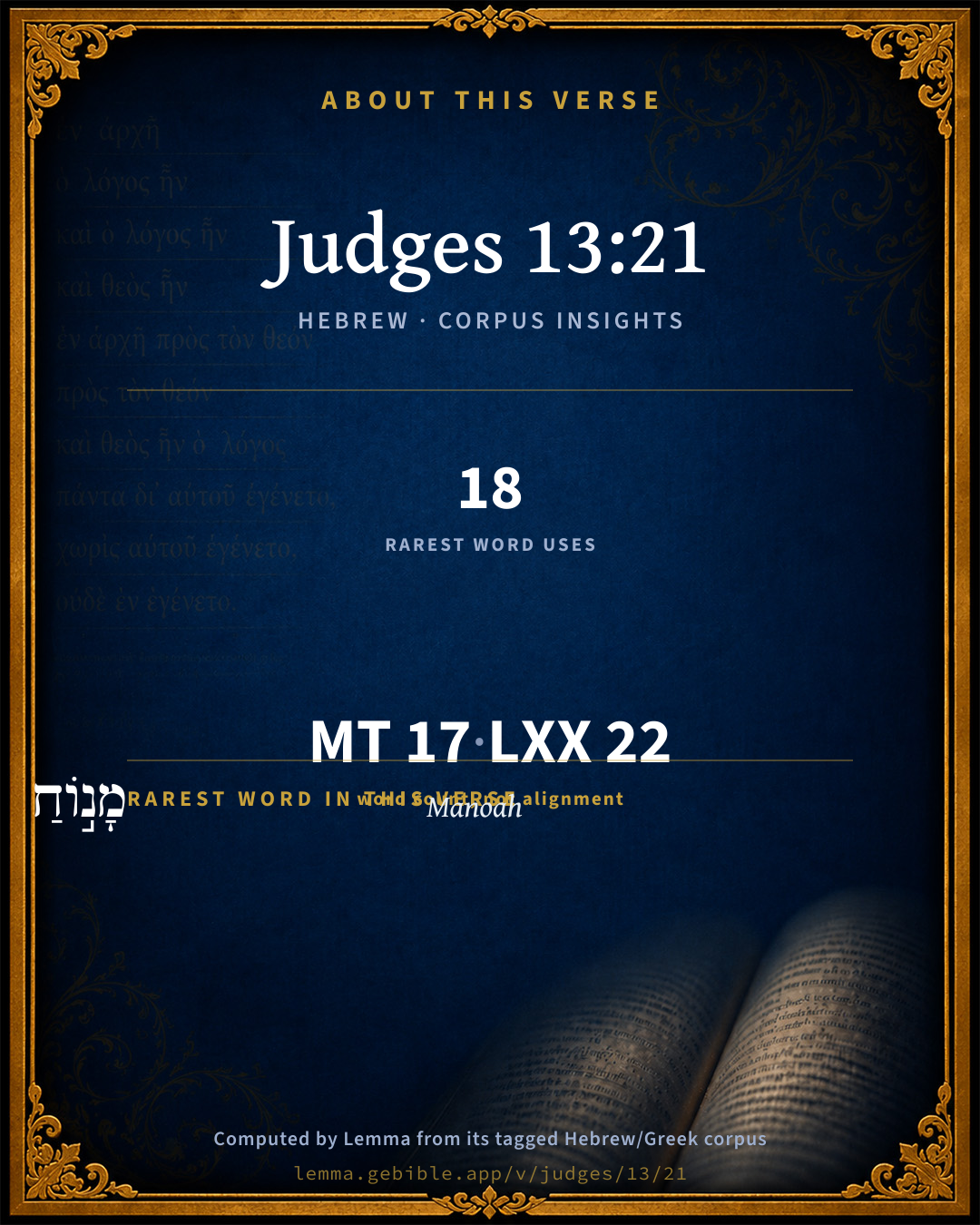
The rarest word here is מָנ֣וֹחַ Manoah H4495 — appearing just 18 times in the whole Hebrew Bible.

Shared distinctive vocabulary

מָנ֣וֹחַ Manoah H4495 occurs in 14 verses of the Hebrew Bible. Also found in:

Grammatical profile

  • 3 verbs
  • 7 nouns
  • 1 pronoun
  • 2 prepositions
  • 1 conjunction
  • 2 adverbs
  • 1 particle

Verb forms

  • יָ֤סַף Qal · Perfect
  • לְהֵרָאֹ֖ה Niphal · Infinitive Construct
  • יָדַ֣ע Qal · Perfect

Repetition

Words recur within this verse — often emphatic in Hebrew:

  • מַלְאַ֣ךְ messenger H4397 ×2
  • יְהוָ֔ה LORD H3068 ×2
  • מָנ֣וֹחַ Manoah H4495 ×2
  • אֶל to H413 ×2

Hebrew & Septuagint length

In English translation the verse runs 25 words from the Hebrew and 23 from the Septuagint (LXX English) — closely comparable.

A rough comparison of the two English renderings, which tokenize alike — not a word-level alignment.

Word counts can differ between the Hebrew and the Greek without any difference in meaning — e.g. the Hebrew direct-object marker אֵת has no separate Greek word, and Greek often adds the article ὁ.

In the original languages it is 17 Hebrew tokens and 22 Greek tokens — but the two are counted differently (Hebrew bundles its prefixes and suffixes into one token; the Greek is in lemma form), so that isn’t a like-for-like length.

Cross-references

3

Topical passages linked to Judges 13:21 in the Treasury of Scripture Knowledge — connected by theme and wording, ordered by reader-vote popularity; previews shown in the World English Bible.

  • Judges 6:22 Gideon saw that he was the angel of Yahweh; and Gideon said, Alas, Lord Yahweh! because I have seen the angel of Yahweh face to face.
  • Judges 13:16 The angel of Yahweh said to Manoah, Though you detain me, I won't eat of your bread; and if you will make ready a burnt offering, you must offer it to Yahweh. For Manoah didn't know that he was the angel of Yahweh.
  • Hosea 12:4–5 Indeed, he had power over the angel, and prevailed; He wept, and made supplication to him. He found him at Bethel, and there he spoke with us,

Cross-references courtesy of OpenBible.info (CC BY 4.0).

Hebrew and Greek witnesses Masoretic Hebrew ↔ Greek Septuagint

The same verse in the two great witnesses to the Old Testament, shown verse-for-verse.

These are two independent witnesses, not word-aligned to each other, and the Septuagint is shown in lemma (dictionary) form.

Hebrew Judges 13:21 Masoretic · Westminster Leningrad Codex

וְלֹא יָ֤סַף עוֹד֙ מַלְאַ֣ךְ יְהוָ֔ה לְהֵרָאֹ֖ה אֶל מָנ֣וֹחַ וְאֶל אִשְׁתּ֑וֹ אָ֚ז יָדַ֣ע מָנ֔וֹחַ כִּֽי מַלְאַ֥ךְ יְהוָ֖ה הֽוּא

But the angel of Yahweh did no more appear to Manoah or to his wife. Then Manoah knew that he was the angel of Yahweh.

World English Bible · Public Domain

Greek LXX Judges 13:21 Septuagint · lemma form

καί οὐ προςτίθημι ἔτι ὁ ἄγγελος κύριος ὁράω πρός μανωε καί πρός ὁ γυνή αὐτός τότε γιγνώσκω μανωε ὅτι ἄγγελος κύριος οὗτος

And the angel appeared no more to Manoe and to his wife: then Manoe knew that this was an angel of the Lord.

LXX2012 (modern English Septuagint) · Public Domain

On this verse, Trapp's Complete Commentary discusses the Septuagint’s reading. Read the note in Commentary ↓

Hebrew: Westminster Leningrad Codex (CC BY 4.0). Greek: Septuagint (public domain); English from LXX2012 (modern English Septuagint) (Public Domain). How the Septuagint differs from the Hebrew →

Targum (Aramaic paraphrase)

1

The Targum is the ancient Jewish Aramaic paraphrase of the Hebrew Scriptures — an interpretive translation, not the Hebrew text itself. Onkelos (literal) and Pseudo-Jonathan (expansive) render the Torah, and Jonathan the Prophets. Coverage is partial: where no permissively-licensed English translation exists for a verse, only the Aramaic is shown. This is verse-level text, not a word-by-word alignment to the Hebrew.

  1. Targum Jonathan Prophets (Joshua–Malachi)
    וְלָא אוֹסִיף עוֹד מַלְאָכָא דַייָ לְאִתְחַזָאָה לְמָנוֹחַ וּלְאִתְּתֵיהּ בְּכֵן יְדַע מָנוֹחַ אֲרֵי מַלְאָכָא דַייָ הוּא:

    (no public-domain English translation for this verse)

    Targum Jonathan — Aramaic: “Mikraot Gedolot” (public domain). English: “Sefaria Community Translation” (CC0 1.0 (public-domain dedication)); “London "Chaldee Paraphrase," 1871” (public domain). Text via Sefaria.

Commentary

Notes on Judges 13:21 from classic Christian and Jewish commentators (each source and its license shown beneath its notes). The classic Christian expositions comment on the surrounding passage and are grouped to its opening verse, so a note may address several verses; the Jewish commentaries on the Tanakh (Rashi and others) are per-verse, so they appear only where the commentator wrote on this verse.

Lemma curates 59 commentaries, every one of them public domain or Creative Commons licensed, each selected and text-cleaned for this edition rather than reprinted as found. About our sources →

Trapp's Complete Commentary

John Trapp

Jdg 13:21 But the angel of the LORD did no more appear to Manoah and to his wife. Then Manoah knew that he [was] an angel of the LORD.

Ver. 21. Then Manoah knew that he was an angel.] Even that Angel of the covenant, the Angel of the great council, as the Septuagint styles him. {a} {/LXXE Isa 9:6} prefixing that before other of Christ’s titles there, though that be not found in the Hebrew.

{a} και καλειται το ονομα αντου μεγαλης βουλης αγγελος.

John Trapp, A Commentary or Exposition upon All the Books of the Old and New Testament (1647–1656) — public domain. Text from a community e-Sword module.

John Gill's Exposition

But the angel of the Lord did no more appear to Manoah and to his wife,.... As the flame and smoke ascended, he disappeared therewith, and was seen no more:

then Manoah knew that he was an angel of the Lord; by the wondrous things he did, causing fire to come down from heaven, or out of the rock, ascending in the midst of the flame, without being hurt by it, and going up to heaven in it.

John Gill's Exposition of the Whole Bible (1746–1763) — public domain (CC PDM 1.0). Text via the HelloAO Bible API.

The Pulpit Commentary

But. It is better rendered and, in close sequence to the preceding words. It follows, Then, i.e. when they saw him go up, they knew that he was an angel.

The Pulpit Commentary (1880–1919), ed. H.D.M. Spence-Jones & Joseph S. Exell — public domain. Text from a community e-Sword module.

Keil & Delitzsch

C. F. Keil & F. Delitzsch

From that time forward the Lord did not appear to them again. But Manoah was afraid that he and his wife should die, because they had seen God (on this belief, see the remarks on Gen 16:13 and Exo 33:20). His wife quieted his fears, however, and said, "Jehovah cannot intend to kill us, as He has accepted our sacrifice, and has shown us all this" (the twofold miracle). "And at this time He has not let us see such things as these." כּעת, at the time in which we live, even if such things may possibly have taken place in the hoary antiquity.

Keil & Delitzsch — Biblical Commentary on the Old Testament (1861–1891) — public domain (CC PDM 1.0). Text via the HelloAO Bible API. (Old Testament only.)

Scofield Reference Notes

C. I. Scofield

angel

(See Scofield "Heb 1:4").

The Scofield Reference Bible (1917 edition), notes by C. I. Scofield — public domain. Text from a community e-Sword module.

unfoldingWord translationNotes

Door43 World Missions Community

that he was the angel of Yahweh

The word "he" refers to the man who Manoah and his wife had seen.

We are sure to die, because we have seen God

It is implied that they think God will cause them to die. This can be made clear. AT: "God will cause us to die because we have seen him" (See: Assumed Knowledge and Implicit Information)

translationWords

angel

Yahweh

die

God

unfoldingWord translationNotes — © Distant Shores Media and the Door43 World Missions Community, licensed CC BY-SA 4.0. Source: git.door43.org/Door43/en_tn.

Lesson kit

Teaching starters — assembled from the data on this page, not authored interpretation. Every prompt links to the verse data it draws on. Edit before teaching.

Judges, in the Historical, opens this verse with 17 words (13 distinct Hebrew lemmas). Its most distinctive word is Mânôwach (“Manoah”). A historical commentator’s framing appears above. Read the whole chapter for the surrounding context.

Discussion questions

  1. What does “Manoah” (Mânôwach) contribute to the verse as a whole?
  2. How does Judges 13:2, which shares the word «Manoah», read alongside this verse?
  3. What does the repetition of “messenger” (2× in this one verse) do in this verse?
  4. These translations render this verse differently; the difference is in the English rendering, not the original. What questions does that raise?
  5. «יָ֤סַף» is a Qal Perfect verb. How does that grammatical form shape the action described?
  6. Compare how Trapp's Complete Commentary and John Gill's Exposition read this verse. Where do they agree or differ?

Things to notice

Reading settings

Reading text

Shown beneath each verse's original-language words.

Old Testament
Old Testament edition

Read the OT as the Masoretic Hebrew (MT) or the Greek Septuagint (LXX).

English shown for the Greek Septuagint (in the Hebrew ↔ Greek comparison).

Comparing translations? Open the Compare panel on any verse page to stack up to four side by side.