
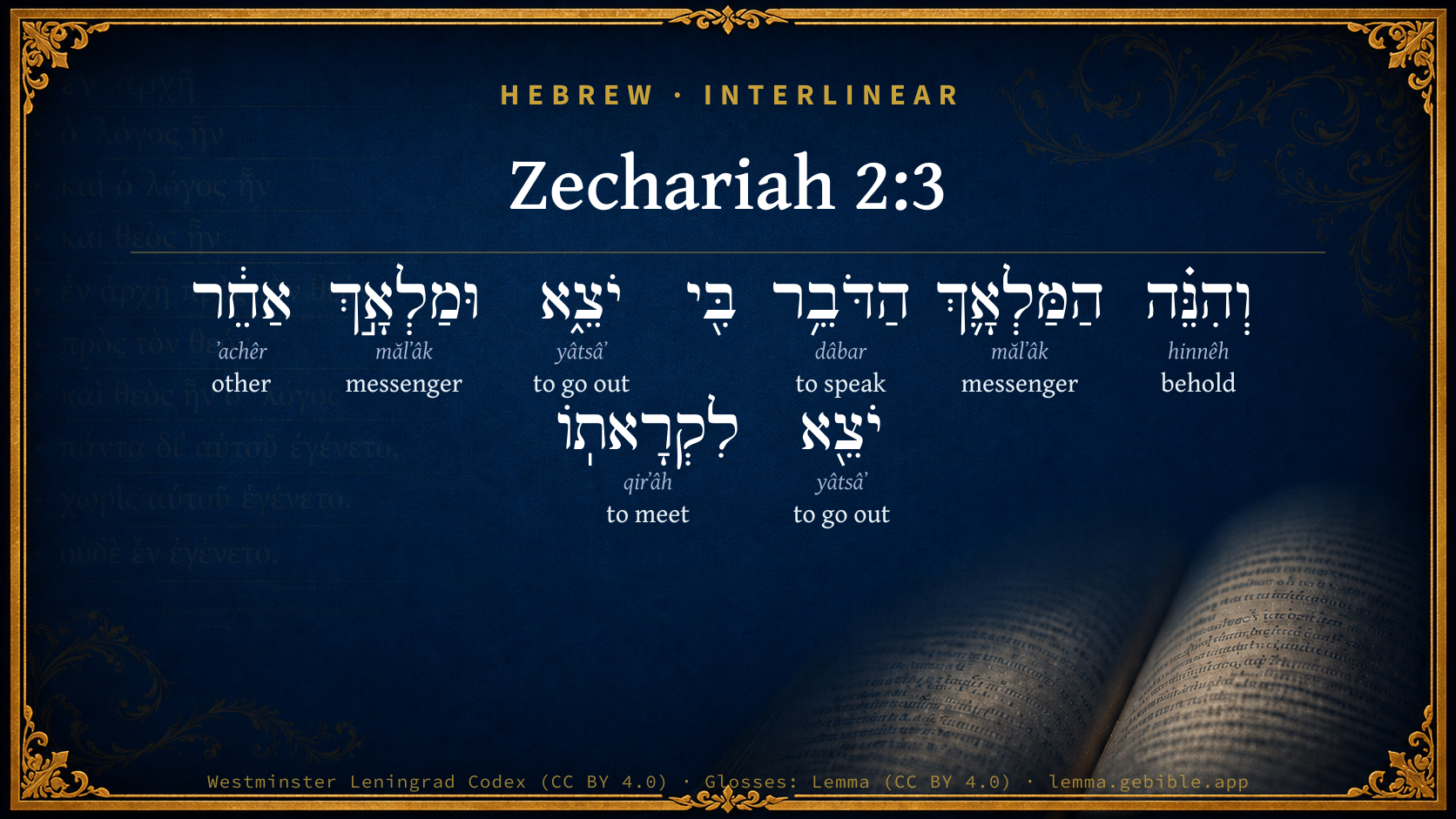
Zechariah 2:3

Hebrew (Westminster Leningrad Codex) Zechariah 2:3 appears in the Hebrew Old Testament. The text above is from the Westminster Leningrad Codex. Each word links to its Strong’s number, a concise gloss, and parsing drawn from the Open Scriptures Hebrew Bible morphology. Click any word for its full Brown-Driver-Briggs (BDB) entry.
Download image
Cite this verse

Zechariah 2:3 (World English Bible). Public Domain. Lemma interlinear Bible study tool, https://lemma.gebible.app/v/zechariah/2/3.

Show BibTeX & RIS
BibTeX
RIS
English Translation
Behold, the angel who talked with me went forth, and another angel went out to meet him,
World English Bible · Public Domain
Download a study sheet

One document with this verse’s original text, its word-by-word gloss line, the meaning frame, cross-references with their text, attributed commentary, and full source and license credits — printable, and it pastes into notes with its structure intact.

This verse Autodidact and up

Study sheet (.html) Plain text (.txt)

A passage Seminary Student

Up to 50 verses in one chapter. A passage sheet keeps up to 6 commentary sources and 12 cross-references per verse, in the order this page ranks them, and says so on the sheet whenever that leaves anything out. Ask for a single verse and you get the Autodidact verse sheet above.

Everything on this page stays free to read, with no account — the sheet is a download of what is already on screen, not access to it.

Want to remove ads? Support Godless Engineer
Compare translations 3

The same verse in 3 English versions, stacked beneath the original-language interlinear above. Click any original word for its lexicon entry.

Each is an independent rendering of the whole verse — the interlinear is not word-aligned to these translations.

Highlighted words mark where these versions differ — a whole-verse word diff, not a word-by-word alignment.

  • World English Bible Public Domain
    Behold, the angel who talked with me went forth, and another angel went out to meet him,
  • King James Version Public Domain
    And, behold, the angel that talked with me went forth, and another angel went out to meet him,
  • unfoldingWord Literal Text CC BY-SA 4.0
    And behold, the angel who was speaking with me was going out, and another angel was going out to meet him.

unfoldingWord Literal Text — © unfoldingWord, licensed CC BY-SA 4.0. Word-aligned USFM3 via Door43 (git.door43.org/unfoldingWord/en_ult).

Versions to compare (up to 4)

3 of 4 selected

Show all 18 translations

Every available English version of this verse, each an independent rendering of the whole verse.

  • World English Bible Public Domain
    Behold, the angel who talked with me went forth, and another angel went out to meet him,
  • Berean Standard Bible Public Domain
    Then the angel who was speaking with me went out, and another angel came out to meet him
  • Majority Standard Bible Public Domain
    Then the angel who was speaking with me went forth, and another angel came forward to meet him
  • King James Version Public Domain
    And, behold, the angel that talked with me went forth, and another angel went out to meet him,
  • American Standard Version (1901) Public Domain
    And, behold, the angel that talked with me went forth, and another angel went out to meet him,
  • Revised Version (1885) Public Domain
    And, behold, the angel that talked with me went forth, and another angel went out to meet him,
  • Geneva Bible (1599) Public Domain
    And beholde, the Angel that talked with me, went foorth: and another Angel went out to meete him,
  • Douay-Rheims (1899) Public Domain
    And behold the angel that spoke in me went forth, and another angel went out to meet him.
  • Young's Literal Translation Public Domain
    And lo, the messenger who is speaking with me is going out, and another messenger is going out to meet him,
  • Literal Standard Version CC BY-SA 4.0
    And behold, the messenger who is speaking with me is going out, and another messenger is going out to meet him,
  • Unlocked Literal Bible CC BY-SA 4.0
    Then the angel who had talked with me went away and another angel went out to meet him.
  • unfoldingWord Literal Text CC BY-SA 4.0
    And behold, the angel who was speaking with me was going out, and another angel was going out to meet him.
  • Darby Bible Public Domain
    And behold, the angel that talked with me went forth; and another angel went forth to meet him,
  • World Messianic Bible Public Domain
    Behold, the angel who talked with me went out, and another angel went out to meet him,
  • Webster's Bible Public Domain
    \\1:20\\And the LORD showed me four carpenters.
  • Free Bible Version CC BY-SA 4.0
    The angel I was talking to came forward and another angel came to meet him
  • Bible in Basic English Public Domain
    And the Lord gave me a vision of four metal-workers.
  • JPS Tanakh (1917) Public Domain
    (2-7) And, behold, the angel that spoke with me went forth, and another angel went out to meet him,

Literal Standard Version (2020), Covenant Press — licensed CC BY-SA 4.0. Text via the HelloAO Bible API (eBible.org). Unlocked Literal Bible (unfoldingWord) — licensed CC BY-SA 4.0. Text via the HelloAO Bible API (eBible.org). unfoldingWord Literal Text — © unfoldingWord, licensed CC BY-SA 4.0. Word-aligned USFM3 via Door43 (git.door43.org/unfoldingWord/en_ult). Free Bible Version, Dr. Jonathan Gallagher — licensed CC BY-SA 4.0. Text via the HelloAO Bible API (eBible.org).

Word by word

More ways to search: Search by grammar → Find every occurrence → Compare this word →

Practice this passage: Drill this verse → Learn its vocabulary →

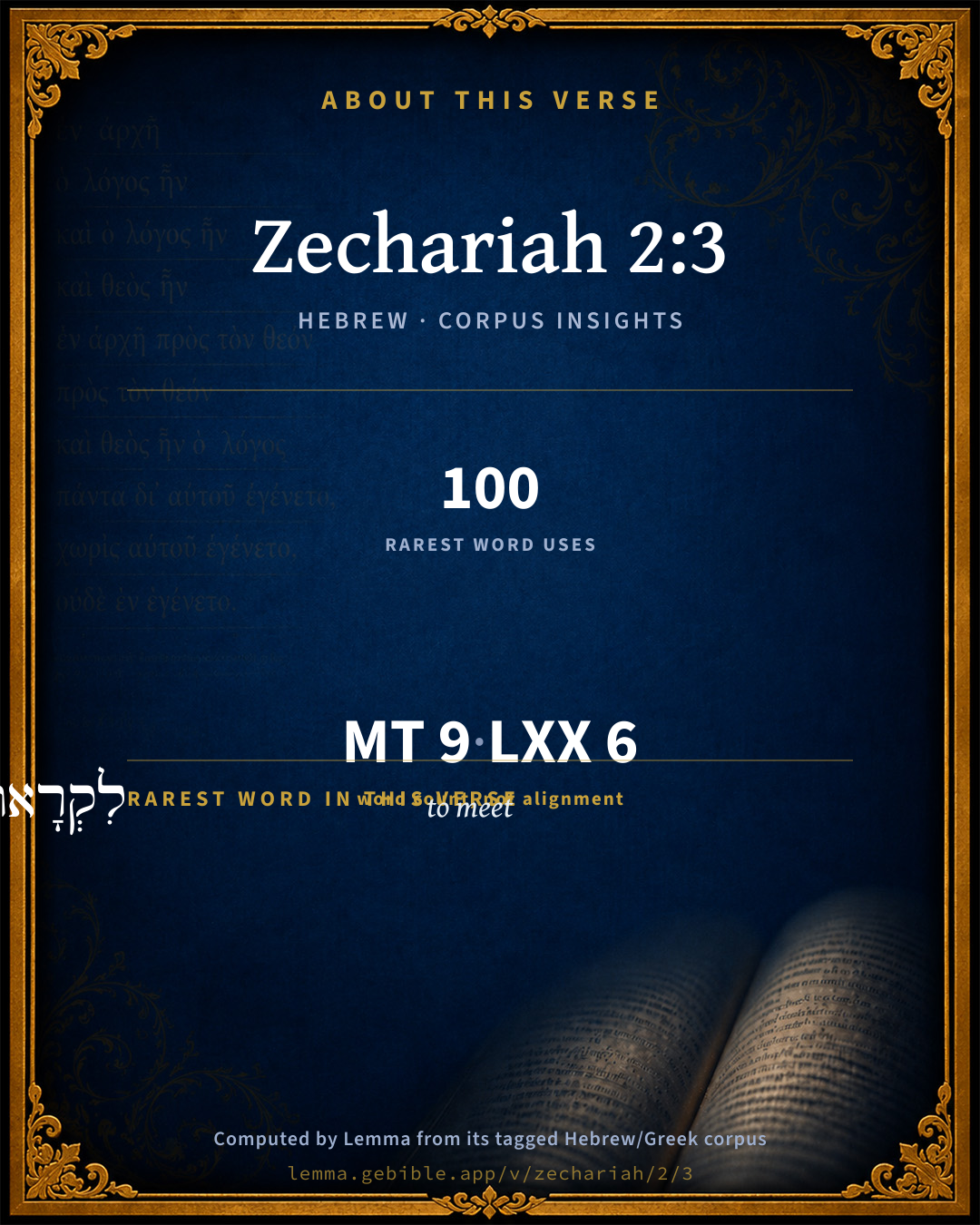
לִקְרָאתֽוֹ
qirʼâh
H7125
“to meet · him”
Preposition + Verb, Qal, Infinitive Construct + Suffix, Personal, 3rd Person, Masculine, Singular
Part of Speech
Preposition + Verb
Stem
Qal
Form
Infinitive Construct
Full BDB Definition

Origin: from H7122

TWOT: 2064

to encounter, befall, meet - (Qal) - to meet, encounter - to befall (figuratively)
  1. וְהִנֵּ֗ה hinnêh H2009 “and · behold” Conjunction + Particle, Demonstrative
  2. הַמַּלְאָ֛ךְ mălʼâk H4397 “the · messenger” Particle, Definite Article + Noun, Common, Masculine, Singular, Absolute
  3. הַדֹּבֵ֥ר dâbar H1696 “the · speaking” Particle, Definite Article + Verb, Qal, Participle Active, Masculine, Singular, Absolute
  4. יֹצֵ֑א yâtsâʼ H3318 “going out” Verb, Qal, Participle Active, Masculine, Singular, Absolute
  5. וּמַלְאָ֣ךְ mălʼâk H4397 “and · messenger” Conjunction + Noun, Common, Masculine, Singular, Absolute
  6. אַחֵ֔ר ʼachêr H312 “other” Adjective, Adjective, Masculine, Singular, Absolute
  7. יֹצֵ֖א yâtsâʼ H3318 “going out” Verb, Qal, Participle Active, Masculine, Singular, Absolute

About this verse

These counts appear in no published source. They are computed here, from the morphology-tagged text and Lemma’s own curated glosses. What Lemma adds →

9
words
6
distinct lemmas
Prophets
section

Grammatical profile

  • 4 verbs
  • 2 nouns
  • 1 adjective
  • 1 preposition
  • 1 particle

Verb forms

  • הַדֹּבֵ֥ר Qal · Participle Active
  • יֹצֵ֑א Qal · Participle Active
  • יֹצֵ֖א Qal · Participle Active
  • לִקְרָאתֽוֹ Qal · Infinitive Construct

Repetition

Words recur within this verse — often emphatic in Hebrew:

  • הַמַּלְאָ֛ךְ messenger H4397 ×2
  • יֹצֵ֑א to go out H3318 ×2

Hebrew & Septuagint length

In English translation the verse runs 17 words from the Hebrew and 18 from the Septuagint (LXX English) — closely comparable.

A rough comparison of the two English renderings, which tokenize alike — not a word-level alignment.

Word counts can differ between the Hebrew and the Greek without any difference in meaning — e.g. the Hebrew direct-object marker אֵת has no separate Greek word, and Greek often adds the article ὁ.

In the original languages it is 9 Hebrew tokens and 6 Greek tokens — but the two are counted differently (Hebrew bundles its prefixes and suffixes into one token; the Greek is in lemma form), so that isn’t a like-for-like length.

Cross-references

6

Topical passages linked to Zechariah 2:3 in the Treasury of Scripture Knowledge — connected by theme and wording, ordered by reader-vote popularity; previews shown in the World English Bible.

  • Zechariah 1:19 I asked the angel who talked with me, "What are these?" He answered me, "These are the horns which have scattered Judah, Israel, and Jerusalem."
  • Zechariah 1:8–11 "I had a vision in the night, and, behold, a man riding on a red horse, and he stood among the myrtle trees that were in a ravine; and behind him there were red, brown, and white horses.
  • Zechariah 1:13–14 Yahweh answered the angel who talked with me with kind and comforting words.
  • Zechariah 4:5 Then the angel who talked with me answered me, "Don't you know what these are?" I said, "No, my lord."
  • Zechariah 5:5 Then the angel who talked with me came forward, and said to me, "Lift up now your eyes, and see what is this that is appearing."
  • Zechariah 4:1 The angel who talked with me came again, and wakened me, as a man who is wakened out of his sleep.

Cross-references courtesy of OpenBible.info (CC BY 4.0).

Hebrew and Greek witnesses Masoretic Hebrew ↔ Greek Septuagint

The same verse in the two great witnesses to the Old Testament, shown verse-for-verse.

These are two independent witnesses, not word-aligned to each other, and the Septuagint is shown in lemma (dictionary) form.

Hebrew Zechariah 2:3 Masoretic · Westminster Leningrad Codex

וְהִנֵּ֗ה הַמַּלְאָ֛ךְ הַדֹּבֵ֥ר בִּ֖י יֹצֵ֑א וּמַלְאָ֣ךְ אַחֵ֔ר יֹצֵ֖א לִקְרָאתֽוֹ

Behold, the angel who talked with me went forth, and another angel went out to meet him,

World English Bible · Public Domain

Greek LXX Zechariah 2:3 Septuagint · lemma form

καί δεικνύω ἐγώ κύριος τέσσαρες τέκτων

And, behold, the angel that spoke with me stood by, and another angel went forth to meet him,

LXX2012 (modern English Septuagint) · Public Domain

On this verse, Whedon's Commentary on the Bible discusses the Septuagint’s reading. Read the note in Commentary ↓

Hebrew: Westminster Leningrad Codex (CC BY 4.0). Greek: Septuagint (public domain); English from LXX2012 (modern English Septuagint) (Public Domain). How the Septuagint differs from the Hebrew →

Targum (Aramaic paraphrase)

1

The Targum is the ancient Jewish Aramaic paraphrase of the Hebrew Scriptures — an interpretive translation, not the Hebrew text itself. Onkelos (literal) and Pseudo-Jonathan (expansive) render the Torah, and Jonathan the Prophets. Coverage is partial: where no permissively-licensed English translation exists for a verse, only the Aramaic is shown. This is verse-level text, not a word-by-word alignment to the Hebrew.

  1. Targum Jonathan Prophets (Joshua–Malachi)
    וְאַחֲזִיַנִי יְיָ אַרְבְּעָא אוּמְנִין:

    (no public-domain English translation for this verse)

    Targum Jonathan — Aramaic: “Mikraot Gedolot” (public domain). English: “Sefaria Community Translation” (CC0 1.0 (public-domain dedication)); “London "Chaldee Paraphrase," 1871” (public domain). Text via Sefaria.

Commentary

Notes on Zechariah 2:3 from classic Christian and Jewish commentators (each source and its license shown beneath its notes). The classic Christian expositions comment on the surrounding passage and are grouped to its opening verse, so a note may address several verses; the Jewish commentaries on the Tanakh (Rashi and others) are per-verse, so they appear only where the commentator wrote on this verse.

Lemma curates 59 commentaries, every one of them public domain or Creative Commons licensed, each selected and text-cleaned for this edition rather than reprinted as found. About our sources →

Trapp's Complete Commentary

John Trapp

Zec 2:3 And, behold, the angel that talked with me went forth, and another angel went out to meet him,

Ver. 3. And behold the angel] Zechariah’s angel, as one calleth him.

Went forth] to take direction from Christ, and to give the prophet further information. {See Trapp on "Zec 1:9"}

And another angel went out to meet him] So ready is Christ to answer prayers and to satisfy his weak but willing people, that draw near unto him with a true heart, Heb 10:22. If any such ask and miss it is because they ask amiss, Jas 4:3.

John Trapp, A Commentary or Exposition upon All the Books of the Old and New Testament (1647–1656) — public domain. Text from a community e-Sword module.

Whedon's Commentary on the Bible

Daniel D. Whedon

3. Now the interpreting angel appears upon the scene.

Went forth — The same verb is translated in the next clause “went out.” This raises the question, whence did the one or the other go forth? For the first verb LXX. reads “stood”; that is, beside the prophet. If the present Hebrew text is retained we must think of the angel as stepping forward from the place where he stood beside the prophet, or from the background to which he had retired after he had interpreted the preceding vision. As he stood forth he was met by another angel who came upon the scene from the opposite direction. This thought is implied also in the reading of LXX. To express the thought more clearly Zec_2:3 might be translated, “And, behold, the angel that talked with me stood forth, and another angel came forth to meet him.” Less natural is the interpretation which makes the interpreting angel come upon the scene from the presence of Jehovah with a new message for the prophet, when he is met by the other angel.

Daniel D. Whedon (gen. ed.), Commentary on the Old and New Testaments (1874–1909) — public domain. Text from a community e-Sword module.

Jamieson, Fausset & Brown

Robert Jamieson, A. R. Fausset & David Brown

angel that talked with me . . . another angel--The interpreting angel is met by another angel sent by the measuring Divine Angel to "run" to Zechariah (Zac 2:4). Those who perform God's will must not merely creep, nor walk, but run with alacrity.

went forth--namely, from me (Zechariah).

went out--from the measuring angel.

Jamieson, Fausset & Brown — Commentary Critical and Explanatory on the Whole Bible (1871) — public domain (CC PDM 1.0). Text via the HelloAO Bible API.

John Calvin's Commentaries

It is said, that the angel went forth, and that another angel met him. It hence appears as from the whole of what the Prophet says, how carefully God provides for the safety of his Church; for he has ever angels as his emissaries, who hasten at his nod, and aid the Church in its necessities. Since then angels thus unite to secure the well-being of the Church, we hence perceive how dear to God are the faithful, in whose favor he thus employs all his angels; and we also see, that it was the Lord’s will that this prophecy should be clear and manifest to all the godly: go, and run to that young man, he says, and tell him. Zechariah had indeed asked for an explanation of the measure in the man’s hand, but from the fact that another angel met him, it appears, as I have already said, that God does not neglect the request and prayers of his people, provided only that they are desirous of learning; he will then perform the part of a true and faithful teacher towards them. But the word “run,” ought especially to be noticed: “go,” he says, “and even hasten, lest the youth should longer doubt, and explain the purpose of this prophecy.” He calls the Prophet a youth, because he was then among angels. He would not call him a man of full age, because he had before called an angel man. What rank could the Prophet hold among angels except that of a youth? This circumstance ought therefore to be observed as the reason why Zechariah spoke disparagingly or humbly of himself.

Now as to the import of the prophecy, we have already said, that here is described the heavenly Jerusalem, which is surrounded by no walls, but is open to the whole world, and which depends not on its own strength, but dwells safely though exposed on all sides to enemies; for the Prophet says not without reason, “through the villages shall Jerusalem be inhabited;” that is, it shall everywhere be inhabited, so that it will have no need of defense to restrain or hinder enemies to come near; for a safe rest shall be given to it, when every one shall quietly occupy his own place. It follows —

John Calvin's Commentaries (1540-1563) — public domain. Text from the Calvin Translation Society English edition (1840s-50s) via the Christian Classics Ethereal Library (ccel.org). Calvin's coverage is partial (roughly two-thirds of the Bible); uncommented books and verses are honest gaps, never fabricated. The 19th-century editor's footnotes and remarks are omitted so the notes are faithfully Calvin's own voice.

Ellicott's Commentary for English Readers

(3) Went forth.—Literally, goes forth, from the prophet’s side, in the direction of the man who went to measure. LXX., εἱστήκει.

Went out.—Literally, comes forth: viz., from the invisible—i.e., appears, reveals himself. The same word in Hebrew means to come and to go forth, according to circumstances. (Comp. Zec_5:5-6.)

A Bible Commentary for English Readers, edited by Charles John Ellicott (1878–1897) — public domain. Text from a community e-Sword module.

The Cambridge Bible for Schools and Colleges

gen. ed. J. J. S. Perowne

3. went forth] from the place where he was standing beside me. Comp. Isa_26:21.

went out] Rather, went forth, the Hebrew word being the same as before. This second angel is seen going forth from the opposite side of the stage on which the vision appears, to meet the interpreting angel as he went forth.

The Cambridge Bible for Schools and Colleges (gen. ed. J. J. S. Perowne; Cambridge University Press, 1878–1918) — public domain. Text from a community e-Sword module.

John Gill's Exposition

And, behold, the angel that talked with me went forth,.... See Zac 1:9 and he "went forth" from the place where the prophet was, with whom he had been conversing:

and another angel went out to meet him: the same that was seen among the myrtle trees, Zac 1:8 and here, with a measuring line in his hand, Zac 2:1.

John Gill's Exposition of the Whole Bible (1746–1763) — public domain (CC PDM 1.0). Text via the HelloAO Bible API.

Albert Barnes' Notes on the Bible

The angel that talked with me went forth - Probably to receive the explanation which was given him for Zechariah; and another angel, a higher angel, since he gives him a commission, “went forth to meet him,” being (it seems probable) instructed by the Angel of the Lord, who laid down the future dimensions of the city. The indefiniteness of the description, another angel, implies that he was neither the Angel of the Lord, nor (were they different) Michael, or the man with the measuring line, but an angel of intermediate rank, instructed by one higher, instructing the lower, who immediately instructed Zechariah.

Albert Barnes' Notes on the Bible (1834–1885) — public domain. Text from a community e-Sword/MySword module.

Haydock's Catholic Bible Commentary

Another. The angel who measured spoke to Michael. (Calmet)

George Leo Haydock (1774–1849), Haydock's Catholic Family Bible and Commentary, 1859 edition — public domain. Excludes Psalms (Douay-Rheims chapter numbering differs from Protestant) and Deuterocanonical books (Catholic canon only).

Matthew Poole's English Annotations

The angel that talked; the great and glorious Angel, i.e. Christ Jesus himself, which had so long talked with Zechariah.

Went forth, from the midst of the myrtle trees, where he was first seen: whither he is going is not said; perhaps to standby, direct, and encourage the person that was going to measure Jerusalem.

Another angel went out to meet him; a created angel, or a ministerial angel, as became his office, offers his service to Christ, who is Lord of angels.

Matthew Poole's English Annotations on the Holy Bible (1683–1685) — public domain. Text from a community e-Sword/MySword module.

The Pulpit Commentary

Went forth. The interpreting angel leaves the prophet, and goes away to meet another angel who advances from the opposite side. Septuagint, eisthkei , "stood." Another angel went out; went forth, the word being the same as before. This latter angel, sent by God with a revelation, is superior to the interpreter, as the latter receives the message from him to deliver to the prophet.

The Pulpit Commentary (1880–1919), ed. H.D.M. Spence-Jones & Joseph S. Exell — public domain. Text from a community e-Sword module.

John Wesley's Explanatory Notes

The angel - Christ, who had so long talked with Zechariah. Went forth - From the midst of the myrtle-trees.

John Wesley, Explanatory Notes Upon the Whole Bible (1754–1765) — public domain. Text via the GEBible commentary corpus.

Scofield Reference Notes

C. I. Scofield

angel

(See Scofield "Heb 1:4").

The Scofield Reference Bible (1917 edition), notes by C. I. Scofield — public domain. Text from a community e-Sword module.

unfoldingWord translationNotes

Door43 World Missions Community

another angel went out to meet him

This angel is a new participant who has not appeared before this verse. (See: Introduction of New and Old Participants)

The second angel said to him

"The second angel said to the angel who had talked with me"

Jerusalem will sit in the open country ... beasts within her

The phrase "will sit in the open country" translates a word that refers to a city that has no walls. There will be so many inhabitants in the city that it will be too large to have walls around it. AT: "Jerusalem will not have walls around it ... beasts within the city" (See: Assumed Knowledge and Implicit Information)

I ... will become for her a wall of fire around her

People built walls around their cities for protection. Here Yahweh speaks of protecting Jerusalem as if he himself were a wall of fire around the city. AT: "I ... will protect the city, like a wall of fire around it" (See: Metaphor)

this is Yahweh's declaration

Yahweh speaks of himself by name to express the certainty of what he is declaring. See how you translated this in Zechariah 1:4. AT: "this is what Yahweh has declared" or "this is what I, Yahweh, have declared" (See: First, Second, or Third Person)

translationWords

angel

Yahweh

declare

fire

glory

unfoldingWord translationNotes — © Distant Shores Media and the Door43 World Missions Community, licensed CC BY-SA 4.0. Source: git.door43.org/Door43/en_tn.

Rashi

Rabbi Shlomo Yitzchaki (Rashi)

four craftsmen Carpenters who know how to saw the horns. And our Rabbis explained in tractate Sukkah (52b) who they are.

Rashi on the Tanakh — English translations: “The Judaica Press complete Tanach with Rashi, translated by A. J. Rosenberg” (CC BY 4.0); “Pentateuch with Rashi's commentary by M. Rosenbaum and A.M. Silbermann, 1929-1934” (public domain); “The Metsudah Tanach series, Lakewood, N.J” (CC BY 4.0); and “The Book of Joshua, Metsudah Publications, 1997” (CC BY 4.0). Text via Sefaria.

Lesson kit

Teaching starters — assembled from the data on this page, not authored interpretation. Every prompt links to the verse data it draws on. Edit before teaching.

Zechariah, in the Prophets, opens this verse with 9 words (6 distinct Hebrew lemmas). Its most distinctive word is qirʼâh (“to meet”). A historical commentator’s framing appears above. Read the whole chapter for the surrounding context.

Discussion questions

  1. What does “to meet” (qirʼâh) contribute to the verse as a whole?
  2. Zechariah 1:19 shares this passage’s theme. How do the two illuminate each other?
  3. “messenger” occurs 2× in this one verse. What is the effect of the repetition?
  4. The translations on this page render this verse differently — a whole-verse word diff, not a word-by-word alignment. What might account for the different wordings?
  5. The verb «הַדֹּבֵ֥ר» is Qal Participle Active. How does its form color the action?
  6. Reading how Trapp's Complete Commentary and Whedon's Commentary on the Bible read this verse, where do the two commentators agree and where do they part?

Things to notice

Reading settings

Reading text

Shown beneath each verse's original-language words.

Old Testament
Old Testament edition

Read the OT as the Masoretic Hebrew (MT) or the Greek Septuagint (LXX).

English shown for the Greek Septuagint (in the Hebrew ↔ Greek comparison).

Comparing translations? Open the Compare panel on any verse page to stack up to four side by side.