Numbers 22:25

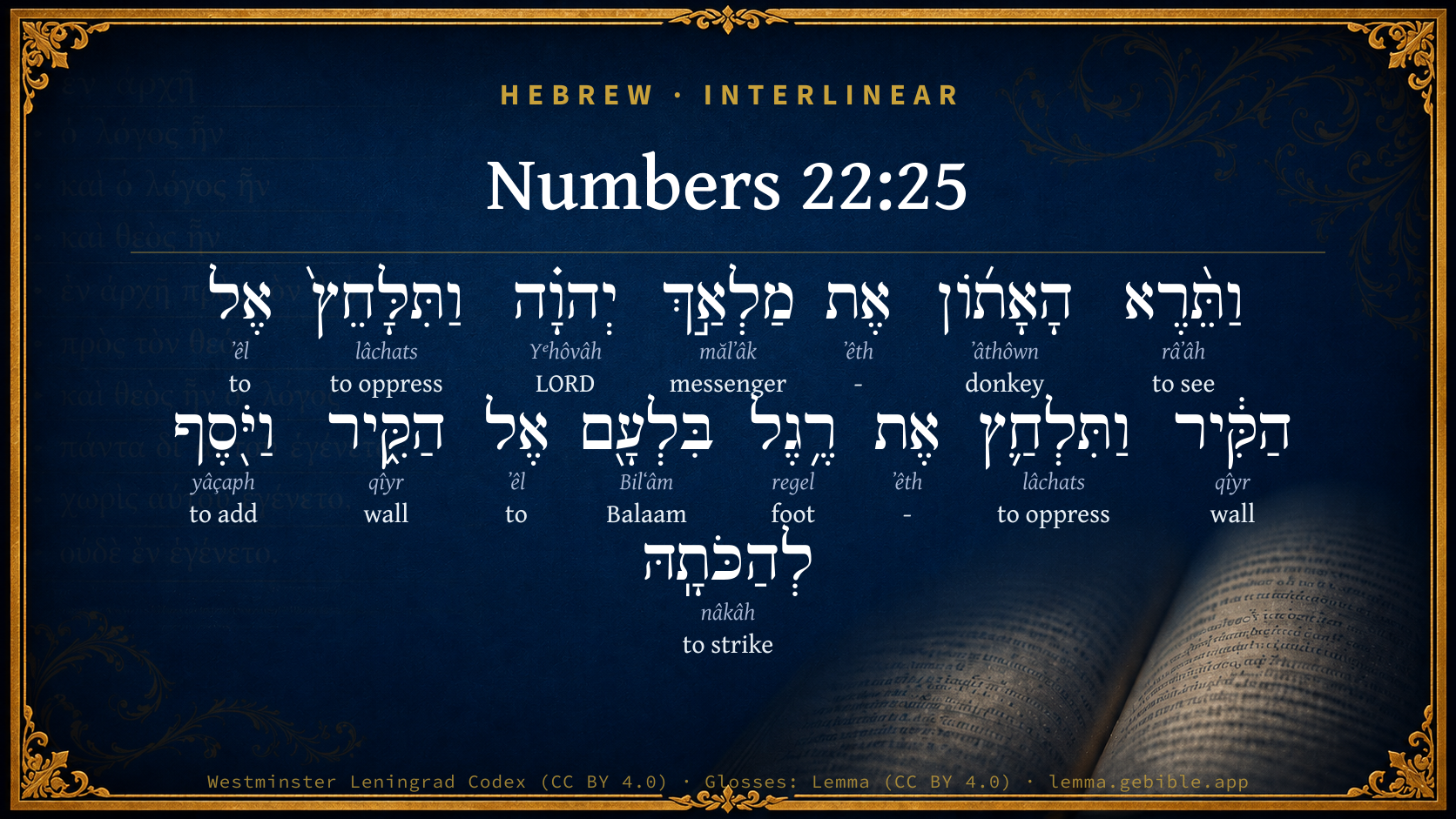
Hebrew (Westminster Leningrad Codex) Numbers 22:25 appears in the Hebrew Old Testament. The text above is from the Westminster Leningrad Codex. Each word links to its Strong’s number, a concise gloss, and parsing drawn from the Open Scriptures Hebrew Bible morphology. Click any word for its full Brown-Driver-Briggs (BDB) entry.
Download image
Cite this verse

Numbers 22:25 (World English Bible). Public Domain. Lemma interlinear Bible study tool, https://lemma.gebible.app/v/numbers/22/25.

Show BibTeX & RIS
BibTeX
RIS
English Translation
The donkey saw the angel of Yahweh, and she thrust herself to the wall, and crushed Balaam's foot against the wall: and he struck her again.
World English Bible · Public Domain
Download a study sheet

One document with this verse’s original text, its word-by-word gloss line, the meaning frame, cross-references with their text, attributed commentary, and full source and license credits — printable, and it pastes into notes with its structure intact.

This verse Autodidact and up

Study sheet (.html) Plain text (.txt)

A passage Seminary Student

Up to 50 verses in one chapter. A passage sheet keeps up to 6 commentary sources and 12 cross-references per verse, in the order this page ranks them, and says so on the sheet whenever that leaves anything out. Ask for a single verse and you get the Autodidact verse sheet above.

Everything on this page stays free to read, with no account — the sheet is a download of what is already on screen, not access to it.

Want to remove ads? Support Godless Engineer
Compare translations 3

The same verse in 3 English versions, stacked beneath the original-language interlinear above. Click any original word for its lexicon entry.

Each is an independent rendering of the whole verse — the interlinear is not word-aligned to these translations.

Highlighted words mark where these versions differ — a whole-verse word diff, not a word-by-word alignment.

  • World English Bible Public Domain
    The donkey saw the angel of Yahweh, and she thrust herself to the wall, and crushed Balaam's foot against the wall: and he struck her again.
  • King James Version Public Domain
    And when the ass saw the angel of the LORD, she thrust herself unto the wall, and crushed Balaam's foot against the wall: and he smote her again.
  • unfoldingWord Literal Text CC BY-SA 4.0
    And the female donkey saw the angel of Yahweh, and she pressed herself against the wall and pressed the foot of Balaam against the wall. And he struck her again.

unfoldingWord Literal Text — © unfoldingWord, licensed CC BY-SA 4.0. Word-aligned USFM3 via Door43 (git.door43.org/unfoldingWord/en_ult).

Versions to compare (up to 4)

3 of 4 selected

Show all 18 translations

Every available English version of this verse, each an independent rendering of the whole verse.

  • World English Bible Public Domain
    The donkey saw the angel of Yahweh, and she thrust herself to the wall, and crushed Balaam's foot against the wall: and he struck her again.
  • Berean Standard Bible Public Domain
    And the donkey saw the angel of the LORD and pressed herself against the wall, crushing Balaam’s foot against it. So he beat her once again.
  • Majority Standard Bible Public Domain
    And the donkey saw the angel of the LORD and pressed herself against the wall, crushing Balaam’s foot against it. So he beat her once again.
  • King James Version Public Domain
    And when the ass saw the angel of the LORD, she thrust herself unto the wall, and crushed Balaam's foot against the wall: and he smote her again.
  • American Standard Version (1901) Public Domain
    And the ass saw the angel of Jehovah, and she thrust herself unto the wall, and crushed Balaam's foot against the wall: and he smote her again.
  • Revised Version (1885) Public Domain
    And the ass saw the angel of the LORD, and she thrust herself unto the wall, and crushed Balaam’s foot against the wall: and he smote her again.
  • Geneva Bible (1599) Public Domain
    And when the asse sawe the Angel of the Lord, she thrust her selfe vnto the wall, and dasht Balaams foote against the wall: wherefore hee smote her againe.
  • Douay-Rheims (1899) Public Domain
    And the ass seeing him, thrust herself close to the wall, and bruised the foot of the rider. But he beat her again:
  • Young's Literal Translation Public Domain
    and the ass seeth the messenger of Jehovah, and is pressed unto the wall, and presseth Balaam's foot unto the wall, and he addeth to smite her;
  • Literal Standard Version CC BY-SA 4.0
    and the donkey sees the Messenger of YHWH, and is pressed to the wall, and presses Balaam’s foot to the wall, and he adds to strike her;
  • Unlocked Literal Bible CC BY-SA 4.0
    The donkey saw the angel of Yahweh again. She went against the wall and pinned Balaam's foot against it. Balaam struck her again.
  • unfoldingWord Literal Text CC BY-SA 4.0
    And the female donkey saw the angel of Yahweh, and she pressed herself against the wall and pressed the foot of Balaam against the wall. And he struck her again.
  • Darby Bible Public Domain
    And the ass saw the Angel of Jehovah, and she pressed herself against the wall, and crushed Balaam's foot against the wall; and he smote her again.
  • World Messianic Bible Public Domain
    The donkey saw the LORD’s angel, and she thrust herself to the wall, and crushed Balaam’s foot against the wall. He struck her again.
  • Webster's Bible Public Domain
    And when the ass saw the angel of the LORD, she thrust herself against the wall, and crushed Balaam's foot against the wall: and he smote her again.
  • Free Bible Version CC BY-SA 4.0
    The donkey saw the angel of the Lord and tried to get past. It pushed up against the wall and crushed Balaam's foot against it. So he beat it again.
  • Bible in Basic English Public Domain
    And the ass saw the angel of the Lord, and went near the wall, crushing Balaam's foot against the wall; and he gave her more blows.
  • JPS Tanakh (1917) Public Domain
    And the ass saw the angel of the LORD, and she thrust herself unto the wall, and crushed Balaam's foot against the wall; and he smote her again.

Literal Standard Version (2020), Covenant Press — licensed CC BY-SA 4.0. Text via the HelloAO Bible API (eBible.org). Unlocked Literal Bible (unfoldingWord) — licensed CC BY-SA 4.0. Text via the HelloAO Bible API (eBible.org). unfoldingWord Literal Text — © unfoldingWord, licensed CC BY-SA 4.0. Word-aligned USFM3 via Door43 (git.door43.org/unfoldingWord/en_ult). Free Bible Version, Dr. Jonathan Gallagher — licensed CC BY-SA 4.0. Text via the HelloAO Bible API (eBible.org).

Word by word

More ways to search: Search by grammar → Find every occurrence → Compare this word →

Practice this passage: Drill this verse → Learn its vocabulary →

וַתִּלָּחֵץ֙
lâchats
H3905
“and · to oppress”
Conjunction + Verb, Niphal, Sequential Imperfect, 3rd Person, Feminine, Singular
Part of Speech
Conjunction + Verb
Stem
Niphal
Form
Sequential Imperfect
Person
3rd Person
Gender
Feminine
Number
Singular
Full BDB Definition

Origin: a primitive root

TWOT: 1106

to squeeze, press, oppress - (Qal) - to squeeze, press - to oppress - (Niphal) to squeeze oneself
  1. וַתֵּ֨רֶא râʼâh H7200 “and · to see” Conjunction + Verb, Qal, Sequential Imperfect, 3rd Person, Feminine, Singular
  2. הָאָת֜וֹן ʼâthôwn H860 “the · donkey” Particle, Definite Article + Noun, Common, Feminine, Singular, Absolute
  3. אֶת ʼêth H853 “-” Particle, Direct Object
  4. מַלְאַ֣ךְ mălʼâk H4397 “messenger of” Noun, Common, Masculine, Singular, Construct
  5. יְהוָ֗ה Yᵉhôvâh H3068 “LORD” Noun, Proper
  6. אֶל ʼêl H413 “to” Preposition
  7. הַקִּ֔יר qîyr H7023 “the · wall” Particle, Definite Article + Noun, Common, Masculine, Singular, Absolute
  8. וַתִּלְחַ֛ץ lâchats H3905 “and · to oppress” Conjunction + Verb, Qal, Sequential Imperfect, 3rd Person, Feminine, Singular
  9. אֶת ʼêth H853 “-” Particle, Direct Object
  10. רֶ֥גֶל regel H7272 “foot of” Noun, Common, Feminine, Singular, Construct
  11. בִּלְעָ֖ם Bilʻâm H1109 “Balaam” Noun, Proper
  12. אֶל ʼêl H413 “to” Preposition
  13. הַקִּ֑יר qîyr H7023 “the · wall” Particle, Definite Article + Noun, Common, Masculine, Singular, Absolute
  14. וַיֹּ֖סֶף yâçaph H3254 “and · to add” Conjunction + Verb, Hiphil, Sequential Imperfect, 3rd Person, Masculine, Singular
  15. לְהַכֹּתָֽהּ nâkâh H5221 “to strike · her” Preposition + Verb, Hiphil, Infinitive Construct + Suffix, Personal, 3rd Person, Feminine, Singular

About this verse

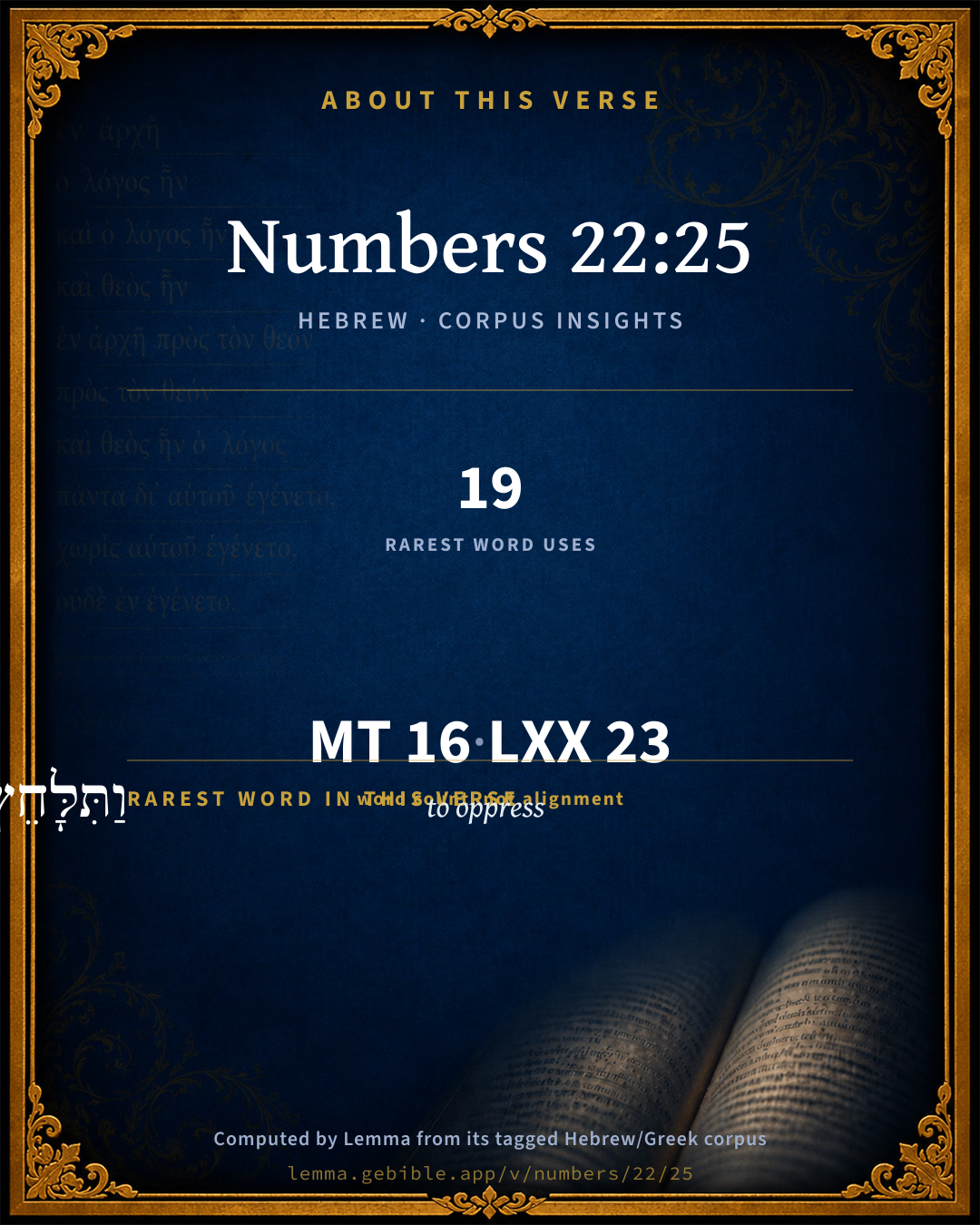
These counts appear in no published source. They are computed here, from the morphology-tagged text and Lemma’s own curated glosses. What Lemma adds →

16
words
12
distinct lemmas
Pentateuch
section

Notable vocabulary

The rarest word here is וַתִּלָּחֵץ֙ to oppress H3905 — appearing just 19 times in the whole Hebrew Bible.

Shared distinctive vocabulary

וַתִּלָּחֵץ֙ to oppress H3905 occurs in 18 verses of the Hebrew Bible. Also found in:

Grammatical profile

  • 5 verbs
  • 7 nouns
  • 2 prepositions
  • 2 particles

Verb forms

  • וַתֵּ֨רֶא Qal · Sequential Imperfect
  • וַתִּלָּחֵץ֙ Niphal · Sequential Imperfect
  • וַתִּלְחַ֛ץ Qal · Sequential Imperfect
  • וַיֹּ֖סֶף Hiphil · Sequential Imperfect
  • לְהַכֹּתָֽהּ Hiphil · Infinitive Construct

Repetition

Words recur within this verse — often emphatic in Hebrew:

  • וַתִּלָּחֵץ֙ to oppress H3905 ×2
  • הַקִּ֔יר wall H7023 ×2
  • אֶל to H413 ×2

Hebrew & Septuagint length

In English translation the verse runs 26 words from the Hebrew and 27 from the Septuagint (LXX English) — closely comparable.

A rough comparison of the two English renderings, which tokenize alike — not a word-level alignment.

Word counts can differ between the Hebrew and the Greek without any difference in meaning — e.g. the Hebrew direct-object marker אֵת has no separate Greek word, and Greek often adds the article ὁ.

In the original languages it is 16 Hebrew tokens and 23 Greek tokens — but the two are counted differently (Hebrew bundles its prefixes and suffixes into one token; the Greek is in lemma form), so that isn’t a like-for-like length.

Cross-references

2

Topical passages linked to Numbers 22:25 in the Treasury of Scripture Knowledge — connected by theme and wording, ordered by reader-vote popularity; previews shown in the World English Bible.

  • Job 5:13–15 He takes the wise in their own craftiness; The counsel of the cunning is carried headlong.
  • Isaiah 47:12 Stand now with your enchantments, and with the multitude of your sorceries, in which you have labored from your youth; if so be you shall be able to profit, if so be you may prevail.

Cross-references courtesy of OpenBible.info (CC BY 4.0).

Hebrew and Greek witnesses Masoretic Hebrew ↔ Greek Septuagint

The same verse in the two great witnesses to the Old Testament, shown verse-for-verse.

These are two independent witnesses, not word-aligned to each other, and the Septuagint is shown in lemma (dictionary) form.

Hebrew Numbers 22:25 Masoretic · Westminster Leningrad Codex

וַתֵּ֨רֶא הָאָת֜וֹן אֶת מַלְאַ֣ךְ יְהוָ֗ה וַתִּלָּחֵץ֙ אֶל הַקִּ֔יר וַתִּלְחַ֛ץ אֶת רֶ֥גֶל בִּלְעָ֖ם אֶל הַקִּ֑יר וַיֹּ֖סֶף לְהַכֹּתָֽהּ

The donkey saw the angel of Yahweh, and she thrust herself to the wall, and crushed Balaam's foot against the wall: and he struck her again.

World English Bible · Public Domain

Greek LXX Numbers 22:25 Septuagint · lemma form

καί ὁράω ὁ ὄνος ὁ ἄγγελος ὁ θεός προςθλίβω ἑαυτοῦ πρός ὁ τοῖχος καί ἀποθλίβω ὁ πούς βαλααμ καί προςτίθημι ἔτι μαστίζω αὐτός

And when the ass saw the angel of God, she thrust herself against the wall, and crushed Balaam's foot against the wall, and he struck her again.

LXX2012 (modern English Septuagint) · Public Domain

Hebrew: Westminster Leningrad Codex (CC BY 4.0). Greek: Septuagint (public domain); English from LXX2012 (modern English Septuagint) (Public Domain). How the Septuagint differs from the Hebrew →

Targum (Aramaic paraphrase)

2

The Targum is the ancient Jewish Aramaic paraphrase of the Hebrew Scriptures — an interpretive translation, not the Hebrew text itself. Onkelos (literal) and Pseudo-Jonathan (expansive) render the Torah, and Jonathan the Prophets. Coverage is partial: where no permissively-licensed English translation exists for a verse, only the Aramaic is shown. This is verse-level text, not a word-by-word alignment to the Hebrew.

  1. Targum Onkelos Torah (Genesis–Deuteronomy)
    וַחֲזַת אֲתָּנָא יַת מַלְאָכָא דַיְיָ וְאִדְחֵיקַת לְכָתְלָא וּדְחֵיקַת יַת רִגְלָא דְבִלְעָם לְכָתְלָא וְאוֹסִיף לְמִמְחַהּ

    (no public-domain English translation for this verse)

    Targum Onkelos — Aramaic: “Onkelos Genesis” (public domain); “Onkelos Exodus” (public domain); “Onkelos Leviticus” (public domain); “Onkelos Numbers” (public domain); “Onkelos Deuteronomy” (public domain). English: “Sefaria Community Translation” (CC0 1.0 (public-domain dedication)); “J.W. Etheridge. The Targums of Onkelos and Jonathan Ben Uzziel on the Pentateuch. London: Longmans, Green, 1862” (public domain). Text via Sefaria.

  2. Targum Pseudo-Jonathan Torah (Genesis–Deuteronomy)
    וַחֲמַת אַתְנָא יַת מַלְאָכָא דַיְיָ וְאִדְחָקַת לִסְיָיגָא וּדְחֵקַת יַת רֵיגַל בִּלְעָם לִסְיָיגָא וְאוֹסִיף לְמִימְחָהּ וּמַלְאָכָא אִתְכַּסֵי מִינָהּ

    And the ass discerned the angel of the Lord, and thrust herself against the hedge, and bruised Bileam's foot by the hedge, and he smote her again; for the angel was invisible to him.

    Targum Pseudo-Jonathan — Aramaic: “Targum Jonathan on Genesis” (public domain); “Targum Jonathan on Exodus” (public domain); “Targum Jonathan on Leviticus” (public domain); “Targum Jonathan on Numbers” (public domain); “Targum Jonathan on Deuteronomy” (public domain). English: “The Targum of Jonathan ben Uzziel, trans. J. W. Etheridge, London, 1862” (public domain). Text via Sefaria.

Commentary

Notes on Numbers 22:25 from classic Christian and Jewish commentators (each source and its license shown beneath its notes). The classic Christian expositions comment on the surrounding passage and are grouped to its opening verse, so a note may address several verses; the Jewish commentaries on the Tanakh (Rashi and others) are per-verse, so they appear only where the commentator wrote on this verse.

Lemma curates 59 commentaries, every one of them public domain or Creative Commons licensed, each selected and text-cleaned for this edition rather than reprinted as found. About our sources →

John Gill's Exposition

And the Lord opened the mouth of the ass, and she said unto Balaam,.... This was a very extraordinary and miraculous affair, and effected by a supernatural power, that a dumb creature, which had not organs endued with speech, should speak so plainly and distinctly, as is after expressed; and yet it should not be thought incredible, for what is it that Omnipotence cannot do? wherefore there is no need to say, as some Jewish writers (i), that this was all done in a visionary way, and not really and literally performed; nor can Heathens well object to the verity of it, if they believe what they themselves report concerning one of the asses which carried Bacchus over a river, to which, for reward, he gave the power of speaking with an human voice (k); though it is very probable the fable was framed from this story, and frequently do their writers speak of other brute creatures endued with speech; so Homer (l) represents Xanthus, the horse of Achilles, having the faculty of speech given it by Juno: Pliny says (m), it is commonly reported among the wonderful things of the ancients, that an ox spoke; and Livy (n) frequently makes mention of an ox spoke speaking in divers places, and of one particularly that said,"Rome, take heed to thyself;''not to take notice of a lamb in Egypt in the times of Bocchoris that spoke, related by Aelianus (o) and others; nor of the ram of Phrixus, or the dog at Ariminum, and the elephant of Porus in India, with others Bochart (p) has collected together: the words spoken by the ass were as follow:

what have l done unto thee, that thou hast smitten me these three times? and just so many times she had been smitten by him, Num 22:23.

(i) Maimon. Moreh Nevochim, par. 2. c. 42. Ben Gersom in loc. (k) Hygin. Poet. Astronomic. l. 2. c. 23. "Lactant, de falsa Relig". l. 1. c. 21. (l) Iliad. 19. "prope finem". (m) Nat. Hist. l. 8. c. 45. (n) Hist. l. 24. c. 10. l. 27. c. 11. l. 28. c. 11. and l. 35. c. 21. (o) De Animal. l. 12. c. 3. (p) Hierozoic. par. 1. l. 2. c. 14. col. 197, 198.

John Gill's Exposition of the Whole Bible (1746–1763) — public domain (CC PDM 1.0). Text via the HelloAO Bible API.

Whedon's Commentary on the Bible

Daniel D. Whedon

25. Crushed Balaam’s foot — By this second sign God came nearer unto Balaam, and revealed to him the vanity of his divining art, showing that he could not foresee the evil that was about to befall him. “The children of God have the angels to keep them in all their ways, and to bear them up lest they dash their foot against a stone. Psa_91:11-12. But Balaam, tempting the Lord, hath his angel to withstand him, whereby, his foot is crushed against the wall; yet maketh he no good use thereof.” —Ainsworth.

Daniel D. Whedon (gen. ed.), Commentary on the Old and New Testaments (1874–1909) — public domain. Text from a community e-Sword module.

The Pulpit Commentary

She thrust herself unto the wall. Apparently in order to pass the angel beyond the reach of his sword; when this was clearly impossible she fell down.

The Pulpit Commentary (1880–1919), ed. H.D.M. Spence-Jones & Joseph S. Exell — public domain. Text from a community e-Sword module.

Rashi

Rabbi Shlomo Yitzchaki (Rashi)

וַתִּלָּחֵץ — the Niphal form denotes that SHE PRESSED HERSELF.

וַתִּלְחַץ — the Kal denotes that SHE PRESSED something else — viz., את רגל בלעם BALAAM’S FOOT.

Rashi on the Tanakh — English translations: “The Judaica Press complete Tanach with Rashi, translated by A. J. Rosenberg” (CC BY 4.0); “Pentateuch with Rashi's commentary by M. Rosenbaum and A.M. Silbermann, 1929-1934” (public domain); “The Metsudah Tanach series, Lakewood, N.J” (CC BY 4.0); and “The Book of Joshua, Metsudah Publications, 1997” (CC BY 4.0). Text via Sefaria.

Lesson kit

Teaching starters — assembled from the data on this page, not authored interpretation. Every prompt links to the verse data it draws on. Edit before teaching.

Numbers, in the Pentateuch, opens this verse with 16 words (12 distinct Hebrew lemmas). Its most distinctive word is lâchats (“to oppress”). A historical commentator’s framing appears above. Read the whole chapter for the surrounding context.

Discussion questions

  1. What does “to oppress” (lâchats) contribute to the verse as a whole?
  2. How does Exodus 3:9, which shares the word «to oppress», read alongside this verse?
  3. What does the repetition of “to oppress” (2× in this one verse) do in this verse?
  4. These translations render this verse differently. What is at stake in choosing one wording over another?
  5. «וַתֵּ֨רֶא» is a Qal Sequential Imperfect verb. How does that grammatical form shape the action described?
  6. Compare how John Gill's Exposition and Whedon's Commentary on the Bible read this verse. Where do they agree or differ?

Things to notice

Reading settings

Reading text

Shown beneath each verse's original-language words.

Old Testament
Old Testament edition

Read the OT as the Masoretic Hebrew (MT) or the Greek Septuagint (LXX).

English shown for the Greek Septuagint (in the Hebrew ↔ Greek comparison).

Comparing translations? Open the Compare panel on any verse page to stack up to four side by side.