Psalms 103:20

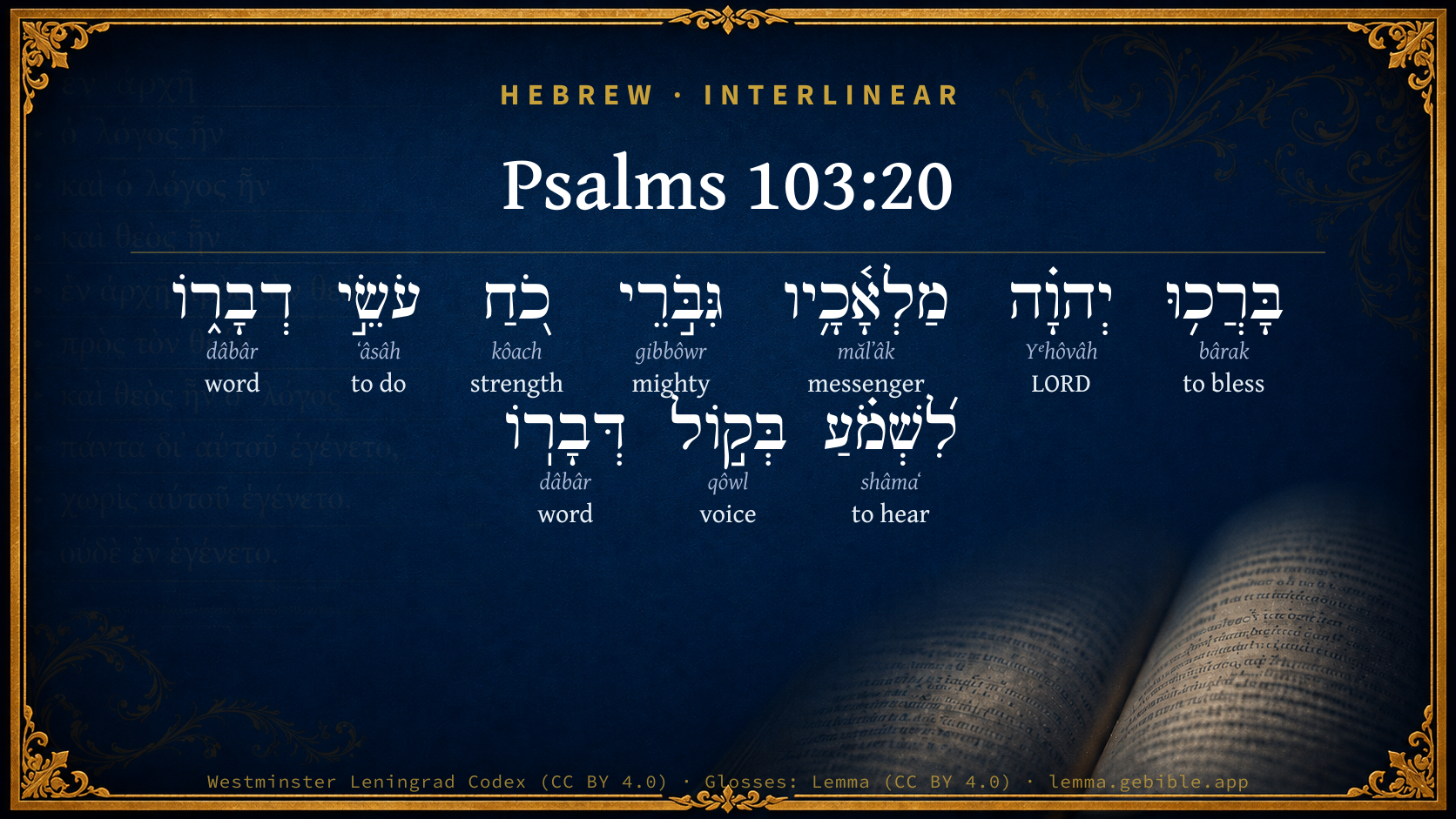
Hebrew (Westminster Leningrad Codex) Psalms 103:20 appears in the Hebrew Old Testament. The text above is from the Westminster Leningrad Codex. Each word links to its Strong’s number, a concise gloss, and parsing drawn from the Open Scriptures Hebrew Bible morphology. Click any word for its full Brown-Driver-Briggs (BDB) entry.
Download image
Cite this verse

Psalms 103:20 (World English Bible). Public Domain. Lemma interlinear Bible study tool, https://lemma.gebible.app/v/psalms/103/20.

Show BibTeX & RIS
BibTeX
RIS
English Translation
Praise Yahweh, you angels of his, Who are mighty in strength, who fulfill his word, Obeying the voice of his word.
World English Bible · Public Domain
Download a study sheet

One document with this verse’s original text, its word-by-word gloss line, the meaning frame, cross-references with their text, attributed commentary, and full source and license credits — printable, and it pastes into notes with its structure intact.

This verse Autodidact and up

Study sheet (.html) Plain text (.txt)

A passage Seminary Student

Up to 50 verses in one chapter. A passage sheet keeps up to 6 commentary sources and 12 cross-references per verse, in the order this page ranks them, and says so on the sheet whenever that leaves anything out. Ask for a single verse and you get the Autodidact verse sheet above.

Everything on this page stays free to read, with no account — the sheet is a download of what is already on screen, not access to it.

Want to remove ads? Support Godless Engineer
Compare translations 3

The same verse in 3 English versions, stacked beneath the original-language interlinear above. Click any original word for its lexicon entry.

Each is an independent rendering of the whole verse — the interlinear is not word-aligned to these translations.

Highlighted words mark where these versions differ — a whole-verse word diff, not a word-by-word alignment.

  • World English Bible Public Domain
    Praise Yahweh, you angels of his, Who are mighty in strength, who fulfill his word, Obeying the voice of his word.
  • King James Version Public Domain
    Bless the LORD, ye his angels, that excel in strength, that do his commandments, hearkening unto the voice of his word.
  • unfoldingWord Literal Text CC BY-SA 4.0
    Bless Yahweh, his angels, warriors of strength, doers of his word, listening to the voice of his word!

unfoldingWord Literal Text — © unfoldingWord, licensed CC BY-SA 4.0. Word-aligned USFM3 via Door43 (git.door43.org/unfoldingWord/en_ult).

Versions to compare (up to 4)

3 of 4 selected

Show all 18 translations

Every available English version of this verse, each an independent rendering of the whole verse.

  • World English Bible Public Domain
    Praise Yahweh, you angels of his, Who are mighty in strength, who fulfill his word, Obeying the voice of his word.
  • Berean Standard Bible Public Domain
    Bless the LORD, all His angels mighty in strength who carry out His word, who hearken to the voice of His command.
  • Majority Standard Bible Public Domain
    Bless the LORD, all His angels mighty in strength who carry out His word, who hearken to the voice of His command.
  • King James Version Public Domain
    Bless the LORD, ye his angels, that excel in strength, that do his commandments, hearkening unto the voice of his word.
  • American Standard Version (1901) Public Domain
    Bless Jehovah, ye his angels, That are mighty in strength, that fulfil his word, Hearkening unto the voice of his word.
  • Revised Version (1885) Public Domain
    Bless the LORD, ye angels of his: ye mighty in strength, that fulfill his word, hearkening unto the voice of his word.
  • Geneva Bible (1599) Public Domain
    Prayse the Lord, ye his Angels, that excell in strength, that doe his commandement in obeying the voyce of his worde.
  • Douay-Rheims (1899) Public Domain
    Bless the Lord, all ye his angels: you that are mighty in strength, and execute his word, hearkening to the voice of his orders.
  • Young's Literal Translation Public Domain
    Bless Jehovah, ye His messengers, Mighty in power -- doing His word, To hearken to the voice of His Word.
  • Literal Standard Version CC BY-SA 4.0
    Bless YHWH, you His messengers, || Mighty in power—doing His word, || To listen to the voice of His word.
  • Unlocked Literal Bible CC BY-SA 4.0
    Give praise to Yahweh, you his angels, you mighty ones who are strong and do his word, and obey the sound of his word.
  • unfoldingWord Literal Text CC BY-SA 4.0
    Bless Yahweh, his angels, warriors of strength, doers of his word, listening to the voice of his word!
  • Darby Bible Public Domain
    Bless Jehovah, ye his angels, mighty in strength, that execute his word, hearkening unto the voice of his word.
  • World Messianic Bible Public Domain
    Praise the LORD, you angels of his, who are mighty in strength, who fulfill his word, obeying the voice of his word.
  • Webster's Bible Public Domain
    Bless the LORD, ye his angels, that excel in strength, that do his commandments, hearkening to the voice of his word.
  • Free Bible Version CC BY-SA 4.0
    Praise the Lord, you angels, you powerful ones who do what he says, listening to what he tells you!
  • Bible in Basic English Public Domain
    Give praise to the Lord, you his angels, who are great in strength, doing his orders, and waiting for his voice.
  • JPS Tanakh (1917) Public Domain
    Bless the LORD, ye angels of His, ye mighty in strength, that fulfil His word, hearkening unto the voice of His word.

Literal Standard Version (2020), Covenant Press — licensed CC BY-SA 4.0. Text via the HelloAO Bible API (eBible.org). Unlocked Literal Bible (unfoldingWord) — licensed CC BY-SA 4.0. Text via the HelloAO Bible API (eBible.org). unfoldingWord Literal Text — © unfoldingWord, licensed CC BY-SA 4.0. Word-aligned USFM3 via Door43 (git.door43.org/unfoldingWord/en_ult). Free Bible Version, Dr. Jonathan Gallagher — licensed CC BY-SA 4.0. Text via the HelloAO Bible API (eBible.org).

Word by word

More ways to search: Search by grammar → Find every occurrence → Compare this word →

Practice this passage: Drill this verse → Learn its vocabulary →

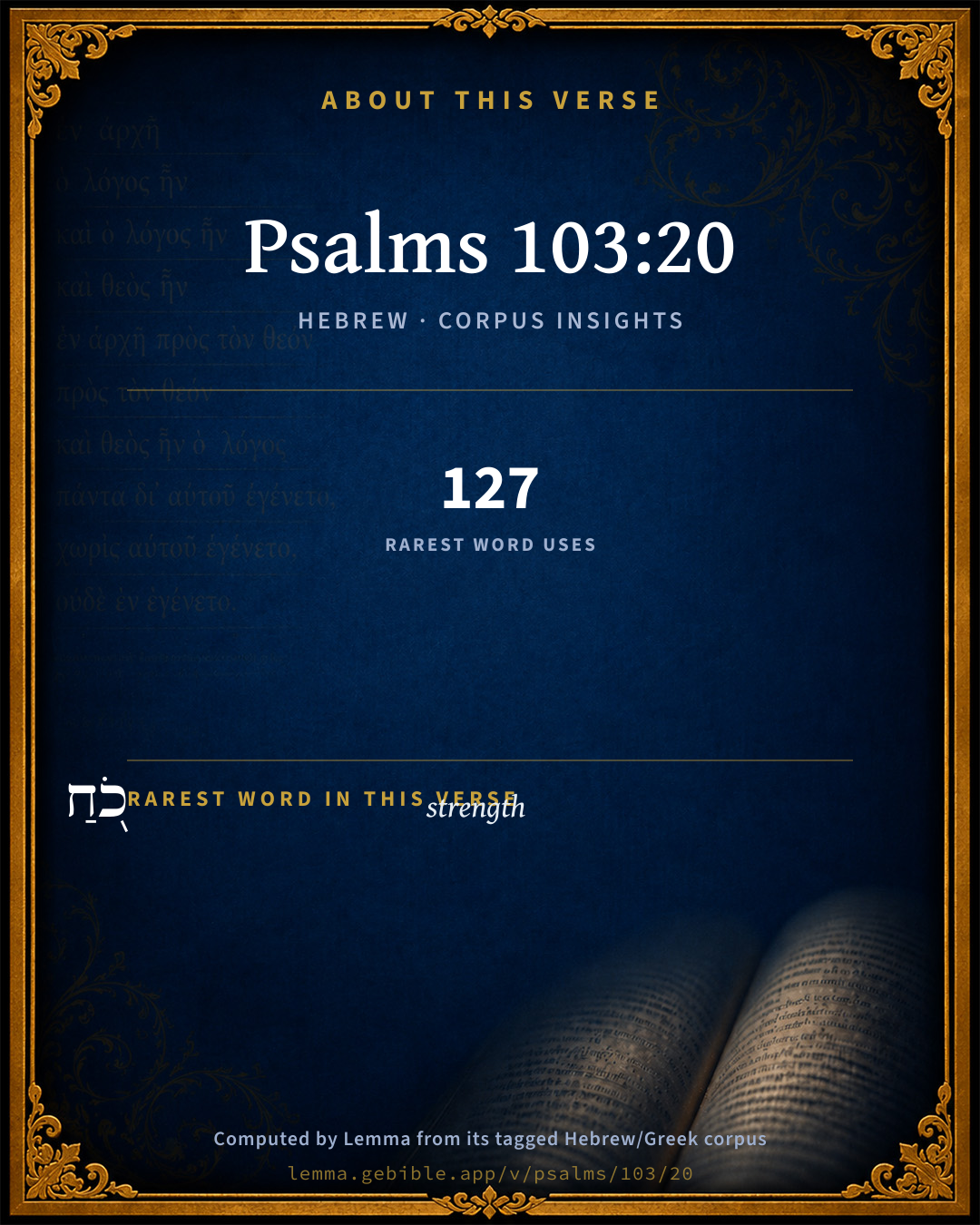
כֹ֭חַ
kôach
H3581
“strength”
Noun, Common, Masculine, Singular, Absolute
Part of Speech
Noun
Type
Common
Gender
Masculine
Number
Singular
State
Absolute
Full BDB Definition

Origin: from an unused root meaning to be firm

TWOT: 973 . 1

strength, power, might - human strength - strength (of angels) - power (of God) - strength (of animals) - strength, produce, wealth (of soil) - a small reptile, probably a kind of lizard, which is unclean - perhaps an extinct animal, exact meaning is unknown
  1. בָּרֲכ֥וּ bârak H1288 “bless” Verb, Piel, Imperative, 2nd Person, Masculine, Plural
  2. יְהוָ֗ה Yᵉhôvâh H3068 “LORD” Noun, Proper
  3. מַלְאָ֫כָ֥יו mălʼâk H4397 “messengers · his” Noun, Common, Masculine, Plural, Construct + Suffix, Personal, 3rd Person, Masculine, Singular
  4. גִּבֹּ֣רֵי gibbôwr H1368 “mighty of” Adjective, Adjective, Masculine, Plural, Construct
  5. עֹשֵׂ֣י ʻâsâh H6213 “doing” Verb, Qal, Participle Active, Masculine, Plural, Construct
  6. דְבָר֑וֹ dâbâr H1697 “word · his” Noun, Common, Masculine, Singular, Construct + Suffix, Personal, 3rd Person, Masculine, Singular
  7. לִ֝שְׁמֹ֗עַ shâmaʻ H8085 “to hear” Preposition + Verb, Qal, Infinitive Construct
  8. בְּק֣וֹל qôwl H6963 “in/at · voice of” Preposition + Noun, Common, Masculine, Singular, Construct
  9. דְּבָרֽוֹ dâbâr H1697 “word · his” Noun, Common, Masculine, Singular, Construct + Suffix, Personal, 3rd Person, Masculine, Singular

About this verse

These counts appear in no published source. They are computed here, from the morphology-tagged text and Lemma’s own curated glosses. What Lemma adds →

10
words
9
distinct lemmas
Wisdom
section

Grammatical profile

  • 3 verbs
  • 6 nouns
  • 1 adjective

Verb forms

  • בָּרֲכ֥וּ Piel · Imperative
  • עֹשֵׂ֣י Qal · Participle Active
  • לִ֝שְׁמֹ֗עַ Qal · Infinitive Construct

Repetition

A word recurs within this verse — often emphatic in Hebrew:

  • דְבָר֑וֹ word H1697 ×2

Hebrew & Septuagint length

In English translation the verse runs 21 words from the Hebrew and 23 from the Septuagint (LXX English) — closely comparable.

A rough comparison of the two English renderings, which tokenize alike — not a word-level alignment.

Word counts can differ between the Hebrew and the Greek without any difference in meaning — e.g. the Hebrew direct-object marker אֵת has no separate Greek word, and Greek often adds the article ὁ.

Cross-references

12

Topical passages linked to Psalms 103:20 in the Treasury of Scripture Knowledge — connected by theme and wording, ordered by reader-vote popularity; previews shown in the World English Bible.

  • Hebrews 1:14 Aren't they all ministering spirits, sent out to do service for the sake of those who will inherit salvation?
  • Psalms 148:2 Praise him, all his angels! Praise him, all his host!
  • Luke 1:19 The angel answered him, "I am Gabriel, who stands in the presence of God. I was sent to speak to you, and to bring you this good news.
  • Matthew 26:53 Or do you think that I couldn't ask my Father, and he would even now send me more than twelve legions of angels?
  • 2 Kings 19:35 It happened that night, that the angel of Yahweh went forth, and struck in the camp of the Assyrians one hundred eighty-five thousand: and when men arose early in the morning, behold, these were all dead bodies.
  • Luke 2:13–14 Suddenly, there was with the angel a multitude of the heavenly host praising God, and saying,
  • Psalms 78:25 Man ate the bread of angels. He sent them food to the full.
  • Matthew 6:10 Let your Kingdom come. Let your will be done, as in heaven, so on earth.
  • Joel 2:11 Yahweh thunders his voice before his army; For his forces are very great; For he is strong who obeys his command; For the day of Yahweh is great and very awesome, And who can endure it?
  • Psalms 29:1 Ascribe to Yahweh, you sons of the mighty, Ascribe to Yahweh glory and strength.
  • Isaiah 6:2 Above him stood the seraphim. Each one had six wings. With two he covered his face. With two he covered his feet. With two he flew.
  • Revelation 19:5–6 A voice came forth from the throne, saying, "Give praise to our God, all you his servants, you who fear him, the small and the great!"

Cross-references courtesy of OpenBible.info (CC BY 4.0).

Hebrew and Greek witnesses Masoretic Hebrew ↔ Greek Septuagint

The same verse in the two great witnesses to the Old Testament, shown verse-for-verse.

You’re reading Greek Psalm 102 (Hebrew Psalm 103). The Septuagint counts the superscription, so verse numbers can differ from the Hebrew — chapter-level alignment, not verse-by-verse. Numbering follows Rahlfs.

These are two independent witnesses, not word-aligned to each other, and the Septuagint is shown in lemma (dictionary) form.

Hebrew Psalms 103:20 Masoretic · Westminster Leningrad Codex

בָּרֲכ֥וּ יְהוָ֗ה מַלְאָ֫כָ֥יו גִּבֹּ֣רֵי כֹ֭חַ עֹשֵׂ֣י דְבָר֑וֹ לִ֝שְׁמֹ֗עַ בְּק֣וֹל דְּבָרֽוֹ

Praise Yahweh, you angels of his, Who are mighty in strength, who fulfill his word, Obeying the voice of his word.

World English Bible · Public Domain

Greek LXX Greek Psalm 102:20 Septuagint · lemma form

εὐλογέω ὁ κύριος πᾶς ὁ ἄγγελος αὐτός δυνατός ἰσχύς ποιέω ὁ λόγος αὐτός ὁ ἀκούω ὁ φωνή ὁ λόγος αὐτός

Bless the Lord, all you⌃ his angels, mighty in strength, who perform his bidding, ready to listen to the voice of his words.

LXX2012 (modern English Septuagint) · Public Domain

Hebrew: Westminster Leningrad Codex (CC BY 4.0). Greek: Septuagint (public domain); English from LXX2012 (modern English Septuagint) (Public Domain). How the Septuagint differs from the Hebrew →

Commentary

Notes on Psalms 103:20 from classic Christian and Jewish commentators (each source and its license shown beneath its notes). The classic Christian expositions comment on the surrounding passage and are grouped to its opening verse, so a note may address several verses; the Jewish commentaries on the Tanakh (Rashi and others) are per-verse, so they appear only where the commentator wrote on this verse.

Lemma curates 59 commentaries, every one of them public domain or Creative Commons licensed, each selected and text-cleaned for this edition rather than reprinted as found. About our sources →

Trapp's Complete Commentary

John Trapp

Psa 103:20 Bless the LORD, ye his angels, that excel in strength, that do his commandments, hearkening unto the voice of his word.

Ver. 20. Bless the Lord, ye his angels] In stirring up the angels to praise God, he awaketh himself; and for this purpose, Incipit a superioribus, et finit in infirmis, saith Kimchi here, he calleth in the help of all the creatures, from the highest to the lowest; and, after all, concludeth as he began, with a saying to himself.

That excel in strength] Heb. Giants for strength, such as can prevail, and do great exploits, yet is all their strength derivative, they have it from God (who is Hagibbor, the mighty one, Deu 10:17), and hence the angel Gabriel hath his name, God is my strength. Labour we to be like unto the angels, strengthened with all might, &c., Col 1:11, walking about the world as conquerors, able to do all things through Christ, who strengtheneth us, Php 4:13.

That do his commandments] viz. Cheerfully, speedily, universally, humbly, constantly. Let us do accordingly, else we mock God when we pray, "Thy will be done in earth, as it is in heaven."

John Trapp, A Commentary or Exposition upon All the Books of the Old and New Testament (1647–1656) — public domain. Text from a community e-Sword module.

The Biblical Illustrator

Joseph S. Exell

Psa_103:20-22

Bless the Lord, ye His angels.

On ministering spirits

I. The lowest occupation of tutelary beings upon the earth consists in the preservation or deliverance of the servants of God from situations of danger. To be conscious, that whithersoever we may bend our steps;--in the midst of the throng, or in the solitary path,--these celestial protectors are at all times beside us,--to encompass as with a shield, and to cover as with a canopy,--must doubtless be an animating and soothing reflection. Yet this is no fanciful supposition (Psa_91:11-12; Psa_34:7; Psa_68:17; Psa_139:3).

II. Another office, in which guardian spirits are engaged, is that of bearing consolation to the afflicted. To diffuse a holy calm throughout the troubled mind;--to pour forth into the wounded bosom their pitcher of refreshment, drawn from the rivers of Paradise;--to suggest considerations which recommend submission or fortitude;--are employments not unsuitable to that heavenly host, concerning whom we know, that one of them stirred the pool of Bethesda, in preparation for the cure of the maimed (Act_1:11).

III. These ethereal spirits are greatly occupied, as messengers of grace in time of temptation;--as servants sent forth by the Holy Ghost into the breast, suggesting good, or banishing unholy thoughts;--as turning away the eye from the seductive spectacle, or sealing the ear to accents of delusion. We speak of sermons, of sicknesses, of afflictions, of a place of graves, as means of grace;--wherefore, then, should not we, in like manner, speak of angels as its dispensers? It is in the highest degree reasonable to believe, that the office of transmitting the suggestions of grace may be imposed on them, on their own account, as intelligences, whom it becomes to praise the Father of the Universe, and to purify and approximate towards perfection their own natures, by active services as well as by hymns of adoration. It is natural to suppose, likewise, that pure and benevolent beings, permitted to witness the affairs of this lower world, should feel deeply interested for the favourable issue of the spiritual conflict sustained by those who may become their future and eternal associates:--and, if by any means possible, that they should exert themselves in promoting that issue.

IV. If to bear from above the emanations of grace be an office in which pure and kind intelligences may be supposed to take high delight, with still greater satisfaction, may it further be presumed, do they wing their way back to the courts of happiness, carrying tidings of the successful result of their embassy (Tob_12:13; Rev_8:2-3).

V. This welcome report of the pure and upright behaviour of faithful sojourners upon earth, being circulated throughout the mansions of bliss, we cannot doubt that the glorified host of the happy will listen to it with complacency and delight;--that they will congratulate each other on the triumph of good;--on the prospect of an increase to their band;--on a new advancement of the glory of the Most High (1Pe_1:12; Luk_15:10).

VI. When the awful hour which awaits every child of Adam, the hour of dissolution, approaches;--when the eye is about to close on those objects of fond affection, of whom it cannot take leave with indifference, another interesting office of guardian spirits will consist in whispering words of peace to the departing followers of Jesus;--in removing the film and dimness from the sight of faith;--in rolling back to its view the curtain of the skies, and permitting it to descry those seats of boundless felicity where it will speedily be, and where it will be as the angels. (J. Grant, M.A.)

Angels real

Some of the eminent doctors, in Rowland Hills day, said that there were no such beings as angels; that they were only Oriental metaphors. Very well, said Rowland Hill, then it was a company of Oriental metaphors that sang at the birth of Christ, Glory to God in the highest. Angels are Oriental metaphors; then it was an Oriental metaphor that slew 185,000 of Sennacheribs army in a single night. Angels are Oriental metaphors; then it was an Oriental metaphor that appeared to Peter in prison, that knocked off his chains, and led him through the streets. Truly, said he, these Oriental metaphors are wonderful things! (C. H. Spurgeon.)

The Biblical Illustrator, edited by Joseph S. Exell (c. 1880s–1900s) — public domain. Text from a community e-Sword module.

Joseph Benson's Commentary

Psa 103:20-22. Bless the Lord, ye his angels — Who, though glorious creatures, are but his ministers and messengers, as the word signifies. And by inviting the angels to bless God he excites men to the same duty, as having more dependance upon God, and obligation to him. That excel in strength — Of which see one evidence, 2Ki 19:35. You are freed from the inabilities and infirmities of mankind; that do his commandments — That live in a universal, constant, and perfect obedience to all God’s commands; hearkening unto the voice of his word — Who diligently wait for his commands, and execute them with all cheerfulness and readiness. Bless the Lord, all ye his hosts — The angels again, to whom he still continues his address, and whom he more particularly describes by the name of hosts, a title often given to them on account of their vast numbers, mighty power, unanimous concurrence, and exquisite order. Ye ministers of his — The Hebrew word משׁרתיו, mesharethaiv, thus rendered, is commonly used of the highest and most honourable sort of servants; that do his pleasure — Whose constant business and delight it is to execute his orders and fulfil his will. Bless the Lord, all his works, in all places of his dominion — All creatures, both in heaven and earth, according to your several capacities. Bless the Lord, O my soul — Which thou hast especial and abundant reason to do. Thus he ends the Psalm with the same words wherewith he began it.

Joseph Benson's Commentary on the Old and New Testaments (1811–1818) — public domain. Text from a community e-Sword module.

J. A. Alexander on Psalms

Joseph Addison Alexander

20. (Psa 103:20) Bless Jehovah, ye his angels, mighty in strength, doing his word, (so as) to listen to the voice of his word. Having finished his assertion of God's claims to universal praise, the Psalmist resumes the tone of exhortation with which he began. His appeal, however, is no longer to his own soul, but to the hosts of heaven, the noblest of God's creatures, the highest order of finite intelligences. Mighty in strength, more exactly mighty (ones) of strength, or, as the first word is applied as a substantive to warriors or conquerors, heroes of strength or mighty heroes. See above, on Psa 24:8; Psa 78:25. The construction in the last clause is obscure. The infinitive may here have the force of a gerund, audiendo, auscultando, by listening to the voice of his word, or, as in Psa 78:18, it may denote the extent or the effect of their obedience, so as to hearken, or so that they hearken, i.e. listen for the faintest intimation of his will. The expression hearken to his voice, as thus applied, is a Mosaic one. See Deu 26:17; Deu 30:20.

Joseph Addison Alexander, The Psalms Translated and Explained (1850) — public domain. Text from a community e-Sword module.

Tyndale Open Study Notes

Tyndale Open Resources

103:20-21 The psalmist exhorts the Lord’s angels, his servants and messengers, to praise the Lord.

Tyndale Open Study Notes — © Tyndale Open Resources, licensed CC BY-SA 4.0. Text via the HelloAO Bible API.

Geneva Bible (1599)

Geneva Bible translators

In that that we, which naturally are slow to praise God, exhort the Angels, who willingly do it, we stir up ourselves to consider our duty, and awake out of our sluggishness.

Geneva Bible (1599) marginal notes — public domain. Text via Bolls.life.

Adam Clarke's Commentary

Verse 20. Bless the Lord, ye his angels] Every person who has a sense of God's goodness to his soul feels his own powers inadequate to the praise which he ought to offer; and therefore naturally calls upon the holiest of men, and the supreme angels, to assist him in this work.

That excel in strength] Some take גברי כה gibborey coach, the mighty in strength, for another class of the hierarchy,-they that do his commandments, hearkening to his words; and consider them to be that order of beings who are particularly employed in operations among and for the children of men; probably such as are called powers in the New Testament.

Adam Clarke's Commentary on the Bible (1810–1826) — public domain. Text from a community e-Sword/MySword module.

Ellicott's Commentary for English Readers

(20) Just as in the highest revelation made by Jesus Christ the angels in heaven rejoice over the repentant sinner, so in the psalmist’s view the mercy of Jehovah to his faithful people is cause for high acclaim among the hosts around the throne.

A Bible Commentary for English Readers, edited by Charles John Ellicott (1878–1897) — public domain. Text from a community e-Sword module.

The Cambridge Bible for Schools and Colleges

gen. ed. J. J. S. Perowne

20. Bless Jehovah, ye angels of his;

Ye mighty in strength, that do his word,

Hearkening unto the voice of his word.

Heavenly beings are most capable of praising the heavenly King. For the address to the angels cp. Psa_29:1; Psa_148:2. They are called mighty in strength as God’s warriors; cp. Joe_3:11. The “blessed obedience” of the angels is an example for man.

The Cambridge Bible for Schools and Colleges (gen. ed. J. J. S. Perowne; Cambridge University Press, 1878–1918) — public domain. Text from a community e-Sword module.

John Gill's Exposition

Bless the Lord, all his works, in all places of his dominion,.... Which some interpret of all his creatures, animate or inanimate, rational or irrational, throughout the whole world, which is all under his government; and who all of them, objectively, bless and praise the Lord, Psa 148:7. Or rather regenerate persons, his sons and daughters, the work of his hand, in each of the parts of the world where they live, are here called upon to bless the Lord; who, of his abundant mercy, hath begotten them again to a glorious inheritance: these are his workmanship in Christ; formed for himself, his service, and glory; and are under the highest obligations to show forth his praise.

Bless the Lord, O my soul: thus the psalmist ends the psalm as he begun it; not excusing himself by what he had done, nor by calling upon others to this service; knowing that this is constant employment for time and eternity; a work in which he delighted, and was desirous of being concerned in, now and for ever.

Next: Psalms Chapter 104

John Gill's Exposition of the Whole Bible (1746–1763) — public domain (CC PDM 1.0). Text via the HelloAO Bible API.

Albert Barnes' Notes on the Bible

Bless the Lord - The psalm began Psa 103:1-2 with an exhortation to “bless the Lord.” That exhortation was, however, then addressed by the psalmist to his own soul, and was especially founded on the benefits which he had himself received. The psalm closes also with an exhortation to “bless the Lord,” yet on a much wider scale. The psalmist feels that there is not only occasion for him to do it, but that the reason for it extends to the whole universe. The meaning is, that God is worthy of universal praise; and all ranks of beings - all worlds - should join in that praise. Man, feeble, frail, dying, could not come up to the fullness of the praise required. Praise such as was appropriate to God - such as his perfections and works deserved - demanded loftier powers than those of man; the loftiest powers in the universe.

Ye his angels - All beings higher than man; beings around and before his throne.

That excel in strength - Margin, as in Hebrew, “mighty in strength,” and therefore more “able” to offer adequate praise.

That do his commandments - Who perfectly obey his law, and who, therefore, can render more acceptable praise than can ever come from human lips.

Hearkening unto the voice of his word - Who always listen to his voice; who never are disobedient; and who can, therefore, approach him as holy beings, and more appropriately worship him.

Albert Barnes' Notes on the Bible (1834–1885) — public domain. Text from a community e-Sword/MySword module.

Matthew Poole's English Annotations

Angels; which, though glorious creatures, are but his ministers and messengers, as the word signifies. And inviting the angels to bless God, he quickens men to the same duty, as having more dependence upon God, and, obligation to him. That excel in strength; of which see evidence 2Ki 19:35. You are freed from the impentencies and infirmities of mankind.

That do his commandments; that live in a universal, constant, and perfect obedience to all God’s commands, which the best of men through the infirmity of the flesh do frequently violate.

Hearkening unto the voice of his word; that diligently wait for God’s commands or errands, and execute them with all cheerfulness and readiness.

Matthew Poole's English Annotations on the Holy Bible (1683–1685) — public domain. Text from a community e-Sword/MySword module.

The Treasury of David

Charles H. Spurgeon

Ver. 20. Bess the Lord, ye his angels, that excel in strength. Finding his work of praise growing upon his hands, he calls upon "the firstborn sons of light" to speak the praises of the Lord, as well they may, for as Milton says, they best can tell. Dwelling nearer to that prepared throne than we as yet have leave to climb, they see in nearer vision the glory which we would adore. To them is given an exceeding might of intellect, and voice, and force which they delight to use in sacred services for him; let them now turn all their strength into that solemn song which we would send up to the third heaven. To him who gave angelic strength let all angelic strength be given. They are his angels, and therefore they are not loath to ring out his praises.

That do his commandments, hearkening unto the voice of his word. We are bidden to do these commandntents, and alas we fail; let those unfallen spirits, whose bliss it is never to have transgressed, give to the Lord the glory of their holiness. They hearken for yet more commands, obeying as much by reverent listening as by energetic action, and in this they teach us how the heavenly will should evermore be done; yet even for this surpassing excellence let them take no praise, but render all to him who has made and kept them what they are. O that we could hear them chant the high praises of God, as did the shepherds on that greatest of all birth nights

"When such music sweet

Their hearts and ears did greet

As never was by mortal finger struck;

Divinely-warbled voice

Answering the stringed noise,

As well their souls in blissful rapture took:

The air, such pleasure loth to lose,

With thousand echoes still prolongs each heavenly close."

Our glad heart anticipates the hour when we shall hear them "harping in loud and solemn guise, "and all to the sole praise of God.

Ver. 20. Bless the Lord, ye his angels, etc. The weight of offering praise unto God is too heavy for men to lift; and as for angels, it will take up all their strength and their best abilities to go about it. David Dickson.

Ver. 20. Angels, that excel it, strength, that do his commandments. The chief excellence of the angels, the main cause of their strength and power, and of their immense superiority to mankind, is that which is set forth in the following words of the text. After the Psalmist has described the angels as excelling in strength, he adds that they do God's commandments, hearkening to the voice of his word. For this is the only living source of lasting strength and power. They who do the will of God faithfully and obediently, have God for them; and then what can be against them? Then work itself strengthens them, and is like a tide bearing them onward; because it is his work. They on the other hand who run counter to the will of God, have God against them; and then what can be for them? Can a man push back the sea? can he lay hold on the sun, and drag him out of his course? Then may he hope to be strong, when he is fighting against the will of God...

Hence we see the falsehood of that maxim, so common on the lips of those who plume themselves upon their mastery in the wisdom of this worldthat Might is Right, a maxim which exactly inverts the truth, and whereby the Prince of darkness is ever setting himself up against the Lord of heaven. The true principle, which is inverted and perverted in this falsehood, the principle which ought to be written up in the councilchambers of princes and on the walls of senate-houses, the principle which explains the secret of the strength of the angels, and indeed of all true strength, that is in accordance with the will of God, may be stated in the selfsame words, if we only invert their order, Right is Might. Julius Charles Hare, 1849.

Ver. 20. His angels that do his commandments, etc. They hearken to the voice of his word, they look upon God as the great General, and if he give out the word, they give out their strength, and go about the work willingly. They are very attentive to his commands; if he says, Go smite Herod for his pride, Balaam for his covetousness, David for his vainglory, Sennacherib for his blasphemy, and Sodom for its uncleanness, presently they go. William Greenhill.

Ver. 20. Commandments. Davar (rkd), to speak, is rendered, "command" twenty times... direct personal communion between the Lord and his messengers seems to be implied. R. B. Girdlestone.

Ver. 20. Hearkenling into the voice of his word. Not only, mightily executing the word when heard; but, ever intently listening, ready to catch the intimation of his will. William Kay.

Ver. 20. Hearkening unto the voice of his word. Angels are vigilant creatures, and wait for opportunities, and when they come they will not lose them. They neither slumber nor sleep, but hearken constantly what the Lord will say, what opportunity there will be for action; so, in Eze 1:11, they are described with their wings stretched upward, manifesting their watchfulness and readiness for service. When Christ was born, a multitude of them appeared and celebrated his nativity, Lu 2:13: when Christ was taken by Judas and his train, Peter drew his sword in his Master's defence; but what saith Christ? "Put up thy sword, it is not a time now to fight, but to suffer: thinkest thou that I cannot now pray to my Father, and he shall presently give me more than twelve legions of angels? It is not a time now to pray for help, I must die, and the Scripture must be fulfilled; but if I would, my Father would bid the angels to aid me, and they presently would come, whole legions of them, yea, all the angels in heaven." Let us learn of angels to watch for opportunities, and take them. There are nicks of time wherein to do the work of Christ. William Greenhill.

Ver. 20. The angels' service instructive to us.

1. Their personal strength is excellent. As servants of God we also should see to our own spiritual health and rigour.

2. They are practical in their obedience, not theorists.

3. They are attentive while at work, ready to learn more, and holding fellowship with God, who speaks personally to them.

4. They do all in the spirit of joyful praise, blessing the Lord.

Ver. 20-21.

1. The centre of praise: "Bless the Lord." All praise centres in him.

2. The concert of praise. (a) Angels. (b) The hosts of the redeemed. (c) Ministers in particular. (d) The surrounding creation.

3. The climax of praise: "Bless the Lord, O my soul." This has the highest claim upon me for gratitude and praise. Vast as the chorus may be, it will not be perfect without my note of praise. This is the culminating note: "Bless the Lord, O my soul." G.R.

Psalms 103:21*

Charles H. Spurgeon's The Treasury of David (1869–1885) — public domain. Psalms only. Text from a community e-Sword/MySword module.

Whedon's Commentary on the Bible

Daniel D. Whedon

20. Angels—A designation of an order of beings, not an office, as messengers. Compare the call upon angels, Psa_29:1-2; Psa_148:2. The call is grounded in our fellowship with them. Heb_12:22-23. If the doctrine of archangels was thus early understood, as in later times, (see Dan_8:16; Dan_9:21; Dan_10:13; Dan_10:21; comp. Luk_1:19; Rev_8:2; Rev_12:7; Tob_12:15,) the following descriptions might well apply to them.

Excel in strength—Hebrew, Mighty of strength. The word mighty, (English version, “excel,”) denotes the highest reach of finite “strength,” skill, and endurance, such as, when applied to man, distinguishes the hero-warrior.

That do his commandments—That execute his word. They are the executive messengers of God.

Hearkening unto the voice— Denoting both attentiveness to learn, and promptness to execute. “As soon as they hear the voice of God they promptly obey.”—Hammond. An example to us.

Daniel D. Whedon (gen. ed.), Commentary on the Old and New Testaments (1874–1909) — public domain. Text from a community e-Sword module.

The Pulpit Commentary

Bless the Lord, ye his angels. (comp. Psa_148:2) That excel in strength. The angels that "excel in strength literally, are mighty in strength may best be understood as those called in the New Testament "archangels", (1Th_4:16 Jud_1:9) the highest of the glorious beings that stand around the throne of God (Rev_8:2, 6 10:1) and execute his behests. These are they that, in an especial sense, do his commandments, hearkening unto the voice of his word.

The Pulpit Commentary (1880–1919), ed. H.D.M. Spence-Jones & Joseph S. Exell — public domain. Text from a community e-Sword module.

Scofield Reference Notes

C. I. Scofield

angels

(See Scofield "Heb 1:4").

The Scofield Reference Bible (1917 edition), notes by C. I. Scofield — public domain. Text from a community e-Sword module.

unfoldingWord translationNotes

Door43 World Missions Community

carry out his will

This is an idiom meaning to "do his will." AT: "do his will" (See: Idiom)

in all the places where he reigns

"praise him in all the places where he reigns"

with all my life

This phrase means that he will praise Yahweh wholeheartedly and is used to emphasize his devotion to him. AT: "with all of me" or "with all my soul" (See: Metonymy)

translationWords

angel

strength

word

command

servant

will of God

creature

unfoldingWord translationNotes — © Distant Shores Media and the Door43 World Missions Community, licensed CC BY-SA 4.0. Source: git.door43.org/Door43/en_tn.

Lesson kit

Teaching starters — assembled from the data on this page, not authored interpretation. Every prompt links to the verse data it draws on. Edit before teaching.

Psalms, in the Wisdom, opens this verse with 10 words (9 distinct Hebrew lemmas). Its most distinctive word is kôach (“strength”). A historical commentator’s framing appears above. Read the whole chapter for the surrounding context.

Discussion questions

  1. What does “strength” (kôach) contribute to the verse as a whole?
  2. Hebrews 1:14 shares this passage’s theme. How do the two illuminate each other?
  3. “word” occurs 2× in this one verse. What is the effect of the repetition?
  4. The translations on this page render this verse differently — a whole-verse word diff, not a word-by-word alignment. What might account for the different wordings?
  5. The verb «בָּרֲכ֥וּ» is Piel Imperative. How does its form color the action?
  6. Reading how Trapp's Complete Commentary and The Biblical Illustrator read this verse, where do the two commentators agree and where do they part?

Things to notice

Reading settings

Reading text

Shown beneath each verse's original-language words.

Old Testament
Old Testament edition

Read the OT as the Masoretic Hebrew (MT) or the Greek Septuagint (LXX).

English shown for the Greek Septuagint (in the Hebrew ↔ Greek comparison).

Comparing translations? Open the Compare panel on any verse page to stack up to four side by side.