
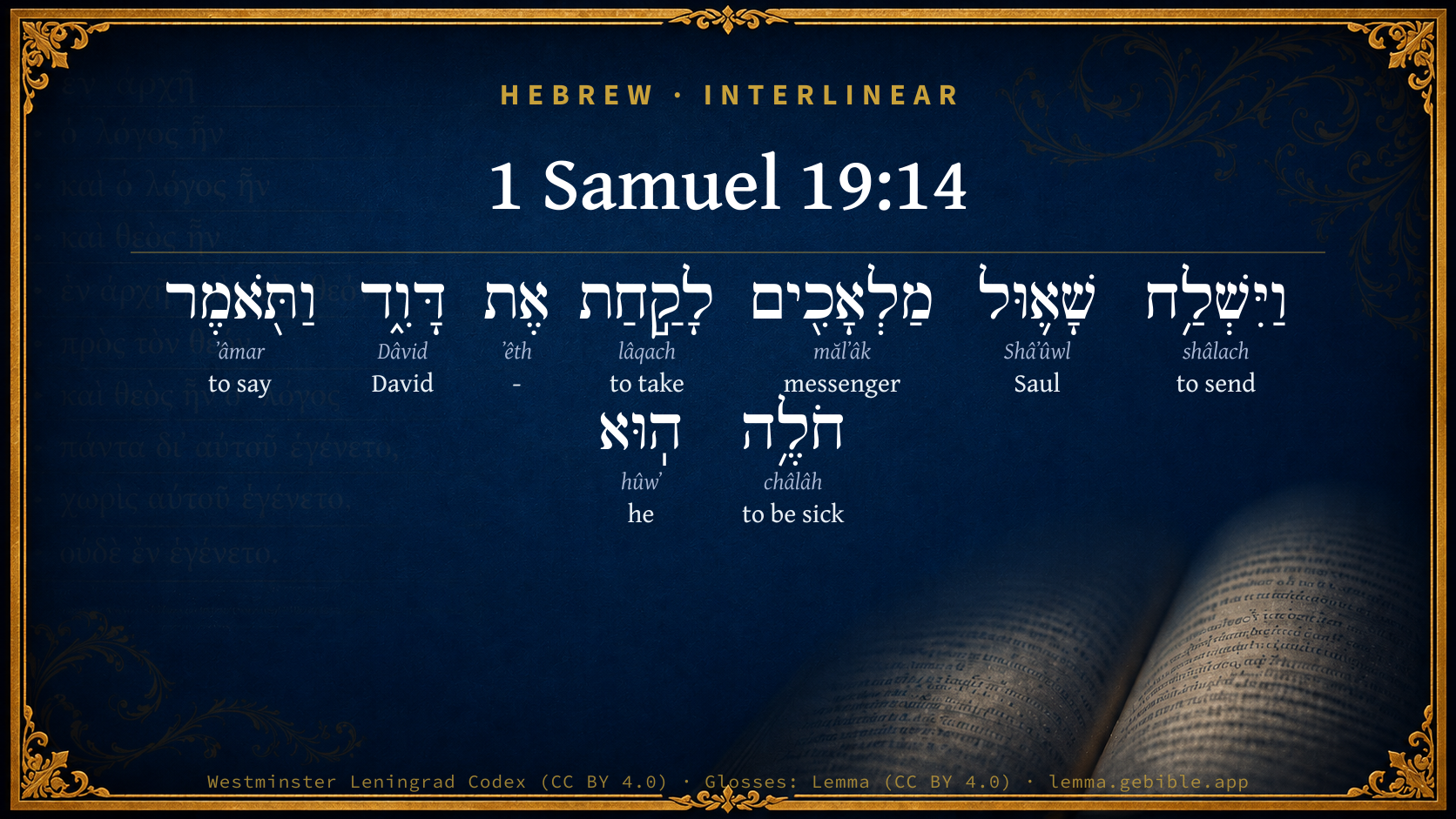
1 Samuel 19:14

Hebrew (Westminster Leningrad Codex) 1 Samuel 19:14 appears in the Hebrew Old Testament. The text above is from the Westminster Leningrad Codex. Each word links to its Strong’s number, a concise gloss, and parsing drawn from the Open Scriptures Hebrew Bible morphology. Click any word for its full Brown-Driver-Briggs (BDB) entry.
Download image
Cite this verse

1 Samuel 19:14 (World English Bible). Public Domain. Lemma interlinear Bible study tool, https://lemma.gebible.app/v/1-samuel/19/14.

Show BibTeX & RIS
BibTeX
RIS
English Translation
When Saul sent messengers to take David, she said, He is sick.
World English Bible · Public Domain
Download a study sheet

One document with this verse’s original text, its word-by-word gloss line, the meaning frame, cross-references with their text, attributed commentary, and full source and license credits — printable, and it pastes into notes with its structure intact.

This verse Autodidact and up

Study sheet (.html) Plain text (.txt)

A passage Seminary Student

Up to 50 verses in one chapter. A passage sheet keeps up to 6 commentary sources and 12 cross-references per verse, in the order this page ranks them, and says so on the sheet whenever that leaves anything out. Ask for a single verse and you get the Autodidact verse sheet above.

Everything on this page stays free to read, with no account — the sheet is a download of what is already on screen, not access to it.

Want to remove ads? Support Godless Engineer
Compare translations 3

The same verse in 3 English versions, stacked beneath the original-language interlinear above. Click any original word for its lexicon entry.

Each is an independent rendering of the whole verse — the interlinear is not word-aligned to these translations.

Highlighted words mark where these versions differ — a whole-verse word diff, not a word-by-word alignment.

  • World English Bible Public Domain
    When Saul sent messengers to take David, she said, He is sick.
  • King James Version Public Domain
    And when Saul sent messengers to take David, she said, He is sick.
  • unfoldingWord Literal Text CC BY-SA 4.0
    And Saul sent messengers to take David. But she said, “He sick.”

unfoldingWord Literal Text — © unfoldingWord, licensed CC BY-SA 4.0. Word-aligned USFM3 via Door43 (git.door43.org/unfoldingWord/en_ult).

Versions to compare (up to 4)

3 of 4 selected

Show all 18 translations

Every available English version of this verse, each an independent rendering of the whole verse.

  • World English Bible Public Domain
    When Saul sent messengers to take David, she said, He is sick.
  • Berean Standard Bible Public Domain
    When Saul sent the messengers to seize David, Michal said, “He is ill.”
  • Majority Standard Bible Public Domain
    When Saul sent the messengers to seize David, Michal said, “He is ill.”
  • King James Version Public Domain
    And when Saul sent messengers to take David, she said, He is sick.
  • American Standard Version (1901) Public Domain
    And when Saul sent messengers to take David, she said, He is sick.
  • Revised Version (1885) Public Domain
    And when Saul sent messengers to take David, she said, He is sick.
  • Geneva Bible (1599) Public Domain
    And when Saul sent messengers to take Dauid, she sayd, He is sicke.
  • Douay-Rheims (1899) Public Domain
    And Saul sent officers to seize David: and it was answered that he was sick.
  • Young's Literal Translation Public Domain
    And Saul sendeth messengers to take David, and she saith, `He `is' sick.'
  • Literal Standard Version CC BY-SA 4.0
    And Saul sends messengers to take David, and she says, “He [is] sick.”
  • Unlocked Literal Bible CC BY-SA 4.0
    When Saul sent messengers to take David, she said, “He is sick.”
  • unfoldingWord Literal Text CC BY-SA 4.0
    And Saul sent messengers to take David. But she said, “He sick.”
  • Darby Bible Public Domain
    And Saul sent messengers to take David, and she said, He is sick.
  • World Messianic Bible Public Domain
    When Saul sent messengers to take David, she said, “He is sick.”
  • Webster's Bible Public Domain
    And when Saul sent messengers to take David, she said, He is sick.
  • Free Bible Version CC BY-SA 4.0
    When Saul sent the messengers to arrest David, Michal told them, “He's sick.”
  • Bible in Basic English Public Domain
    And when Saul sent men to take David, she said, He is ill.
  • JPS Tanakh (1917) Public Domain
    And when Saul sent messengers to take David, she said: 'He is sick.'

Literal Standard Version (2020), Covenant Press — licensed CC BY-SA 4.0. Text via the HelloAO Bible API (eBible.org). Unlocked Literal Bible (unfoldingWord) — licensed CC BY-SA 4.0. Text via the HelloAO Bible API (eBible.org). unfoldingWord Literal Text — © unfoldingWord, licensed CC BY-SA 4.0. Word-aligned USFM3 via Door43 (git.door43.org/unfoldingWord/en_ult). Free Bible Version, Dr. Jonathan Gallagher — licensed CC BY-SA 4.0. Text via the HelloAO Bible API (eBible.org).

Word by word

More ways to search: Search by grammar → Find every occurrence → Compare this word →

Practice this passage: Drill this verse → Learn its vocabulary →

חֹלֶ֥ה
châlâh
H2470
“being sick”
Verb, Qal, Participle Active, Masculine, Singular, Absolute
Part of Speech
Verb
Stem
Qal
Form
Participle Active
Gender
Masculine
Number
Singular
State
Absolute
Full BDB Definition

Origin: a primitive root [compare H2342 , H2470 , H2490 ]

TWOT: 655

to be or become weak, be or become sick, be or become diseased, be or become grieved, be or become sorry - (Qal) to be weak, be sick - (Piel) - to be or become weak, feel weak - to become sick, become ill - (CLBL) to entreat, pray, beg - (Niphal) - to make oneself sick - to be made sick - to be tired - (Pual) to be made weak, become weak - (Hithpael) to make oneself sick - (Hiphil) - to make sore - to make sick - to show signs of sickness, become sick - to grieve - (Hophal) - to be made sick - to be wounded
  1. וַיִּשְׁלַ֥ח shâlach H7971 “and · to send” Conjunction + Verb, Qal, Sequential Imperfect, 3rd Person, Masculine, Singular
  2. שָׁא֛וּל Shâʼûwl H7586 “Saul” Noun, Proper
  3. מַלְאָכִ֖ים mălʼâk H4397 “messengers” Noun, Common, Masculine, Plural, Absolute
  4. לָקַ֣חַת lâqach H3947 “to take” Preposition + Verb, Qal, Infinitive Construct
  5. אֶת ʼêth H853 “-” Particle, Direct Object
  6. דָּוִ֑ד Dâvid H1732 “David” Noun, Proper
  7. וַתֹּ֖אמֶר ʼâmar H559 “and · to say” Conjunction + Verb, Qal, Sequential Imperfect, 3rd Person, Feminine, Singular
  8. הֽוּא hûwʼ H1931 “he” Pronoun, Personal, 3rd Person, Masculine, Singular

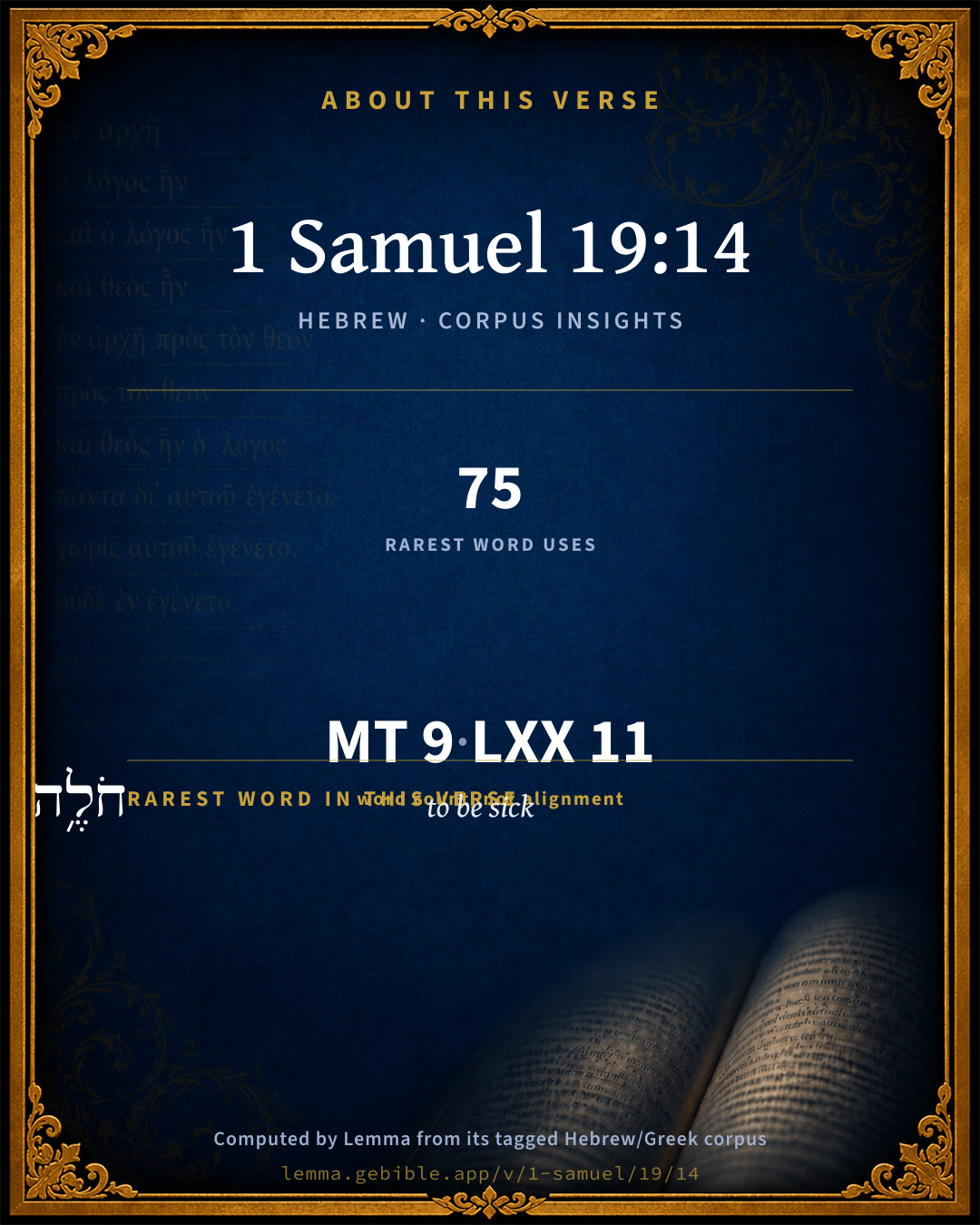
About this verse

These counts appear in no published source. They are computed here, from the morphology-tagged text and Lemma’s own curated glosses. What Lemma adds →

9
words
9
distinct lemmas
Historical
section

Grammatical profile

  • 4 verbs
  • 3 nouns
  • 1 pronoun
  • 1 particle

Verb forms

  • וַיִּשְׁלַ֥ח Qal · Sequential Imperfect
  • לָקַ֣חַת Qal · Infinitive Construct
  • וַתֹּ֖אמֶר Qal · Sequential Imperfect
  • חֹלֶ֥ה Qal · Participle Active

Hebrew & Septuagint length

In English translation the verse runs 12 words from the Hebrew and 14 from the Septuagint (LXX English) — closely comparable.

A rough comparison of the two English renderings, which tokenize alike — not a word-level alignment.

Word counts can differ between the Hebrew and the Greek without any difference in meaning — e.g. the Hebrew direct-object marker אֵת has no separate Greek word, and Greek often adds the article ὁ.

In the original languages it is 9 Hebrew tokens and 11 Greek tokens — but the two are counted differently (Hebrew bundles its prefixes and suffixes into one token; the Greek is in lemma form), so that isn’t a like-for-like length.

Cross-references

3

Topical passages linked to 1 Samuel 19:14 in the Treasury of Scripture Knowledge — connected by theme and wording, ordered by reader-vote popularity; previews shown in the World English Bible.

  • Joshua 2:5 and it happened about the time of the shutting of the gate, when it was dark, that the men went out; where the men went I don't know: pursue after them quickly; for you will overtake them.
  • 2 Samuel 16:17–19 Absalom said to Hushai, Is this your kindness to your friend? Why didn't you go with your friend?
  • 2 Samuel 17:20 Absalom's servants came to the woman to the house; and they said, Where are Ahimaaz and Jonathan? The woman said to them, They have gone over the brook of water. When they had sought and could not find them, they returned to Jerusalem.

Cross-references courtesy of OpenBible.info (CC BY 4.0).

Hebrew and Greek witnesses Masoretic Hebrew ↔ Greek Septuagint

The same verse in the two great witnesses to the Old Testament, shown verse-for-verse.

These are two independent witnesses, not word-aligned to each other, and the Septuagint is shown in lemma (dictionary) form.

Hebrew 1 Samuel 19:14 Masoretic · Westminster Leningrad Codex

וַיִּשְׁלַ֥ח שָׁא֛וּל מַלְאָכִ֖ים לָקַ֣חַת אֶת דָּוִ֑ד וַתֹּ֖אמֶר חֹלֶ֥ה הֽוּא

When Saul sent messengers to take David, she said, He is sick.

World English Bible · Public Domain

Greek LXX 1 Samuel 19:14 Septuagint · lemma form

καί ἀποστέλλω σαούλ ἄγγελος λαμβάνω ὁ δαυίδ καί λέγω ἐνὀχλέω αὐτός

And Saul sent messengers to take David; and they say that he is sick.

LXX2012 (modern English Septuagint) · Public Domain

Hebrew: Westminster Leningrad Codex (CC BY 4.0). Greek: Septuagint (public domain); English from LXX2012 (modern English Septuagint) (Public Domain). How the Septuagint differs from the Hebrew →

Targum (Aramaic paraphrase)

1

The Targum is the ancient Jewish Aramaic paraphrase of the Hebrew Scriptures — an interpretive translation, not the Hebrew text itself. Onkelos (literal) and Pseudo-Jonathan (expansive) render the Torah, and Jonathan the Prophets. Coverage is partial: where no permissively-licensed English translation exists for a verse, only the Aramaic is shown. This is verse-level text, not a word-by-word alignment to the Hebrew.

  1. Targum Jonathan Prophets (Joshua–Malachi)
    וּשְׁלַח שָׁאוּל אִזְגַדִין לְמִדְבַּר יַת דָוִד וַאֲמַרַת שְׁכִיב מְרַע הוּא:

    (no public-domain English translation for this verse)

    Targum Jonathan — Aramaic: “Mikraot Gedolot” (public domain). English: “Sefaria Community Translation” (CC0 1.0 (public-domain dedication)); “London "Chaldee Paraphrase," 1871” (public domain). Text via Sefaria.

Commentary

Notes on 1 Samuel 19:14 from classic Christian and Jewish commentators (each source and its license shown beneath its notes). The classic Christian expositions comment on the surrounding passage and are grouped to its opening verse, so a note may address several verses; the Jewish commentaries on the Tanakh (Rashi and others) are per-verse, so they appear only where the commentator wrote on this verse.

Lemma curates 59 commentaries, every one of them public domain or Creative Commons licensed, each selected and text-cleaned for this edition rather than reprinted as found. About our sources →

Trapp's Complete Commentary

John Trapp

1Sa 19:14 And when Saul sent messengers to take David, she said, He [is] sick.

Ver. 14. She said, He is sick.] This officious lie she held belike either no sin, or a very peccadillo, since it was to save the life of her husband: wherein she becometh an example of human infirmity.

John Trapp, A Commentary or Exposition upon All the Books of the Old and New Testament (1647–1656) — public domain. Text from a community e-Sword module.

Joseph Benson's Commentary

1Sa 19:14-17. Saul sent messengers to take David — As he did not come out of doors, where they waited for him, Saul sent other messengers to take him in the house. She said, He is sick — Her affection for David, and fear for his life, induced her to tell a plain lie, in which she is neither to be justified nor imitated. She intended hereby, however, to keep Saul in suspense for a while, till David should arrive at some place of safety. He said, Let me go; why should I kill thee? — This was another untruth; and an untruth very injurious to David’s reputation. Far was it from him either to intend or threaten to kill any one, much more his own wife. But Michal feared to enrage her father to too high a degree if she told the truth. Her weakness is to be pitied, while it is to be condemned and shunned.

Joseph Benson's Commentary on the Old and New Testaments (1811–1818) — public domain. Text from a community e-Sword module.

The Cambridge Bible for Schools and Colleges

gen. ed. J. J. S. Perowne

14. she said, He is sick] Apparently she took the messengers into the outer chamber and pointed to the figure in bed in an inner closet, not letting them go near enough to detect the imposture. The plan gained David time to escape. The Sept. has, “and they [the messengers] brought word that he was sick.”

The Cambridge Bible for Schools and Colleges (gen. ed. J. J. S. Perowne; Cambridge University Press, 1878–1918) — public domain. Text from a community e-Sword module.

John Gill's Exposition

And when Saul sent messengers to take David,.... Either the same who in the morning inquired for David, or those staying longer than Saul expected, and fearing they were negligent or corrupted, he sent others: to whom

she said, he is sick; and in bed, and cannot be spoke with; this lie she told through her affection to David, and to preserve his life; and this stratagem she devised to gain time, that while she was amusing the messengers with this tale of hers, before they could discover the truth of the matter David would be out of their reach; whereas, had she denied his being at home, or signified that he had made his escape, they would have immediately pursued after him, and he would have been in danger of being taken by them.

John Gill's Exposition of the Whole Bible (1746–1763) — public domain (CC PDM 1.0). Text via the HelloAO Bible API.

Haydock's Catholic Bible Commentary

Sick. This is an officious lie. She tells another to excuse herself, ver. 17. The children of Saul strive to prevent their father’s cruelty, by taking part with the innocent David. (Haydock) --- It is thought that David composed the 68th Psalm, Eripe, &c., on this occasion. (Calmet)

George Leo Haydock (1774–1849), Haydock's Catholic Family Bible and Commentary, 1859 edition — public domain. Excludes Psalms (Douay-Rheims chapter numbering differs from Protestant) and Deuterocanonical books (Catholic canon only).

Matthew Poole's English Annotations

Messengers, to wit, other messengers in the morning, supposing the former to be either slow or perfidious.

Matthew Poole's English Annotations on the Holy Bible (1683–1685) — public domain. Text from a community e-Sword/MySword module.

The Pulpit Commentary

Vers. 14-17. When, after waiting till the usual hour for David"s appearance, he came not, the watchers send and inform Saul, who now orders his open arrest. But Michal despatches a messenger to tell her father that he is sick. Upon this Saul orders bed and all to be brought, that he may slay him. As an Oriental bed is usually a mere strip of carpet, this would be easy enough. But when the messengers force their way through, in spite of every obstruction which Michal can devise to waste time, and come up close to the sleeping figure, "Lo, teraphim in the bed, and a goatskin at its head." They carry the news to Saul, who sends for Michal, and reproaches her for letting his enemy go. And she, afraid of bringing her father"s anger upon herself, answers with a falsehood, such as we find David also too readily having resort to; for she tells Saul that his flight was David"s own doing, and that she had taken part in it only to save her life. Why should I kill thee? She pretends that David had told her not to force him to kill her by refusing to give her aid in his escape. Saul, no doubt, saw that she had been a willing agent; but as she professed to have been driven to do what she had done by David"s threats, he could say no more.

The Pulpit Commentary (1880–1919), ed. H.D.M. Spence-Jones & Joseph S. Exell — public domain. Text from a community e-Sword module.

unfoldingWord translationNotes

Door43 World Missions Community

General Information:

Saul acts out his desire to kill David.

take David

"take David back to Saul"

she said

Here "she" refers to Michal.

Bring him up to me in the bed

The reason why the men thought David was in bed can be made explicit. AT: "If he really is too sick to come to me, bring me the bed with him in it" (See: Assumed Knowledge and Implicit Information)

translationWords

Saul (OT)

David

unfoldingWord translationNotes — © Distant Shores Media and the Door43 World Missions Community, licensed CC BY-SA 4.0. Source: git.door43.org/Door43/en_tn.

Lesson kit

Teaching starters — assembled from the data on this page, not authored interpretation. Every prompt links to the verse data it draws on. Edit before teaching.

1 Samuel, in the Historical, opens this verse with 9 words (9 distinct Hebrew lemmas). Its most distinctive word is châlâh (“to be sick”). A historical commentator’s framing appears above. Read the whole chapter for the surrounding context.

Discussion questions

  1. The word châlâh carries the sense “to be sick.” How does it shape the verse?
  2. How does Joshua 2:5, which shares this passage’s theme, read alongside this verse?
  3. These translations render this verse differently. What is at stake in choosing one wording over another?
  4. «וַיִּשְׁלַ֥ח» is a Qal Sequential Imperfect verb. How does that grammatical form shape the action described?
  5. Compare how Trapp's Complete Commentary and Joseph Benson's Commentary read this verse. Where do they agree or differ?

Things to notice

Reading settings

Reading text

Shown beneath each verse's original-language words.

Old Testament
Old Testament edition

Read the OT as the Masoretic Hebrew (MT) or the Greek Septuagint (LXX).

English shown for the Greek Septuagint (in the Hebrew ↔ Greek comparison).

Comparing translations? Open the Compare panel on any verse page to stack up to four side by side.