2 Kings 19:9

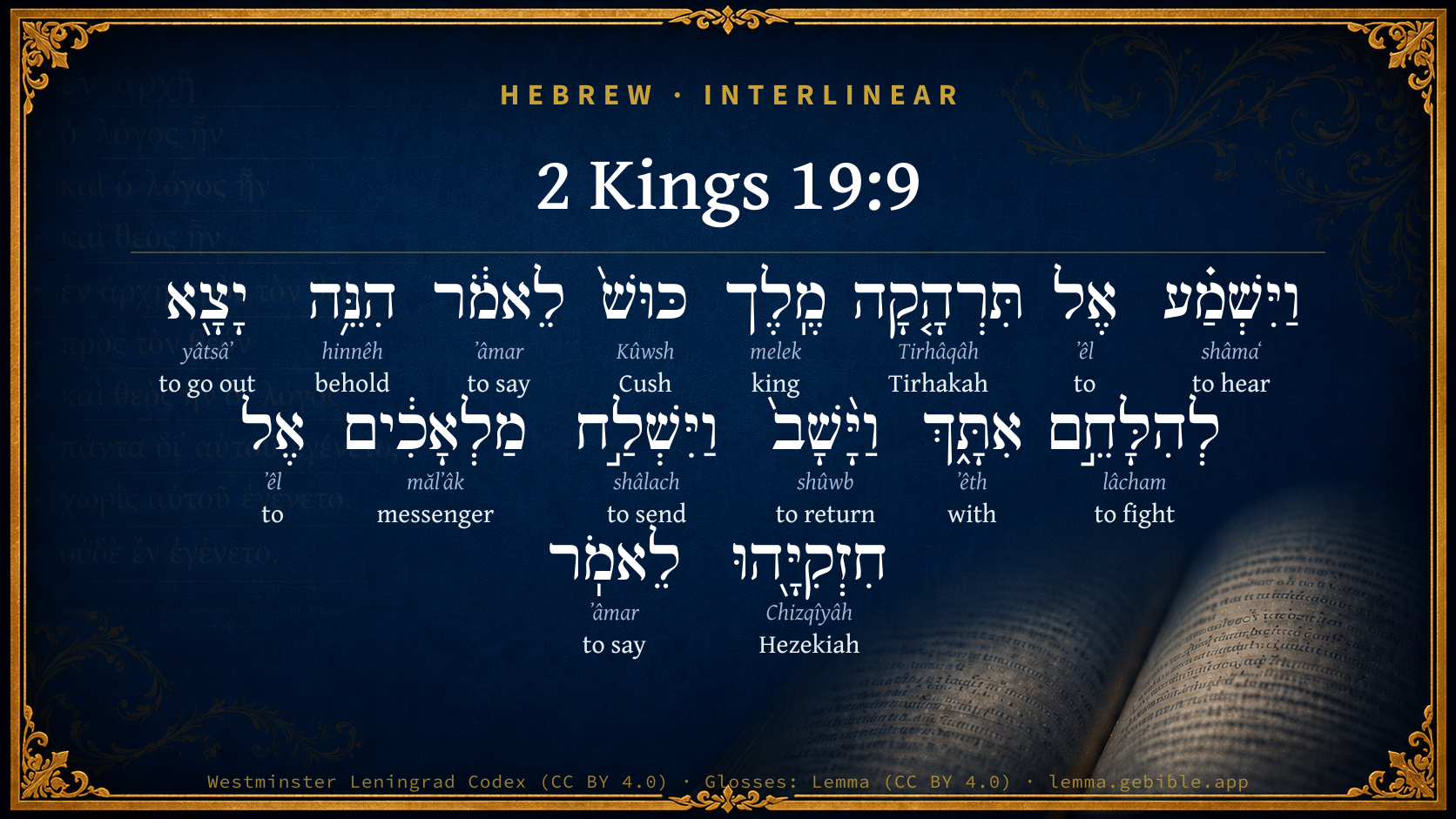
Hebrew (Westminster Leningrad Codex) 2 Kings 19:9 appears in the Hebrew Old Testament. The text above is from the Westminster Leningrad Codex. Each word links to its Strong’s number, a concise gloss, and parsing drawn from the Open Scriptures Hebrew Bible morphology. Click any word for its full Brown-Driver-Briggs (BDB) entry.
Download image
Cite this verse

2 Kings 19:9 (World English Bible). Public Domain. Lemma interlinear Bible study tool, https://lemma.gebible.app/v/2-kings/19/9.

Show BibTeX & RIS
BibTeX
RIS
English Translation
When he heard say of Tirhakah king of Ethiopia, Behold, he is come out to fight against you, he sent messengers again to Hezekiah, saying,
World English Bible · Public Domain
Highlights
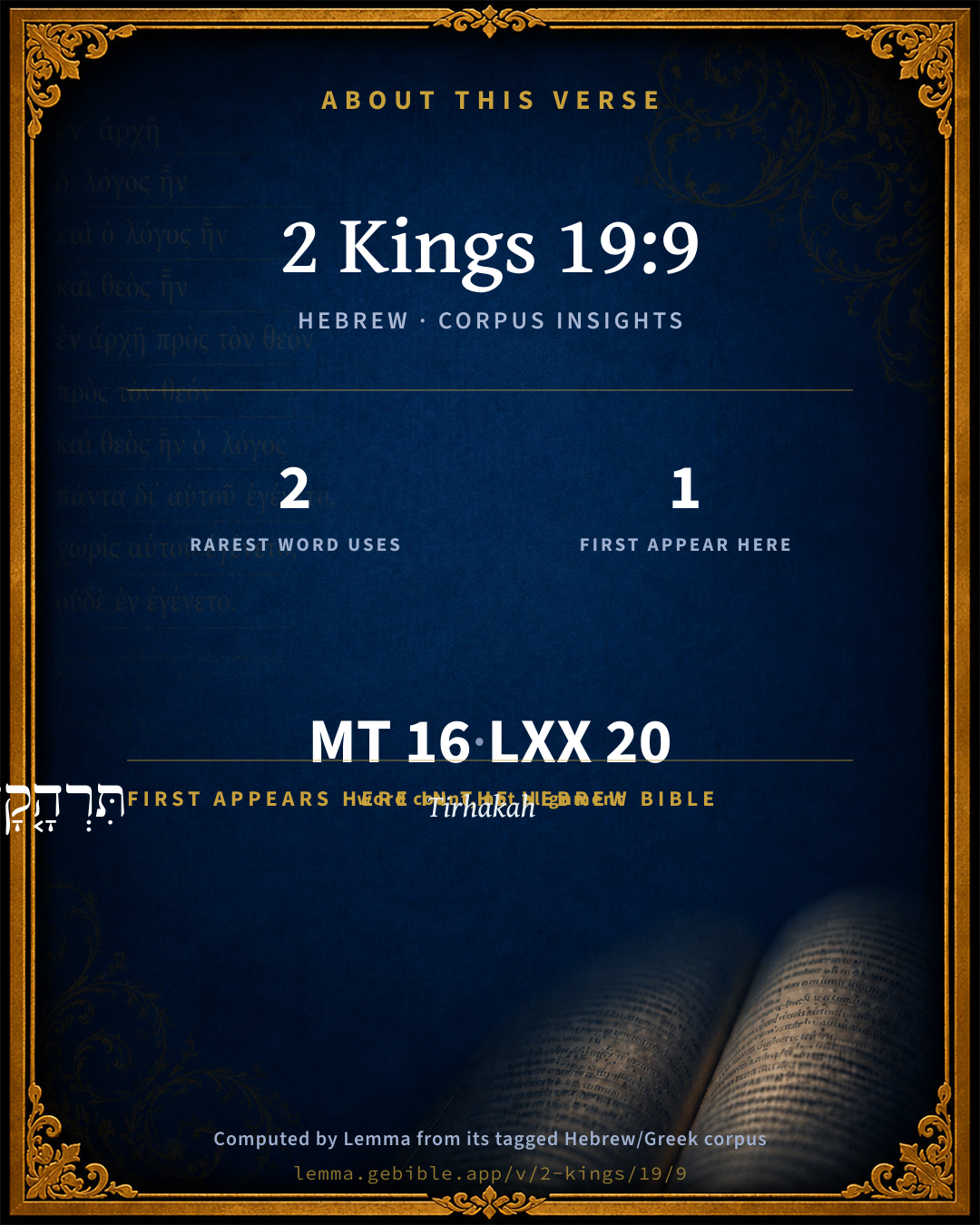
  • 1 first appearance in the Hebrew Bible
Full analysis ↓
Download a study sheet

One document with this verse’s original text, its word-by-word gloss line, the meaning frame, cross-references with their text, attributed commentary, and full source and license credits — printable, and it pastes into notes with its structure intact.

This verse Autodidact and up

Study sheet (.html) Plain text (.txt)

A passage Seminary Student

Up to 50 verses in one chapter. A passage sheet keeps up to 6 commentary sources and 12 cross-references per verse, in the order this page ranks them, and says so on the sheet whenever that leaves anything out. Ask for a single verse and you get the Autodidact verse sheet above.

Everything on this page stays free to read, with no account — the sheet is a download of what is already on screen, not access to it.

Want to remove ads? Support Godless Engineer
Compare translations 3

The same verse in 3 English versions, stacked beneath the original-language interlinear above. Click any original word for its lexicon entry.

Each is an independent rendering of the whole verse — the interlinear is not word-aligned to these translations.

Highlighted words mark where these versions differ — a whole-verse word diff, not a word-by-word alignment.

  • World English Bible Public Domain
    When he heard say of Tirhakah king of Ethiopia, Behold, he is come out to fight against you, he sent messengers again to Hezekiah, saying,
  • King James Version Public Domain
    And when he heard say of Tirhakah king of Ethiopia, Behold, he is come out to fight against thee: he sent messengers again unto Hezekiah, saying,
  • unfoldingWord Literal Text CC BY-SA 4.0
    Then he heard concerning Tirhakah, the king of Cush, saying, “Behold, he has come out to fight with you.” And he returned and sent messengers to Hezekiah, saying,

unfoldingWord Literal Text — © unfoldingWord, licensed CC BY-SA 4.0. Word-aligned USFM3 via Door43 (git.door43.org/unfoldingWord/en_ult).

Versions to compare (up to 4)

3 of 4 selected

Show all 18 translations

Every available English version of this verse, each an independent rendering of the whole verse.

  • World English Bible Public Domain
    When he heard say of Tirhakah king of Ethiopia, Behold, he is come out to fight against you, he sent messengers again to Hezekiah, saying,
  • Berean Standard Bible Public Domain
    Now Sennacherib had been warned about Tirhakah king of Cush: “Look, he has set out to fight against you.” So Sennacherib again sent messengers to Hezekiah, saying,
  • Majority Standard Bible Public Domain
    Now Sennacherib had been warned about Tirhakah king of Cush: “Look, he has set out to fight against you.” So Sennacherib again sent messengers to Hezekiah, saying,
  • King James Version Public Domain
    And when he heard say of Tirhakah king of Ethiopia, Behold, he is come out to fight against thee: he sent messengers again unto Hezekiah, saying,
  • American Standard Version (1901) Public Domain
    And when he heard say of Tirhakah king of Ethiopia, Behold, he is come out to fight against thee, he sent messengers again unto Hezekiah, saying,
  • Revised Version (1885) Public Domain
    And when he heard say of Tirhakah king of Ethiopia, Behold, he is come out to fight against thee: he sent messengers again unto Hezekiah, saying,
  • Geneva Bible (1599) Public Domain
    He heard also men say of Tirhakah King of Ethiopia, Beholde, he is come out to fight against thee: he therefore departed and sent other messengers vnto Hezekiah, saying,
  • Douay-Rheims (1899) Public Domain
    And when he heard of Theraca king of Ethiopia: Behold, he is come out to fight with thee: and was going against him, he sent messengers to Ezechias, saying:
  • Young's Literal Translation Public Domain
    And he heareth concerning Tirhakah king of Cush, saying, `Lo, he hath come out to fight with thee;' and he turneth and sendeth messengers unto Hezekiah, saying,
  • Literal Standard Version CC BY-SA 4.0
    And he hears concerning Tirhakah king of Cush, saying, “Behold, he has come out to fight with you”; and he turns and sends messengers to Hezekiah, saying,
  • Unlocked Literal Bible CC BY-SA 4.0
    Then Sennacherib heard that Tirhakah king of Cush and Egypt had mobilized to fight against him, so he sent messengers again to Hezekiah with a message:
  • unfoldingWord Literal Text CC BY-SA 4.0
    Then he heard concerning Tirhakah, the king of Cush, saying, “Behold, he has come out to fight with you.” And he returned and sent messengers to Hezekiah, saying,
  • Darby Bible Public Domain
    And he heard say of Tirhakah king of Ethiopia, Behold, he has come forth to make war with thee. And he sent messengers again to Hezekiah, saying,
  • World Messianic Bible Public Domain
    When he heard it said of Tirhakah king of Ethiopia, “Behold, he has come out to fight against you,” he sent messengers again to Hezekiah, saying,
  • Webster's Bible Public Domain
    And when he heard it said of Tirhakah king of Cush, Behold, he hath come out to fight against thee: he sent messengers again to Hezekiah, saying,
  • Free Bible Version CC BY-SA 4.0
    Sennacherib had received a message about Tirhakah, king of Ethiopia, that said, “Watch out! He has set out to attack you.” So Sennacherib sent messengers again to Hezekiah, saying,
  • Bible in Basic English Public Domain
    And when news came to him that Tirhakah, king of Ethiopia, had made an attack on him, he sent representatives to Hezekiah again, saying,
  • JPS Tanakh (1917) Public Domain
    And when he heard say of Tirhakah king of Ethiopia: 'Behold, he is come out to fight against thee'; he sent messengers again unto Hezekiah, saying:

Literal Standard Version (2020), Covenant Press — licensed CC BY-SA 4.0. Text via the HelloAO Bible API (eBible.org). Unlocked Literal Bible (unfoldingWord) — licensed CC BY-SA 4.0. Text via the HelloAO Bible API (eBible.org). unfoldingWord Literal Text — © unfoldingWord, licensed CC BY-SA 4.0. Word-aligned USFM3 via Door43 (git.door43.org/unfoldingWord/en_ult). Free Bible Version, Dr. Jonathan Gallagher — licensed CC BY-SA 4.0. Text via the HelloAO Bible API (eBible.org).

Word by word

More ways to search: Search by grammar → Find every occurrence → Compare this word →

Practice this passage: Drill this verse → Learn its vocabulary →

תִּרְהָ֤קָה
Tirhâqâh
H8640
“Tirhakah”
Noun, Proper
Part of Speech
Noun
Type
Proper
Full BDB Definition

Origin: of foreign derivation

TWOT: None

Tirhakah = "he searched out the pious: he searched out the waiter" - king of Ethiopia and Egypt in the time of Sennacherib
  1. וַיִּשְׁמַ֗ע shâmaʻ H8085 “and · to hear” Conjunction + Verb, Qal, Sequential Imperfect, 3rd Person, Masculine, Singular
  2. אֶל ʼêl H413 “to” Preposition
  3. מֶֽלֶך melek H4428 “king of” Noun, Common, Masculine, Singular, Construct
  4. כּוּשׁ֙ Kûwsh H3568 “Cush” Noun, Proper
  5. לֵאמֹ֔ר ʼâmar H559 “to say” Preposition + Verb, Qal, Infinitive Construct
  6. הִנֵּ֥ה hinnêh H2009 “behold” Particle, Demonstrative
  7. יָצָ֖א yâtsâʼ H3318 “to go out” Verb, Qal, Perfect, 3rd Person, Masculine, Singular
  8. לְהִלָּחֵ֣ם lâcham H3898 “to fight” Preposition + Verb, Niphal, Infinitive Construct
  9. אִתָּ֑ךְ ʼêth H854 “with · you” Preposition + Suffix, Personal, 2nd Person, Feminine, Singular
  10. וַיָּ֨שָׁב֙ shûwb H7725 “and · to return” Conjunction + Verb, Qal, Sequential Imperfect, 3rd Person, Masculine, Singular
  11. וַיִּשְׁלַ֣ח shâlach H7971 “and · to send” Conjunction + Verb, Qal, Sequential Imperfect, 3rd Person, Masculine, Singular
  12. מַלְאָכִ֔ים mălʼâk H4397 “messengers” Noun, Common, Masculine, Plural, Absolute
  13. אֶל ʼêl H413 “to” Preposition
  14. חִזְקִיָּ֖הוּ Chizqîyâh H2396 “Hezekiah” Noun, Proper
  15. לֵאמֹֽר ʼâmar H559 “to say” Preposition + Verb, Qal, Infinitive Construct

About this verse

These counts appear in no published source. They are computed here, from the morphology-tagged text and Lemma’s own curated glosses. What Lemma adds →

16
words
14
distinct lemmas
Historical
section

Notable vocabulary

The rarest word here is תִּרְהָ֤קָה Tirhakah H8640 — appearing just 2 times in the whole Hebrew Bible.

First appearance in Scripture

This word makes its first canonical appearance in the Hebrew Bible here:

  • תִּרְהָ֤קָה Tirhakah H8640

Shared distinctive vocabulary

תִּרְהָ֤קָה Tirhakah H8640 occurs in 2 verses of the Hebrew Bible. Also found in:

Grammatical profile

  • 7 verbs
  • 5 nouns
  • 3 prepositions
  • 1 particle

Verb forms

  • וַיִּשְׁמַ֗ע Qal · Sequential Imperfect
  • לֵאמֹ֔ר Qal · Infinitive Construct
  • יָצָ֖א Qal · Perfect
  • לְהִלָּחֵ֣ם Niphal · Infinitive Construct
  • וַיָּ֨שָׁב֙ Qal · Sequential Imperfect
  • וַיִּשְׁלַ֣ח Qal · Sequential Imperfect
  • לֵאמֹֽר Qal · Infinitive Construct

Repetition

Words recur within this verse — often emphatic in Hebrew:

  • לֵאמֹ֔ר to say H559 ×2
  • אֶל to H413 ×2

Hebrew & Septuagint length

In English translation the verse runs 25 words from the Hebrew and 28 from the Septuagint (LXX English) — closely comparable.

A rough comparison of the two English renderings, which tokenize alike — not a word-level alignment.

Word counts can differ between the Hebrew and the Greek without any difference in meaning — e.g. the Hebrew direct-object marker אֵת has no separate Greek word, and Greek often adds the article ὁ.

In the original languages it is 16 Hebrew tokens and 20 Greek tokens — but the two are counted differently (Hebrew bundles its prefixes and suffixes into one token; the Greek is in lemma form), so that isn’t a like-for-like length.

Cross-references

3

Topical passages linked to 2 Kings 19:9 in the Treasury of Scripture Knowledge — connected by theme and wording, ordered by reader-vote popularity; previews shown in the World English Bible.

  • 1 Samuel 23:27 But there came a messenger to Saul, saying, Haste you, and come; for the Philistines have made a raid on the land.
  • 2 Kings 18:17 The king of Assyria sent Tartan and Rabsaris and Rabshakeh from Lachish to king Hezekiah with a great army to Jerusalem. They went up and came to Jerusalem. When they were come up, they came and stood by the conduit of the upper pool, which is in the highway of the fuller's field.
  • Isaiah 37:9 He heard say concerning Tirhakah king of Ethiopia, He is come out to fight against you. When he heard it, he sent messengers to Hezekiah, saying,

Cross-references courtesy of OpenBible.info (CC BY 4.0).

Hebrew and Greek witnesses Masoretic Hebrew ↔ Greek Septuagint

The same verse in the two great witnesses to the Old Testament, shown verse-for-verse.

These are two independent witnesses, not word-aligned to each other, and the Septuagint is shown in lemma (dictionary) form.

Hebrew 2 Kings 19:9 Masoretic · Westminster Leningrad Codex

וַיִּשְׁמַ֗ע אֶל תִּרְהָ֤קָה מֶֽלֶך כּוּשׁ֙ לֵאמֹ֔ר הִנֵּ֥ה יָצָ֖א לְהִלָּחֵ֣ם אִתָּ֑ךְ וַיָּ֨שָׁב֙ וַיִּשְׁלַ֣ח מַלְאָכִ֔ים אֶל חִזְקִיָּ֖הוּ לֵאמֹֽר

When he heard say of Tirhakah king of Ethiopia, Behold, he is come out to fight against you, he sent messengers again to Hezekiah, saying,

World English Bible · Public Domain

Greek LXX 2 Kings 19:9 Septuagint · lemma form

καί ἀκούω περί θαρακα βασιλεύς αἰθίοψ λέγω ἰδού ἐκἔρχομαι πολεμέω μετά σύ καί ἐπιστρέφω καί ἀποστέλλω ἄγγελος πρός εζεκιας λέγω

And he heard concerning Tharaca king of the Ethiopians, saying, Behold, he is come forth to fight with you: and he returned, and sent messengers to Ezekias, saying,

LXX2012 (modern English Septuagint) · Public Domain

Hebrew: Westminster Leningrad Codex (CC BY 4.0). Greek: Septuagint (public domain); English from LXX2012 (modern English Septuagint) (Public Domain). How the Septuagint differs from the Hebrew →

Targum (Aramaic paraphrase)

1

The Targum is the ancient Jewish Aramaic paraphrase of the Hebrew Scriptures — an interpretive translation, not the Hebrew text itself. Onkelos (literal) and Pseudo-Jonathan (expansive) render the Torah, and Jonathan the Prophets. Coverage is partial: where no permissively-licensed English translation exists for a verse, only the Aramaic is shown. This is verse-level text, not a word-by-word alignment to the Hebrew.

  1. Targum Jonathan Prophets (Joshua–Malachi)
    וּשְׁמַע עַל תִּרְהָקָה מַלְכָּא דְכוּשׁ לְמֵימָר הָא נְפַק לְאַגָחָא קְרָבָא עִמָךְ וְתַב וּשְׁלַח אִזְגַדִין לְוַת חִזְקִיָה לְמֵימָר:

    (no public-domain English translation for this verse)

    Targum Jonathan — Aramaic: “Mikraot Gedolot” (public domain). English: “Sefaria Community Translation” (CC0 1.0 (public-domain dedication)); “London "Chaldee Paraphrase," 1871” (public domain). Text via Sefaria.

Commentary

Notes on 2 Kings 19:9 from classic Christian and Jewish commentators (each source and its license shown beneath its notes). The classic Christian expositions comment on the surrounding passage and are grouped to its opening verse, so a note may address several verses; the Jewish commentaries on the Tanakh (Rashi and others) are per-verse, so they appear only where the commentator wrote on this verse.

Lemma curates 59 commentaries, every one of them public domain or Creative Commons licensed, each selected and text-cleaned for this edition rather than reprinted as found. About our sources →

Trapp's Complete Commentary

John Trapp

2Ki 19:9 And when he heard say of Tirhakah king of Ethiopia, Behold, he is come out to fight against thee: he sent messengers again unto Hezekiah, saying,

Ver. 9. Of Tirhakah king of Ethiopia.] A potent prince. See 2Ch 14:9. Strabo {a} called him Tearkon the Ethiopian; and further relateth out of Megasthenes, an old historian, that he passed into Europe, and advanced as far as to Hercules’s pillars.

King of Ethiopia.] Not of that Ethiopia, saith Drusius, which is above Egypt, and now the kingdom of the Abyssines, but of that which is part of Arabia, and is called Chusaea. The word here rendered Ethiopia is Cush.

Behold, he is come out to fight against thee.] Regnum Assyriorum invadit, saith Sulpitius, he invaded Assyria. Not so, saith Drusius, but he went to fight against Sennacherib, in favour of the Jews, while he lay before Libnah; or at least against Rabshakeh, who besieged Jerusalem.

He sent messengers.] And withal he gave them letters {2Ki 19:14} to the same effect with his message; so eager was he upon Jerusalem, which yet he should never lick his lips with.

{a} Lib. i. cap. 15.

John Trapp, A Commentary or Exposition upon All the Books of the Old and New Testament (1647–1656) — public domain. Text from a community e-Sword module.

Joseph Benson's Commentary

2Ki 19:9. He heard say of Tirhakah, king of Ethiopia, &c. — Probably of Ethiopia beyond Egypt. For Josephus affirms that the Egyptians (against whom, according to Herodotus and Berosus, this Sennacherib warred) and Ethiopians were confederates in this expedition. It is most likely he was the same with the Sabaco of Herodotus. See Universal Hist., vol. 4, p. 321. He sent messengers again unto Hezekiah — It is probable the king of Assyria thought by this message to terrify Hezekiah and the people to compliance, which it was now the more necessary for him to do, as the invasion of Tirhakah rendered it less proper for him to attempt so long a siege as that of Jerusalem was likely to prove.

Joseph Benson's Commentary on the Old and New Testaments (1811–1818) — public domain. Text from a community e-Sword module.

Tyndale Open Study Notes

Tyndale Open Resources

19:9 King Tirhakah of Ethiopia would later become pharaoh over Egypt. At this time he was a commander in his brother Shebitku’s army.

Tyndale Open Study Notes — © Tyndale Open Resources, licensed CC BY-SA 4.0. Text via the HelloAO Bible API.

Geneva Bible (1599)

Geneva Bible translators

For the Kings of Ethiopia and Egypt joined together against the King of Assyria because of his oppression of other countries.

That is, Sennacherib.

Or, black Moors.

Geneva Bible (1599) marginal notes — public domain. Text via Bolls.life.

Jamieson, Fausset & Brown

Robert Jamieson, A. R. Fausset & David Brown

when he heard say of Tirhakah . . ., Behold, he is come out to fight against thee, &c.--This was the "rumor" to which Isaiah referred [Kg2 19:7]. Tirhakah reigned in Upper Egypt, while So (or Sabaco) ruled in Lower Egypt. He was a powerful monarch, another Sesostris, and both he and Sabaco have left many monuments of their greatness. The name and figure of Tirhakah receiving war captives, are still seen in the Egyptian temple of Medinet Abou. This was the expected succor which was sneered at by Rab-shakeh as "a bruised reed" (Kg2 18:21). Rage against Hezekiah for allying himself with Egypt, or the hope of being better able to meet this attack from the south, induced him, after hearing the rumor of Tirhakah's advance, to send a menacing letter to Hezekiah, in order that he might force the king of Judah to an immediate surrender of his capital. This letter, couched in the same vaunting and imperious style as the speech of Rab-shakeh, exceeded it in blasphemy, and contained a larger enumeration of conquered places, with the view of terrifying Hezekiah and showing him the utter hopelessness of all attempts at resistance.

Jamieson, Fausset & Brown — Commentary Critical and Explanatory on the Whole Bible (1871) — public domain (CC PDM 1.0). Text via the HelloAO Bible API.

Ellicott's Commentary for English Readers

(9) Heard say of Tirhakah.—For the construction, comp. Psa_2:7; Psa_3:2.

Tirhakah.—Called in Egyptian inscriptions Taharka, in Assyrian Tarqû; the Ταρακὺς of Manetho, and Teapxwws of Strabo. He was the last king of the 25th, or Ethiopian (Cushite) dynasty, and son of Shabataka the son of Shabaka (2Ki_17:4). Sennacherib does not name Tirhakah, but calls him “the king of Meluhhu,” i.e., Meroë. The two successors of Sennacherib had further wars with Tirhakah. Esarhaddon, according to notices in the annals of Assurbanipal, conquered Tirhakah, “king of Mizraim and Cush, and divided Egypt between a number of vassal kings. A list of twenty names is preserved, beginning with” Necho king of Memphis and Sais.” This was Esarhaddon’s tenth expedition (circ. 671 B.C. ). Tirhakah, however, invaded Egypt once more, for “he despised the might of Asshur, Istar, and the great gods my lords, and trusted to his own power.” This led to Assurbanipal’s first expedition, which was directed against Egypt. Ewald and Knobel suppose that Isaiah 18 refers to an embassy from Tirhakah asking the co-operation of Judah against the common foe. If it be alleged that Shabataka was still nominal king of Egypt, we may regard Tirhakah as commanding in his father’s name. But Egyptian chronology is too uncertain to be allowed much weight in the question.

A Bible Commentary for English Readers, edited by Charles John Ellicott (1878–1897) — public domain. Text from a community e-Sword module.

The Cambridge Bible for Schools and Colleges

gen. ed. J. J. S. Perowne

9. And when he heard say of Tirhakah] Tirhakah is called by Manetho, Tarakos. He was the third and last king of the 25th dynasty, which was Ethiopian. The duration of his reign is not accurately known. The news of Tirhakah’s advance caused Sennacherib to feel the importance of getting Jerusalem into his possession, seeing it was so much stronger than any position which he yet had. It had been a fortress of considerable importance in the time of the Jebusites (2Sa_5:6), and in the intervening period between David and Hezekiah its defences had been made much more complete.

he sent messengers again unto Hezekiah] This time they were the bearers of a letter (see below, verse 14) to the king. This may be the letter alluded to 2Ch_32:17.

The Cambridge Bible for Schools and Colleges (gen. ed. J. J. S. Perowne; Cambridge University Press, 1878–1918) — public domain. Text from a community e-Sword module.

Albert Barnes' Notes on the Bible

Tirhakah king of Ethiopia - The Tehrak or Teharka of the hieroglyphics. He was the last king of the 25th or Ethiopian dynasty, which commenced with Shebek or Sabaco, and he reigned upward of 26 years. The Assyrian inscriptions show that he still ruled in Egypt as late as 667 B.C., when Esarhaddon 2Ki 19:37 died, and his son Asshur-bani-pal succeeded him. He probably ascended the Egyptian throne about 692 B.C., having previously ruled over Ethiopia before he became king of Egypt (compare Isa 37:9). Thus he was probably reigning in Ethiopia at the time of Sennacherib’s expedition, while Sethos and perhaps other secondary monarchs bore rule over Egypt. His movements caused Sennacherib to send a second embassy, instead of marching in person against the Jewish king.

Albert Barnes' Notes on the Bible (1834–1885) — public domain. Text from a community e-Sword/MySword module.

Haydock's Catholic Bible Commentary

When he, Sennacherib, though it would seem to refer to Rabsaces. (Haydock) --- Tharaca, called by Thearchon by Strabo, (i., and xv. p. 653.) extended his conquests as far as the pillars of Hercules. (Megasthenes) --- The Egyptians seem to have called him Sethon, and assert that the god (Vulcan) appeared to him on the approach of Sennacherib, assuring him of his protection. He encamped near Pelusium, where the enemy’s army on its arrival was infested with rats, which destroyed their armour, and made them an easy prey. (Herodotus ii. 141.) It is probable that Taphnes, near Pelusium, was the capital city of Tharaca, Isaias xviii., and xxx. 4. He does not appear to have joined battle with Sennacherib, whose army was destroyed on its march (Isaias x. 24.) the very night that the prophet promised Ezechias a deliverance.

George Leo Haydock (1774–1849), Haydock's Catholic Family Bible and Commentary, 1859 edition — public domain. Excludes Psalms (Douay-Rheims chapter numbering differs from Protestant) and Deuterocanonical books (Catholic canon only).

Matthew Poole's English Annotations

King of Ethiopia, Heb. of Cush, i.e. either,

1. Of Arabia, as that word is most commonly meant; of which see the notes, and especially my Latin Synopsis, upon Num 12:1. Or rather,

2. Of Ethiopia beyond Egypt. Nor was there any need that he should force his passage through Egypt, which is objected against this opinion by a very learned man; because the Egyptians (against whom this Sennacherib warred, as heathen historians, Herodotus and Berosus, relate) and the Ethiopians were confederates in this expedition, as Josephus expressly affirms; who lived above 1600 years nearer the time when this was done than we, and therefore was more likely to understand it.

Matthew Poole's English Annotations on the Holy Bible (1683–1685) — public domain. Text from a community e-Sword/MySword module.

Whedon's Commentary on the Bible

Daniel D. Whedon

9. Tirhakah king of Ethiopia — According to Manetho he was the third and last king of the twenty-fifth Egyptian dynasty. His successful resistance of the Assyrian invasion is chronicled on the walls of a temple at Thebes, and his monuments still exist in Egypt and Ethiopia. Rawlinson treats of the events connected with this verse as follows: “The Apis stelae show that Tirhakah did not ascend the throne of Egypt till B.C. 690, eight years after this; but he may have been already, as he is called in Scripture, king of Ethiopia. It is probable that Sennacherib, having received the submission of Libnah, had advanced upon Egypt. It was important to crush an Egyptian army which had been collected against him by a certain Sethos, one of the many native princes who at this time ruled in the lower country, before the great Ethiopian monarch Tehrak, or Tirhakah, who was known to be on his march, should effect a junction with the troops of this minor potentate. Sethos, with his army, was at Pelusium, (Herodotus, 2:141,) and Sennacherib, advancing to attack him, had arrived within sight of the Egyptian host, and pitched his camp over against the camp of the enemy, just at the time when Hezekiah received his letter and made the prayer to which Isaiah was instructed to respond. The two hosts lay down at night in their respective stations, the Egyptians and their king full of anxious alarm, Sennacherib and his Assyrians proudly confident, intending on the morrow to advance to the combat and repeat the lesson taught at Raphia and Attaku.” — Ancient Monarchies, vol. ii, p. 167.

Sent messengers again — For with the Ethiopian forces before him he did not wish to have Jerusalem fall upon his rear, and he apparently hoped to awe Hezekiah into a surrender.

Daniel D. Whedon (gen. ed.), Commentary on the Old and New Testaments (1874–1909) — public domain. Text from a community e-Sword module.

The Pulpit Commentary

Vers. 9-14. Sennacherib"s letter to Hezekiah. Sennacherib seems to have been induced to write to Hezekiah by the fact that he could not march against him at once. A forward movement on the part of Tirhakah was reported to him (ver. 9), and he thought it necessary to meet, or at least watch it. But he must vent his anger on the rebel Judaean monarch in some way. He sends a letter, therefore, as more weighty and impressive than a mere message. He warns Hezekiah against being himself deceived by Jehovah (ver. 10); and he expands his inductive argument in proof of the irresistible might of Assyria, by an enumeration of four more recent conquests (ver. 12). Otherwise, he does little but repeat what Rabshakeh had already urged.

And when he heard say of Tirhakah King of Ethiopia. Tirhakah was one of the most distinguished of the later Egyptian monarchs. An Ethiopian by birth, and originally ruling from Napata over the Upper Nile valley from the First Cataract to (perhaps) Khartoum, he extended his dominion over Egypt probably about B.C. 700, maintaining, however, Shabatok, as a sort of puppet-king, upon the throne. About B.C. 693 he succeeded Shabatok, and held the throne till B.C. 667, being engaged in many wars with the Assyrians. The native form of his name is "Tahrak" or "Tahark," the Assyrian "Tarku" or "Tarqu," the Greek "Taracos" or "Tearchon." He has left numerous memorials in Egypt and Ethiopia, and was regarded by the Greeks as a great conqueror. At the time of Sennacherib"s second attack on Hezekiah (about B.C. 699) he was, as appears in the text, not yet King of Egypt, but only of Ethiopia. Still, he regarded Egypt as practically under his suzerainty, and when it was threatened by Sennacherib"s approach, he marched to the rescue. Behold, he is come out to fight against thee. He may have regarded himself as bound in honor to come to the relief of Hezekiah, or he may have been simply bent on defending his own territory. He sent messengers again unto Hezekiah, saying,

The Pulpit Commentary (1880–1919), ed. H.D.M. Spence-Jones & Joseph S. Exell — public domain. Text from a community e-Sword module.

Rashi

Rabbi Shlomo Yitzchaki (Rashi)

He again sent messengers. To notify him that he was not returning to his land, rather he was waging war with Cush, and then to return here.

Rashi on the Tanakh — English translations: “The Judaica Press complete Tanach with Rashi, translated by A. J. Rosenberg” (CC BY 4.0); “Pentateuch with Rashi's commentary by M. Rosenbaum and A.M. Silbermann, 1929-1934” (public domain); “The Metsudah Tanach series, Lakewood, N.J” (CC BY 4.0); and “The Book of Joshua, Metsudah Publications, 1997” (CC BY 4.0). Text via Sefaria.

Lesson kit

Teaching starters — assembled from the data on this page, not authored interpretation. Every prompt links to the verse data it draws on. Edit before teaching.

2 Kings, in the Historical, opens this verse with 16 words (14 distinct Hebrew lemmas). Its most distinctive word is Tirhâqâh (“Tirhakah”). A historical commentator’s framing appears above. Read the whole chapter for the surrounding context.

Discussion questions

  1. How does “Tirhakah” (Tirhâqâh) shape what this verse is saying?
  2. This is the first place “Tirhakah” appears in Scripture (first appears here). What does its debut here establish?
  3. How does Isaiah 37:9, which shares the word «Tirhakah», read alongside this verse?
  4. What does the repetition of “to say” (2× in this one verse) do in this verse?
  5. These translations render this verse differently; the difference is in the English rendering, not the original. What questions does that raise?
  6. «וַיִּשְׁמַ֗ע» is a Qal Sequential Imperfect verb. How does that grammatical form shape the action described?
  7. Compare how Trapp's Complete Commentary and Joseph Benson's Commentary read this verse. Where do they agree or differ?

Things to notice

Reading settings

Reading text

Shown beneath each verse's original-language words.

Old Testament
Old Testament edition

Read the OT as the Masoretic Hebrew (MT) or the Greek Septuagint (LXX).

English shown for the Greek Septuagint (in the Hebrew ↔ Greek comparison).

Comparing translations? Open the Compare panel on any verse page to stack up to four side by side.