
2 Chronicles 35:21

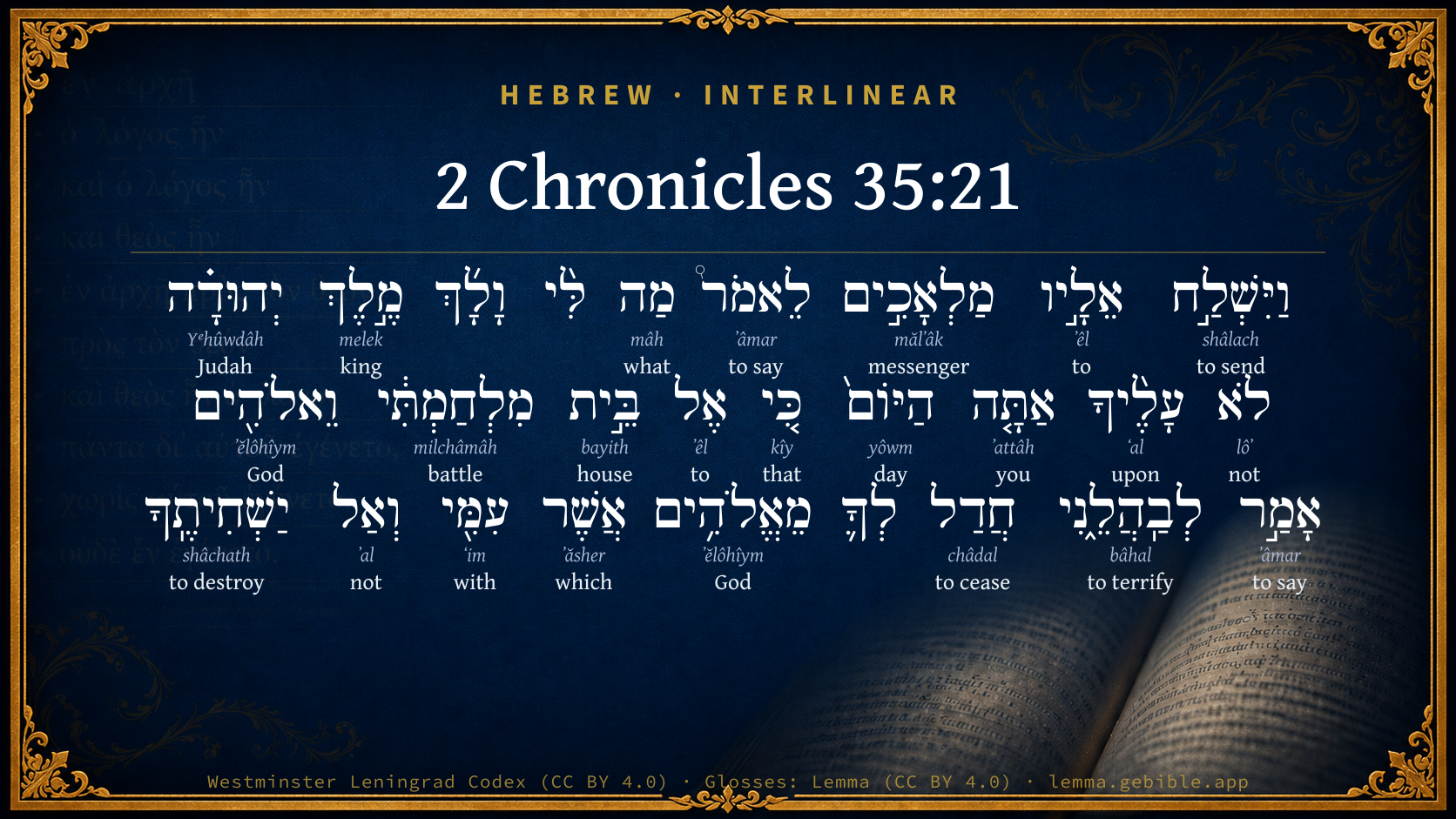
Hebrew (Westminster Leningrad Codex) 2 Chronicles 35:21 appears in the Hebrew Old Testament. The text above is from the Westminster Leningrad Codex. Each word links to its Strong’s number, a concise gloss, and parsing drawn from the Open Scriptures Hebrew Bible morphology. Click any word for its full Brown-Driver-Briggs (BDB) entry.
Download image
Cite this verse

2 Chronicles 35:21 (World English Bible). Public Domain. Lemma interlinear Bible study tool, https://lemma.gebible.app/v/2-chronicles/35/21.

Show BibTeX & RIS
BibTeX
RIS
English Translation
But he sent ambassadors to him, saying, What have I to do with you, you king of Judah? [I come] not against you this day, but against the house with which I have war; and God has commanded me to make haste: forbear you from [meddling with] God, who is with me, that he not destroy you.
World English Bible · Public Domain
Download a study sheet

One document with this verse’s original text, its word-by-word gloss line, the meaning frame, cross-references with their text, attributed commentary, and full source and license credits — printable, and it pastes into notes with its structure intact.

This verse Autodidact and up

Study sheet (.html) Plain text (.txt)

A passage Seminary Student

Up to 50 verses in one chapter. A passage sheet keeps up to 6 commentary sources and 12 cross-references per verse, in the order this page ranks them, and says so on the sheet whenever that leaves anything out. Ask for a single verse and you get the Autodidact verse sheet above.

Everything on this page stays free to read, with no account — the sheet is a download of what is already on screen, not access to it.

Want to remove ads? Support Godless Engineer
Compare translations 3

The same verse in 3 English versions, stacked beneath the original-language interlinear above. Click any original word for its lexicon entry.

Each is an independent rendering of the whole verse — the interlinear is not word-aligned to these translations.

Highlighted words mark where these versions differ — a whole-verse word diff, not a word-by-word alignment.

  • World English Bible Public Domain
    But he sent ambassadors to him, saying, What have I to do with you, you king of Judah? [I come] not against you this day, but against the house with which I have war; and God has commanded me to make haste: forbear you from [meddling with] God, who is with me, that he not destroy you.
  • King James Version Public Domain
    But he sent ambassadors to him, saying, What have I to do with thee, thou king of Judah? I come not against thee this day, but against the house wherewith I have war: for God commanded me to make haste: forbear thee from meddling with God, who is with me, that he destroy thee not.
  • unfoldingWord Literal Text CC BY-SA 4.0
    And he sent to him messengers, saying, “What to me and to you, King of Judah? Not against you yourself today, but against the house of my battle. And God said for me to hurry. Stop yourself from God, who is with me, and let him not destroy you.”

unfoldingWord Literal Text — © unfoldingWord, licensed CC BY-SA 4.0. Word-aligned USFM3 via Door43 (git.door43.org/unfoldingWord/en_ult).

Versions to compare (up to 4)

3 of 4 selected

Show all 18 translations

Every available English version of this verse, each an independent rendering of the whole verse.

  • World English Bible Public Domain
    But he sent ambassadors to him, saying, What have I to do with you, you king of Judah? [I come] not against you this day, but against the house with which I have war; and God has commanded me to make haste: forbear you from [meddling with] God, who is with me, that he not destroy you.
  • Berean Standard Bible Public Domain
    But Neco sent messengers to him, saying, “What is the issue between you and me, O king of Judah? I have not come against you today, but I am fighting another dynasty. God told me to hurry; so stop opposing God, who is with me, or He will destroy you!”
  • Majority Standard Bible Public Domain
    But Neco sent messengers to him, saying, “What is the issue between you and me, O king of Judah? I have not come against you today, but I am fighting another dynasty, and God has told me to hurry. So stop opposing God, who is with me, or He will destroy you!”
  • King James Version Public Domain
    But he sent ambassadors to him, saying, What have I to do with thee, thou king of Judah? I come not against thee this day, but against the house wherewith I have war: for God commanded me to make haste: forbear thee from meddling with God, who is with me, that he destroy thee not.
  • American Standard Version (1901) Public Domain
    But he sent ambassadors to him, saying, What have I to do with thee, thou king of Judah? `I come' not against thee this day, but against the house wherewith I have war; and God hath commanded me to make haste: forbear thee from `meddling with' God, who is with me, that he destroy thee not.
  • Revised Version (1885) Public Domain
    But he sent ambassadors to him, saying, What have I to do with thee, thou king of Judah? I come not against thee this day, but against the house wherewith I have war; and God hath commanded me to make haste: forbear thee from meddling with God, who is with me, that he destroy thee not.
  • Geneva Bible (1599) Public Domain
    But he sent messengers to him, saying, What haue I to doe with thee, thou King of Iudah? I come not against thee this day, but against the house of mine enemie, and God commanded me to make haste: leaue of to come against God, which is with me, least he destroy thee.
  • Douay-Rheims (1899) Public Domain
    But he sent messengers to him, saying: What have I to do with thee, O king of Juda? I come not against thee this day, but I fight against another house, to which God hath commanded me to go in haste: forbear to do against God, who is with me, lest he kill thee.
  • Young's Literal Translation Public Domain
    and he sendeth unto him messengers, saying, `What -- to me and to thee, O king of Judah? not against thee do I come to-day, but unto the house with which I have war, and God said to haste me; cease for thee from God who `is' with me, and He doth not destroy thee.'
  • Literal Standard Version CC BY-SA 4.0
    and he sends messengers to him, saying, “And what do I [have to do] with you, O king of Judah? I do not come against you today, but to the house with which I have war, and God commanded to hurry me; cease for yourself from God who [is] with me, and He does not destroy you.”
  • Unlocked Literal Bible CC BY-SA 4.0
    But Necho sent ambassadors to him, saying, “What have I to do with you, king of Judah? I am not coming against you today, but against the house with which I am making war. God has commanded me to hurry, so refrain from interfering with God, who is with me, or he might destroy you.”
  • unfoldingWord Literal Text CC BY-SA 4.0
    And he sent to him messengers, saying, “What to me and to you, King of Judah? Not against you yourself today, but against the house of my battle. And God said for me to hurry. Stop yourself from God, who is with me, and let him not destroy you.”
  • Darby Bible Public Domain
    And he sent messengers to him, saying, What have I to do with thee, thou king of Judah? I come not against thee this day, but against the house with which I have war; and God has told me to make haste: keep aloof from God who is with me, that he destroy thee not.
  • World Messianic Bible Public Domain
    But he sent ambassadors to him, saying, “What have I to do with you, you king of Judah? I come not against you today, but against the house with which I have war. God has commanded me to make haste. Beware that it is God who is with me, that he not destroy you.”
  • Webster's Bible Public Domain
    But he sent embassadors to him, saying, What have I to do with thee, thou king of Judah? I come not against thee this day, but against the house with which I have war: for God commanded me to make haste: forbear thee from meddling with God, who is with me, that he may not destroy thee.
  • Free Bible Version CC BY-SA 4.0
    Neco sent messengers to him, saying, “What argument is there between you and me, king of Judah? I have not come to attack you today, because I'm fighting with another kingdom. God told me I should hurry, so stop obstructing God, who is with me, or he'll destroy you!”
  • Bible in Basic English Public Domain
    But he sent representatives to him, saying, What have I to do with you, O king of Judah? I have not come against you this day, but against those with whom I am at war; and God has given me orders to go forward quickly: keep out of God's way, for he is with me, or he will send destruction on you.
  • JPS Tanakh (1917) Public Domain
    But he sent ambassadors to him, saying: 'What have I to do with thee, thou king of Judah? I come not against thee this day, but against the house wherewith I have war; and God hath given command to speed me; forbear thee from meddling with God, who is with me, that He destroy thee not.'

Literal Standard Version (2020), Covenant Press — licensed CC BY-SA 4.0. Text via the HelloAO Bible API (eBible.org). Unlocked Literal Bible (unfoldingWord) — licensed CC BY-SA 4.0. Text via the HelloAO Bible API (eBible.org). unfoldingWord Literal Text — © unfoldingWord, licensed CC BY-SA 4.0. Word-aligned USFM3 via Door43 (git.door43.org/unfoldingWord/en_ult). Free Bible Version, Dr. Jonathan Gallagher — licensed CC BY-SA 4.0. Text via the HelloAO Bible API (eBible.org).

Word by word

More ways to search: Search by grammar → Find every occurrence → Compare this word →

Practice this passage: Drill this verse → Learn its vocabulary →

לְבַֽהֲלֵ֑נִי
bâhal
H926
“to terrify · me”
Preposition + Verb, Piel, Infinitive Construct + Suffix, Personal, 1st Person, Common, Singular
Part of Speech
Preposition + Verb
Stem
Piel
Form
Infinitive Construct
Full BDB Definition

Origin: a primitive root

TWOT: 207

to disturb, alarm, terrify, hurry, be disturbed, be anxious, be afraid, be hurried, be nervous - (Niphal) - to be disturbed, dismayed, terrified, anxious - to be in haste, be hasty - (Piel) - to make haste, act hastily, be hurried, be hastened - to dismay, terrify - (Pual) - to hasten - hastened, hastily gained (participle) - (Hiphil) - to hasten, hurry, make haste - to dismay, terrify
  1. וַיִּשְׁלַ֣ח shâlach H7971 “and · to send” Conjunction + Verb, Qal, Sequential Imperfect, 3rd Person, Masculine, Singular
  2. אֵלָ֣יו ʼêl H413 “to · him” Preposition + Suffix, Personal, 3rd Person, Masculine, Singular
  3. מַלְאָכִ֣ים mălʼâk H4397 “messengers” Noun, Common, Masculine, Plural, Absolute
  4. לֵאמֹר֩ ʼâmar H559 “to say” Preposition + Verb, Qal, Infinitive Construct
  5. מַה mâh H4100 “what” Particle, Interrogative
  6. מֶ֣לֶךְ melek H4428 “king of” Noun, Common, Masculine, Singular, Construct
  7. יְהוּדָ֗ה Yᵉhûwdâh H3063 “Judah” Noun, Proper
  8. לֹא lôʼ H3808 “not” Particle, Negative
  9. עָלֶ֨יךָ ʻal H5921 “upon · you” Preposition + Suffix, Personal, 2nd Person, Masculine, Singular
  10. אַתָּ֤ה ʼattâh H859 “you” Pronoun, Personal, 2nd Person, Masculine, Singular
  11. הַיּוֹם֙ yôwm H3117 “the · day” Particle, Definite Article + Noun, Common, Masculine, Singular, Absolute
  12. כִּ֚י kîy H3588 “that” Conjunction
  13. אֶל ʼêl H413 “to” Preposition
  14. בֵּ֣ית bayith H1004 “house of” Noun, Common, Masculine, Singular, Construct
  15. מִלְחַמְתִּ֔י milchâmâh H4421 “battle · my” Noun, Common, Feminine, Singular, Construct + Suffix, Personal, 1st Person, Common, Singular
  16. וֵאלֹהִ֖ים ʼĕlôhîym H430 “and · God(s)” Conjunction + Noun, Common, Masculine, Plural, Absolute
  17. אָמַ֣ר ʼâmar H559 “to say” Verb, Qal, Perfect, 3rd Person, Masculine, Singular
  18. חֲדַל châdal H2308 “cease” Verb, Qal, Imperative, 2nd Person, Masculine, Singular
  19. מֵאֱלֹהִ֥ים ʼĕlôhîym H430 “from · God(s)” Preposition + Noun, Common, Masculine, Plural, Absolute
  20. אֲשֶׁר ʼăsher H834 “which” Particle, Relative
  21. עִמִּ֖י ʻim H5973 “with · me” Preposition + Suffix, Personal, 1st Person, Common, Singular
  22. וְאַל ʼal H408 “and · not” Conjunction + Particle, Negative
  23. יַשְׁחִיתֶֽךָ shâchath H7843 “to destroy · you” Verb, Hiphil, Jussive, 3rd Person, Masculine, Singular + Suffix, Personal, 2nd Person, Masculine, Singular

About this verse

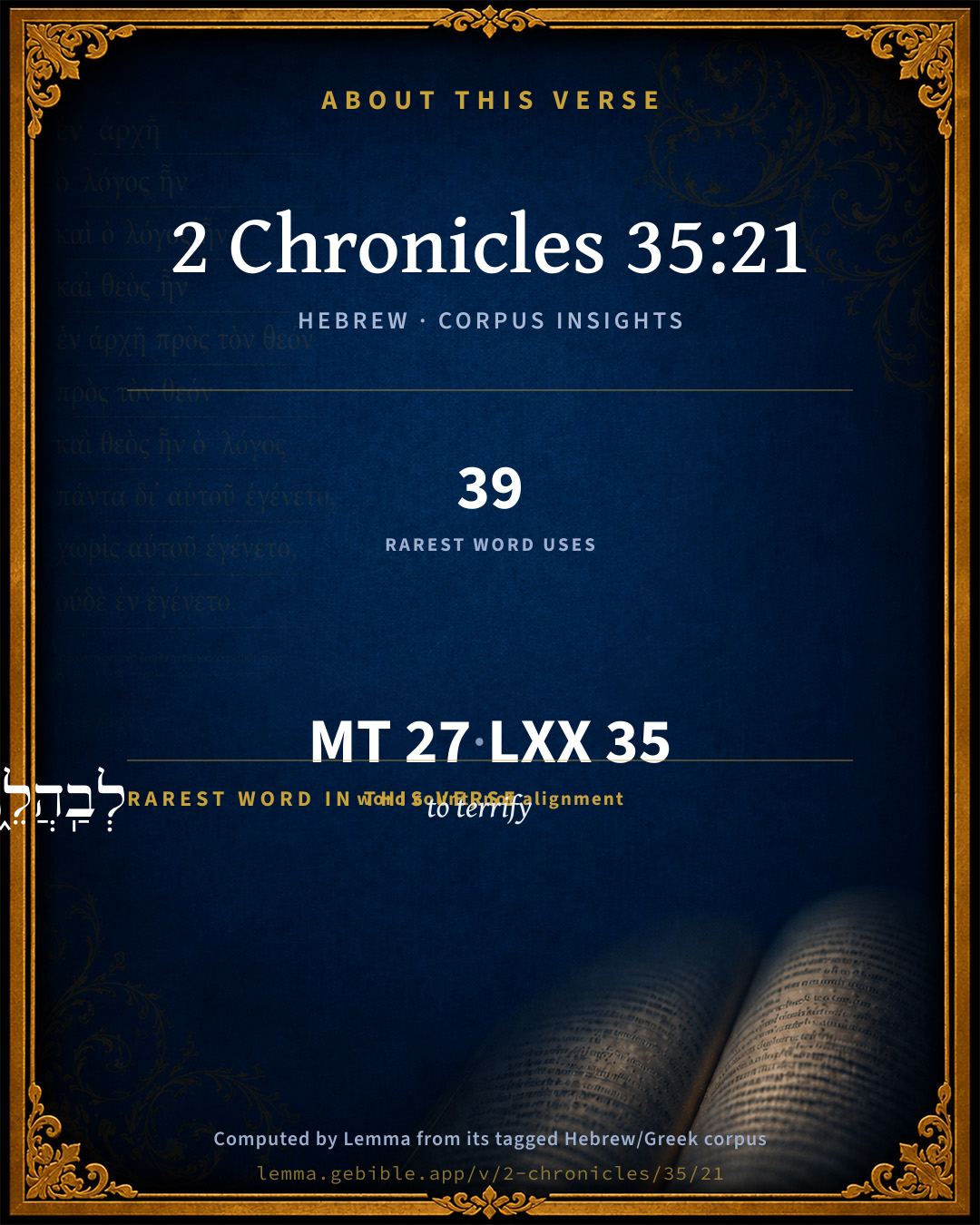
These counts appear in no published source. They are computed here, from the morphology-tagged text and Lemma’s own curated glosses. What Lemma adds →

27
words
21
distinct lemmas
Historical
section

Shared distinctive vocabulary

לְבַֽהֲלֵ֑נִי to terrify H926 occurs in 39 verses of the Hebrew Bible. Also found in:

Grammatical profile

  • 6 verbs
  • 8 nouns
  • 1 pronoun
  • 7 prepositions
  • 1 conjunction
  • 4 particles

Verb forms

  • וַיִּשְׁלַ֣ח Qal · Sequential Imperfect
  • לֵאמֹר֩ Qal · Infinitive Construct
  • אָמַ֣ר Qal · Perfect
  • לְבַֽהֲלֵ֑נִי Piel · Infinitive Construct
  • חֲדַל Qal · Imperative
  • יַשְׁחִיתֶֽךָ Hiphil · Jussive

Repetition

Words recur within this verse — often emphatic in Hebrew:

  • לֵאמֹר֩ to say H559 ×2
  • וֵאלֹהִ֖ים God H430 ×2
  • אֵלָ֣יו to H413 ×2

Hebrew & Septuagint length

In English translation the verse runs 57 words from the Hebrew and 46 from the Septuagint (LXX English) — closely comparable.

A rough comparison of the two English renderings, which tokenize alike — not a word-level alignment.

Word counts can differ between the Hebrew and the Greek without any difference in meaning — e.g. the Hebrew direct-object marker אֵת has no separate Greek word, and Greek often adds the article ὁ.

In the original languages it is 27 Hebrew tokens and 35 Greek tokens — but the two are counted differently (Hebrew bundles its prefixes and suffixes into one token; the Greek is in lemma form), so that isn’t a like-for-like length.

Cross-references

6

Topical passages linked to 2 Chronicles 35:21 in the Treasury of Scripture Knowledge — connected by theme and wording, ordered by reader-vote popularity; previews shown in the World English Bible.

  • 2 Kings 18:25 Am I now come up without Yahweh against this place to destroy it? Yahweh said to me, Go up against this land, and destroy it.
  • 2 Chronicles 25:19 You say, Behold, you have struck Edom; and your heart lifts you up to boast: abide now at home; why should you meddle to [your] hurt, that you should fall, even you, and Judah with you?
  • 2 Samuel 16:10 The king said, What have I to do with you, you sons of Zeruiah? Because he curses, and because Yahweh has said to him, Curse David; who then shall say, Why have you done so?
  • Isaiah 36:10 Am I now come up without Yahweh against this land to destroy it? Yahweh said to me, Go up against this land, and destroy it.
  • Matthew 8:29 Behold, they cried out, saying, "What do we have to do with you, Jesus, Son of God? Have you come here to torment us before the time?"
  • John 2:4 Jesus said to her, "Woman, what does that have to do with you and me? My hour has not yet come."

Cross-references courtesy of OpenBible.info (CC BY 4.0).

Hebrew and Greek witnesses Masoretic Hebrew ↔ Greek Septuagint

The same verse in the two great witnesses to the Old Testament, shown verse-for-verse.

These are two independent witnesses, not word-aligned to each other, and the Septuagint is shown in lemma (dictionary) form.

Hebrew 2 Chronicles 35:21 Masoretic · Westminster Leningrad Codex

וַיִּשְׁלַ֣ח אֵלָ֣יו מַלְאָכִ֣ים לֵאמֹר֩ מַה לִּ֨י וָלָ֜ךְ מֶ֣לֶךְ יְהוּדָ֗ה לֹא עָלֶ֨יךָ אַתָּ֤ה הַיּוֹם֙ כִּ֚י אֶל בֵּ֣ית מִלְחַמְתִּ֔י וֵאלֹהִ֖ים אָמַ֣ר לְבַֽהֲלֵ֑נִי חֲדַל לְךָ֛ מֵאֱלֹהִ֥ים אֲשֶׁר עִמִּ֖י וְאַל יַשְׁחִיתֶֽךָ

But he sent ambassadors to him, saying, What have I to do with you, you king of Judah? [I come] not against you this day, but against the house with which I have war; and God has commanded me to make haste: forbear you from [meddling with] God, who is with me, that he not destroy you.

World English Bible · Public Domain

Greek LXX 2 Chronicles 35:21 Septuagint · lemma form

καί ἀποστέλλω πρός αὐτός ἄγγελος λέγω τίς ἐγώ καί σύ βασιλεύς ἰουδά οὐ ἐπί σύ ἥκω σήμερον πόλεμος ποιέω καί ὁ θεός εἶπον κατασπεύδω ἐγώ προςἔχω ἀπό ὁ θεός ὁ μετά ἐγώ μή καταφθείρω σύ

And he sent messengers to him, saying, What have I to do with you, O king of Juda? I am not come today to war against you; and God has told me to hasten: beware of the God that is with me, lest he destroy you.

LXX2012 (modern English Septuagint) · Public Domain

On this verse, Ellicott's Commentary for English Readers discusses the Septuagint’s reading. Read the note in Commentary ↓

Hebrew: Westminster Leningrad Codex (CC BY 4.0). Greek: Septuagint (public domain); English from LXX2012 (modern English Septuagint) (Public Domain). How the Septuagint differs from the Hebrew →

Commentary

Notes on 2 Chronicles 35:21 from classic Christian and Jewish commentators (each source and its license shown beneath its notes). The classic Christian expositions comment on the surrounding passage and are grouped to its opening verse, so a note may address several verses; the Jewish commentaries on the Tanakh (Rashi and others) are per-verse, so they appear only where the commentator wrote on this verse.

Lemma curates 59 commentaries, every one of them public domain or Creative Commons licensed, each selected and text-cleaned for this edition rather than reprinted as found. About our sources →

The Biblical Illustrator

Joseph S. Exell

2Ch_35:21

For God commanded me to make haste.

Spiritual haste

Haste is not hurry. Hurry implies confusion and disorder. It is not the same with speed.

I. What it refers to. We should not err were we to apply it to the duties of relative and secular life. It applies particularly--

1. To the salvation of the soul.

2. To a course of godliness.

3. To labour for the welfare of others (Pro_3:27-28).

II. On what it is founded.

1. The importance of the thing itself.

2. The limitation of our opportunities.

3. This only season is short. (W. Jay.)

The Biblical Illustrator, edited by Joseph S. Exell (c. 1880s–1900s) — public domain. Text from a community e-Sword module.

Joseph Benson's Commentary

2Ch 35:21. I come not against thee, but against the house wherewith I have war — Against the house of the king of Assyria, between whom and me there is war. For God commanded me to make haste — Therefore, give me no hinderance. Some think he only pretended this, because he knew Josiah had a great reverence for God, and in obedience to him might desist from his purpose. And the Targum, with some of the Jews, thinks he called his own idol by the name of God; though Kimchi thinks, and the event makes it most probable, that he spoke of the true God, who perhaps admonished him in a dream, as he did Abimelech, or sent him a message to go against the Assyrians by the Prophet Jeremiah, many of whose prophecies are directed to foreign nations. Forbear thee from meddling with God, who is with me, &c. — It is at thy peril if thou engage against one who has both a better army, and a better cause, and God on his side.

Joseph Benson's Commentary on the Old and New Testaments (1811–1818) — public domain. Text from a community e-Sword module.

Geneva Bible (1599)

Geneva Bible translators

Hebrew, of my battle.

Geneva Bible (1599) marginal notes — public domain. Text via Bolls.life.

Jamieson, Fausset & Brown

Robert Jamieson, A. R. Fausset & David Brown

But he sent ambassadors . . . What have I to do with thee, thou king of Judah?--Not wishing to spend time, or strength in vain, Necho informed the king of Judah that he had no intention of molesting the Jews; that his expedition was directed solely against his old Assyrian enemy; and that he had undertaken it by an express commission from God. Commentators are not agreed whether it was really a divine commission given him through Jeremiah, or whether he merely used the name of God as an authority that Josiah would not refuse to obey. As he could not know the truth of Necho's declaration, Josiah did not sin in opposing him; or, if he sinned at all, it was a sin of ignorance. The engagement took place. Josiah was mortally wounded [Ch2 35:23].

Jamieson, Fausset & Brown — Commentary Critical and Explanatory on the Whole Bible (1871) — public domain (CC PDM 1.0). Text via the HelloAO Bible API.

Adam Clarke's Commentary

Verse 21. God commanded me to make haste] The Targum gives a curious turn to this and the following verse: "My idol commanded me to make haste; refrain therefore from me and my idol which is with me, that he betray thee not. When he heard him mention his idol, he would not go back; and he hearkened not unto the words of Necho, which he spake concerning his idol." Here is the rabbinical excuse for the conduct of Josiah.

Adam Clarke's Commentary on the Bible (1810–1826) — public domain. Text from a community e-Sword/MySword module.

Ellicott's Commentary for English Readers

(21) But . . . ambassadors.—And . . . messengers.

What have I to do with thee?—Literally, what to me and to thee? Τί ἐμοὶ καὶ σοί; (LXX.; and Mar_5:7; Luk_8:28).

I come not against thee.—So the old versions. The Hebrew is, “not against thee—thee—to-day,” The versions appear to have read ‘attâh, “thee,” with different points as ‘ôtheh, “coming.” (Comp. Syriac, ôthê ‘nû, “come I.”)

But against the house . . . war.—A strange expression. (Comp. 1Ch_18:10.) Probably the reading indicated by 3 Esdr. 1:25 is right (ὲπὶ γὰρ τοῡ Εὐφράτου δ πόλεμος μοῡ ἐστί), “but against the Euphrates is my war” (Perath for bêth). Josephus supports this. LXX. and Syriac omit; Vulg., “sed contra allain pugno domum.”

For God . . . haste.—And God . . . The Egyptian kings, like those of Israel, consulted their prophets before undertaking any expedition. So did the Assyrians, as abundantly appears from their inscriptions. So, too, we read on the Moabite stone, “Chemosh said unto me, Go; take Nebo . . . Go up against Horonaim, and take it.” These facts sufficiently explain the text, without assuming that Necho had received an oracle from Jehovah, or was referring to the God of Israel. (Comp. Herod, ii. 158.)

A Bible Commentary for English Readers, edited by Charles John Ellicott (1878–1897) — public domain. Text from a community e-Sword module.

The Cambridge Bible for Schools and Colleges

gen. ed. J. J. S. Perowne

21. against the house wherewith I have war] In 1Es_1:27 there is a different reading “My war is upon Euphrates.”

commanded] R.V. hath commanded.

The Cambridge Bible for Schools and Colleges (gen. ed. J. J. S. Perowne; Cambridge University Press, 1878–1918) — public domain. Text from a community e-Sword module.

John Gill's Exposition

Nevertheless, Josiah would not turn his face from him,.... Or withdraw his forces, and go back:

but disguised himself that he might fight with him; without being personally known, and aimed at, see Kg1 22:30.

and hearkened not unto the words of Necho from the mouth of God: not believing that what he said came from the Lord, though it might; and his infirmity was, that he did not inquire of the Lord about it:

and came to fight in the valley of Megiddo; which was in the tribe of Manasseh, thought to be the Magdolum of Herodotus, where he says Necho fought the battle (z); See Gill on Kg2 23:29.

(z) Gale in Herodot. ut supra. (Euterpe, sive, l. 2. c. 159. & Galei not. in ib.)

John Gill's Exposition of the Whole Bible (1746–1763) — public domain (CC PDM 1.0). Text via the HelloAO Bible API.

Albert Barnes' Notes on the Bible

The house wherewith I have war - Necho viewed Babylon as the successor and representative of Assyria - the hereditary enemy of Egypt - and he means that he is merely continuing an old hostility with which Josiah has nothing to do. No doubt the Assyrian and Egyptian armies had often passed up and down Syria by the coast route, without approaching Jerusalem, or even touching the soil of Judaea.

God commanded me to make haste: forbear thee from meddling with God - These are remarkable words in the mouth of a pagan; but ancient inscriptions show that the Egyptian kings, in a certain sense, acknowledged a single supreme god, and considered their actions to be inspired by him. (e. g. The god Tum (compare) the name of his city, Pithom, Exo 1:11 note) was worshipped as ankh, “the living One” (compare “Yahweh”)). Hence, Necho merely expressed himself as Egyptian kings were in the habit of doing.

Albert Barnes' Notes on the Bible (1834–1885) — public domain. Text from a community e-Sword/MySword module.

Haydock's Catholic Bible Commentary

With me. Grotius thinks that Jeremias had given the order; and the author of Hebrew Traditions, supposes that he forbade Josias to oppose Pharao, who, it seems, was assured of victory. C. --- But this is uncertain; and Josias might justly suspect that the king of Egypt spoke without authority. H. --- The augurs of the latter might declare the truth, (M.) though they could not dive into futurity. H. --- Herodotus (i.) informs us, that Nechos fought against the Syrians, (or Israelites) in Magdelum, and took Cadythis, a city as large as Sardis, of Lydia; probably Jerusalem, (D.) or Cades. C.

George Leo Haydock (1774–1849), Haydock's Catholic Family Bible and Commentary, 1859 edition — public domain. Excludes Psalms (Douay-Rheims chapter numbering differs from Protestant) and Deuterocanonical books (Catholic canon only).

Matthew Poole's English Annotations

Against the house wherewith I have war, Heb. against the house or family of my war, i.e. against the house of the king of Assyria, between whom and me there is war.

God commanded me; either his false god by their lying priests; or the true God, either,

1. By some prophet; for God’s prophets used sometimes to deliver or send commands from God to heathen kings. Though it is not probable either that Pharaoh would regard the command of the true God; or that a prophet of the Lord would not acquaint Josiah with this message; or that Josiah would oppose Pharaoh in a war undertaken by God’s command. Or rather,

2. By a dream, as God spoke to another heathen king, Abimelech, Gen 20:3. Though it is not impossible that he pretended this for his own advantage, that Josiah might not assist his enemies.

Matthew Poole's English Annotations on the Holy Bible (1683–1685) — public domain. Text from a community e-Sword/MySword module.

Whedon's Commentary on the Bible

Daniel D. Whedon

21. God commanded me to make haste — This message of Necho to Josiah is preserved only by the chronicler, and is specially interesting as coming from a heathen king. Some have thought that Necho here referred to some prophecy of Jeremiah, (compare 1Es_1:28,) or of some other prophet. But the words are appropriate in the mouth of a monotheistic sovereign, who regarded himself as a favourite of heaven. In an inscription of an Egyptian king of about this period occur the following words, as translated by the Revelation Canon Cook: “Didst thou not know that the Divine shade was over me? I have not acted without his knowledge; he commanded my acts.”

Daniel D. Whedon (gen. ed.), Commentary on the Old and New Testaments (1874–1909) — public domain. Text from a community e-Sword module.

The Pulpit Commentary

Not against thee this day. Possibly the suggestion couched in these last two words may have been the opposite of agreeable to King Josiah. For God commanded me to make haste. The margin reading of the Revised Version seems preferable, both for the Hebrew text and the connection, hath given command to speed me.

The Pulpit Commentary (1880–1919), ed. H.D.M. Spence-Jones & Joseph S. Exell — public domain. Text from a community e-Sword module.

John Wesley's Explanatory Notes

The house - Against the house of the king of Assyria, between whom and me there is war. It is at thy peril, if thou engage against one who has both a better army, and a better cause and God on his side.

John Wesley, Explanatory Notes Upon the Whole Bible (1754–1765) — public domain. Text via the GEBible commentary corpus.

Lesson kit

Teaching starters — assembled from the data on this page, not authored interpretation. Every prompt links to the verse data it draws on. Edit before teaching.

2 Chronicles, in the Historical, opens this verse with 27 words (21 distinct Hebrew lemmas). Its most distinctive word is bâhal (“to terrify”). A historical commentator’s framing appears above. Read the whole chapter for the surrounding context.

Discussion questions

  1. How does “to terrify” (bâhal) shape what this verse is saying?
  2. How does Genesis 45:3, which shares the word «to terrify», read alongside this verse?
  3. What does the repetition of “to say” (2× in this one verse) do in this verse?
  4. These translations render this verse differently; the difference is in the English rendering, not the original. What questions does that raise?
  5. «וַיִּשְׁלַ֣ח» is a Qal Sequential Imperfect verb. How does that grammatical form shape the action described?
  6. Compare how The Biblical Illustrator and Joseph Benson's Commentary read this verse. Where do they agree or differ?

Things to notice

Reading settings

Reading text

Shown beneath each verse's original-language words.

Old Testament
Old Testament edition

Read the OT as the Masoretic Hebrew (MT) or the Greek Septuagint (LXX).

English shown for the Greek Septuagint (in the Hebrew ↔ Greek comparison).

Comparing translations? Open the Compare panel on any verse page to stack up to four side by side.