Psalms 78:49

Hebrew (Westminster Leningrad Codex) Psalms 78:49 appears in the Hebrew Old Testament. The text above is from the Westminster Leningrad Codex. Each word links to its Strong’s number, a concise gloss, and parsing drawn from the Open Scriptures Hebrew Bible morphology. Click any word for its full Brown-Driver-Briggs (BDB) entry.
Download image
Cite this verse

Psalms 78:49 (World English Bible). Public Domain. Lemma interlinear Bible study tool, https://lemma.gebible.app/v/psalms/78/49.

Show BibTeX & RIS
BibTeX
RIS
English Translation
He threw on them the fierceness of his anger, Wrath, indignation, and trouble, And a band of angels of evil.
World English Bible · Public Domain
Highlights
  • 1 first appearance in the Hebrew Bible
Full analysis ↓
Download a study sheet

One document with this verse’s original text, its word-by-word gloss line, the meaning frame, cross-references with their text, attributed commentary, and full source and license credits — printable, and it pastes into notes with its structure intact.

This verse Autodidact and up

Study sheet (.html) Plain text (.txt)

A passage Seminary Student

Up to 50 verses in one chapter. A passage sheet keeps up to 6 commentary sources and 12 cross-references per verse, in the order this page ranks them, and says so on the sheet whenever that leaves anything out. Ask for a single verse and you get the Autodidact verse sheet above.

Everything on this page stays free to read, with no account — the sheet is a download of what is already on screen, not access to it.

Want to remove ads? Support Godless Engineer
Compare translations 3

The same verse in 3 English versions, stacked beneath the original-language interlinear above. Click any original word for its lexicon entry.

Each is an independent rendering of the whole verse — the interlinear is not word-aligned to these translations.

Highlighted words mark where these versions differ — a whole-verse word diff, not a word-by-word alignment.

  • World English Bible Public Domain
    He threw on them the fierceness of his anger, Wrath, indignation, and trouble, And a band of angels of evil.
  • King James Version Public Domain
    He cast upon them the fierceness of his anger, wrath, and indignation, and trouble, by sending evil angels among them.
  • unfoldingWord Literal Text CC BY-SA 4.0
    He sent among them the burning of his nose, fury and indignation and distress, a group of messengers of calamity.

unfoldingWord Literal Text — © unfoldingWord, licensed CC BY-SA 4.0. Word-aligned USFM3 via Door43 (git.door43.org/unfoldingWord/en_ult).

Versions to compare (up to 4)

3 of 4 selected

Show all 18 translations

Every available English version of this verse, each an independent rendering of the whole verse.

  • World English Bible Public Domain
    He threw on them the fierceness of his anger, Wrath, indignation, and trouble, And a band of angels of evil.
  • Berean Standard Bible Public Domain
    He unleashed His fury against them, wrath, indignation, and calamity—a band of destroying angels.
  • Majority Standard Bible Public Domain
    He unleashed His fury against them, wrath, indignation, and calamity—a band of destroying angels.
  • King James Version Public Domain
    He cast upon them the fierceness of his anger, wrath, and indignation, and trouble, by sending evil angels among them.
  • American Standard Version (1901) Public Domain
    He cast upon them the fierceness of his anger, Wrath, and indignation, and trouble, A band of angels of evil.
  • Revised Version (1885) Public Domain
    He cast upon them the fierceness of his anger, wrath, and indignation, and trouble, a band of angels of evil.
  • Geneva Bible (1599) Public Domain
    Hee cast vpon them the fiercenesse of his anger, indignation and wrath, and vexation by the sending out of euill Angels.
  • Douay-Rheims (1899) Public Domain
    And he sent upon them the wrath of his indignation: indignation and wrath and trouble, which he sent by evil angels.
  • Young's Literal Translation Public Domain
    He sendeth on them the fury of His anger, Wrath, and indignation, and distress -- A discharge of evil messengers.
  • Literal Standard Version CC BY-SA 4.0
    He sends on them the fury of His anger, || Wrath, and indignation, and distress—A discharge of evil messengers.
  • Unlocked Literal Bible CC BY-SA 4.0
    The fierceness of his anger lashed out against them. He sent wrath, fury, and trouble like agents who bring disaster.
  • unfoldingWord Literal Text CC BY-SA 4.0
    He sent among them the burning of his nose, fury and indignation and distress, a group of messengers of calamity.
  • Darby Bible Public Domain
    He cast upon them the fierceness of his anger, wrath, and indignation, and distress, -- a mission of angels of woes.
  • World Messianic Bible Public Domain
    He threw on them the fierceness of his anger, wrath, indignation, and trouble, and a band of angels of evil.
  • Webster's Bible Public Domain
    He cast upon them the fierceness of his anger, wrath, and indignation, and trouble, by sending evil angels among them.
  • Free Bible Version CC BY-SA 4.0
    He poured out on them his fierce anger—rage and hostility and anguish—sending a band of destroying angels against them.
  • Bible in Basic English Public Domain
    He sent on them the heat of his wrath, his bitter disgust, letting loose evil angels among them.
  • JPS Tanakh (1917) Public Domain
    He sent forth upon them the fierceness of His anger, wrath, and indignation, and trouble, a sending of messengers of evil.

Literal Standard Version (2020), Covenant Press — licensed CC BY-SA 4.0. Text via the HelloAO Bible API (eBible.org). Unlocked Literal Bible (unfoldingWord) — licensed CC BY-SA 4.0. Text via the HelloAO Bible API (eBible.org). unfoldingWord Literal Text — © unfoldingWord, licensed CC BY-SA 4.0. Word-aligned USFM3 via Door43 (git.door43.org/unfoldingWord/en_ult). Free Bible Version, Dr. Jonathan Gallagher — licensed CC BY-SA 4.0. Text via the HelloAO Bible API (eBible.org).

Word by word

More ways to search: Search by grammar → Find every occurrence → Compare this word →

Practice this passage: Drill this verse → Learn its vocabulary →

מִ֝שְׁלַ֗חַת
mishlachath
H4917
“sending of”
Noun, Common, Feminine, Singular, Construct
Part of Speech
Noun
Type
Common
Gender
Feminine
Number
Singular
State
Construct
Full BDB Definition

Origin: from H4916

TWOT: 2394f

discharge, sending, sending away, deputation - discharge - deputation
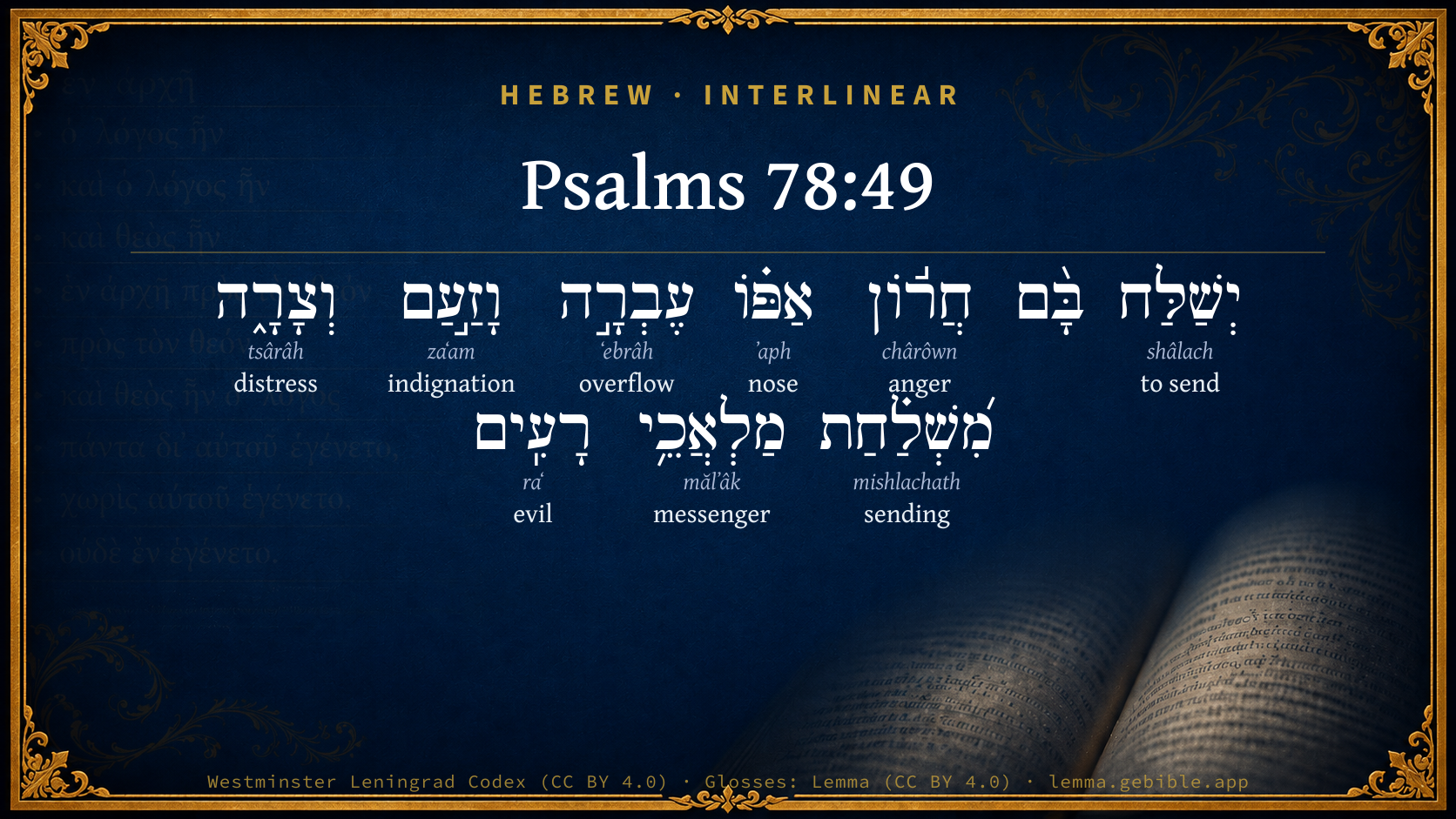
  1. יְשַׁלַּח shâlach H7971 “to send” Verb, Piel, Imperfect, 3rd Person, Masculine, Singular
  2. חֲר֬וֹן chârôwn H2740 “anger of” Noun, Common, Masculine, Singular, Construct
  3. אַפּ֗וֹ ʼaph H639 “nose · his” Noun, Common, Masculine, Singular, Construct + Suffix, Personal, 3rd Person, Masculine, Singular
  4. עֶבְרָ֣ה ʻebrâh H5678 “overflow” Noun, Common, Feminine, Singular, Absolute
  5. וָזַ֣עַם zaʻam H2195 “and · indignation” Conjunction + Noun, Common, Masculine, Singular, Absolute
  6. וְצָרָ֑ה tsârâh H6869 “and · distress” Conjunction + Noun, Common, Feminine, Singular, Absolute
  7. מַלְאֲכֵ֥י mălʼâk H4397 “messengers of” Noun, Common, Masculine, Plural, Construct
  8. רָעִֽים raʻ H7451 “evil” Adjective, Adjective, Masculine, Plural, Absolute

About this verse

These counts appear in no published source. They are computed here, from the morphology-tagged text and Lemma’s own curated glosses. What Lemma adds →

10
words
9
distinct lemmas
Wisdom
section

Notable vocabulary

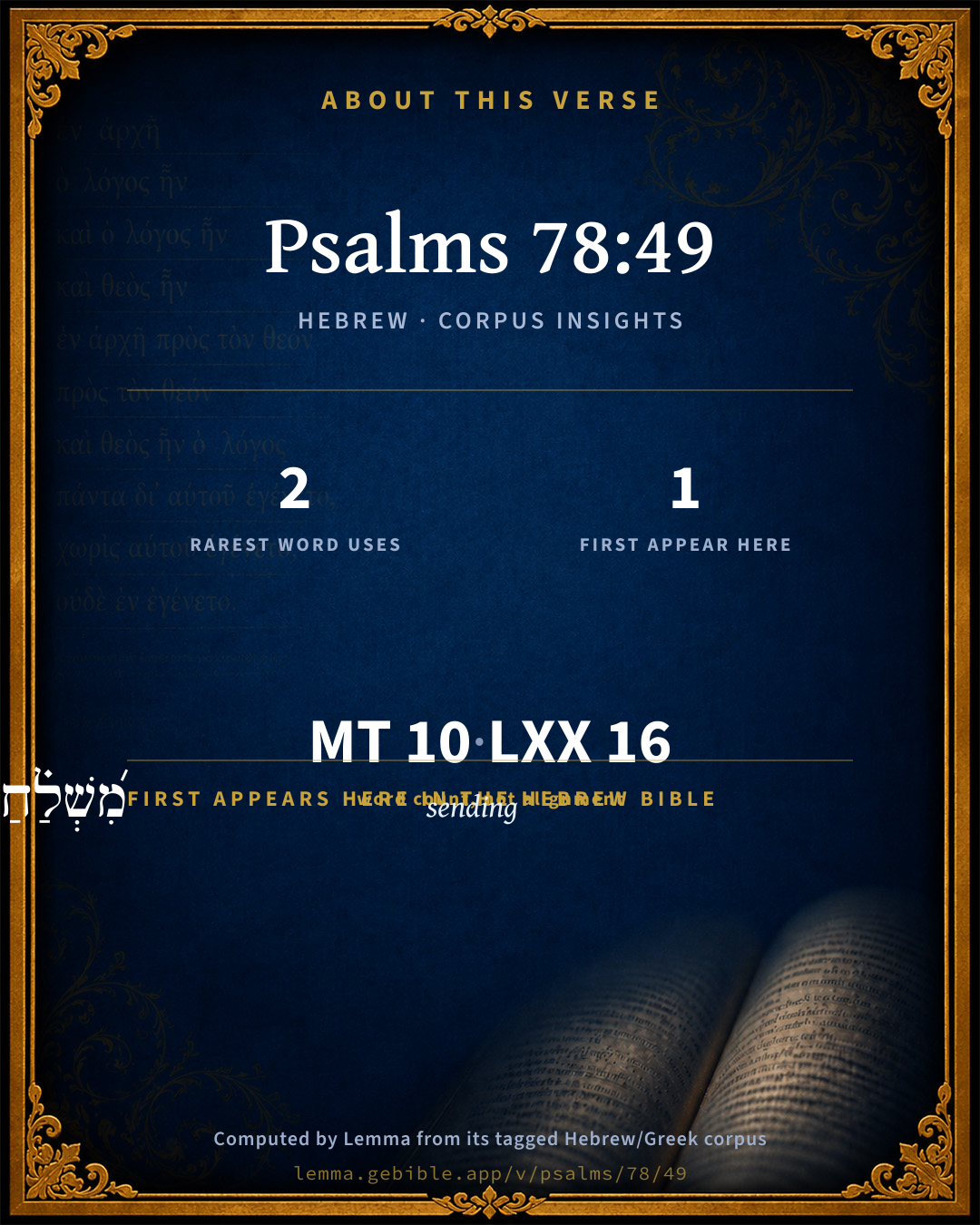
The rarest word here is מִ֝שְׁלַ֗חַת sending H4917 — appearing just 2 times in the whole Hebrew Bible.

First appearance in Scripture

This word makes its first canonical appearance in the Hebrew Bible here:

  • מִ֝שְׁלַ֗חַת sending H4917

Shared distinctive vocabulary

מִ֝שְׁלַ֗חַת sending H4917 occurs in 2 verses of the Hebrew Bible. Also found in:

Grammatical profile

  • 1 verb
  • 7 nouns
  • 1 adjective
  • 1 preposition

Verb forms

  • יְשַׁלַּח Piel · Imperfect

Hebrew & Septuagint length

In English translation the verse runs 20 words from the Hebrew and 20 from the Septuagint (LXX English) — the same length.

A rough comparison of the two English renderings, which tokenize alike — not a word-level alignment.

Word counts can differ between the Hebrew and the Greek without any difference in meaning — e.g. the Hebrew direct-object marker אֵת has no separate Greek word, and Greek often adds the article ὁ.

In the original languages it is 10 Hebrew tokens and 16 Greek tokens — but the two are counted differently (Hebrew bundles its prefixes and suffixes into one token; the Greek is in lemma form), so that isn’t a like-for-like length.

Cross-references

12

Topical passages linked to Psalms 78:49 in the Treasury of Scripture Knowledge — connected by theme and wording, ordered by reader-vote popularity; previews shown in the World English Bible.

  • Exodus 12:13 The blood shall be to you for a token on the houses where you are: and when I see the blood, I will pass over you, and there shall no plague be on you to destroy you, when I strike the land of Egypt.
  • Exodus 15:7 In the greatness of your excellency, you overthrow those who rise up against you: You send forth your wrath. It consumes them as stubble.
  • 2 Samuel 24:16 When the angel stretched out his hand toward Jerusalem to destroy it, Yahweh repented him of the evil, and said to the angel who destroyed the people, It is enough; now stay your hand. The angel of Yahweh was by the threshing floor of Araunah the Jebusite.
  • 1 Kings 22:21–22 There came forth a spirit, and stood before Yahweh, and said, I will entice him.
  • Psalms 11:6 On the wicked he will rain blazing coals; Fire, sulfur, and scorching wind shall be the portion of their cup.
  • Lamentations 4:11 Yahweh has accomplished his wrath, he has poured out his fierce anger; He has kindled a fire in Zion, which has devoured the foundations of it.
  • Job 1:12 Yahweh said to Satan, "Behold, all that he has is in your power. Only on himself don't put forth your hand." So Satan went forth from the presence of Yahweh.
  • Job 2:6–7 Yahweh said to Satan, "Behold, he is in your hand. Only spare his life."
  • Job 20:23 When he is about to fill his belly, God will cast the fierceness of his wrath on him. It will rain on him while he is eating.
  • Isaiah 42:25 Therefore he poured on him the fierceness of his anger, and the strength of battle; and it set him on fire round about, yet he didn't know; and it burned him, yet he didn't lay it to heart.
  • Zephaniah 3:8 "Therefore wait for me," says Yahweh, "until the day that I rise up to the prey, for my determination is to gather the nations, that I may assemble the kingdoms, to pour on them my indignation, even all my fierce anger, for all the earth will be devoured with the fire of my jealousy.
  • Romans 2:8–9 but to those who are self-seeking, and don't obey the truth, but obey unrighteousness, will be wrath and indignation,

Cross-references courtesy of OpenBible.info (CC BY 4.0).

Hebrew and Greek witnesses Masoretic Hebrew ↔ Greek Septuagint

The same verse in the two great witnesses to the Old Testament, shown verse-for-verse.

You’re reading Greek Psalm 77 (Hebrew Psalm 78). The Septuagint counts the superscription, so verse numbers can differ from the Hebrew — chapter-level alignment, not verse-by-verse. Numbering follows Rahlfs.

These are two independent witnesses, not word-aligned to each other, and the Septuagint is shown in lemma (dictionary) form.

Hebrew Psalms 78:49 Masoretic · Westminster Leningrad Codex

יְשַׁלַּח בָּ֨ם חֲר֬וֹן אַפּ֗וֹ עֶבְרָ֣ה וָזַ֣עַם וְצָרָ֑ה מִ֝שְׁלַ֗חַת מַלְאֲכֵ֥י רָעִֽים

He threw on them the fierceness of his anger, Wrath, indignation, and trouble, And a band of angels of evil.

World English Bible · Public Domain

Greek LXX Greek Psalm 77:49 Septuagint · lemma form

ἐκ ἀποστέλλω εἰς αὐτός ὀργή θυμός αὐτός θυμός καί ὀργή καί θλῖψις ἀποστολή διά ἄγγελος πονηρός

He sent out against them the fury of his anger, wrath, and indignation, and affliction, a message by evil angels.

LXX2012 (modern English Septuagint) · Public Domain

On this verse, Ellicott's Commentary for English Readers discusses the Septuagint’s reading. Read the note in Commentary ↓

Hebrew: Westminster Leningrad Codex (CC BY 4.0). Greek: Septuagint (public domain); English from LXX2012 (modern English Septuagint) (Public Domain). How the Septuagint differs from the Hebrew →

Commentary

Notes on Psalms 78:49 from classic Christian and Jewish commentators (each source and its license shown beneath its notes). The classic Christian expositions comment on the surrounding passage and are grouped to its opening verse, so a note may address several verses; the Jewish commentaries on the Tanakh (Rashi and others) are per-verse, so they appear only where the commentator wrote on this verse.

Lemma curates 59 commentaries, every one of them public domain or Creative Commons licensed, each selected and text-cleaned for this edition rather than reprinted as found. About our sources →

Trapp's Complete Commentary

John Trapp

Psa 78:49 He cast upon them the fierceness of his anger, wrath, and indignation, and trouble, by sending evil angels [among them].

Ver. 49. By sending evil angels among them] i.e. Some messengers of his wrath and displeasure, whether good or evil angels it skills not.

John Trapp, A Commentary or Exposition upon All the Books of the Old and New Testament (1647–1656) — public domain. Text from a community e-Sword module.

Joseph Benson's Commentary

Psa 78:49. He cast upon them the fierceness of his anger — Anger in the highest degree, wrath and indignation, the cause, and trouble, (tribulation and anguish, Rom 2:8-9,) the effect. These he cast upon them from on high, and did not spare. By sending evil angels among them — Hebrew, משׁלחת, mishlachath, the sending of evil angels, or, of the angels, or messengers, of evil things; namely, as most commentators understand it, the angels whom God employed in producing these plagues. The reader must observe, that “some of the Egyptian plagues having been specified in the foregoing verses, others of them are here thrown together, and the whole scene is affirmed to have been a full display of wrath and vengeance, executed upon the oppressors of the church by evil angels, agents, or messengers; whether, by this expression, we understand the material instruments of divine displeasure, or angels employed as ministers of vengeance, or the actual appearance and ministration of evil spirits, suffered to torment the wicked in this world, as they certainly will do in the next. Tradition seems to have favoured this last opinion, since the author of the book of Wisdom, above referred to, describes the Egyptian darkness as a kind of temporary hell, in which there appeared to the wicked, whose conscience suggested to them every thing that was horrible, ‘a fire kindled of itself, very dreadful; they were seared with beasts that passed by, and hissing of serpents; and they were vexed with monstrous apparitions, so that they fainted, and died for fear; while over them was spread a heavy night, an image of that darkness which should afterward receive them,’” Wisdom 17.

Joseph Benson's Commentary on the Old and New Testaments (1811–1818) — public domain. Text from a community e-Sword module.

Keil & Delitzsch

C. F. Keil & F. Delitzsch

When these plagues rose to the highest pitch, Israel became free, and removed, being led by its God, into the Land of Promise; but it continued still to behave there just as it had done in the desert. The poet in Psa 78:49-51 brings the fifth Egyptian plague, the pestilence (Exo 9:1-7), and the tenth and last, the smiting of the first-born (מכּת בּכרות), Exo 11:1, together. Psa 78:49 sounds like Job 20:23 (cf. below Psa 78:64). מלאכי רעים are not wicked angels, against which view Hengstenberg refers to the scriptural thesis of Jacobus Ode in his work De Angelis, Deum ad puniendos malos homines mittere bonos angelos et ad castigandos pios usurpare malos, but angels that bring misfortune. The mode of construction belongs to the chapter of the genitival subordination of the adjective to the substantive, like אשׁת רע, Pro 6:24, cf. Sa1 28:7; Num 5:18, Num 5:24; Kg1 10:15; Jer 24:2, and the Arabic msjdu 'l-jâm‛, the mosque of the assembling one, i.e., the assembling (congregational) mosque, therefore: angels (not of the wicked ones = wicked angels, which it might signify elsewhere, but) of the evil ones = evil, misfortune-bringing angels (Ew. ֗287, a). The poet thus paraphrases the המּשׁחית that is collectively conceived in Exo 12:13, Exo 12:23; Heb 11:28. In Psa 78:50 the anger is conceived of as a stream of fire, in Psa 78:50 death as an executioner, and in 50c the pestilence as a foe. ראשׁית אונים (Gen 49:3; Deu 21:17) is that which had sprung for the first time from manly vigour (plur. intensivus). Egypt is called חם as in Ps 105 and Psa 111:1-10 according to Gen 10:6, and is also called by themselves in ancient Egyptian Kemi, Coptic Chmi, Kme (vid., Plutarch, De Iside et Osiride, ch. 33). When now these plagues which softened their Pharaoh went forth upon the Egyptians, God procured for His people a free departure, He guided flock-like (כּעדר like בּעדר, Jer 31:24, with Dag. implicitum), i.e., as a shepherd, the flock of His people (the favourite figure of the Psalms of Asaph) through the desert, - He led them safely, removing all terrors out of the way and drowning their enemies in the Red Sea, to His holy territory, to the mountain which (זה) His right hand had acquired, or according to the accents (cf. supra, p. 104): to the mountain there (זה), which, etc. It is not Zion that is meant, but, as in the primary passage Exo 15:16., in accordance with the parallelism (although this is not imperative) and the usage of the language, which according to Isa 11:9; Isa 57:13, is incontrovertible, the whole of the Holy Land with its mountains and valleys (cf. Deu 11:11). בּחבל נחלה is the poetical equivalent to בּנחלה, Num 34:2; Num 36:2, and frequently. The Beth is Beth essentiae (here in the same syntactical position as in Isa 48:10; Eze 20:41, and also Job 22:24 surely): He made them (the heathen, viz., as in Jos 23:4 their territories) fall to them (viz., as the expression implies, by lot, בגורל) as a line of inheritance, i.e., (as in Psa 105:11) as a portion measured out as an inheritance. It is only in Psa 78:56 (and not so early as Psa 78:41) that the narration passes over to the apostate conduct of the children of the generation of the desert, that is to say, of the Israel of Canaan. Instead of עדוריו from עדוּת, the word here is עדוריו from עדה (a derivative of עוּד, not יעד). Since the apostasy did not gain ground until after the death of Joshua and Eleazar, it is the Israel of the period of the Judges that we are to think of here. קשׁת רמיּה, Psa 78:57, is not: a bow of slackness, but: a bow of deceit; for the point of comparison, according to Hos 7:16, is its missing the mark: a bow that discharges its arrow in a wrong direction, that makes no sure shot. The verb רמה signifies not only to allow to hang down slack (cogn. רפה), but also, according to a similar conception to spe dejicere, to disappoint, deny. In the very act of turning towards God, or at least being inclined towards Him by His tokens of power and loving-kindness, they turned (Jer 2:21) like a vow that misses the mark and disappoints both aim and expectation. The expression in Psa 78:58 is like Deu 32:16, Deu 32:21. שׁמע refers to their prayer to the Ba(a4lim (Jdg 2:11). The word התעבּר, which occurs three times in this Psalm, is a word belonging to Deuteronomy (Deu 3:26). Psa 78:59 is purposely worded exactly like Psa 78:21. The divine purpose of love spurned by the children just as by the fathers, was obliged in this case, as in the former, to pass over into angry provocation.

Keil & Delitzsch — Biblical Commentary on the Old Testament (1861–1891) — public domain (CC PDM 1.0). Text via the HelloAO Bible API. (Old Testament only.)

J. A. Alexander on Psalms

Joseph Addison Alexander

49. (Psa 78:49) He sends upon them the heat of his anger, wrath and indignation and anguish, a mission of angels of evil. Before mentioning the last and greatest plague of all, he accumulates expressions to describe it as the effect of thedivine displeasure. The slaughter of the first-born is ascribed in the history itself to a destroyer or destroying angel (Exo 12:23, Heb 11:28), which may be a collective as it seems to be in 1Sa 13:17, or denote the commander of a destroying host (Jos 5:15), here called a mission or commission of angels. The destroying angel reappears in the history of David (2Sa 24:16) and of Hezekiah (2Ki 19:35). The original construction in the case before us is peculiar, angels of evil (ones). This cannot mean evil angels, in the sense of fallen spirits, who are not described in the Old Testament as the executioners of God's decrees. The best explanation is perhaps to take the plural evils in an abstract sense, angels of evil, not moral but physical, i.e. authors of suffering or destruction.

Joseph Addison Alexander, The Psalms Translated and Explained (1850) — public domain. Text from a community e-Sword module.

Geneva Bible (1599)

Geneva Bible translators

So called either of the effect, that is, of punishing the wicked: or else because they were wicked spirits, whom God permitted to vex men.

Geneva Bible (1599) marginal notes — public domain. Text via Bolls.life.

Adam Clarke's Commentary

Verse 49. By sending evil angels] This is the first mention we have of evil angels. There is no mention of them in the account we have of the plagues of Egypt in the Book of Exodus, and what they were we cannot tell: but by what the psalmist says here of their operations, they were the sorest plague that God had sent; they were marks of the fierceness of his anger, wrath, indignation, and trouble. Some think the destroying angel that slew all the first-born is what is here intended; but this is distinctly mentioned in Ps 78:51. An angel or messenger may be either animate or inanimate; a disembodied spirit or human being; any thing or being that is an instrument sent of God for the punishment or support of mankind.

Adam Clarke's Commentary on the Bible (1810–1826) — public domain. Text from a community e-Sword/MySword module.

Ellicott's Commentary for English Readers

(49) Evil angels.—So LXX. and Vulg., but in the Hebrew angels (or messengers) of ills (so Symmachus), with evident reference to the destruction of the firstborn.

A Bible Commentary for English Readers, edited by Charles John Ellicott (1878–1897) — public domain. Text from a community e-Sword module.

The Cambridge Bible for Schools and Colleges

gen. ed. J. J. S. Perowne

49. He cast upon them the fierceness of his anger] Lit., he sent, as in Psa_78:45. The same phrase is found in Job_20:23.

by sending evil angels among them] R.V., a band of angels of evil: lit. a mission of evil angels: not wicked angels, but destroying angels, commissioned by God to execute His purposes of punishment. Cp. “the destroyer,” Exo_12:23; and see 2Sa_24:16 f.; 2Ki_19:35; Job_33:22.

49–51. The culmination of the plagues in the death of the firstborn.

The Cambridge Bible for Schools and Colleges (gen. ed. J. J. S. Perowne; Cambridge University Press, 1878–1918) — public domain. Text from a community e-Sword module.

John Gill's Exposition

He made a way to his anger,.... Or, "for" it, so that nothing could obstruct it, or hinder the execution of it; or "he weighed a path for his anger" (m); he weighed it in the balance of justice, and proportioned his anger to their crimes, and punished them according to their just deserts:

he spared not their soul from death, but gave their life over to the pestilence; which some understand of their cattle, and of the murrain that came upon them, by which they were destroyed, and which was the fifth plague of Egypt, Exo 9:3, so the Targum,

"their beasts he delivered unto death;''

but Aben Ezra interprets it of the slaughter of the firstborn, expressed in the following verse; and so others.

(m) "ponderavit semitam furori suo", Pagninus, Vatablus; "libravit semitam irae suae", Tigurine version; "iter ad iram suam", Junius & Tremellius, Piscator.

John Gill's Exposition of the Whole Bible (1746–1763) — public domain (CC PDM 1.0). Text via the HelloAO Bible API.

Albert Barnes' Notes on the Bible

He cast upon them the fierceness of his anger ... - This verse is designed to describe the last, and the most dreadful of the plagues that came upon the Egyptians, the slaying of their first-born; and hence, there is such an accumulation of expressions: anger - fierce anger - wrath - indignation - trouble. All these expressions are designed to be emphatic; all these things were combined when the first-born were slain. There was no form of affliction that could surpass this; and in this trial all the expressions of the divine displeasure seemed to be exhausted. It was meant that this should be the last of the plagues; it was meant that the nation should be humbled, and should be made willing that the people of Israel should go.

By sending evil angels among them - There is reference here undoubtedly to the slaying of the first-born in Egypt. Exo 11:4-5; Exo 12:29-30. This work is ascribed to the agency of a destroyer (Exo 12:23; compare Heb 11:28), and the allusion seems to be to a destroying angel, or to an angel employed and commissioned to accomplish such a work. Compare 2Sa 24:16; 2Ki 19:35. The idea here is not that the angel himself was evil or wicked, but that he was the messenger of evil or calamity; he was the instrument by which these afflictions were brought upon them.

Albert Barnes' Notes on the Bible (1834–1885) — public domain. Text from a community e-Sword/MySword module.

Matthew Poole's English Annotations

Indignation and trouble; other most grievous plagues, which were mixed with and were the effects of his anger and wrath; whereby their miseries were greatly aggravated, and distinguished from the afflictions which God sent upon the Israelites in Egypt, which were only fatherly chastisements, and the effects of God’s love and occasions of their deliverance.

By sending evil angels, Heb. the sending (or the operation or effects) of evil angels, or of the angels or messengers of evil things; either of the angels whom God employed in producing these plagues; or of Moses and Aaron, who were to the Egyptians messengers of evil, and by whom these judgments were sent to and inflicted upon them.

Matthew Poole's English Annotations on the Holy Bible (1683–1685) — public domain. Text from a community e-Sword/MySword module.

The Treasury of David

Charles H. Spurgeon

Ver. 49. He cast upon them the fierceness of his anger, wrath, and indignation, and trouble. His last arrow was the sharpest. He reserved the strong wine of his indignation to the last. Note how the psalmist piles up the words, and well he might; for blow followed blow, each one more staggering than its predecessor, and then the crushing stroke was reserved for the end.

By sending evil angels among them. Messengers of evil entered their houses at midnight, and smote the dearest objects of their love. The angels were evil to them, though good enough in themselves; those who to the heirs of salvation are ministers of grace, are to the heirs of wrath executioners of judgment. When God sends angels, they are sure to come, and if he bids them slay they will not spare. See how sin sets all the powers of heaven in array against man; he has no friend left in the universe when God is his enemy.

Ver. 49. By sending evil angels. Evils come uncalled, but not unsent. Are they nor here called angels? they are sent; the word angel means a messenger. Not things only without life, but not living creatures neither, brute, nor men, nor Satan's self can hurt unless God bid. The three days' darkness in Egypt, how came it? "He sent darkness, "saith David. Ps 105:28. So the hail, thunder, and lightning, the Lord sent them, saith Moses. The frogs, flies, lice, grasshoppers, and caterpillars, that infected Egypt, and the lions that slew the idolaters in Samaria (2Ki 17:1-41), the text saith of them all, Dominus immisit, the Lord sent them. And for men"Am I come" (saith Rabshakeh) "without the Lord?" He bade me go. Yea, the devil, the arch evil angel, who seeks to devour, yet must be sent ere he can do ought. The lying spirit in the mouths of the false prophets longed to seduce Ahab; God must first bid; Egredere, go forth, and do so. The use of this is easy without my help: not to fear, doing well; not man, fiend, any creature, can hurt you, God not sending them. But sinning, to fear everything. The weakest creature can quell the mightiest man, if God bid, go. A mouse (saith the poet) will bite a wicked man. Be it proud Herod, great Antiochus; if God but ask the creatures, Quem mittam, which of you shall I send? the worm will answer, Ecce me, send me; I will devour him. And such poor, silly, despicable creatures are some of these evil angels in my text. He sent: what sent he? evil angels, the next thing in this Scripture.

Evil angels? Par dispar, a pair of words which seem not well matched. The latter may say to the former, Quid mihi et tibi, what have I to do with thee? Angels were the best and holiest of God's creatures. They all were good, very good, Moses saith; but angels kat exochn, excellently good. Then is evil here an evil epithet for angels. And is never read but here, and here (some think) not well translated. But the phrase of evil angels hath other meaning here: evil angels, i.e., the angels, i.e., the messengers of evil. It is in the Hebrew, not (Mykalm), but (ykalm); insomuch that some expositors think the psalmist means the words of Moses and Aaron; that they were sent from God to be the messengers of evil, i.e., all of the plagues that God would bring on Egypt. That sense I censure not, but follow not. The Greek Fathers have anotherthat by the evil angels, are meant the evil spirits. Christ calls them angels too, thee devil's angels. Augustine likes not that sense. The most current exposition is as a Jewish writer speaks: the "evil angels" are the ten several plagues. Richard Clerke. (1634.)

Ver. 49. By sending evil angels among them. That the devil and his angels are so very evil, that for them everlasting fire is prepared, no believer is ignorant: but that there should be sent by means of them an infliction from the Lord God upon certain whom he judgeth to be deserving of this punishment, seemeth to be a hard thing to those who are little prone to consider how the perfect justice of God doth use well even evil things. For these indeed, as far as regardeth their substance, what other person but himself hath made? But evil he hath not made them; yet he doth use them, inasmuch as he is good, conveniently and justly; just as on the other hand unrighteous men do use his good creatures in evil manner: God therefore doth use evil angels not only to punish evil men, as in the case of all those concerning whom the Psalm doth speak, as in the case of king Ahab, whom a spirit of lying by the will of God did beguile, in order that he might fall in war; but also to prove and make manifest good men, as he did in the case of Job. Augustine.

None.

Charles H. Spurgeon's The Treasury of David (1869–1885) — public domain. Psalms only. Text from a community e-Sword/MySword module.

Whedon's Commentary on the Bible

Daniel D. Whedon

49, 50. Evil angels—That is, good angels as the executioners of evil, as 2Ki_19:34; 1Ch_21:15. It is better to understand it thus than to personify the physical causes of the plague. The idea of wicked angels, Satanic agencies, is inadmissible here.

He made a way to his anger—Literally, He weighed a path for his anger. His judgments were by due measure, accurately weighed out, according to their sin and the moral ends to be served. See Lev_26:21-28.

But gave their life over— Their living ones. “Life” is to be taken in the concrete for things having life. It is parallel to soul in the previous member, which also should be taken concretely.

Daniel D. Whedon (gen. ed.), Commentary on the Old and New Testaments (1874–1909) — public domain. Text from a community e-Sword module.

The Pulpit Commentary

He cast upon them the fierceness of his anger, wrath, and indignation, and trouble. "The accumulation of terms signifying Divine wrath is designed to set forth the dreadful nature of this last judgment" (Hengstenberg) the death of the firstborn. By sending evil angels among them. Most modern critics regard this clause as in apposition with the preceding one, and consider the "wrath, indignation, and trouble" to be themselves the "evil angels" spoken of. Some, however, as Hengstenberg and Kay, interpret the passage of spiritual beings not, however, of spirits of evil, who are never said to be ministers of God"s wrath, but of good angels, who on this occasion were "ministers of woe."

The Pulpit Commentary (1880–1919), ed. H.D.M. Spence-Jones & Joseph S. Exell — public domain. Text from a community e-Sword module.

John Wesley's Explanatory Notes

Evil angels - Whom God employed in producing these plagues.

John Wesley, Explanatory Notes Upon the Whole Bible (1754–1765) — public domain. Text via the GEBible commentary corpus.

Lesson kit

Teaching starters — assembled from the data on this page, not authored interpretation. Every prompt links to the verse data it draws on. Edit before teaching.

Psalms, in the Wisdom, opens this verse with 10 words (9 distinct Hebrew lemmas). Its most distinctive word is mishlachath (“sending”). A historical commentator’s framing appears above. Read the whole chapter for the surrounding context.

Discussion questions

  1. What does “sending” (mishlachath) contribute to the verse as a whole?
  2. The word “sending” first appears here in Scripture. What is being introduced at this debut?
  3. Ecclesiastes 8:8 shares the word «sending» with this verse. How do the two illuminate each other?
  4. These translations render this verse differently. What is at stake in choosing one wording over another?
  5. The verb «יְשַׁלַּח» is Piel Imperfect. How does its form color the action?
  6. Reading how Trapp's Complete Commentary and Joseph Benson's Commentary read this verse, where do the two commentators agree and where do they part?

Things to notice

Reading settings

Reading text

Shown beneath each verse's original-language words.

Old Testament
Old Testament edition

Read the OT as the Masoretic Hebrew (MT) or the Greek Septuagint (LXX).

English shown for the Greek Septuagint (in the Hebrew ↔ Greek comparison).

Comparing translations? Open the Compare panel on any verse page to stack up to four side by side.