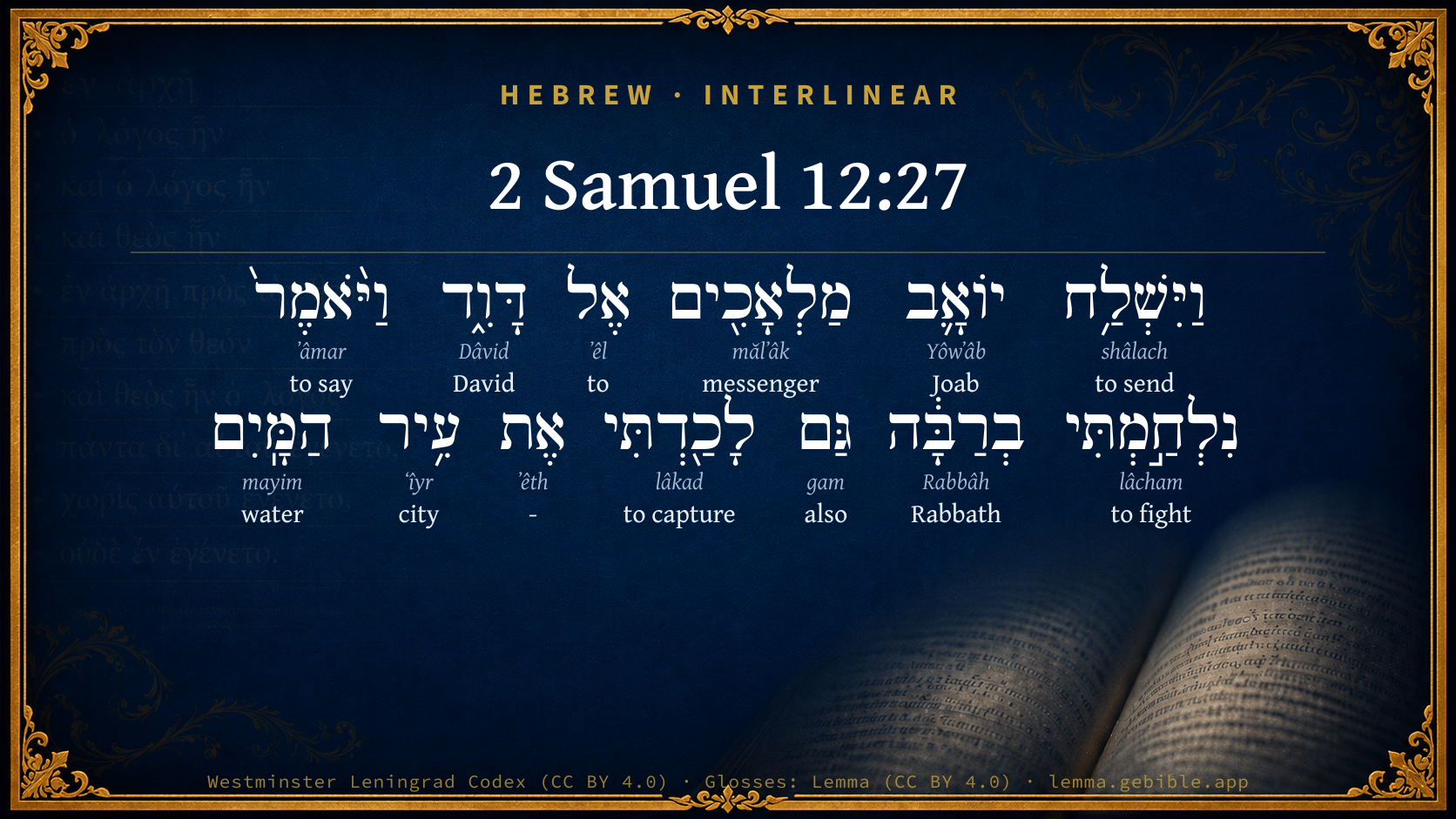
2 Samuel 12:27

Hebrew (Westminster Leningrad Codex) 2 Samuel 12:27 appears in the Hebrew Old Testament. The text above is from the Westminster Leningrad Codex. Each word links to its Strong’s number, a concise gloss, and parsing drawn from the Open Scriptures Hebrew Bible morphology. Click any word for its full Brown-Driver-Briggs (BDB) entry.
Download image
Cite this verse

2 Samuel 12:27 (World English Bible). Public Domain. Lemma interlinear Bible study tool, https://lemma.gebible.app/v/2-samuel/12/27.

Show BibTeX & RIS
BibTeX
RIS
English Translation
Joab sent messengers to David, and said, I have fought against Rabbah; yes, I have taken the city of waters.
World English Bible · Public Domain
Download a study sheet

One document with this verse’s original text, its word-by-word gloss line, the meaning frame, cross-references with their text, attributed commentary, and full source and license credits — printable, and it pastes into notes with its structure intact.

This verse Autodidact and up

Study sheet (.html) Plain text (.txt)

A passage Seminary Student

Up to 50 verses in one chapter. A passage sheet keeps up to 6 commentary sources and 12 cross-references per verse, in the order this page ranks them, and says so on the sheet whenever that leaves anything out. Ask for a single verse and you get the Autodidact verse sheet above.

Everything on this page stays free to read, with no account — the sheet is a download of what is already on screen, not access to it.

Want to remove ads? Support Godless Engineer
Compare translations 3

The same verse in 3 English versions, stacked beneath the original-language interlinear above. Click any original word for its lexicon entry.

Each is an independent rendering of the whole verse — the interlinear is not word-aligned to these translations.

Highlighted words mark where these versions differ — a whole-verse word diff, not a word-by-word alignment.

  • World English Bible Public Domain
    Joab sent messengers to David, and said, I have fought against Rabbah; yes, I have taken the city of waters.
  • King James Version Public Domain
    And Joab sent messengers to David, and said, I have fought against Rabbah, and have taken the city of waters.
  • unfoldingWord Literal Text CC BY-SA 4.0
    And Joab sent messengers to David, and he said, “I have fought against Rabbah. Also, I have captured the city of waters.

unfoldingWord Literal Text — © unfoldingWord, licensed CC BY-SA 4.0. Word-aligned USFM3 via Door43 (git.door43.org/unfoldingWord/en_ult).

Versions to compare (up to 4)

3 of 4 selected

Show all 18 translations

Every available English version of this verse, each an independent rendering of the whole verse.

  • World English Bible Public Domain
    Joab sent messengers to David, and said, I have fought against Rabbah; yes, I have taken the city of waters.
  • Berean Standard Bible Public Domain
    Then Joab sent messengers to David to say, “I have fought against Rabbah and have captured the water supply of the city.
  • Majority Standard Bible Public Domain
    Then Joab sent messengers to David to say, “I have fought against Rabbah and have captured the water supply of the city.
  • King James Version Public Domain
    And Joab sent messengers to David, and said, I have fought against Rabbah, and have taken the city of waters.
  • American Standard Version (1901) Public Domain
    And Joab sent messengers to David, and said, I have fought against Rabbah; yea, I have taken the city of waters.
  • Revised Version (1885) Public Domain
    And Joab sent messengers to David, and said, I have fought against Rabbah, yea, I have taken the city of waters.
  • Geneva Bible (1599) Public Domain
    Therefore Ioab sent messengers to Dauid, saying, I haue fought against Rabbah, and haue taken the citie of waters.
  • Douay-Rheims (1899) Public Domain
    And Joab sent messengers to David, saying: I have fought against Rabbath, and the city of waters is about to be taken.
  • Young's Literal Translation Public Domain
    and Joab sendeth messengers unto David, and saith, `I have fought against Rabbah -- also I have captured the city of waters;
  • Literal Standard Version CC BY-SA 4.0
    and Joab sends messengers to David and says, “I have fought against Rabbah—I have also captured the city of waters;
  • Unlocked Literal Bible CC BY-SA 4.0
    So Joab sent messengers to David and said, “I have fought against Rabbah, and I have taken the city's water supply.
  • unfoldingWord Literal Text CC BY-SA 4.0
    And Joab sent messengers to David, and he said, “I have fought against Rabbah. Also, I have captured the city of waters.
  • Darby Bible Public Domain
    And Joab sent messengers to David, and said, I have fought against Rabbah, and have taken the city of waters.
  • World Messianic Bible Public Domain
    Joab sent messengers to David, and said, “I have fought against Rabbah. Yes, I have taken the city of waters.
  • Webster's Bible Public Domain
    And Joab sent messengers to David, and said, I have fought against Rabbah, and have taken the city of waters.
  • Free Bible Version CC BY-SA 4.0
    Joab sent messengers to David to tell him, “I have attacked Rabbah and I have also captured its water supply.
  • Bible in Basic English Public Domain
    And Joab sent men to David, saying, I have made war against Rabbah and have taken the water-town.
  • JPS Tanakh (1917) Public Domain
    And Joab sent messengers to David, and said: 'I have fought against Rabbah, yea, I have taken the city of waters.

Literal Standard Version (2020), Covenant Press — licensed CC BY-SA 4.0. Text via the HelloAO Bible API (eBible.org). Unlocked Literal Bible (unfoldingWord) — licensed CC BY-SA 4.0. Text via the HelloAO Bible API (eBible.org). unfoldingWord Literal Text — © unfoldingWord, licensed CC BY-SA 4.0. Word-aligned USFM3 via Door43 (git.door43.org/unfoldingWord/en_ult). Free Bible Version, Dr. Jonathan Gallagher — licensed CC BY-SA 4.0. Text via the HelloAO Bible API (eBible.org).

Word by word

More ways to search: Search by grammar → Find every occurrence → Compare this word →

Practice this passage: Drill this verse → Learn its vocabulary →

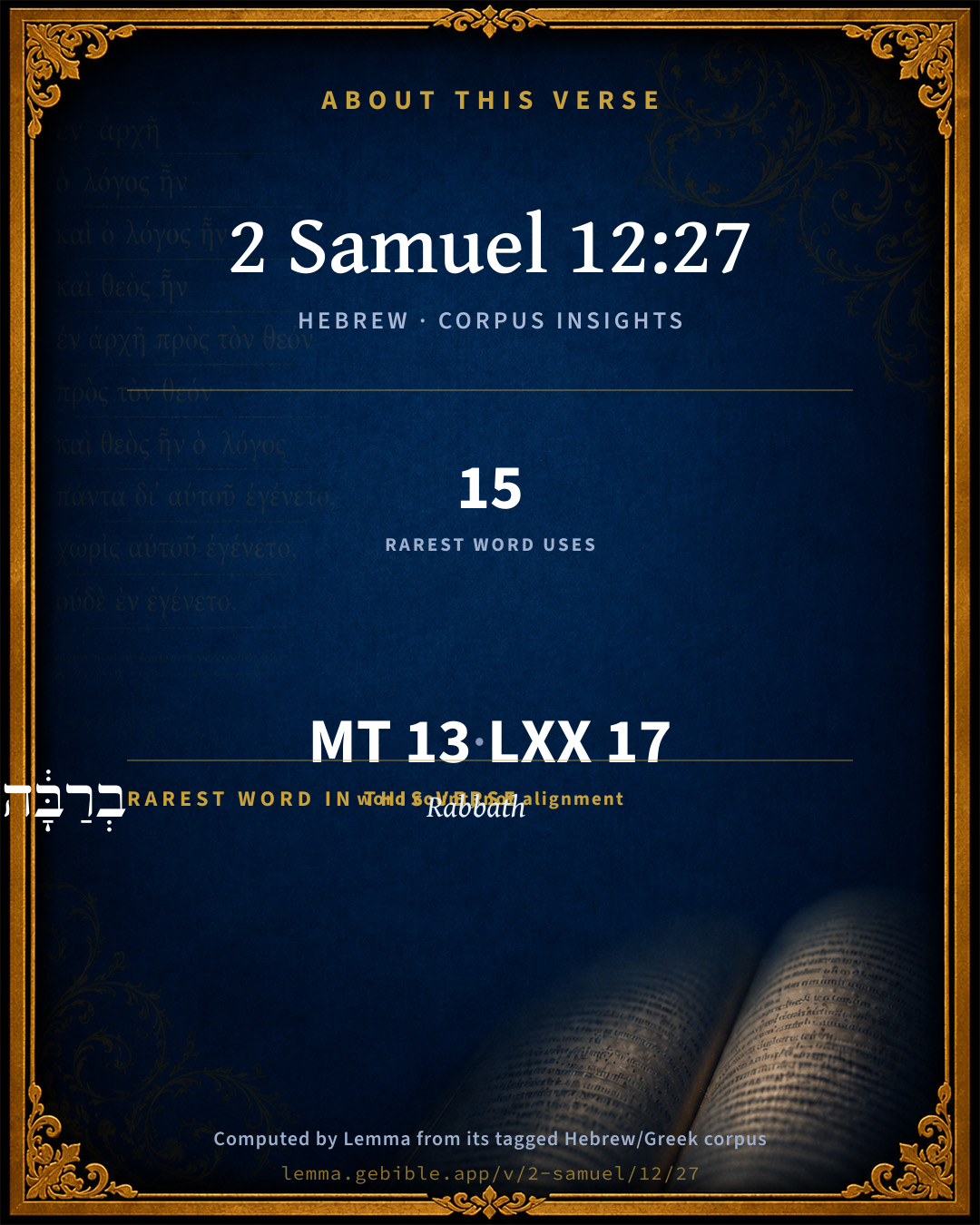
בְרַבָּ֔ה
Rabbâh
H7237
“in/at · Rabbath”
Preposition + Noun, Proper
Part of Speech
Preposition + Noun
Type
Proper
Full BDB Definition

Origin: fem. of H7227

TWOT: None

Rabbath = "great" - the capital city of the Ammonites located east of the Jordan - a town in Judah; site uncertain
  1. וַיִּשְׁלַ֥ח shâlach H7971 “and · to send” Conjunction + Verb, Qal, Sequential Imperfect, 3rd Person, Masculine, Singular
  2. יוֹאָ֛ב Yôwʼâb H3097 “Joab” Noun, Proper
  3. מַלְאָכִ֖ים mălʼâk H4397 “messengers” Noun, Common, Masculine, Plural, Absolute
  4. אֶל ʼêl H413 “to” Preposition
  5. דָּוִ֑ד Dâvid H1732 “David” Noun, Proper
  6. וַיֹּ֨אמֶר֙ ʼâmar H559 “and · to say” Conjunction + Verb, Qal, Sequential Imperfect, 3rd Person, Masculine, Singular
  7. נִלְחַ֣מְתִּי lâcham H3898 “to fight” Verb, Niphal, Perfect, 1st Person, Common, Singular
  8. גַּם gam H1571 “also” Particle, Accusative
  9. לָכַ֖דְתִּי lâkad H3920 “to capture” Verb, Qal, Perfect, 1st Person, Common, Singular
  10. אֶת ʼêth H853 “-” Particle, Direct Object
  11. עִ֥יר ʻîyr H5892 “city of” Noun, Common, Feminine, Singular, Construct
  12. הַמָּֽיִם mayim H4325 “the · water(s)” Particle, Definite Article + Noun, Common, Masculine, Plural, Absolute

About this verse

These counts appear in no published source. They are computed here, from the morphology-tagged text and Lemma’s own curated glosses. What Lemma adds →

13
words
13
distinct lemmas
Historical
section

Notable vocabulary

The rarest word here is בְרַבָּ֔ה Rabbath H7237 — appearing just 15 times in the whole Hebrew Bible.

Shared distinctive vocabulary

בְרַבָּ֔ה Rabbath H7237 occurs in 14 verses of the Hebrew Bible. Also found in:

Grammatical profile

  • 4 verbs
  • 6 nouns
  • 1 preposition
  • 2 particles

Verb forms

  • וַיִּשְׁלַ֥ח Qal · Sequential Imperfect
  • וַיֹּ֨אמֶר֙ Qal · Sequential Imperfect
  • נִלְחַ֣מְתִּי Niphal · Perfect
  • לָכַ֖דְתִּי Qal · Perfect

Hebrew & Septuagint length

In English translation the verse runs 20 words from the Hebrew and 19 from the Septuagint (LXX English) — closely comparable.

A rough comparison of the two English renderings, which tokenize alike — not a word-level alignment.

Word counts can differ between the Hebrew and the Greek without any difference in meaning — e.g. the Hebrew direct-object marker אֵת has no separate Greek word, and Greek often adds the article ὁ.

In the original languages it is 13 Hebrew tokens and 17 Greek tokens — but the two are counted differently (Hebrew bundles its prefixes and suffixes into one token; the Greek is in lemma form), so that isn’t a like-for-like length.

Cross-references

3

Topical passages linked to 2 Samuel 12:27 in the Treasury of Scripture Knowledge — connected by theme and wording, ordered by reader-vote popularity; previews shown in the World English Bible.

  • Deuteronomy 3:11 (For only Og king of Bashan remained of the remnant of the Rephaim; behold, his bedstead was a bedstead of iron; isn't it in Rabbah of the children of Ammon? nine cubits was the length of it, and four cubits the breadth of it, after the cubit of a man.)
  • 2 Samuel 11:1 It happened, at the return of the year, at the time when kings go out [to battle], that David sent Joab, and his servants with him, and all Israel; and they destroyed the children of Ammon, and besieged Rabbah. But David stayed at Jerusalem.
  • Ezekiel 21:20 You shall appoint a way for the sword to come to Rabbah of the children of Ammon, and to Judah in Jerusalem the fortified.

Cross-references courtesy of OpenBible.info (CC BY 4.0).

Hebrew and Greek witnesses Masoretic Hebrew ↔ Greek Septuagint

The same verse in the two great witnesses to the Old Testament, shown verse-for-verse.

These are two independent witnesses, not word-aligned to each other, and the Septuagint is shown in lemma (dictionary) form.

Hebrew 2 Samuel 12:27 Masoretic · Westminster Leningrad Codex

וַיִּשְׁלַ֥ח יוֹאָ֛ב מַלְאָכִ֖ים אֶל דָּוִ֑ד וַיֹּ֨אמֶר֙ נִלְחַ֣מְתִּי בְרַבָּ֔ה גַּם לָכַ֖דְתִּי אֶת עִ֥יר הַמָּֽיִם

Joab sent messengers to David, and said, I have fought against Rabbah; yes, I have taken the city of waters.

World English Bible · Public Domain

Greek LXX 2 Samuel 12:27 Septuagint · lemma form

καί ἀποστέλλω ιωαβ ἄγγελος πρός δαυίδ καί εἶπον πολεμέω ἐν ραββαθ καί καταλαμβάνω ὁ πόλις ὁ ὕδωρ

And Joab sent messengers to David, and said, I have fought against Rabbath, and taken the city of waters.

LXX2012 (modern English Septuagint) · Public Domain

Hebrew: Westminster Leningrad Codex (CC BY 4.0). Greek: Septuagint (public domain); English from LXX2012 (modern English Septuagint) (Public Domain). How the Septuagint differs from the Hebrew →

Targum (Aramaic paraphrase)

1

The Targum is the ancient Jewish Aramaic paraphrase of the Hebrew Scriptures — an interpretive translation, not the Hebrew text itself. Onkelos (literal) and Pseudo-Jonathan (expansive) render the Torah, and Jonathan the Prophets. Coverage is partial: where no permissively-licensed English translation exists for a verse, only the Aramaic is shown. This is verse-level text, not a word-by-word alignment to the Hebrew.

  1. Targum Jonathan Prophets (Joshua–Malachi)
    וּשְׁלַח יוֹאָב אִזְגַדִין לְוַת דָוִד וַאֲמַר אַגָחִית קְרָבָא בְרַבָּה וְאַף כְּבָשִׁית יַת קִרְיַת מַלְכוּתָא:

    (no public-domain English translation for this verse)

    Targum Jonathan — Aramaic: “Mikraot Gedolot” (public domain). English: “Sefaria Community Translation” (CC0 1.0 (public-domain dedication)); “London "Chaldee Paraphrase," 1871” (public domain). Text via Sefaria.

Commentary

Notes on 2 Samuel 12:27 from classic Christian and Jewish commentators (each source and its license shown beneath its notes). The classic Christian expositions comment on the surrounding passage and are grouped to its opening verse, so a note may address several verses; the Jewish commentaries on the Tanakh (Rashi and others) are per-verse, so they appear only where the commentator wrote on this verse.

Lemma curates 59 commentaries, every one of them public domain or Creative Commons licensed, each selected and text-cleaned for this edition rather than reprinted as found. About our sources →

Trapp's Complete Commentary

John Trapp

2Sa 12:27 And Joab sent messengers to David, and said, I have fought against Rabbah, and have taken the city of waters.

Ver. 27. The city of waters,] i.e., { a} The palace royal encompassed with waters, both for safeguard and delight. Or, The city of waters, that is, the waters of the city; {b} so that it cannot long hold out; praecisis aquae ductibus, saith Josephus.

{a} By Hypallage.

{b} Jun

John Trapp, A Commentary or Exposition upon All the Books of the Old and New Testament (1647–1656) — public domain. Text from a community e-Sword module.

Geneva Bible (1599)

Geneva Bible translators

That is, the chief city and where all the conduits are, is as good as taken.

Geneva Bible (1599) marginal notes — public domain. Text via Bolls.life.

Jamieson, Fausset & Brown

Robert Jamieson, A. R. Fausset & David Brown

the city of waters--Rabbah, like Aroer, was divided into two parts--one the lower town, insulated by the winding course of the Jabbok, which flowed almost round it, and the upper and stronger town, called the royal city. "The first was taken by Joab, but the honor of capturing so strongly a fortified place as the other was an honor reserved for the king himself."

Jamieson, Fausset & Brown — Commentary Critical and Explanatory on the Whole Bible (1871) — public domain (CC PDM 1.0). Text via the HelloAO Bible API.

Adam Clarke's Commentary

Verse 27. And have taken the city of waters.] The city where the tank or reservoir was that supplied the city and suburbs with water. Some think that the original, לכדתי את עיר המים lachadti eth ir hammayim, should be translated I have intercepted, or cut off, the waters of the city: and Houbigant translates the place, et aquas ab urbe jam derivavi; "And I have already drawn off the waters from the city." This perfectly agrees with the account in Josephus, who says ων τε ὑδατων αυτους αποτεμνομενος, having cut off their waters, Antiq., lib. vii., cap. 7. This was the reason why David should come speedily, as the citadel, deprived of water, could not long hold out.

Adam Clarke's Commentary on the Bible (1810–1826) — public domain. Text from a community e-Sword/MySword module.

The Cambridge Bible for Schools and Colleges

gen. ed. J. J. S. Perowne

27. the city of waters] “Just before reaching Ammân [the modern name of Rabbah], the gorge takes a sudden turn to the north, and then swells into a narrow plain, covered with luxuriant grass, and embosomed in low round hills. The fish-stocked stream, with shells studding every stone and pebble, winds in the midst, a narrow channel, receiving occasional affluents in its course, and making Rabbah most truly a ‘city of waters.’ ” Tristram’s Land of Israel, p. 533.

The Cambridge Bible for Schools and Colleges (gen. ed. J. J. S. Perowne; Cambridge University Press, 1878–1918) — public domain. Text from a community e-Sword module.

John Gill's Exposition

Now therefore gather the rest of the people together,.... The rest of the soldiers in the land of Israel, and come to Rabbah:

and encamp against the city; invest it in form:

and take it; upon a surrender or by storm; for it could not hold out long:

lest I take the city, and it be called after my name; so great a regard had Joab, though an ambitious man, to the fame and credit of David his king: so Craterus (a) at the siege of Artacacna, being prepared to take it, waited the coming of Alexander, that he might have the honour of it.

(a) Curt. Hist. l. 6. c. 6.

John Gill's Exposition of the Whole Bible (1746–1763) — public domain (CC PDM 1.0). Text via the HelloAO Bible API.

Albert Barnes' Notes on the Bible

The city of waters - The lower town of Rabbah (the modern Ammam), so called from a stream which rises within it and flows through it. The upper town with the citadel lay on a hill to the north of the stream, and was probably not tenable for any length of time after the supply of water was cut off.

Albert Barnes' Notes on the Bible (1834–1885) — public domain. Text from a community e-Sword/MySword module.

Haydock's Catholic Bible Commentary

CHAPTER XII.

The city of waters. Rabbath, the royal city of the Ammonites, was called the city of waters, from being encompassed with waters. (Challoner) See chap. v. 8. --- The Hebrew in the preceding verse seems to insinuate, (Haydock) that "he had taken the royal city." But he was only on the point of doing it, or had, perhaps, made himself master of some part of it. Here the Hebrew, "I have taken," may be explained in the same sense, unless the city of waters were the lower part of Rabbath, lying on the Jaboc. Junius translates, "He cut off the waters, which entered the city;" and Josephus favours this explanation. It seems the siege lasted about two years. (Calmet) --- Antiochus took this city, by depriving the inhabitants of water. (Polybius v.)

George Leo Haydock (1774–1849), Haydock's Catholic Family Bible and Commentary, 1859 edition — public domain. Excludes Psalms (Douay-Rheims chapter numbering differs from Protestant) and Deuterocanonical books (Catholic canon only).

Matthew Poole's English Annotations

The same royal city so called, because it either stood beside the river, or was encompassed with water, both for defence and delight. Although the words are by some learned men rendered thus,

I have taken, or intercepted, or cut off water from the city; which well agrees, both with the words, eth being here put for meeth, which is frequent; as Gen 4:1; 44:4; Exo 9:29, &c.; and with the relation of Josephus the Jew, who saith, The conduits of water were cut off, and so the city was taken; and with a relation of Polybius concerning the same city, which was taken afterwards by Antiochus in the same manner, by cutting off water from the city.

Matthew Poole's English Annotations on the Holy Bible (1683–1685) — public domain. Text from a community e-Sword/MySword module.

John Wesley's Explanatory Notes

Of waters - Rabbah was so called because it was encompassed with water.

John Wesley, Explanatory Notes Upon the Whole Bible (1754–1765) — public domain. Text via the GEBible commentary corpus.

Lesson kit

Teaching starters — assembled from the data on this page, not authored interpretation. Every prompt links to the verse data it draws on. Edit before teaching.

2 Samuel, in the Historical, opens this verse with 13 words (13 distinct Hebrew lemmas). Its most distinctive word is Rabbâh (“Rabbath”). A historical commentator’s framing appears above. Read the whole chapter for the surrounding context.

Discussion questions

  1. The word Rabbâh carries the sense “Rabbath.” How does it shape the verse?
  2. How does Deuteronomy 3:11, which shares the word «Rabbath», read alongside this verse?
  3. These translations render this verse differently; the difference is in the English rendering, not the original. What questions does that raise?
  4. «וַיִּשְׁלַ֥ח» is a Qal Sequential Imperfect verb. How does that grammatical form shape the action described?
  5. Compare how Trapp's Complete Commentary and Geneva Bible (1599) read this verse. Where do they agree or differ?

Things to notice

Reading settings

Reading text

Shown beneath each verse's original-language words.

Old Testament
Old Testament edition

Read the OT as the Masoretic Hebrew (MT) or the Greek Septuagint (LXX).

English shown for the Greek Septuagint (in the Hebrew ↔ Greek comparison).

Comparing translations? Open the Compare panel on any verse page to stack up to four side by side.