2 Samuel 3:26

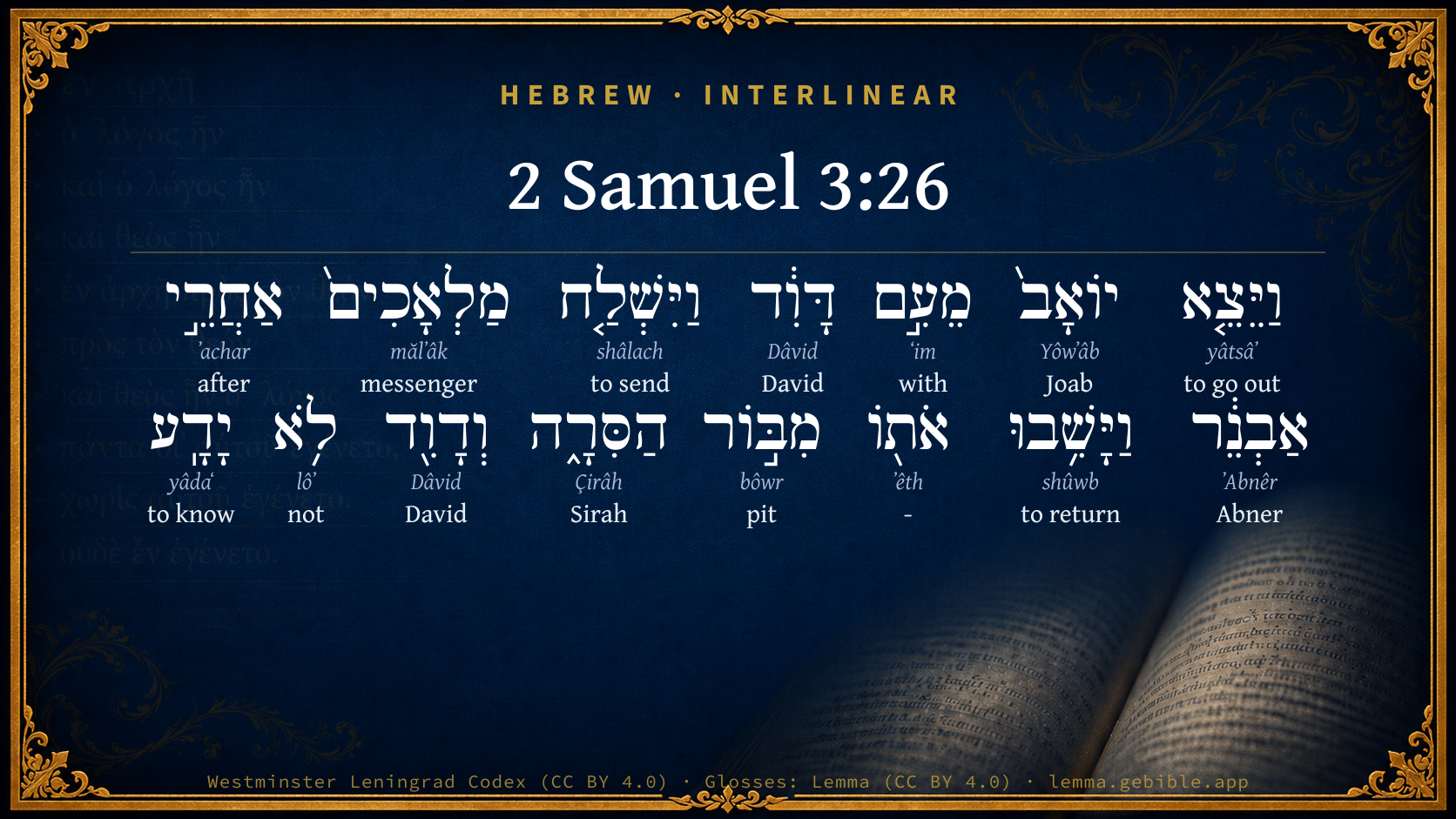
Hebrew (Westminster Leningrad Codex) 2 Samuel 3:26 appears in the Hebrew Old Testament. The text above is from the Westminster Leningrad Codex. Each word links to its Strong’s number, a concise gloss, and parsing drawn from the Open Scriptures Hebrew Bible morphology. Click any word for its full Brown-Driver-Briggs (BDB) entry.
Download image
Cite this verse

2 Samuel 3:26 (World English Bible). Public Domain. Lemma interlinear Bible study tool, https://lemma.gebible.app/v/2-samuel/3/26.

Show BibTeX & RIS
BibTeX
RIS
English Translation
When Joab was come out from David, he sent messengers after Abner, and they brought him back from the well of Sirah: but David didn't know it.
World English Bible · Public Domain
Highlights
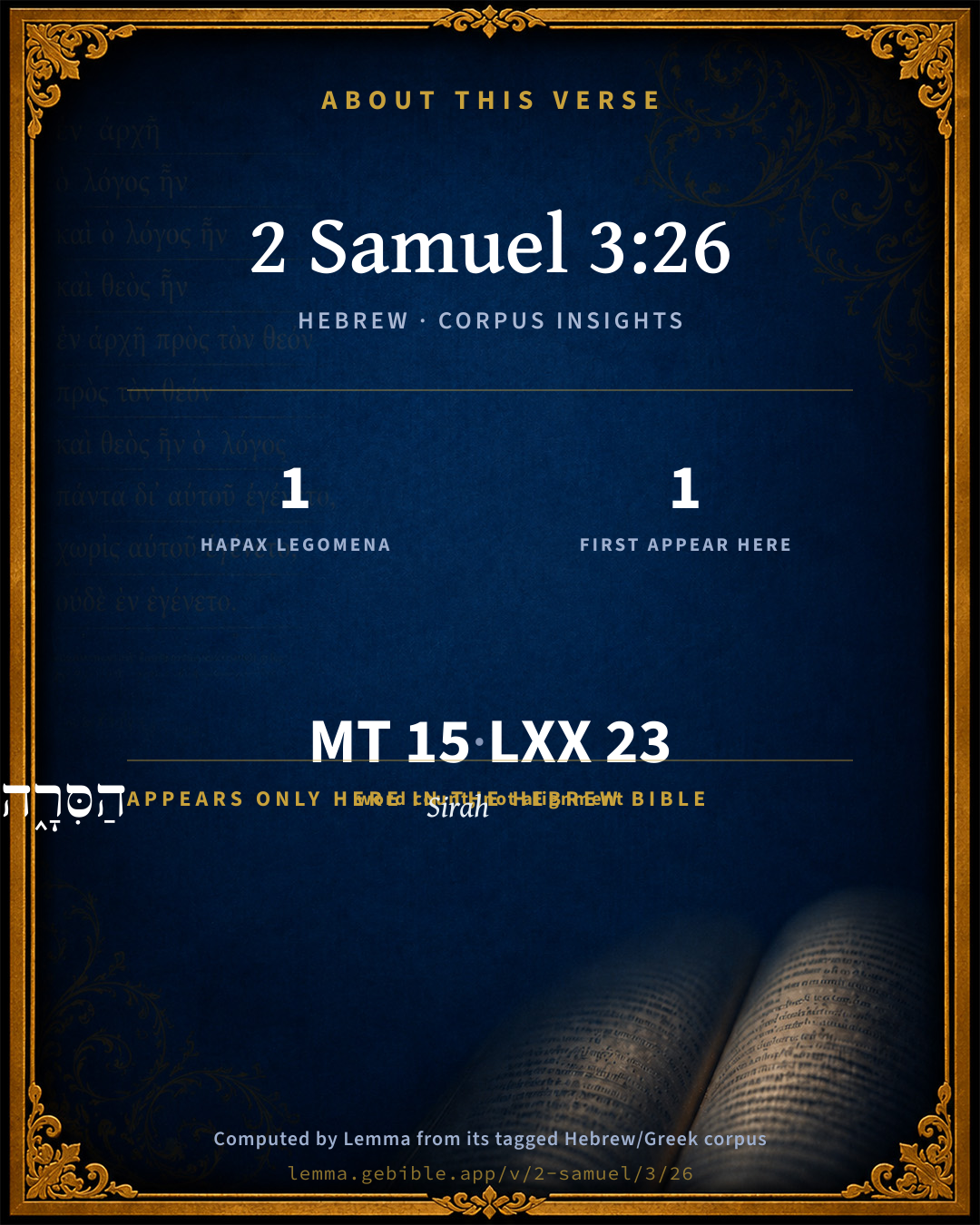
  • 1 hapax legomenon — only here in the Hebrew Bible
  • 1 first appearance in the Hebrew Bible
Full analysis ↓
Download a study sheet

One document with this verse’s original text, its word-by-word gloss line, the meaning frame, cross-references with their text, attributed commentary, and full source and license credits — printable, and it pastes into notes with its structure intact.

This verse Autodidact and up

Study sheet (.html) Plain text (.txt)

A passage Seminary Student

Up to 50 verses in one chapter. A passage sheet keeps up to 6 commentary sources and 12 cross-references per verse, in the order this page ranks them, and says so on the sheet whenever that leaves anything out. Ask for a single verse and you get the Autodidact verse sheet above.

Everything on this page stays free to read, with no account — the sheet is a download of what is already on screen, not access to it.

Want to remove ads? Support Godless Engineer
Compare translations 3

The same verse in 3 English versions, stacked beneath the original-language interlinear above. Click any original word for its lexicon entry.

Each is an independent rendering of the whole verse — the interlinear is not word-aligned to these translations.

Highlighted words mark where these versions differ — a whole-verse word diff, not a word-by-word alignment.

  • World English Bible Public Domain
    When Joab was come out from David, he sent messengers after Abner, and they brought him back from the well of Sirah: but David didn't know it.
  • King James Version Public Domain
    And when Joab was come out from David, he sent messengers after Abner, which brought him again from the well of Sirah: but David knew it not.
  • unfoldingWord Literal Text CC BY-SA 4.0
    And Joab went out from with David, and he sent messengers after Abner, and they brought him back from the cistern of Sirah. But David did not know.

unfoldingWord Literal Text — © unfoldingWord, licensed CC BY-SA 4.0. Word-aligned USFM3 via Door43 (git.door43.org/unfoldingWord/en_ult).

Versions to compare (up to 4)

3 of 4 selected

Show all 18 translations

Every available English version of this verse, each an independent rendering of the whole verse.

  • World English Bible Public Domain
    When Joab was come out from David, he sent messengers after Abner, and they brought him back from the well of Sirah: but David didn't know it.
  • Berean Standard Bible Public Domain
    As soon as Joab had left David, he sent messengers after Abner, who brought him back from the well of Sirah; but David was unaware of it.
  • Majority Standard Bible Public Domain
    As soon as Joab had left David, he sent messengers after Abner, who brought him back from the well of Sirah. But David was unaware of it.
  • King James Version Public Domain
    And when Joab was come out from David, he sent messengers after Abner, which brought him again from the well of Sirah: but David knew it not.
  • American Standard Version (1901) Public Domain
    And when Joab was come out from David, he sent messengers after Abner, and they brought him back from the well of Sirah: but David knew it not.
  • Revised Version (1885) Public Domain
    And when Joab was come out from David, he sent messengers after Abner, and they brought him back from the well of Sirah: but David knew it not.
  • Geneva Bible (1599) Public Domain
    And when Ioab was gone out from Dauid, he sent messengers after Abner, which brought him againe from the well of Siriah vnknowing to Dauid.
  • Douay-Rheims (1899) Public Domain
    Then Joab going out from David, sent messengers after Abner, and brought him back from the cistern of Sira, David knowing nothing of it.
  • Young's Literal Translation Public Domain
    And Joab goeth out from David, and sendeth messengers after Abner, and they bring him back from the well of Sirah, and David knew not.
  • Literal Standard Version CC BY-SA 4.0
    And Joab goes out from David, and sends messengers after Abner, and they bring him back from the well of Sirah, and David did not know.
  • Unlocked Literal Bible CC BY-SA 4.0
    When Joab left David, he sent messengers after Abner, and they brought him back from the well of Sirah, but David did not know this.
  • unfoldingWord Literal Text CC BY-SA 4.0
    And Joab went out from with David, and he sent messengers after Abner, and they brought him back from the cistern of Sirah. But David did not know.
  • Darby Bible Public Domain
    And when Joab was come out from David, he sent messengers after Abner, who brought him again from the well of Sirah; but David did not know it.
  • World Messianic Bible Public Domain
    When Joab had come out from David, he sent messengers after Abner, and they brought him back from the well of Sirah; but David didn’t know it.
  • Webster's Bible Public Domain
    And when Joab had come out from David, he sent messengers after Abner, who brought him again from the well of Sirah: but David knew it not.
  • Free Bible Version CC BY-SA 4.0
    When Joab left David, he sent messengers after Abner. They met up with him at the well of Sirah and brought him back, but David didn't know anything about it.
  • Bible in Basic English Public Domain
    And when Joab had come out from David, he sent men after Abner, and they overtook him at the water-spring of Sirah, and made him come back with them: but David had no knowledge of it.
  • JPS Tanakh (1917) Public Domain
    And when Joab was come out from David, he sent messengers after Abner, and they brought him back from Bor-sirah; but David knew it not.

Literal Standard Version (2020), Covenant Press — licensed CC BY-SA 4.0. Text via the HelloAO Bible API (eBible.org). Unlocked Literal Bible (unfoldingWord) — licensed CC BY-SA 4.0. Text via the HelloAO Bible API (eBible.org). unfoldingWord Literal Text — © unfoldingWord, licensed CC BY-SA 4.0. Word-aligned USFM3 via Door43 (git.door43.org/unfoldingWord/en_ult). Free Bible Version, Dr. Jonathan Gallagher — licensed CC BY-SA 4.0. Text via the HelloAO Bible API (eBible.org).

Word by word

More ways to search: Search by grammar → Find every occurrence → Compare this word →

Practice this passage: Drill this verse → Learn its vocabulary →

הַסִּרָ֑ה
Çirâh
H5626
“Sirah”
Noun, Proper
Part of Speech
Noun
Type
Proper
Full BDB Definition

Origin: from H5493

TWOT: None

Sirah = "the turning" - a well or cistern; apparently on the road north from Hebron
  1. וַיֵּצֵ֤א yâtsâʼ H3318 “and · to go out” Conjunction + Verb, Qal, Sequential Imperfect, 3rd Person, Masculine, Singular
  2. יוֹאָב֙ Yôwʼâb H3097 “Joab” Noun, Proper
  3. מֵעִ֣ם ʻim H5973 “from · with” Preposition + Preposition
  4. דָּוִ֔ד Dâvid H1732 “David” Noun, Proper
  5. וַיִּשְׁלַ֤ח shâlach H7971 “and · to send” Conjunction + Verb, Qal, Sequential Imperfect, 3rd Person, Masculine, Singular
  6. מַלְאָכִים֙ mălʼâk H4397 “messengers” Noun, Common, Masculine, Plural, Absolute
  7. אַחֲרֵ֣י ʼachar H310 “after” Preposition
  8. אַבְנֵ֔ר ʼAbnêr H74 “Abner” Noun, Proper
  9. וַיָּשִׁ֥בוּ shûwb H7725 “and · to return” Conjunction + Verb, Hiphil, Sequential Imperfect, 3rd Person, Masculine, Plural
  10. אֹת֖וֹ ʼêth H853 “- · him” Particle, Direct Object + Suffix, Personal, 3rd Person, Masculine, Singular
  11. מִבּ֣וֹר bôwr H953 “from · pit” Preposition + Noun, Proper
  12. וְדָוִ֖ד Dâvid H1732 “and · David” Conjunction + Noun, Proper
  13. לֹ֥א lôʼ H3808 “not” Particle, Negative
  14. יָדָֽע yâdaʻ H3045 “to know” Verb, Qal, Perfect, 3rd Person, Masculine, Singular

About this verse

These counts appear in no published source. They are computed here, from the morphology-tagged text and Lemma’s own curated glosses. What Lemma adds →

15
words
14
distinct lemmas
Historical
section

Notable vocabulary

1 hapax legomenon — a word that appears only here in the entire Hebrew Bible:

  • הַסִּרָ֑ה Sirah H5626

First appearance in Scripture

This word makes its first canonical appearance in the Hebrew Bible here:

  • הַסִּרָ֑ה Sirah H5626

Grammatical profile

  • 4 verbs
  • 7 nouns
  • 2 prepositions
  • 2 particles

Verb forms

  • וַיֵּצֵ֤א Qal · Sequential Imperfect
  • וַיִּשְׁלַ֤ח Qal · Sequential Imperfect
  • וַיָּשִׁ֥בוּ Hiphil · Sequential Imperfect
  • יָדָֽע Qal · Perfect

Repetition

A word recurs within this verse — often emphatic in Hebrew:

  • דָּוִ֔ד David H1732 ×2

Hebrew & Septuagint length

In English translation the verse runs 27 words from the Hebrew and 27 from the Septuagint (LXX English) — the same length.

A rough comparison of the two English renderings, which tokenize alike — not a word-level alignment.

Word counts can differ between the Hebrew and the Greek without any difference in meaning — e.g. the Hebrew direct-object marker אֵת has no separate Greek word, and Greek often adds the article ὁ.

In the original languages it is 15 Hebrew tokens and 23 Greek tokens — but the two are counted differently (Hebrew bundles its prefixes and suffixes into one token; the Greek is in lemma form), so that isn’t a like-for-like length.

Cross-references

2

Topical passages linked to 2 Samuel 3:26 in the Treasury of Scripture Knowledge — connected by theme and wording, ordered by reader-vote popularity; previews shown in the World English Bible.

  • Proverbs 26:23–26 Like silver dross on an earthen vessel Are the lips of a fervent one with an evil heart.
  • Proverbs 27:4–6 Wrath is cruel, And anger is overwhelming; But who is able to stand before jealousy?

Cross-references courtesy of OpenBible.info (CC BY 4.0).

Hebrew and Greek witnesses Masoretic Hebrew ↔ Greek Septuagint

The same verse in the two great witnesses to the Old Testament, shown verse-for-verse.

These are two independent witnesses, not word-aligned to each other, and the Septuagint is shown in lemma (dictionary) form.

Hebrew 2 Samuel 3:26 Masoretic · Westminster Leningrad Codex

וַיֵּצֵ֤א יוֹאָב֙ מֵעִ֣ם דָּוִ֔ד וַיִּשְׁלַ֤ח מַלְאָכִים֙ אַחֲרֵ֣י אַבְנֵ֔ר וַיָּשִׁ֥בוּ אֹת֖וֹ מִבּ֣וֹר הַסִּרָ֑ה וְדָוִ֖ד לֹ֥א יָדָֽע

When Joab was come out from David, he sent messengers after Abner, and they brought him back from the well of Sirah: but David didn't know it.

World English Bible · Public Domain

Greek LXX 2 Samuel 3:26 Septuagint · lemma form

καί ἀναστρέφω ιωαβ ἀπό ὁ δαυίδ καί ἀποστέλλω ἄγγελος ὀπίσω αβεννηρ καί ἐπιστρέφω αὐτός ἀπό ὁ φρέαρ ὁ σεϊραμ καί δαυίδ οὐ οἶδα

And Joab returned from David, and sent messengers to Abenner after him; and they bring him back from the well of Seiram: but David knew it not.

LXX2012 (modern English Septuagint) · Public Domain

Hebrew: Westminster Leningrad Codex (CC BY 4.0). Greek: Septuagint (public domain); English from LXX2012 (modern English Septuagint) (Public Domain). How the Septuagint differs from the Hebrew →

Targum (Aramaic paraphrase)

1

The Targum is the ancient Jewish Aramaic paraphrase of the Hebrew Scriptures — an interpretive translation, not the Hebrew text itself. Onkelos (literal) and Pseudo-Jonathan (expansive) render the Torah, and Jonathan the Prophets. Coverage is partial: where no permissively-licensed English translation exists for a verse, only the Aramaic is shown. This is verse-level text, not a word-by-word alignment to the Hebrew.

  1. Targum Jonathan Prophets (Joshua–Malachi)
    וּנְפַק יוֹאָב מִן קֳדָם דָוִד וּשְׁלַח אִזְגַדִין בָּתַר אַבְנֵר וַאֲתִיבוּ יָתֵיהּ מִגוּבָא דְסִירָתָא וְדָוִד לָא יְדָע:

    (no public-domain English translation for this verse)

    Targum Jonathan — Aramaic: “Mikraot Gedolot” (public domain). English: “Sefaria Community Translation” (CC0 1.0 (public-domain dedication)); “London "Chaldee Paraphrase," 1871” (public domain). Text via Sefaria.

Commentary

Notes on 2 Samuel 3:26 from classic Christian and Jewish commentators (each source and its license shown beneath its notes). The classic Christian expositions comment on the surrounding passage and are grouped to its opening verse, so a note may address several verses; the Jewish commentaries on the Tanakh (Rashi and others) are per-verse, so they appear only where the commentator wrote on this verse.

Lemma curates 59 commentaries, every one of them public domain or Creative Commons licensed, each selected and text-cleaned for this edition rather than reprinted as found. About our sources →

Trapp's Complete Commentary

John Trapp

2Sa 3:26 And when Joab was come out from David, he sent messengers after Abner, which brought him again from the well of Sirah: but David knew [it] not.

Ver. 26. And when Joab was come out from David] In a great heat, flinging out from his presence: as did likewise Robert, Earl of Essex, once from Queen Elizabeth; who followed him at the heels, and fetched him again with a cuff on the ear. {a} But so durst not David deal by General Joab.

He sent messengers.] In the king’s name, saith Josephus.

From the well of Sirah.] The Vulgate hath it, the cistern Syra; Tremellius, the cistern of Sisera. But Piscator thinketh that Sisera was there mendose scripture pro Sira, the fault of the scribe, for Sira writing Sisera.

{a} Camden’s Elisab.

John Trapp, A Commentary or Exposition upon All the Books of the Old and New Testament (1647–1656) — public domain. Text from a community e-Sword module.

Joseph Benson's Commentary

2Sa 3:26-27. When Joab was come out from David — He seems to have gone out in anger; not staying for an answer. He sent messengers after Abner — Probably in the king’s name, as if he had something further to communicate to him. For otherwise it is not credible that Abner would have returned. Joab took him aside in the gate — Where, it appears, he had waited for him, and, as it was a public place, where men met to do business, and where the courts of judgment sat, Abner suspected no danger, especially since Joab took him by the hand in a friendly manner, as if he wished to have some discourse with him. And smote him there under the fifth rib, that he died — Thus fell Abner by an unexpected and surprising treachery! and in the very article of returning to his duty, and in the eve of a great revolution, seemingly depending on his fate! And thus his thoughts, purposes, and boasts of gathering all Israel to David, and translating the kingdom to him, perished in a moment! In this, however treacherously and wickedly Joab acted, the Lord, in permitting it, was righteous. Abner had deliberately and maliciously opposed David, and in opposing him had acted against the dictates of his own conscience, and of his known duty to God, and that for a series of years: he had sported with the lives of his brethren, and spilled the first blood shed in this civil war; and, it may be, all the blood that was shed; at least we hear of none after the battle of Gibeon. He had now basely deserted Ish-bosheth, and betrayed him, under pretence of regard to God and Israel; but, in reality, from a principle of pride and revenge, and impatience of control. God, therefore, would not use so ill a man in so good a work as the uniting of Israel to Judah, and thereby preventing the progress of war and slaughter. And he hereby showed that he did not need his help, but could, with infinite ease, accomplish his purposes without him, thus pouring contempt on the pride of man. The following reflection of Dr. Delaney here appears both just and important.

“It is true Abner was now returned to his duty; but it is true that he returned to it now as he departed from it before, upon a pique; and from motives of ambition, interest, and revenge. He well knew the purposes and declarations of God in relation to David, and yet he deliberately opposed himself to them. And it is but just in the appointments of Providence (and nothing is more conspicuous in his government of the world) not to permit the wicked to effect that good from wrong motives which they once obstructed upon the same principles. The occasions of duty, once notoriously neglected, seldom return, at least, to equal advantage. Let no man decline the good that is in his power; if he once does so, he is no more worthy to be the happy instrument of effecting it in the hand of God. To conclude; a great revolution apparently depended upon Abner’s fate, but it did so only in the eye of human providence, as was plainly manifested from the event.”

For the blood of Asahel his brother — This was one reason of his committing this murder; but, doubtless, envy and jealousy of Abner’s great merit with David, in gaining over the tribes to him, were the main motives that impelled him to it. In the mean time his pretence was fidelity to his sovereign, and excess of care for his safety. “What,” says Josephus, reflecting on this crime, “will not men dare to do who are covetous, ambitious, and will be inferior to none, to obtain what they desire! They will commit a thousand crimes, and rather than lose what they have got, they will not fear to commit still greater wickedness.”

Joseph Benson's Commentary on the Old and New Testaments (1811–1818) — public domain. Text from a community e-Sword module.

Tyndale Open Study Notes

Tyndale Open Resources

3:26 The precise location of the well of Sirah is unknown; presumably it was not far from Hebron. • David knew nothing about it: See study note on 3:21.

Tyndale Open Study Notes — © Tyndale Open Resources, licensed CC BY-SA 4.0. Text via the HelloAO Bible API.

Ellicott's Commentary for English Readers

(26) Sent messengers after Abner.—Whether this was done in his own or in David’s name (though without his knowledge) does not appear, but in either case Abner would readily suppose that the coming of Joab had made further conference desirable. His entire confidence in David is shown by his unsuspecting return.

The well of Sirah.—The only knowledge of this locality is from the testimony of Josephus (Antt. vii. 1, 5), that it was twenty stadia (two and a half miles) from Hebron; and there is still a spring and reservoir called Ain Sareh, rather more than a mile north of the town. If this is correct, Abner must have just left David when Joab arrived.

A Bible Commentary for English Readers, edited by Charles John Ellicott (1878–1897) — public domain. Text from a community e-Sword module.

The Cambridge Bible for Schools and Colleges

gen. ed. J. J. S. Perowne

26. he sent messengers after Abner] No doubt in David’s name, pretending to recall him for a further interview. A message from Joab would have excited Abner’s suspicion, while on David’s good faith he could place entire reliance.

the well of Sirah] Rather more than a mile out of Hebron on the old paved road to the north is a spring with a reservoir called Ain Sareh, which is in all probability “the well of Sirah.” This agrees sufficiently well with Josephus’ statement that it was twenty stadia or two miles and a half distant from Hebron.

The Cambridge Bible for Schools and Colleges (gen. ed. J. J. S. Perowne; Cambridge University Press, 1878–1918) — public domain. Text from a community e-Sword module.

John Gill's Exposition

And when Joab was come out from David,.... Which perhaps he did at once, as soon as ever he had spoken his mind, and flew out of the room in a great passion, not waiting for the king's answer, since we read of none returned; though it may be the king disdained to give him one, or cared not to confer with him while in his passion, until it subsided; or chose not to provoke him more, for it is plain he had great power over him; which generals of armies at this time very much assumed, see Sa2 3:39;

he sent messengers after Abner; in the name of the king, as Abarbinel rightly supposes, and so Josephus (f); for otherwise it can hardly be thought he would have returned on a message from Joab only, who he knew bore him ill will:

which brought him again from the well of Sirah; which might have its name from the thorns and briers that grew about it. Josephus (g) calls it Besira, and says it was twenty furlongs or two and an half miles from Hebron:

but David knew it not; that Joab had sent messengers in his name after Abner to fetch him back; it was not done by his order, with his consent or knowledge; this is observed, to clear David from any concern in the death of Abner, as follows.

(f) Antiqu. l. 7. c. 1. sect. 5. (g) Ibid.

John Gill's Exposition of the Whole Bible (1746–1763) — public domain (CC PDM 1.0). Text via the HelloAO Bible API.

Albert Barnes' Notes on the Bible

The well Sirah - Nowhere else mentioned; according to Josephus, about two and a half miles from Hebron.

Albert Barnes' Notes on the Bible (1834–1885) — public domain. Text from a community e-Sword/MySword module.

Haydock's Catholic Bible Commentary

Messengers, in the king’s name. --- Sira. See Judges iii. 26. Josephus says the place was 20 stadia from Hebron. (Antiquities vii. 1.)

George Leo Haydock (1774–1849), Haydock's Catholic Family Bible and Commentary, 1859 edition — public domain. Excludes Psalms (Douay-Rheims chapter numbering differs from Protestant) and Deuterocanonical books (Catholic canon only).

Matthew Poole's English Annotations

He sent messengers after Abner, in the king’s name, and upon pretence of some further communication with him.

Matthew Poole's English Annotations on the Holy Bible (1683–1685) — public domain. Text from a community e-Sword/MySword module.

Whedon's Commentary on the Bible

Daniel D. Whedon

26. Well of Sirah — Evidently a place well known at the time of the writer, and apparently on the northern road from Hebron. There is said to be a spring and reservoir called Ain Sara on this road about a mile north of Hebron, and this would seem still to mark the ancient spot — GROVE, in Smith’s Dictionary.

Daniel D. Whedon (gen. ed.), Commentary on the Old and New Testaments (1874–1909) — public domain. Text from a community e-Sword module.

The Pulpit Commentary

The well Hebrew, cisternof Sirah. Josephus ("Ant.," 8. 1. 5) says that this cistern was situated about two miles and a half north ofHebron. There was probably a caravanserai there, at which Abner halted, intending to continue his march homewards as soon as the coolness of evening set in. Here Joab"s messengers overtook him, and, speaking in David"s name for otherwise Abner would not have fallen into the trap asked him to return for further conference, mentioning, perhaps, Joab"s arrival as the reason. In this way Abner"s suspicions would be set at rest, and it would seem quite natural for him to find Joab waiting for him at the gate.

The Pulpit Commentary (1880–1919), ed. H.D.M. Spence-Jones & Joseph S. Exell — public domain. Text from a community e-Sword module.

Rashi

Rabbi Shlomo Yitzchaki (Rashi)

From Bor HaSiroh. The name of a place [But] the Rabbis said: A well and a thorn caused Avner to be killed, by not grasping unto the deeds of Dovid, by [ignoring] the jug of water that [Dovid] took from [under] the head of Shaul and also [by ignoring] the corner of Shaul's garment [Avner dismissed this and] he said "Perhaps one of the thorns caught upon [the garment] and tore it.

Rashi on the Tanakh — English translations: “The Judaica Press complete Tanach with Rashi, translated by A. J. Rosenberg” (CC BY 4.0); “Pentateuch with Rashi's commentary by M. Rosenbaum and A.M. Silbermann, 1929-1934” (public domain); “The Metsudah Tanach series, Lakewood, N.J” (CC BY 4.0); and “The Book of Joshua, Metsudah Publications, 1997” (CC BY 4.0). Text via Sefaria.

Lesson kit

Teaching starters — assembled from the data on this page, not authored interpretation. Every prompt links to the verse data it draws on. Edit before teaching.

2 Samuel, in the Historical, opens this verse with 15 words (14 distinct Hebrew lemmas). Its most distinctive word is Çirâh (“Sirah”). A historical commentator’s framing appears above. Read the whole chapter for the surrounding context.

Discussion questions

  1. The word Çirâh carries the sense “Sirah.” How does it shape the verse?
  2. This verse holds 1 word here found nowhere else in the Hebrew Bible. What might the rare word draw attention to?
  3. The word “Sirah” first appears here in Scripture. What is being introduced at this debut?
  4. Proverbs 26:23–26 shares this passage’s theme. How do the two illuminate each other?
  5. “David” occurs 2× in this one verse. What is the effect of the repetition?
  6. The translations on this page render this verse differently — a whole-verse word diff, not a word-by-word alignment. What might account for the different wordings?
  7. The verb «וַיֵּצֵ֤א» is Qal Sequential Imperfect. How does its form color the action?
  8. Reading how Trapp's Complete Commentary and Joseph Benson's Commentary read this verse, where do the two commentators agree and where do they part?

Things to notice

  • 1 word in this verse appears nowhere else in the Hebrew Bible.
  • 1 word makes its first canonical appearance in Scripture here.
  • This verse counts 15 Hebrew ↔ 23 Greek words.
  • These translations choose different wording for 12 words in this verse.
  • “David” occurs 2× in this single verse.

Reading settings

Reading text

Shown beneath each verse's original-language words.

Old Testament
Old Testament edition

Read the OT as the Masoretic Hebrew (MT) or the Greek Septuagint (LXX).

English shown for the Greek Septuagint (in the Hebrew ↔ Greek comparison).

Comparing translations? Open the Compare panel on any verse page to stack up to four side by side.