Job 1:14

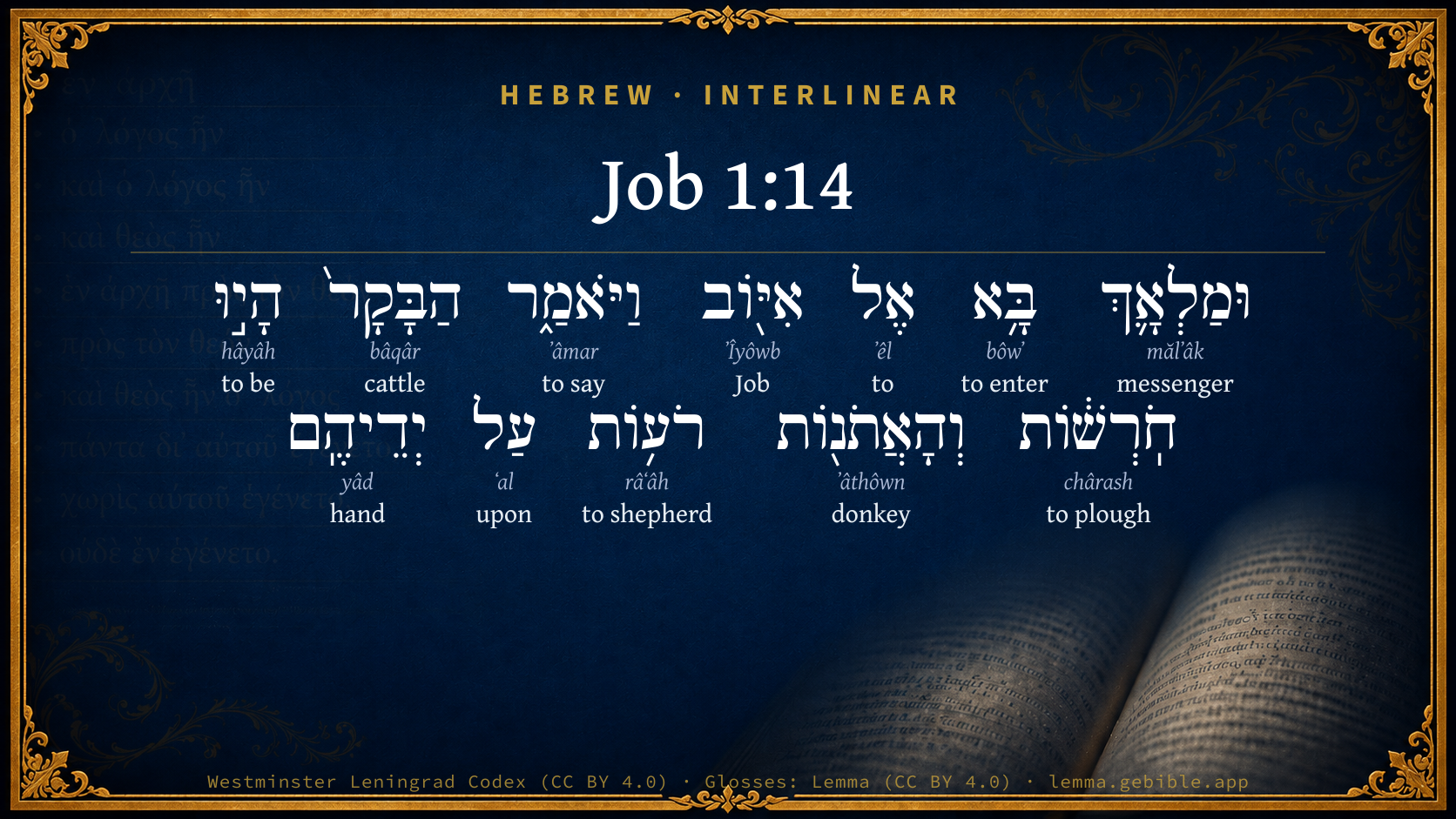
Hebrew (Westminster Leningrad Codex) Job 1:14 appears in the Hebrew Old Testament. The text above is from the Westminster Leningrad Codex. Each word links to its Strong’s number, a concise gloss, and parsing drawn from the Open Scriptures Hebrew Bible morphology. Click any word for its full Brown-Driver-Briggs (BDB) entry.
Download image
Cite this verse

Job 1:14 (World English Bible). Public Domain. Lemma interlinear Bible study tool, https://lemma.gebible.app/v/job/1/14.

Show BibTeX & RIS
BibTeX
RIS
English Translation
that there came a messenger to Job, and said, "The oxen were plowing, and the donkeys feeding beside them,
World English Bible · Public Domain
Download a study sheet

One document with this verse’s original text, its word-by-word gloss line, the meaning frame, cross-references with their text, attributed commentary, and full source and license credits — printable, and it pastes into notes with its structure intact.

This verse Autodidact and up

Study sheet (.html) Plain text (.txt)

A passage Seminary Student

Up to 50 verses in one chapter. A passage sheet keeps up to 6 commentary sources and 12 cross-references per verse, in the order this page ranks them, and says so on the sheet whenever that leaves anything out. Ask for a single verse and you get the Autodidact verse sheet above.

Everything on this page stays free to read, with no account — the sheet is a download of what is already on screen, not access to it.

Want to remove ads? Support Godless Engineer
Compare translations 3

The same verse in 3 English versions, stacked beneath the original-language interlinear above. Click any original word for its lexicon entry.

Each is an independent rendering of the whole verse — the interlinear is not word-aligned to these translations.

Highlighted words mark where these versions differ — a whole-verse word diff, not a word-by-word alignment.

  • World English Bible Public Domain
    that there came a messenger to Job, and said, "The oxen were plowing, and the donkeys feeding beside them,
  • King James Version Public Domain
    And there came a messenger unto Job, and said, The oxen were plowing, and the asses feeding beside them:
  • unfoldingWord Literal Text CC BY-SA 4.0
    And a messenger came to Job and said, “The oxen were plowing and the donkeys feeding at their hand.

unfoldingWord Literal Text — © unfoldingWord, licensed CC BY-SA 4.0. Word-aligned USFM3 via Door43 (git.door43.org/unfoldingWord/en_ult).

Versions to compare (up to 4)

3 of 4 selected

Show all 18 translations

Every available English version of this verse, each an independent rendering of the whole verse.

  • World English Bible Public Domain
    that there came a messenger to Job, and said, "The oxen were plowing, and the donkeys feeding beside them,
  • Berean Standard Bible Public Domain
    a messenger came and reported to Job: “While the oxen were plowing and the donkeys were grazing nearby,
  • Majority Standard Bible Public Domain
    a messenger came and reported to Job: “While the oxen were plowing and the donkeys were grazing nearby,
  • King James Version Public Domain
    And there came a messenger unto Job, and said, The oxen were plowing, and the asses feeding beside them:
  • American Standard Version (1901) Public Domain
    that there came a messenger unto Job, and said, The oxen were plowing, and the asses feeding beside them;
  • Revised Version (1885) Public Domain
    that there came a messenger unto Job, and said, The oxen were plowing, and the asses feeding beside them:
  • Geneva Bible (1599) Public Domain
    There came a messenger vnto Iob, and said, The oxen were plowing, and the asses feeding in their places,
  • Douay-Rheims (1899) Public Domain
    There came a messenger to Job, and said: The oxen were ploughing, and the asses feeding beside them,
  • Young's Literal Translation Public Domain
    And a messenger hath come in unto Job and saith, `The oxen have been plowing, and the she-asses feeding by their sides,
  • Literal Standard Version CC BY-SA 4.0
    And a messenger has come to Job and says, “The oxen have been plowing, and the female donkeys feeding by their sides,
  • Unlocked Literal Bible CC BY-SA 4.0
    A messenger came to Job and said, “The oxen were plowing and the donkeys were feeding beside them.
  • unfoldingWord Literal Text CC BY-SA 4.0
    And a messenger came to Job and said, “The oxen were plowing and the donkeys feeding at their hand.
  • Darby Bible Public Domain
    And there came a messenger to Job and said, The oxen were ploughing, and the asses feeding beside them;
  • World Messianic Bible Public Domain
    that a messenger came to Job, and said, “The oxen were plowing, and the donkeys feeding beside them,
  • Webster's Bible Public Domain
    And there came a messenger to Job, and said, The oxen were plowing, and the asses feeding beside them:
  • Free Bible Version CC BY-SA 4.0
    a messenger came to Job and told him, “As the oxen were plowing and female donkeys were grazing nearby,
  • Bible in Basic English Public Domain
    And a man came to Job, and said, The oxen were ploughing, and the asses were taking their food by their side:
  • JPS Tanakh (1917) Public Domain
    that there came a messenger unto Job, and said: 'The oxen were plowing, and the asses feeding beside them;

Literal Standard Version (2020), Covenant Press — licensed CC BY-SA 4.0. Text via the HelloAO Bible API (eBible.org). Unlocked Literal Bible (unfoldingWord) — licensed CC BY-SA 4.0. Text via the HelloAO Bible API (eBible.org). unfoldingWord Literal Text — © unfoldingWord, licensed CC BY-SA 4.0. Word-aligned USFM3 via Door43 (git.door43.org/unfoldingWord/en_ult). Free Bible Version, Dr. Jonathan Gallagher — licensed CC BY-SA 4.0. Text via the HelloAO Bible API (eBible.org).

Word by word

More ways to search: Search by grammar → Find every occurrence → Compare this word →

Practice this passage: Drill this verse → Learn its vocabulary →

וְהָאֲתֹנ֖וֹת
ʼâthôwn
H860
“and · the · donkeys”
Conjunction + Particle, Definite Article + Noun, Common, Feminine, Plural, Absolute
Part of Speech
Conjunction + Particle + Noun
Type
Common
Gender
Feminine
Number
Plural
State
Absolute
Full BDB Definition

Origin: probably from the same as H386 (sense of patience)

TWOT: 190a

she-ass, she-donkey
  1. וּמַלְאָ֛ךְ mălʼâk H4397 “and · messenger” Conjunction + Noun, Common, Masculine, Singular, Absolute
  2. בָּ֥א bôwʼ H935 “to enter” Verb, Qal, Perfect, 3rd Person, Masculine, Singular
  3. אֶל ʼêl H413 “to” Preposition
  4. אִיּ֖וֹב ʼÎyôwb H347 “Job” Noun, Proper
  5. וַיֹּאמַ֑ר ʼâmar H559 “and · to say” Conjunction + Verb, Qal, Sequential Imperfect, 3rd Person, Masculine, Singular
  6. הַבָּקָר֙ bâqâr H1241 “the · cattle” Particle, Definite Article + Noun, Common, Both, Singular, Absolute
  7. הָי֣וּ hâyâh H1961 “to be” Verb, Qal, Perfect, 3rd Person, Common, Plural
  8. חֹֽרְשׁ֔וֹת chârash H2790 “ploughing” Verb, Qal, Participle Active, Feminine, Plural, Absolute
  9. רֹע֥וֹת râʻâh H7462 “shepherding” Verb, Qal, Participle Active, Feminine, Plural, Absolute
  10. עַל ʻal H5921 “upon” Preposition
  11. יְדֵיהֶֽם yâd H3027 “hands · their” Noun, Common, Both, Dual, Construct + Suffix, Personal, 3rd Person, Masculine, Plural

About this verse

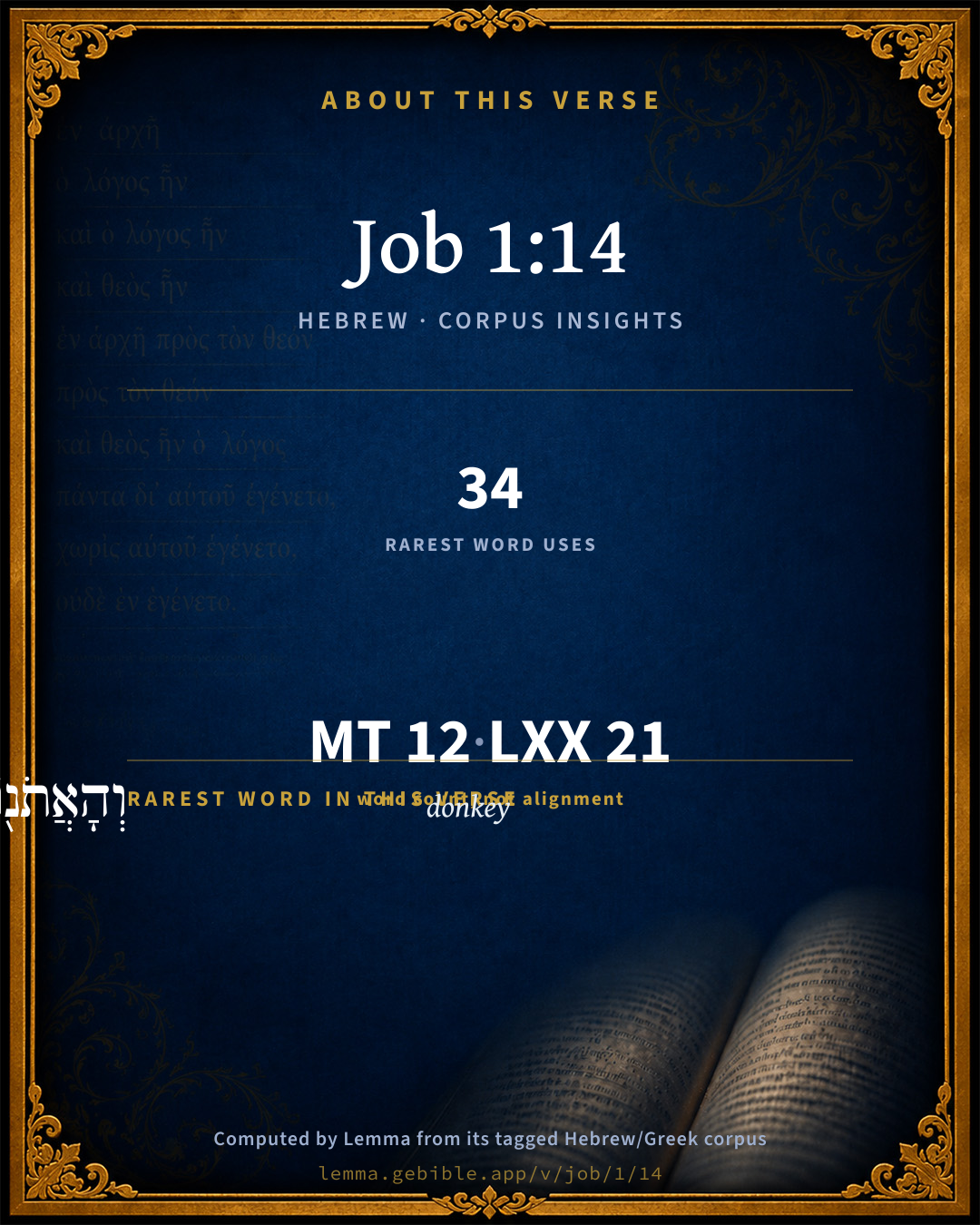
These counts appear in no published source. They are computed here, from the morphology-tagged text and Lemma’s own curated glosses. What Lemma adds →

12
words
12
distinct lemmas
Wisdom
section

Shared distinctive vocabulary

וְהָאֲתֹנ֖וֹת donkey H860 occurs in 28 verses of the Hebrew Bible. Also found in:

Grammatical profile

  • 5 verbs
  • 5 nouns
  • 2 prepositions

Verb forms

  • בָּ֥א Qal · Perfect
  • וַיֹּאמַ֑ר Qal · Sequential Imperfect
  • הָי֣וּ Qal · Perfect
  • חֹֽרְשׁ֔וֹת Qal · Participle Active
  • רֹע֥וֹת Qal · Participle Active

Hebrew & Septuagint length

In English translation the verse runs 19 words from the Hebrew and 25 from the Septuagint (LXX English) — closely comparable.

A rough comparison of the two English renderings, which tokenize alike — not a word-level alignment.

Word counts can differ between the Hebrew and the Greek without any difference in meaning — e.g. the Hebrew direct-object marker אֵת has no separate Greek word, and Greek often adds the article ὁ.

In the original languages it is 12 Hebrew tokens and 21 Greek tokens — but the two are counted differently (Hebrew bundles its prefixes and suffixes into one token; the Greek is in lemma form), so that isn’t a like-for-like length.

Cross-references

3

Topical passages linked to Job 1:14 in the Treasury of Scripture Knowledge — connected by theme and wording, ordered by reader-vote popularity; previews shown in the World English Bible.

  • 1 Samuel 4:17 He who brought the news answered, Israel is fled before the Philistines, and there has been also a great slaughter among the people, and your two sons also, Hophni and Phinehas, are dead, and the ark of God is taken.
  • Jeremiah 51:31 One post shall run to meet another, and one messenger to met another, to show the king of Babylon that his city is taken on every quarter:
  • 2 Samuel 15:13 There came a messenger to David, saying, The hearts of the men of Israel are after Absalom.

Cross-references courtesy of OpenBible.info (CC BY 4.0).

Hebrew and Greek witnesses Masoretic Hebrew ↔ Greek Septuagint

The same verse in the two great witnesses to the Old Testament, shown verse-for-verse.

These are two independent witnesses, not word-aligned to each other, and the Septuagint is shown in lemma (dictionary) form.

Hebrew Job 1:14 Masoretic · Westminster Leningrad Codex

וּמַלְאָ֛ךְ בָּ֥א אֶל אִיּ֖וֹב וַיֹּאמַ֑ר הַבָּקָר֙ הָי֣וּ חֹֽרְשׁ֔וֹת וְהָאֲתֹנ֖וֹת רֹע֥וֹת עַל יְדֵיהֶֽם

that there came a messenger to Job, and said, "The oxen were plowing, and the donkeys feeding beside them,

World English Bible · Public Domain

Greek LXX Job 1:14 Septuagint · lemma form

καί ἰδού ἄγγελος ἔρχομαι πρός ιωβ καί εἶπον αὐτός ὁ ζεῦγος ὁ βοῦς ἀροτριάω καί ὁ θῆλυς ὄνος βόσκω ἔχω αὐτός

And, behold, there came a messenger to Job, and said to him, The yokes of oxen were plowing, and the she-asses were feeding near them;

LXX2012 (modern English Septuagint) · Public Domain

On this verse, Albert Barnes' Notes on the Bible discusses the Septuagint’s reading. Read the note in Commentary ↓

Hebrew: Westminster Leningrad Codex (CC BY 4.0). Greek: Septuagint (public domain); English from LXX2012 (modern English Septuagint) (Public Domain). How the Septuagint differs from the Hebrew →

Commentary

Notes on Job 1:14 from classic Christian and Jewish commentators (each source and its license shown beneath its notes). The classic Christian expositions comment on the surrounding passage and are grouped to its opening verse, so a note may address several verses; the Jewish commentaries on the Tanakh (Rashi and others) are per-verse, so they appear only where the commentator wrote on this verse.

Lemma curates 59 commentaries, every one of them public domain or Creative Commons licensed, each selected and text-cleaned for this edition rather than reprinted as found. About our sources →

Trapp's Complete Commentary

John Trapp

Job 1:14 And there came a messenger unto Job, and said, The oxen were plowing, and the asses feeding beside them:

Ver. 14. And there came a messenger] A sad relater, not a devil in the shape of a man, as the Rabbis would have it (let that pass for a Jewish fable), but one of Job’s own servants, or some other eye witness, to make Job believe, belike, that, as an evil man, he only sought rebellion, since such cruel messengers were sent against him, Pro 17:11.

The oxen were plowing, and the asses feeding, &c.] i.e. We were none of us either idle, or ill-occupied; but taking pains, and tending our cattle, when this disaster befell us. "Fools, because of their transgression, and because of their iniquities, are afflicted," Psa 107:17; they create themselves crosses, such as must therefore needs come with a sting in them, see Gen 42:21. But Job’s servants were honestly employed when plundered and assassinated; which showeth that his losses were not penal, but probational.

And the asses feeding beside them] Peter Martyr, upon the First of Samuel, wittily applieth this text to prelates and non-residents; who, when put in mind of their duty, would usually answer, that they had substitutes and curates to do their business for them, Ita labor aliorum est, et proventus ipsorum; so that others took the pains, and they the profit, saith he, and as it is in the Book of Job, The oxen plow, and the asses feed beside them.

John Trapp, A Commentary or Exposition upon All the Books of the Old and New Testament (1647–1656) — public domain. Text from a community e-Sword module.

Joseph Benson's Commentary

Job 1:14-15. And the asses feeding beside them — That is, beside the oxen. And the Sabeans fell upon them — A people of Arabia, who led a wandering life, and lived by robbery and plunder, as Strabo and other heathen writers observe. They were the descendants of Abraham by Keturah, whose son Jokshan begat Sheba, their progenitor. Indeed, the Hebrew here is, Sheba fell upon them; and took them away — The whole five hundred yoke of oxen, and the five hundred asses which he had. Yea, they have slain the servants, &c. — Who faithfully and bravely did their best to defend them. And I only am escaped to tell thee — Him Satan spared no less maliciously than he destroyed the rest, that Job might have speedy and certain intelligence of his calamity.

Joseph Benson's Commentary on the Old and New Testaments (1811–1818) — public domain. Text from a community e-Sword module.

Jamieson, Fausset & Brown

Robert Jamieson, A. R. Fausset & David Brown

the asses feeding beside them--Hebrew, "she asses." A graphic picture of rural repose and peace; the more dreadful, therefore, by contrast is the sudden attack of the plundering Arabs.

Jamieson, Fausset & Brown — Commentary Critical and Explanatory on the Whole Bible (1871) — public domain (CC PDM 1.0). Text via the HelloAO Bible API.

Adam Clarke's Commentary

Verse 14. The asses feeding beside them] אתנות athonoth, the she-asses, which appear to have been more domesticated, as of more worth and use than the others, both for their milk and their work.

Adam Clarke's Commentary on the Bible (1810–1826) — public domain. Text from a community e-Sword/MySword module.

The Cambridge Bible for Schools and Colleges

gen. ed. J. J. S. Perowne

14, 15. The first stroke, the loss of the oxen and she-asses, with the slaughter of the servants. Job’s servants were probably armed, as is usual in the East, and offered resistance, for the Bedawin do not usually shed blood unless opposed. The Sabeans were an Arab tribe, or possibly different tribes bore the name (Gen_10:7; Gen_10:28; Gen_25:3). In Job_6:19 they are represented as trading with caravans. They are mentioned in connexion with Dedan, and probably detachments of them encamped on the borders of Edom, and these would be the assailants of Job’s servants. The raid came from the direction of the South, and the fact that the oxen were plowing indicates that the disaster befell in winter.

The Cambridge Bible for Schools and Colleges (gen. ed. J. J. S. Perowne; Cambridge University Press, 1878–1918) — public domain. Text from a community e-Sword module.

John Gill's Exposition

And there came a messenger unto Job,.... Not a messenger of Satan, as Jarchi, or one of his angels, or evil spirits; though this is a sense which is embraced not only by some Jewish Rabbins, but by several of the ancient Christian writers, as Sanctius on the place observes; and such they suppose the other messengers after mentioned were; but both this and they were servants of Job, who escaped the calamity that came upon the rest of their fellow servants:

and said, the oxen were ploughing: the five hundred yoke of oxen Job had, Job 1:3, which were all out in the fields, and employed in ploughing them; and to plough with such was usual in those times and countries, as it now is in some places; see Kg1 19:19

and the asses feeding beside them; beside the oxen, where they were ploughing, in pasture ground, adjoining to the arable land; and beside the servants that were ploughing with the oxen: "at their hands" (b); as it may be literally rendered, just by them, under their eye and care; or "in their places" (c); where they should be, and where they used to feed (d); these were the five hundred asses, male and female, reckoned among Job's substance, Job 1:3, which were brought hither to feed, and some for the servants to ride on; this ploughed land being at some distance from Job's house; and others to carry the seed that was was to be sown here: now the situation and employment of these creatures are particularly mentioned, to show that they were in their proper places, and at their proper work; and that what befell them was not owing to the want of care of them, or to the indolence and negligence of the servants.

(b) "ad manus eorum", Mercerus. (c) "Suis locis", Vatablus, Schmidt; so Jarchi, Aben Ezra, and Bar Tzemach. (d) "More solito", Schultens.

John Gill's Exposition of the Whole Bible (1746–1763) — public domain (CC PDM 1.0). Text via the HelloAO Bible API.

Albert Barnes' Notes on the Bible

And there came a messenger unto Job - Hebrew מלאך mal'âk; the word usually rendered “angel,” appropriately rendered “messenger” here. The word properly means “one who is sent.”

The oxen were plowing - Hebrew “the cattle” (בקר bâqâr) including not merely “oxen,” but probably also “cows;” see the notes at Job 1:3.

And the asses - Hebrew אתון 'âthôn “she-asses.” The “sex” is here expressly mentioned and Dr. Good maintains that it should be in the translation. So it is in the Septuagint αἱ θήλειαι ὄνοι hai thēleiai onoi. So Jerome, “asinoe.” The reason why the sex is specified is, that female asses, on account of their milk, were much more valuable than males. On this account they were preferred also for traveling; see the notes at Job 1:3.

Beside them - Hebrew “By their hands,” that is, by their sides, for the Hebrew יד yâd is often used in this sense; compare the notes at Isa 33:21.

Albert Barnes' Notes on the Bible (1834–1885) — public domain. Text from a community e-Sword/MySword module.

Matthew Poole's English Annotations

i.e. Beside the oxen, therefore both were taken away together.

Matthew Poole's English Annotations on the Holy Bible (1683–1685) — public domain. Text from a community e-Sword/MySword module.

Whedon's Commentary on the Bible

Daniel D. Whedon

FIRST MESSENGER.

14. A messenger — In each of the four cases the messenger was, Chrysostom thinks, (though without authority from the text,) Satan himself, who brought the tidings to Job that he might feed on his misery.

The oxen were ploughing — A single touch of the pencil sets forth the quietude and peace that reigned around. The scientist speaks of a like hush of nature before an earthquake. “The ancient plough was entirely of wood, and of as simple a form as that of modern Egypt. It consisted of a share, two handles, and the pole or beam, which last was inserted into the lower end of the stilt on the base of the handles, and was strengthened by a rope connecting it with the heel. It had no coulter, nor were wheels applied to any Egyptian plough; but it is probable that the point was shod with a metal sock of bronze or iron. It was drawn by two oxen, and the ploughman guided and drove them with a long goad, without the assistance of reins, which are used by the modern Egyptians.” — Wilkinson.

89504e470d0a1a0a0000000d494844520000010800000072080300000098e6bfde00000300504c5445000000fffffffefefefdfdfde9e9e9dadadae1e1e1f4f4f4fbfbfbdcdcdccdcdcdd7d7d7f1f1f1f8f8f8f6f6f6ecececb6b6b6bfbfbfefefefe6e6e67979795c5c5c696969939393b4b4b4c1c1c1e3e3e3f5f5f5fcfcfcc8c8c86363634343435555558989899999999c9c9cb9b9b9d6d6d6eaeaeae8e8e88d8d8d474747272727323232aeaeaefafafad3d3d32121210202020101010c0c0c2424243535354848486c6c6ca4a4a4b8b8b8c4c4c4dededeebebebf0f0f02222220909090707070404040d0d0d2b2b2b565656787878919191a9a9a9bcbcbcd0d0d0e7e7e7b5b5b5292929585858e4e4e49898985d5d5d4f4f4f4545451313130303030808081818182d2d2d3d3d3d4949496161617373737b7b7b7676767d7d7d7f7f7f3838384444444646461e1e1e1010100b0b0b3333334e4e4e6f6f6f878787a1a1a1c3c3c3d2d2d2d5d5d5e5e5e5f3f3f31616161b1b1ba0a0a0d8d8d8cbcbcb8686866565654c4c4c2e2e2e2020201212120606060505053b3b3b909090cacaca6767674141413131312323231717173f3f3f505050545454525252959595848484757575f7f7f7626262b1b1b1a2a2a28f8f8f575757404040141414f9f9f9c5c5c5b0b0b09494948080806b6b6b5353533a3a3a1111117070705f5f5f5e5e5eafafaf4a4a4aeeeeeed9d9d9bababab3b3b3a6a6a69797978b8b8bbebebedbdbdbf2f2f2aaaaaa929292777777ededed2525258e8e8e8c8c8c1919193939396464646d6d6dc9c9c9e0e0e07a7a7abbbbbb727272acacac2828284242428282820a0a0a0f0f0f1f1f1f5b5b5b6e6e6ea7a7a76868681a1a1abdbdbd1d1d1d2626262a2a2a858585abababc6c6c63e3e3e606060cfcfcfb2b2b24d4d4dc7c7c7ddddddd4d4d4666666343434e2e2e2747474363636a8a8a8c2c2c2dfdfdfcececeadadad7171712f2f2fd1d1d1515151373737c0c0c02c2c2c4b4b4b1515157e7e7e595959cccccc8888883c3c3c0e0e0e1c1c1c5a5a5a8a8a8a9d9d9db7b7b79f9f9f7c7c7c818181a3a3a39e9e9e3030309696969a9a9a9b9b9b838383a5a5a56a6a6a4ca953eb00000001624b47440088051d48000000097048597300000ec400000ec401952b0e1b000019a349444154789ced5d075813c9dbdf6743092d342b0982481130900454a424c10aa2580288e544423940aae8111215046c170f95d8a30858103c11cb59100c58687645c1820aa2628313ecedbed9dd8028880412f4ff3dfe1e0532bb3be5b733efbcf3ce3b6f20f81750403fba023f0b7e1121c62f22c4f8458418bf8810e3171162fc22428c5f4488f16d227072f20a8a5fa5e195945554d5086ab2add30f416b22d4953534b5c06fed1e3d7bf5eed3575987486abea6db4f4fbfbf41ef018646c60452ab27ffa7d18a089381a666e683c830cec29242a559590f1e3270a8cd30655b3b7b752d426f073a834967380e1f3172d4e831c39c9c89ff6fe86845c458170882c68d87617bd709132759bb4c66b9b97b4cf19c3a6dfa8cdf06ce1c6ce6356996b717db87e1cbf69be2ff7b40a04dd0ec608b1072a8faff3825ad8808080344844780669142e6441a8e9e3b6fde843fa64471a2b9149ea3a51967fe8285ca6306cc8d895de411174fa3872f4a58bc6469af65cbff1cfb23aadf29e015e684b64afc9a08fe0a3740848f6bf3fb253acb2938f5fd2b71e5b455abada33849bc1188041568afe9b376e8baf51b366eb21232a9943047c66619575f5a2085246e49deda2af96b2274525880082b0d396d39dc1717c8a969c3b66ddfb1d33a3e7d97724626c1588b84232bca056beefe7b4f3f070ac4182ac3ca4b0f591a2bfbeda5ba67b7baf035116bac010f90d0736acf79fb126d941542bf1afaf82194fd07262ddd3cfde03f3b0fc91111b20459878fd021476599555e6a30763a9ae317cfa346273bb5baf63511c77221144c16237eaf5fdec67f8e2f1b7a2c28cd99d8d43f16205729a27c1ebd60f589932b0fd9e341e2294748d457d6cde82ad4344fcfb276a4167a4e5b66816f75f56b228aac29500b5044938b4b4abdbc37f63a6370f69c3c100fc77c9b2f5299a2c2f3178eb81e2619f84234ddee694ea721bf7c932f14653d61f445e7aff544045f1391ba7b66b2a9259d0a7d012a4b1456906badb79c00ebac82a8bc1657183e053b08a34490957377b4a6732085685ebab422cff3f249cd2b19e4b6ef69357d12edcaae1625ce3db9e75a4ffd7247ca977cb854c0f865bcf306d767ddb01431c5a9a29bfc95226863ebdef673006fbb75fd1f51f3d79dba6561341ef7cddbda5c6be0f8a921723a954ab7ef0cbcbbc5bfaad832dc0d6b332308875b23cc513431aabe7573e7b47b353e88d27105d78f0b2d93594bba04d5fb67bcad9284c3e7963549395c5924bf8d1bdb5f7d0aec4d746cabaf1c3a777343093a1e06e261b9072bd0fcf8a17295b71e82c9d6a19a90c7a2dc927613a4828c2125b5dcb013372f362bbea4d153bc8eb571674796e1381c8e2ff708d138a114029cf9d853d07445cd7035172a35c29b32a395a4527169029735e6f86047d6de1963c67fee0246d7c399f9ebdbb8bbc3f688486b4480c6aac1fc7d25b6cda9c1977990977c8507d5ac2d49fc03417ab2ec9ff2429fb81567d6a4368b47a78117f63a022de9691b0f74980872b63b20e299224cda951bd99cbad6830a9d187fce1d32ed5abda50c5b83c5f1f9bebec3a7eba6868a85b8e0d0ca8396756ec8dbac2f6ae3918e5ba8882318403056c07085796273e2b00310b4c76e6121f46f17ab2e3d685d3c35a19ec6a3c4b9068f6fb212380f1ae95de8cb4095026a5daf8ee811ede07912047177815cbd7a35a7ddbf0141bf65297a334774adf6524359eff93e6e4ceae54b41954d23827fb861932f9785b1e0d3ab51b74d039b0444bc2804395d03940f999f2a4ec2bd88437ac46d174a4cd7ea2f15e0529dd273591496f0c05f4dd211479c3d6a56341721814a61595edfa6f32d4d420222fa1480ec0e803132cac5a8a99c814070bccc6a1042d3bbd0006900470ed5cd29e131dddc270ea868d2ed04b603f31cb1a5028fee77f76c453bc6230988e81b87684f2130b98fc3a9a6b49b608df62a55238932a8930d900af04475e5de1bdd198ef5ab229a5568bc62c6f352f10a32dffaf4a0acf6f39080880c3f44e1068bcc8caae34d6943f742945199afa3ddcb3a517fe9001faa53347d960fd3d7f2e0e860a238514daba2f17a1c2a15788eee796fe4be9b8d044464a620cae5df30ace339afa98fbdde0bd53692378b2c43246e8074a018d2f7d55b37ae90bd7acfb6a6c900afa5f2fada7006ba3ea6ef370dd0d0fef612a3191210813f4903792fc1c1597ba668634982973e10670deeb8a38b96c44d9002f876c13bffc8678595faa71735c96f819d6dd1480fc4ccc6a2c7e79edf1251d1b1bc24d9e9fa6b3fc8de431d26bc7111ab24fc9175905524bc2d6c11b1fd47650142d9ee9c523761b1d73b15557192c04e657bcef97864083338cf26bcb74825743437498818c6410a688449b738d331c1ac9843835c2ec2114297d4ef3c2b6d08b28213537ceb4a96f64894172791b28cd64e4f10225325b7d87ce3316d8936e42421e2b039a09af90f0cab54f963ef407d1e03f2a8866d6aa3322529b4ab20db550f3a13ebebe3f27b1f715fc0f1edcaee0798d6222c50c2a2367ea896b4429210c14f7603c53c23c2cebd1e629351ea693a643e1b5e137fa0ad25be8c109a7669a65e122fbe7cdaf6a65233670f9dd9d3838e88c7fc52d38f9a7692e72ad16e78830f28c94a07e67fd29b8d2654e8b320bf6af87ed86341fb4f4a0d848cfbcbc6593a72cafde7de12cb25e3db360b2646237281c2759f3f6d90ed378c71ed4322220ce31153ff6d202d6a1ad0049514087a1b6977dd7746a70a97146a76b7df4cf04bf259146330c616a33e346dfb91c125685f60840f9ef7fc4a67cd0112115191c78420df4018be3aeb2edaf227b11054f54429963951e69e0238a2d1d87533528add3725afef23eefa445bcdf41325c85409f10a3c4f8f72caecfcfb90cc51c4a00e4c1b60eda970210535ce4402229e0513e7d6ad96b18ce0a7bd9eabff4018e697bc725708d65a7e65d1be150710d58692e491d0cfc029ab4be663c988a82ca1424c4f3e9c7ac6e312f259692215f257826f4e8e91a58c10cc6e0c58c5a6fb96f71ba571186b2d5fbe71df05af7c7492a8d37bbe3628a4ab4674c98820cda74054332398bc7df82be4bd549b52a17195b0ab4fb6cc8cf93879cd754bfdeaa8b4d83336e2656568da5fcbc7f94d46c4232bce7348c0b00e6b4ded40421faad5a0741f031836baec8f586b839e41d01605fc485a838cbc230415377bceafa797fc7172e5306c92c0651dfd6d69950fbae112ffec9fb34fdadcb7921c121231014826ee442dd8e4cf1bf7614c465cd3c1af70fb20831e81cbbc7af6b755a58cda7b67febae88c49637cc8a9ff6a3016ea6a563404496fad272111d960014a2d3182edfbe78e061f235743d05d1338bb6ea0f489b0bb33c474b88f28f7f180d998fa4856bff5e2d1895c3abad334fcc402cd32694e551212a1620a6ab17f2d2c18ed82d8c495f32028c704be33799d7489c02bd8bc9b3adc97c7befcd4300d9300823139fad671d1c8e29a55683a53433eb3036b6b09202111a481a022f40921b0c592646318bead0741ff85c0671c3f48534608948f0ff6603bbaebbdec139c8a3657a0f26248551dbad9ca0a9bf4ead26c63a9f740491d4e13111d8ef3024e5dbe7a0d98352641503f1df89d8fabd42aa666b13bc7bc96173e629f8685b8b9aadb630e7050db23d7ecc4d33e16eab250632525e23e2aadd7c1a4d1e511305c768f02f53086138543a5d32308462f92a32c85eefae945b6f6180b64a7880bb934d40ced9397ae7b385546cabca444642e461c01c0d8d05d3a1086c78f63416752e1f73e97a431602fa62f1e5e4867ccef7fab02630117d2b7777255a12f6a62f0e8b1adcc5eba72a12524f6c50e12817763b616b60f7a02d489142a34531d6e4c7a21e1d0e0db7f9d42b8face6f32178a3ed8a75255dcbd4c16cce724d1d1b9d2f2f4d93959325dd8494c44289828a0dafea0cf0a70b0ee7908fa4d1d76729f2a998adde8b968c5c29609150dfe0ed12cdfc12b0f353597b870a07f3c2a1e29499eef8db264bdaa939808fc72a49fdeb383b3aec8935e9740d0ab2cd8be5c32c34c91158fc2080f68ea4584c8996feb78d19ed31be5300f6f9cd6b999a6e18ee80695cf1f032cd4bbc1ec233111b83ec86b32d78515e7e8c0066c087a0a7af9e32a49d4fdd4494816d4f031e827db05deb56e14eb86347b3ec68cf1a5d30f26bba17b95ccb77b34d505b2130c2d20f9790db92850c3c29530e240f209f4888f5930e9de64150972088c47f79f7853b6c1e439cfcb793cabe4f79562b9a0ba6b8343d3866de9ddb5cef86e6101ee0c116aeb10f1550386f8b97e96e0d50261c9d76345743c03c24606b61347b19c7e6f329396b0436c0227912b4f9688fdf958d14b4f757047423ae8c4091e394f50d1b00018d69d85d47a1f181a31dce3df7fae09462e4d4e7a2cb7fc074730e31a899f39fed37f98b589caa517ae3ad66a5e912d3a410479ab1b18bdfae361fec73a50ed7450e33734ff8e3f3fcc0ae381c7d15bae8c5addc99915862f27b1317f458a1bfbb4c1936e7756eccc99ae9055e0c5959e05b320e25705344bb8b220aaa36399444cafc51a5ca5824e0638a2ced8bbe62234cdcd273aac7eea0ff1e1ed0c11a461fb2188362d14cebc0eea3f11b1d08c8837e9c083f84c639535cb5c302f56de4624896f77f5bd673e2616ea8ac7a51bac1dd9919ca48f4e9df2b335053d41ef368cefef4e41b6fc60f82e73f7f71ec2db57ec5a707a51ad08f080c816560d9f946571f3a4b5081b10fb0ffcb90d7411dc9c6edc2b6a814e1111fa864d850a7a1370ca17849025d293b379c9ed3e81cfca38da5f3f9ce690b2c793067a034286c3932bbf95632eeea202af11ae953ff43054e7ce7d660580d62404e1e03ed6acb0b140294ee4967e7b1b98a4a554f47122bbceaae6da56633810286154a44bd0f51ea0ee2c75eea5133e2911ba4b61f8063a7900d6691304e5bf5284b37a24b14601c96fc3f0bdd3f69d24858b1a4f57e5fa38249cdc1d8c1ca5ba321c6a014a98e9e6749befb8f574073a4984f16f3c08ba6701e6c23cee23d00cdb12de91b6ee539d732926b69e1ee73923e22aa685e3ae3c684103ad744f9ae0a7381fd84922c8636e50a1c2e3ceb05a03e7b43378effb98175adda46a74b4ff3836afd83b26224dac176455375e8fff4c446dbf1de3bb507969a2b367c333d745035de20e1e56ef771a698b76fde02faee3d4748e06ac1ace133e3bf82e58bcf3c0af089aebefe2f69907eaa2d667ab7e143a7d483e520facc6af55c2f0c222543b1c62d9e2749b9ad1eeecffcce9493726be0a127b57a9e99c1bb0e11972be83faf934ccdbe0aed55e8ae83411eac7c1fccffed07c92d4c66de31cf19f6af211ffeea5b95bdf7b6aa882d9534876c3fe8ec92b46bcf2921e6cfcd707ed0e60169dd4adebaa76d1692270c366f120eac38b4d9fc72fa24d478c4be4b2b1d927ac188ee7d30d83c5aa915af0ebcdab6bd1adca78d3fe5b55ca1e72c19f6009eab8e1e7893bd0f9f81199676ba8903027432cf3c973296f67c3c4db0392cdc38407ae3dbddfd457421ad317ef459d1e6951fd762e449223a211a7603001cff8790e82752190867d762104c55f17f76edc45339f234e2bbde3c2ccf5fbef5250c4f42339cd65c9e5e8d91fb7dc13cfb78bdd5caeeec74484cff56e5e6bb783ae441451190116ceeecb8db14f04d7e8026f2b8f793b8b825531160446892b0ed4238b6b66f8e58f97e68436298faa1bb1039349fda5b1a12f1d748508c16b33d01af632b18b9f492f0ad3fc4ea5b86d24f95339ded890a8f57c74b63ab5a5da743f9c8a48cbb0515d285dcae8528c19938fe1a0a17b77609e0bf8d98b597a95d815d543019e2575887ce46dbabebbdaeeab2d0935530a328b464b60d79235ba166c27e44c3178b3cfc427fcc86bbc393b41f7c7eb44f4bc81ee49f0364ded7ddbb98d3d8f834ca447442fef52e9524517a30e39cfa80572709e2d36fad58a12ccdf057dda3cab0039534d652f5de6a4d0b6076c3fd4389994deb5d2a589ae865faac8990c4175abc407c38989e1fbcdd8e8fe7d7ede99beb6dff4039e87da276b5b8771f861e8721c2ab947a04f88aea9639f42fe444df534bf79a7d2b4bead24082ea36a76fd77cd5add87ae07e44aede70b41befed8f2899491238420ab6c79bb760d6e59a5e8f645fdd92e972e3548213299d2bf60d5c1e560a1554821c785b457dfd3939c0b1197612a7b6dd74b9716a440042e6b3a0db4ab003bdf860b3992744de13b8f2820a78a291047a3eba54b0b52895527f84847f4a60074eec0d9ed73181cd4fe2242bb1eb54f95574aa374e9403a41fb70eb903dafe847988ea9fae6c1de75eaedddaf1e47859874d6ea1f7000ea5b9056f442c30220fee80ffb623dc1701377a2533ba6c82793216ab419d7ffc76c61b409a985710c42ce1752e3de28a2ed57581ee7b55df59b37af03130dcb5134ef079bf05b427af12c8da6221e80b5ff3dc134ea537e852fcbbed1f57177516d83e7f9f32c3ea519d83373661872f82da1110be2a532d5fd59b6429b0e6021e62cc442c53affed3ed3ed90668453c5860740a3a0bced2d8f5ae0541754d579da68b721070c81321a560c890e76cb01a88e41aaa15ed582fe75e741908ffed632d442a5fba74b6dcfd1ceada4e6827c08724f828401d22cbc8b9072ccdb9095537cc0f411762f511ea5a2288513fdfb7d852f7b85e0841bb2fd49e5fc4c911fa51dfc977f684801b2c4aed58f40f7f79d1347945aad185dd9d226116c85ae3478fe3f91ac94411464edbfcf87218beca4719faa91d37859c7522cc357ecae6e5e7f10d6a3fb1a50fe4aa997dd05c8201c3451f7e343d464ebfe707d642862bd341857523878e015754c6dd01c8e6d75155ffc4e46dd0a99c4c516a8ec7b1887a80a3cd374c3abaa30a9e28dbe55d294991a4aaa78d8b827e62f4559d4ae16dedd905180706275c46336222bdc1e2c795a3447115ff662c32c87aa0bcb0db51339d8a60663c84f3479ca3252bafcbb14f4f03e9576e3f1731b79adac27cbc6b1453543ced33122c276c9ace8ce408621e3c991e9e36aead0fdde3af3132f032fda67b86e789c8b85c582a8353fd5c8906dec7c42dad1a78fcb312ee89697976f8d3cac743d49ec1be1e26ab870fccf3381cafa4b048869dbb2276c2a44c40565b2474a8f862dd162df0866f18d495b5eedb059a8dd5d2117da45377c9b0221a36fc4ddf9986470e4d432c53d02f5b5149a95e7f55c3fd466b66c8fe77400ddf3b51202edfb4fc70d17b50c1c4be5512156be83070d624697f84deab9c7e05463906d77fa4b9032abc77cf6e0eaaeefd7c069cd695c77bcc7e6557e4d5194012bbce2bcc7e1182dccfc02b3b737527206062adb3a2bca980f1c8188131c7eb122cfbc7f73a4ae6efca2117c68965c48dab0a9939b432c53e8616c7a8b5e0251eaf6c7d5e8a59c8879f54263cdc5ca5445e2f7e587784c0942330944390b0545325f35535de94a9053859cf3e14a1527cd530d2f6e5e3a762ad060c1f3e5af9ebfdf19d0ffccd42d337a993ad029d0bdab4dd9b420c2eed6cd53ba1972f65a8861255435544ecbce39d52e33d4ae32cd044f92bbb8abef1ca7b5db0c3f34d86a2bc8d9dbab871c36d1b65552484dd5b95a66979579d8d6c4ce3ed54e4e47db4e558d440825e0f1a0f130e2776e4240a2eae1092673948ce534ef89a0764161317c93382e557e09298b47f41bf9b7c1829dae2f5e7fda7167d0dab53b021b3ebc7f139878f3e6eb881d6f7abbde8cd8777af953d7880fafe66d5cfc7889774dac7e4cb2ffe5c1cfaaa2ca577b4f4a48f02a7f1057c08933db1b67595c185f9be4ce2e0e8b0fa3bbf9d0d0ddd78916ad8908758de270a26ee8794f7a18f3ead1d2c17f24cc8a3daf173bf88f4907ac07e7dcf5accacd2d8f8a2b29a967d79cdf94e0ed9d37e540c2f99a9af97a7af317d5c4e6796ff24a889d95179b30ff7c9e6772cc3dd325f30e6e3e1933fde58cc779b14beeae1f7261857e6c79cdead553d8ccf689f8cc0893c71009f787bb878717b30b380e0e71711c76717d7d319bcde180ffc5fbc339ec785a525838bb3ec997cb73e3b2a814068dce63a267a1282c1685426dbf841ce7d64404eb233bd8541693c9a3454733983c16c888c562f298142a2fbf8e47c59cea91014da180bb40292c0a958a14079e6231c14714c8453a8dcb64f8fad639d284c27c37168b5117ed28123158c88d2c4abb75eb4ed0fc87e15b13a13d52c860b5f35413b914de17c95c742e000f5228c859550a781928650c471a9dc964d44da671190c06446138460b6985fbc14f61f9c34dd6a5a2e878066028df17a28a927cdc4474aec8717fb8a3a32f208c277203dd81229e638150a573c18f168552b92ca0ba3f60d3a9902f972b4c0273909b88569f6b9e32cb2a6e75f95e21d73daaca8a53481386d59694ee7de0e5656e161fee51fe60caac67258b262ebd910feae4e6f5bec52cf59908bcf6309b4fcb3efe1ef3dfefd737e41c7f747adad37dd92b5ff55f7066fdf177d91f0d46af5b3f73dff37d67461fbbde23dda0f7ccecc088ec3f5f2edbdef7cdf5e9efcebe0f3c3b5af3ecfb052f8e25067e0a0c1c1ab13df28ae6a0addb0ecdd61d6b7354634043a3aed3135d0ba773b7231702d9a29011a4ec7474d0561bddfbaeefb6391dda764b73ecad2757832317de0abaafb1fdd6aed7a7068d363018da7be691f58fe6ded1d40808dcfe615dffcd4bbc278db8f6cfe9e71a83de046a64041f7dbff3d6d8b10bcf050ebd7434a86fb5928289735a5a4885bcf2d88b8715e4e7585c3914795bc936a332647c859245b0ad8eadb6b376c6613963055d1b9b6d86462d8dec2d84258e8457e32b66aaaa668666662a2aaa66128904822291405454e41314f90282a222114020080d258204829a1a2154914026a985828b7c3581002fe013d4046a18c8203b01194fc291c8783c99af4626e170d83fcc2a01fe40afe3f97c3cb895840737202728492412990c6a221008f87c358262282855802713d5c87c0231532b2b4b4b3553954806c580e9023c0ceec691c0073c89f479970447c6761f415a73e2177b28243cc01729bfbea74b8c5f4488f17f2bcec5bc205a10f20000000049454e44ae426082

Daniel D. Whedon (gen. ed.), Commentary on the Old and New Testaments (1874–1909) — public domain. Text from a community e-Sword module.

The Pulpit Commentary

And there came a messenger unto Job, and said, The oxen were ploughing, and the asses (literally, the she-asses) feeding beside them (literally, at their hand). Note that, notwithstanding the festival, labour was still going on; there was no general holiday; the oxen were at work in the field, not perhaps all of them, but the greater number, for the ploughing-time is short in the Oriental countries, and the "earing" is all done at the same time. The bulk of Job"s labourers were probably engaged in the business, and they had brought the asses with them, probably to keep them under their eye, lest thieves should carry them off, when the catastrophe related in the next verse occurred.

The Pulpit Commentary (1880–1919), ed. H.D.M. Spence-Jones & Joseph S. Exell — public domain. Text from a community e-Sword module.

John Wesley's Explanatory Notes

Messenger, &c. - One messenger immediately followed another; Satan so ordering by God's permission, that there might seem to be more than ordinary displeasure of God against him in his troubles, and that he might not have leisure to recollect himself, but be overwhelmed by a complication of calamities.

John Wesley, Explanatory Notes Upon the Whole Bible (1754–1765) — public domain. Text via the GEBible commentary corpus.

Rashi

Rabbi Shlomo Yitzchaki (Rashi)

beside them Heb. על ידיהם lit. on their hands. This is an expression of a place only because it is prepared and available at his hand. Our Sages of blessed memory said in the Aggadah (Baba Bathra 15b, 16a), that the Holy One, blessed be He, gave them a taste of the world to come; for after the plowing by the she-donkeys, they would sow with the plowing, and the she-donkeys would immediately graze on the young greens from the furrow.

Rashi on the Tanakh — English translations: “The Judaica Press complete Tanach with Rashi, translated by A. J. Rosenberg” (CC BY 4.0); “Pentateuch with Rashi's commentary by M. Rosenbaum and A.M. Silbermann, 1929-1934” (public domain); “The Metsudah Tanach series, Lakewood, N.J” (CC BY 4.0); and “The Book of Joshua, Metsudah Publications, 1997” (CC BY 4.0). Text via Sefaria.

Lesson kit

Teaching starters — assembled from the data on this page, not authored interpretation. Every prompt links to the verse data it draws on. Edit before teaching.

Job, in the Wisdom, opens this verse with 12 words (12 distinct Hebrew lemmas). Its most distinctive word is ʼâthôwn (“donkey”). A historical commentator’s framing appears above. Read the whole chapter for the surrounding context.

Discussion questions

  1. How does “donkey” (ʼâthôwn) shape what this verse is saying?
  2. How does Genesis 12:16, which shares the word «donkey», read alongside this verse?
  3. These translations render this verse differently. What is at stake in choosing one wording over another?
  4. «בָּ֥א» is a Qal Perfect verb. How does that grammatical form shape the action described?
  5. Compare how Trapp's Complete Commentary and Joseph Benson's Commentary read this verse. Where do they agree or differ?

Things to notice

Reading settings

Reading text

Shown beneath each verse's original-language words.

Old Testament
Old Testament edition

Read the OT as the Masoretic Hebrew (MT) or the Greek Septuagint (LXX).

English shown for the Greek Septuagint (in the Hebrew ↔ Greek comparison).

Comparing translations? Open the Compare panel on any verse page to stack up to four side by side.