

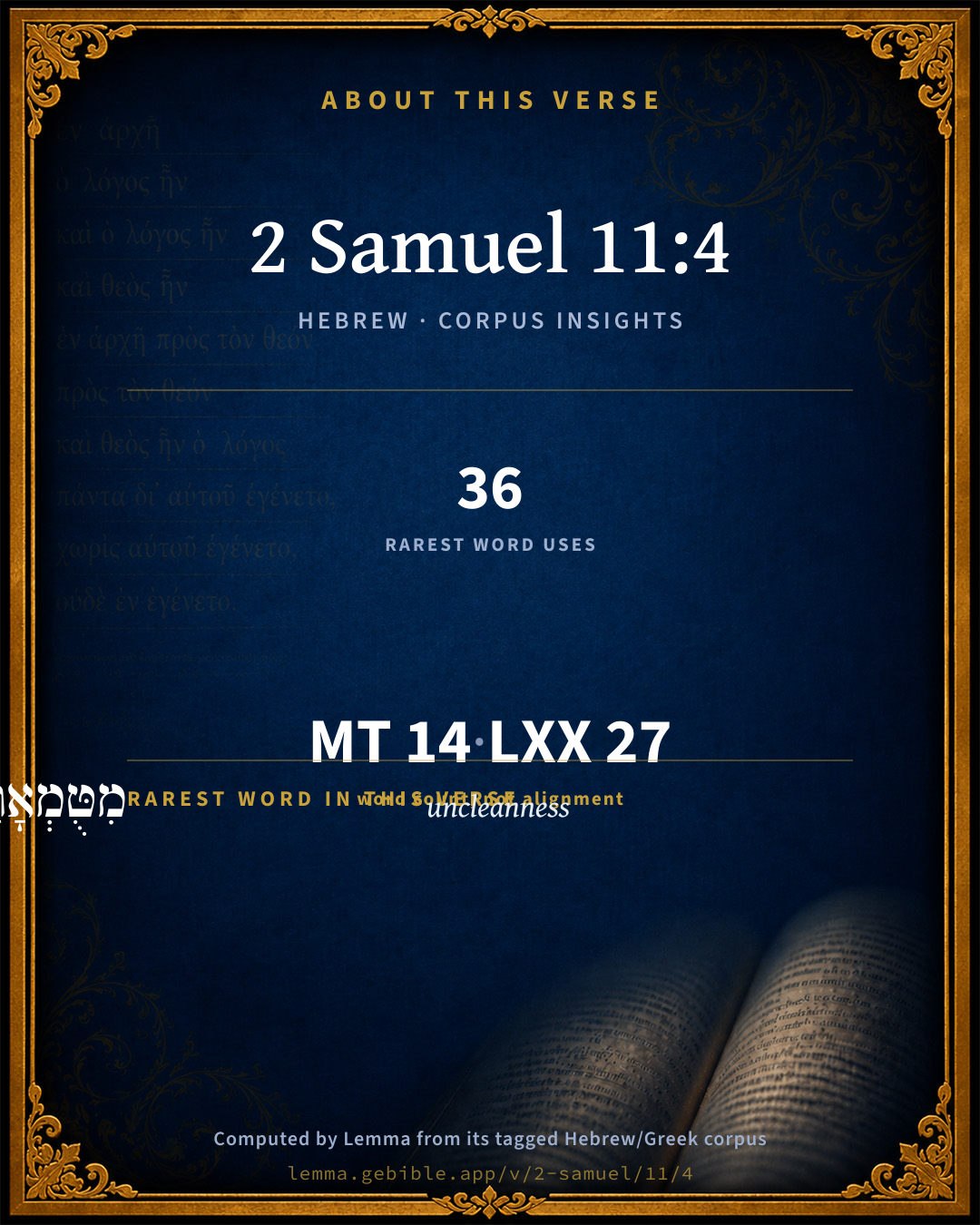
2 Samuel 11:4

Hebrew (Westminster Leningrad Codex) 2 Samuel 11:4 appears in the Hebrew Old Testament. The text above is from the Westminster Leningrad Codex. Each word links to its Strong’s number, a concise gloss, and parsing drawn from the Open Scriptures Hebrew Bible morphology. Click any word for its full Brown-Driver-Briggs (BDB) entry.
Download image
Cite this verse

2 Samuel 11:4 (World English Bible). Public Domain. Lemma interlinear Bible study tool, https://lemma.gebible.app/v/2-samuel/11/4.

Show BibTeX & RIS
BibTeX
RIS
English Translation
David sent messengers, and took her; and she came in to him, and he lay with her (for she was purified from her uncleanness); and she returned to her house.
World English Bible · Public Domain
Download a study sheet

One document with this verse’s original text, its word-by-word gloss line, the meaning frame, cross-references with their text, attributed commentary, and full source and license credits — printable, and it pastes into notes with its structure intact.

This verse Autodidact and up

Study sheet (.html) Plain text (.txt)

A passage Seminary Student

Up to 50 verses in one chapter. A passage sheet keeps up to 6 commentary sources and 12 cross-references per verse, in the order this page ranks them, and says so on the sheet whenever that leaves anything out. Ask for a single verse and you get the Autodidact verse sheet above.

Everything on this page stays free to read, with no account — the sheet is a download of what is already on screen, not access to it.

Want to remove ads? Support Godless Engineer
Compare translations 3

The same verse in 3 English versions, stacked beneath the original-language interlinear above. Click any original word for its lexicon entry.

Each is an independent rendering of the whole verse — the interlinear is not word-aligned to these translations.

Highlighted words mark where these versions differ — a whole-verse word diff, not a word-by-word alignment.

  • World English Bible Public Domain
    David sent messengers, and took her; and she came in to him, and he lay with her (for she was purified from her uncleanness); and she returned to her house.
  • King James Version Public Domain
    And David sent messengers, and took her; and she came in unto him, and he lay with her; for she was purified from her uncleanness: and she returned unto her house.
  • unfoldingWord Literal Text CC BY-SA 4.0
    And David sent messengers, and he took her. And she came to him, and he lay with her. (Now she had been sanctifying herself from her uncleanness.) And she returned to her house.

unfoldingWord Literal Text — © unfoldingWord, licensed CC BY-SA 4.0. Word-aligned USFM3 via Door43 (git.door43.org/unfoldingWord/en_ult).

Versions to compare (up to 4)

3 of 4 selected

Show all 18 translations

Every available English version of this verse, each an independent rendering of the whole verse.

  • World English Bible Public Domain
    David sent messengers, and took her; and she came in to him, and he lay with her (for she was purified from her uncleanness); and she returned to her house.
  • Berean Standard Bible Public Domain
    Then David sent messengers to get her, and when she came to him, he slept with her. (Now she had just purified herself from her uncleanness.) Then she returned home.
  • Majority Standard Bible Public Domain
    Then David sent messengers to get her, and when she came to him, he slept with her. (Now she had just purified herself from her uncleanness.) Then she returned home.
  • King James Version Public Domain
    And David sent messengers, and took her; and she came in unto him, and he lay with her; for she was purified from her uncleanness: and she returned unto her house.
  • American Standard Version (1901) Public Domain
    And David sent messengers, and took her; and she came in unto him, and he lay with her (for she was purified from her uncleanness); and she returned unto her house.
  • Revised Version (1885) Public Domain
    And David sent messengers, and took her; and she came in unto him, and he lay with her; (for she was purified from her uncleanness;) and she returned unto her house.
  • Geneva Bible (1599) Public Domain
    Then Dauid sent messengers, and tooke her away: and she came vnto him and he lay with her: (now she was purified from her vncleannes) and she returned vnto her house.
  • Douay-Rheims (1899) Public Domain
    And David sent messengers, and took her, and she came in to him, and he slept with her: and presently she was purified from her uncleanness:
  • Young's Literal Translation Public Domain
    And David sendeth messengers, and taketh her, and she cometh unto him, and he lieth with her -- and she is purifying herself from her uncleanness -- and she turneth back unto her house;
  • Literal Standard Version CC BY-SA 4.0
    And David sends messengers, and takes her, and she comes to him, and he lies with her—and she is purifying herself from her uncleanness—and she turns back to her house;
  • Unlocked Literal Bible CC BY-SA 4.0
    David sent messengers and took her; she came in to him, and he slept with her (for she had just purified herself from menstruation). Then she returned to her house.
  • unfoldingWord Literal Text CC BY-SA 4.0
    And David sent messengers, and he took her. And she came to him, and he lay with her. (Now she had been sanctifying herself from her uncleanness.) And she returned to her house.
  • Darby Bible Public Domain
    And David sent messengers, and took her; and she came in to him, and he lay with her; and she had purified herself from her uncleanness; and she returned to her house.
  • World Messianic Bible Public Domain
    David sent messengers, and took her; and she came in to him, and he lay with her (for she was purified from her uncleanness); and she returned to her house.
  • Webster's Bible Public Domain
    And David sent messengers, and took her; and she came in to him, and he lay with her; for she was purified from her uncleanness: and she returned to her house.
  • Free Bible Version CC BY-SA 4.0
    David sent messengers to fetch her. When she came to him, he had sex with her. (Now she had just purified herself from having her period.) Afterwards she went back home.
  • Bible in Basic English Public Domain
    And David sent and took her; and she came to him, and he took her to his bed: (for she had been made clean;) then she went back to her house.
  • JPS Tanakh (1917) Public Domain
    And David sent messengers, and took her; and she came in unto him, and he lay with her; for she was purified from her uncleanness; and she returned unto her house.

Literal Standard Version (2020), Covenant Press — licensed CC BY-SA 4.0. Text via the HelloAO Bible API (eBible.org). Unlocked Literal Bible (unfoldingWord) — licensed CC BY-SA 4.0. Text via the HelloAO Bible API (eBible.org). unfoldingWord Literal Text — © unfoldingWord, licensed CC BY-SA 4.0. Word-aligned USFM3 via Door43 (git.door43.org/unfoldingWord/en_ult). Free Bible Version, Dr. Jonathan Gallagher — licensed CC BY-SA 4.0. Text via the HelloAO Bible API (eBible.org).

Word by word

More ways to search: Search by grammar → Find every occurrence → Compare this word →

Practice this passage: Drill this verse → Learn its vocabulary →

מִטֻּמְאָתָ֑הּ
ṭumʼâh
H2932
“from · uncleanness · her”
Preposition + Noun, Common, Feminine, Singular, Construct + Suffix, Personal, 3rd Person, Feminine, Singular
Part of Speech
Preposition + Noun
Type
Common
Gender
Feminine
Number
Singular
State
Construct
Full BDB Definition

Origin: from H2930

TWOT: 809b

uncleanness - sexual - of filthy mass - ethical and religious - ritual - local (of nations)
  1. וַיִּשְׁלַח֩ shâlach H7971 “and · to send” Conjunction + Verb, Qal, Sequential Imperfect, 3rd Person, Masculine, Singular
  2. דָּוִ֨ד Dâvid H1732 “David” Noun, Proper
  3. מַלְאָכִ֜ים mălʼâk H4397 “messengers” Noun, Common, Masculine, Plural, Absolute
  4. וַיִּקָּחֶ֗הָ lâqach H3947 “and · to take · her” Conjunction + Verb, Qal, Sequential Imperfect, 3rd Person, Masculine, Singular + Suffix, Personal, 3rd Person, Feminine, Singular
  5. וַתָּב֤וֹא bôwʼ H935 “and · to enter” Conjunction + Verb, Qal, Sequential Imperfect, 3rd Person, Feminine, Singular
  6. אֵלָיו֙ ʼêl H413 “to · him” Preposition + Suffix, Personal, 3rd Person, Masculine, Singular
  7. וַיִּשְׁכַּ֣ב shâkab H7901 “and · to lie down” Conjunction + Verb, Qal, Sequential Imperfect, 3rd Person, Masculine, Singular
  8. עִמָּ֔הּ ʻim H5973 “with · her” Preposition + Suffix, Personal, 3rd Person, Feminine, Singular
  9. וְהִ֥יא hûwʼ H1931 “and · he” Conjunction + Pronoun, Personal, 3rd Person, Feminine, Singular
  10. מִתְקַדֶּ֖שֶׁת qâdash H6942 “consecrating” Verb, Hithpael, Participle Active, Feminine, Singular, Absolute
  11. וַתָּ֖שָׁב shûwb H7725 “and · to return” Conjunction + Verb, Qal, Sequential Imperfect, 3rd Person, Feminine, Singular
  12. אֶל ʼêl H413 “to” Preposition
  13. בֵּיתָֽהּ bayith H1004 “house · her” Noun, Common, Masculine, Singular, Construct + Suffix, Personal, 3rd Person, Feminine, Singular

About this verse

These counts appear in no published source. They are computed here, from the morphology-tagged text and Lemma’s own curated glosses. What Lemma adds →

14
words
13
distinct lemmas
Historical
section

Shared distinctive vocabulary

מִטֻּמְאָתָ֑הּ uncleanness H2932 occurs in 31 verses of the Hebrew Bible. Also found in:

Grammatical profile

  • 6 verbs
  • 4 nouns
  • 1 pronoun
  • 3 prepositions

Verb forms

  • וַיִּשְׁלַח֩ Qal · Sequential Imperfect
  • וַיִּקָּחֶ֗הָ Qal · Sequential Imperfect
  • וַתָּב֤וֹא Qal · Sequential Imperfect
  • וַיִּשְׁכַּ֣ב Qal · Sequential Imperfect
  • מִתְקַדֶּ֖שֶׁת Hithpael · Participle Active
  • וַתָּ֖שָׁב Qal · Sequential Imperfect

Repetition

A word recurs within this verse — often emphatic in Hebrew:

  • אֵלָיו֙ to H413 ×2

Hebrew & Septuagint length

In English translation the verse runs 30 words from the Hebrew and 29 from the Septuagint (LXX English) — closely comparable.

A rough comparison of the two English renderings, which tokenize alike — not a word-level alignment.

Word counts can differ between the Hebrew and the Greek without any difference in meaning — e.g. the Hebrew direct-object marker אֵת has no separate Greek word, and Greek often adds the article ὁ.

In the original languages it is 14 Hebrew tokens and 27 Greek tokens — but the two are counted differently (Hebrew bundles its prefixes and suffixes into one token; the Greek is in lemma form), so that isn’t a like-for-like length.

Cross-references

9

Topical passages linked to 2 Samuel 11:4 in the Treasury of Scripture Knowledge — connected by theme and wording, ordered by reader-vote popularity; previews shown in the World English Bible.

  • Leviticus 18:19 "'You shall not approach a woman to uncover her nakedness, as long as she is impure by her uncleanness.
  • James 1:14–15 But each one is tempted, when he is drawn away by his own lust, and enticed.
  • Psalms 51:1–19 Have mercy on me, God, according to your loving kindness. According to the multitude of your tender mercies, blot out my transgressions.
  • Leviticus 12:2–5 "Speak to the children of Israel, saying, 'If a woman conceives, and bears a male child, then she shall be unclean seven days; as in the days of her monthly period she shall be unclean.
  • Proverbs 30:20 So is the way of an adulterous woman: She eats and wipes her mouth, And says, 'I have done nothing wrong.'
  • Genesis 39:7 It happened after these things, that his master's wife cast her eyes on Joseph; and she said, "Lie with me."
  • Leviticus 15:19–33 "'If a woman has a discharge, and her discharge in her flesh is blood, she shall be in her impurity seven days: and whoever touches her shall be unclean until the evening.
  • Job 31:9–11 "If my heart has been enticed to a woman, And I have laid wait at my neighbor's door;
  • Psalms 50:18 When you saw a thief, you consented with him, And have participated with adulterers.

Cross-references courtesy of OpenBible.info (CC BY 4.0).

Hebrew and Greek witnesses Masoretic Hebrew ↔ Greek Septuagint

The same verse in the two great witnesses to the Old Testament, shown verse-for-verse.

These are two independent witnesses, not word-aligned to each other, and the Septuagint is shown in lemma (dictionary) form.

Hebrew 2 Samuel 11:4 Masoretic · Westminster Leningrad Codex

וַיִּשְׁלַח֩ דָּוִ֨ד מַלְאָכִ֜ים וַיִּקָּחֶ֗הָ וַתָּב֤וֹא אֵלָיו֙ וַיִּשְׁכַּ֣ב עִמָּ֔הּ וְהִ֥יא מִתְקַדֶּ֖שֶׁת מִטֻּמְאָתָ֑הּ וַתָּ֖שָׁב אֶל בֵּיתָֽהּ

David sent messengers, and took her; and she came in to him, and he lay with her (for she was purified from her uncleanness); and she returned to her house.

World English Bible · Public Domain

Greek LXX 2 Samuel 11:4 Septuagint · lemma form

καί ἀποστέλλω δαυίδ ἄγγελος καί λαμβάνω αὐτός καί εἰςἔρχομαι πρός αὐτός καί κοιμάω μετά αὐτός καί αὐτός ἁγιάζω ἀπό ἀκαθαρσία αὐτός καί ἀποστρέφω εἰς ὁ οἶκος αὐτός

And David sent messengers, and took her, and went in to her, and he lay with her: and she was purified from her uncleanness, and returned to her house.

LXX2012 (modern English Septuagint) · Public Domain

On this verse, Haydock's Catholic Bible Commentary discusses the Septuagint’s reading. Read the note in Commentary ↓

Hebrew: Westminster Leningrad Codex (CC BY 4.0). Greek: Septuagint (public domain); English from LXX2012 (modern English Septuagint) (Public Domain). How the Septuagint differs from the Hebrew →

Targum (Aramaic paraphrase)

1

The Targum is the ancient Jewish Aramaic paraphrase of the Hebrew Scriptures — an interpretive translation, not the Hebrew text itself. Onkelos (literal) and Pseudo-Jonathan (expansive) render the Torah, and Jonathan the Prophets. Coverage is partial: where no permissively-licensed English translation exists for a verse, only the Aramaic is shown. This is verse-level text, not a word-by-word alignment to the Hebrew.

  1. Targum Jonathan Prophets (Joshua–Malachi)
    וּשְׁלַח דָוִד אִזְגַדִין וְדַבְּרָהּ וַאֲתַת לְוָתֵיהּ וּשְׁכִיב עִמָהּ וְהִיא מִתְדַכְיָא מִסוֹבְתָהּ וְתָבַת לְבֵיתָהּ:

    (no public-domain English translation for this verse)

    Targum Jonathan — Aramaic: “Mikraot Gedolot” (public domain). English: “Sefaria Community Translation” (CC0 1.0 (public-domain dedication)); “London "Chaldee Paraphrase," 1871” (public domain). Text via Sefaria.

Commentary

Notes on 2 Samuel 11:4 from classic Christian and Jewish commentators (each source and its license shown beneath its notes). The classic Christian expositions comment on the surrounding passage and are grouped to its opening verse, so a note may address several verses; the Jewish commentaries on the Tanakh (Rashi and others) are per-verse, so they appear only where the commentator wrote on this verse.

Lemma curates 59 commentaries, every one of them public domain or Creative Commons licensed, each selected and text-cleaned for this edition rather than reprinted as found. About our sources →

Trapp's Complete Commentary

John Trapp

2Sa 11:4 And David sent messengers, and took her; and she came in unto him, and he lay with her; for she was purified from her uncleanness: and she returned unto her house.

Ver. 4. And David sent messengers, and took her.] Unbridled lust, like the wild fig, will soon mount over the wall, and break out into unclean practices. It is a law of the members in a double sense, &c. It is, as Reuben, the eldest child of old Adam’s strength. It is the butter which the devil presenteth in so lordly a dish, that the soul spieth not; the hammer and nail in his hand, till he have driven it into the temples. Cavete.

And she came in unto him.] Not so well fortified as she ought against such a temptation: as the window of her house had before been too open, so now the window of her ark was not so well shut, but that the waters of wickedness entered into it. She resisteth not David’s unchaste motion that we read of, no not in word; but too easily consenteth. So did not Susanna, Lucretia, or that other Roman lady, who being taken from the table by Augustus the emperor into a chamber, and afterwards brought back again, her eyes were very red, and her hair all disordered. {a}

And he lay with her.] Wherein he received a foul foil, saith Mr Bradford, {b} and in this sin lay long asleep, as many do now-a-days: God give them good waking! The best of God’s children, saith another, may not only be drenched in the waves of sin, but lie in them for the time: and perhaps sink twice to the bottom. This and other foul faults in David the Holy Ghost hath recorded, not to encourage any to do the like, but as sea marks, that they may avoid these rocks, against which such a choice vessel dashed, and had surely split and perished, had not God’s grace and Holy Spirit, as a timely gale of wind, blown him off, and reduced him into his right course by unfeigned repentance.

For she was purified from her uncleanness,] i.e., Her monthly flows; and so was the more apt to conceive with child. Or, And when she had purified herself from her uncleanness, she returned home; that is, from that legal uncleanness contracted by her carnal copulation with David, - yea, though he had been her own husband. See Exo 19:15 Lev 15:18 1Sa 21:4. But doth Bathsheba make conscience of ceremonial, and none of moral purity? Or, doth David’s deceitful heart make him think that he may the more safely lie with Bathsheba, because she was purified?

And she returned unto her house.] But a far worse woman than when she went out of it, and with a sting in her conscience: for transit voluptas, manet dolor.

“ Habet omnis hoc voluptas,

Stimulis agit fruentes, &c.

Laeta venire Venus, tristis abire solet. ” - Boet. {c}

{a} Sueton.

{b} Serm. of Rep.

{c} Lib. iii. metr. 7.

John Trapp, A Commentary or Exposition upon All the Books of the Old and New Testament (1647–1656) — public domain. Text from a community e-Sword module.

Joseph Benson's Commentary

2Sa 11:4. David sent messengers and took her — — From her own house into his palace, not by force, but by persuasion. And he lay with her — See how all the way to sin is down hill! When men begin they cannot soon stop themselves. And she returned unto her house — With a guilty conscience, and oppressed with terror, no doubt; for she had committed a sin for which the law condemned her to be stoned. She returned, it is probable, early in the morning, to prevent discovery. But how little did it avail to conceal from man a crime, of the commission of which the holy and sin-avenging God, who is no respecter of persons, had been a witness. Alas for poor Bath-sheba! Her confusion and distress were doubtless unutterable. But, in the mean time who can describe the wretched state of David’s mind, when the tumult of passion was subsided, Bath-sheba departed, and reason and reflection returned! “The calm reflections of a spirit truly religious,” says Dr. Delaney, “will best imagine the horrors of so complicated a guilt on the recoil of conscience; when all those passions whose blandishments, but a few moments before, deluded, seduced, and overset his reason, now resumed their full deformity, or rushed into their contrary extremes; desire, into distraction; the sweets of pleasure, into bitterness of soul; love, into self-detestation; and hope, almost into the horrors of despair. The wife of one of his own worthies, apparently an innocent and a valuable woman, abused, and tainted, and brought to the very brink of ruin and infamy! A brave man basely dishonoured! and a faithful subject irreparably injured! The laws of God trampled under foot, of that God who had so eminently distinguished, exalted, and honoured him! Well might he cry out, in the anguish of this distracted condition, Fearfulness and trembling are come upon me, and horror hath overwhelmed me. In one word, his condition was now so dreadful that it was not easy to bring himself to the presumption of even petitioning for mercy! And this I take to be the true reason why we find no psalm of David penned upon this occasion.” Here we may observe, that any other historian but the sacred would have endeavoured to draw a veil over the conduct of the admired hero of his story, that his reader might not see him falling into such crimes as would shock us even in the most abandoned of men. But the Scriptures are divine. They were written by persons whom divine inspiration had raised above the low thoughts of the mere human mind, and they therefore proceed in another manner. They give us a faithful account of things, without any false colouring, without partiality to any one, without concealing the blemishes or vices of the most favoured characters. For they were intended as well to instruct us by the sins of these persons as by their virtues, and therefore set forth their example in all its parts, that we may as well learn to shun the former as to imitate the latter. We have in this crime of David with Bath- sheba as strong a picture represented to us, as ever was set before the eyes of men, of the true nature and progress of vice, how it insinuates itself into the corrupt minds of men, how easily it overcomes them, if not resisted, and how it proceeds from bad to worse, till, it may be, it plunges them into the greatest depth of iniquity and misery, even, as we see here, into adultery and murder!

Joseph Benson's Commentary on the Old and New Testaments (1811–1818) — public domain. Text from a community e-Sword module.

Tyndale Open Study Notes

Tyndale Open Resources

11:4 It is not clear whether Bathsheba came to David’s palace voluntarily. That no protestations are recorded (cp. 13:12-13) and that she married David, bore him another child, and persuaded him to designate their child as heir (1 Kgs 1:11-21) suggest that she might have been a willing partner. However, Bathsheba mourned for her husband (2 Sam 11:26-27), and only David was condemned for this act (11:27), so she might have been violated against her will. • The phrase after having her menstrual period (see Lev 15:19-24) is included to show that the child Bathsheba conceived could not possibly have been Uriah’s.

Tyndale Open Study Notes — © Tyndale Open Resources, licensed CC BY-SA 4.0. Text via the HelloAO Bible API.

Jamieson, Fausset & Brown

Robert Jamieson, A. R. Fausset & David Brown

David sent messengers, and took her--The despotic kings of the East, when they take a fancy for a woman, send an officer to the house were she lives, who announces it to be the royal pleasure she should remove to the palace. An apartment is there assigned to her; and if she is made queen, the monarch orders the announcement to be made that he has made choice of her to be queen. Many instances in modern Oriental history show the ease and despatch with which such secondary marriages are contracted, and a new beauty added to the royal seraglio. But David had to make a promise, or rather an express stipulation, to Bath-sheba, before she complied with the royal will (Kg1 1:13, Kg1 1:15, Kg1 1:17, Kg1 1:28); for in addition to her transcendent beauty, she appears to have been a woman of superior talents and address in obtaining the object of her ambition; in her securing that her son should succeed on the throne; in her promptitude to give notice of her pregnancy; in her activity in defeating Adonijah's natural expectation of succeeding to the crown; in her dignity as the king's mother--in all this we see very strong indications of the ascendency she gained and maintained over David, who, perhaps, had ample leisure and opportunity to discover the punishment of this unhappy connection in more ways than one [TAYLOR, Calmet].

Jamieson, Fausset & Brown — Commentary Critical and Explanatory on the Whole Bible (1871) — public domain (CC PDM 1.0). Text via the HelloAO Bible API.

Adam Clarke's Commentary

Verse 4. And she came in unto him] We hear nothing of her reluctance, and there is no evidence that she was taken by force.

Adam Clarke's Commentary on the Bible (1810–1826) — public domain. Text from a community e-Sword/MySword module.

Ellicott's Commentary for English Readers

(4) Sent messengers, and took her.—This does not imply the use of violence. Bath-sheba, however beautiful, appears from the narrative of 1Ki_2:13-22, to have been a woman of little discretion, and now yielded to David’s will without resistance, perhaps flattered by the approach of the king.

For she was.—Read, and she was. Under the Law she was unclean until the evening. She therefore remained in David’s palace until that time, scrupulous in this detail while conscious of a capital crime and a high offence against God. David, nevertheless, was a far greater offender.

A Bible Commentary for English Readers, edited by Charles John Ellicott (1878–1897) — public domain. Text from a community e-Sword module.

The Cambridge Bible for Schools and Colleges

gen. ed. J. J. S. Perowne

4. David sent messengers] Bath-sheba cannot be acquitted from blame, for it does not appear that she offered any resistance. Vanity and ambition prevailed over the voice of conscience. “Cupido dominandi cunctis affectibus flagrantior est.” “The lust of power burns more fiercely than any other passion” (Tac. Ann. XV. 53).

The Cambridge Bible for Schools and Colleges (gen. ed. J. J. S. Perowne; Cambridge University Press, 1878–1918) — public domain. Text from a community e-Sword module.

John Gill's Exposition

And David sent messengers,.... To invite her to his palace:

and took her; not by force, but through persuasion:

and she came in unto him; into the apartment where he was:

and he lay with her; she consenting to it, being prevailed upon, and drawn into it through the greatness and goodness of the man, which might make the sin appear the lesser to her. This is recorded to show what the best of men are, when left to themselves; how strong and prevalent corrupt nature is in regenerate persons, when grace is not in exercise; what need the saints stand in of fresh supplies of grace, to keep them from falling; what caution is necessary to everyone that stands, lest he fall; and that it becomes us to abstain from all appearance of sin, and whatever leads unto it, and to watch and pray that we enter not into temptation; and such a record as this is an argument for the integrity of the Scriptures, that they conceal not the faults of the greatest favourites mentioned in them, as well as it serves to prevent despair in truly penitent backsliders:

for she was purified from her uncleanness; this clause is added in a parenthesis, partly to show the reason of her washing herself, which was not for health and pleasure, and to cool herself in a hot day, but to purify herself from her menstruous pollution, according to the law in Lev 15:19; the term of her separation being expired; and partly to give a reason why she the more easily consented, and he was the more eager to enjoy her; and in this he sinned, not that he did not lie with an unclean person; but, then, as some observe, he did that which was much worse, he committed adultery; also this may be added to observe, that she was the more apt for conception, as Ben Gersom notes, and to account for the quickness of it, with which the philosopher (i) agrees:

and she returned unto her house; whether that evening, or next morning, or how long she stayed, is not said.

(i) Aristot. Hist. Animal. l. 7. c. 2.

John Gill's Exposition of the Whole Bible (1746–1763) — public domain (CC PDM 1.0). Text via the HelloAO Bible API.

Haydock's Catholic Bible Commentary

Purified. Literally, "sanctified." Hebrew and Septuagint, "for she was, " &c. (Haydock) --- Hoc ideo additum ne miraremur illico eam concepisse. (Grotius; Aristotle, Anim. vii. 20. --- Women were obliged to bathe after such actions, Leviticus xv. 18.

George Leo Haydock (1774–1849), Haydock's Catholic Family Bible and Commentary, 1859 edition — public domain. Excludes Psalms (Douay-Rheims chapter numbering differs from Protestant) and Deuterocanonical books (Catholic canon only).

Matthew Poole's English Annotations

David sent and took her from her own house into his palace, not by force, but by persuasion, as desiring to speak with her.

She came in unto him; into his palace and chamber, as he desired. For she was purified, to wit, from her menstruous pollution, according to the law, Lev 18:19; which is here noted as the reason, either why David pursued his lustful desire, or why she so easily yielded to it, because she was not under that pollution which might alienate her from it; or rather, why she so readily conceived, that time being observed by Aristotle and others to be the most likely time for conception.

Matthew Poole's English Annotations on the Holy Bible (1683–1685) — public domain. Text from a community e-Sword/MySword module.

Whedon's Commentary on the Bible

Daniel D. Whedon

4. David sent messengers — So the king’s great sin could not have been altogether secret. These messengers knew of it, and very possibly rumours of it reached Uriah’s ears.

She came in unto him — She seems to have yielded herself willingly to his desires.

For she was purified — The word for is here unauthorized and incorrect. The margin gives the proper rendering: And she purified herself from her uncleanness, and returned, etc. This purification was that required by the law after carnal intercourse. Lev_15:18. Bathsheba was like many who are scrupulously careful about ceremonies, while they plunge without reserve into darkest crimes.

Daniel D. Whedon (gen. ed.), Commentary on the Old and New Testaments (1874–1909) — public domain. Text from a community e-Sword module.

The Pulpit Commentary

David sent messengers, and took her. David"s fall seems as sudden as it was complete; but we may feel sure that there had been gradual preparation for it during the previous period of great prosperity. David had always been a man of strong passions, and the large harem he had set up at Jerusalem, so far from satisfying him, only intensified his lust. And now he who had previously shown himself so chivalrous and noble stoops to robbing one of his own officers of his honour. And stern and terrible was the punishment. When he sent those messengers, who were some of the vile people who hang about great personages, ready to minister to their sins, he was preparing the way for his daughter"s disgrace, for the murder of Amnon, for Absalom"s rebellion and death, and for the death of Adonijah. From that day his own house was the scene of horrible crimes, feuds, scandals, and miseries of every kind; and the long interval after his repentance, between the birth of Solomon and David"s death, is passed over in gloomy silence. No act of the penitent king after his restoration to the throne is deemed worthy of record. He was pardoned, but his place henceforward was not in the light of God"s favour, but in shadow and retirement. Men who fall so grievously must be content to be removed into the outer court. Of Bathsheba it must be said that she remained a faithful wife, and bare David four sons besides the one who was the fruit of their adultery, and that she retained her influence over him to the last (1Ch_3:5; 1Ki_1:15-31) For she was purified from her uncleanness; Hebrew, and she purified herself from her uncleanness; that is, having committed an act of gross immorality, she nevertheless carefully observed the ceremonial enactment commanded in Lev_15:18. She went home unrepentant, and with her conscience defiled, but was all the more scrupulous in performing the rite that purified her outwardly.

Bathsheba.

The Books of Samuel furnish abundant materials for instructive studies of female character, in

(1) the praying Hannah,

(2) the provoking Peuinnah,

(3) the broken hearted wife of Phineas,

(4) the proud Michel,

(5) the persuasive Abigail,

(6) the beautiful Bathsheba,

(7) the unfortunate Tamar,

(8) the wily woman of Tekoah,

(9) the devoted Rizpah,

(10) the peaceable woman of Abel, and (in a minor degree)

(11) the terrified nurse of Mephibesheth, (2Sa_4:3)

(12) the faithful maidservant at En-rogel,

(13) the sympathizing woman of Bahurim. (2Sa_17:17, 2Sa_17:18)

Bathsheba was the daughter of Eliam, (Ammiel 1Ch_3:5) the granddaughter of Ahithophel the king"s counsellor, (2Sa_23:34) and well known (ver. 3) as the wife of Uriah the Hittite. "Eliam and Uriah must have been thrown much together, being beth of the same rank, and being each one of the thirty-seven officers of the king"s guard" (Blunt, "Undesigned Coincidences"). She was:

1. Endowed with perilous gifts extraordinary beauty (ver. 2), ardent temperament, quick perceptions, ambitious aims. Something of her natural character may be inferred from 1Ki_1:15-21 and 1Ki_2:13-21, "a woman ignorant of ruling, but skilled in love matters.

2. Destitute of adequate safeguards, such as would have been afforded by the presence of her husband, who was away at the siege of Rabbah; careful moral training; and firm religious principles. (Pro_11:22)

1. Overcome by a great temptation. "And David sent messengers, and took her; and she came," etc. "There is no intimation whatever" (as Delany

2. endeavours to show) "that David brought Bathsheba into the palace through craft or violence; but rather that she came at his request, without any hesitation, and offered no resistance to his desires. Consequently, she is not to be regarded as free from blame" (Keil). "One is even disposed to suspect that she was a designing, ambitious woman, who laid a snare for the king. Nothing is told us concerning her in order that the iniquity of David might not be relieved" (R. Tuck, "The First Three Kings of Israel"). She, like others, admired the king, felt flattered by his attentions, and had not sufficient moral strength to resist his wishes or control her own inordinate vanity. "Had she been mindful of her matrimonial fidelity, perhaps David had been soon checked in his inordinate desire" (Hall). Yet she was a woman "more sinned against than sinning" (ver. 27; 2Sa_12:4)

3. Observant of customary ceremonies. "And she was purified," etc. "More scrupulous about the ceremonial law than the moral". (Lev_15:18) "She also mourned for her husband when she heard of his death (ver. 26), but not for her sin which caused it" (Guild); being chiefly concerned about appearances; for her sin had been kept, as far as possible, a profound secret.

4. Visited by deserved chastisement. Beset by tormenting anxieties and terrible fears, knowing the penalty due to her transgression; and, subsequently, overwhelmed with grief on account of the affliction and death of her child; nor was this the only retribution she experienced.

5. Treated with merciful consideration. (Ver. 27.) As David himself, the supreme administrator on earth of the Divine Law, did not suffer death, "and it is easy to perceive that, to leave this single act of criminality unpunished in a great king, was for the advantage of the people" (Michaelis, "Laws of Moses," 1:37), as he was expressly exempted from it by the word of the prophet; (2Sa_12:13) so, in the exercise of his royal prerogative, he very properly dispensed with the penalty in the case of the partner of his guilt. Like him, also, she probably repented of her sin; and "mercy glorieth against judgment". (Jam_2:13) Evil was even overruled for good (2Sa_12:24; 1Ch_3:5; Matthew. Luk_3:31) It has been thought (though without sufficient reason) that the counsels contained in Proverbs 31. were given by her to her son Solomon. "Favour is deceitful, and beauty is vain: but a woman that feareth the Lord, she shall be praised," D.

The Pulpit Commentary (1880–1919), ed. H.D.M. Spence-Jones & Joseph S. Exell — public domain. Text from a community e-Sword module.

John Wesley's Explanatory Notes

Took her - From her own house into his palace, not by force, but by persuasion. Lay with her - See how all the way to sin is down hill! When men begin, they cannot soon stop themselves.

John Wesley, Explanatory Notes Upon the Whole Bible (1754–1765) — public domain. Text via the GEBible commentary corpus.

unfoldingWord translationNotes

Door43 World Missions Community

took her

"and he took her." Here it says that David took the woman, but it was actually the messengers whom he sent that took her and brought her to him. AT: "they brought her to him" (See: Metonymy)

she came in to him, and he slept with her

The phrase "she came in to him" is a graphic description of David having sex with the woman. These two phrases have the same meaning and are used together to emphasize that they slept together. AT: "he slept with her" or "he had sex with her" (See: Parallelism)

menstruation

a woman's monthly period

she sent and told David; she said, "I am pregnant."

Here the word "sent" means that she sent a messenger. She sent him to tell David that she was pregnant. AT: "she sent a messenger to David to tell him that she was pregnant" (See: Idiom)

translationWords

messenger

had relations with

pure

unfoldingWord translationNotes — © Distant Shores Media and the Door43 World Missions Community, licensed CC BY-SA 4.0. Source: git.door43.org/Door43/en_tn.

Rashi

Rabbi Shlomo Yitzchaki (Rashi)

From her uncleanliness. From her menstrual impurity.

Rashi on the Tanakh — English translations: “The Judaica Press complete Tanach with Rashi, translated by A. J. Rosenberg” (CC BY 4.0); “Pentateuch with Rashi's commentary by M. Rosenbaum and A.M. Silbermann, 1929-1934” (public domain); “The Metsudah Tanach series, Lakewood, N.J” (CC BY 4.0); and “The Book of Joshua, Metsudah Publications, 1997” (CC BY 4.0). Text via Sefaria.

Lesson kit

Teaching starters — assembled from the data on this page, not authored interpretation. Every prompt links to the verse data it draws on. Edit before teaching.

2 Samuel, in the Historical, opens this verse with 14 words (13 distinct Hebrew lemmas). Its most distinctive word is ṭumʼâh (“uncleanness”). A historical commentator’s framing appears above. Read the whole chapter for the surrounding context.

Discussion questions

  1. What does “uncleanness” (ṭumʼâh) contribute to the verse as a whole?
  2. How does Leviticus 5:3, which shares the word «uncleanness», read alongside this verse?
  3. What does the repetition of “to” (2× in this one verse) do in this verse?
  4. The translations on this page render this verse differently — a whole-verse word diff, not a word-by-word alignment. What might account for the different wordings?
  5. «וַיִּשְׁלַח֩» is a Qal Sequential Imperfect verb. How does that grammatical form shape the action described?
  6. Compare how Trapp's Complete Commentary and Joseph Benson's Commentary read this verse. Where do they agree or differ?

Things to notice

Reading settings

Reading text

Shown beneath each verse's original-language words.

Old Testament
Old Testament edition

Read the OT as the Masoretic Hebrew (MT) or the Greek Septuagint (LXX).

English shown for the Greek Septuagint (in the Hebrew ↔ Greek comparison).

Comparing translations? Open the Compare panel on any verse page to stack up to four side by side.