
Zechariah 1:11

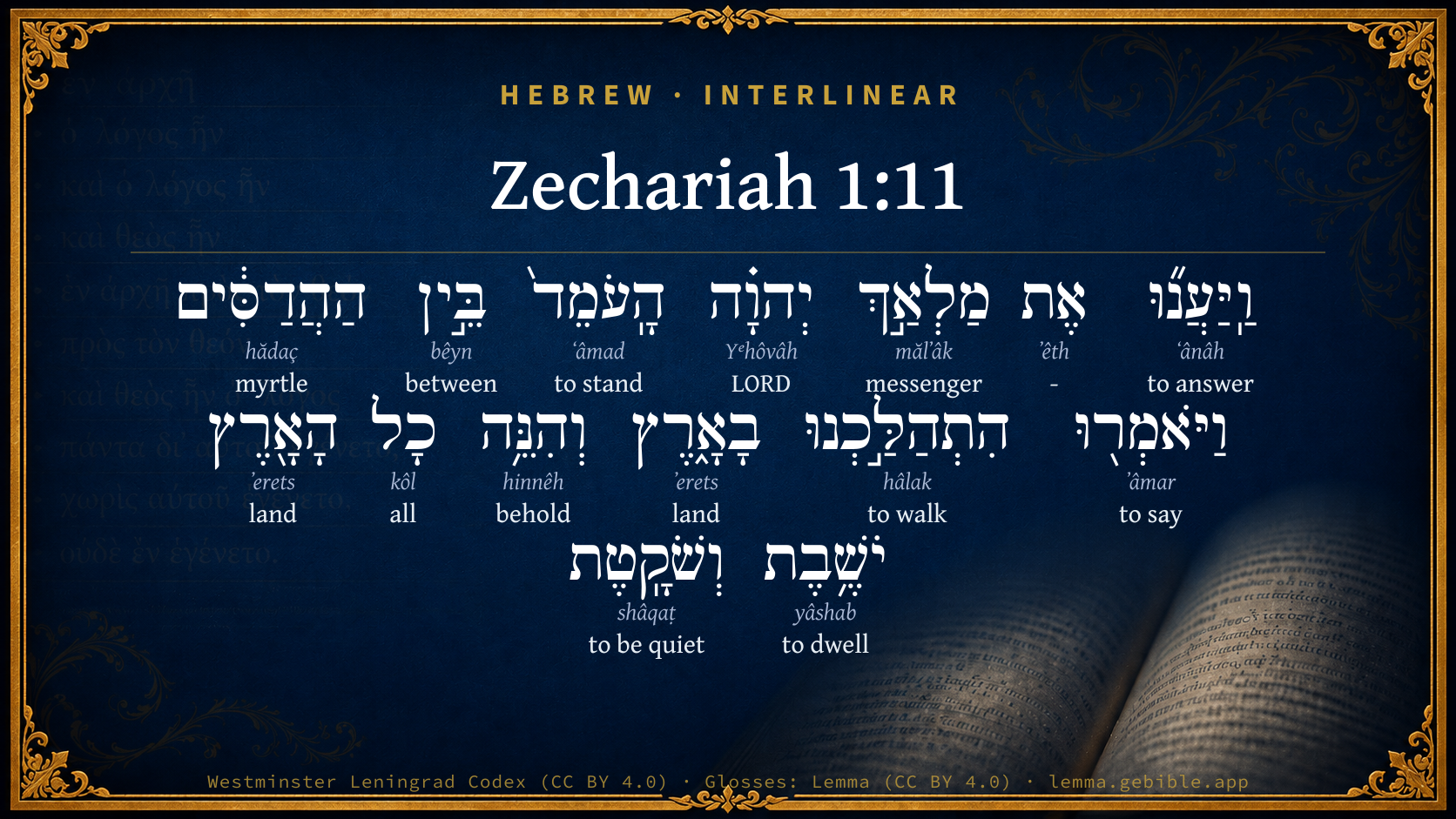
Hebrew (Westminster Leningrad Codex) Zechariah 1:11 appears in the Hebrew Old Testament. The text above is from the Westminster Leningrad Codex. Each word links to its Strong’s number, a concise gloss, and parsing drawn from the Open Scriptures Hebrew Bible morphology. Click any word for its full Brown-Driver-Briggs (BDB) entry.
Download image
Cite this verse

Zechariah 1:11 (World English Bible). Public Domain. Lemma interlinear Bible study tool, https://lemma.gebible.app/v/zechariah/1/11.

Show BibTeX & RIS
BibTeX
RIS
English Translation
They reported to the angel of Yahweh who stood among the myrtle trees, and said, "We have walked back and forth through the earth, and, behold, all the earth is at rest and in peace."
World English Bible · Public Domain
Download a study sheet

One document with this verse’s original text, its word-by-word gloss line, the meaning frame, cross-references with their text, attributed commentary, and full source and license credits — printable, and it pastes into notes with its structure intact.

This verse Autodidact and up

Study sheet (.html) Plain text (.txt)

A passage Seminary Student

Up to 50 verses in one chapter. A passage sheet keeps up to 6 commentary sources and 12 cross-references per verse, in the order this page ranks them, and says so on the sheet whenever that leaves anything out. Ask for a single verse and you get the Autodidact verse sheet above.

Everything on this page stays free to read, with no account — the sheet is a download of what is already on screen, not access to it.

Want to remove ads? Support Godless Engineer
Compare translations 3

The same verse in 3 English versions, stacked beneath the original-language interlinear above. Click any original word for its lexicon entry.

Each is an independent rendering of the whole verse — the interlinear is not word-aligned to these translations.

Highlighted words mark where these versions differ — a whole-verse word diff, not a word-by-word alignment.

  • World English Bible Public Domain
    They reported to the angel of Yahweh who stood among the myrtle trees, and said, "We have walked back and forth through the earth, and, behold, all the earth is at rest and in peace."
  • King James Version Public Domain
    And they answered the angel of the LORD that stood among the myrtle trees, and said, We have walked to and fro through the earth, and, behold, all the earth sitteth still, and is at rest.
  • unfoldingWord Literal Text CC BY-SA 4.0
    And they answered the angel of Yahweh who was standing among the myrtle trees, and they said, “We have walked about in the earth, and behold, all of the earth is sitting and is at rest.”

unfoldingWord Literal Text — © unfoldingWord, licensed CC BY-SA 4.0. Word-aligned USFM3 via Door43 (git.door43.org/unfoldingWord/en_ult).

Versions to compare (up to 4)

3 of 4 selected

Show all 18 translations

Every available English version of this verse, each an independent rendering of the whole verse.

  • World English Bible Public Domain
    They reported to the angel of Yahweh who stood among the myrtle trees, and said, "We have walked back and forth through the earth, and, behold, all the earth is at rest and in peace."
  • Berean Standard Bible Public Domain
    And the riders answered the angel of the LORD who was standing among the myrtle trees, “We have patrolled the earth, and behold, all the earth is at rest and tranquil.”
  • Majority Standard Bible Public Domain
    And the riders answered the angel of the LORD who was standing among the myrtle trees, “We have patrolled the earth, and behold, all the earth is at rest and tranquil.”
  • King James Version Public Domain
    And they answered the angel of the LORD that stood among the myrtle trees, and said, We have walked to and fro through the earth, and, behold, all the earth sitteth still, and is at rest.
  • American Standard Version (1901) Public Domain
    And they answered the angel of Jehovah that stood among the myrtle-trees, and said, We have walked to and fro through the earth, and, behold, all the earth sitteth still, and is at rest.
  • Revised Version (1885) Public Domain
    And they answered the angel of the LORD that stood among the myrtle trees, and said, We have walked to and fro through the earth, and, behold, all the earth sitteth still, and is at rest.
  • Geneva Bible (1599) Public Domain
    And they answered the Angel of the Lord, that stood among the mirre trees, and sayd, We haue gone thorowe the world: and beholde, all the world sitteth still, and is at rest.
  • Douay-Rheims (1899) Public Domain
    And they answered the angel of the Lord, that stood among the myrtle trees, and said: We have walked through the earth, and behold all the earth is inhabited, and is at rest.
  • Young's Literal Translation Public Domain
    And they answer the messenger of Jehovah who is standing between the myrtles, and say, `We have walked up and down in the land, and lo, all the land is sitting still, and at rest.'
  • Literal Standard Version CC BY-SA 4.0
    And they answer the Messenger of YHWH who is standing between the myrtles, and say, “We have walked up and down in the land, and behold, all the land is sitting still, and at rest.”
  • Unlocked Literal Bible CC BY-SA 4.0
    They answered the angel of Yahweh who stood among the myrtle trees; they said to him, “We have been roaming throughout the earth; see, all the earth sits still and is at rest.”
  • unfoldingWord Literal Text CC BY-SA 4.0
    And they answered the angel of Yahweh who was standing among the myrtle trees, and they said, “We have walked about in the earth, and behold, all of the earth is sitting and is at rest.”
  • Darby Bible Public Domain
    And they answered the angel of Jehovah that stood among the myrtle-trees, and said, We have walked to and fro through the earth, and behold, all the earth sitteth still and is at rest.
  • World Messianic Bible Public Domain
    They reported to the LORD’s angel who stood among the myrtle trees, and said, “We have walked back and forth through the earth, and behold, all the earth is at rest and in peace.”
  • Webster's Bible Public Domain
    And they answered the angel of the LORD that stood among the myrtle-trees, and said, We have walked to and fro through the earth, and behold, all the earth sitteth still, and is at rest.
  • Free Bible Version CC BY-SA 4.0
    The riders reported to the angel of the Lord who was among the myrtle trees, “We have been patrolling the earth and saw that the whole earth has been pacified. ”
  • Bible in Basic English Public Domain
    And the man who was between the mountains, answering, said to the angel of the Lord, We have gone up and down through the earth, and all the earth is quiet and at rest.
  • JPS Tanakh (1917) Public Domain
    And they answered the angel of the LORD that stood among the myrtle-trees, and said: 'We have walked to and fro through the earth, and, behold, all the earth sitteth still, and is at rest.'

Literal Standard Version (2020), Covenant Press — licensed CC BY-SA 4.0. Text via the HelloAO Bible API (eBible.org). Unlocked Literal Bible (unfoldingWord) — licensed CC BY-SA 4.0. Text via the HelloAO Bible API (eBible.org). unfoldingWord Literal Text — © unfoldingWord, licensed CC BY-SA 4.0. Word-aligned USFM3 via Door43 (git.door43.org/unfoldingWord/en_ult). Free Bible Version, Dr. Jonathan Gallagher — licensed CC BY-SA 4.0. Text via the HelloAO Bible API (eBible.org).

Word by word

More ways to search: Search by grammar → Find every occurrence → Compare this word →

Practice this passage: Drill this verse → Learn its vocabulary →

הַהֲדַסִּ֔ים
hădaç
H1918
“the · myrtles”
Particle, Definite Article + Noun, Common, Masculine, Plural, Absolute
Part of Speech
Particle + Noun
Type
Common
Gender
Masculine
Number
Plural
State
Absolute
Full BDB Definition

Origin: of uncertain derivation

TWOT: 475

myrtle (tree)
  1. וַֽיַּעֲנ֞וּ ʻânâh H6030 “and · to answer” Conjunction + Verb, Qal, Sequential Imperfect, 3rd Person, Masculine, Plural
  2. אֶת ʼêth H853 “-” Particle, Direct Object
  3. מַלְאַ֣ךְ mălʼâk H4397 “messenger of” Noun, Common, Masculine, Singular, Construct
  4. יְהוָ֗ה Yᵉhôvâh H3068 “LORD” Noun, Proper
  5. הָֽעֹמֵד֙ ʻâmad H5975 “the · standing” Particle, Definite Article + Verb, Qal, Participle Active, Masculine, Singular, Absolute
  6. בֵּ֣ין bêyn H996 “between” Preposition
  7. וַיֹּאמְר֖וּ ʼâmar H559 “and · to say” Conjunction + Verb, Qal, Sequential Imperfect, 3rd Person, Masculine, Plural
  8. הִתְהַלַּ֣כְנוּ hâlak H1980 “to walk” Verb, Hithpael, Perfect, 1st Person, Common, Plural
  9. בָאָ֑רֶץ ʼerets H776 “in/at the · land” Preposition, Determined + Noun, Common, Both, Singular, Absolute
  10. וְהִנֵּ֥ה hinnêh H2009 “and · behold” Conjunction + Particle, Demonstrative
  11. כָל kôl H3605 “all of” Noun, Common, Masculine, Singular, Construct
  12. הָאָ֖רֶץ ʼerets H776 “the · land” Particle, Definite Article + Noun, Common, Both, Singular, Absolute
  13. יֹשֶׁ֥בֶת yâshab H3427 “dwelling” Verb, Qal, Participle Active, Feminine, Singular, Absolute
  14. וְשֹׁקָֽטֶת shâqaṭ H8252 “and · being quiet” Conjunction + Verb, Qal, Participle Active, Feminine, Singular, Absolute

About this verse

These counts appear in no published source. They are computed here, from the morphology-tagged text and Lemma’s own curated glosses. What Lemma adds →

15
words
14
distinct lemmas
Prophets
section

Notable vocabulary

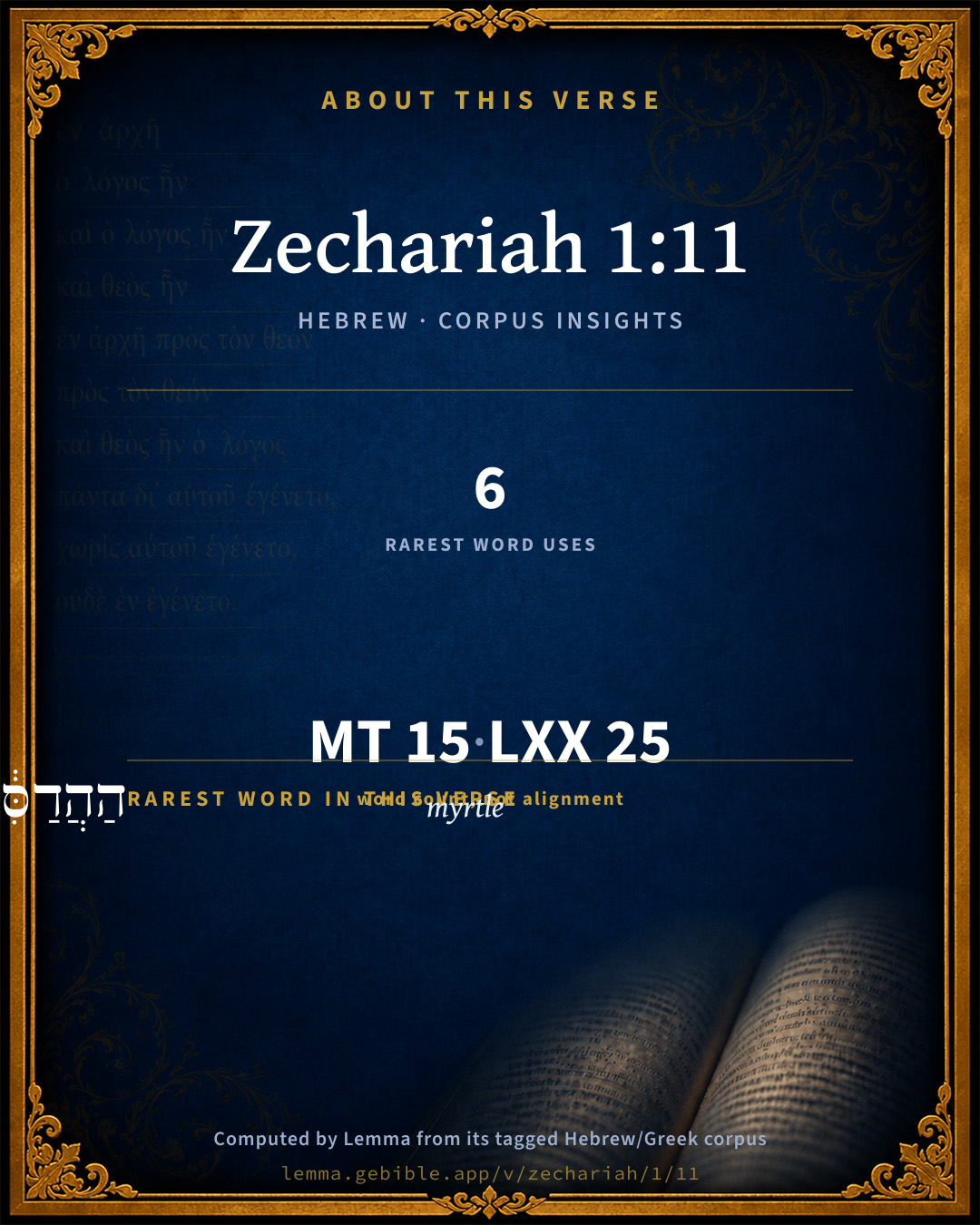
The rarest word here is הַהֲדַסִּ֔ים myrtle H1918 — appearing just 6 times in the whole Hebrew Bible.

Shared distinctive vocabulary

הַהֲדַסִּ֔ים myrtle H1918 occurs in 6 verses of the Hebrew Bible. Also found in:

Grammatical profile

  • 6 verbs
  • 6 nouns
  • 1 preposition
  • 2 particles

Verb forms

  • וַֽיַּעֲנ֞וּ Qal · Sequential Imperfect
  • הָֽעֹמֵד֙ Qal · Participle Active
  • וַיֹּאמְר֖וּ Qal · Sequential Imperfect
  • הִתְהַלַּ֣כְנוּ Hithpael · Perfect
  • יֹשֶׁ֥בֶת Qal · Participle Active
  • וְשֹׁקָֽטֶת Qal · Participle Active

Repetition

A word recurs within this verse — often emphatic in Hebrew:

  • בָאָ֑רֶץ land H776 ×2

Hebrew & Septuagint length

In English translation the verse runs 35 words from the Hebrew and 33 from the Septuagint (LXX English) — closely comparable.

A rough comparison of the two English renderings, which tokenize alike — not a word-level alignment.

Word counts can differ between the Hebrew and the Greek without any difference in meaning — e.g. the Hebrew direct-object marker אֵת has no separate Greek word, and Greek often adds the article ὁ.

In the original languages it is 15 Hebrew tokens and 25 Greek tokens — but the two are counted differently (Hebrew bundles its prefixes and suffixes into one token; the Greek is in lemma form), so that isn’t a like-for-like length.

Cross-references

15

Topical passages linked to Zechariah 1:11 in the Treasury of Scripture Knowledge — connected by theme and wording, ordered by reader-vote popularity; previews shown in the World English Bible.

  • Zechariah 1:10 The man who stood among the myrtle trees answered, "They are the ones Yahweh has sent to go back and forth through the earth."
  • Psalms 103:20–21 Praise Yahweh, you angels of his, Who are mighty in strength, who fulfill his word, Obeying the voice of his word.
  • Zechariah 1:8 "I had a vision in the night, and, behold, a man riding on a red horse, and he stood among the myrtle trees that were in a ravine; and behind him there were red, brown, and white horses.
  • Zechariah 1:15 I am very angry with the nations that are at ease; for I was but a little displeased, but they added to the calamity."
  • Matthew 24:30–31 and then the sign of the Son of Man will appear in the sky. Then all the tribes of the earth will mourn, and they will see the Son of Man coming on the clouds of the sky with power and great glory.
  • Psalms 68:17 The chariots of God are tens of thousands and thousands of thousands. The Lord is among them, from Sinai, into the sanctuary.
  • Isaiah 14:7 The whole earth is at rest, [and] is quiet: they break forth into singing.
  • Daniel 10:20 Then he said, "Do you know why I have come to you? Now I will return to fight with the prince of Persia. When I go forth, behold, the prince of Greece shall come.
  • Zechariah 6:7 The strong went out, and sought to go that they might walk back and forth through the earth: and he said, "Go around and through the earth!" So they walked back and forth through the earth.
  • Matthew 13:41 The Son of Man will send out his angels, and they will gather out of his Kingdom all things that cause stumbling, and those who do iniquity,
  • Matthew 13:49 So will it be in the end of the world. The angels will come forth, and separate the wicked from among the righteous,
  • Matthew 25:31 "But when the Son of Man comes in his glory, and all the holy angels with him, then he will sit on the throne of his glory.
  • 1 Thessalonians 5:3 For when they are saying, "Peace and safety," then sudden destruction will come on them, like birth pains on a pregnant woman; and they will in no way escape.
  • Revelation 1:1 This is the Revelation of Jesus Christ, which God gave him to show to his servants the things which must happen soon, which he sent and made known by his angel to his servant, John,
  • 2 Thessalonians 1:7 and to give relief to you that are afflicted with us, when the Lord Jesus is revealed from heaven with his mighty angels in flaming fire,

Cross-references courtesy of OpenBible.info (CC BY 4.0).

Hebrew and Greek witnesses Masoretic Hebrew ↔ Greek Septuagint

The same verse in the two great witnesses to the Old Testament, shown verse-for-verse.

These are two independent witnesses, not word-aligned to each other, and the Septuagint is shown in lemma (dictionary) form.

Hebrew Zechariah 1:11 Masoretic · Westminster Leningrad Codex

וַֽיַּעֲנ֞וּ אֶת מַלְאַ֣ךְ יְהוָ֗ה הָֽעֹמֵד֙ בֵּ֣ין הַהֲדַסִּ֔ים וַיֹּאמְר֖וּ הִתְהַלַּ֣כְנוּ בָאָ֑רֶץ וְהִנֵּ֥ה כָל הָאָ֖רֶץ יֹשֶׁ֥בֶת וְשֹׁקָֽטֶת

They reported to the angel of Yahweh who stood among the myrtle trees, and said, "We have walked back and forth through the earth, and, behold, all the earth is at rest and in peace."

World English Bible · Public Domain

Greek LXX Zechariah 1:11 Septuagint · lemma form

καί ἀποκρίνω ὁ ἄγγελος κύριος ὁ ἐπιἵστημι ἀνά μέσος ὁ ὄρος καί εἶπον περιὁδεύω πᾶς ὁ γῆ καί ἰδού πᾶς ὁ γῆ καταοἰκέω καί ἡσυχάζω

And they answered the angel of the Lord that stood between the mountains, and said, We have gone round all the earth, and, behold, all the earth is inhabited, and is at rest.

LXX2012 (modern English Septuagint) · Public Domain

Hebrew: Westminster Leningrad Codex (CC BY 4.0). Greek: Septuagint (public domain); English from LXX2012 (modern English Septuagint) (Public Domain). How the Septuagint differs from the Hebrew →

Targum (Aramaic paraphrase)

1

The Targum is the ancient Jewish Aramaic paraphrase of the Hebrew Scriptures — an interpretive translation, not the Hebrew text itself. Onkelos (literal) and Pseudo-Jonathan (expansive) render the Torah, and Jonathan the Prophets. Coverage is partial: where no permissively-licensed English translation exists for a verse, only the Aramaic is shown. This is verse-level text, not a word-by-word alignment to the Hebrew.

  1. Targum Jonathan Prophets (Joshua–Malachi)
    וְאָתִיבוּ יַת מַלְאֲכָא דַייָ דְקָאֵים בֵּין אִילָנֵי הֲדַסַיָא וַאֲמָרוּ הַלֵכְנָא בְאַרְעָא וְהָא כָל אַרְעָא יָתְבָא שְׁלֵיוָא וּשְׁקִיטָא:

    (no public-domain English translation for this verse)

    Targum Jonathan — Aramaic: “Mikraot Gedolot” (public domain). English: “Sefaria Community Translation” (CC0 1.0 (public-domain dedication)); “London "Chaldee Paraphrase," 1871” (public domain). Text via Sefaria.

Commentary

Notes on Zechariah 1:11 from classic Christian and Jewish commentators (each source and its license shown beneath its notes). The classic Christian expositions comment on the surrounding passage and are grouped to its opening verse, so a note may address several verses; the Jewish commentaries on the Tanakh (Rashi and others) are per-verse, so they appear only where the commentator wrote on this verse.

Lemma curates 59 commentaries, every one of them public domain or Creative Commons licensed, each selected and text-cleaned for this edition rather than reprinted as found. About our sources →

Trapp's Complete Commentary

John Trapp

Zec 1:11 And they answered the angel of the LORD that stood among the myrtle trees, and said, We have walked to and fro through the earth, and, behold, all the earth sitteth still, and is at rest.

Ver. 11. We have walked to and fro through the earth] Itavimus, we have coursed up and down with incredible swiftness. Hence they are called the chariots of God, Psa 68:17 (Heb. God’s chariot, to note out their joint service, as of one), as here his horsemen, ready pressed to do his pleasure.

And behold all the earth sitteth still, and is at rest] Excepting the Church alone, which, like Noah’s ark, is ever tossed up and down till it rest at last on the everlasting mountain; then she shall have her happy halcyons; then she shall see her enemies afar off, as Lazarus did Dives, or as the Israelites at the Red Sea did their persecutors, dead upon the shore. Meanwhile, she must not expect to be calm and quiet for any continuance. In the world ye shall have trouble, and ye shall weep and lament; but the world shall rejoice; they shall revel, and laugh themselves fat, Joh 16:20; Joh 16:23 "The king and Haman sat down to drink; but the city Shushan was perplexed," Est 3:15. The Church is called God’s threshing floor, because threshed with continual crosses; and God’s husbandry, because he will be sure to plough his own ground, and to make long furrows upon their backs, whatsoever become of the waste, Isa 21:10 1Co 3:9; and to weed his own garden, though the rest of the world be let alone, and grow wild. Moab is not poured from vessel to vessel, but settleth upon the lees, Jer 48:11; when the Israel of God is poured out as milk, and curdled like cheese, as Job speaketh in another case, Job 10:10.

John Trapp, A Commentary or Exposition upon All the Books of the Old and New Testament (1647–1656) — public domain. Text from a community e-Sword module.

Tyndale Open Study Notes

Tyndale Open Resources

1:11 The man sitting on a red horse among the myrtle trees (1:8) is called the angel of the Lord (cp. Gen 16:7-13; Exod 23:23; 32:34; Judg 13:21-22).

Tyndale Open Study Notes — © Tyndale Open Resources, licensed CC BY-SA 4.0. Text via the HelloAO Bible API.

Jamieson, Fausset & Brown

Robert Jamieson, A. R. Fausset & David Brown

The attendant angels report to the Lord of angels, "the earth . . . is at rest." The flourishing state of the heathen "earth," while Judah was desolate and its temple not yet restored, is the powerful plea in the Divine Angel's intercession with God the Father in Zac 1:12. When Judah was depressed to the lowest point, and the heathen elated to the highest, it was time for Jehovah to work for His people.

sitteth still--dwells surely.

Jamieson, Fausset & Brown — Commentary Critical and Explanatory on the Whole Bible (1871) — public domain (CC PDM 1.0). Text via the HelloAO Bible API.

Adam Clarke's Commentary

Verse 11. All the earth sitteth still, and is at rest.] There is general peace through the Persian empire, and other states connected with Judea; but the Jews are still in affliction; their city is not yet restored, nor their temple built.

Adam Clarke's Commentary on the Bible (1810–1826) — public domain. Text from a community e-Sword/MySword module.

John Calvin's Commentaries

They said that the whole earth was then quiet, that is, the countries bordering on Judea, or the oriental regions. Hence a greater confidence might be entertained by the Jews, for with the prayer of the angel is connected a complaint — “God of hosts, what is thy purpose?” that is, “Is it thy will that all others should enjoy quietness and peace, while enemies are continually hostile and troublesome to thy people? Is it right that thy Church should be ever miserably distressed, while heathens, who have no care for religion, should be so bountifully favored by thee? Is it not better that the memory of thy name should be extinguished, and that all worship should fall to the ground, than that so unjust a reward should be returned to thy servants?” We now see the design of the vision, even that the Jews might be assured that the distresses which they endured would not be perpetual. How so? because God slept not in heaven, but had his runners; and further, since his will was that all nations should be tranquil, he would no doubt have at length a regard for his own people, so as to deliver them from their troubles.

Though then the vision is obscure, yet its design is not doubtful. Besides, if we are content with what is moderate, there will be found here nothing so perplexing but that we may easily learn at least the import of the Prophecy. But the curiosity of those interpreters has done much harm, who by examining every single syllable have advanced many puerile things. There is therefore nothing better than to attend to the design of the Prophet, and then to regard the circumstances of the time, and thirdly, to follow the analogy between the signs and things signified.

I have said that angels are here introduced, because it would be difficult for us to ascend to the highest glory of God. God, we know, is not constrained by necessity to employ angels as ministers to execute his judgments, to punish men, or to confer benefits: for God himself is sufficient for all these things. Why then does he employ angels and make use of their ministration, if it be superfluous? The obvious answer is this — as we are prone to unbelief, we ever tremble in dangers, except we know that God is prepared with many forces to help us in time of need. When it is said in Psalm 24 that angels encamp around those who fear God, is it not a much more effectual relief than if it had been simply said that God is our citadel? It is indeed said in many places that God is an unassailable fortress; but as many still continue to doubt when they hear that there is a sufficient defense for them in God, he consults now their weakness, and adds, “I come with a great host; I am not alone your helper, but there is a great army ready at my bidding. Whenever then it may please me a troop of angels, yea, many myriads shall assemble together.” When therefore God thus speaks, it is a mode of teaching suitable to the capacities of men. So now, when Zechariah sees many runners, who have been sent by God to perambulate and to survey the earth, it may with greater certainty be learnt that nothing is carried on without design or by chance in the world, but that all things come before God, and that the manner in which all things occur is set forth by the angels. In the same way is the representation given in the first chapter of Job (Job 1:1) All the sons of God, that is, angels, came before his throne; and also among them Satan came; for though he does not willingly obey God, yet while he perambulates the earth, he at the same time executes God’s judgments, though unwillingly. We now then see the reason why God did not himself appear, and testified to the Prophet, that whatever took place among the nations was known to him; but he shows that his runners rode swiftly through the whole earth, and returned afterwards to the heavenly tribunal, and proved that they had carefully performed their office.

Now the Prophet says, that he had this vision in the eleventh month, called Sebat, and on the twenty-fourth day of the month; that is, in the third month after his first Prophecy. He had in the eighth month sharply reproved the Jews: now a consolation is added, lest they should despair, but know that they were still the objects of God’s care. And possibly the reproof referred to had been effectual; nay, it is probable, that the Prophet did not labor in vain in exhorting the Jews to true and sincere repentance. When therefore they had given some evidence of religion, we see that God afterwards treated them more kindly, and set before them the hope of a future deliverance.

With regard to the night time, it is of importance to observe, that though God does not always set forth with full clearness his predictions, they are not yet without instruction, provided we be attentive, and provided also we suffer ourselves, while in darkness, to be ruled by the spirit of knowledge. By whatever different means then God may teach his faithful people, he always teaches them something useful, provided they murmur not when any thing is for a time obscure, but wait for the day of full revelation. And this is the design of Paul’s admonition, “If ye think otherwise, this also will God reveal to you.” Let us then know that God’s manner of teaching is not always the same, but that his teaching is always profitable, provided the faithful retain due moderation and sobriety, and suffer themselves to be guided step by step by God. This observation is to be applied to the whole verse, when it is said, that the horses and the horsemen stood under the myrtles, and also in a low place.

And, then, as to the various colors of the horses, it ought not to be deemed strange, that God should thus allot different offices to angels; for he does not always punish us by the ministry of Satan. He has celestial angels, when it pleases him, as executioners of his vengeance; and he sometimes employs devils for this purpose. However this may be, it is in his power to delegate angels as ministers of his kindness, or to send them to execute his vengeance, so that they appear in red color, or in some other. In conclusion, it ought also to be borne in mind, that angels do stand before the tribunal of God, after having diligently perambulated the earth, not after the manner of men: for it would be gross and puerile to imagine angels sitting on horses, inasmuch as they are spirits who are confined to no certain place; but as we cannot understand, according to our capacities, the celestial mysteries of God, it is necessary that such representations should be set before our eyes. however this may be, it ought to remain a fixed principle, that angels are always employed, for they survey the earth, that nothing may be done or carried on without design; and they are also sent with power and authority, so that they are, as it were, the hand of God: and at one time they execute his judgments, inflict punishments, as it has been said; and at another they come with blessings from God. This then is the meaning as to the horsemen. I cannot proceed farther: the rest I shall defer.

John Calvin's Commentaries (1540-1563) — public domain. Text from the Calvin Translation Society English edition (1840s-50s) via the Christian Classics Ethereal Library (ccel.org). Calvin's coverage is partial (roughly two-thirds of the Bible); uncommented books and verses are honest gaps, never fabricated. The 19th-century editor's footnotes and remarks are omitted so the notes are faithfully Calvin's own voice.

Ellicott's Commentary for English Readers

(11) And they answered need not necessarily imply that any question had been asked. Like the New Testament ἀπεκρίθησαν, it often implies merely “began to speak.”

The angel of the Lord.—That is, the man riding upon a bay horse. (See Note on Zec_1:8.) Just two months before this, Haggai had prophesied (Hag_2:20-23) that God would shake the heavens and the earth, and overthrow the throne of kingdoms, &c. The horsemen had been sent forth to act, as it were, as scouts, and to bring back an account of the state of the world, that at the intercession of the angel of the Lord comforting words might be announced to Zechariah, and by him to the people. They reported the world to be still, and at rest: i.e., dwelling in self-confident security. The overthrow of the kingdoms foretold by Haggai had not yet begun, and so, although the building of the Temple was, by the decree of Darius (Ezra 5, 6), being carried on, Judah was still insecure as long as the heathen nations flourished.

A Bible Commentary for English Readers, edited by Charles John Ellicott (1878–1897) — public domain. Text from a community e-Sword module.

The Cambridge Bible for Schools and Colleges

gen. ed. J. J. S. Perowne

11. the angel of the Lord] The man on the red horse, who as it now appears is an angel of Jehovah in human form, having told Zechariah, in Zec_1:10, what the other riders were, now turns to them and elicits from them, probably by sign or look, the fact for the prophet’s information, that they had traversed the earth and found universal peace prevailing.

The Cambridge Bible for Schools and Colleges (gen. ed. J. J. S. Perowne; Cambridge University Press, 1878–1918) — public domain. Text from a community e-Sword module.

John Gill's Exposition

And they answered the Angel of the Lord, that stood among the myrtle trees, and said,.... That is, the ministering angels, signified by the red horses, speckled, and white, replied to what the Angel of the Lord had said concerning them; or rather agreed to and confirmed his account of them; or else gave up the account of their tour through the earth, with their observations upon the state of it:

We have walked to and fro through the earth; according to their mission and commission:

and, behold, all the earth sitteth still, and is at rest; was free from wars, as it was in the reign of Darius; though the people of the Jews were infested with enemies, who gave them trouble, and hindered all they could the rebuilding of the temple; wherefore it follows:

John Gill's Exposition of the Whole Bible (1746–1763) — public domain (CC PDM 1.0). Text via the HelloAO Bible API.

Albert Barnes' Notes on the Bible

Sitteth still and is at rest - At rest, as the word seems to express, from its accustomed state of tumult and war. Wars, although soon to break out again, were in the second year of Darius for the time suspended. The rest, in which the world was, suggests the contrast of the yet continuing unrest allotted to the people of God. Such rest had been promised to Israel, on its return from the captivity, but had not yet been fulfilled. Through the hostility of the Samaritans the building of the temple had been hindered and was just recommenced; the wall of Jerusalem was yet broken down Neh 1:3; its fire-burned gates not restored; itself was a waste Neh 2:3; its houses unbuilt Neh 7:4. This gives occasion to the intercession “of the Angel of the Lord.”

Albert Barnes' Notes on the Bible (1834–1885) — public domain. Text from a community e-Sword/MySword module.

Haydock's Catholic Bible Commentary

Rest. All the country under Michael’s care enjoyed peace, (Calmet) in the second year of Darius. (Haydock) -- The red horse implies slaughter, Apocalypse vi. 4. It was now repressed. (Tournemine)

George Leo Haydock (1774–1849), Haydock's Catholic Family Bible and Commentary, 1859 edition — public domain. Excludes Psalms (Douay-Rheims chapter numbering differs from Protestant) and Deuterocanonical books (Catholic canon only).

Matthew Poole's English Annotations

They; the ministerial angels, signified by the horses and horsemen.

Answered the angel of the Lord; or rather, the Angel the Lord, the uncreated Angel, who sent them out, and receives account what they had done.

We have walked to and fro; as men who would give an exact account, survey every part, so we have searched all nations and kingdoms, walked the length and breadth of them.

Through the earth; the world, but chiefly through the Babylonish empire, which accounts itself lord of all the earth.

Behold; it is wonderful to be seen, and therefore we beseech time, O Lord, to behold and consider this.

All the earth sitteth still; as having ended their toil, or weathered the storm, composed their differences, and sheathed their swords; are full of peace, and sit still to take their ease.

And is at rest; either the same thing repeated, to heighten the quiet of these states, or to confirm the truth of the thing, or to express the inward quiet of mind the people had with their outward quiet. The public peaceable, and every one’s mind satisfied, this is the state of the earth, the empire which at that time ruled all.

Matthew Poole's English Annotations on the Holy Bible (1683–1685) — public domain. Text from a community e-Sword/MySword module.

Whedon's Commentary on the Bible

Daniel D. Whedon

11. Having been presented, the horsemen make their report; whether through a spokesman or in unison is not stated.

The angel of Jehovah — Not to be identified with “man” in Zec_1:8; Zec_1:10. The angel is the one who receives the report of the horsemen, of whom the “man” is the leader. Any angel might be called “angel of Jehovah” (1Ki_19:7; 2Sa_24:16), but there are passages in the Old Testament in which the phrase has a peculiar meaning (Gen_31:11-13; Exo_23:20-21, etc.). To the latter class belongs this verse. In these passages the “angel of Jehovah” is “not a created angel; he is Jehovah himself,” manifesting himself without men, that is, in the external affairs of men, just as in the Old Testament “spirit of Jehovah” is Jehovah manifesting himself within men (compare A.B. Davidson, The Theology of the Old Testament, pp. 296ff.). Nowack, on the basis of Zec_1:12, thinks that this verse marks an advance over the more ancient passages, because here the angel is no longer identified with Jehovah, but is separate from and subordinate to him; and there is much to be said in favor of this view, but the testimony of Zec_1:12 is not conclusive (see comment). Whether the ancients ever considered the metaphysical aspects of this “incarnation,” and if so, what were their exact notions, we cannot determine, nor can we speak dogmatically about the connection between this manifestation of Jehovah and the divine incarnation in the person of Jesus. The suggestion of some commentators, that in this passage the “angel of Jehovah” is identical with the “man among the myrtle trees,” that the title “angel of Jehovah” is a later addition due to a confusion of the man with the interpreting angel, and that the original was “the man,” is intended to remove a difficulty, but the change is not warranted.

The earth sitteth still and is at rest — The horsemen report that all is peaceful, undisturbed by war or revolution. Evidently an allusion to Hag_2:6-7; Hag_2:21-22, or at least to the hope expressed there. The expectation was that Jehovah would “shake the nations” preliminary to the restoration of his grace and mercy to Zion. The people expected a speedy fulfillment of the Messianic promise; the delay produced despondency. The report of the horsemen would intensify the feeling of disappointment, for while peace and quietness prevailed the former promises would not be fulfilled.

Daniel D. Whedon (gen. ed.), Commentary on the Old and New Testaments (1874–1909) — public domain. Text from a community e-Sword module.

The Pulpit Commentary

They answered. Having said who they were, the angel directs them to tell of their doings. The angel of the Lord. The "man riding upon the red horse" (ver. 8) is now called "the Angel of Jehovah." This term is usually held to denote a manifestation of the Logos, the Second Person of the Holy Trinity, assuming an angelic form or imparting his immediate presence to the revealer of his will. Sitteth still, and is at rest. The world was lying in proud security. There was no sign of that shaking of nations which Haggai (Hag_2:7, Hag_2:21, Hag_2:22) had foretold should precede the coming of Messiah and the restoration of Israel. In this second year of Darius, the empire, though suffering from internal disturbances, was outwardly at peace, and was threatened by no enemy at a distance. But the condition of the Jews was sad and disheartening; the temple still unbuilt, the walls of Jerusalem lying in ruins, themselves only a small remnant, exposed to the insults and attacks of jealous neighbours, living on sufferance as subjects of a heathen power, and no sign of the predicted salvation appearing, this was their state. And the angel sees their despondency, recognizes their disappointment, and intercedes for them.

The wonder of indifference.

rest;" i.e. secure, proud, and licentious, as if there were no God in heaven" (Wordsworth). May be taken to illustrate a common state of mind as to religion. Indifference seems wonderful when we consider

I THE VAST INTERESTS AT STAKE. What questions so deep and urgent as those that concern God and truth and immortality?

II THE BRIEF TIME FOR DECISION. Life is short. Delay, and youth is gone; delay, and manhood is past; delay, and all is lost. Besides, what uncertainty and what constant interruptions and claims of other things! "The world is too much with us.

III THE GREAT IMPORTANCE OF EARNESTNESS. See how men act in other matters. Firm and decided. "The children of this world are wiser in their generation than the children of light.

IV THE CEASELESS ACTIVITY OF THE POWERS OF EVIL. (1Pe_5:8)

V THE URGENT APPEALS OF GOD. How much of Holy Scripture is taken up with calls, and pleadings, and remonstrances, and beseechings! Then, how often does the voice of God in providence give the deeper force and significance to the warnings of his Word! Surely what lies so near the heart of God should be the chief thing for us. Surely what moved the eternal Son to come to earth should be the supreme interest with us. His mind should be our mind, and our highest blessedness should be to consecrate ourselves, like him, to the service of God and of humanity. F.

The Pulpit Commentary (1880–1919), ed. H.D.M. Spence-Jones & Joseph S. Exell — public domain. Text from a community e-Sword module.

John Wesley's Explanatory Notes

Is at rest - All men sit still to take their ease. All is peaceable. This was the state of the empire which at that time ruled all.

John Wesley, Explanatory Notes Upon the Whole Bible (1754–1765) — public domain. Text via the GEBible commentary corpus.

Scofield Reference Notes

C. I. Scofield

angel

(See Scofield "Heb 1:4")

The Scofield Reference Bible (1917 edition), notes by C. I. Scofield — public domain. Text from a community e-Sword module.

Lesson kit

Teaching starters — assembled from the data on this page, not authored interpretation. Every prompt links to the verse data it draws on. Edit before teaching.

Zechariah, in the Prophets, opens this verse with 15 words (14 distinct Hebrew lemmas). Its most distinctive word is hădaç (“myrtle”). A historical commentator’s framing appears above. Read the whole chapter for the surrounding context.

Discussion questions

  1. What does “myrtle” (hădaç) contribute to the verse as a whole?
  2. Nehemiah 8:15 shares the word «myrtle» with this verse. How do the two illuminate each other?
  3. “land” occurs 2× in this one verse. What is the effect of the repetition?
  4. These translations render this verse differently; the difference is in the English rendering, not the original. What questions does that raise?
  5. The verb «וַֽיַּעֲנ֞וּ» is Qal Sequential Imperfect. How does its form color the action?
  6. Reading how Trapp's Complete Commentary and Tyndale Open Study Notes read this verse, where do the two commentators agree and where do they part?

Things to notice

Reading settings

Reading text

Shown beneath each verse's original-language words.

Old Testament
Old Testament edition

Read the OT as the Masoretic Hebrew (MT) or the Greek Septuagint (LXX).

English shown for the Greek Septuagint (in the Hebrew ↔ Greek comparison).

Comparing translations? Open the Compare panel on any verse page to stack up to four side by side.