
2 Kings 1:16

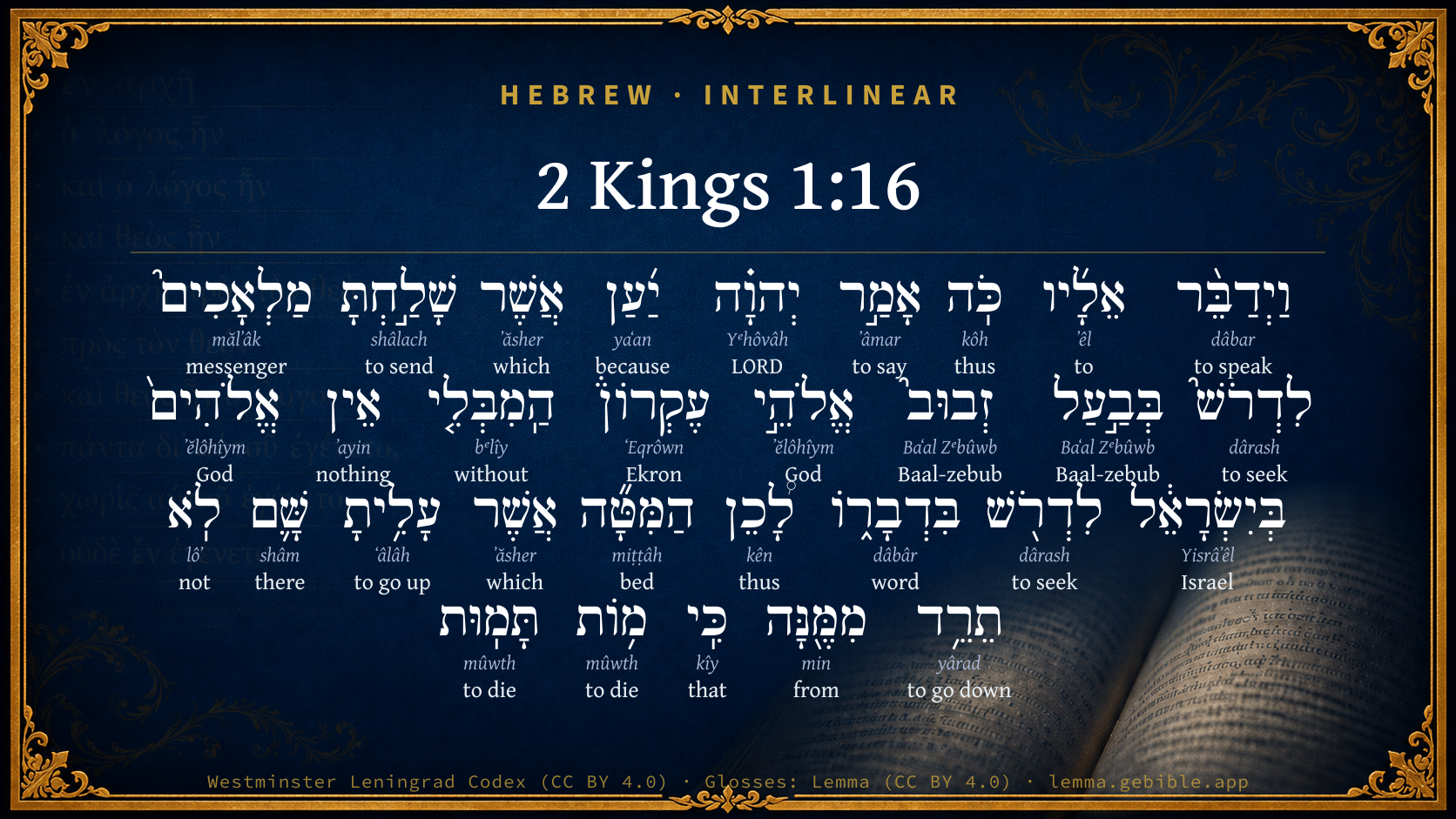
Hebrew (Westminster Leningrad Codex) 2 Kings 1:16 appears in the Hebrew Old Testament. The text above is from the Westminster Leningrad Codex. Each word links to its Strong’s number, a concise gloss, and parsing drawn from the Open Scriptures Hebrew Bible morphology. Click any word for its full Brown-Driver-Briggs (BDB) entry.
Download image
Cite this verse

2 Kings 1:16 (World English Bible). Public Domain. Lemma interlinear Bible study tool, https://lemma.gebible.app/v/2-kings/1/16.

Show BibTeX & RIS
BibTeX
RIS
English Translation
He said to him, Thus says Yahweh, Because you have sent messengers to inquire of Baal Zebub, the god of Ekron, is it because there is no God in Israel to inquire of his word? therefore you shall not come down from the bed where you are gone up, but shall surely die.
World English Bible · Public Domain
Download a study sheet

One document with this verse’s original text, its word-by-word gloss line, the meaning frame, cross-references with their text, attributed commentary, and full source and license credits — printable, and it pastes into notes with its structure intact.

This verse Autodidact and up

Study sheet (.html) Plain text (.txt)

A passage Seminary Student

Up to 50 verses in one chapter. A passage sheet keeps up to 6 commentary sources and 12 cross-references per verse, in the order this page ranks them, and says so on the sheet whenever that leaves anything out. Ask for a single verse and you get the Autodidact verse sheet above.

Everything on this page stays free to read, with no account — the sheet is a download of what is already on screen, not access to it.

Want to remove ads? Support Godless Engineer
Compare translations 3

The same verse in 3 English versions, stacked beneath the original-language interlinear above. Click any original word for its lexicon entry.

Each is an independent rendering of the whole verse — the interlinear is not word-aligned to these translations.

Highlighted words mark where these versions differ — a whole-verse word diff, not a word-by-word alignment.

  • World English Bible Public Domain
    He said to him, Thus says Yahweh, Because you have sent messengers to inquire of Baal Zebub, the god of Ekron, is it because there is no God in Israel to inquire of his word? therefore you shall not come down from the bed where you are gone up, but shall surely die.
  • King James Version Public Domain
    And he said unto him, Thus saith the LORD, Forasmuch as thou hast sent messengers to enquire of Baalzebub the god of Ekron, is it not because there is no God in Israel to enquire of his word? therefore thou shalt not come down off that bed on which thou art gone up, but shalt surely die.
  • unfoldingWord Literal Text CC BY-SA 4.0
    And he said to him, “Thus says Yahweh, ‘Because you sent messengers to inquire of Baal Zebub, the god of Ekron— because there is no God in Israel to inquire of his word?— therefore, the bed where you have gone up there, you will not come down from it, for dying, you will die.’”

unfoldingWord Literal Text — © unfoldingWord, licensed CC BY-SA 4.0. Word-aligned USFM3 via Door43 (git.door43.org/unfoldingWord/en_ult).

Versions to compare (up to 4)

3 of 4 selected

Show all 18 translations

Every available English version of this verse, each an independent rendering of the whole verse.

  • World English Bible Public Domain
    He said to him, Thus says Yahweh, Because you have sent messengers to inquire of Baal Zebub, the god of Ekron, is it because there is no God in Israel to inquire of his word? therefore you shall not come down from the bed where you are gone up, but shall surely die.
  • Berean Standard Bible Public Domain
    And Elijah said to King Ahaziah, “This is what the LORD says: Is there really no God in Israel for you to inquire of His word? Is that why you have sent messengers to inquire of Baal-zebub, the god of Ekron? Therefore you will not get up from the bed on which you are lying. You will surely die.”
  • Majority Standard Bible Public Domain
    And Elijah said to King Ahaziah, “This is what the LORD says: Is there really no God in Israel for you to inquire of His word? Is that why you have sent messengers to inquire of Baal-zebub, the god of Ekron? Therefore you will not get up from the bed on which you are lying. You will surely die.”
  • King James Version Public Domain
    And he said unto him, Thus saith the LORD, Forasmuch as thou hast sent messengers to enquire of Baalzebub the god of Ekron, is it not because there is no God in Israel to enquire of his word? therefore thou shalt not come down off that bed on which thou art gone up, but shalt surely die.
  • American Standard Version (1901) Public Domain
    And he said unto him, Thus saith Jehovah, Forasmuch as thou hast sent messengers to inquire of Baal-zebub, the god of Ekron, is it because there is no God in Israel to inquire of his word? therefore thou shalt not come down from the bed whither thou art gone up, but shalt surely die.
  • Revised Version (1885) Public Domain
    And he said unto him, Thus saith the LORD, Forasmuch as thou hast sent messengers to inquire of Baal-zebub the god of Ekron, is it because there is no God in Israel to inquire of his word? therefore thou shalt not come down from the bed whither thou art gone up, but shalt surely die.
  • Geneva Bible (1599) Public Domain
    And he saide vnto him, Thus saith the Lord, Because thou hast sent messengers to enquire of Baal-zebub the god of Ekron, (was it not because there was no God in Israel to inquire of his worde?) therefore thou shalt not come downe off the bed, on which thou art gone vp, but shalt die the death.
  • Douay-Rheims (1899) Public Domain
    And said to him: Thus saith the Lord: Because thou hast sent messengers to consult Beelzebub the god of Accaron, as though there were not a God in Israel, of whom thou mightest inquire the word; therefore from the bed on which thou art gone up, thou shalt not come down, but thou shalt surely die.
  • Young's Literal Translation Public Domain
    and speaketh unto him, `Thus said Jehovah, Because that thou hast sent messengers to inquire of Baal-Zebub god of Ekron -- is it because there is not a God in Israel to inquire of His word? therefore, the bed whither thou hast gone up -- thou dost not come down from it, for thou dost certainly die.'
  • Literal Standard Version CC BY-SA 4.0
    and speaks to him, “Thus said YHWH: Because that you have sent messengers to inquire of Ba‘al-Zebub god of Ekron—is it because there is not a God in Israel to inquire of His word? Therefore, the bed to where you have gone up—you do not come down from it, for you certainly die.”
  • Unlocked Literal Bible CC BY-SA 4.0
    Later Elijah said to Ahaziah, “This is what Yahweh says, 'You have sent messengers to consult with Baal-Zebub, the god of Ekron. Is it because there is no God in Israel from whom you can ask for information? So now, you will not come down from the bed where you have gone up; you will certainly die.'”
  • unfoldingWord Literal Text CC BY-SA 4.0
    And he said to him, “Thus says Yahweh, ‘Because you sent messengers to inquire of Baal Zebub, the god of Ekron— because there is no God in Israel to inquire of his word?— therefore, the bed where you have gone up there, you will not come down from it, for dying, you will die.’”
  • Darby Bible Public Domain
    And he said to him, Thus saith Jehovah: Forasmuch as thou hast sent messengers to inquire of Baal-zebub the god of Ekron, is it because there is no God in Israel to inquire of his word? therefore thou shalt not come down from the bed on which thou art gone up, but shalt certainly die.
  • World Messianic Bible Public Domain
    He said to him, “The LORD says, ‘Because you have sent messengers to inquire of Baal Zebub, the god of Ekron, is it because there is no God in Israel to inquire of his word? Therefore you will not come down from the bed where you have gone up, but you will surely die.’”
  • Webster's Bible Public Domain
    And he said to him, Thus saith the LORD, Forasmuch as thou hast sent messengers to inquire of Baal-zebub the god of Ekron, is it not because there is no God in Israel to inquire of his word? therefore thou shalt not come down off that bed on which thou art gone up, but shalt surely die.
  • Free Bible Version CC BY-SA 4.0
    Elijah told the king, “This is what the Lord says: ‘Is it because there's no God in Israel for you to consult that you have sent messengers to ask advice of Baal-zebub, the god of Ekron? As a result you will not leave the bed on which you are lying. You're definitely going to die.’”
  • Bible in Basic English Public Domain
    And he said to him, This is the word of the Lord: Because you sent men to put a question to Baal-zebub, the god of Ekron, for this reason you will never again get down from the bed on to which you have gone up, but death will certainly come to you.
  • JPS Tanakh (1917) Public Domain
    And he said unto him: 'Thus saith the LORD: Forasmuch as thou hast sent messengers to inquire of Baal-zebub the god of Ekron, is it because there is no God in Israel to inquire of His word? therefore thou shalt not come down from the bed whether thou art gone up, but shalt surely die.'

Literal Standard Version (2020), Covenant Press — licensed CC BY-SA 4.0. Text via the HelloAO Bible API (eBible.org). Unlocked Literal Bible (unfoldingWord) — licensed CC BY-SA 4.0. Text via the HelloAO Bible API (eBible.org). unfoldingWord Literal Text — © unfoldingWord, licensed CC BY-SA 4.0. Word-aligned USFM3 via Door43 (git.door43.org/unfoldingWord/en_ult). Free Bible Version, Dr. Jonathan Gallagher — licensed CC BY-SA 4.0. Text via the HelloAO Bible API (eBible.org).

Word by word

More ways to search: Search by grammar → Find every occurrence → Compare this word →

Practice this passage: Drill this verse → Learn its vocabulary →

בְּבַ֣עַל
Baʻal Zᵉbûwb
H1176
“in/at · Baal-zebub”
Preposition + Noun, Proper
Part of Speech
Preposition + Noun
Type
Proper
Full BDB Definition

Origin: from H1168 and H2070

TWOT: None

Baal-zebub = "lord of the fly" - a Philistine deity worshipped at Ekron
  1. וַיְדַבֵּ֨ר dâbar H1696 “and · to speak” Conjunction + Verb, Piel, Sequential Imperfect, 3rd Person, Masculine, Singular
  2. אֵלָ֜יו ʼêl H413 “to · him” Preposition + Suffix, Personal, 3rd Person, Masculine, Singular
  3. כֹּֽה kôh H3541 “thus” Adverb
  4. אָמַ֣ר ʼâmar H559 “to say” Verb, Qal, Perfect, 3rd Person, Masculine, Singular
  5. יְהוָ֗ה Yᵉhôvâh H3068 “LORD” Noun, Proper
  6. יַ֜עַן yaʻan H3282 “because” Conjunction
  7. אֲשֶׁר ʼăsher H834 “which” Particle, Relative
  8. שָׁלַ֣חְתָּ shâlach H7971 “to send” Verb, Qal, Perfect, 2nd Person, Masculine, Singular
  9. מַלְאָכִים֮ mălʼâk H4397 “messengers” Noun, Common, Masculine, Plural, Absolute
  10. לִדְרֹשׁ֮ dârash H1875 “to seek” Preposition + Verb, Qal, Infinitive Construct
  11. זְבוּב֮ Baʻal Zᵉbûwb H1176 “Baal-zebub” Noun, Proper
  12. אֱלֹהֵ֣י ʼĕlôhîym H430 “God(s) of” Noun, Common, Masculine, Plural, Construct
  13. עֶקְרוֹן֒ ʻEqrôwn H6138 “Ekron” Noun, Proper
  14. הַֽמִבְּלִ֤י bᵉlîy H1097 “from · without” Particle, Interrogative + Preposition + Adverb
  15. אֵין ʼayin H369 “nothing” Particle, Negative
  16. אֱלֹהִים֙ ʼĕlôhîym H430 “God(s)” Noun, Common, Masculine, Plural, Absolute
  17. בְּיִשְׂרָאֵ֔ל Yisrâʼêl H3478 “in/at · Israel” Preposition + Noun, Proper
  18. לִדְרֹ֖שׁ dârash H1875 “to seek” Preposition + Verb, Qal, Infinitive Construct
  19. בִּדְבָר֑וֹ dâbâr H1697 “in/at · word · his” Preposition + Noun, Common, Masculine, Singular, Construct + Suffix, Personal, 3rd Person, Masculine, Singular
  20. לָ֠כֵן kên H3651 “to/for · thus” Preposition + Adverb
  21. הַמִּטָּ֞ה miṭṭâh H4296 “the · bed” Particle, Definite Article + Noun, Common, Feminine, Singular, Absolute
  22. אֲשֶׁר ʼăsher H834 “which” Particle, Relative
  23. עָלִ֥יתָ ʻâlâh H5927 “to go up” Verb, Qal, Perfect, 2nd Person, Masculine, Singular
  24. שָּׁ֛ם shâm H8033 “there” Adverb
  25. לֹֽא lôʼ H3808 “not” Particle, Negative
  26. תֵרֵ֥ד yârad H3381 “to go down” Verb, Qal, Imperfect, 2nd Person, Masculine, Singular
  27. מִמֶּ֖נָּה min H4480 “from · her” Preposition + Suffix, Personal, 3rd Person, Feminine, Singular
  28. כִּֽי kîy H3588 “that” Conjunction
  29. מ֥וֹת mûwth H4191 “to die” Verb, Qal, Infinitive Absolute
  30. תָּמֽוּת mûwth H4191 “to die” Verb, Qal, Imperfect, 2nd Person, Masculine, Singular

About this verse

These counts appear in no published source. They are computed here, from the morphology-tagged text and Lemma’s own curated glosses. What Lemma adds →

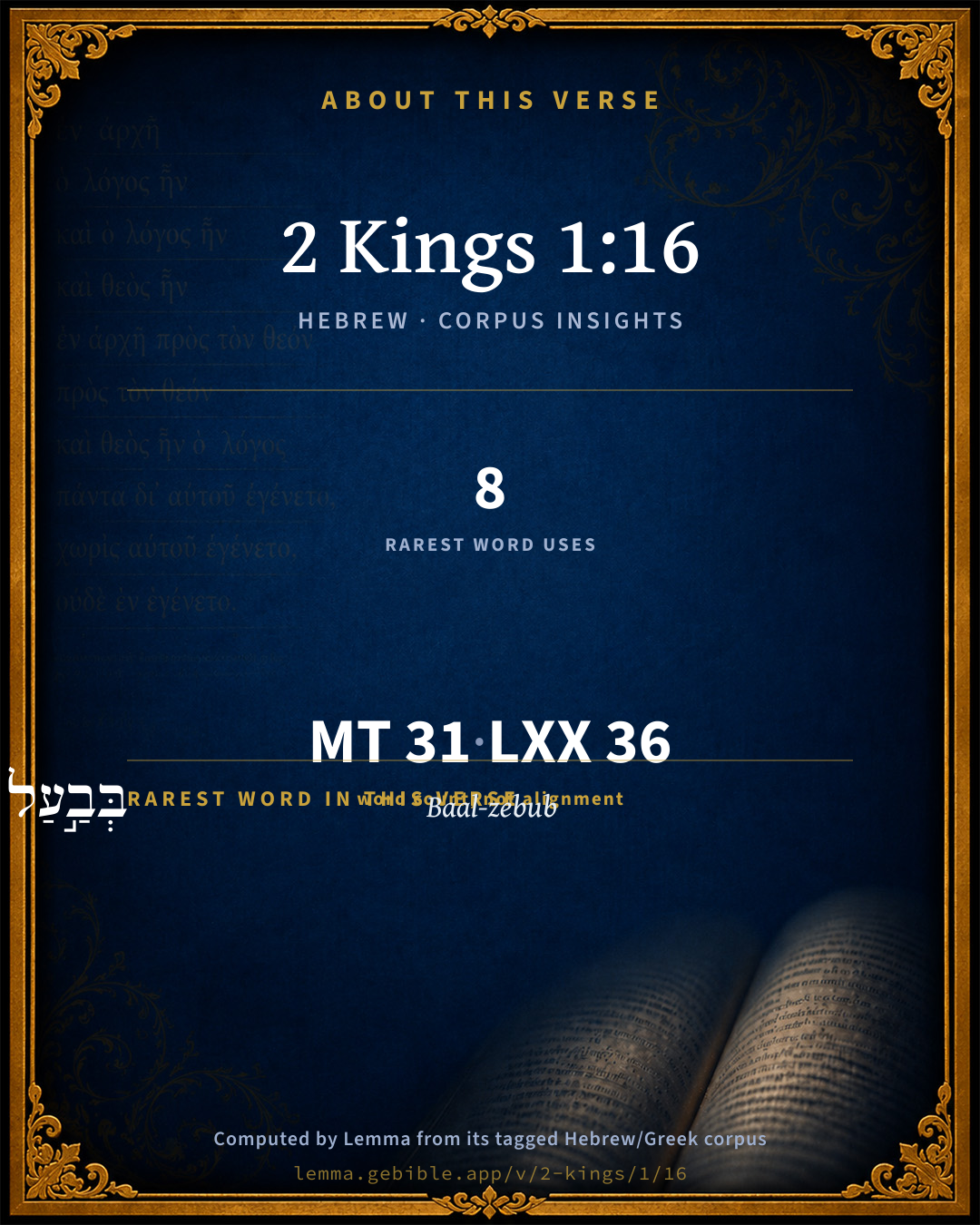
31
words
26
distinct lemmas
Historical
section

Notable vocabulary

The rarest word here is בְּבַ֣עַל Baal-zebub H1176 — appearing just 8 times in the whole Hebrew Bible.

Shared distinctive vocabulary

בְּבַ֣עַל Baal-zebub H1176 occurs in 4 verses of the Hebrew Bible. Also found in:

Grammatical profile

  • 9 verbs
  • 10 nouns
  • 2 prepositions
  • 2 conjunctions
  • 4 adverbs
  • 4 particles

Verb forms

  • וַיְדַבֵּ֨ר Piel · Sequential Imperfect
  • אָמַ֣ר Qal · Perfect
  • שָׁלַ֣חְתָּ Qal · Perfect
  • לִדְרֹשׁ֮ Qal · Infinitive Construct
  • לִדְרֹ֖שׁ Qal · Infinitive Construct
  • עָלִ֥יתָ Qal · Perfect
  • תֵרֵ֥ד Qal · Imperfect
  • מ֥וֹת Qal · Infinitive Absolute
  • תָּמֽוּת Qal · Imperfect

Repetition

Words recur within this verse — often emphatic in Hebrew:

  • לִדְרֹשׁ֮ to seek H1875 ×2
  • בְּבַ֣עַל Baal-zebub H1176 ×2
  • אֱלֹהֵ֣י God H430 ×2
  • מ֥וֹת to die H4191 ×2
  • אֲשֶׁר which H834 ×2

Hebrew & Septuagint length

In English translation the verse runs 53 words from the Hebrew and 50 from the Septuagint (LXX English) — closely comparable.

A rough comparison of the two English renderings, which tokenize alike — not a word-level alignment.

Word counts can differ between the Hebrew and the Greek without any difference in meaning — e.g. the Hebrew direct-object marker אֵת has no separate Greek word, and Greek often adds the article ὁ.

In the original languages it is 31 Hebrew tokens and 36 Greek tokens — but the two are counted differently (Hebrew bundles its prefixes and suffixes into one token; the Greek is in lemma form), so that isn’t a like-for-like length.

Cross-references

8

Topical passages linked to 2 Kings 1:16 in the Treasury of Scripture Knowledge — connected by theme and wording, ordered by reader-vote popularity; previews shown in the World English Bible.

  • 2 Kings 1:2–4 Ahaziah fell down through the lattice in his upper chamber that was in Samaria, and was sick: and he sent messengers, and said to them, Go, inquire of Baal Zebub, the god of Ekron, whether I shall recover of this sickness.
  • Exodus 4:22–23 You shall tell Pharaoh, 'Thus says Yahweh, Israel is my son, my firstborn,
  • 1 Kings 14:6–13 It was so, when Ahijah heard the sound of her feet, as she came in at the door, that he said, Come in, you wife of Jeroboam; why feign you yourself to be another? for I am sent to you with heavy news.
  • 1 Kings 21:18–24 Arise, go down to meet Ahab king of Israel, who dwells in Samaria: behold, he is in the vineyard of Naboth, where he is gone down to take possession of it.
  • 1 Kings 22:28 Micaiah said, If you return at all in peace, Yahweh has not spoken by me. He said, Hear, you peoples, all of you.
  • 2 Kings 5:21 So Gehazi followed after Naaman. When Naaman saw one running after him, he alighted from the chariot to meet him, and said, Is all well?
  • Psalms 132:3 "Surely I will not come into the structure of my house, Nor go up into my bed;
  • 2 Kings 1:6 They said to him, There came up a man to meet us, and said to us, Go, turn again to the king who sent you, and tell him, Thus says Yahweh, Is it because there is no God in Israel, that you send to inquire of Baal Zebub, the god of Ekron? therefore you shall not come down from the bed where you are gone up, but shall surely die.

Cross-references courtesy of OpenBible.info (CC BY 4.0).

Hebrew and Greek witnesses Masoretic Hebrew ↔ Greek Septuagint

The same verse in the two great witnesses to the Old Testament, shown verse-for-verse.

These are two independent witnesses, not word-aligned to each other, and the Septuagint is shown in lemma (dictionary) form.

Hebrew 2 Kings 1:16 Masoretic · Westminster Leningrad Codex

וַיְדַבֵּ֨ר אֵלָ֜יו כֹּֽה אָמַ֣ר יְהוָ֗ה יַ֜עַן אֲשֶׁר שָׁלַ֣חְתָּ מַלְאָכִים֮ לִדְרֹשׁ֮ בְּבַ֣עַל זְבוּב֮ אֱלֹהֵ֣י עֶקְרוֹן֒ הַֽמִבְּלִ֤י אֵין אֱלֹהִים֙ בְּיִשְׂרָאֵ֔ל לִדְרֹ֖שׁ בִּדְבָר֑וֹ לָ֠כֵן הַמִּטָּ֞ה אֲשֶׁר עָלִ֥יתָ שָּׁ֛ם לֹֽא תֵרֵ֥ד מִמֶּ֖נָּה כִּֽי מ֥וֹת תָּמֽוּת

He said to him, Thus says Yahweh, Because you have sent messengers to inquire of Baal Zebub, the god of Ekron, is it because there is no God in Israel to inquire of his word? therefore you shall not come down from the bed where you are gone up, but shall surely die.

World English Bible · Public Domain

Greek LXX 2 Kings 1:16 Septuagint · lemma form

καί λαλέω πρός αὐτός καί εἶπον ηλιου ὅδε λέγω κύριος τίς ὅτι ἀποστέλλω ἄγγελος ζητέω ἐν ὁ βααλ μυῖα θεός ακκαρων οὐ οὕτως ὁ κλίνη ἐπί ὅς ἀναβαίνω ἐκεῖ οὐ καταβαίνω ἀπό αὐτός ὅτι θάνατος ἀποθνήσκω

And Eliu spoke to him, and said, Thus says the Lord, Why have you sent messengers to enquire of Baal fly, the god of Accaron? it shall not be so: the bed on which you are gone up, you shall not come down from it, for you shall surely die.

LXX2012 (modern English Septuagint) · Public Domain

On this verse, Ellicott's Commentary for English Readers discusses the Septuagint’s reading. Read the note in Commentary ↓

Hebrew: Westminster Leningrad Codex (CC BY 4.0). Greek: Septuagint (public domain); English from LXX2012 (modern English Septuagint) (Public Domain). How the Septuagint differs from the Hebrew →

Targum (Aramaic paraphrase)

1

The Targum is the ancient Jewish Aramaic paraphrase of the Hebrew Scriptures — an interpretive translation, not the Hebrew text itself. Onkelos (literal) and Pseudo-Jonathan (expansive) render the Torah, and Jonathan the Prophets. Coverage is partial: where no permissively-licensed English translation exists for a verse, only the Aramaic is shown. This is verse-level text, not a word-by-word alignment to the Hebrew.

  1. Targum Jonathan Prophets (Joshua–Malachi)
    וּמַלֵיל עִמֵיהּ כִּדְנַן אֲמַר יְיָ חֲלַף דִשְׁלַחְתָּא אִזְגַדִין לְמִשְׁאַל בְּבַעַל זְבוּב טַעֲוַת עֶקְרוֹן הֲלָא אֱלָהָא קַיָם דִשְׁכִנְתֵּיהּ שַׁרְיָא בְיִשְׂרָאֵל לְמִשְׁאַל בְּפִתְגָמֵיהּ בְּכֵן עַרְסָא דִסְלֵיקְתָּא תַמָן לָא תֵיחוֹת מִנָה אֲרֵי מֵימַת תְּמוּת:

    (no public-domain English translation for this verse)

    Targum Jonathan — Aramaic: “Mikraot Gedolot” (public domain). English: “Sefaria Community Translation” (CC0 1.0 (public-domain dedication)); “London "Chaldee Paraphrase," 1871” (public domain). Text via Sefaria.

Commentary

Notes on 2 Kings 1:16 from classic Christian and Jewish commentators (each source and its license shown beneath its notes). The classic Christian expositions comment on the surrounding passage and are grouped to its opening verse, so a note may address several verses; the Jewish commentaries on the Tanakh (Rashi and others) are per-verse, so they appear only where the commentator wrote on this verse.

Lemma curates 59 commentaries, every one of them public domain or Creative Commons licensed, each selected and text-cleaned for this edition rather than reprinted as found. About our sources →

Trapp's Complete Commentary

John Trapp

2Ki 1:16 And he said unto him, Thus saith the LORD, Forasmuch as thou hast sent messengers to enquire of Baalzebub the god of Ekron, [is it] not because [there is] no God in Israel to enquire of his word? therefore thou shalt not come down off that bed on which thou art gone up, but shalt surely die.

Ver. 16. Forasmuch as thou hast sent messengers.] This if he had not done, but sought to God, though he were mortally bruised, yet he might have, through mercy, recovered, as Hezekiah did.

John Trapp, A Commentary or Exposition upon All the Books of the Old and New Testament (1647–1656) — public domain. Text from a community e-Sword module.

Tyndale Open Study Notes

Tyndale Open Resources

1:16 Is there no God in Israel? God’s message to Ahaziah remained unchanged (cp. 1:3-4).

Tyndale Open Study Notes — © Tyndale Open Resources, licensed CC BY-SA 4.0. Text via the HelloAO Bible API.

Ellicott's Commentary for English Readers

(16) And he said.—Heb., spake. The LXX. adds, “and Elijah said.”

Is it not because.—Omit “not.” The question is here parenthetic, the connection of the main sentence being, “Forasmuch as thou hast sent . . . therefore thou shalt not come down,” &c.

Off.—From, as in 2Ki_1:4; 2Ki_1:6. The words of the oracle are thrice repeated verbally.

“Here, just as in other cases,” says Bähr, “Elijah reappears suddenly and disappears again, and no one knows whence he comes or whither he goes.” The peculiar form of the story suggests that it was derived in the first instance from oral tradition rather than from a written source.

A Bible Commentary for English Readers, edited by Charles John Ellicott (1878–1897) — public domain. Text from a community e-Sword module.

John Gill's Exposition

And he said unto him,.... Elijah to King Ahaziah when introduced into his chamber; and after some discourse passed between them, he confirmed what he had said to his messengers, and expressed it in the same language as in Kg2 1:3; see Gill on Kg2 1:3, Kg2 1:4

2 Kings 1:17

kg2 1:17

kg2 1:17

kg2 1:17So he died, according to the word of the Lord which Elijah had spoken,.... How long or how soon after this is not said; however, he died of the sickness, and on the bed to which he went up, as he said:

and Jehoram reigned in his stead: who was another son of Ahab, and brother of Ahaziah, Kg2 3:1, in the second year of Jehoram the son of Jehoshaphat king of Judah; but as he must begin his reign in the nineteenth, or in the latter end of the eighteenth year of Jehoshaphat, see Kg1 22:51 and Jehoshaphat reigned in all twenty five years, Kg1 22:42, he must live and reign after this six or seven years; this therefore is to be reconciled by observing, that this son of Jehoshaphat was made viceroy, or was taken into partnership in the throne by his father when he went with Ahab to Ramothgilead; and it was in the second year of this his reign with his father that the other Jehoram began his:

because he had no son; that is, Ahaziah, wherefore his brother reigned in his stead.

John Gill's Exposition of the Whole Bible (1746–1763) — public domain (CC PDM 1.0). Text via the HelloAO Bible API.

Matthew Poole's English Annotations

And he said unto him; to his very face. Nor durst the king lay hands upon him, being daunted with the prophet’s presence, and great courage, and confidence; and affrighted by the late dreadful evidence of his power with God and over men: and withal, struck with a Divine and extraordinary terror.

Matthew Poole's English Annotations on the Holy Bible (1683–1685) — public domain. Text from a community e-Sword/MySword module.

The Pulpit Commentary

He said unto him; i.e. Elijah said to the king. Introduced into the royal presence, as a prisoner, perhaps fettered and chained, the prophet in no way lowered his tone or abated from the severity of his speech. Distinctly, in the plainest possible words, he warned the monarch that his end approached he would never quit the bed whereon he lay, but, because he had insulted Jehovah by sending to consult the god of Ekron, would surely die. Apparently the king, abashed and confounded, released the prophet, and allowed him to go his way. Thus saith the Lord. Elijah rehearses the words of the message which he had sent by the first of the three captains (see ver. 6). Thus saith the Lord, Forasmuch as thou hast sent messengers to inquire of Baal-zebub the god of Ekron, is it not because there is no God in Israel to inquire of his word! Therefore thou shalt not come down off that bed on which thou art gone up, but shalt surely die. God"s determinations are unalterable.

The Pulpit Commentary (1880–1919), ed. H.D.M. Spence-Jones & Joseph S. Exell — public domain. Text from a community e-Sword module.

John Wesley's Explanatory Notes

He said - To his very face. Nor durst the king lay hands upon him, being daunted with the prophet's presence, and confidence; and affrighted by the late dreadful evidence of his power with God.

John Wesley, Explanatory Notes Upon the Whole Bible (1754–1765) — public domain. Text via the GEBible commentary corpus.

Lesson kit

Teaching starters — assembled from the data on this page, not authored interpretation. Every prompt links to the verse data it draws on. Edit before teaching.

2 Kings, in the Historical, opens this verse with 31 words (26 distinct Hebrew lemmas). Its most distinctive word is Baʻal Zᵉbûwb (“Baal-zebub”). A historical commentator’s framing appears above. Read the whole chapter for the surrounding context.

Discussion questions

  1. The word Baʻal Zᵉbûwb carries the sense “Baal-zebub.” How does it shape the verse?
  2. 2 Kings 1:2 shares the word «Baal-zebub» with this verse. How do the two illuminate each other?
  3. “to seek” occurs 2× in this one verse. What is the effect of the repetition?
  4. These translations render this verse differently; the difference is in the English rendering, not the original. What questions does that raise?
  5. The verb «וַיְדַבֵּ֨ר» is Piel Sequential Imperfect. How does its form color the action?
  6. Reading how Trapp's Complete Commentary and Tyndale Open Study Notes read this verse, where do the two commentators agree and where do they part?

Things to notice

Reading settings

Reading text

Shown beneath each verse's original-language words.

Old Testament
Old Testament edition

Read the OT as the Masoretic Hebrew (MT) or the Greek Septuagint (LXX).

English shown for the Greek Septuagint (in the Hebrew ↔ Greek comparison).

Comparing translations? Open the Compare panel on any verse page to stack up to four side by side.