Numbers 22:24

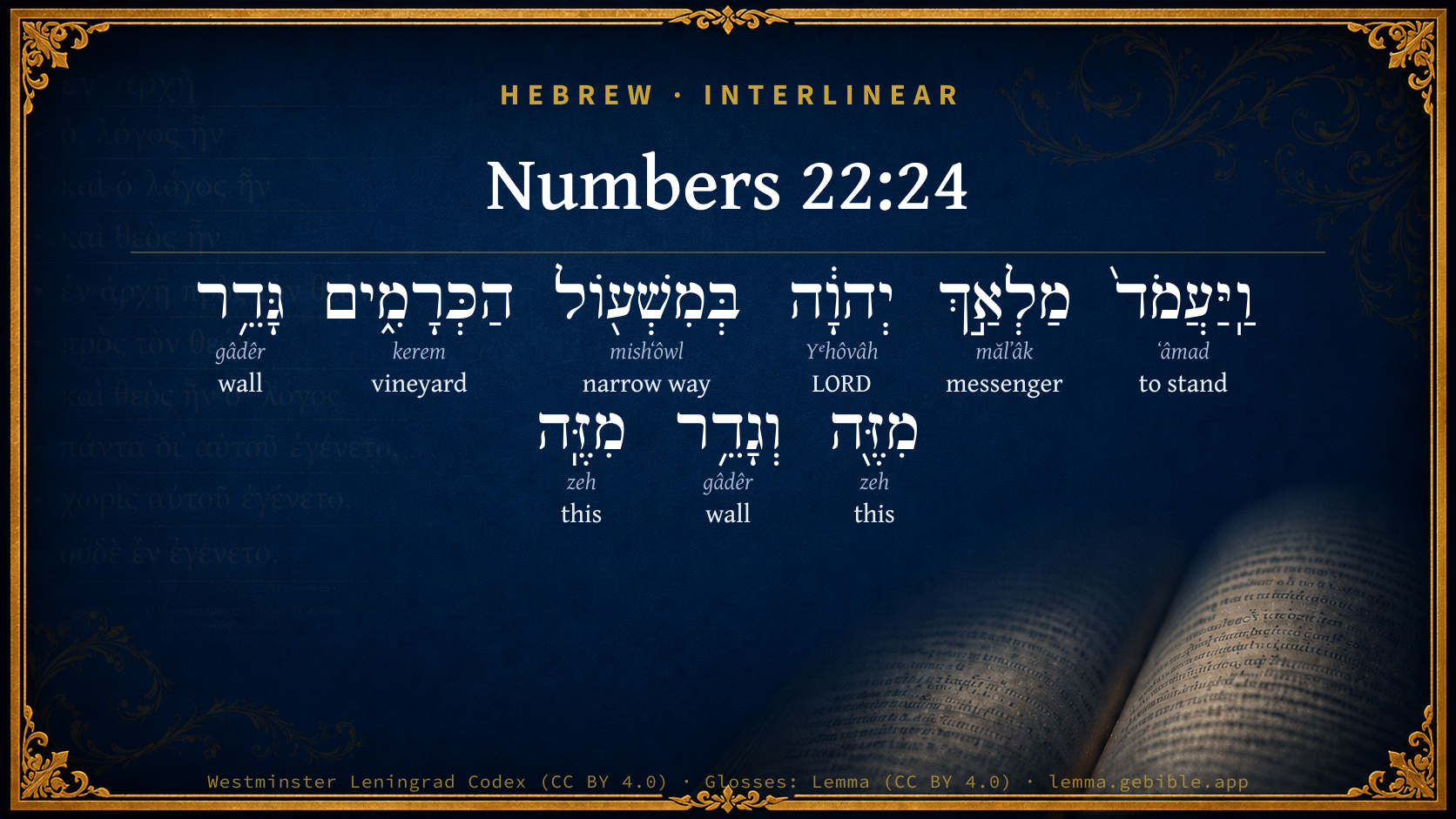
Hebrew (Westminster Leningrad Codex) Numbers 22:24 appears in the Hebrew Old Testament. The text above is from the Westminster Leningrad Codex. Each word links to its Strong’s number, a concise gloss, and parsing drawn from the Open Scriptures Hebrew Bible morphology. Click any word for its full Brown-Driver-Briggs (BDB) entry.
Download image
Cite this verse

Numbers 22:24 (World English Bible). Public Domain. Lemma interlinear Bible study tool, https://lemma.gebible.app/v/numbers/22/24.

Show BibTeX & RIS
BibTeX
RIS
English Translation
Then the angel of Yahweh stood in a narrow path between the vineyards, a wall being on this side, and a wall on that side.
World English Bible · Public Domain
Highlights
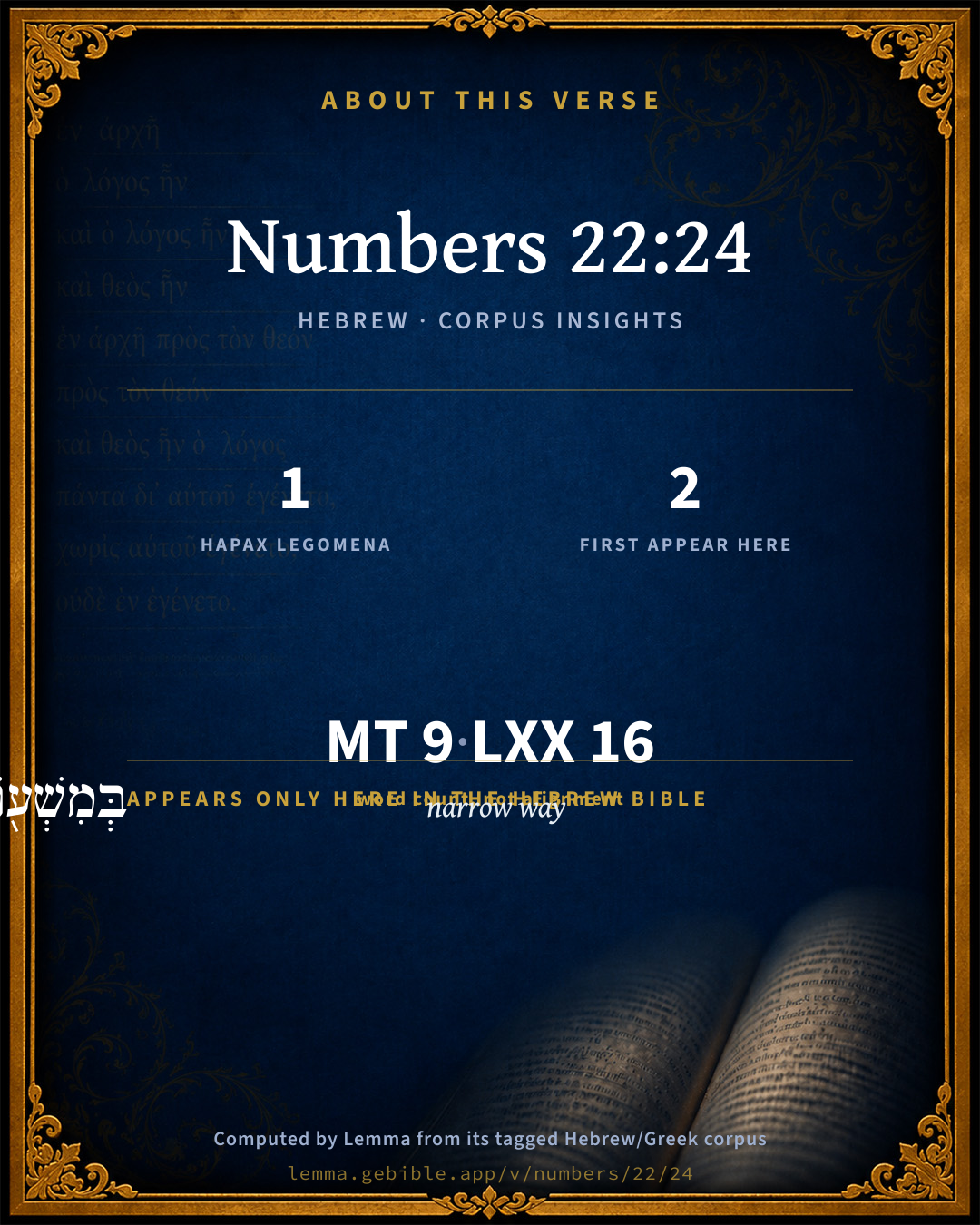
  • 1 hapax legomenon — only here in the Hebrew Bible
  • 2 first appearances in the Hebrew Bible
Full analysis ↓
Download a study sheet

One document with this verse’s original text, its word-by-word gloss line, the meaning frame, cross-references with their text, attributed commentary, and full source and license credits — printable, and it pastes into notes with its structure intact.

This verse Autodidact and up

Study sheet (.html) Plain text (.txt)

A passage Seminary Student

Up to 50 verses in one chapter. A passage sheet keeps up to 6 commentary sources and 12 cross-references per verse, in the order this page ranks them, and says so on the sheet whenever that leaves anything out. Ask for a single verse and you get the Autodidact verse sheet above.

Everything on this page stays free to read, with no account — the sheet is a download of what is already on screen, not access to it.

Want to remove ads? Support Godless Engineer
Compare translations 3

The same verse in 3 English versions, stacked beneath the original-language interlinear above. Click any original word for its lexicon entry.

Each is an independent rendering of the whole verse — the interlinear is not word-aligned to these translations.

Highlighted words mark where these versions differ — a whole-verse word diff, not a word-by-word alignment.

  • World English Bible Public Domain
    Then the angel of Yahweh stood in a narrow path between the vineyards, a wall being on this side, and a wall on that side.
  • King James Version Public Domain
    But the angel of the LORD stood in a path of the vineyards, a wall being on this side, and a wall on that side.
  • unfoldingWord Literal Text CC BY-SA 4.0
    And the angel of Yahweh stood in the narrow path of the vineyards, a wall on this and a wall on that

unfoldingWord Literal Text — © unfoldingWord, licensed CC BY-SA 4.0. Word-aligned USFM3 via Door43 (git.door43.org/unfoldingWord/en_ult).

Versions to compare (up to 4)

3 of 4 selected

Show all 18 translations

Every available English version of this verse, each an independent rendering of the whole verse.

  • World English Bible Public Domain
    Then the angel of Yahweh stood in a narrow path between the vineyards, a wall being on this side, and a wall on that side.
  • Berean Standard Bible Public Domain
    Then the angel of the LORD stood in a narrow passage between two vineyards, with walls on either side.
  • Majority Standard Bible Public Domain
    Then the angel of the LORD stood in a narrow passage between two vineyards, with walls on either side.
  • King James Version Public Domain
    But the angel of the LORD stood in a path of the vineyards, a wall being on this side, and a wall on that side.
  • American Standard Version (1901) Public Domain
    Then the angel of Jehovah stood in a narrow path between the vineyards, a wall being on this side, and a wall on that side.
  • Revised Version (1885) Public Domain
    Then the angel of the LORD stood in a hollow way between the vineyards, a fence being on this side, and a fence on that side.
  • Geneva Bible (1599) Public Domain
    Againe the Angel of the Lord stood in a path of the vineyardes, hauing a wall on the one side, and a wall on the other.
  • Douay-Rheims (1899) Public Domain
    The angel stood in a narrow place between two walls, wherewith the vineyards were enclosed.
  • Young's Literal Translation Public Domain
    And the messenger of Jehovah standeth in a narrow path of the vineyards -- a wall on this `side' and a wall on that --
  • Literal Standard Version CC BY-SA 4.0
    And the Messenger of YHWH stands in a narrow path of the vineyards, [with] a wall on this [side] and a wall on that [side],
  • Unlocked Literal Bible CC BY-SA 4.0
    Then the angel of Yahweh stood in a narrow part of the road between some vineyards, with a wall on his right side and another wall on his left side.
  • unfoldingWord Literal Text CC BY-SA 4.0
    And the angel of Yahweh stood in the narrow path of the vineyards, a wall on this and a wall on that
  • Darby Bible Public Domain
    And the Angel of Jehovah stood in a hollow of the vineyards, a wall being on this side, and a wall on that side.
  • World Messianic Bible Public Domain
    Then the LORD’s angel stood in a narrow path between the vineyards, a wall being on this side, and a wall on that side.
  • Webster's Bible Public Domain
    But the angel of the LORD stood in a path of the vineyards, a wall being on this side, and a wall on that side.
  • Free Bible Version CC BY-SA 4.0
    Then the angel of the Lord stood in a narrow part of the road that passed between two vineyards, with walls on both sides.
  • Bible in Basic English Public Domain
    Then the angel of the Lord took up his position in a narrow road through the vine-gardens, with a wall on this side and on that.
  • JPS Tanakh (1917) Public Domain
    Then the angel of the LORD stood in a hollow way between the vineyards, a fence being on this side, and a fence on that side.

Literal Standard Version (2020), Covenant Press — licensed CC BY-SA 4.0. Text via the HelloAO Bible API (eBible.org). Unlocked Literal Bible (unfoldingWord) — licensed CC BY-SA 4.0. Text via the HelloAO Bible API (eBible.org). unfoldingWord Literal Text — © unfoldingWord, licensed CC BY-SA 4.0. Word-aligned USFM3 via Door43 (git.door43.org/unfoldingWord/en_ult). Free Bible Version, Dr. Jonathan Gallagher — licensed CC BY-SA 4.0. Text via the HelloAO Bible API (eBible.org).

Word by word

More ways to search: Search by grammar → Find every occurrence → Compare this word →

Practice this passage: Drill this verse → Learn its vocabulary →

בְּמִשְׁע֖וֹל
mishʻôwl
H4934
“in/at · narrow way of”
Preposition + Noun, Common, Masculine, Singular, Construct
Part of Speech
Preposition + Noun
Type
Common
Gender
Masculine
Number
Singular
State
Construct
Full BDB Definition

Origin: from the same as H8168

TWOT: 2432b

hollow way, narrow way - of a road shut in between vineyards
  1. וַֽיַּעֲמֹד֙ ʻâmad H5975 “and · to stand” Conjunction + Verb, Qal, Sequential Imperfect, 3rd Person, Masculine, Singular
  2. מַלְאַ֣ךְ mălʼâk H4397 “messenger of” Noun, Common, Masculine, Singular, Construct
  3. יְהוָ֔ה Yᵉhôvâh H3068 “LORD” Noun, Proper
  4. הַכְּרָמִ֑ים kerem H3754 “the · vineyards” Particle, Definite Article + Noun, Common, Both, Plural, Absolute
  5. גָּדֵ֥ר gâdêr H1447 “wall” Noun, Common, Masculine, Singular, Absolute
  6. מִזֶּ֖ה zeh H2088 “from · this” Preposition + Pronoun, Demonstrative, Masculine, Singular
  7. וְגָדֵ֥ר gâdêr H1447 “and · wall” Conjunction + Noun, Common, Masculine, Singular, Absolute
  8. מִזֶּֽה zeh H2088 “from · this” Preposition + Pronoun, Demonstrative, Masculine, Singular

About this verse

These counts appear in no published source. They are computed here, from the morphology-tagged text and Lemma’s own curated glosses. What Lemma adds →

9
words
7
distinct lemmas
Pentateuch
section

Notable vocabulary

1 hapax legomenon — a word that appears only here in the entire Hebrew Bible:

  • בְּמִשְׁע֖וֹל narrow way H4934

First appearance in Scripture

These words make their first canonical appearance in the Hebrew Bible here:

  • בְּמִשְׁע֖וֹל narrow way H4934
  • גָּדֵ֥ר wall H1447

Shared distinctive vocabulary

גָּדֵ֥ר wall H1447 occurs in 10 verses of the Hebrew Bible. Also found in:

Grammatical profile

  • 1 verb
  • 6 nouns
  • 2 pronouns

Verb forms

  • וַֽיַּעֲמֹד֙ Qal · Sequential Imperfect

Repetition

Words recur within this verse — often emphatic in Hebrew:

  • גָּדֵ֥ר wall H1447 ×2
  • מִזֶּ֖ה this H2088 ×2

Hebrew & Septuagint length

In English translation the verse runs 25 words from the Hebrew and 24 from the Septuagint (LXX English) — closely comparable.

A rough comparison of the two English renderings, which tokenize alike — not a word-level alignment.

Word counts can differ between the Hebrew and the Greek without any difference in meaning — e.g. the Hebrew direct-object marker אֵת has no separate Greek word, and Greek often adds the article ὁ.

In the original languages it is 9 Hebrew tokens and 16 Greek tokens — but the two are counted differently (Hebrew bundles its prefixes and suffixes into one token; the Greek is in lemma form), so that isn’t a like-for-like length.

Hebrew and Greek witnesses Masoretic Hebrew ↔ Greek Septuagint

The same verse in the two great witnesses to the Old Testament, shown verse-for-verse.

These are two independent witnesses, not word-aligned to each other, and the Septuagint is shown in lemma (dictionary) form.

Hebrew Numbers 22:24 Masoretic · Westminster Leningrad Codex

וַֽיַּעֲמֹד֙ מַלְאַ֣ךְ יְהוָ֔ה בְּמִשְׁע֖וֹל הַכְּרָמִ֑ים גָּדֵ֥ר מִזֶּ֖ה וְגָדֵ֥ר מִזֶּֽה

Then the angel of Yahweh stood in a narrow path between the vineyards, a wall being on this side, and a wall on that side.

World English Bible · Public Domain

Greek LXX Numbers 22:24 Septuagint · lemma form

καί ἵστημι ὁ ἄγγελος ὁ θεός ἐν ὁ αὖλαξ ὁ ἄμπελος φραγμός ἐντεῦθεν καί φραγμός ἐντεῦθεν

And the angel of the Lord stood in the avenues of the vines, a fence being on this side and a fence on that.

LXX2012 (modern English Septuagint) · Public Domain

Hebrew: Westminster Leningrad Codex (CC BY 4.0). Greek: Septuagint (public domain); English from LXX2012 (modern English Septuagint) (Public Domain). How the Septuagint differs from the Hebrew →

Targum (Aramaic paraphrase)

2

The Targum is the ancient Jewish Aramaic paraphrase of the Hebrew Scriptures — an interpretive translation, not the Hebrew text itself. Onkelos (literal) and Pseudo-Jonathan (expansive) render the Torah, and Jonathan the Prophets. Coverage is partial: where no permissively-licensed English translation exists for a verse, only the Aramaic is shown. This is verse-level text, not a word-by-word alignment to the Hebrew.

  1. Targum Onkelos Torah (Genesis–Deuteronomy)
    וְקָם מַלְאָכָא דַיְיָ בִּשְׁבִיל כַּרְמַיָא אַתְרָא דְגָדֵירָא מִכָּא וְגָדֵירָא מִכָּא

    (no public-domain English translation for this verse)

    Targum Onkelos — Aramaic: “Onkelos Genesis” (public domain); “Onkelos Exodus” (public domain); “Onkelos Leviticus” (public domain); “Onkelos Numbers” (public domain); “Onkelos Deuteronomy” (public domain). English: “Sefaria Community Translation” (CC0 1.0 (public-domain dedication)); “J.W. Etheridge. The Targums of Onkelos and Jonathan Ben Uzziel on the Pentateuch. London: Longmans, Green, 1862” (public domain). Text via Sefaria.

  2. Targum Pseudo-Jonathan Torah (Genesis–Deuteronomy)
    וְקָם מַלְאָכָא דַיְיָ בְּדוֹחֲקָא דְמִיצַע בֵּינֵי כְרָמַיָא אֲתַר דְאָקִים יַעֲקב וְלָבָן אוֹגַר וְקָמָא מִצִטְרָא מִיכָּא וְשָכוּתָא מִצִיטְרָא מִיכָּא וְקַיְימוּ דְלָא לְמֵעִיבַר דֵין תְּחוּם דֵין לְבִישָׁא

    And the angel of the Lord stood in a narrow path that was in the midst between vineyards, in the place where Jacob and Laban raised the mound, the pillar on this side and the observatory on that side, which they raised, that neither should pass that limit to do evil (to the other).

    Targum Pseudo-Jonathan — Aramaic: “Targum Jonathan on Genesis” (public domain); “Targum Jonathan on Exodus” (public domain); “Targum Jonathan on Leviticus” (public domain); “Targum Jonathan on Numbers” (public domain); “Targum Jonathan on Deuteronomy” (public domain). English: “The Targum of Jonathan ben Uzziel, trans. J. W. Etheridge, London, 1862” (public domain). Text via Sefaria.

Commentary

Notes on Numbers 22:24 from classic Christian and Jewish commentators (each source and its license shown beneath its notes). The classic Christian expositions comment on the surrounding passage and are grouped to its opening verse, so a note may address several verses; the Jewish commentaries on the Tanakh (Rashi and others) are per-verse, so they appear only where the commentator wrote on this verse.

Lemma curates 59 commentaries, every one of them public domain or Creative Commons licensed, each selected and text-cleaned for this edition rather than reprinted as found. About our sources →

Trapp's Complete Commentary

John Trapp

Num 22:24 But the angel of the LORD stood in a path of the vineyards, a wall [being] on this side, and a wall on that side.

Ver. 24. But the angel] If an angel stand in the way of a sorcerer’s sin, how much more ready are all those heavenly spirits to stop the miscarriages of God’s dear children! Surely as our good endeavours are oft hindered by Satan, so are our evil by good angels; else were not our protection equal to our danger, and we could neither stand nor rise.

John Trapp, A Commentary or Exposition upon All the Books of the Old and New Testament (1647–1656) — public domain. Text from a community e-Sword module.

Geneva Bible (1599)

Geneva Bible translators

The second time.

Geneva Bible (1599) marginal notes — public domain. Text via Bolls.life.

Jamieson, Fausset & Brown

Robert Jamieson, A. R. Fausset & David Brown

the angel of the Lord stood in a path of the vineyards--The roads which lead through fields and vineyards are so narrow that in most parts a man could not pass a beast without care and caution. A stone or mud fence flanks each side of these roads, to prevent the soil being washed off by the rains.

Jamieson, Fausset & Brown — Commentary Critical and Explanatory on the Whole Bible (1871) — public domain (CC PDM 1.0). Text via the HelloAO Bible API.

Ellicott's Commentary for English Readers

(24) In a path of the vineyards.—Better, in the hollow pass of the vineyards.

A wall.—Or, a fence.

A Bible Commentary for English Readers, edited by Charles John Ellicott (1878–1897) — public domain. Text from a community e-Sword module.

The Cambridge Bible for Schools and Colleges

gen. ed. J. J. S. Perowne

24. The ‘Angel’ retreated and stopped the ass in an enclosed spot between two walls or, perhaps, fences, where it could not turn aside into open country. But by pressing close to the wall the ass is pictured as contriving to pass the Angel. He therefore retreated once more, and stood in a narrow place where there was no possibility of avoiding Him. The naïve anthropomorphic conception of Jehovah involved in this narrative belongs to a very early age of folklore.

The Cambridge Bible for Schools and Colleges (gen. ed. J. J. S. Perowne; Cambridge University Press, 1878–1918) — public domain. Text from a community e-Sword module.

John Gill's Exposition

And when the ass saw the angel of the Lord,.... The third time; for it seems that he was not always in sight, but disappeared as he removed from place to place, and at every new place where he stood the ass saw him, though her master did not:

she fell down under Balaam; upon her knees on the ground, not being able to go backwards nor forwards, nor to turn out of the way to the right or left:

and Balaam's anger was kindled; he was displeased and out of humour before, when it turned into the field, and when it squeezed his foot against the wall, and therefore he smote it; but now falling down with him, he was in a fume and fury, quite enraged:

and he smote the ass with a staff; which he rode with, perhaps his divining staff, see Hos 4:12, it is not said what he smote it with before but probably with the same: Aben Ezra says, at the first and second time he smote it with a small stick, or with a thong.

John Gill's Exposition of the Whole Bible (1746–1763) — public domain (CC PDM 1.0). Text via the HelloAO Bible API.

Albert Barnes' Notes on the Bible

In a path of the vineyards - i. e., in a path shut in by vineyard-walls on each side. The progress from the road through the open field Num 22:23 to that walled in, and thence to the strait place, where there was no room to turn Num 22:26, shows that Balaam was approaching a city, no doubt that which was the goal of his journey.

Albert Barnes' Notes on the Bible (1834–1885) — public domain. Text from a community e-Sword/MySword module.

Whedon's Commentary on the Bible

Daniel D. Whedon

24. A path of the vineyards — A footpath between the walls of two adjoining vineyards.

Daniel D. Whedon (gen. ed.), Commentary on the Old and New Testaments (1874–1909) — public domain. Text from a community e-Sword module.

Keil & Delitzsch

C. F. Keil & F. Delitzsch

The angel then stationed himself in a pass of the vineyards where walls (גּדר, vineyard walls, Isa 5:5) were on both sides, so that the animal, terrified by the angel, pressed against the wall, and squeezed Balaam's foot against the wall, for which Balaam smote her again.

Keil & Delitzsch — Biblical Commentary on the Old Testament (1861–1891) — public domain (CC PDM 1.0). Text via the HelloAO Bible API. (Old Testament only.)

unfoldingWord translationNotes

Door43 World Missions Community

She went against the wall

This was an attempt to escape from the angel of Yahweh in the road.

She went

Sometimes animals are referred to as "her" or "she." AT: "It went"

pinned Balaam's foot against it

"pushed Balaam's foot against it" or "hurt Balaam's foot against it"

translationWords

angel

Yahweh

vineyard

Balaam

unfoldingWord translationNotes — © Distant Shores Media and the Door43 World Missions Community, licensed CC BY-SA 4.0. Source: git.door43.org/Door43/en_tn.

Rashi

Rabbi Shlomo Yitzchaki (Rashi)

במשעול — Understand this as the Targum does: IN A PATH. And similar is, (1 Kings 20:10) “If the dust of Samaria shall suffice לשעלים” — the dust that attaches itself to the soles of peoples’ feet when they walk. And similarly, (Isaiah 40:12) “Who hath measured the water בשעלו” — with his feet and through his walking (as one measures by pacing).

גדר מזה וגדר מזה A FENCE BEING ON THIS SIDE AND A FENCE ON THAT SIDE — The term גדר without further definition is one of stone (and that is why in the next verse it is called a קיר which is a term for a stone wall; cf. Leviticus 14:37—40).

Rashi on the Tanakh — English translations: “The Judaica Press complete Tanach with Rashi, translated by A. J. Rosenberg” (CC BY 4.0); “Pentateuch with Rashi's commentary by M. Rosenbaum and A.M. Silbermann, 1929-1934” (public domain); “The Metsudah Tanach series, Lakewood, N.J” (CC BY 4.0); and “The Book of Joshua, Metsudah Publications, 1997” (CC BY 4.0). Text via Sefaria.

Lesson kit

Teaching starters — assembled from the data on this page, not authored interpretation. Every prompt links to the verse data it draws on. Edit before teaching.

Numbers, in the Pentateuch, opens this verse with 9 words (7 distinct Hebrew lemmas). Its most distinctive word is mishʻôwl (“narrow way”). A historical commentator’s framing appears above. Read the whole chapter for the surrounding context.

Discussion questions

  1. The word mishʻôwl carries the sense “narrow way.” How does it shape the verse?
  2. This verse holds 1 word here found nowhere else in the Hebrew Bible. What might the rare word draw attention to?
  3. 2 words here appear for the first time in Scripture. What is being introduced at this debut?
  4. Ezra 9:9 shares the word «wall» with this verse. How do the two illuminate each other?
  5. “wall” occurs 2× in this one verse. What is the effect of the repetition?
  6. These translations render this verse differently; the difference is in the English rendering, not the original. What questions does that raise?
  7. The verb «וַֽיַּעֲמֹד֙» is Qal Sequential Imperfect. How does its form color the action?
  8. Reading how Trapp's Complete Commentary and Geneva Bible (1599) read this verse, where do the two commentators agree and where do they part?

Things to notice

  • 1 word in this verse appears nowhere else in the Hebrew Bible.
  • 2 words make their first canonical appearance in Scripture here.
  • This verse counts 9 Hebrew ↔ 16 Greek words.
  • These translations choose different wording for 6 words in this verse.
  • “wall” occurs 2× in this single verse.

Reading settings

Reading text

Shown beneath each verse's original-language words.

Old Testament
Old Testament edition

Read the OT as the Masoretic Hebrew (MT) or the Greek Septuagint (LXX).

English shown for the Greek Septuagint (in the Hebrew ↔ Greek comparison).

Comparing translations? Open the Compare panel on any verse page to stack up to four side by side.