

Zechariah 1:13

Hebrew (Westminster Leningrad Codex) Zechariah 1:13 appears in the Hebrew Old Testament. The text above is from the Westminster Leningrad Codex. Each word links to its Strong’s number, a concise gloss, and parsing drawn from the Open Scriptures Hebrew Bible morphology. Click any word for its full Brown-Driver-Briggs (BDB) entry.
Download image
Cite this verse

Zechariah 1:13 (World English Bible). Public Domain. Lemma interlinear Bible study tool, https://lemma.gebible.app/v/zechariah/1/13.

Show BibTeX & RIS
BibTeX
RIS
English Translation
Yahweh answered the angel who talked with me with kind and comforting words.
World English Bible · Public Domain
Download a study sheet

One document with this verse’s original text, its word-by-word gloss line, the meaning frame, cross-references with their text, attributed commentary, and full source and license credits — printable, and it pastes into notes with its structure intact.

This verse Autodidact and up

Study sheet (.html) Plain text (.txt)

A passage Seminary Student

Up to 50 verses in one chapter. A passage sheet keeps up to 6 commentary sources and 12 cross-references per verse, in the order this page ranks them, and says so on the sheet whenever that leaves anything out. Ask for a single verse and you get the Autodidact verse sheet above.

Everything on this page stays free to read, with no account — the sheet is a download of what is already on screen, not access to it.

Want to remove ads? Support Godless Engineer
Compare translations 3

The same verse in 3 English versions, stacked beneath the original-language interlinear above. Click any original word for its lexicon entry.

Each is an independent rendering of the whole verse — the interlinear is not word-aligned to these translations.

Highlighted words mark where these versions differ — a whole-verse word diff, not a word-by-word alignment.

  • World English Bible Public Domain
    Yahweh answered the angel who talked with me with kind and comforting words.
  • King James Version Public Domain
    And the LORD answered the angel that talked with me with good words and comfortable words.
  • unfoldingWord Literal Text CC BY-SA 4.0
    And Yahweh answered the angel who was speaking with me, good words, words of comfort.

unfoldingWord Literal Text — © unfoldingWord, licensed CC BY-SA 4.0. Word-aligned USFM3 via Door43 (git.door43.org/unfoldingWord/en_ult).

Versions to compare (up to 4)

3 of 4 selected

Show all 18 translations

Every available English version of this verse, each an independent rendering of the whole verse.

  • World English Bible Public Domain
    Yahweh answered the angel who talked with me with kind and comforting words.
  • Berean Standard Bible Public Domain
    So the LORD spoke kind and comforting words to the angel who was speaking with me.
  • Majority Standard Bible Public Domain
    So the LORD spoke kind and comforting words to the angel who was speaking with me.
  • King James Version Public Domain
    And the LORD answered the angel that talked with me with good words and comfortable words.
  • American Standard Version (1901) Public Domain
    And Jehovah answered the angel that talked with me with good words, `even' comfortable words.
  • Revised Version (1885) Public Domain
    And the LORD answered the angel that talked with me with good words, even comfortable words.
  • Geneva Bible (1599) Public Domain
    And the Lord answered the Angel that talked with me, with good wordes and comfortable wordes.
  • Douay-Rheims (1899) Public Domain
    And the Lord answered the angel, that spoke in me, good words, comfortable words.
  • Young's Literal Translation Public Domain
    And Jehovah answereth the messenger, who is speaking with me, good words, comfortable words.
  • Literal Standard Version CC BY-SA 4.0
    And YHWH answers the messenger, who is speaking with me, good words, comfortable words.
  • Unlocked Literal Bible CC BY-SA 4.0
    Yahweh answered the angel who had talked with me, with good words, words of comfort.
  • unfoldingWord Literal Text CC BY-SA 4.0
    And Yahweh answered the angel who was speaking with me, good words, words of comfort.
  • Darby Bible Public Domain
    And Jehovah answered the angel that talked with me good words, comforting words.
  • World Messianic Bible Public Domain
    The LORD answered the angel who talked with me with kind and comforting words.
  • Webster's Bible Public Domain
    And the LORD answered the angel that talked with me with good words and comforting words.
  • Free Bible Version CC BY-SA 4.0
    So the Lord replied to the angel I was talking to with kind and comforting words.
  • Bible in Basic English Public Domain
    And the Lord gave an answer in good and comforting words to the angel who was talking to me.
  • JPS Tanakh (1917) Public Domain
    And the LORD answered the angel that spoke with me with good words, even comforting words —

Literal Standard Version (2020), Covenant Press — licensed CC BY-SA 4.0. Text via the HelloAO Bible API (eBible.org). Unlocked Literal Bible (unfoldingWord) — licensed CC BY-SA 4.0. Text via the HelloAO Bible API (eBible.org). unfoldingWord Literal Text — © unfoldingWord, licensed CC BY-SA 4.0. Word-aligned USFM3 via Door43 (git.door43.org/unfoldingWord/en_ult). Free Bible Version, Dr. Jonathan Gallagher — licensed CC BY-SA 4.0. Text via the HelloAO Bible API (eBible.org).

Word by word

More ways to search: Search by grammar → Find every occurrence → Compare this word →

Practice this passage: Drill this verse → Learn its vocabulary →

About this verse

These counts appear in no published source. They are computed here, from the morphology-tagged text and Lemma’s own curated glosses. What Lemma adds →

10
words
8
distinct lemmas
Prophets
section

Notable vocabulary

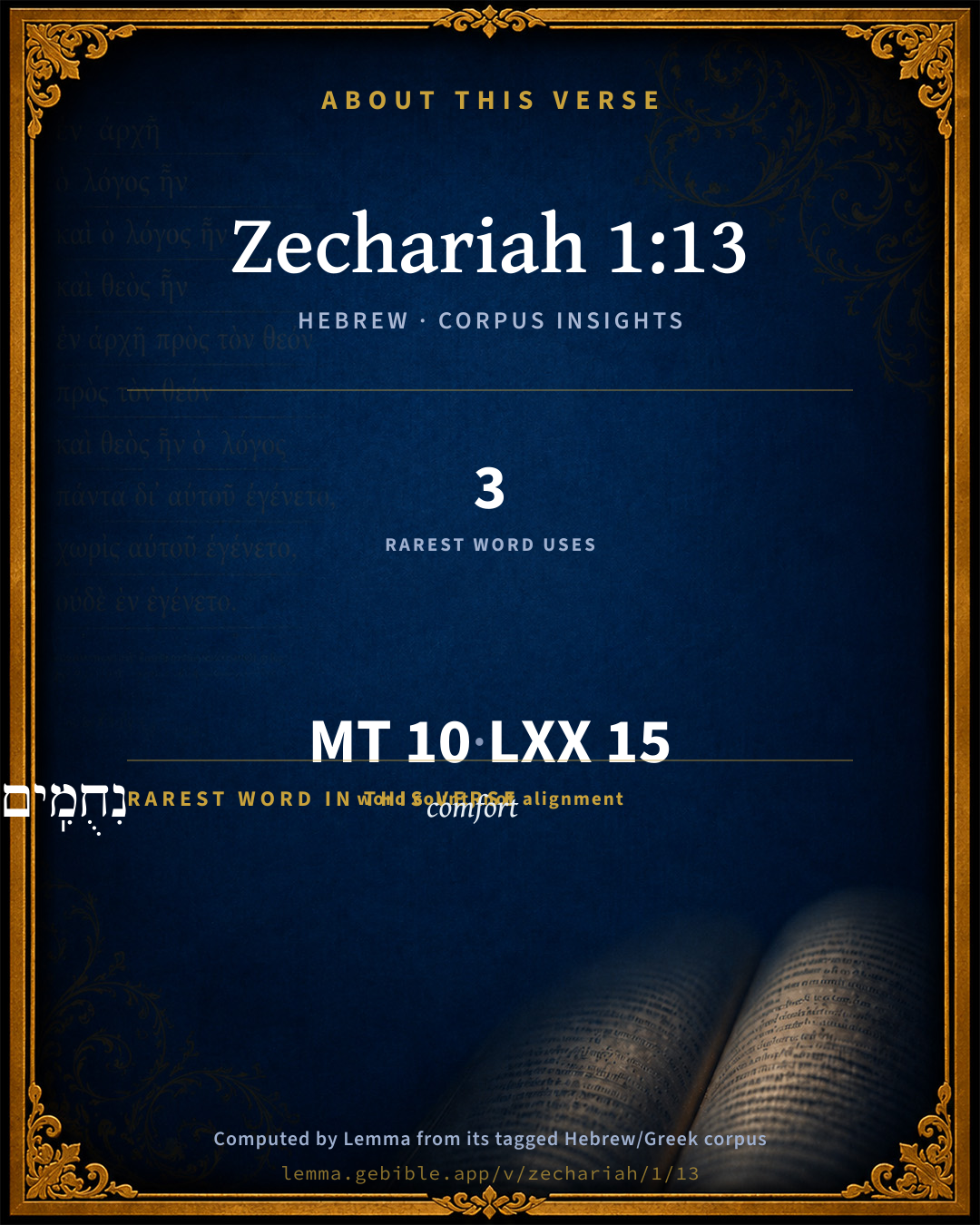
The rarest word here is נִחֻמִֽים comfort H5150 — appearing just 3 times in the whole Hebrew Bible.

Shared distinctive vocabulary

נִחֻמִֽים comfort H5150 occurs in 3 verses of the Hebrew Bible. Also found in:

Grammatical profile

  • 2 verbs
  • 5 nouns
  • 1 adjective
  • 1 preposition
  • 1 particle

Verb forms

  • וַיַּ֣עַן Qal · Sequential Imperfect
  • הַדֹּבֵ֥ר Qal · Participle Active

Repetition

A word recurs within this verse — often emphatic in Hebrew:

  • דְּבָרִ֣ים word H1697 ×2

Hebrew & Septuagint length

In English translation the verse runs 13 words from the Hebrew and 16 from the Septuagint (LXX English) — closely comparable.

A rough comparison of the two English renderings, which tokenize alike — not a word-level alignment.

Word counts can differ between the Hebrew and the Greek without any difference in meaning — e.g. the Hebrew direct-object marker אֵת has no separate Greek word, and Greek often adds the article ὁ.

In the original languages it is 10 Hebrew tokens and 15 Greek tokens — but the two are counted differently (Hebrew bundles its prefixes and suffixes into one token; the Greek is in lemma form), so that isn’t a like-for-like length.

Cross-references

12

Topical passages linked to Zechariah 1:13 in the Treasury of Scripture Knowledge — connected by theme and wording, ordered by reader-vote popularity; previews shown in the World English Bible.

  • Isaiah 40:1–2 Comfort you, comfort you my people, says your God.
  • Jeremiah 29:10 For thus says Yahweh, After seventy years are accomplished for Babylon, I will visit you, and perform my good word toward you, in causing you to return to this place.
  • Jeremiah 30:10–22 Therefore don't you be afraid, O Jacob my servant, says Yahweh; neither be dismayed, Israel: for, behold, I will save you from afar, and your seed from the land of their captivity; and Jacob shall return, and shall be quiet and at ease, and none shall make him afraid.
  • Jeremiah 31:3–14 Yahweh appeared of old to me, [saying], Yes, I have loved you with an everlasting love: therefore with loving kindness have I drawn you.
  • Amos 9:11–15 In that day I will raise up the tent of David who is fallen, and close up its breaches, and I will raise up its ruins, and I will build it as in the days of old;
  • Zephaniah 3:14–20 Sing, daughter of Zion! Shout, Israel! Be glad and rejoice with all your heart, daughter of Jerusalem.
  • Zechariah 1:9 Then I asked, 'My lord, what are these?'" The angel who talked with me said to me, "I will show you what these are."
  • Zechariah 1:14–16 So the angel who talked with me said to me, "Proclaim, saying, 'Thus says Yahweh of Hosts: "I am jealous for Jerusalem and for Zion with a great jealousy.
  • Zechariah 2:4–12 and said to him, "Run, speak to this young man, saying, 'Jerusalem will be inhabited as villages without walls, because of the multitude of men and cattle in it.
  • Zechariah 4:1 The angel who talked with me came again, and wakened me, as a man who is wakened out of his sleep.
  • Zechariah 8:2–8 Thus says Yahweh of Hosts: "I am jealous for Zion with great jealousy, and I am jealous for her with great wrath."
  • Zechariah 8:19 Thus says Yahweh of Hosts: "The fasts of the fourth fifth, seventh, and tenth months shall be for the house of Judah joy and gladness, and cheerful feasts. Therefore love truth and peace."

Cross-references courtesy of OpenBible.info (CC BY 4.0).

Hebrew and Greek witnesses Masoretic Hebrew ↔ Greek Septuagint

The same verse in the two great witnesses to the Old Testament, shown verse-for-verse.

These are two independent witnesses, not word-aligned to each other, and the Septuagint is shown in lemma (dictionary) form.

Hebrew Zechariah 1:13 Masoretic · Westminster Leningrad Codex

וַיַּ֣עַן יְהוָ֗ה אֶת הַמַּלְאָ֛ךְ הַדֹּבֵ֥ר בִּ֖י דְּבָרִ֣ים טוֹבִ֑ים דְּבָרִ֖ים נִחֻמִֽים

Yahweh answered the angel who talked with me with kind and comforting words.

World English Bible · Public Domain

Greek LXX Zechariah 1:13 Septuagint · lemma form

καί ἀποκρίνω κύριος παντοκράτωρ ὁ ἄγγελος ὁ λαλέω ἐν ἐγώ ῥῆμα καλός καί λόγος παρακλητικός

And the Lord Almighty answered the angel that spoke with me good words and consolatory sayings.

LXX2012 (modern English Septuagint) · Public Domain

Hebrew: Westminster Leningrad Codex (CC BY 4.0). Greek: Septuagint (public domain); English from LXX2012 (modern English Septuagint) (Public Domain). How the Septuagint differs from the Hebrew →

Targum (Aramaic paraphrase)

1

The Targum is the ancient Jewish Aramaic paraphrase of the Hebrew Scriptures — an interpretive translation, not the Hebrew text itself. Onkelos (literal) and Pseudo-Jonathan (expansive) render the Torah, and Jonathan the Prophets. Coverage is partial: where no permissively-licensed English translation exists for a verse, only the Aramaic is shown. This is verse-level text, not a word-by-word alignment to the Hebrew.

  1. Targum Jonathan Prophets (Joshua–Malachi)
    וַאֲתִיב יְיָ יַת מַלְאֲכָא דִי מַלֵיל עִמִי פִּתְגָמִין תַּקְנִין פִּתְגָמִין דְנִיחוּמִין:

    (no public-domain English translation for this verse)

    Targum Jonathan — Aramaic: “Mikraot Gedolot” (public domain). English: “Sefaria Community Translation” (CC0 1.0 (public-domain dedication)); “London "Chaldee Paraphrase," 1871” (public domain). Text via Sefaria.

Commentary

Notes on Zechariah 1:13 from classic Christian and Jewish commentators (each source and its license shown beneath its notes). The classic Christian expositions comment on the surrounding passage and are grouped to its opening verse, so a note may address several verses; the Jewish commentaries on the Tanakh (Rashi and others) are per-verse, so they appear only where the commentator wrote on this verse.

Lemma curates 59 commentaries, every one of them public domain or Creative Commons licensed, each selected and text-cleaned for this edition rather than reprinted as found. About our sources →

Trapp's Complete Commentary

John Trapp

Zec 1:13 And the LORD answered the angel that talked with me [with] good words [and] comfortable words.

Ver. 13. And the Lord answered the angel] How should God do otherwise than answer his well beloved Son with good and comfortable words, since he is all in all with the Father, and can do anything with him? Father, saith he, I know thou hearest me always, Joh 11:42. Did God hear Abraham for Ishmael, nay, for Sodom? Did David hear Joab, interceding for Absalom? Did Herod hearken to Blastus, making request for those of Tyre and Sidon, with whom he was highly displeased? Act 12:20. And shall not God give ear to his Son, praying for his people, that are as dear to him as the apple of his eye? Good and comfortable words he doth surely answer him; such as were once those, Joh 12:27-28, when Christ had thus prayed, "Now is my soul troubled; and what shall I say? Father, save me from this hour: but for this cause came I to this hour. Father, glorify thy name. Then came there a voice from heaven" (Bath-col the Rabbis call it), "saying, I have both glorified it, and will glorify it again." So, when he shall say in his daily intercession (for he ever liveth to make request for us, at the right hand of the majesty on high), It irketh me, that the whole earth is at rest, and my Church at so much unrest: "Return, O Lord, how long? and let it repent thee concerning thy servants," Psa 90:13 "Save now, I beseech thee, O Lord: O Lord, I beseech thee, send now prosperity," Psa 118:25. How can God do less than answer, as Isa 33:10 "Now will I arise, now will I be exalted; now will I lift up myself"; or as in the words next following here (which indeed are all good along words and comfortable words), I am jealous for Jerusalem. The Lord shall yet comfort Zion, and shall yet choose Jerusalem; yet for all the sorrow he shall do for it, and for all that others call her an outcast, saying, "This is Zion, whom no man seeketh after," Jer 30:17; and she herself concludeth her doleful ditty with, "Thou hast utterly rejected us; thou art very wroth against us." Lam 4:22

John Trapp, A Commentary or Exposition upon All the Books of the Old and New Testament (1647–1656) — public domain. Text from a community e-Sword module.

Joseph Benson's Commentary

Zec 1:13-17. And the Lord answered the angel — “By a voice, or impulse; and the angel communicated the reply to Zechariah.” — Newcome. So the angel said, Cry thou — Now publish what thou hearest, and assure God’s poor, captive, empoverished church, that he will do her good. Saying, Thus saith the Lord of hosts — The God of armies, and the Father of his people; I am jealous for Jerusalem — I have been jealous against, but now am jealous for Jerusalem; my love is now raised to a very high degree of compassion for my people, and of indignation against her enemies and oppressors. The words may be rendered, I am jealous for Jerusalem with great zeal, for so the word קנאהoften signifies. So that the meaning is, I have a great concern for the welfare of my people, and I will not any longer suffer them to be ill treated. I am very sore displeased with the heathen, &c. — The remnant of the Babylonians, Philistines, Edomites, Samaritans, &c., which had not been made such examples of God’s severity as the Jews were. For I was but a little displeased —

Namely, with the Jewish nation; and they — Namely, their enemies; helped forward the affliction — They added to, or lengthened out, the time of the affliction, namely, by hindering the accomplishment of Cyrus’s decree in favour of the Jews: see Ezr 4:1-6. Or the meaning is, “Mine anger did not rise so high, as the punishment which the enemies of my people inflicted.” I made the Babylonians instruments of my vengeance; but they exceeded their commission, and acted as they were prompted by their own ambition and cruelty; and I was displeased with them for their extreme cruelty, and with the nations who insulted over my people in their distress. Therefore I am returned to Jerusalem with mercies — I will have compassion on Jerusalem, and cause her to experience the effects of my favour. And a line shall be stretched forth upon Jerusalem — That is, the architect’s measuring-line, for laying out the buildings. And Jerusalem shall be wholly rebuilt, and fortified with walls, &c. This accordingly was fulfilled not many years after, as we read Neh 3:4. My cities through prosperity shall yet be spread abroad — Over the face of Judea: or, the cities of Judea shall be rebuilt, enlarged, and adorned, throughout the land. And the Lord shall yet comfort Zion — By showing his wonted kindness to her after her affliction.

Joseph Benson's Commentary on the Old and New Testaments (1811–1818) — public domain. Text from a community e-Sword module.

The Preacher's Complete Homiletical Commentary

Joseph S. Exell (gen. ed.)

CRITICAL NOTES.]

Zec_1:16. Returned] to Jerusalem, from whom God had withdrawn. Line] All obstacles removed, the temple completed, and the whole city shall be regular in shape, and exact in its survey.

Zec_1:17. Cities] Other cities of Judah belong to God, will prosper and spread] Lit. scattered not by an invading foe, but by growth and abundance (cf. Zec_2:4; Zec_8:4).

Zec_1:18-21.] Four horns] The second vision. The foes of the Jews will be destroyed. Scattered] The people of God surrounded by enemies on all sides. The number four referred to the four quarters of the earth in relation to Palestine [cf. Hend]; by others, to four chief nations.

Zec_1:20. Carpenters] Artificers for each horn, indicating the agencies God employs for the destruction of those hostile to his people; “skilful to destroy” (Eze_21:31). Lifted up] Depressed with suffering and fear (Job_10:15). Fray] Terrify and scatter them in their pride and tyranny (Eze_30:9; Psa_75:4-5).

HOMILETICS

COMFORTABLE WORDS.—Zec_1:13-17

Jehovah replied to the intercession of the angel that he loved Jerusalem, and that this love would be displayed in securing its good. If we wait patiently, and commit our trouble to our Intercessor, we shall have “good words” for ourselves, and “comfortable” words for others.

I. God’s love in its objects. He was jealous for his people, and angry with their enemies.

1. He loved Jerusalem. The city had been wronged by others. His honour was involved in its insults. He was zealous for her interests, zealous, “with a great jealousy,” for her good. He had been ill-requited for kindness—had chastised them for deserts—but his love changed not. In the past and in the present he was “a jealous God” (Exo_34:14).

2. He was displeased with their enemies. “I am very sore displeased with the heathen that are at ease.” He was “but a little displeased,” when he gave them permission to chastise his people. But they afflicted them more than he desired, and sought their extinction to gratify lust and revenge. “They helped forward the affliction.” God’s displeasure is temporary and for good; men’s displeasure is lasting and cruel.

II. God’s love in its consequences. “Therefore, thus saith the Lord,” &c. (Zec_1:16). Judgments were designed to restore them to God—that he might return in mercy to them. God hides his face and we are troubled (Psa_30:7); he returns and we rejoice. We have mercy instead of wrath—mercies repeated and manifold. “I am returned to Jerusalem with mercies.”

1. The capital shall be built. All hindrances shall be removed, and instead of scattered houses, the whole city shall be measured in order and regularity. “A line shall be stretched forth over Jerusalem.”

2. The temple shall be restored. “My house shall be built in it.” The worship of God should be the concern of men. Cities without churches are cities without ornaments. The palace of the prince must never take the place of the temple of God.

3. The country shall flourish. “Cry yet,” in addition to foregoing promises, “my cities shall overflow with prosperity.” Not only Jerusalem, but subordinate cities of Judah, shall have abundance of outward and spiritual increase. The produce of the vintage and the fruits of the earth; an extension of trade and an increase of population, shall be given. Whatever be the immediate prospects of the Church, God has great consolation for her. He will yet prosper and comfort Zion. The completion of the temple, the restoration of the city, and the increase of the people, are a declaration of his love, a manifestation of his purpose, and a pledge of his fidelity. “The Lord shall comfort Zion; he will comfort all her waste places; and he will make her wilderness like Eden, and her desert like the garden of the Lord.”

THE FOUR HORNS AND THE FOUR SMITHS, OR THE DANGER AND THE DEFENCE OF THE CHURCH.—Zec_1:18-21

This second vision is a fulfilment of the foregoing promise. The horn is an emblem of power. The four mentioned indicate hostile powers on every side, which seek to oppress and crush the people of God. The four smiths signify antagonistic forces which God has raised up and commisioned to destroy. Learn—

I. The Church of Christ exists in the midst of conflict. “These are the horns which have scattered Judah, Israel, and Jerusalem.” The Jews, in every age, were opposed by enemies. In Apostolic and succeeding times, the Christian Church had to contend with powers and principalities—persecutions strong and violent. In every quarter of the earth the people of God have been in danger, have had to endure wrath, conflict, and death. Fiery trials await them everywhere. They are left to be tossed by the horns of the enemies, apparently defenceless, though loyal subjects of him who has all power in heaven and earth. It is God’s will that they should struggle and conquer in conflict with evil.

II. In this conflict God raises up men. Enemies and difficulties may surround the Church, but God provides help, and opens our eyes to discern it. “The Lord showed me four (carpenters) smiths.”

1. Men qualified in strength. Workmen are needed. Men of iron hand and resolute will. Smiths who can wield the hammer and smash the horns in pieces. Right kind of men are often wanting. Jeremiah searched in vain (ch. Jer_4:22-25; Jer_5:1), and another cries with a similar result: “I sought for a man among them, that should make up the hedge and stand in the gap before me, for the land, that I should not destroy it; but I found none” (Eze_22:30).

2. Men sufficient in number. For every horn there was a smith to fray or destroy it. Strange that a kind of equilibrium between assault and defence should be maintained. But this is no ground for despair. The agencies to foil are as numerous as the enemies themselves. For every evil there is a remedy, and for every danger a deliverer. The horn may do its work, but the smith will follow to take vengeance.

III. Men of the right kind are raised up at the right time. The prophet saw the horns first, but had not long to wait for the carpenters. Just when they wore required they came ready for work. Men will be called and qualified when God has a work for them to do. They may be in the hut of the peasant or in the school of the prophet, preparing for the contest. Moses and Joshua, Paul and Luther, Knox and Whitfield, were raised up at the right time. Have confidence then. A providence silent and unseen works on and prepares the way. Where God has a people, there he is to defend and prosper them. Rutherford wrote to a little church in Scotland, harassed and ready to despair on account of persecution: “So long as there is any of the Lord’s lost money in your town, he won’t put out the candle.”

HOMILETIC HINTS AND SUGGESTIONS

Zec_1:15. God’s displeasure.

1. Towards his people only short. “A little displeased.” “Little,” says Pusey, “in comparison with our deserts; little, in comparison with the anger of the human instruments of his displeasure; little, in comparison with their’s who, in their anger, sought their own ends.”

2. Towards his enemies very great. “I am very sore displeased with the heathen.” At ease themselves they persecute others. Though permitted to correct God’s people, they often with revengeful malice exceed their commission, and thus bring mischief upon themselves (Pro_24:17-18). The chastisement of believers is temporary, and in love; the punishment of the wicked will be in anger, and for ever. “God uses not the rod where he means to use the sword,” says Bishop Hall.

Zec_1:16-17.

1. The nature of the mercies. The rebuilding of the temple—restoration of public worship—rebuilding of the metropolis, and increase of the cities.

2. The source of the mercies. “Thus saith the Lord, I am returned.” “Thou hast punished us less than our iniquities deserve” (Ezr_9:13; Lam_3:22).

3. The measure of the mercies. In Zec_1:17 there are four yets, and all very gracious ones; to break their hard hearts and to raise their faith on his promised mercies. You shall have plentiful increase of men, cattle, and all manner of fruits of the earth, so that it shall no more be said, This is Zion whom no man careth for (Jer_30:17); yea, you shall have a fulness of all things, not only repletive, but diffusive, not only of abundance but of redundance too; your cup shall overflow into the lesser vessels of others [cf. Trapp].

“Surer to prosper than prosperity

Could have assured us” [Milton].

Zec_1:18-21. We learn from these verses that the friends of Zion are numerous as her foes; that her defence is equal to her danger; that as the state of his people requires it, the Lord will seasonably raise up means and instruments for their succour and deliverance. The assurance may be derived from four principles: the love of God—the power of God—the faithfulness of God—the conduct of God. In the first, we see that he may be inclined to appear for them, as they are infinitely dear to him. In the second, we see that he is able to save them. In the third, that he is engaged to do it. In the fourth, that he always has done it. Scripture, history, and experience, being witness—

“Then let the would forbear their rage,

The Church renounce her fear;

Israel must live through every age,

And be the Almighty’s care” [Jay].

ILLUSTRATIONS TO CHAPTER 1

Zec_1:18-20. Fray. The Church may rest calmly in the assurance that every hostile power shall be judged and destroyed. The primary reference was to the Jews in restoring the city and completing the temple. But it has a wider significance. In the long history of the Church, it is proved that “no weapon formed against her shall prosper” [cf. Lange]. God directs and overrules all counsels and events for the progress and ultimate triumph of his kingdom.

The Preacher's Complete Homiletical Commentary (gen. ed. Joseph S. Exell; Funk & Wagnalls, c. 1892) — public domain (pre-1929). A full-Bible homiletical/sermon-outline anthology covering 65 of 66 books (2 John is absent from the source module). Text from a community e-Sword module.

Jamieson, Fausset & Brown

Robert Jamieson, A. R. Fausset & David Brown

the Lord--JEHOVAH, called "the angel of the Lord (Jehovah)" (Zac 1:12).

good words and comfortable words--literally, "words, consolations." The subject of these consolatory words is stated in Zac 1:14, &c.; the promise of full re-establishment, Jer 29:10-11 (compare Isa 57:18; Hos 11:8).

Jamieson, Fausset & Brown — Commentary Critical and Explanatory on the Whole Bible (1871) — public domain (CC PDM 1.0). Text via the HelloAO Bible API.

Adam Clarke's Commentary

Verse 13. The Lord answered the angel] And the angel told the prophet that the answer was gracious and comfortable. This answer is given in the next verse.

Adam Clarke's Commentary on the Bible (1810–1826) — public domain. Text from a community e-Sword/MySword module.

John Calvin's Commentaries

The Prophet shows here, that though God did not immediately on the first day stretch forth his hand to the miserable Jews, he was yet propitious to them. But we must notice, that God speaks only, and does not yet manifest his power. The Prophet’s design must be here observed; for first he reminds the faithful that there was no reason for them to despair, or to be cast down with sorrow; for celestial angels prayed to God for them, and pleaded for their salvation. This is one thing. But a greater and fuller confirmation is added; for God testifies that he is ready to deliver the Jews, though he does not declare this immediately at first. And here we may remark, that it ought to be sufficient to sustain our hope and patience, when God testifies and affirms that he favors us, and that our salvation is dear to him, however miserable our condition may apparently be. God might indeed have immediately given a real proof to the Jews that the time had come to restore them to full prosperity: this he did not, but only made a promise. He gave words only: but his purpose was, by an actual trial, to prove the patience and obedience of his people, when he said that he had not forgotten his covenant, on which depended all the promises previously made.

But the Prophet seems to allude to a prophecy of Isaiah in the fortieth chapter,

“Comfort ye my people, saith your God.” Isaiah 40:1

The Prophets had been for a long time silent: it was indeed right that the Jews should remain long struggling, as they had for so many years hardened themselves against all threatening, and even despised all God’s judgments, according to what is said by Isaiah,

“Let us eat and drink, tomorrow we shall die.” (Isaiah 22:13.)

As then the obstinacy of the people had been so great, it was proper that they should long mourn without comfort. But Isaiah says, that the time would come when God would command his servants to comfort his people again as in former times. Zechariah says now, that God spoke consoling words. We hence learn, that the desires of the godly and the prayer of the angel had been heard; for redemption was now nigh at hand, according to what is said in the hundred and second Psalm, “It is time for thee, O God, to have mercy on Sion, for its time is come;” that is, “The seventy years are completed, which it has pleased thee to assign for our exile.” It now follows —

John Calvin's Commentaries (1540-1563) — public domain. Text from the Calvin Translation Society English edition (1840s-50s) via the Christian Classics Ethereal Library (ccel.org). Calvin's coverage is partial (roughly two-thirds of the Bible); uncommented books and verses are honest gaps, never fabricated. The 19th-century editor's footnotes and remarks are omitted so the notes are faithfully Calvin's own voice.

Ellicott's Commentary for English Readers

(13) Angel.—The Lord does not reply directly to the intercessor, but addresses the angel-interpreter, who at once, in the words of Zec_1:14-17, delivers the message of comfort to the prophet.

A Bible Commentary for English Readers, edited by Charles John Ellicott (1878–1897) — public domain. Text from a community e-Sword module.

The Cambridge Bible for Schools and Colleges

gen. ed. J. J. S. Perowne

13. the Lord] i.e. Jehovah. This may either mean, that Almighty God answered from heaven the intercession of the Angel of the Lord (Zec_1:12), not to himself directly, but to the interpreting angel, by words which, whether he heard them himself or gathered their import from the angel’s address to him (Zec_1:14), the prophet knew to be “good, even comfortable;” or the Angel of the Lord of Zec_1:12 may be here identified with Jehovah (comp. Gen_18:1-2; Gen_18:13; Gen_18:17; Gen_18:22; Jos_5:13; Jos_6:2). and represented as Himself communicating to the interpreting angel the answer, which He had received from heaven.

The Cambridge Bible for Schools and Colleges (gen. ed. J. J. S. Perowne; Cambridge University Press, 1878–1918) — public domain. Text from a community e-Sword module.

John Gill's Exposition

And the Lord answered the angel that talked with me,.... See Zac 1:9 what was the effect of Christ's intercession for the people of the Jews, was communicated to a ministering angel, and by him to the Prophet Zechariah:

with good words, and comfortable words; such as would be for the good and comfort of God's people, as follows; see Isa 40:1.

John Gill's Exposition of the Whole Bible (1746–1763) — public domain (CC PDM 1.0). Text via the HelloAO Bible API.

Albert Barnes' Notes on the Bible

And the Lord answered the angel that talked with me - Either directly, at the intercession of the angel of the Lord, or mediately through an answer first given to him, and by him communicated to the subordinate angel. Neither is expressed.

Good words - As God had promised, “after seventy years shall be accomplished at Babylon, I will visit you and perform My good word unto you, causing you to return to this place” Jer 29:10; and Joshua says, “There failed not ought of any good word which the Lord spake unto the house of Israel” (Jos 21:43 (45 English) add Jos 23:14-15).

Comfortable words - Literally, “consolations” (as Isa 57:18). Perhaps the Angel who received the message had, from their tender compassion for us, whereby they “joy over one sinner that repenteth” Luk 15:10, a part in these consolations which he conveyed.

Albert Barnes' Notes on the Bible (1834–1885) — public domain. Text from a community e-Sword/MySword module.

Haydock's Catholic Bible Commentary

Answered. We have here a proof of the intercession of angel, and of its good effects. (Haydock) --- In me; revealing God’s will. (St. Jerome) --- Yet it seems to be St. Michael, chap. iv. 1. (Chaldean; Theod.[Theodotion or Theodoret]) (Calmet)

George Leo Haydock (1774–1849), Haydock's Catholic Family Bible and Commentary, 1859 edition — public domain. Excludes Psalms (Douay-Rheims chapter numbering differs from Protestant) and Deuterocanonical books (Catholic canon only).

Matthew Poole's English Annotations

The Lord, God the Father, answered the angel; Christ, the uncreated Angel, Lord of angels and Redeemer of Israel.

That talked with me; who had first talked by signs and visions, and next by explaining the mind and meaning of them, and answering the inquiries Zechariah made.

Good words; suitable and seasonable.

Comfortable words: the words ministered comfort to Jerusalem and the captives, the words imported deliverance and blessings.

Matthew Poole's English Annotations on the Holy Bible (1683–1685) — public domain. Text from a community e-Sword/MySword module.

Whedon's Commentary on the Bible

Daniel D. Whedon

13. Jehovah answered — Jehovah is to be identified with Jehovah of hosts (12). The fact that the reply disregards entirely the angel of Jehovah favors the identification of the two (compare Gen_31:11; Gen_31:13; Jos_5:13; Jos_6:2). The reply is addressed to the interpreting angel (see on Zec_1:9).

Good… comfortable — Though the contents of the divine answer had to be explained by the angel, the prophet seems to have understood from the beginning that the message was one of cheer. Good — promising good, salutary (Jer_29:10); comfortable, literally, consolations, so called because they were intended to cheer the drooping spirit of the prophet and the community.

Daniel D. Whedon (gen. ed.), Commentary on the Old and New Testaments (1874–1909) — public domain. Text from a community e-Sword module.

The Pulpit Commentary

The Lord answered. The Angel of Jehovah is thus ca]led as the representative of God, whether we regard him as the Logos or a created angel empowered by God (see note on ver. 11). This personage is often seemingly identified with Jehovah. (comp. Zec_3:2 Gen_18:1, Gen_18:2, Gen_18:13, Gen_18:17, 22Jo 5:14, 15 6:2) He gives the answer to the interpreting angel, which the latter is to convey to the prophet, which he, in turn, was to announce to the people. Good words, promising blessing and salvation; (1Ki_12:7) and these are comfortable words, (Isa_57:18) a message calculated to bring comfort to the people"s desponding hearts. What the message is given in the following verses (14-17).

The Pulpit Commentary (1880–1919), ed. H.D.M. Spence-Jones & Joseph S. Exell — public domain. Text from a community e-Sword module.

Rashi

Rabbi Shlomo Yitzchaki (Rashi)

And the Lord answered the angel who was speaking to me, good words Not that the prophet heard what He answered [the angel], but from what the angel said to him, “Proclaim, saying, ‘I am jealous etc.,’” I know that He answered him good words.

Rashi on the Tanakh — English translations: “The Judaica Press complete Tanach with Rashi, translated by A. J. Rosenberg” (CC BY 4.0); “Pentateuch with Rashi's commentary by M. Rosenbaum and A.M. Silbermann, 1929-1934” (public domain); “The Metsudah Tanach series, Lakewood, N.J” (CC BY 4.0); and “The Book of Joshua, Metsudah Publications, 1997” (CC BY 4.0). Text via Sefaria.

Lesson kit

Teaching starters — assembled from the data on this page, not authored interpretation. Every prompt links to the verse data it draws on. Edit before teaching.

Zechariah, in the Prophets, opens this verse with 10 words (8 distinct Hebrew lemmas). Its most distinctive word is nichûwm (“comfort”). A historical commentator’s framing appears above. Read the whole chapter for the surrounding context.

Discussion questions

  1. What does “comfort” (nichûwm) contribute to the verse as a whole?
  2. Isaiah 57:18 shares the word «comfort» with this verse. How do the two illuminate each other?
  3. “word” occurs 2× in this one verse. What is the effect of the repetition?
  4. The translations on this page render this verse differently — a whole-verse word diff, not a word-by-word alignment. What might account for the different wordings?
  5. The verb «וַיַּ֣עַן» is Qal Sequential Imperfect. How does its form color the action?
  6. Reading how Trapp's Complete Commentary and Joseph Benson's Commentary read this verse, where do the two commentators agree and where do they part?

Things to notice

Reading settings

Reading text

Shown beneath each verse's original-language words.

Old Testament
Old Testament edition

Read the OT as the Masoretic Hebrew (MT) or the Greek Septuagint (LXX).

English shown for the Greek Septuagint (in the Hebrew ↔ Greek comparison).

Comparing translations? Open the Compare panel on any verse page to stack up to four side by side.