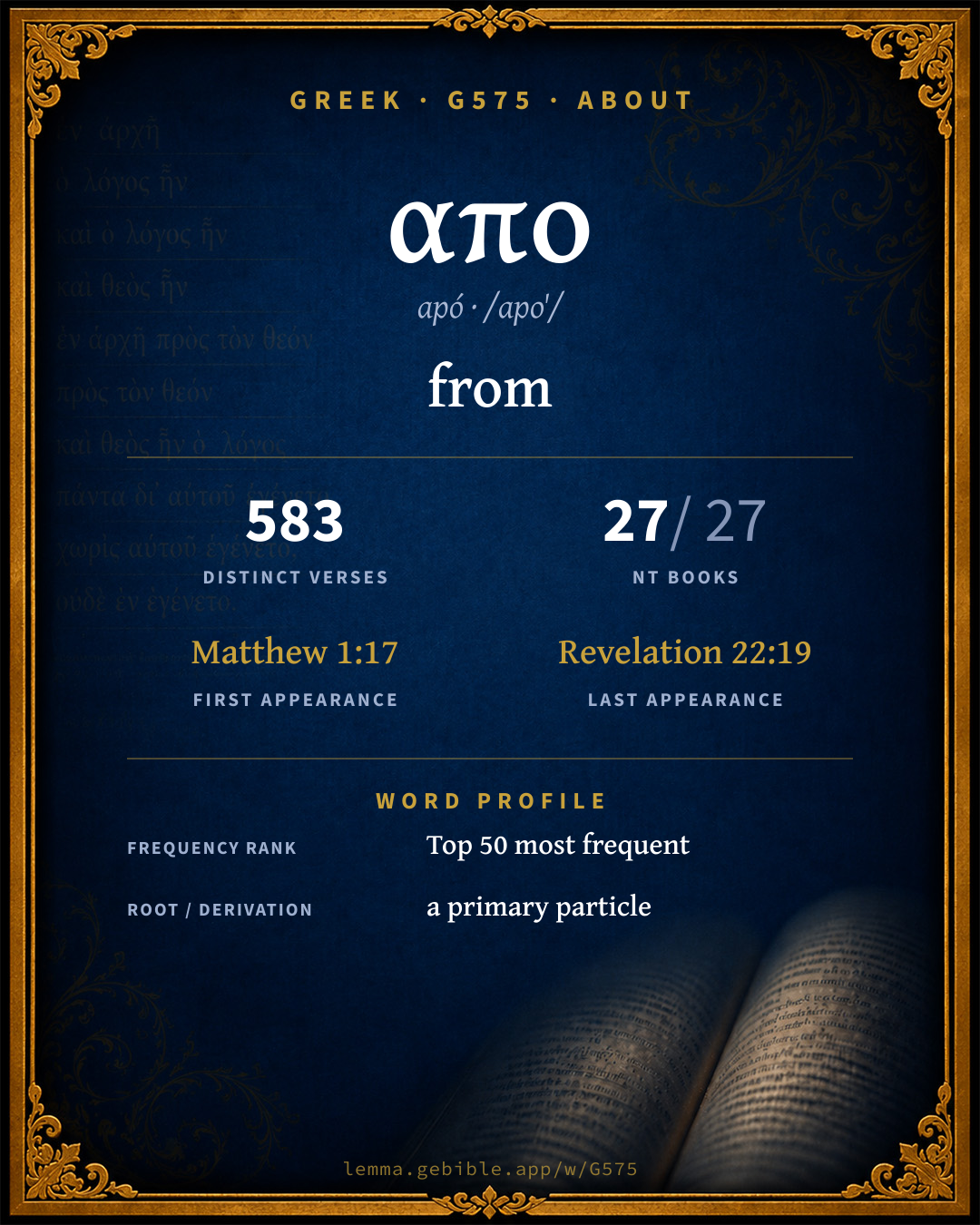
ἀπό
from
‘from’ is one of 6 main senses fuller range ↓
Full lexicon entry — Thayer's Greek Lexicon
From Thayer's Greek Lexicon
Where this word appears
Grammar key — what these labels mean
Part of speech
- Preposition
- A relational word governing a noun in a particular case.
Page 1 of 3 — showing verses 1–200 of 583 distinct verses where G575 appears, across 27 books. Click any verse to open its interlinear word-by-word view. Verse text shown in the World English Bible for context — . Each verse’s Greek form is shown with its reference; the English is not keyword-highlighted, since the data carries no word-level English alignment. Use “Compare translations” on any verse to read it across multiple English versions. This concordance covers the Greek New Testament; Septuagint (Greek Old Testament) occurrences of this word are not indexed here.
Matthew 98 verses
- Matthew 1:17 ἀπὸ ἀπὸ ἀπὸ prep prep prep So all the generations from Abraham to David are fourteen generations; from David to the exile to Babylon fourteen generations; and from the carrying away to Babylon to the Christ, fourteen generations.
- Matthew 1:21 ἀπὸ prep She shall bring forth a son. You shall call his name Jesus, for it is he who shall save his people from their sins."
- Matthew 1:24 ἀπὸ prep Joseph arose from his sleep, and did as the angel of the Lord commanded him, and took his wife to himself;
- Matthew 2:1 ἀπὸ prep Now when Jesus was born in Bethlehem of Judea in the days of Herod the king, behold, wise men from the east came to Jerusalem, saying,
- Matthew 2:16 ἀπὸ prep Then Herod, when he saw that he was mocked by the wise men, was exceedingly angry, and sent out, and killed all the male children who were in Bethlehem and in all the surrounding countryside, from two years old and under, according to the exact time which he had learned from the wise men.
- Matthew 3:4 ἀπὸ prep Now John himself wore clothing made of camel's hair, with a leather belt around his waist. His food was locusts and wild honey.
- Matthew 3:7 ἀπὸ prep But when he saw many of the Pharisees and Sadducees coming for his baptism, he said to them, "You offspring of vipers, who warned you to flee from the wrath to come?
- Matthew 3:13 ἀπὸ prep Then Jesus came from Galilee to the Jordan to John, to be baptized by him.
- Matthew 3:16 ἀπὸ prep Jesus, when he was baptized, went up directly from the water: and behold, the heavens were opened to him. He saw the Spirit of God descending as a dove, and coming on him.
- Matthew 4:17 Ἀπὸ prep From that time, Jesus began to preach, and to say, "Repent! For the Kingdom of Heaven is at hand."
- Matthew 4:25 ἀπὸ prep Great multitudes from Galilee, Decapolis, Jerusalem, Judea and from beyond the Jordan followed him.
- Matthew 5:18 ἀπὸ prep For most assuredly, I tell you, until heaven and earth pass away, not even one smallest letter or one tiny pen stroke shall in any way pass away from the law, until all things are accomplished.
- Matthew 5:29 ἀπὸ prep If your right eye causes you to stumble, pluck it out and throw it away from you. For it is more profitable for you that one of your members should perish, than for your whole body to be cast into Gehenna.
- Matthew 5:30 ἀπὸ prep If your right hand causes you to stumble, cut it off, and throw it away from you: for it is profitable for you that one of your members should perish, and not your whole body be thrown into Gehenna.
- Matthew 5:42 ἀπὸ prep Give to him who asks you, and don't turn away him who desires to borrow from you.
- Matthew 6:13 ἀπὸ prep Bring us not into temptation, but deliver us from the evil one. For yours is the Kingdom, the power, and the glory forever. Amen.'
- Matthew 7:15 ἀπὸ prep "Beware of false prophets, who come to you in sheep's clothing, but inwardly are ravening wolves.
- Matthew 7:16 ἀπὸ ἀπὸ ἀπὸ prep prep prep By their fruits you will know them. Do you gather grapes from thorns, or figs from thistles?
- Matthew 7:20 ἀπὸ prep Therefore, by their fruits you will know them.
- Matthew 7:23 ἀπ’ prep Then I will tell them, 'I never knew you. Depart from me, you who work iniquity.'
- Matthew 8:1 ἀπὸ prep When he came down from the mountain, great multitudes followed him.
- Matthew 8:11 ἀπὸ prep I tell you that many will come from the east and the west, and will sit down with Abraham, Isaac, and Jacob in the Kingdom of Heaven,
- Matthew 8:30 ἀπ’ prep Now there was a herd of many pigs feeding far away from them.
- Matthew 8:34 ἀπὸ prep Behold, all the city came out to meet Jesus. When they saw him, they begged that he would depart from their borders.
- Matthew 9:15 ἀπ’ prep Jesus said to them, "Can the friends of the bridegroom mourn, as long as the bridegroom is with them? But the days will come when the bridegroom will be taken away from them, and then they will fast.
- Matthew 9:16 ἀπὸ prep No one puts a piece of unshrunk cloth on an old garment; for the patch would tear away from the garment, and a worse hole is made.
- Matthew 9:22 ἀπὸ prep But Jesus, turning around and seeing her, said, "Daughter, cheer up! Your faith has made you well." And the woman was made well from that hour.
- Matthew 10:17 ἀπὸ prep But beware of men: for they will deliver you up to councils, and in their synagogues they will scourge you.
- Matthew 10:28 ἀπὸ prep Don't be afraid of those who kill the body, but are not able to kill the soul. Rather, fear him who is able to destroy both soul and body in Gehenna.
- Matthew 11:12 ἀπὸ prep From the days of John the Baptizer until now, the Kingdom of Heaven suffers violence, and the violent take it by force.
- Matthew 11:19 ἀπὸ prep The Son of Man came eating and drinking, and they say, 'Behold, a gluttonous man and a drunkard, a friend of tax collectors and sinners!' But wisdom is justified by her children."
- Matthew 11:25 ἀπὸ prep At that time, Jesus answered, "I thank you, Father, Lord of heaven and earth, that you hid these things from the wise and understanding, and revealed them to infants.
- Matthew 11:29 ἀπ’ prep Take my yoke upon you, and learn from me, for I am gentle and lowly in heart; and you will find rest for your souls.
- Matthew 12:38 ἀπὸ prep Then certain of the scribes and Pharisees answered, "Teacher, we want to see a sign from you."
- Matthew 12:43 ἀπὸ prep But the unclean spirit, when he is gone out of the man, passes through waterless places, seeking rest, and doesn't find it.
- Matthew 13:12 ἀπ’ prep For whoever has, to him will be given, and he will have abundance, but whoever doesn't have, from him will be taken away even that which he has.
- Matthew 13:35 ἀπὸ prep that it might be fulfilled which was spoken through the prophet, saying, "I will open my mouth in parables; I will utter things hidden from the foundation of the world."
- Matthew 13:44 ἀπὸ prep "Again, the Kingdom of Heaven is like a treasure hidden in the field, which a man found, and hid. In his joy, he goes and sells all that he has, and buys that field.
- Matthew 14:2 ἀπὸ prep and said to his servants, "This is John the Baptizer. He is risen from the dead. That is why these powers work in him."
- Matthew 14:13 ἀπὸ prep Now when Jesus heard this, he withdrew from there in a boat, to a deserted place apart. When the multitudes heard it, they followed him on foot from the cities.
- Matthew 14:26 ἀπὸ prep When the disciples saw him walking on the sea, they were troubled, saying, "It's a ghost!" and they cried out for fear.
- Matthew 14:29 ἀπὸ prep He said, "Come!" Peter stepped down from the boat, and walked on the waters to come to Jesus.
- Matthew 15:1 ἀπὸ prep Then Pharisees and scribes came to Jesus from Jerusalem, saying,
- Matthew 15:8 ἀπ’ prep 'These people draw near to me with their mouth, And honor me with their lips; But their heart is far from me.
- Matthew 15:22 ἀπὸ prep Behold, a Canaanite woman came out from those borders, and cried, saying, "Have mercy on me, Lord, you son of David! My daughter is severely demonized!"
- Matthew 15:27 ἀπὸ ἀπὸ prep prep But she said, "Yes, Lord, but even the dogs eat the crumbs which fall from their masters' table."
- Matthew 15:28 ἀπὸ prep Then Jesus answered her, "Woman, great is your faith! Be it done to you even as you desire." And her daughter was healed from that hour.
- Matthew 16:6 ἀπὸ prep Jesus said to them, "Take heed and beware of the yeast of the Pharisees and Sadducees."
- Matthew 16:11 ἀπὸ prep How is it that you don't perceive that I didn't speak to you concerning bread? But beware of the yeast of the Pharisees and Sadducees."
- Matthew 16:12 ἀπὸ ἀπὸ prep prep Then they understood that he didn't tell them to beware of the yeast of bread, but of the teaching of the Pharisees and Sadducees.
- Matthew 16:21 Ἀπὸ ἀπὸ prep prep From that time, Jesus began to show his disciples that he must go to Jerusalem and suffer many things from the elders, chief priests, and scribes, and be killed, and the third day be raised up.
- Matthew 17:18 ἀπ’ ἀπὸ prep prep Jesus rebuked him, the demon went out of him, and the boy was cured from that hour.
- Matthew 17:25 ἀπὸ ἀπὸ ἀπὸ prep prep prep He said, "Yes." When he came into the house, Jesus anticipated him, saying, "What do you think, Simon? From whom do the kings of the earth receive toll or tribute? From their children, or from strangers?"
- Matthew 17:26 ἀπὸ prep Peter said to him, "From strangers." Jesus said to him, "Therefore the children are exempt.
- Matthew 18:7 ἀπὸ prep "Woe to the world because of occasions of stumbling! For it must be that the occasions come, but woe to that person through whom the occasion comes!
- Matthew 18:8 ἀπὸ prep If your hand or your foot causes you to stumble, cut it off, and cast it from you. It is better for you to enter into life maimed or crippled, rather than having two hands or two feet to be cast into the eternal fire.
- Matthew 18:9 ἀπὸ prep If your eye causes you to stumble, pluck it out, and cast it from you. It is better for you to enter into life with one eye, rather than having two eyes to be cast into the Gehenna of fire.
- Matthew 18:35 ἀπὸ prep So my heavenly Father will also do to you, if you don't each forgive your brother from your hearts for his misdeeds."
- Matthew 19:1 ἀπὸ prep It happened when Jesus had finished these words, he departed from Galilee, and came into the borders of Judea beyond the Jordan.
- Matthew 19:4 ἀπ’ prep He answered, "Haven't you read that he who made them from the beginning made them male and female,
- Matthew 19:8 ἀπ’ prep He said to them, "Moses, because of the hardness of your hearts, allowed you to divorce your wives, but from the beginning it has not been so.
- Matthew 20:8 ἀπὸ prep When evening had come, the lord of the vineyard said to his steward, 'Call the laborers and pay them their wages, beginning from the last to the first.'
- Matthew 20:29 ἀπὸ prep As they went out from Jericho, a great multitude followed him.
- Matthew 21:8 ἀπὸ prep A very great multitude spread their clothes on the road. Others cut branches from the trees, and spread them on the road.
- Matthew 21:11 ἀπὸ prep The multitudes said, "This is the prophet, Jesus, from Nazareth of Galilee."
- Matthew 21:43 ἀφ’ prep "Therefore I tell you, the Kingdom of God will be taken away from you, and will be given to a nation bringing forth its fruits.
- Matthew 22:46 ἀπ’ prep No one was able to answer him a word, neither dared any man from that day forth ask him any more questions.
- Matthew 23:33 ἀπὸ prep You serpents, you offspring of vipers, how will you escape the judgment of Gehenna?
- Matthew 23:34 ἀπὸ prep Therefore, behold, I send to you prophets, wise men, and scribes. Some of them you will kill and crucify; and some of them you will scourge in your synagogues, and persecute from city to city;
- Matthew 23:35 ἀπὸ prep that on you may come all the righteous blood shed on the earth, from the blood of righteous Abel to the blood of Zachariah son of Barachiah, whom you killed between the sanctuary and the altar.
- Matthew 23:39 ἀπ’ prep For I tell you, you will not see me from now on, until you say, 'Blessed is he who comes in the name of the Lord!'"
- Matthew 24:1 ἀπὸ prep Jesus went out from the temple, and was going on his way. His disciples came to him to show him the buildings of the temple.
- Matthew 24:21 ἀπ’ prep for then there will be great oppression, such as has not been from the beginning of the world until now, no, nor ever will be.
- Matthew 24:27 ἀπὸ prep For as the lightning comes forth from the east, and is seen even to the west, so will be the coming of the Son of Man.
- Matthew 24:31 ἀπ’ prep He will send out his angels with a great sound of a trumpet, and they will gather together his chosen ones from the four winds, from one end of the sky to the other.
- Matthew 24:32 Ἀπὸ prep "Now from the fig tree learn this parable. When its branch has now become tender, and puts forth its leaves, you know that the summer is near.
- Matthew 25:28 ἀπ’ prep Take away therefore the talent from him, and give it to him who has the ten talents.
- Matthew 25:29 ἀπ’ prep For to everyone who has will be given, and he will have abundance, but from him who has not, even that which he has will be taken away.
- Matthew 25:32 ἀπ’ ἀπὸ prep prep Before him all the nations will be gathered, and he will separate them one from another, as a shepherd separates the sheep from the goats.
- Matthew 25:34 ἀπὸ prep Then the King will tell those on his right hand, 'Come, blessed of my Father, inherit the Kingdom prepared for you from the foundation of the world;
- Matthew 25:41 ἀπ’ prep Then he will say also to those on the left hand, 'Depart from me, you cursed, into the eternal fire which is prepared for the devil and his angels;
- Matthew 26:16 ἀπὸ prep From that time he sought opportunity to betray him.
- Matthew 26:29 ἀπ’ prep But I tell you that I will not drink of this fruit of the vine from now on, until that day when I drink it anew with you in my Father's Kingdom."
- Matthew 26:39 ἀπ’ prep He went forward a little, fell on his face, and prayed, saying, "My Father, if it is possible, let this cup pass away from me; nevertheless, not what I desire, but what you desire."
- Matthew 26:47 ἀπὸ prep While he was still speaking, behold, Judas, one of the twelve, came, and with him a great multitude with swords and clubs, from the chief priest and elders of the people.
- Matthew 26:64 ἀπ’ prep Jesus said to him, "You have said it. Nevertheless, I tell you, henceforth you will see the Son of Man sitting at the right hand of Power, and coming on the clouds of the sky."
- Matthew 27:9 ἀπὸ prep Then that which was spoken through Jeremiah the prophet was fulfilled, saying, "They took the thirty pieces of silver, The price of him upon whom a price had been set, Whom some of the children of Israel priced,
- Matthew 27:21 ἀπὸ prep But the governor answered them, "Which of the two do you want me to release to you?" They said, "Barabbas!"
- Matthew 27:24 ἀπὸ prep So when Pilate saw that nothing was being gained, but rather that a disturbance was starting, he took water, and washed his hands before the multitude, saying, "I am innocent of the blood of this righteous person. You see to it."
- Matthew 27:40 ἀπὸ prep and saying, "You who destroy the temple, and build it in three days, save yourself! If you are the Son of God, come down from the cross!"
- Matthew 27:42 ἀπὸ prep "He saved others, but he can't save himself. If he is the King of Israel, let him come down from the cross now, and we will believe in him.
- Matthew 27:45 Ἀπὸ prep Now from the sixth hour there was darkness over all the land until the ninth hour.
- Matthew 27:55 ἀπὸ ἀπὸ prep prep Many women were there watching from afar, who had followed Jesus from Galilee, serving him.
- Matthew 27:57 ἀπὸ prep When evening had come, a rich man from Arimathaea, named Joseph, who himself was also Jesus' disciple came.
- Matthew 27:64 ἀπὸ prep Command therefore that the tomb be made secure until the third day, lest perhaps his disciples come at night and steal him away, and tell the people, 'He is risen from the dead;' and the last deception will be worse than the first."
- Matthew 28:4 ἀπὸ prep For fear of him, the guards shook, and became like dead men.
- Matthew 28:7 ἀπὸ prep Go quickly and tell his disciples, 'He has risen from the dead, and behold, he goes before you into Galilee; there you will see him.' Behold, I have told you."
- Matthew 28:8 ἀπὸ prep They departed quickly from the tomb with fear and great joy, and ran to bring his disciples word.
Mark 47 verses
- Mark 1:9 ἀπὸ prep It happened in those days, that Jesus came from Nazareth of Galilee, and was baptized by John in the Jordan.
- Mark 1:42 ἀπ’ prep When he had said this, immediately the leprosy departed from him, and he was made clean.
- Mark 2:20 ἀπ’ prep But the days will come when the bridegroom will be taken away from them, and then will they fast in that day.
- Mark 2:21 ἀπ’ prep No one sews a piece of unshrunk cloth on an old garment, or else the patch shrinks and the new tears away from the old, and a worse hole is made.
- Mark 3:7 ἀπὸ ἀπὸ prep prep Jesus withdrew to the sea with his disciples, and a great multitude followed him from Galilee, from Judea,
- Mark 3:8 ἀπὸ ἀπὸ prep prep from Jerusalem, from Idumaea, beyond the Jordan, and those from around Tyre and Sidon. A great multitude, hearing what great things he did, came to him.
- Mark 3:22 ἀπὸ prep The scribes who came down from Jerusalem said, "He has Beelzebul," and, "By the prince of the demons he casts out the demons."
- Mark 4:25 ἀπ’ prep For whoever has, to him will more be given, and he who doesn't have, from him will be taken away even that which he has."
- Mark 5:6 ἀπὸ prep When he saw Jesus from afar, he ran and bowed down to him,
- Mark 5:17 ἀπὸ prep They began to beg him to depart from their region.
- Mark 5:29 ἀπὸ prep Immediately the flow of her blood was dried up, and she felt in her body that she was healed of her affliction.
- Mark 5:34 ἀπὸ prep He said to her, "Daughter, your faith has made you well. Go in peace, and be cured of your disease."
- Mark 5:35 ἀπὸ prep While he was still speaking, they came from the synagogue ruler's house saying, "Your daughter is dead. Why bother the Teacher any more?"
- Mark 6:33 ἀπὸ prep They saw them going, and many recognized him and ran there on foot from all the cities. They arrived before them and came together to him.
- Mark 6:43 ἀπὸ prep They took up twelve baskets full of broken pieces and also of the fish.
- Mark 7:1 ἀπὸ prep Then the Pharisees, and some of the scribes gathered together to him, having come from Jerusalem.
- Mark 7:4 ἀπὸ prep They don't eat when they come from the marketplace, unless they bathe themselves, and there are many other things, which they have received to hold to: washings of cups, pitchers, bronze vessels, and couches.)
- Mark 7:6 ἀπ’ prep He answered them, "Well did Isaiah prophesy of you hypocrites, as it is written, 'This people honors me with their lips, But their heart is far from me.
- Mark 7:17 ἀπὸ prep When he had entered into a house away from the multitude, his disciples asked him about the parable.
- Mark 7:28 ἀπὸ prep But she answered him, "Yes, Lord. Yet even the dogs under the table eat the children's crumbs."
- Mark 7:33 ἀπὸ prep He took him aside from the multitude, privately, and put his fingers into his ears, and he spat, and touched his tongue.
- Mark 8:3 ἀπὸ prep If I send them away fasting to their home, they will faint on the way, for some of them have come a long way."
- Mark 8:11 ἀπὸ prep The Pharisees came out and began to question him, seeking from him a sign from heaven, and testing him.
- Mark 8:15 ἀπὸ prep He charged them, saying, "Take heed: beware of the yeast of the Pharisees and the yeast of Herod."
- Mark 9:9 ἀπὸ prep As they were coming down from the mountain, he charged them that they should tell no one what things they had seen, until after the Son of Man had risen from the dead.
- Mark 10:6 ἀπὸ prep But from the beginning of the creation, 'God made them male and female.
- Mark 10:46 ἀπὸ prep They came to Jericho. As he went out from Jericho, with his disciples and a great multitude, the son of Timaeus, Bartimaeus, a blind beggar, was sitting by the road.
- Mark 11:12 ἀπὸ prep The next day, when they had come out from Bethany, he was hungry.
- Mark 11:13 ἀπὸ prep Seeing a fig tree afar off having leaves, he came to see if perhaps he might find anything on it. When he came to it, he found nothing but leaves, for it was not the season for figs.
- Mark 12:2 ἀπὸ prep When it was time, he sent a servant to the farmer to get from the farmer his share of the fruit of the vineyard.
- Mark 12:34 ἀπὸ prep When Jesus saw that he answered wisely, he said to him, "You are not far from the Kingdom of God." No one dared ask him any question after that.
- Mark 12:38 ἀπὸ prep In his teaching he said to them, "Beware of the scribes, who like to walk in long robes, and to get greetings in the marketplaces,
- Mark 13:19 ἀπ’ prep For in those days there will be oppression, such as there has not been the like from the beginning of the creation which God created until now, and never will be.
- Mark 13:27 ἀπ’ prep Then he will send out his angels, and will gather together his chosen ones from the four winds, from the ends of the earth to the ends of the sky.
- Mark 13:28 Ἀπὸ prep "Now from the fig tree, learn this parable. When the branch has now become tender, and puts forth its leaves, you know that the summer is near;
- Mark 14:35 ἀπ’ prep He went forward a little, and fell on the ground, and prayed that, if it were possible, the hour might pass away from him.
- Mark 14:36 ἀπ’ prep He said, "Abba, Father, all things are possible to you. Please remove this cup from me. However, not what I desire, but what you desire."
- Mark 14:54 ἀπὸ prep Peter had followed him from a distance, until he came into the court of the high priest. He was sitting with the officers, and warming himself in the light of the fire.
- Mark 15:21 ἀπ’ prep They compelled one passing by, coming from the country, Simon of Cyrene, the father of Alexander and Rufus, to go with them, that he might bear his cross.
- Mark 15:30 ἀπὸ prep save yourself, and come down from the cross!"
- Mark 15:32 ἀπὸ prep Let the Christ, the King of Israel, now come down from the cross, that we may see and believe him." Those who were crucified with him insulted him.
- Mark 15:38 ἀπὸ prep The veil of the temple was torn in two from the top to the bottom.
- Mark 15:40 ἀπὸ prep There were also women watching from afar, among whom were both Mary Magdalene, and Mary the mother of James the less and of Joses, and Salome;
- Mark 15:43 ἀπὸ prep Joseph of Arimathaea, a prominent council member who also himself was looking for the Kingdom of God, came. He boldly went in to Pilate, and asked for Jesus' body.
- Mark 15:45 ἀπὸ prep When he found out from the centurion, he granted the body to Joseph.
- Mark 16:8 ἀπὸ prep They went out, and fled from the tomb, for trembling and astonishment had come on them. They said nothing to anyone; for they were afraid.
- Mark 16:9 ἀφ’ prep Now when he had risen early on the first day of the week, he appeared first to Mary Magdalene, from whom he had cast out seven demons.
Luke 111 verses
- Luke 1:2 ἀπ’ prep even as those who from the beginning were eyewitnesses and ministers of the word delivered them to us,
- Luke 1:26 ἀπὸ prep Now in the sixth month, the angel Gabriel was sent from God to a city of Galilee, named Nazareth,
- Luke 1:38 ἀπ’ prep Mary said, "Behold, the handmaid of the Lord; be it to me according to your word." The angel departed from her.
- Luke 1:48 ἀπὸ prep For he has looked at the humble state of his handmaid. For behold, from now on, all generations will call me blessed.
- Luke 1:52 ἀπὸ prep He has put down princes from their thrones. And has exalted the lowly.
- Luke 1:70 ἀπ’ prep (As he spoke by the mouth of his holy prophets who have been from of old),
- Luke 2:4 ἀπὸ prep Joseph also went up from Galilee, out of the city of Nazareth, into Judea, to the city of David, which is called Bethlehem, because he was of the house and family of David;
- Luke 2:15 ἀπ’ prep It happened, when the angels went away from them into the sky, that the shepherds said one to another, "Let's go to Bethlehem, now, and see this thing that has happened, which the Lord has made known to us."
- Luke 2:36 ἀπὸ prep There was one Anna, a prophetess, the daughter of Phanuel, of the tribe of Asher (she was of a great age, having lived with a husband seven years from her virginity,
- Luke 3:7 ἀπὸ prep He said therefore to the multitudes who went out to be baptized by him, "You offspring of vipers, who warned you to flee from the wrath to come?
- Luke 4:1 ἀπὸ prep Jesus, full of the Holy Spirit, returned from the Jordan, and was led by the Spirit into the wilderness
- Luke 4:13 ἀπ’ prep When the devil had completed every temptation, he departed from him until another time.
- Luke 4:35 ἀπ’ ἀπ’ prep prep Jesus rebuked him, saying, "Be silent, and come out of him!" When the demon had thrown him down in their midst, he came out of him, having done him no harm.
- Luke 4:38 ἀπὸ prep He rose up from the synagogue, and entered into Simon's house. Simon's mother-in-law was afflicted with a great fever, and they begged him for her.
- Luke 4:41 ἀπὸ prep Demons also came out from many, crying out, and saying, "You are the Christ, the Son of God!" Rebuking them, he didn't allow them to speak, because they knew that he was the Christ.
- Luke 4:42 ἀπ’ prep When it was day, he departed and went into an uninhabited place, and the multitudes looked for him, and came to him, and held on to him, so that he wouldn't go away from them.
- Luke 5:2 ἀπ’ prep He saw two boats standing by the lake, but the fishermen had gone out of them, and were washing their nets.
- Luke 5:3 ἀπὸ prep He entered into one of the boats, which was Simon's, and asked him to put out a little from the land. He sat down and taught the multitudes from the boat.
- Luke 5:8 ἀπ’ prep But Simon Peter, when he saw it, fell down at Jesus' knees, saying, "Depart from me, for I am a sinful man, Lord."
- Luke 5:10 ἀπὸ prep and so also were James and John, sons of Zebedee, who were partners with Simon. Jesus said to Simon, "Don't be afraid. From now on you will be catching people alive."
- Luke 5:13 ἀπ’ prep He stretched out his hand, and touched him, saying, "I want to. Be made clean." Immediately the leprosy left him.
- Luke 5:15 ἀπὸ prep But the report concerning him spread much more, and great multitudes came together to hear, and to be healed by him of their infirmities.
- Luke 5:35 ἀπ’ prep But the days will come when the bridegroom will be taken away from them. Then they will fast in those days."
- Luke 5:36 ἀπὸ ἀπὸ prep prep He also told a parable to them. "No one puts a piece from a new garment on an old garment, or else he will tear the new, and also the piece from the new will not match the old.
- Luke 6:13 ἀπ’ prep When it was day, he called his disciples, and from them he chose twelve, whom he also named apostles:
- Luke 6:17 ἀπὸ ἀπὸ prep prep He came down with them, and stood on a level place, with a crowd of his disciples, and a great number of the people from all Judea and Jerusalem, and the sea coast of Tyre and Sidon, who came to hear him and to be healed of their diseases;
- Luke 6:18 ἀπὸ prep as well as those who were troubled by unclean spirits, and they were being healed.
- Luke 6:29 ἀπὸ prep To him who strikes you on the cheek, offer also the other; and from him who takes away your cloak, don't withhold your coat also.
- Luke 6:30 ἀπὸ prep Give to everyone who asks you, and don't ask him who takes away your goods to give them back again.
- Luke 7:21 ἀπὸ prep In that hour he cured many of diseases and plagues and evil spirits; and to many who were blind he gave sight.
- Luke 7:35 ἀπὸ prep Wisdom is justified by all her children."
- Luke 7:45 ἀφ’ prep You gave me no kiss, but she, since the time I came in, has not ceased to kiss my feet.
- Luke 8:2 ἀπὸ ἀφ’ prep prep and certain women who had been healed of evil spirits and infirmities: Mary who was called Magdalene, from whom seven demons had gone out;
- Luke 8:12 ἀπὸ prep Those along the road are those who hear, then the devil comes, and takes away the word from their heart, that they may not believe and be saved.
- Luke 8:18 ἀπ’ prep Be careful therefore how you hear. For whoever has, to him will be given; and whoever doesn't have, from him will be taken away even that which he thinks he has."
- Luke 8:29 ἀπὸ prep For Jesus was commanding the unclean spirit to come out of the man. For the unclean spirit had often seized the man. He was kept under guard, and bound with chains and fetters. Breaking the bands apart, he was driven by the demon into the desert.
- Luke 8:33 ἀπὸ prep The demons came out from the man, and entered into the pigs, and the herd rushed down the steep bank into the lake, and were drowned.
- Luke 8:35 ἀφ’ prep People went out to see what had happened. They came to Jesus, and found the man from whom the demons had gone out, sitting at Jesus' feet, clothed and in his right mind; and they were afraid.
- Luke 8:37 ἀπ’ prep All the people of the surrounding country of the Gadarenes asked him to depart from them, for they were very much afraid. He entered into the boat, and returned.
- Luke 8:38 ἀφ’ prep But the man from whom the demons had gone out begged him that he might go with him, but Jesus sent him away, saying,
- Luke 8:43 ἀπὸ ἀπ’ prep prep A woman who had a flow of blood for twelve years, who had spent all her living on physicians, and could not be healed by any,
- Luke 8:46 ἀπ’ prep But Jesus said, "Someone did touch me, for I perceived that power has gone out of me."
- Luke 9:5 ἀπὸ ἀπὸ prep prep As many as don't receive you, when you depart from that city, shake off even the dust from your feet for a testimony against them."
- Luke 9:22 ἀπὸ prep saying, "The Son of Man must suffer many things, and be rejected by the elders, chief priests, and scribes, and be killed, and the third day be raised up."
- Luke 9:33 ἀπ’ prep It happened, as they were parting from him, that Peter said to Jesus, "Master, it is good for us to be here. Let's make three tents: one for you, and one for Moses, and one for Elijah," not knowing what he said.
- Luke 9:37 ἀπὸ prep It happened on the next day, when they had come down from the mountain, that a great multitude met him.
- Luke 9:38 ἀπὸ prep Behold, a man from the crowd called out, saying, "Teacher, I beg you to look at my son, for he is my only child.
- Luke 9:39 ἀπ’ prep Behold, a spirit takes him, he suddenly cries out, and it convulses him so that he foams, and it hardly departs from him, bruising him severely.
- Luke 9:45 ἀπ’ prep But they didn't understand this saying. It was concealed from them, that they should not perceive it, and they were afraid to ask him about this saying.
- Luke 9:54 ἀπὸ prep When his disciples, James and John, saw this, they said, "Lord, do you want us to command fire to come down from the sky, and destroy them, just as Elijah did?"
- Luke 10:21 ἀπὸ prep In that same hour Jesus rejoiced in the Holy Spirit, and said, "I thank you, O Father, Lord of heaven and earth, that you have hidden these things from the wise and understanding, and revealed them to little children. Yes, Father, for so it was well-pleasing in your sight."
- Luke 10:30 ἀπὸ prep Jesus answered, "A certain man was going down from Jerusalem to Jericho, and he fell among robbers, who both stripped him and beat him, and departed, leaving him half dead.
- Luke 11:24 ἀπὸ prep The unclean spirit, when he has gone out of the man, passes through dry places, seeking rest, and finding none, he says, 'I will turn back to my house from which I came out.'
- Luke 11:50 ἀπὸ ἀπὸ prep prep that the blood of all the prophets, which was shed from the foundation of the world, may be required of this generation;
- Luke 11:51 ἀπὸ ἀπὸ prep prep from the blood of Abel to the blood of Zachariah, who perished between the altar and the sanctuary.' Yes, I tell you, it will be required of this generation.
About this entry
At a glance — auto-summarized from this page’s data, not written by a person. Every figure links to its source below. This summary describes the numbers; it doesn’t interpret them.
“from” is the headline sense of the Greek word απο (apó). Catalogued under 6 senses, its meaning is not single-sense. With 583 verses in 27 books, it is one of the most common word in the Greek New Testament. Scripture first uses it in Matthew 1:17. From the same root come απαγγελλω, απαγχομαι and απαγω. See the sense tree, 583-verse concordance, and the renderings breakdown below.
Gloss history
Strong's 1890 vs modern scholarship

About this word
Strong's G575 catalogs a Greek word from the Greek New Testament.
These counts are not copied from any lexicon or concordance. They are computed here, from the morphology-tagged Greek New Testament. What Lemma adds →
- 583
- distinct verses
- The word appears in 583 distinct verses.
- 27 / 27
- NT books
- The word appears in 27 of 27 New Testament books.
- #30
- by frequency
- Top 50 most frequent Greek words (rank 30 of 5,347 Greek words by occurrence).
View all 583 occurrences in the concordance →
By section of the New Testament
By traditional corpus
Conventional, traditional groupings — biblical authorship is debated, so this is a traditional corpus grouping, not an authorship claim. Some books belong to more than one corpus (Luke is in both the Gospels and the Lukan corpus, and so on), so these shares overlap and need not total 100%. Each figure is a share of the word’s 583 distinct verses.
- Gospels 293 verses · 50%
- Lukan (Luke–Acts) 216 verses · 37%
- Pauline corpus 102 verses · 17%
- Johannine 84 verses · 14%
- General (Catholic) Epistles 35 verses · 6%
- Revelation 26 verses · 4%
- Hebrews 22 verses · 4%
How translations render this word
Counts come from each version’s own published word-to-Strong’s tagging or interlinear alignment — an approximate guide to how each version renders this word, not a word-level alignment the data otherwise carries. Because each total is that version’s own tagged count, the per-version totals vary from one another and need not match the appearance or distinct-verse counts above. These counts may also differ from a printed concordance because Lemma counts each distinctly tagged rendering and does not collapse phrase taggings into a single head-word total. This is a fixed set of word-tagged versions (KJV, ASV, BSB, ULT) and does not change with the reading translation you choose elsewhere. Each version’s license is shown beside its name below (and on Sources).
- King James Version: From 370×, Of 164×, For 10×
- American Standard Version: From 411×, Of 99×, For 14×
- Berean Standard Bible: From 363×, Of 61×, By 20×
- unfoldingWord Literal Text: From 561×, By 18×, Of 15×
King James Version Public Domain
Renders G575 across 648 tagged occurrences — most commonly:
Plus other, less common renderings. Plus 29 renderings that appear only once — usually multi-word phrases or single function words the recovered tagging swept in, not distinct renderings. Not rendered by a distinct English word in 9 further occurrences.
American Standard Version Public Domain
Renders G575 across 640 tagged occurrences — most commonly:
Plus other, less common renderings. Plus 48 renderings that appear only once — usually multi-word phrases or single function words the recovered tagging swept in, not distinct renderings.
Berean Standard Bible Public Domain
Renders G575 across 549 tagged occurrences — most commonly:
Plus other, less common renderings. Plus 18 renderings that appear only once — usually multi-word phrases or single function words the recovered tagging swept in, not distinct renderings. Not rendered by a distinct English word in 80 further occurrences.
unfoldingWord Literal Text CC BY-SA 4.0
Renders G575 across 644 tagged occurrences — most commonly:
Plus 12 renderings that appear only once — usually multi-word phrases or single function words the recovered tagging swept in, not distinct renderings.
Senses in Thayer's
The 6 senses Thayer's distinguishes for this word, in lexicon order (not ranked by frequency or importance). The full entry — with sub-senses — is in the Lexicon Entry tab.
- of local separation, after verbs of motion from a place i.e. of departing, of fleeing, ...
- of separation of a part from the whole
- of any kind of separation of one thing from another by which the union or fellowship of the two is destroyed
- of a state of separation, that is of distance
- of the place whence anything is, comes, befalls, is taken
- of origin of a cause
Word origin
Origin: a primary particle
A primary particle; off that is away (from something near) in various senses (of place time or relation; literally or figuratively): - (X here-) after ago at because of before by (the space of) for (-th) from in (out) of off (up-) on (-ce) since with. In composition (as a prefix) it usually denotes separation departure cessation completion reversal etc.
— Strong’s Exhaustive Concordance (1890), public domain.
Forms in the corpus
The 5 distinct written forms G575 takes in the Greek New Testament, most frequent first — each parse links to that case’s occurrences in the concordance.
| Form | Parsing | Example | Uses |
|---|---|---|---|
| ἀπὸ apò | Preposition | Matthew 1:17 | 468 |
| ἀπ’ ap | Preposition | Matthew 7:23 | 119 |
| ἀφ’ aph | Preposition | Matthew 21:43 | 44 |
| Ἀπὸ Apò | Preposition | Matthew 4:17 | 6 |
| ἀπό apó | Preposition | Acts 28:23 | 1 |
Same root — word family
Other Thayer's entries built from the same root as G575, grouped by Strong’s listed origin. These share a root / origin per the lexicon — not necessarily a shared meaning. Each links to that word’s own entry.
Derived from this word
- απαγγελλω apangéllō G518 to report
- απαγχομαι apánchomai G519 to strangle
- απαγω apágō G520 to lead away
- απαιρω apaírō G522 to take away
- απαιτεω apaitéō G523 to demand back
- απαλγεω apalgéō G524 to cease grieving
- απαλλασσω apallássō G525 to depart
- απαλλοτριοω apallotrióō G526 to estrange
- απανταω apantáō G528 to meet
- απαρνεομαι aparnéomai G533 to deny
- απαρτι apárti G534 henceforth
- απαρχη aparchḗ G536 to offer firstfruits
- απαυγασμα apaúgasma G541 brightness
- απειδω apeídō G542 to look away
- απειμι ápeimi G548 to depart
- απειμι ápeimi G549 to depart
- απειπομην apeipómēn G550 to declare
- απεκδεχομαι apekdéchomai G553 waiting for
- απεκδυομαι apekdýomai G554 to despoil
- απελαυνω apelaúnō G556 to drive away
- απελεγμος apelegmós G557 censure
- απελευθερος apeleútheros G558 freedman
- απελπιζω apelpízō G560 not despairing
- απεναντι apénanti G561 opposite
+86 more words derive from G575 (not shown).
Compare all same-root words → Showing 4 of 111 — not the complete family. They share a root, not necessarily a meaning.
Septuagint usage
The same Greek word απο appears 3,452 times in the Greek Old Testament (Septuagint), across 2,803 verses in 38 books.
- 3,452
- LXX occurrences
- Tagged occurrences of this Greek word in the Septuagint.
- 2,803
- verses
- Distinct Septuagint verses containing this word.
- 38 / 39
- OT books
- The word appears in 38 of the 39 Old Testament books.
Sample Septuagint occurrences
- Genesis 2:2 ἀπό
- Exodus 1:12 ἀπό
- Leviticus 1:2 ἀπό
- Numbers 1:3 ἀπό
- Deuteronomy 1:17 ἀπό
- Joshua 1:4 ἀπό
- Judges 1:14 ἀπό
- Ruth 1:1 ἀπό
- 1 Samuel 2:8 ἀπό
- 2 Samuel 1:22 ἀπό
- 1 Kings 1:50 ἀπό
- 2 Kings 1:4 ἀπό
Septuagint occurrences (same lexeme)
Every verse where the same Strong’s number (G575) appears in the Greek Septuagint — showing the first 50 of 2,803. Verse text shown in the World English Bible for context; the Greek form is the matched word — the English is not keyword-highlighted.
- Genesis 2:2 ἀπό On the seventh day God finished his work which he had made; and he rested on the seventh day from all his work which he had made.
- Genesis 2:3 ἀπό God blessed the seventh day, and made it holy, because he rested in it from all his work which he had created and made.
- Genesis 2:7 ἀπό Yahweh God formed man from the dust of the ground, and breathed into his nostrils the breath of life; and man became a living soul.
- Genesis 2:16 ἀπό Yahweh God commanded the man, saying, "Of every tree of the garden you may freely eat:
- Genesis 2:17 ἀπό but of the tree of the knowledge of good and evil, you shall not eat of it: for in the day that you eat of it you will surely die."
- Genesis 2:22 ἀπό He made the rib, which Yahweh God had taken from the man, into a woman, and brought her to the man.
- Genesis 3:1 ἀπό Now the serpent was more subtle than any animal of the field which Yahweh God had made. He said to the woman, "Yes, has God said, 'You shall not eat of any tree of the garden?'"
- Genesis 3:2 ἀπό The woman said to the serpent, "Of the fruit of the trees of the garden we may eat,
- Genesis 3:3 ἀπό but of the fruit of the tree which is in the midst of the garden, God has said, 'You shall not eat of it, neither shall you touch it, lest you die.'"
- Genesis 3:5 ἀπό for God knows that in the day you eat it, your eyes will be opened, and you will be like God, knowing good and evil."
- Genesis 3:8 ἀπό They heard the voice of Yahweh God walking in the garden in the cool of the day, and the man and his wife hid themselves from the presence of Yahweh God among the trees of the garden.
- Genesis 3:11 ἀπό God said, "Who told you that you were naked? Have you eaten from the tree that I commanded you not to eat from?"
- Genesis 3:12 ἀπό The man said, "The woman whom you gave to be with me, she gave me of the tree, and I ate."
- Genesis 3:14 ἀπό Yahweh God said to the serpent, "Because you have done this, cursed are you above all cattle, and above every animal of the field. On your belly shall you go, and you shall eat dust all the days of your life.
- Genesis 3:17 ἀπό To Adam he said, "Because you have listened to your wife's voice, and have eaten of the tree, of which I commanded you, saying, 'You shall not eat of it,' cursed is the ground for your sake. In toil you will eat of it all the days of your life.
- Genesis 4:3 ἀπό As time passed, it happened that Cain brought an offering to Yahweh from the fruit of the ground.
- Genesis 4:4 ἀπό Abel also brought some of the firstborn of his flock and of the fat of it. Yahweh respected Abel and his offering,
- Genesis 4:11 ἀπό Now you are cursed because of the ground, which has opened its mouth to receive your brother's blood from your hand.
- Genesis 4:14 ἀπό Behold, you have driven me out this day from the surface of the ground. I will be hidden from your face, and I will be a fugitive and a wanderer in the earth. It will happen that whoever finds me will kill me."
- Genesis 4:16 ἀπό Cain went out from Yahweh's presence, and dwelt in the land of Nod, on the east of Eden.
- Genesis 5:29 ἀπό and he named him Noah, saying, "This same will comfort us in our work and in the toil of our hands, because of the ground which Yahweh has cursed."
- Genesis 6:2 ἀπό that God's sons saw that men's daughters were beautiful, and they took for themselves wives of all that they chose.
- Genesis 6:4 ἀπό The Nephilim were in the earth in those days, and also after that, when God's sons came to men's daughters. They bore children to them: the same were the mighty men who were of old, men of renown.
- Genesis 6:7 ἀπό Yahweh said, "I will destroy man whom I have created from the surface of the ground; man, along with animals, creeping things, and birds of the sky; for I am sorry that I have made them."
- Genesis 6:13 ἀπό God said to Noah, "The end of all flesh has come before me, for the earth is filled with violence through them. Behold, I will destroy them with the earth.
- Genesis 6:19 ἀπό Of every living thing of all flesh, you shall bring two of every sort into the ark, to keep them alive with you. They shall be male and female.
- Genesis 6:20 ἀπό Of the birds after their kind, of the cattle after their kind, of every creeping thing of the ground after its kind, two of every sort shall come to you, to keep them alive.
- Genesis 6:21 ἀπό Take with you of all food that is eaten, and gather it to you; and it will be for food for you, and for them."
- Genesis 7:2 ἀπό You shall take seven pairs of every clean animal with you, the male and his female. Of the animals that are not clean, take two, the male and his female.
- Genesis 7:3 ἀπό Also of the birds of the sky, seven and seven, male and female, to keep seed alive on the surface of all the earth.
- Genesis 7:4 ἀπό In seven days, I will cause it to rain on the earth for forty days and forty nights. Every living thing that I have made, I will destroy from the surface of the ground."
- Genesis 7:8 ἀπό Clean animals, animals that are not clean, birds, and everything that creeps on the ground
- Genesis 7:15 ἀπό They went to Noah into the ark, by pairs of all flesh with the breath of life in them.
- Genesis 7:16 ἀπό Those who went in, went in male and female of all flesh, as God commanded him; and Yahweh shut him in.
- Genesis 7:17 ἀπό The flood was forty days on the earth. The waters increased, and lifted up the ark, and it was lifted up above the earth.
- Genesis 7:23 ἀπό Every living thing was destroyed that was on the surface of the ground, including man, cattle, creeping things, and birds of the sky. They were destroyed from the earth. Only Noah was left, and those who were with him in the ark.
- Genesis 8:2 ἀπό The deep's fountains and the sky's windows were also stopped, and the rain from the sky was restrained.
- Genesis 8:3 ἀπό The waters receded from off the earth continually. After the end of one hundred fifty days the waters decreased.
- Genesis 8:7 ἀπό and he sent forth a raven. It went back and forth, until the waters were dried up from off the earth.
- Genesis 8:8 ἀπό He sent forth a dove from him, to see if the waters were abated from off the surface of the ground,
- Genesis 8:11 ἀπό The dove came back to him at evening, and, behold, in her mouth was an olive leaf plucked off. So Noah knew that the waters were abated from off the earth.
- Genesis 8:13 ἀπό It happened in the six hundred first year, in the first month, the first day of the month, the waters were dried up from off the earth. Noah removed the covering of the ark, and looked. He saw that the surface of the ground was dried.
- Genesis 8:17 ἀπό Bring forth with you every living thing that is with you of all flesh, including birds, cattle, and every creeping thing that creeps on the earth; that they may breed abundantly in the earth, and be fruitful, and multiply on the earth."
- Genesis 8:20 ἀπό Noah built an altar to Yahweh, and took of every clean animal, and of every clean bird, and offered burnt offerings on the altar.
- Genesis 9:10 ἀπό and with every living creature that is with you: the birds, the cattle, and every animal of the earth with you. Of all that go out of the ark, even every animal of the earth.
- Genesis 9:11 ἀπό I will establish my covenant with you; neither will all flesh be cut off any more by the waters of the flood; neither will there any more be a flood to destroy the earth."
- Genesis 9:19 ἀπό These three were the sons of Noah, and from these, the whole earth was populated.
- Genesis 9:24 ἀπό Noah awoke from his wine, and knew what his youngest son had done to him.
- Genesis 10:19 ἀπό The border of the Canaanites was from Sidon, as you go toward Gerar, to Gaza; as you go toward Sodom, Gomorrah, Admah, and Zeboiim, to Lasha.
- Genesis 10:30 ἀπό Their dwelling was from Mesha, as you go toward Sephar, the mountain of the east.
These are occurrences of the same Greek lexeme (G575) in the Septuagint — not a translation of any one Hebrew word. The store carries no word-level Hebrew↔Greek alignment, so no Hebrew original is asserted here. Counts come from the recovered LXX Strong's tagging — high-frequency vocabulary is well covered, while rare or late forms may be untagged — so they reflect tagged occurrences and may slightly undercount.