Luke 7:35

Greek (Tischendorf 8th ed.) Luke 7:35 appears in the Greek New Testament. The text above is from the Tischendorf 8th edition. Each word links to its Strong’s number and a concise gloss. Click any word for its full Thayer’s Greek Lexicon entry.
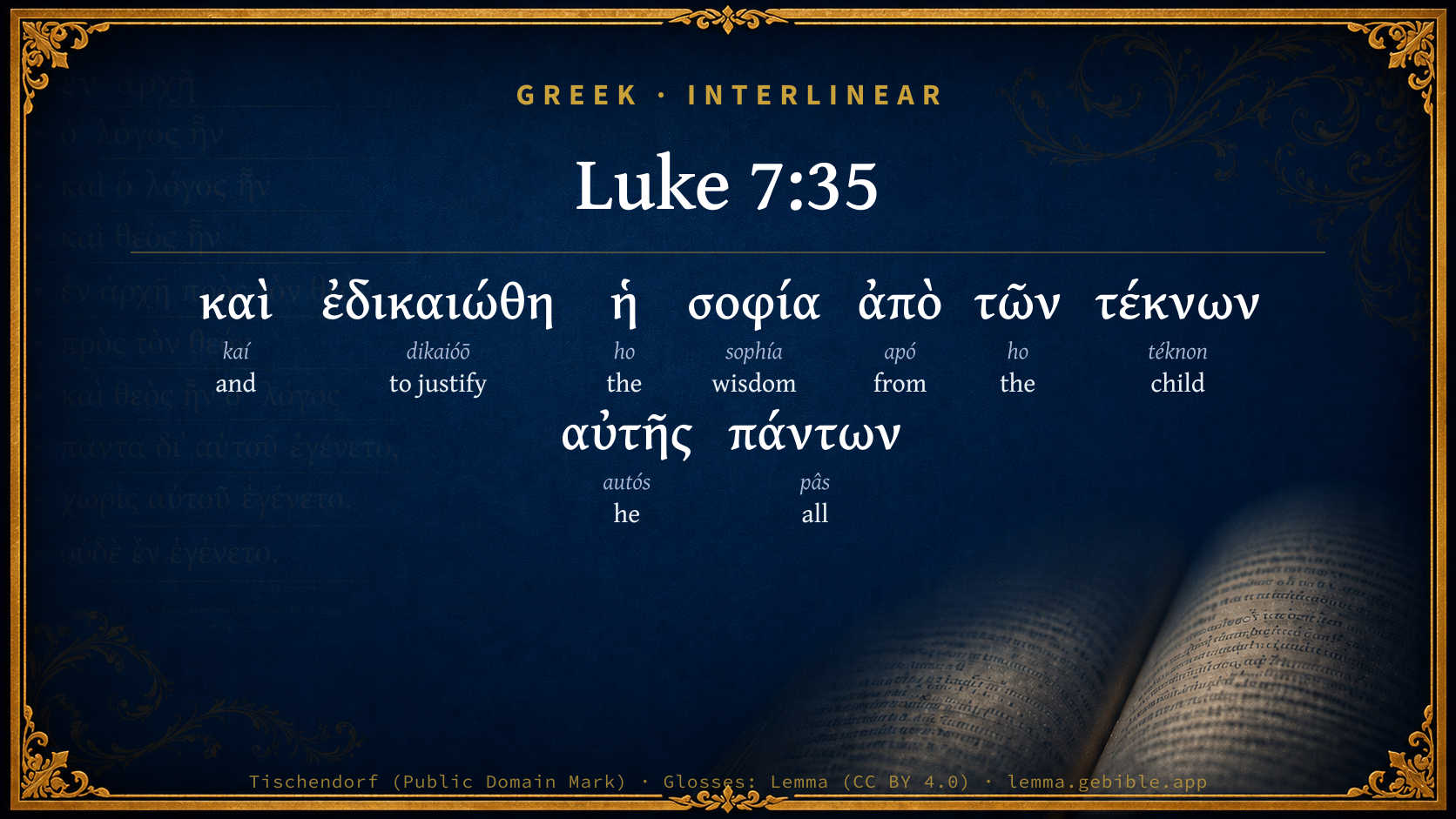
Download image
Cite this verse

Luke 7:35 (World English Bible). Public Domain. Lemma interlinear Bible study tool, https://lemma.gebible.app/v/luke/7/35.

Show BibTeX & RIS
BibTeX
RIS
English Translation
Wisdom is justified by all her children."
World English Bible · Public Domain
Download a study sheet

One document with this verse’s original text, its word-by-word gloss line, the meaning frame, cross-references with their text, attributed commentary, and full source and license credits — printable, and it pastes into notes with its structure intact.

This verse Autodidact and up

Study sheet (.html) Plain text (.txt)

A passage Seminary Student

Up to 50 verses in one chapter. A passage sheet keeps up to 6 commentary sources and 12 cross-references per verse, in the order this page ranks them, and says so on the sheet whenever that leaves anything out. Ask for a single verse and you get the Autodidact verse sheet above.

Everything on this page stays free to read, with no account — the sheet is a download of what is already on screen, not access to it.

Want to remove ads? Support Godless Engineer
Compare translations 3

The same verse in 3 English versions, stacked beneath the original-language interlinear above. Click any original word for its lexicon entry.

Each is an independent rendering of the whole verse — the interlinear is not word-aligned to these translations.

Highlighted words mark where these versions differ — a whole-verse word diff, not a word-by-word alignment.

  • World English Bible Public Domain
    Wisdom is justified by all her children."
  • King James Version Public Domain
    But wisdom is justified of all her children.
  • unfoldingWord Literal Text CC BY-SA 4.0
    But wisdom has been justified by all her children.”

unfoldingWord Literal Text — © unfoldingWord, licensed CC BY-SA 4.0. Word-aligned USFM3 via Door43 (git.door43.org/unfoldingWord/en_ult).

Versions to compare (up to 4)

3 of 4 selected

Show all 19 translations

Every available English version of this verse, each an independent rendering of the whole verse.

  • World English Bible Public Domain
    Wisdom is justified by all her children."
  • Berean Standard Bible Public Domain
    But wisdom is vindicated by all her children.”
  • Majority Standard Bible Public Domain
    But wisdom is vindicated by all her children.”
  • King James Version Public Domain
    But wisdom is justified of all her children.
  • American Standard Version (1901) Public Domain
    And wisdom is justified of all her children.
  • Revised Version (1885) Public Domain
    And wisdom is justified of all her children.
  • Geneva Bible (1599) Public Domain
    But wisdome is iustified of all her children.
  • Douay-Rheims (1899) Public Domain
    And wisdom is justified by all her children.
  • Young's Literal Translation Public Domain
    and the wisdom was justified from all her children.'
  • Literal Standard Version CC BY-SA 4.0
    and the wisdom was justified from all her children.”
  • Unlocked Literal Bible CC BY-SA 4.0
    But wisdom is justified by all her children.”
  • unfoldingWord Literal Text CC BY-SA 4.0
    But wisdom has been justified by all her children.”
  • Darby Bible Public Domain
    and wisdom has been justified of all her children.
  • World Messianic Bible Public Domain
    Wisdom is justified by all her children.”
  • Webster's Bible Public Domain
    But wisdom is justified by all her children.
  • Free Bible Version CC BY-SA 4.0
    However, God's wise ways are proved right by all who follow him!”
  • Bible in Basic English Public Domain
    But wisdom is judged to be right by all her children.
  • Text-Critical English NT CC BY 4.0
    Yet wisdom is vindicated by all her children.”
  • Tyndale New Testament (1534) Public Domain
    Yet is wysdome iustified of all her chyldren.

Literal Standard Version (2020), Covenant Press — licensed CC BY-SA 4.0. Text via the HelloAO Bible API (eBible.org). Unlocked Literal Bible (unfoldingWord) — licensed CC BY-SA 4.0. Text via the HelloAO Bible API (eBible.org). unfoldingWord Literal Text — © unfoldingWord, licensed CC BY-SA 4.0. Word-aligned USFM3 via Door43 (git.door43.org/unfoldingWord/en_ult). Free Bible Version, Dr. Jonathan Gallagher — licensed CC BY-SA 4.0. Text via the HelloAO Bible API (eBible.org).

Word by word

More ways to search: Search by grammar → Find every occurrence → Compare this word →

Practice this passage: Drill this verse → Learn its vocabulary →

About this verse

These counts appear in no published source. They are computed here, from the morphology-tagged text and Lemma’s own curated glosses. What Lemma adds →

9
words
8
distinct lemmas
Gospels
section

Shared distinctive vocabulary

ἐδικαιώθη to justify G1344 occurs in 35 verses of the Greek New Testament. Also found in:

Repetition

A word recurs within this verse:

Cross-references

6

Topical passages linked to Luke 7:35 in the Treasury of Scripture Knowledge — connected by theme and wording, ordered by reader-vote popularity; previews shown in the World English Bible.

  • Proverbs 8:32–36 "Now therefore, my sons, listen to me, For blessed are those who keep my ways.
  • Matthew 11:19 The Son of Man came eating and drinking, and they say, 'Behold, a gluttonous man and a drunkard, a friend of tax collectors and sinners!' But wisdom is justified by her children."
  • Hosea 14:9 Who is wise, that he may understand these things? Who is prudent, that he may know them? For the ways of Yahweh are right, And the righteous walk in them; But the rebellious stumble in them.
  • 1 Corinthians 2:14–15 Now the natural man doesn't receive the things of God's Spirit, for they are foolishness to him, and he can't know them, because they are spiritually discerned.
  • Proverbs 17:16 Why is there money in the hand of a fool to buy wisdom, Seeing he has no understanding?
  • Luke 7:29 When all the people and the tax collectors heard this, they declared God to be just, having been baptized with John's baptism.

Cross-references courtesy of OpenBible.info (CC BY 4.0).

Commentary

Notes on Luke 7:35 from classic Christian and Jewish commentators (each source and its license shown beneath its notes). The classic Christian expositions comment on the surrounding passage and are grouped to its opening verse, so a note may address several verses; the Jewish commentaries on the Tanakh (Rashi and others) are per-verse, so they appear only where the commentator wrote on this verse.

Lemma curates 59 commentaries, every one of them public domain or Creative Commons licensed, each selected and text-cleaned for this edition rather than reprinted as found. About our sources →

The Biblical Illustrator

Joseph S. Exell

Luk_7:35

But wisdom is Justified of all her children

Wisdoms justification

We trace the truth and the applicability of this saying--

I.

IN THE DIFFERENT FIELDS OF PURELY HUMAN INTEREST AND STUDY. Each subject that engages the attention of man has a wisdom, that is to say, governing principles, methods, modes of thought and inquiry--in short, a philosophy peculiar to its own. Those who have mastered this wisdom even in part are prepared for results which are startling or absurd in the eyes of others who are strangers to it.

II. IN THE REGION OF HUMAN CHARACTER. That which enables us to do justice to character is sympathy with it.

III. IN REGARD TO THE CHRISTIAN CREED. Here, too, it is clear, upon reflection, that wisdom is justified of her children. The word wisdom in our Lords mouth had a special significance. His more instructed hearers would recognize in it an ancient and consecrated word (see Pro_8:1-36.). This Eternal Wisdom, born of a virgin in the fulness of time, crucified, bruised, risen, ascended, is at once the Teacher, and in the main the substance, of the Christian creed. Two practical lessons:

1. Nothing is so fatal to the recognition of moral and religious truth as a scornful temper.

2. Wisdom may and must be won by prayer. (Canon Liddon.)

Wisdom justified of her children

Justified means acquitted, recognized, or acknowledged. Of means by. And Christ says, Wisdom is recognized by her children. The wisdom of a Divine life had appeared in two forms--ascetic in John the Baptist, social in Christ. The world recognized it in neither. In John they said it was insanity; in Christ worldliness and irreligion. To the world Christ replies that they were incompetent judges. None could recognize the Divine life but those who lived it; none justify wisdom except her children. The Divine life was always the same, but it expressed itself outwardly in no special single form of life. Wisdom, under whatever form she might appear--the life of asceticism or the life social--would be justified or recognized by her children.

I. THE TONE OF MIND WHICH CAPACITATES FOR JUDGING HUMAN CHARACTER. By sympathy alone can you judge of character. This is the doctrine of the metaphor. A mother, changing her garb, may be mistaken by strangers, but under every metamorphosis she is recognized by her children, who know her voice by the secret tact of sympathy. Would you judge of Christ? Feel Christ. Learn to love one living man.

II. THE TONE OF MIND WHICH INCAPACITATES, AND THE HINDRANCES TO RIGHT JUDGMENT OF HUMAN CHARACTER.

1. The habit of insincere praise incapacitates for forming a right judgment of character. During the life of Jesus the Pharisees and Sadducees alike flattered Him. To their unreal flatteries He returned indignant replies: Why tempt ye Me, ye hypocrites?

2. A light, satirical, and irreverent spirit also incapacitates. See how ribaldry unfitted them for judging, and how even a Divine character could be made to seem ridiculous! That such cannot judge of character is intelligible. One reason is--

(1) Because excellence of character is not shown them; and another,

(2) because this spirit withers all it touches.

3. Jealousy incapacitates for forming a right judgment. The scribes were jealous of Christ, because His teaching was on a principle different from theirs; the Pharisees, because His righteousness was of a different stamp. Josephs brethren, Haman--examples of jealousy. (F. W. Robertson, M. A.)

Lifes gladness, its joy, its humour, and its mirth, are sometimes stumbling-blocks to serious people. Wisdoms children, in the main, we charitably and devoutly hope they are, but none the less we see in them a touch and trick of the children in the market-place. There is a foolish seriousness, and there is a wise mirth. How often do we see pathos and humour, tears and laughter, rapidly following each other, even joining and blending in the person of some strong, wise man, whom we can both respect and love; while the stolid people, who pride themselves upon their seriousness, too dull for mirth, are amongst the most unlovable. Robert Hall was conspicuous for the blending in his fine nature of the pathos and humour that we speak of. On one occasion, when he had preached a most solemn and pathetic discourse, and was followed in the evening by a serious brother, when the days work was done, he was as witty as he was wise, mirthful and jocund, and the cause of wit in others. The serious brother at length remonstrated. Mr. Hall, I am surprised at you, sir, after the solemn discourse you preached this morning, that you should trifle as you are doing now. Are you, sir, replied Mr. Hall; , shall I tell you the difference between you and me, sir? You talk your nonsense in the pulpit, I talk mine out of it. A bit of sound philosophy l for the bent spring when released will recoil, and where the mind of a man has been wrought up to the highest tension, the reaction, by Gods great mercy, comes as one of the conservators of the forces of life. And herein, also, is wisdom justified of her children. (J W. Lance.)

If wisdom was justified in the cases both of John and Jesus, it follows

I. THAT WISDOM IS COMPATIBLE WITH VARIOUS WAYS OF LIFE.

II. THAT WISDOM IS NOT A TIME-SERVER, SEEKING TO PLEASE THE WORLD BY FOLLOWING ITS FASHION. Many men, many minds. It is hard to please all, and best not to try. Following fashion is wearisome, for fashion changes fast. (A. B. Bruce, D. D.)

Waywardness and wisdom

I. WE HAVE HERE A CONTRAST PRESENTED. On the one side the perverseness and waywardness of man; on the other side the sympathy of wisdom with wisdom; the kindred and affinity which exists between the voice of God in His Word and the voice of God in the heart and conscience of His creatures.

II. THE WAYWARDNESS OF WHICH OUR LORD HERE SPEAKS IS MORE OR LESS IN ALL OF US.

III. THE MOST DISTRESSING OF IT IS THAT IN WHICH IT RUNS ON INTO THE AFFAIRS OF THE SOUL. (Dean Vaughan.)

Seeing wisdom.

They whose hearts are softened by a true self-knowledge, and enlightened by a real communion with God; they who are wise in that wisdom of which the condition is humility, and the beginning the fear of the Lord, will see wisdom in that which to the caviller is folly, will recognize a Divine harmony where all is discord to the self-confident, and own an abundance of resource worthy of the All-wise and the Allmerciful, in that variety of evidence which affords to different minds and, perhaps, to different ages of the world, their appropriate, as well as conclusive, reason for believing. The very things which others calumniate are to them indications of wisdom. They see how the message of the Baptist and the habits of the Baptist--the office of the Saviour and the life of the Saviour--are severally harmonious and of a piece. (Dean Vaughan.)

Wisdoms justification

The union of good men is internal, though there may be outward differences. The union of selfish men may be external, but there are always inward differences. The children of folly may unite for a common purpose, may be allied together as Herod and Pilate were allied against Christ. Pirates may join for plunder; the children of this world, for power, pleasure, and earthly gain, But there is no inward union, and, as soon as the outward advantage of the alliance ceases, the partnership is dissolved. But good men, though separated outward-y, are inwardly at one. They belong to one invisible and indivisible Church. By and by they shall come together outwardly, and see eye to eye. The inevitable logic of faith and reason shall at last unite them, and then wisdom shall be justified of all her children. John the Baptist will understand Christ; Barnabas will comprehend Paul: Fenelon and Martin Luther, Athanasius and Arius, Dr. Channing and Dr. Beecher, will recognize each others worth, and bless God together for what each has accomplished for the kingdom of heaven. So shall wisdom be at last justified of all her children. So shall all good men, sincerely desiring to do right, be found at last to be walking together on the same road towards the best things. Wisdom is not sectarian nor bigoted; she has a large Church, and many children, and is justified of them all. (James Freeman Clarke.)

The Biblical Illustrator, edited by Joseph S. Exell (c. 1880s–1900s) — public domain. Text from a community e-Sword module.

Tyndale Open Study Notes

Tyndale Open Resources

7:35 But wisdom is shown to be right by the lives of those who follow it (or But wisdom is justified by all her children): In Proverbs, Wisdom is personified as a woman who calls God’s people to a life of godliness and obedience to God’s commands (Prov 1:20-33; 8:1–9:6). Wisdom’s children are those who live righteously, as God’s word instructs.

Tyndale Open Study Notes — © Tyndale Open Resources, licensed CC BY-SA 4.0. Text via the HelloAO Bible API.

Bengel's Gnomon

Johann Albrecht Bengel

Luk 7:35. Καὶ ἐδικαιώθη ἡ σοφία ἀπὸ τῶν τέκνων αὐτῆς πάντων) and wisdom has been (habitually) justified by [on the part of, owing to] all who are her sons. Καὶ has the force, and; for Jesus manifestly continues His complaint (comp. Mat 11:19, where He does not express until the end of Luk 7:25 that which these words might otherwise be thought to denote, but all her children have justified wisdom): and moreover transfers, as it were indirectly, the complaint from the hypothesis, viz. concerning the perverseness of the men of that time, to the thesis, viz. concerning the perpetual and habitual characteristic of the Jewish people, just as He has also transferred it in ch. Luk 11:47-48. It is to this that the adjective πάντων, all, has reference: this also is the intention of the use of the past time (wherein often is included the force of the verb, is wont) in has been (habitually) justified (whereas, ye say, in the present time, precedes: Luk 7:34): this also is the reason of the employment of the term, Wisdom [viz. as appropriate when speaking, as here, of a fact habitual in all times]; for He is no longer now called the Son of man, as in the preceding verse, but Wisdom: and of these terms the one (Son of man) is suitable to Christ’s manifested state; the other (Wisdom) to all times: ch. Luk 11:49. Furthermore He is called in this place Wisdom, inasmuch as He Himself best knows what is to be done; and His own actions, replete with the purest accommodation [adaptation] to sinners, ought not to have been called to account. Add Pro 8:1; Pro 8:32. The children of this Wisdom are not Pharisees, and those like them (which otherwise would not be inappropriate to be said here; comp. ch. Luk 13:34, at the end, and Mat 8:12); but the Apostles, as well as all publicans and sinners who had been converted to Jesus out of the whole people; whom He thus names, in order to show His own tie of connection with them, and His right of associating with them, and the perverseness of the calumniators. In Thucydides and other writers, δικαιοῦν, to justify, when used of a person, denotes to pass sentence or fix a punishment against (to be inflicted on) any one, and that a just sentence or punishment; when used of a thing, it denotes to account anything just. Gataker, Diss. de stilo Novi Instr. cap. 8, proves this in opposition to Pfochenius, and considers this to be an altogether striking instance of Biblical Græcism beins different from the Greek style of the heathen classics: for in the sacred writings הצדיק, δικαιοῦν, signifies to give one’s judgment in favour of any one, or in other words, to pronounce one just, whether by a just or unjust judgment. Comp. note on Rom 3:20. Δικαιοῦσθαι, Sir 18:22, is the same as ἀποδοῦναι: for he who owes a debt is as it were arraigned [a defendant]; he who pays it [ἀποδίδωσι], or makes good what he was bound to make good, is set free [δικαιοῦται]. French, s’acquitter [to pay off, lit. to acquit one’s self]. And yet we are not to think that both senses of the term cannot be reduced to the one notion, justifying; for the judge accounts that satisfaction has been given him, both in the case of him who has borne his full punishment, and in the case of him who has been acquitted, and thence that both are in his eyes just. There is in the former use of the word the additional element of an Euphemism, which is not needed in the latter. In this passage also δικαιοῦν is employed in the good sense: and ἐδικαιώθη, has been justified, contains a Metonymy of the consequent for the antecedent (for every justification presupposes an accusation, a cause at issue and some controversy, Rom 3:4; Gen 44:16, LXX.: [and so here the consequent, has been justified, is put instead of the antecedent, has been subjected to trial]), combined with a strong Euphemism. Wisdom has been justified; that is to say, accusers have brought her to trial, have been offended at her, Luk 7:23, and have brought the matter to such a pass, that she has been at length obliged to have herself justified, and to be vindicated as just, and that it should be shown, that all her actions have been so ordered as to swallow up (counteract) injustice, and fulfil righteousness; whereas, however, she ought to have been embraced without any objection being raised to need justification of her. A similar passage occurs, Rom 10:21; 1Co 4:12-13. Wisdom has been defended and justified from the taunts of gluttony and wine-bibbing, thrown out against her; and that too by (ἀπὸ) her own children, and by them all: on the part of all her own sons arose to her the necessity of justifying herself, and of defending all her actions along with them [as well as defending them]. See ch. Luk 5:22; Luk 5:30; Luk 5:33, Luk 6:2; Luk 6:7, and in this 7th chapter itself Luk 7:40; Luk 11:17; Luk 13:16; Luk 15:3; Luk 19:7; Mat 15:2. Comp. the use of a ἀπὸ, Luk 19:3 [He was not able, ἀπὸ τοῦ ὄχλου, owing to the throng]; 2Co 2:3,[76] Luk 10:7; Heb 10:22; LXX. Ecc 8:11; Isa 25:9; Job 35:9; Psa 28:1 (Psa 27:1), Psa 33:8, Psa 119:53, and Isa 49:19; Isa 2:3, in the Hebr. מדרכיו. So ἀπὸ, on account of, LXX. Psalms 67(Hebr. 68):29 [ἈΠῸ ΤΟῦ ΝΑΟῦ ΣΟῦ ἘΠΊ ἹΕΡΟΥΣΑΛῊΜ, on account of, because of, thy temple at Jerusalem; as here, Because of her children, Wisdom has had to be justified], where î and על are parallel.

[76] “Have sorrow, ἀφʼ ὧν ἔδει με χαίρειν, arising from those from whom I ought to have cause of joy.” So here, Wisdom has needed to justify her actions, the need arising on the part of her children, whom, as well as herself and her actions, with respect to them she has had to justify.—ED. and TRANSL.

Bengel's Gnomon of the New Testament — English translation (T&T Clark, Edinburgh, 1860) — public domain. Text from a community e-Sword module.

Expositor's Greek Testament

ed. W. Robertson Nicoll

Luk 7:35 . καὶ , etc., and wisdom is wont to be justified by all her children; by all who are themselves wise, not foolish and unreasonable like the “generation” described. On this adage vide notes on Mat 11:19 . Bornemann thinks that this verse is part of what the adverse critics said, of course spoken in irony = their conduct shown to be folly by results; what converts they made: the refuse of the population!

The Expositor's Greek Testament, edited by W. Robertson Nicoll (1897–1910) — public domain. Text from a community e-Sword module.

Adam Clarke's Commentary

Verse 35. Wisdom is justified, c.] Probably the children of wisdom is a mere Hebraism here for the products or fruits of wisdom hence the Vatican MS., one other, and some versions, have εργων, works, instead of τεκνων, sons, in the parallel place, Mt 11:19. True wisdom shows itself by its works; folly is never found in the wise man's way, any more than wisdom is in the path of a fool. Theophylact's note on this place should not be overlooked. Εδικαιωθη, τουτ' εστιν ετιμηθη, Wisdom IS JUSTIFIED, that is, IS HONOURED, by all her children.

Adam Clarke's Commentary on the Bible (1810–1826) — public domain. Text from a community e-Sword/MySword module.

The Cambridge Bible for Schools and Colleges

gen. ed. J. J. S. Perowne

35. But] Literally, “And,” but the Greek kai often has the force of ‘and yet.’

wisdom] The personification of God’s wisdom was common in the later Jewish literature, as in the Book of Wisdom. It is also found in the Old Testament (Pro_1:20; Pro_1:9, &c.).

is justified of all her children] Rather, was justified by, i.e. has from the first been acquitted of all wrong and error, receives the witness of being just, at the hands of all her children. The “children of wisdom” genei-ally (Pro_2:1; Pro_3:1, &c.) are those who obey God, and here are those of that generation who accepted the baptism of John and the ministry of Jesus, without making a stumbling-block of their different methods. The Jews, like the petulant children, refused to sympathise either with John or Jesus—the one they condemned for exaggerated strictness, the other for dangerous laxity: yet the Wise,—Wisdom’s true children—once for all declare that she is righteous, and free from blame: for they know that wisdom is polu- poikilos, ‘richly-variegated,’ ‘of many colours,’ Eph_3:10. The world’s wisdom was foolishness; those whom the world called fools were divinely wise, Joh_3:33. Wisdom is thus justified by her children both actively and passively; they declare her to be just and holy, and the world ultimately sees that her guidance as exemplified by their lives is the best guidance (Wis_5:5; Wis_5:4; Psa_51:4; Rom_3:4). The reading ἔργων ‘works’ for τέκνων “children” in א may be derived from the variant reading in Mat_11:19.

The Cambridge Bible for Schools and Colleges (gen. ed. J. J. S. Perowne; Cambridge University Press, 1878–1918) — public domain. Text from a community e-Sword module.

John Gill's Exposition

Now when the Pharisee, which had bidden him, saw it,.... Simon, who had invited Christ to eat with him, when he saw what was done by the woman, how she stood at his feet, and washed them with her tears, and wiped them with her hairs, and then kissed and anointed them:

he spoke within himself; not openly and publicly, being in good manners, though not in real respect to Christ, unwilling to affront his guest; but turned these things over in his mind, and reasoned upon them within himself:

saying, this man, if he were a prophet; as he was said, and believed to be by many, but questioned by this Pharisee:

would have known who and what manner of woman this is, that toucheth him; he took it for granted that Christ did not know this woman personally, that she was one of the city; nor her character, or "what" was "her fame", as the Syriac version renders it, which was very ill; or "her condition", as the Arabic version, she being not a religious person, but a notorious lewd one: this he concluded, from his admitting her to such nearness to him, and familiarity with him; and from hence argues within himself, that he could not be a prophet; since, according to his notion of a prophet, he must know persons and their characters; though this was not always requisite in a prophet, nor did the prophetic gift at all times show itself in this way: however, this man reasoned upon the commonly received notions of the Pharisees, both of the Messiah, the prophet that Moses said should come, and of their own conduct, and of all religious men: their notion with respect to the Messiah was, that he should be of so quick an understanding, or smell, as in Isa 11:3 that he should know at once who was a wicked person, and who not.

"Bar Coziba (they say (w)) reigned two years and a half; he said to, the Rabbans, I am the Messiah; they replied to him, it is written of the Messiah, Isa 11:3 that he smells, or is of quick understanding and judges (the gloss on it is, he smells on a man, and judges and knows, , "who is a wicked man"): let us see whether he smells and judges; and when they saw that he did not smell and judge, they killed him.''

But Jesus, the true Messiah, could do so; he knew who were sinners, he knew this woman to be one, as the following account shows: and their notion with respect to the conduct of religious persons towards the common people, and those of a bad character, and which the Pharisee here suggests, was, that the touch of such persons was defiling, and therefore to be avoided: for they say (x), that

"the Pharisees, if they touched the garments of the common people, they were defiled.''

And therefore when they walked in the streets,

"they walked in the sides (of the ways), that they might not be defiled, "by the touch" of the common people (y)''

For she is a sinner; a notorious one; or "that she is a sinner"; and the sense is, Christ, had he been a prophet, the Pharisee intimates, would have known that this woman was a vile creature; and he would have shown it; by his abhorrence and rejection of her; or as the Persic version adds, "would have declared her sins".

(w) T. Bab. Sanhedrin, fol. 93. 9. (x) Maimon. in Misn. Chagiga, c. 2. sect. 7. (y) Ib. Hilchot Abot Hatumaot, c. 13. sect. 8.

John Gill's Exposition of the Whole Bible (1746–1763) — public domain (CC PDM 1.0). Text via the HelloAO Bible API.

Trapp's Complete Commentary

John Trapp

34 The Son of man is come eating and drinking; and ye say, Behold a gluttonous man, and a winebibber, a friend of publicans and sinners!

35 But wisdom is justified of all her children.

Ver. 35. Of all her children] That is, her disciples, Psa 34:11.

John Trapp, A Commentary or Exposition upon All the Books of the Old and New Testament (1647–1656) — public domain. Text from a community e-Sword module.

The Pulpit Commentary

But wisdom is justified of all her children. One of those bright, wise sayings of the Son of mail which belong not to the society of Capernaum and Jerusalem, but which are the heritage of all ages. The words find their fulfilment in all those holy and humble men of heart rich as well as poor who rejoice in goodness and purity, in self-denying love and bright faith, whether it be preached or advocated by a Fenelon or a Wesley.

Our treatment of wisdom.

Whatever might have been expected to be the case, the fact is that wisdom has received but poor and sad treatment from the children of men. We perceive, without any search for it

I ITS REJECTION BY THE WORLD.

1. Up to the time of the coming of our Lord. The Eternal Wisdom uttered its voice by the constitution and course of nature, by the human reason and conscience, by occasional revelation. But that voice was unheard or unheeded. Few, indeed, in every age and land recognized and obeyed it in comparison with the vast multitudes that remained in ignorance and folly. The heavens declared the glory of God, but men knew not the hand Divine that moved the stars in their course. "The candle of the Lord" was kindled, and it shone within the soul, but men hid it under the bushel of their unholy habits and their perverting prejudices. Through those long, dark ages Wisdom spake, and (it might be almost said that) "no man regarded.

2. The coming of Christ. He who was the very "Wisdom of God" himself, he who was "the Truth," dwelt amongst us; and "he was despised and rejected of men." Those who should have been the first to appreciate and to welcome him were the first to dislike and to denounce him. "He came unto his own, and his own received him not.

3. From that time to our own day. Divine Wisdom, speaking in the gospel of Christ, has been summoning men to reconciliation with God, to peace, to virtue, to sacred joy, to immortal blessedness; and the world, upon the whole, has turned to it a deaf ear, has gone on its own way of folly, has refused to walk in its light, and to receive its benediction. If.

ITS RECOGNITION BY ITS OWN SONS.

1. There were some in the dark days before Christ who heard and heeded the voice of God. These may have been more numerous than we have supposed. "In every nation he that feared God and wrought righteousness was accepted of him." There may have been we may rightly hope that there were great numbers of the "children of wisdom" who recognized its voice and obeyed its teaching.

2. When our Saviour came there were those who recognized his voice and responded to it. Many of these were women, many of them "little ones," despised by the authorities of their day. They did not think him "possessed," nor charge him with self-indulgence (vers 33 34); they perceived in him a Divine Teacher, a true Friend, a gracious Saviour, and they "rose and followed him;" then, indeed, was "Wisdom justified of all her children.

3. Throughout these Christian ages the same truth has held. The psalmist prays, "Do good unto those that be good, and to them that are upright in their hearts". (Psa_125:4) And while it is true that men of the most perverse and froward spirit may be so mightily affected by Divine power and grace that the truth of God breaks through the thickest armour of opposition, yet is it generally true that it is only they who have the spirit of wisdom in them children of wisdom who enter the kingdom of truth and righteousness. "Only the good discern the good," writes one of our truest poets and deepest thinkers. It is only they who are sincere seekers after the truth who reach the goal. It is "to the upright that there ariseth light in the darkness;" it is to the pure and the upright and the merciful that God shows himself to be such, and by them is seen to be such. (Psa_112:4 Psa_18:25, Psa_18:26) We cannot see the wisdom, the faithfulness, the kindness, the mercy of God, while our hearts are wrong with him. But when we ourselves are right with God, and we have so much of the spirit of goodness in us that we may be called the children of wisdom, then God"s dealings with our race, with our Church, with our family, with ourselves, are recognized as the just and kind and faithful things they are, and in our experience "Wisdom is justified of all her children.

(1) We need not be surprised if God"s manifestations of himself in his Son or in his providence are misinterpreted. That is to be expected in the case of the children of error.

(2) If we are pining and complaining under the hand of God, and are supposing ourselves ill treated, we may be sure that what is needed by us is not something done for us, but a change wrought within us. For that we must seek in humility and in prayer. C.

The Pulpit Commentary (1880–1919), ed. H.D.M. Spence-Jones & Joseph S. Exell — public domain. Text from a community e-Sword module.

Cambridge Greek Testament for Schools and Colleges

35. καί. ‘And yet.’ καὶ is often thus emphatic.

ἡ σοφία. The personification of God’s wisdom was common in the later Jewish literature, as in the Book of Wisdom. It is also found in the Old Testament (Pro 1:20; Pro 1:9, &c.).

ἐδικαιώθη ἀπό. ‘Is justified’ (the aorist being gnomic), or ‘was justified by,’ or ‘on the part of,’ i.e. has from the first been acquitted of all wrong and error, receives the witness of being just, at the hands of all her children. The “children of wisdom” generally (Pro 2:1; Pro 3:1, &c.) are those who obey God, and here are those of that generation who accepted the baptism of John and the ministry of Jesus, without making a stumbling-block of their different methods. The Jews, like the petulant children, refuse to sympathize either with John or Jesus—the one they condemned for exaggerated strictness, the other for dangerous laxity: yet the Wise,—Wisdom’s true children—once for all declare that she is righteous, and free from blame: for they know that wisdom is πολυποίκιλος, ‘richly-variegated,’ ‘of many colours,’ Eph 3:10. The world’s wisdom was foolishness; those whom the world called fools were divinely wise, Joh 3:33. Wisdom is thus justified by her children both actively and passively; they declare her to be just and holy, and the world ultimately sees that her guidance as exemplified by their lives is the best guidance (Wis 5:4-5; Psa 51:4; Rom 3:4). The reading ἔργων ‘works’ for τέκνων “children” in א may be derived from the variant reading in Mat 11:19.

πάντων. The position adds emphasis to the word—‘by her children—all of them,’ even publicans and sinners, who embraced truth when it reached them, whether from John or from the Lord, and “justified (ἐδικαίωσαν) God.” Hence the following narrative is, as Godet points out, a special illustration of the general principle.

Cambridge Greek Testament for Schools and Colleges (Cambridge University Press, 1896; 21 vols, various authors incl. Carr, Maclear, Plummer, Farrar, Lumby, Moule, M. R. James, Simcox) — public domain. Text from a community e-Sword module.

International Critical Commentary

35. καὶ ἐδικαιώθη ἡ σοφία. “And yet wisdom was justified.” In N. T. καί often introduces a contrast, which is placed side by side with that with which it is contrasted: “and (instead of what might be expected), and yet.” This is specially common in Jn. (1:5, 10, 3:11, 32, 5:39, 40, 6:36, 43, 70, 7:28, etc.). Atque sometimes has the same tam; Cic. De Off. iii. II. 48. Although the Jews as a nation rejected the methods both of John and of Christ, yet there were some who could believe that in both these methods the Divine wisdom was doing what was right.

ἐδικαιώθη. This looks back to ἐδικαίωσαν in ver. 29, and ἡ σοφία looks back to τὴν βουλὴν τοῦ Θεοῦ in ver. 30. Here, as in Rom 3:4 (Psa 51:6), δικαόω means “Show or pronounce to be righteous, declare or admit to be just.” The analogy of verbs in -όω is often wrongly urged. An important distinction is sometimes overlooked. In the case of external qualities, such verbs do mean to “make or render, ” whatever the noun from which they are derived signifies (ἐρημόω, τυφλόω, χρυσόω, κ.τ.λ.).But in the case of moral qualities this is scarcely possible, and it may be doubted whether there is a passage in which δικαιόω clearly means “I make righteous.” Similarly, ἀξιόω never means “I make worthy,” but “I consider worthy, treat as worthy.” In the case of words which might apply to either external or moral qualities both meanings are possible acc. to the context: thus ὁμοιόω may mean either “make like,” e.g. make an image like a man (Eur. Hel. 33, comp. Act 14:11; Rom 9:29), or “consider like, compare” (ver. 31, 13:18, 20).

In ἐδικαιώθη we perhaps have an example of what is sometimes the ornic aorist. Comp. Joh 15:6; Jas 1:2, Jas 1:24; 1Pe 1:24. Burton., § 43. But see Win. 11. b. 1, p. 346, where the existence of this aorist in N.T. is denied.

ἀπὸ πάντων τῶν τέκνων αὐτῶς. “At the hands of all her children”: the justification comes from them. It is certainly incorrect to interpret ἀπό as implying rescuing or protecting “from the attacks of all her children,” viz. from the Jews. The children of the Divine Wisdom are the faithful minority who have welcomed the Baptist and the Christ, not the unbelieving majority who rejected them. In Mat 11:19 there is no πάντων, and D L M X omit A here. But it is certainly genuine: see on 6:30. In A P Ξ πάντων is placed last with emphasis: there are no exceptions. But the order of א B is to be preferred. Mt. has ἔργων for τέκνων, and אhas ἔργων here. For the personification of the Wisdom of God comp. Pro 8:9.; Ecclus. 24.; Wisd. 6:22-9:18.

International Critical Commentary — older volumes (1896–1929), various authors — public domain. Text from a community e-Sword module.

Lesson kit

Teaching starters — assembled from the data on this page, not authored interpretation. Every prompt links to the verse data it draws on. Edit before teaching.

Luke, in the Gospels, opens this verse with 9 words (8 distinct Greek lemmas). Its most distinctive word is dikaióō (“to justify”). A historical commentator’s framing appears above. Read the whole chapter for the surrounding context.

Discussion questions

  1. How does “to justify” (dikaióō) shape what this verse is saying?
  2. Matthew 11:19 shares the word «to justify» with this verse. How do the two illuminate each other?
  3. “the” occurs 2× in this one verse. What is the effect of the repetition?
  4. These translations render this verse differently. What is at stake in choosing one wording over another?
  5. Reading how The Biblical Illustrator and Tyndale Open Study Notes read this verse, where do the two commentators agree and where do they part?

Things to notice

  • These translations choose different wording for 2 words in this verse.
  • “the” occurs 2× in this single verse.
  • 8 distinct Greek lemmas span 9 words in this verse.

Reading settings

Reading text

Shown beneath each verse's original-language words.

Old Testament
Old Testament edition

Read the OT as the Masoretic Hebrew (MT) or the Greek Septuagint (LXX).

English shown for the Greek Septuagint (in the Hebrew ↔ Greek comparison).

Comparing translations? Open the Compare panel on any verse page to stack up to four side by side.