
Mark 15:43

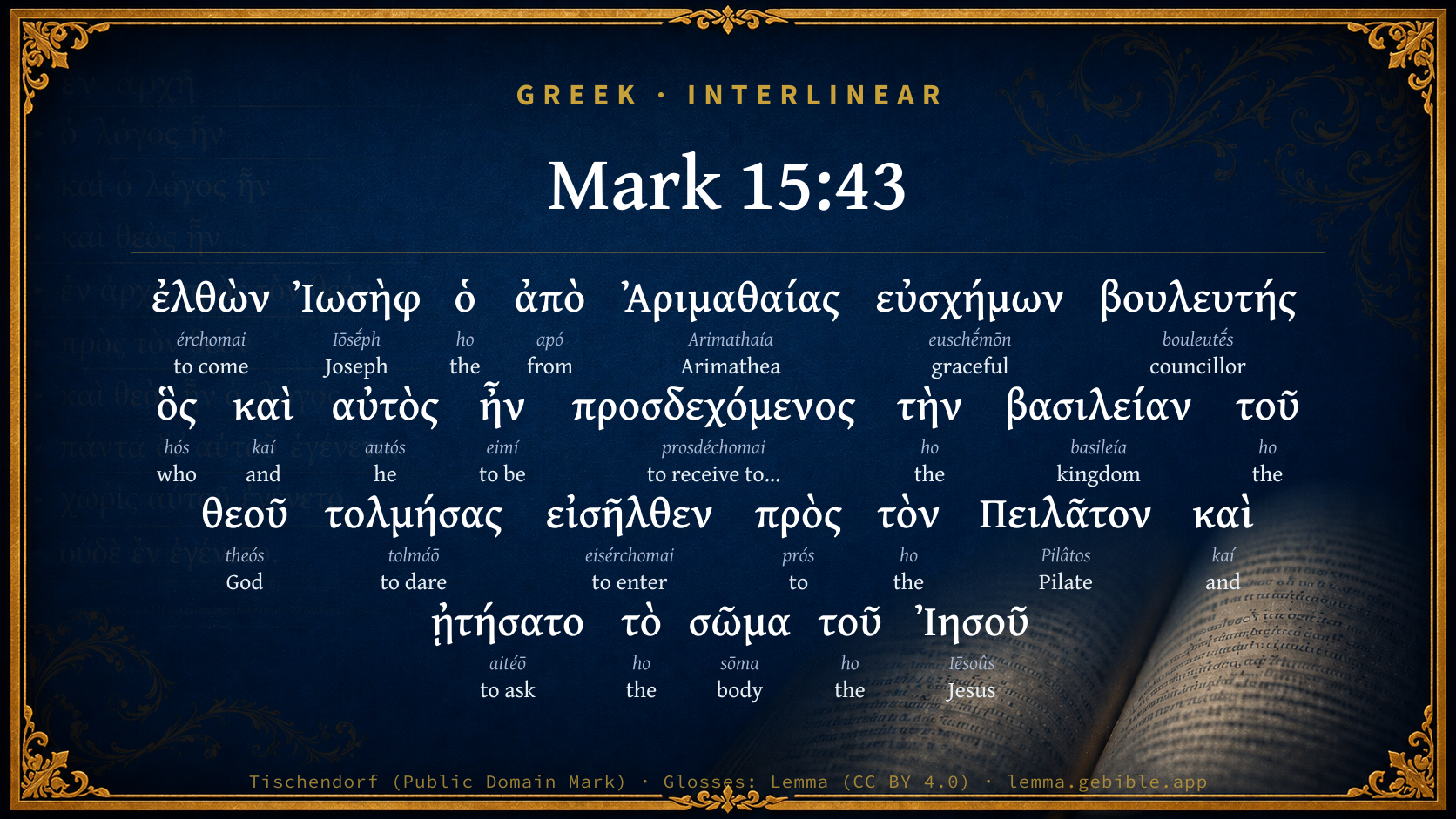
Greek (Tischendorf 8th ed.) Mark 15:43 appears in the Greek New Testament. The text above is from the Tischendorf 8th edition. Each word links to its Strong’s number and a concise gloss. Click any word for its full Thayer’s Greek Lexicon entry.
Download image
Cite this verse

Mark 15:43 (World English Bible). Public Domain. Lemma interlinear Bible study tool, https://lemma.gebible.app/v/mark/15/43.

Show BibTeX & RIS
BibTeX
RIS
English Translation
Joseph of Arimathaea, a prominent council member who also himself was looking for the Kingdom of God, came. He boldly went in to Pilate, and asked for Jesus' body.
World English Bible · Public Domain
Highlights
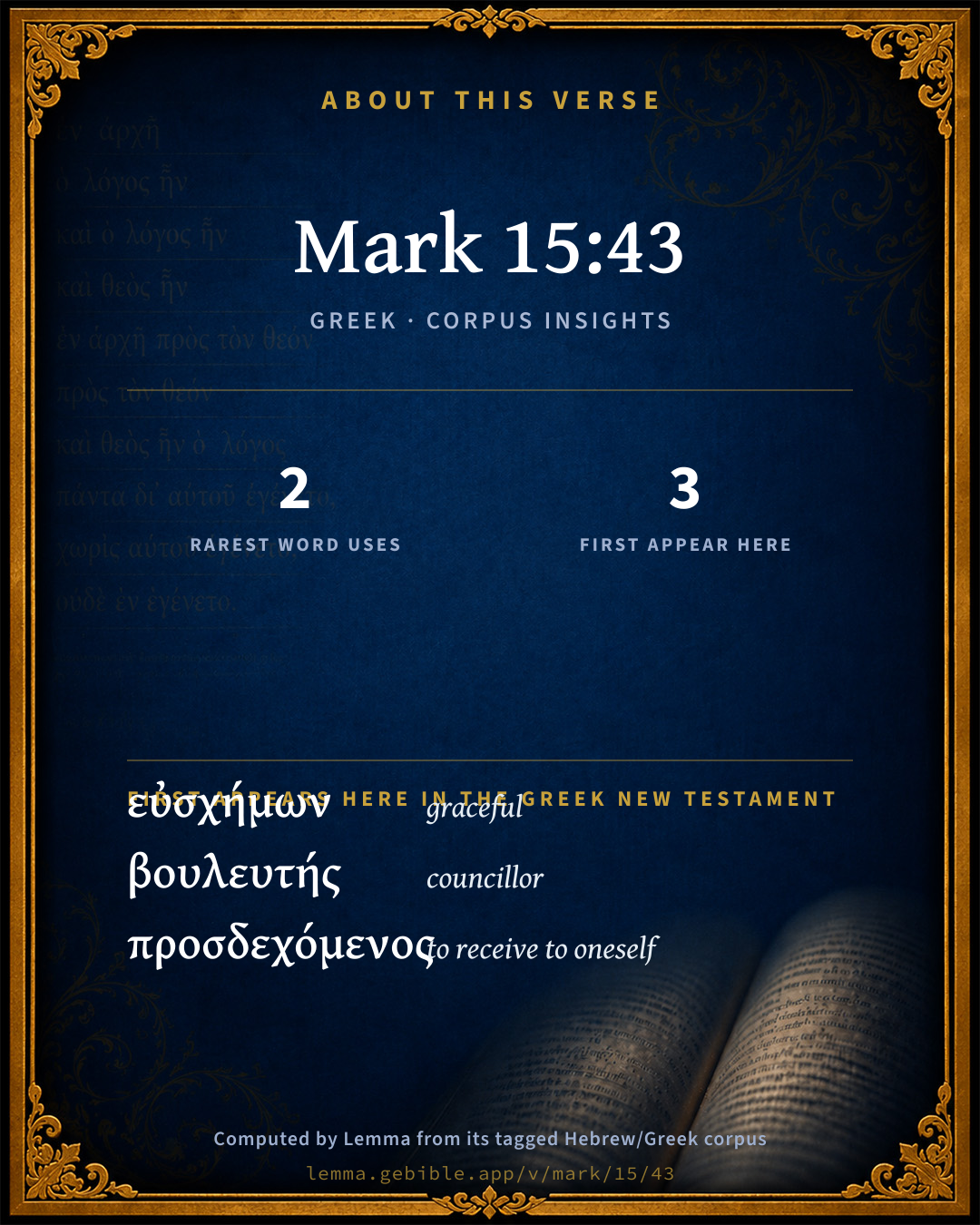
  • 3 first appearances in the Greek New Testament
Full analysis ↓
Download a study sheet

One document with this verse’s original text, its word-by-word gloss line, the meaning frame, cross-references with their text, attributed commentary, and full source and license credits — printable, and it pastes into notes with its structure intact.

This verse Autodidact and up

Study sheet (.html) Plain text (.txt)

A passage Seminary Student

Up to 50 verses in one chapter. A passage sheet keeps up to 6 commentary sources and 12 cross-references per verse, in the order this page ranks them, and says so on the sheet whenever that leaves anything out. Ask for a single verse and you get the Autodidact verse sheet above.

Everything on this page stays free to read, with no account — the sheet is a download of what is already on screen, not access to it.

Want to remove ads? Support Godless Engineer
Compare translations 3

The same verse in 3 English versions, stacked beneath the original-language interlinear above. Click any original word for its lexicon entry.

Each is an independent rendering of the whole verse — the interlinear is not word-aligned to these translations.

Highlighted words mark where these versions differ — a whole-verse word diff, not a word-by-word alignment.

  • World English Bible Public Domain
    Joseph of Arimathaea, a prominent council member who also himself was looking for the Kingdom of God, came. He boldly went in to Pilate, and asked for Jesus' body.
  • King James Version Public Domain
    Joseph of Arimathaea, an honourable counsellor, which also waited for the kingdom of God, came, and went in boldly unto Pilate, and craved the body of Jesus.
  • unfoldingWord Literal Text CC BY-SA 4.0
    Joseph, the one from Arimathea, a respected member of the council who also himself was waiting for the kingdom of God, having come, having dared, entered in to Pilate and asked for the body of Jesus.

unfoldingWord Literal Text — © unfoldingWord, licensed CC BY-SA 4.0. Word-aligned USFM3 via Door43 (git.door43.org/unfoldingWord/en_ult).

Versions to compare (up to 4)

3 of 4 selected

Show all 19 translations

Every available English version of this verse, each an independent rendering of the whole verse.

  • World English Bible Public Domain
    Joseph of Arimathaea, a prominent council member who also himself was looking for the Kingdom of God, came. He boldly went in to Pilate, and asked for Jesus' body.
  • Berean Standard Bible Public Domain
    Joseph of Arimathea, a prominent Council member who himself was waiting for the kingdom of God, boldly went to Pilate to ask for the body of Jesus.
  • Majority Standard Bible Public Domain
    Joseph of Arimathea, a prominent Council member who himself was waiting for the kingdom of God, boldly went to Pilate to ask for the body of Jesus.
  • King James Version Public Domain
    Joseph of Arimathaea, an honourable counsellor, which also waited for the kingdom of God, came, and went in boldly unto Pilate, and craved the body of Jesus.
  • American Standard Version (1901) Public Domain
    there came Joseph of Arimathaea, a councillor of honorable estate, who also himself was looking for the kingdom of God; and he boldly went in unto Pilate, and asked for the body of Jesus.
  • Revised Version (1885) Public Domain
    there came Joseph of Arimathaea, a councillor of honourable estate, who also himself was looking for the kingdom of God; and he boldly went in unto Pilate, and asked for the body of Jesus.
  • Geneva Bible (1599) Public Domain
    Ioseph of Arimathea, an honorable counsellour, which also looked for the kingdome of God, came, and went in boldly vnto Pilate, and asked the body of Iesus.
  • Douay-Rheims (1899) Public Domain
    Joseph of Arimathea, a noble counsellor, who was also himself looking for the kingdom of God, came and went in boldly to Pilate, and begged the body of Jesus.
  • Young's Literal Translation Public Domain
    Joseph of Arimathea, an honourable counsellor, who also himself was waiting for the reign of God, came, boldly entered in unto Pilate, and asked the body of Jesus.
  • Literal Standard Version CC BY-SA 4.0
    Joseph of Arimathea, an honorable counselor, who also himself was waiting for the Kingdom of God, came, boldly entered in to Pilate, and asked for the body of Jesus.
  • Unlocked Literal Bible CC BY-SA 4.0
    Joseph of Arimathea came there. He was a respected member of the council, who was waiting for the kingdom of God. He boldly went in to Pilate and asked for the body of Jesus.
  • unfoldingWord Literal Text CC BY-SA 4.0
    Joseph, the one from Arimathea, a respected member of the council who also himself was waiting for the kingdom of God, having come, having dared, entered in to Pilate and asked for the body of Jesus.
  • Darby Bible Public Domain
    Joseph of Arimathaea, an honourable councillor, who also himself was awaiting the kingdom of God, coming, emboldened himself and went in to Pilate and begged the body of Jesus.
  • World Messianic Bible Public Domain
    Joseph of Arimathaea, a prominent council member who also himself was looking for God’s Kingdom, came. He boldly went in to Pilate, and asked for Yeshua’s body.
  • Webster's Bible Public Domain
    Joseph of Arimathea, an honorable counselor, who also waited for the kingdom of God, came, and went in boldly to Pilate, and craved the body of Jesus.
  • Free Bible Version CC BY-SA 4.0
    Joseph of Arimathea, a member of the governing council who was himself waiting for the kingdom of God, had the courage to go to Pilate and ask for Jesus' body.
  • Bible in Basic English Public Domain
    There came Joseph of Arimathaea, a responsible man in high honour, who was himself waiting for the kingdom of God; and he went in to Pilate without fear, and made a request for the body of Jesus.
  • Text-Critical English NT CC BY 4.0
    Joseph of Arimathea, a respected council member, who was himself also waiting for the kingdom of God, came and boldly went in before Pilate to ask for Jesus' body.
  • Tyndale New Testament (1534) Public Domain
    Ioseph of Arimathia a noble councelour which also loked for the kyngdome of God came and went in booldly vnto Pylate and begged the boddy of Iesu.

Literal Standard Version (2020), Covenant Press — licensed CC BY-SA 4.0. Text via the HelloAO Bible API (eBible.org). Unlocked Literal Bible (unfoldingWord) — licensed CC BY-SA 4.0. Text via the HelloAO Bible API (eBible.org). unfoldingWord Literal Text — © unfoldingWord, licensed CC BY-SA 4.0. Word-aligned USFM3 via Door43 (git.door43.org/unfoldingWord/en_ult). Free Bible Version, Dr. Jonathan Gallagher — licensed CC BY-SA 4.0. Text via the HelloAO Bible API (eBible.org).

Word by word

More ways to search: Search by grammar → Find every occurrence → Compare this word →

Practice this passage: Drill this verse → Learn its vocabulary →

βουλευτής
bouleutḗs
G1010
“councillor”
Noun, Nominative, Singular, Masculine
Part of Speech
Noun
Case
Nominative
Number
Singular
Gender
Masculine
Full Thayer's Definition

Origin: from G1011

TDNT: None

1. a councillor, senator 2. a member of the Sanhedrin
  1. ἐλθὼν érchomai G2064 “to come” Verb, Aorist, Active, Participle, Nominative, Singular, Masculine
  2. Ἰωσὴφ Iōsḗph G2501 “Joseph” Noun, Proper, indeclinable
  3. ὁ ho G3588 “the” Article, Nominative, Singular, Masculine
  4. ἀπὸ apó G575 “from” Preposition
  5. Ἀριμαθαίας Arimathaía G707 “Arimathea” Noun, Genitive, Singular, Feminine
  6. εὐσχήμων euschḗmōn G2158 “graceful” Adjective, Nominative, Singular, Masculine
  7. ὃς hós G3739 “who” Relative pronoun, Nominative, Singular, Masculine
  8. καὶ kaí G2532 “and” Conjunction
  9. αὐτὸς autós G846 “he” Personal pronoun, Nominative, Singular, Masculine
  10. ἦν eimí G1510 “to be” Verb, Imperfect, Active, Indicative, 3rd person, Singular
  11. προσδεχόμενος prosdéchomai G4327 “to receive to oneself” Verb, Present, Middle or Passive deponent, Participle, Nominative, Singular, Masculine
  12. τὴν ho G3588 “the” Article, Accusative, Singular, Feminine
  13. βασιλείαν basileía G932 “kingdom” Noun, Accusative, Singular, Feminine
  14. τοῦ ho G3588 “the” Article, Genitive, Singular, Masculine
  15. θεοῦ theós G2316 “God” Noun, Genitive, Singular, Masculine
  16. τολμήσας tolmáō G5111 “to dare” Verb, Aorist, Active, Participle, Nominative, Singular, Masculine
  17. εἰσῆλθεν eisérchomai G1525 “to enter” Verb, Aorist, Active, Indicative, 3rd person, Singular
  18. πρὸς prós G4314 “to” Preposition
  19. τὸν ho G3588 “the” Article, Accusative, Singular, Masculine
  20. Πειλᾶτον Pilâtos G4091 “Pilate” Noun, Accusative, Singular, Masculine
  21. καὶ kaí G2532 “and” Conjunction
  22. ᾐτήσατο aitéō G154 “to ask” Verb, Aorist, Middle, Indicative, 3rd person, Singular
  23. τὸ ho G3588 “the” Article, Accusative, Singular, Neuter
  24. σῶμα sōma G4983 “body” Noun, Accusative, Singular, Neuter
  25. τοῦ ho G3588 “the” Article, Genitive, Singular, Masculine
  26. Ἰησοῦ Iēsoûs G2424 “Jesus” Noun, Genitive, Singular, Masculine

About this verse

These counts appear in no published source. They are computed here, from the morphology-tagged text and Lemma’s own curated glosses. What Lemma adds →

27
words
21
distinct lemmas
Gospels
section

Notable vocabulary

The rarest word here is βουλευτής councillor G1010 — appearing just 2 times in the whole Greek New Testament.

First appearance in Scripture

These words make their first canonical appearance in the Greek New Testament here:

  • εὐσχήμων graceful G2158
  • βουλευτής councillor G1010
  • προσδεχόμενος to receive to oneself G4327

Shared distinctive vocabulary

βουλευτής councillor G1010 occurs in 2 verses of the Greek New Testament. Also found in:
Repetition

Words recur within this verse:

Cross-references

14

Topical passages linked to Mark 15:43 in the Treasury of Scripture Knowledge — connected by theme and wording, ordered by reader-vote popularity; previews shown in the World English Bible.

  • Luke 2:25 Behold, there was a man in Jerusalem whose name was Simeon. This man was righteous and devout, looking for the consolation of Israel, and the Holy Spirit was on him.
  • Luke 2:38 Coming up at that very hour, she gave thanks to the Lord, and spoke of him to all those who were looking for redemption in Jerusalem.
  • Luke 23:51 (he had not consented to their counsel and deed), from Arimathaea, a city of the Jews, who was also waiting for the Kingdom of God:
  • Matthew 27:57 When evening had come, a rich man from Arimathaea, named Joseph, who himself was also Jesus' disciple came.
  • John 19:38 After these things, Joseph of Arimathaea, being a disciple of Jesus, but secretly for fear of the Jews, asked of Pilate that he might take away Jesus' body. Pilate gave him permission. He came therefore and took away his body.
  • Acts 17:12 Many of them therefore believed; also of the prominent Greek women, and not a few men.
  • Matthew 19:30 But many will be last who are first; and first who are last.
  • Matthew 20:16 So the last will be first, and the first last. For many are called, but few are chosen."
  • Mark 10:23–27 Jesus looked around, and said to his disciples, "How difficult it is for those who have riches to enter into the Kingdom of God!"
  • Mark 14:54 Peter had followed him from a distance, until he came into the court of the high priest. He was sitting with the officers, and warming himself in the light of the fire.
  • Mark 14:66–72 As Peter was in the courtyard below, one of the maids of the high priest came,
  • Acts 4:8–13 Then Peter, filled with the Holy Spirit, said to them, "You rulers of the people, and elders of Israel,
  • Acts 13:50 But the Jews stirred up the devout and prominent women and the chief men of the city, and stirred up a persecution against Paul and Barnabas, and threw them out of their borders.
  • Philippians 1:14 and that most of the brothers in the Lord, being confident through my bonds, are more abundantly bold to speak the word of God without fear.

Cross-references courtesy of OpenBible.info (CC BY 4.0).

Commentary

Notes on Mark 15:43 from classic Christian and Jewish commentators (each source and its license shown beneath its notes). The classic Christian expositions comment on the surrounding passage and are grouped to its opening verse, so a note may address several verses; the Jewish commentaries on the Tanakh (Rashi and others) are per-verse, so they appear only where the commentator wrote on this verse.

Lemma curates 59 commentaries, every one of them public domain or Creative Commons licensed, each selected and text-cleaned for this edition rather than reprinted as found. About our sources →

Tyndale Open Study Notes

Tyndale Open Resources

15:43-45 Joseph of Arimathea (possibly from the village of Ramathaim, twenty miles northwest of Jerusalem) was an honored member of the high council and a secret disciple of Jesus who was waiting for the Kingdom of God to come (see Matt 27:57; Luke 23:50-51; John 19:38). He courageously requested the body of Jesus from Pilate for burial. Since he was a member of the high council and was not known to be Jesus’ disciple, it served Rome’s purposes to grant his request: It would satisfy Jewish concerns about leaving the dead exposed after sunset (Deut 21:22-23), and Jesus’ disciples would not receive the body.

Tyndale Open Study Notes — © Tyndale Open Resources, licensed CC BY-SA 4.0. Text via the HelloAO Bible API.

Bengel's Gnomon

Johann Albrecht Bengel

Mar 15:43. Ὁ ἀπὸ Ἀριμαθαίας, who was from Arimathea) The article shows, that this had become a surname of Joseph. Matthew does not employ the article, because he wrote before Mark.—εὐσχήμων, honourable) Distinguished by both honour and dignity.—βουλευτὴς, senator) of the Jerusalem Sanhedrim.—τολμήσας, having boldly ventured) A praiseworthy boldness. [Not unattended with personal risk.—V. g.] Joh 19:38. An elegant and effective Asyndeton.[10] [It very frequently happens in the case of those making such bold ventures, that their efforts succeed better than you would have supposed.—V. g.]

[10] Omission of the copula between ἐλθὼν and τολμήσας.—ED. and TRANSL.

Bengel's Gnomon of the New Testament — English translation (T&T Clark, Edinburgh, 1860) — public domain. Text from a community e-Sword module.

Expositor's Greek Testament

ed. W. Robertson Nicoll

Mar 15:43 . εὐσχήμων : Mt. has πλούσιος ; vide there for remarks on the two epithets. βουλευτής , a councillor, not in the provincial town, Arimathaea, which would have been mentioned, but in the grand council in Jerusalem. καὶ αὐτὸς : not in contrast to the Sanhedrists generally (Weiss), but in company with the women previously named (Schanz); he, like them, was an expectant of the Kingdom of God. τολμήσας : a graphic word, in Mk. only, giving a vivid idea of the situation. Objections to be feared on Pilate’s part on score of time dead so soon? possibly surly indifference to the decencies of burial in the case of a crucified person, risk of offence to the religious leaders in Jerusalem by sympathy shown to the obnoxious One, even in death. Therefore to be rendered: “ taking courage , went in unto Pilate” ( vide Field, Ot. Nor. , ad loc. ).

The Expositor's Greek Testament, edited by W. Robertson Nicoll (1897–1910) — public domain. Text from a community e-Sword module.

Geneva Bible (1599)

Geneva Bible translators

If we consider what danger Joseph cast himself into, we shall perceive how bold he was.

A man of great authority, of the counsel of the Sanhedrin, or else taken into counsel by Pilate.

Geneva Bible (1599) marginal notes — public domain. Text via Bolls.life.

Adam Clarke's Commentary

Verse 43. Went in boldly unto Pilate] He who was a coward before now acts a more open, fearless part, than any of the disciples of our Lord! This the Holy Spirit has thought worthy of especial notice. It needed no small measure of courage to declare now for Jesus, who had been a few hours ago condemned as a blasphemer by the Jews, and as a seditious person by the Romans; and this was the more remarkable in Joseph, because hitherto, for fear of the Jews, he had been only a secret disciple of our Lord. See Joh 19:38.

The apostle says, We have BOLDNESS to enter into the holiest through his blood. Strange as it may appear, the death of Jesus is the grand cause of confidence and courage to a believing soul.

Adam Clarke's Commentary on the Bible (1810–1826) — public domain. Text from a community e-Sword/MySword module.

Ellicott's Commentary for English Readers

(43) Joseph of Arimathsea.—The account given of him is fuller than in St. Matthew. The phrase, “which also waited for the kingdom of God,” has its parallel in Luk_23:51.

Went in boldly.—Better, waxed bold, and went in. There is an implied contrast between his boldness now and his previous timidity.

A Bible Commentary for English Readers, edited by Charles John Ellicott (1878–1897) — public domain. Text from a community e-Sword module.

The Cambridge Bible for Schools and Colleges

gen. ed. J. J. S. Perowne

43. Joseph of Arimathæa] i. e. either of Rama in Benjamin (Mat_2:18) or Ramathaim in Ephraim (1Sa_1:1). Probably the latter. The place is called in the LXX. “Armathaim,” and by Josephus “Armathia.” Joseph was a man of wealth (Mat_27:57), a member of the Sanhedrim (Luk_23:50), and a secret disciple of Jesus (Joh_19:38), who had not consented to the resolution of the rest to put Him to death (Luk_23:51).

waited for the kingdom] like Simeon (Luk_2:25) and Anna (Luk_2:38).

went in boldly] He is no longer a secret disciple. He casts away all fear. The Cross transfigures cowards into heroes. “It was no light matter Joseph had undertaken: for to take part in a burial, at any time, would defile him for seven days, and make everything unclean which he touched (Num_19:11; Hag_2:13); and to do so now involved his seclusion through the whole Passover week—with all its holy observances and rejoicings.” Geikie, ii. 576.

craved the body of Jesus] It was not the Roman custom to remove the bodies of the crucified from the cross. Instead of shortening their agonies the Roman law left them to die a lingering death, and suffered their bodies to moulder under the action of sun and rain (comp. Cic. Tusc. Quæst. i. 43, “Theodori nihil interest humine an sublime putrescat”), or be devoured by wild beasts (comp. Hor. Epist. xvi. 48, “Non hominem occidi: non pasces in cruce corvos”). The more merciful Jewish Law, however, did not allow such barbarities, and the Roman rulers had made an express exception in their favour. In accordance, therefore, with the request of the Jewish authorities, the legs of the malefactors had been broken to put them out of their misery (Joh_19:31), but our Lord was found to be dead already (Joh_19:33), and the soldier had pierced His side with a spear, the point of which was a handbreadth in width, thus causing a wound which would of itself have been sufficient to cause death, whereupon there had issued forth blood and water (Joh_19:34). Thus the Holy Body was now ready for its entombment.

The Cambridge Bible for Schools and Colleges (gen. ed. J. J. S. Perowne; Cambridge University Press, 1878–1918) — public domain. Text from a community e-Sword module.

John Gill's Exposition

And Mary Magdalene, and Mary the mother of Joses,.... Or Joseph, as the Vulgate Latin and Ethiopic versions read:

beheld where he was laid: very likely they saw Joseph, and his men, take him down from the cross, and they followed him, and observed where he laid him; or, as the Ethiopic version reads, "where they buried him"; placing themselves, as Matthew suggests, right "over against the sepulchre", Mat 27:61; so that they were witnesses of his death, and of his burial, as they afterwards were of his resurrection from the dead.

Next: Mark Chapter 16

John Gill's Exposition of the Whole Bible (1746–1763) — public domain (CC PDM 1.0). Text via the HelloAO Bible API.

Trapp's Complete Commentary

John Trapp

43 Joseph of Arimathaea, an honourable counsellor, which also waited for the kingdom of God, came, and went in boldly unto Pilate, and craved the body of Jesus.

Ver. 43. Went in boldly unto Pilate] It was boldly done indeed, thus to oppose, not the Jews only, but Pilate in that which he had done to Christ. Good blood will not belie itself.

John Trapp, A Commentary or Exposition upon All the Books of the Old and New Testament (1647–1656) — public domain. Text from a community e-Sword module.

Albert Barnes' Notes on the Bible

Joseph, an honorable counselor - A distinguished man, who probably held a high office among the Jews, as one of their great council, or a Jewish senator. The word “honorable,” here, is not a mere title of “office,” but is given in reference to his personal character, as being a man of integrity and blameless life.

Waited for the kingdom of God - Waited for, or expected, the coming of the Messiah. But this expression means more than an “indefinite” expectation that the Messiah “would” come, for all the Jews expected that. It implies that he believed “Jesus” to be the Messiah, and that he had “waited” for Him to build up the kingdom of God; and this agrees with what John says Joh 19:38, that he was a disciple of Jesus, but secretly, for fear of the Jews. He had retained his “secret” belief, in the hope that Jesus would be proclaimed and treated as the Messiah, and then he probably proposed openly to acknowledge his attachment to him. But God called him to a public profession of attachment in a different manner, and gave this distinguished man grace to evince it. So men often delay a profession of attachment to Christ. They cherish a secret love, they indulge a hope in the mercy of God, but they conceal it for fear of man; whereas God requires that the attachment should be made known. “Whosoever is ashamed of me,” said the Saviour, “and of my words, of him also shall the Son of man be ashamed when he cometh in the glory of his Father and with the holy angels,” Mar 8:38. Those who love the Saviour have no right to hide their light under a bushel. As soon as they have evidence satisfactory to their own mind that they are Christians, or have a “prevalent” belief, after faithful examination, that they truly love God, and that they depend on the Lord Jesus for salvation, so soon are they bound to profess Christ before men. This is the command of God, and this is the way of peace. None have the prospect of “comfort” in religion who do not have respect to all of the commandments of God.

Went in boldly unto Pilate - God had raised up this distinguished counselor and secret disciple for a special and most important occasion. The disciples of Jesus had fled, and if they had not, they had no influence with Pilate. Unless there had been a special application to Pilate in behalf of Jesus, his body would have been buried “that night” in the same grave with the malefactors, for it was a law of the Jews that the body of an executed man should not remain on the cross on the Sabbath. At this critical juncture God called forward this secret disciple - this friend of Jesus, though unknown as such to the world - and gave him confidence. He dared to express sympathy for the Saviour; he went in boldly and begged the body of Jesus. It needed no small measure of courage to do this. Jesus had just been condemned, mocked, spit on, crucified - the death of a slave or of the most guilty wretch. To avow attachment for him now was proof of sincere affection; and the Holy Spirit has thought this worthy of special notice, and has set down this bold attachment of a senator for Jesus for our imitation.

Craved the body - Begged, or asked.

Albert Barnes' Notes on the Bible (1834–1885) — public domain. Text from a community e-Sword/MySword module.

Haydock's Catholic Bible Commentary

A noble Decurion. The Decurions among the Romans were first called so as having ten men under them, as the centurions were over a hundred. But some of the Decurions were also Counsellors in towns, as is here signified by the Greek word Bouleutes. (Witham)

George Leo Haydock (1774–1849), Haydock's Catholic Family Bible and Commentary, 1859 edition — public domain. Excludes Psalms (Douay-Rheims chapter numbering differs from Protestant) and Deuterocanonical books (Catholic canon only).

Whedon's Commentary on the Bible

Daniel D. Whedon

43. Joseph of Arimathea… craved the body of Jesus — The cruelty of Roman law allowed the malefactor to hang until putrefaction had dissolved his body, or the beasts and birds had torn it in pieces. But the humaner law of Moses directed that the malefactor hanged on a tree should be taken down before nightfall. Roman policy usually yielded to such peculiarities in their conquered provinces. Accordingly the crucified bodies are taken down, and the process of death is hastened, or at least the impossibility of escape ensured, in the case of the thieves, by breaking their legs. But the special divine provision in order to secure the fulfilment of the prophetic type of the paschal victim, of which not a bone was to be broken, the earlier death of Jesus, prevented the execution of the same violence upon his body. When thus taken down and found fully deceased, the moment arrived when it should be rescued from desecration by the interposition of Joseph. Otherwise he would have been consigned forthwith to the shameful burial of ordinary malefactors.

Daniel D. Whedon (gen. ed.), Commentary on the Old and New Testaments (1874–1909) — public domain. Text from a community e-Sword module.

The Pulpit Commentary

Joseph of Arimathaea. St. Jerome says that this city was called Ramathaim-Zophim (the lofty place), where dwelt Elkanah and Hannah of old, and where Samuel was born. Joseph was most probably a native of Arimathaea; but he was now a citizen and counsellor of Jerusalem. He was an honorable counsellor (euschmwn bouleuthv), a councillor of honorable estate (Revised Version). St. Matthew says he was a rich man. It is evident that he regarded himself as a settled inhabitant of Jerusalem, since he had thus provided himself with a place of sepulture. He was waiting for (prosdecomenov) literally, looking forthe kingdom of God. St. Matthew (Mat_27:57) says that he was a disciple of Jesus. These circumstances explain his desire to bury our Lord. He boldly went in (tolmhsav eishlye) literally, he took courage and went in unto Pilate, and asked for the body of Jesus. A poor man would not have dared to approach Pilate for such a purpose as this. St. Chrysostom says, "The courage of Joseph is greatly to be admired, in that, for the love of Christ, he exposed himself to the danger of death." The fact that he was "looking for the kingdom of God" explains his conduct. It shows that he believed in Christ, and through his grace hoped for everlasting salvation; and in this hope he thought little of shelving his reverence for Christ, and so" boldly went in unto Pilate, and asked for the body of Jesus.

Joseph of Arimathaea.

In comparison with the leading apostles of our Lord Joseph of Arimathaea was not distinguished, lie had not the spirituality of St. John, nor the prominence of St. Peter, nor the world-wide influence of St. Paul. We are consciously turning from the generals of Christ"s army to contemplate one of the ordinary soldiers; but it was he who, when his natural leaders had fallen, stepped to the front and proved himself a hero. We know but little of Joseph beyond such facts as these: he was a rich man, respected by his countrymen as one who was "good and just;" a member of the Sanhedrim, who refused his consent to the resolution passed that Jesus should be put to death; and a resident in Jerusalem, who, having prepared for himself a new grave, dedicated it to his crucified Lord. We may learn valuable lessons from his courage and fidelity, the more so if we blend together all the references made to him by the evangelists.

I THAT WE OUGHT TO REFUSE OUR CONSENT TO A WRONG, EVEN THOUGH OUR REFUSAL WILL NOT PREVENT ITS ACCOMPLISHMENT. Except for Nicodemus, Joseph stood alone in protesting against the action resolved on by the council against Jesus. He was, no doubt, strongly urged to yield to the majority, so that the council might appear united in the endeavor to put down One who had disregarded its authority. But although his protest was seemingly powerless, he resolutely persisted in it, and to the last he "did not consent to the counsel and deed of them." lie was an example in this to all who conscientiously object to habits and practices which obtain in their own sphere of activity, be they politicians, men of business, or boys and girls at school. But let all such be sure that a real principle is at stake, not a prejudice, and that they are not moved by self-assertion, obstinacy, or pride.

II THAT BY BRAVELY DOING WHAT WE BELIEVE TO BE RIGHT WE EMBOLDEN AND HELP OTHERS. Joseph required courage on the council, and still more now when he went in to Pilate to beg the body of Jesus. So terrible was the hatred felt against Jesus by the chief priests that the procurator himself had trembled before it, and Peter, with his fellow-disciples, had forsaken the Lord. Yet Joseph stepped to the front as a friend of the crucified One, and Nicodemus followed him. All men of decided convictions thus influence others. Thousands thanked God secretly for the stand which Elijah made on Carmel. Multitudes wait to be led aright by those whose character and ability bring responsibility.

III THAT IF WE GO RIGHT ONWARD IN THE PATH OF DUTY WE SHALL SUCCEED BETTER THAN WE EXPECT. When Joseph undertook his mission he knew that he might risk his life, or at least his reputation; that he might be called on to pay a heavy and prohibitory ransom as a bribe to the governor; or that he might be refused with scorn and insult. Yet, when he went in boldly to Pilate, to his own amazement, his request was freely granted! Many have had a similar experience: e.g. the Israelites when they obeyed the command, "Go forward," and saw the sea divide before their advancing footsteps; and Peter, who followed the angel and found the great gate of the prison open of its own accord. Apply this to typical experiences in a Christian"s life.

IV THAT A CRISIS COMES IN THE HISTORY OF MEN WHICH DETERMINES THEIR WHOLE FUTURE. The crucifixion of Jesus constituted a crisis to Joseph. Under the influence of sorrow and indignation he was prompted to this step, and the future destiny of this secret disciple depended upon his taking it. Such times come to us all. Our spiritual life has not always the same even flow. Occasionally we are strangely, strongly moved to resolve, to speak, or to act, and tremendous issues depend upon our obedience to God-given impulse. If the vessel aground on the harbor bar is not set free when the tide is highest, she will be wrecked in the coming storm.

V THAT THE MOVING CAUSE OF DECISION FOR GOD IS THE CROSS OF THE LORD JESUS CHRIST. Joseph had listened to the teaching of Jesus, and witnessed his superhuman works, but till now had been a disciple "secretly," for fear of the Jews. That position was a false one, and so long as he was in it he was deficient in gratitude and courage. But when he saw Jesus on the cross he felt as the centurion did when he cried, "Truly this was the Son of God;" and henceforth he was known as the Lord"s disciple and servant. Christ"s death has been to millions the beginning of new life.

VI THAT GOD WILL FULFILL HIS PURPOSES WHETHER HIS AVOWED SERVANTS ARE LOYAL TO HIM OR NOT. The twelve were scattered and the Church seemed destroyed, when suddenly there came forth from their former obscurity two secret disciples, who took upon themselves the work which others had left. And in all ages God has his faithful ones who are sometimes unrecognized by the Church; yet, filled with his Spirit, they shall aid in establishing the kingdom of the crucified, and now risen, Christ.

The Pulpit Commentary (1880–1919), ed. H.D.M. Spence-Jones & Joseph S. Exell — public domain. Text from a community e-Sword module.

John Wesley's Explanatory Notes

honourable - A man of character and reputation: A counsellor - A member of the sanhedrim. Who waited for the kingdom of God - Who expected to see it set up on earth. Matt. xxvii, 57; Luke xxiii, 50; John xix, 38.

John Wesley, Explanatory Notes Upon the Whole Bible (1754–1765) — public domain. Text via the GEBible commentary corpus.

Cambridge Greek Testament for Schools and Colleges

43. ὁ ἀπὸ Ἀριμθείας. The site of Arimathaea is unknown. It has been identified by some with Ramah, the birthplace and burial-place of Samuel. Its full name was Ramathaim-zophim, “Double Height of the Watchers” (Stanley, Sin. and Pal. p. 224). The ἀπό suggests that Joseph had ceased to reside at Arimathaea, and his having a tomb at Jerusalem and being a member of the Sanhedrin shows that he had settled in the city. Mt. says that he was πλούσιος, Lk. that he was ἀγαθὸς καὶ δίκαιος, which may all be summed up in Mk’s εὐσχήμων. Only a person of good position and bearing would have had much hope of at once being admitted to an audience with Pilate.

ἦν προσδεχόμενος. Cf. Luk 2:25; Luk 2:38.

τολμήσας. Took courage; see Field, p. 44. It required courage to go to the Procurator on such an errand. He was no relation of the Crucified, and therefore had no claim to this favour, and his being a member of the Sanhedrin might be fatal. The Sanhedrin had that day driven Pilate to condemn an innocent person to death,—a humiliating and exasperating thought for a Roman judge, and Pilate would know nothing of Joseph’s having taken no part in this crime. Above all, there was danger as to what the Sanhedrin would do, when they heard of Joseph’s visit to the Procurator. But reverence and affection for the Master gave him the necessary courage.

Cambridge Greek Testament for Schools and Colleges (Cambridge University Press, 1896; 21 vols, various authors incl. Carr, Maclear, Plummer, Farrar, Lumby, Moule, M. R. James, Simcox) — public domain. Text from a community e-Sword module.

Alford’s Greek Testament

Henry Alford

43.] ἐλθών, or ἦλθεν, is common to Matt., Mark, and John, but in different connexion—see on Matt.

εὐσχήμων—probably in its later sense of noble, ‘honourable,’ i.e. in station. But Meyer supposes it rather to refer to something noble in the character or appearance of Joseph.

βουλευτής, a member of the Sanhedrim: see Luke ver. 51.

προσδ. τ. β. τ. θ., common to Mark and Luke.

τολμήσας εἰς., characteristic of Mark’s narrative. On the change of mind produced in Joseph and in Nicodemus by the crucifixion, see note, Joh 19:39.

Henry Alford, The Greek Testament (1849–1861) — public domain. Text from a community e-Sword module.

International Critical Commentary

43. ἐλθὼν Ἰωσὴφ ὁ ἀπὸ Ἀριμαθαίας—Joseph of Arimathea, having come. Arimathea, the Heb. Ramah, was the name of several places in Palestine. Probably, this was the one mentioned in the O.T. as the birthplace of Samuel in Mt. Ephraim.2 Mt. tells us about this Joseph that he was rich, and a disciple of Jesus. Lk., that he was a righteous man, and not implicated in the plot of the Jews against Jesus, and that he was expecting the kingdom of God. J., that he was a secret disciple. εὐσχήμων3 βουλευτής—an honorable member of the council (Sanhedrim). τολμήσας—having gathered courage. Having laid aside the fear of the odium which would attach to his act. ὃς καὶ αὐτὸς προσδεχόμενος τὴν βασιλείαν τοῦ Θεοῦ—This language is inconsistent with the supposition that this account regards him as a disciple of Jesus. It evidently means that he was in sympathy with the disciples in this element of their faith. He was not a follower of Jesus, but in common with him he was awaiting the kingdom of God, and wished to do honor to one who had suffered in its behalf.

ἐλθὼν, instead of ἦλθεν, Tisch. Treg. WH. RV. א ABCKLMU ΓΔΠ, Memph. Insert τὸν before Πειλᾶτον, Tisch. Treg. WH. א BL Δ 33. Πειλᾶτον, instead of Πιλάτον, Tisch. WH. א AB* D.

International Critical Commentary — older volumes (1896–1929), various authors — public domain. Text from a community e-Sword module.

Vincent's Word Studies in the New Testament

Marvin R. Vincent

Joseph of Arimathaea [ιωσηφ ο απο αριμαθαιας] . Lit., Joseph, he from Arimathaea : the article indicating a man well known.

Honorable [ευσχημων] . Compounded of eu, well, and schma, form, shape, figure. On the latter word, see on Mt 17:2. In its earlier use this adjective would, therefore, emphasize the dignified external appearance and deportment. So Plato, noble bearing (" Republic, " 413). Later, it came to be used in the sense of noble; honorable in rank. See Act 13:50; Act 17:12.

Counsellor. A member of the Sanhedrim, as appears from Luk 23:51. Went in boldly [τολμησας εισηλθεν] . Lit., having dared went in. Daring all possible consequences.

Marvin R. Vincent, Word Studies in the New Testament (1887–1900) — public domain. Text from a community e-Sword/MySword module.

Lesson kit

Teaching starters — assembled from the data on this page, not authored interpretation. Every prompt links to the verse data it draws on. Edit before teaching.

Mark, in the Gospels, opens this verse with 27 words (21 distinct Greek lemmas). Its most distinctive word is bouleutḗs (“councillor”). A historical commentator’s framing appears above. Read the whole chapter for the surrounding context.

Discussion questions

  1. The word bouleutḗs carries the sense “councillor.” How does it shape the verse?
  2. 3 words here appear for the first time in Scripture. What is being introduced at this debut?
  3. Luke 23:50 shares the word «councillor» with this verse. How do the two illuminate each other?
  4. “the” occurs 6× in this one verse. What is the effect of the repetition?
  5. The translations on this page render this verse differently — a whole-verse word diff, not a word-by-word alignment. What might account for the different wordings?
  6. Reading how Tyndale Open Study Notes and Bengel's Gnomon read this verse, where do the two commentators agree and where do they part?

Things to notice

  • 3 words make their first canonical appearance in Scripture here.
  • These translations choose different wording for 24 words in this verse.
  • “the” occurs 6× in this single verse.
  • 21 distinct Greek lemmas span 27 words in this verse.

Reading settings

Reading text

Shown beneath each verse's original-language words.

Old Testament
Old Testament edition

Read the OT as the Masoretic Hebrew (MT) or the Greek Septuagint (LXX).

English shown for the Greek Septuagint (in the Hebrew ↔ Greek comparison).

Comparing translations? Open the Compare panel on any verse page to stack up to four side by side.