Matthew 27:9

Greek (Tischendorf 8th ed.) Matthew 27:9 appears in the Greek New Testament. The text above is from the Tischendorf 8th edition. Each word links to its Strong’s number and a concise gloss. Click any word for its full Thayer’s Greek Lexicon entry.
Download image
Cite this verse

Matthew 27:9 (World English Bible). Public Domain. Lemma interlinear Bible study tool, https://lemma.gebible.app/v/matthew/27/9.

Show BibTeX & RIS
BibTeX
RIS
English Translation
Then that which was spoken through Jeremiah the prophet was fulfilled, saying, "They took the thirty pieces of silver, The price of him upon whom a price had been set, Whom some of the children of Israel priced,
World English Bible · Public Domain
Download a study sheet

One document with this verse’s original text, its word-by-word gloss line, the meaning frame, cross-references with their text, attributed commentary, and full source and license credits — printable, and it pastes into notes with its structure intact.

This verse Autodidact and up

Study sheet (.html) Plain text (.txt)

A passage Seminary Student

Up to 50 verses in one chapter. A passage sheet keeps up to 6 commentary sources and 12 cross-references per verse, in the order this page ranks them, and says so on the sheet whenever that leaves anything out. Ask for a single verse and you get the Autodidact verse sheet above.

Everything on this page stays free to read, with no account — the sheet is a download of what is already on screen, not access to it.

Want to remove ads? Support Godless Engineer
Compare translations 3

The same verse in 3 English versions, stacked beneath the original-language interlinear above. Click any original word for its lexicon entry.

Each is an independent rendering of the whole verse — the interlinear is not word-aligned to these translations.

Highlighted words mark where these versions differ — a whole-verse word diff, not a word-by-word alignment.

  • World English Bible Public Domain
    Then that which was spoken through Jeremiah the prophet was fulfilled, saying, "They took the thirty pieces of silver, The price of him upon whom a price had been set, Whom some of the children of Israel priced,
  • King James Version Public Domain
    Then was fulfilled that which was spoken by Jeremy the prophet, saying, And they took the thirty pieces of silver, the price of him that was valued, whom they of the children of Israel did value;
  • unfoldingWord Literal Text CC BY-SA 4.0
    Then was fulfilled was spoken through Jeremiah the prophet, saying, “And they took the 30 pieces of silver, the price of the one having been priced, whom they from the sons of Israel priced,

unfoldingWord Literal Text — © unfoldingWord, licensed CC BY-SA 4.0. Word-aligned USFM3 via Door43 (git.door43.org/unfoldingWord/en_ult).

Versions to compare (up to 4)

3 of 4 selected

Show all 19 translations

Every available English version of this verse, each an independent rendering of the whole verse.

  • World English Bible Public Domain
    Then that which was spoken through Jeremiah the prophet was fulfilled, saying, "They took the thirty pieces of silver, The price of him upon whom a price had been set, Whom some of the children of Israel priced,
  • Berean Standard Bible Public Domain
    Then what was spoken through Jeremiah the prophet was fulfilled: “They took the thirty pieces of silver, the price set on Him by the people of Israel,
  • Majority Standard Bible Public Domain
    Then what was spoken through Jeremiah the prophet was fulfilled: “They took the thirty pieces of silver, the price set on Him by the people of Israel,
  • King James Version Public Domain
    Then was fulfilled that which was spoken by Jeremy the prophet, saying, And they took the thirty pieces of silver, the price of him that was valued, whom they of the children of Israel did value;
  • American Standard Version (1901) Public Domain
    Then was fulfilled that which was spoken through Jeremiah the prophet, saying, And they took the thirty pieces of silver, the price of him that was priced, whom `certain' of the children of Israel did price;
  • Revised Version (1885) Public Domain
    Then was fulfilled that which was spoken by Jeremiah the prophet, saying, And they took the thirty pieces of silver, the price of him that was priced, whom certain of the children of Israel did price;
  • Geneva Bible (1599) Public Domain
    (Then was fulfilled that which was spoken by Ieremias the Prophet, saying, And they tooke thirtie siluer pieces, ye price of him that was valued, whom they of ye children of Israel valued.
  • Douay-Rheims (1899) Public Domain
    Then was fulfilled that which was spoken by Jeremias the prophet, saying: And they took the thirty pieces of silver, the price of him that was prized, whom they prized of the children of Israel.
  • Young's Literal Translation Public Domain
    Then was fulfilled that spoken through Jeremiah the prophet, saying, `And I took the thirty silverlings, the price of him who hath been priced, whom they of the sons of Israel did price,
  • Literal Standard Version CC BY-SA 4.0
    Then was fulfilled that spoken through Jeremiah the prophet, saying, “And I took the thirty pieces of silver, the price of Him who has been priced, whom they of the sons of Israel priced,
  • Unlocked Literal Bible CC BY-SA 4.0
    Then that which had been spoken by Jeremiah the prophet was fulfilled, saying, “They took the thirty pieces of silver, the price set on him by the people of Israel,
  • unfoldingWord Literal Text CC BY-SA 4.0
    Then was fulfilled was spoken through Jeremiah the prophet, saying, “And they took the 30 pieces of silver, the price of the one having been priced, whom they from the sons of Israel priced,
  • Darby Bible Public Domain
    Then was fulfilled that which was spoken through Jeremias the prophet, saying, And I took the thirty pieces of silver, the price of him that was set a price on, whom [they who were] of the sons of Israel had set a price on,
  • World Messianic Bible Public Domain
    Then that which was spoken through Jeremiah the prophet was fulfilled, saying, “They took the thirty pieces of silver, the price of him upon whom a price had been set, whom some of the children of Israel priced,
  • Webster's Bible Public Domain
    Then was fulfilled that which was spoken by Jeremiah the prophet, saying, And they took the thirty pieces of silver, the price of him that was valued, whom they of the children of Israel did value;
  • Free Bible Version CC BY-SA 4.0
    This fulfilled the prophecy spoken through the prophet Jeremiah: “They took thirty silver coins—the ‘value’ of the one who was bought at the price set by some of the children of Israel—
  • Bible in Basic English Public Domain
    Then came true that which was said by Jeremiah the prophet, And they took the thirty bits of silver, the price of him who was valued by the children of Israel;
  • Text-Critical English NT CC BY 4.0
    Then what was spoken by the prophet Jeremiah was fulfilled: “They took the thirty pieces of silver, the price of him on whom a price had been set, on whom some of the sons of Israel had set a price,
  • Tyndale New Testament (1534) Public Domain
    Then was fulfylled that which was spoken by Ieremy the Prophet sayinge: and they toke.xxx. sylver plattes the prise of him that was valued whom they bought of the chyldren of Israel

Literal Standard Version (2020), Covenant Press — licensed CC BY-SA 4.0. Text via the HelloAO Bible API (eBible.org). Unlocked Literal Bible (unfoldingWord) — licensed CC BY-SA 4.0. Text via the HelloAO Bible API (eBible.org). unfoldingWord Literal Text — © unfoldingWord, licensed CC BY-SA 4.0. Word-aligned USFM3 via Door43 (git.door43.org/unfoldingWord/en_ult). Free Bible Version, Dr. Jonathan Gallagher — licensed CC BY-SA 4.0. Text via the HelloAO Bible API (eBible.org).

Word by word

More ways to search: Search by grammar → Find every occurrence → Compare this word →

Practice this passage: Drill this verse → Learn its vocabulary →

Ἰερεμίου
Hieremías
G2408
“Jeremiah”
Noun, Genitive, Singular, Masculine
Part of Speech
Noun
Case
Genitive
Number
Singular
Gender
Masculine
Full Thayer's Definition

Origin: of hebrew origin H3414

TDNT: 3:218,*

Jeremiah = "whom Jehovah has appointed" 1. the son of Hilkiah of the priests that were in Anathoth. He was called very young (B.C. 2. to the prophetic office, and prophesied 42 years. He probably died in Egypt.
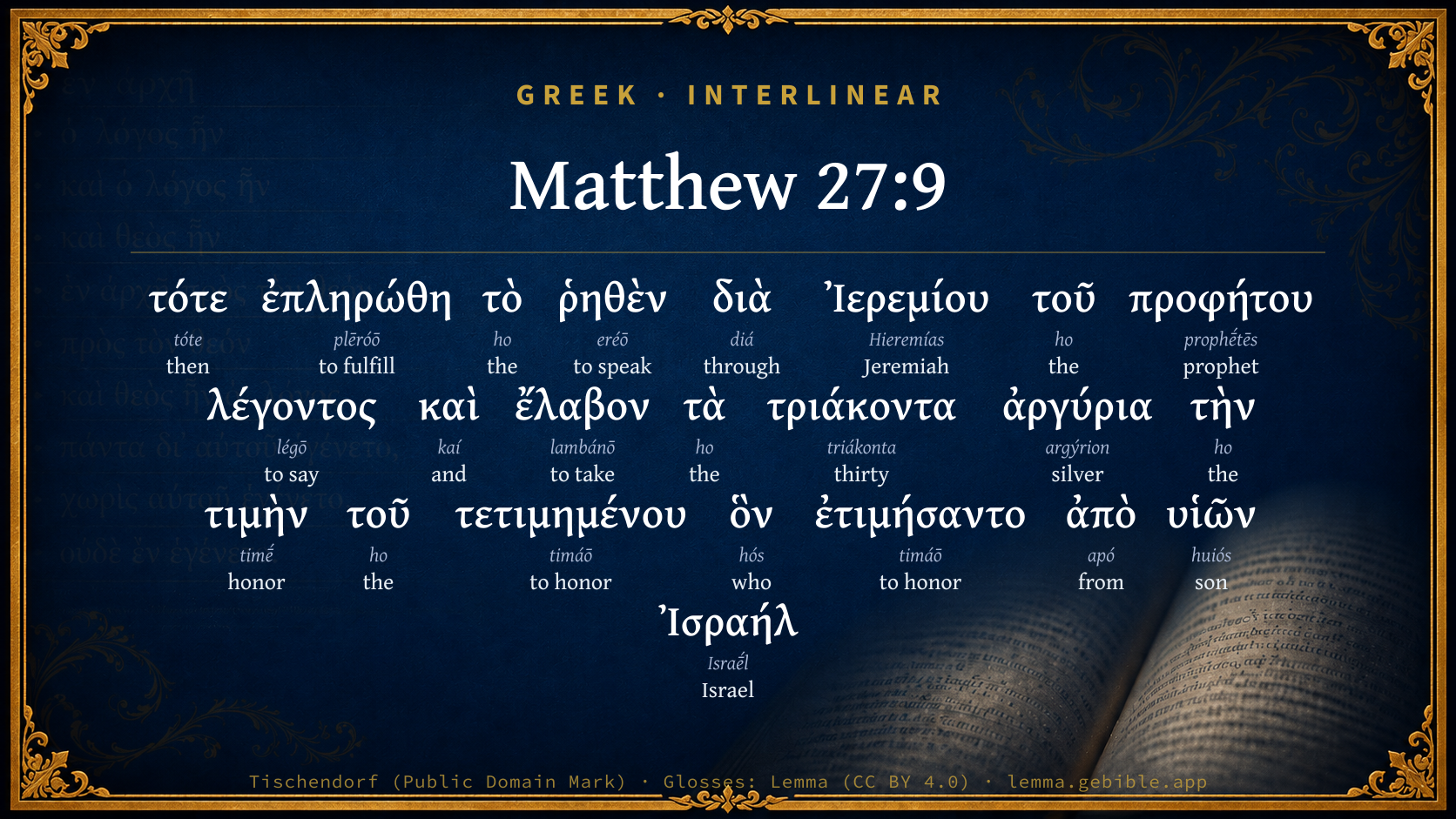
  1. τότε tóte G5119 “then” Adverb
  2. ἐπληρώθη plēróō G4137 “to fulfill” Verb, Aorist, Passive, Indicative, 3rd person, Singular
  3. τὸ ho G3588 “the” Article, Nominative, Singular, Neuter
  4. ῥηθὲν eréō G2046 “to speak” Verb, Aorist, Passive, Participle, Nominative, Singular, Neuter
  5. διὰ diá G1223 “through” Preposition
  6. τοῦ ho G3588 “the” Article, Genitive, Singular, Masculine
  7. προφήτου prophḗtēs G4396 “prophet” Noun, Genitive, Singular, Masculine
  8. λέγοντος légō G3004 “to say” Verb, Present, Active, Participle, Genitive, Singular, Masculine
  9. καὶ kaí G2532 “and” Conjunction
  10. ἔλαβον lambánō G2983 “to take” Verb, Aorist, Active, Indicative, 3rd person, Plural
  11. τὰ ho G3588 “the” Article, Accusative, Plural, Neuter
  12. τριάκοντα triákonta G5144 “thirty” Adjective, Numeral (indeclinable)
  13. ἀργύρια argýrion G694 “silver” Noun, Accusative, Plural, Neuter
  14. τὴν ho G3588 “the” Article, Accusative, Singular, Feminine
  15. τιμὴν timḗ G5092 “honor” Noun, Accusative, Singular, Feminine
  16. τοῦ ho G3588 “the” Article, Genitive, Singular, Masculine
  17. τετιμημένου timáō G5091 “to honor” Verb, Perfect, Passive, Participle, Genitive, Singular, Masculine
  18. ὃν hós G3739 “who” Relative pronoun, Accusative, Singular, Masculine
  19. ἐτιμήσαντο timáō G5091 “to honor” Verb, Aorist, Middle, Indicative, 3rd person, Plural
  20. ἀπὸ apó G575 “from” Preposition
  21. υἱῶν huiós G5207 “son” Noun, Genitive, Plural, Masculine
  22. Ἰσραήλ Israḗl G2474 “Israel” Noun, Proper, indeclinable

About this verse

These counts appear in no published source. They are computed here, from the morphology-tagged text and Lemma’s own curated glosses. What Lemma adds →

23
words
18
distinct lemmas
Gospels
section

Notable vocabulary

The rarest word here is Ἰερεμίου Jeremiah G2408 — appearing just 3 times in the whole Greek New Testament.

Shared distinctive vocabulary

Ἰερεμίου Jeremiah G2408 occurs in 3 verses of the Greek New Testament. Also found in:

Repetition

Words recur within this verse:

  • τετιμημένου to honor G5091 ×2
  • τὸ the G3588 ×5

Cross-references

3

Topical passages linked to Matthew 27:9 in the Treasury of Scripture Knowledge — connected by theme and wording, ordered by reader-vote popularity; previews shown in the World English Bible.

  • Zechariah 11:12–13 I said to them, "If you think it best, give me my wages; and if not, keep them." So they weighed for my wages thirty pieces of silver.
  • Leviticus 27:2–7 "Speak to the children of Israel, and say to them, 'When a man makes a vow, the persons shall be for Yahweh by your valuation.
  • Matthew 1:22 Now all this has happened, that it might be fulfilled which was spoken by the Lord through the prophet, saying,

Cross-references courtesy of OpenBible.info (CC BY 4.0).

Commentary

Notes on Matthew 27:9 from classic Christian and Jewish commentators (each source and its license shown beneath its notes). The classic Christian expositions comment on the surrounding passage and are grouped to its opening verse, so a note may address several verses; the Jewish commentaries on the Tanakh (Rashi and others) are per-verse, so they appear only where the commentator wrote on this verse.

Lemma curates 59 commentaries, every one of them public domain or Creative Commons licensed, each selected and text-cleaned for this edition rather than reprinted as found. About our sources →

Joseph Benson's Commentary

Mat 27:9. Then was fulfilled that which was spoken by Jeremy — The words here quoted are not in any copy of Jeremiah extant. But they bear a strong resemblance to the words of Zec 11:12-13. One MS., not of great account, has Ζεχαριου, of Zechariah. Another adds no name to the word prophet, and there is none added in the Syriac version, the words being only, which was spoken by the prophet. And it seems, from a remark of Augustine, that some copies in his time named no prophet. Indeed it is not improbable that the name Jeremiah was inserted by some officious transcriber. Or we may suppose, with Bishop Hall, that in copying the words, Jeremiah was put down for Zechariah, a blunder which transcribers might easily commit, especially if the names were written by abbreviation, Ιριου for Ζριου, as the bishop says he has seen in some ancient MSS. But if the present reading is retained, we may allow, that, as the Jewish Scriptures were divided into three parts, the Law, the Prophets, and the Psalms, what was found in the prophets might properly enough be said to be in Jeremiah, if his prophecies stood first in the collection, just as our Lord affirmed that whatever was in the Hagiographa concerning him, was contained in the Psalms, because the Psalms stood first in that division of the Scriptures. Or, we may adopt the solution offered by Grotius, who observes, that the Jews had many prophecies handed down to them by tradition, such as the prophecy of Enoch, Jdg 1:14-15, and the traditionary prophecies concerning the destruction of Jerusalem mentioned by Josephus, and that the later prophets often allude to and repeat the words of the former. He therefore declares it to be his opinion, that the prophecy concerning the thirty pieces of silver, recorded Zec 11:12-13, which represented symbolically, according to the manner of the prophets, the things that were to befall the Messiah, was originally acted and spoken by Jeremiah, as Matthew affirms; but that Zechariah, who in many particulars followed Jeremiah, was directed by the Spirit to repeat it afterward, and preserve it in writing among his other prophecies; and that the Jews had preserved the knowledge of this fact by tradition; wherefore, though it be now found in Zechariah, being originally spoken by Jeremiah, Matthew has committed no error here in referring it to him. See note on Zec 11:12-13.

Joseph Benson's Commentary on the Old and New Testaments (1811–1818) — public domain. Text from a community e-Sword module.

Tyndale Open Study Notes

Tyndale Open Resources

27:9-10 the prophecy of Jeremiah: The citation is from Zech 11:12-13. Matthew might merely have been conforming to the Jewish custom of citing books by referring to the first book in the particular scroll—the first book in the scroll containing Zechariah would have been Jeremiah. Or, Matthew might have thought of similar passages in Jeremiah (Jer 19:1-13; 18:2-6; 32:6-15) along with Zech 11:12-13. • Matthew sees a striking resemblance between Zechariah’s actions and those of the leading priests. Both contexts deal with the rejection of God’s messenger who was to be king of God’s people.

Tyndale Open Study Notes — © Tyndale Open Resources, licensed CC BY-SA 4.0. Text via the HelloAO Bible API.

Bengel's Gnomon

Johann Albrecht Bengel

Mat 27:9. Τοῦ προφήτου, κ.τ.λ., the prophet, etc.) These words are clearly found in Zechariah, whose writings were well known to St Matthew; see ch. Mat 21:4-5; cf. App. Crit.[1175] p. 493 (Ed. ii. pp. 141, 142).—καὶ ἔλαβον, κ.τ.λ., and they took, etc.) In Zec 11:12-13, the LXX. have καὶ ερῶ πρὸς αὐτοὺς, εἰ καλὸν ἐνώπιον ὑμῶν ἐστι, δότε στήσαντες[1176] τὸν μισθόν μου, ἢ ἀπείπασθε· καὶ ἔστησαν τὸν μισθόν μου τριάκοντα ἀργυροῦς, καὶ εἶπε Κύριος πρός με· κάθες αὐτοὺς εἰς τὸ χωνευτήριον, καὶ σκέψομαι αὐτὸ, εἰ δοκιμόν ἐστιν, ὅν τρόπον ἐδοκιμάσθην ὑπὲρ αὐτῶν. καὶ ἔλαβον τοὺς τριάκοντα ἀργυροῦς, καὶ ἐνέβαλον αὐτοὺς εἰς οἶκον Κυρίου εἰς τὸ χωνευτήριον—And I will say unto them, if it is good in your sight, weigh and give me my price, or else refuse it; and they weighed my price, thirty silver pieces. And the Lord said unto me, Cast them into the melting furnace, and I will assay it (whether it be good) in the same manner that I was assayed by them. And I took the thirty silver pieces, and cast them into the house of the Lord, into the melting furnace. The Evangelist regards the scope of the matter, and adds a paraphrase.—τὴν τιμὴν τοῦ τετιμημένου, ὅν ἐτιμήσαντο, the value of Him that was valued, whom they valued) The force of the words is great.—ὁ τετιμημένος—הַיְּקָר, precious, although in the Hebrew Bible it is הַיְקָר, a price; see Louis de Dieu.—ἀπὸ υἱῶν Ἰσραὴλ, from the children of Israel, or of the children of Israel) cf. Zec 11:13—מעליחם, of them. The preposition ἈΠῸ, from, may be construed either with ἒλαβον, they received—or rather with ἘΤΙΜΉΣΑΝΤΟ, they valued. The Chief Priests, as much as in them lay, alienated Christ from the children of Israel.

[1175] E. M. has’ Ἰερεμίου.

[1176] The Vatican MS. omits the word στήσαντες.—(I. B.)

Beng. shows, in his Apparatus, Ed. ii., p. 141, 142, 493, that the word Ἰερεμίου is a gloss, and that many modern writers wish to expunge it.—Not. Crit.

But the oldest authorities are against the omission. B reads Ἱερεμίου. A and C corrected, Ἱηρεμίου. Hil. 747, Vulg. and c, and MSS. quoted in Origen, Euseb., and Jerome, read Jeremiah. It is only the later Syr. in the margin, and other recent authorities, read Ζαχαρίου. ab, however, support the omission of Jeremiah or Zechariah, as Beng. would read. Comp. Jer 18:2. The quotation is not literatim from Zech.: Jer 18:1-2, and Jer 32:6-12, may have also been in the mind of Matthew. This may account for the presence of the name Ἱερεμίου. Lightfoot thinks that the 3d division of Scripture, the Prophets, began with Jeremiah; and that the whole body of the prophets is thus quoted by the name Jeremiah, he refers to B. Bathra and D. Kimchi.—ED.

Bengel's Gnomon of the New Testament — English translation (T&T Clark, Edinburgh, 1860) — public domain. Text from a community e-Sword module.

Meyer's Critical & Exegetical Commentary

Heinrich August Wilhelm Meyer

Mat_27:9 f. Τότε] when they bought this field for the thirty pieces of money.

The passage here quoted is a very free adaptation of Zec_11:12-13,[32] Ἱερεμίου being simply a slip of the memory (comp. Augustine, de cons. ev. iii. 8, and recently Keil himself, following Calvin and the Fathers), such, however, as might readily enough occur through a reminiscence of Jer_18:2. Considering that in the original Hebrew the resemblance of this latter passage to Zechariah, as above, is sufficiently close to warrant the typical mode of interpretation (Credner, Beitr. II. p. 152 f.), it is arbitrary to maintain, in the somewhat uncritical fashion of Rupert, Lyra, Maldonatus, Jansen, Clericus, Friedlieb, that Ἱερεμίου is spurious; or, on the other hand, to resort, as Origen, Euthymius Zigabenus, Kuinoel, Ewald have done, to the idea of some lost production of Jeremiahs, or of some oral utterance that had never been committed to writing (see, above all, Calovius, who in support of this view lays great stress on ῥηθέν). As for the statement of Jerome, that he had seen the passage in a copy of Jeremiah belonging to some person at Nazareth, there can be no doubt that what he saw was an interpolation, for he also is one of those who ascribe the citation in question to Zechariah. No less arbitrary is the conjecture of Eusebius, Dem. ev. x. 4, that the Jews may have deleted the passage from Jeremiah; for though it reappears again in a certain Arabic work (Bengel, Appar. crit. p. 142), and in a Sahidic and a Coptic lectionary (see Michaelis, Bibl. IV. p. 208 ff.; Briefwechs. III. pp. 63, 89; Einleit. I. p. 264), it does so simply as an interpolation from our present passage. See Paulus, exeget. Handb. III. p. 615 ff.

According to the historical sense of Zechariah, as above, the prophet, acting in Jehovahs name, resigns his office of shepherd over Ephraim to Ephraims own ruin; and having requested his wages, consisting of 30 shekels of silver, to be paid him, he casts the money, as being Gods property, into the treasury of the temple. And they weighed for my wages thirty pieces of silver. Then Jehovah said to me: Cast it into the treasury, that handsome (ironically) sum of which they have thought me worthy! So I took the thirty pieces of silver, and cast them into the treasury that was in Gods house, Ewald, Proph.; Bleek in the Stud. u. Krit. 1852, p. 279 ff. For we ought to read אֶל־הַיּוֹצָר, into the treasury (equivalent, as Kimchi explains, to אל האוצר, and as is actually the reading of two MSS. in Kennicott), and not אֶל־הַיּוֹצֵר, to the potter, as Matthew, in fact, also read and understood the words, though such a meaning is entirely foreign to the context in Zechariah. Comp. Hitzig, kl. Proph. p. 374. The expositors of Zechariah, who take היוֹצר in the sense of potter, have had recourse to many an unfounded and sometimes singular hypothesis. For specimens of these, see also Hengstenbergs Christol. III. 1, p. 457 ff.; Hofmann, Weissag. u. Erf. II p. 128 f.; Lange, L. J. II. p. 1494 f.; Steinmeyer, p. 105 f.; Haupt, alttest. Citate, p. 272 ff.

ἔλαβον] in Zechaiah and LXX. is the first person singular, here it is the third person plural. The liberty thus used with the terms of the quotation may be supposed to be warranted by the concluding words: καθὰ συνέταξέ μοι ὁ κύριος. Neither the original Hebrew nor the LXX. countenances the supposition that the evangelist erroneously took ἜΛΑΒΟΝ to be third person plural, like ἜΔΩΚΑΝ immediately following (in opposition to Hilgenfeld).

ΤᾺ ΤΡΙΆΚΟΝΤΑ ἈΡΓΎΡ.] meaning, according to the typical reference in Matthew, the thirty shekels brought back by Judas.

τὴν τιμὴν, κ.τ.λ.] In apposition with τὰ τριάκ. ἀργ. The words correspond more with the Hebrew than with the LXX., though in this instance too a slight liberty is taken with them, inasmuch as for אֲשֶׁר יָקַרְתִּי we have once more (comp. on ἔλαβον) the third person plural ὃν ἐτιμήσαντο, and for מֵעֲלֵיהֶם the explanatory rendering ἀπὸ υἱῶν Ἰσραήλ. The passage then is to be rendered as follows: And they took the thirty pieces of silverthe value of the highly valued One, on whom they put their own price (middle, ἘΤΙΜΉΣΑΝΤΟ) at the instance of sons of Israel, i.e. the price of the priceless One, whose market value they fixed for themselves upon an occasion furnished by sons of Israel. The expression ΥἹῶΝ ἸΣΡΑΉΛ is the plural of category (Mat_2:20), and is regarded as finding its historical antitype in Judas, who, Mat_26:14 f., undertakes and carries through the shameful transaction there referred to,he a son of Israel negotiates the sale of the Messiah of the people of Israel. In addition to what has just been observed, we would direct attention to the following details:(1) τοῦ τετιμημένου is intended to represent the Hebrew word הַיְקָר (pretii); but the evangelist has evidently read הַיָקָר (cari, aestumati), which he refers to Jesus as being the highly valued One ΚΑΤʼ ἘΞΟΧΉΝ; nor must we fail to notice here the remarkable collocation: pretium pretiosi, i.e. τὴν ὠνὴν τοῦ παντίμου Χριστοῦ, Euthymius Zigabenus; comp. Theophylact, also Ewald. That distinguished personage, whose worth as such cannot in fact be estimated by any mere money standard (τιμή), they have actually valued (ἐτιμήσαντο) at thirty shekels! To take the τοῦ τετιμημ. merely in the sense of ὃν ἐτιμής. (of the valued one, him whom they have valued), as the majority of expositors do (including even yet de Wette, Lange, and Hofmann, Weissag. u. Erf. II. p. 130), instead of expressing the idea in a more forcible manner, would simply produce, especially after τ. τιμήν, a tautological redundancy. (2) The subject of ἐτιμήσαντο is the same as that of ἔλαβον, namely, the high priests; nor is the verb to be taken in the sense of estimating highly, as in the case of τετιμημ., but in that of valuing, putting a price upon, the sense in which it is used in Isa_55:2, and very frequently by classical writers, and in which the Hebrew יָקַרְתִּי is intended to be understood. (3) ἈΠῸ ΥἹῶΝ ἸΣΡ., which is a more definite rendering of the מעליהם of the original, must necessarily be connected, like its corresponding Hebrew expression, with ἘΤΙΜΉΣΑΝΤΟ, and not with ἜΛΑΒΟΝ (Fritzsche, Hilgenfeld), nor with ΤΟῦ ΤΕΤΙΜΗΜ. (which de Wette considers possible), and be understood as denoting origin, i.e. as denoting, in our present passage, the occasion brought about by some one (comp. also Bleek) in connection with which the ἘΤΙΜΉΣΑΝΤΟ took place; ἈΠΌ de eo ponitur, quod praebet occasionem vel opportunitatem, ut aliquid fieri possit, Stallbaum, ad Plat. Rep. p. 549 A; comp. Kühner, II. 1, p. 396; similarly xi. 19; see also Ellendt, Lex. Soph. I. p. 194. They were indebted to the sons of Israel (Judas, see above) for that which suggested and led to the ἘΤΙΜΉΣΑΝΤΟ. We cannot approve of the course which some adopt of supplying ΤΙΝΈς: equivalent to ΟἹ ἸΣΡΑΗΛῖΤΑΙ (Euthymius Zigabenus), or qui sunt ex filiis Israel (Beza, Grotius, Maldonatus, Paulus, Kuinoel, Ewald, de Wette, Grimm, Anger), thus making ἀπὸ υἱῶν Ἰσρ. the subject of ἐτιμής. In that case, the ordinary ἐκ (comp. Buttmann, Neut. Gr. p. 138 [E. T. 158]) would have been used (as in Mat_23:34; Joh_16:17, al.), and instead of υἱῶν we should have had τῶν υἱῶν, inasmuch as the whole community would be intended to which the τινές are supposed to belong. Comp. also 1Ma_7:33, 3Ma_1:8, where, though ἀπό is the preposition used, the article is conjoined with the substantive following. The absence of the article here is likewise unfavourable to the views of Hofmann, Weissag. u. Erf. II. p. 131, who, taking ἈΠΌ to mean on the part of, interprets thus: What Caiaphas and Judas did (ἐτιμήσαντο), was done indirectly by the whole nation. To explain ἈΠΌ as others have done, by assuming the idea of purchase in connection with it (Castalio: quem licitati emerunt ab Israelitis, comp. Erasmus, Luther, Vatablus, Jansen, Lange), is not only arbitrary, inasmuch as the idea involved in ἐτιμήσαντο does not justify the supposed pregnant force of ἀπό (Buttmann, p. 276 [E. T. 322]), but is incompatible with the מעל of the original. No less inconsistent with the original is the explanation of Baumgarten-Crusius: whom they had valued from among the children of Israel, that is to say, which they had fixed as the price of one of the children of Israel. In that case, again, we should have required the article along with ΥἹῶΝ; and, besides, what a poor designation of the Messiah would be the result of such an interpretation! With an equal disregard of the terms of the passage, Linder maintains, in the Stud. u. Krit. 1859, p. 513, that ἀπό is equivalent to τινὰ ἐκ: as an Israelite (whom they treated like a slave); and to the same effect is the explanation of Steinmeyer, p. 107: whom they have valued in the name of the nation. Neither the simple ἀπό nor the anarthrous υἱῶν Ἰσρ. admits of being so understood, although Hilgenfeld is also of opinion that our passage meant to describe the betrayal as an act for which the whole body of the Jewish people was to be held responsible. Mat_27:10. ΚΑῚ ἜΔΩΚΑΝ ΑὐΤᾺ ΕἸς ΤῸΝ ἈΓΡῸΝ ΤΟῦ ΚΕΡΑΜ.] Zech., as above, וְוַישְׁלִךְ אוֹתוֹ בֵּית יְהֹוָה אֶל הַיּוֹצֵר. But, inasmuch as the important matter here was the purchase of the potters field, Matthew leaves בית יהוה entirely out of view, takes יוֹצֵר in the sense of potter (see, on the other hand, on Mat_27:9 above), and, in order that אֶל הַיּוֹצֵר may fully harmonize with a typical and prophetic view of the passage, he paraphrases the words thus: εἰς τὸν ἀγρὸν τοῦ κεραμέως, where εἰς is intended to express the destined object of the thing: for the purpose of acquiring the field belonging to the potter.

καθὰ συνέταξέ μοι κύριος] corresponds to Zechariahs וַיֹּאמֶר יְהֹוָה אֵלַי, Mat_27:13, the words employed by the prophet when he asserts that in casting the shekels into the treasury of the temple he did so in obedience to the command of God. In accordance with the typical reference ascribed to the passage by Matthew, the words according to that which the Lord commanded me are so applied as to express the idea that the using of the traitors reward for the purpose of buying the potters field was simply giving effect to the decree of Him from whom the prophet had received the command in question. That which God had commissioned the prophet (μοι) to do with the thirty pieces of silver is done in the antitypical fulfilment of the prophecy by the high priests, who thus carry out the divine decree above referred to. Καθά, just as (Xen. Mem. iv. 6. 5; Polyb. iii. 107. 10; Lucian, Cont. 24; Diod. Sic. i. 36; in classical Greek ΚΑΘΆΠΕΡ is usually employed), occurs nowhere else in the New Testament. It is quite possible that the words used in the Hebrew original of Matthew were בַּאֲשֶׁר דִּבֶּר or בַּאֲשֶׁר צִוָּה, which in the LXX. are likewise rendered by ΚΑΘᾺ ΣΥΝΈΤΑΞΕ, Exo_9:12; Exo_40:25; Num_8:3.

[32] If the evangelist had meant to combine two different predictions (Hofmann, Weissag. u. Erf. II. p. 128 f.; Haupt, alttest. Citate, p. 286 ff.), then, according to the analogy of Mat_2:23, we should have expected the words διὰ τῶν προφητῶν to be used. But, in short, our quotation belongs so exclusively to Zechariah, that candour forbids the idea of a combination with Jeremiah 18, as well as the view adopted by Hengstenberg (comp. Grotius), that Zechariah reproduces the prediction of Jeremiah. For a detailed enumeration of the various attempts that have been made to deal with the inaccurate use of Ἱερεμίου, consult Morison, who follows Clericus in holding that there must have been a transcribers error in the very earliest copy of our Gospel.

Meyer — Critical and Exegetical Commentary on the New Testament — English translation by Peter Christie, edited by Frederick Crombie (T&T Clark, 1880) — public domain. Text from a community e-Sword module.

Expositor's Greek Testament

ed. W. Robertson Nicoll

Mat 27:9-10 . Prophetic reference , τότε , as in Mat 2:17 , not ἵνα or ὅπως . διὰ Ἰερεμίου , by Jeremiah, in reality by Zechariah (Zec 11:13 ), the reference to Jeremiah probably due to there being somewhat similar texts in that prophet (Jer 18:2-3 , Jer 32:6-15 ) running in the evangelist’s mind. A petty error. More serious is the question whether this is not a case of prophecy creating “facts,” whether the whole story here told is not a legend growing out of the O. T. text quoted. So Brandt, who thinks the betrayal the only fact in the story of Judas, all the rest legendary ( E. G. , p. 11). The truth rather seems to be that facts, historical traditions, suggested texts which otherwise would never have been thought of. This may be inferred from the manipulation necessary to make the prophecy correspond to the facts: ἔλαβον , 1st person singular in Sept [149] , 3rd person plural here = they took; the expression “the children of Israel” introduced with apparent intention to make the nation responsible for the betrayal; the substitution of the phrase “the field of the potter” for “the house of the Lord”. And after all the manipulation how different the circumstances in the two cases! In the one case it is the prophet himself, valued at a petty sum, who cast his price into the House of the Lord; in the other, it is the priests, who bought the life of the prophet of Nazareth for a small sum, who give the money for a potter’s field. The only real point of resemblance is the small value set upon a prophet in either case. It is a most unsatisfactory instance of prophetic fulfilment, almost as much so as that in Mat 2:23 . But its very un-satisfactoriness makes for the historicity of the story. That the prophetic text, once associated with the story in the minds of believers, reacted on the manner of telling it, e.g. , as to the weighing of the price (Mat 26:15 ), and the casting of the money into the holy place (Mat 27:5 ), is conceivable.

[149] Septuagint.

The Expositor's Greek Testament, edited by W. Robertson Nicoll (1897–1910) — public domain. Text from a community e-Sword module.

Geneva Bible (1599)

Geneva Bible translators

Seeing this prophecy is read in Zech. 11:12, it cannot be denied, but Jeremiah’s name crept into the text, either through the Printer’s fault, or some other’s ignorance: it may be also that it came out of the margin, by reason of the abbreviation of the letters, the one being iou, and the other zou, which are not much unlike: but in the Syrian text the Prophet’s name is not set down at all.

The Evangelist doth not follow the Prophet’s words, but his meaning, which he showeth to be fulfilled.

Geneva Bible (1599) marginal notes — public domain. Text via Bolls.life.

Jamieson, Fausset & Brown

Robert Jamieson, A. R. Fausset & David Brown

Then was fulfilled that which was spoken by Jeremy the prophet, saying-- (Zac 11:12-13). Never was a complicated prophecy, otherwise hopelessly dark, more marvellously fulfilled. Various conjectures have been formed to account for Matthew's ascribing to Jeremiah a prophecy found in the book of Zechariah. But since with this book he was plainly familiar, having quoted one of its most remarkable prophecies of Christ but a few chapters before (Mat 21:4-5), the question is one more of critical interest than real importance. Perhaps the true explanation is the following, from LIGHTFOOT: "Jeremiah of old had the first place among the prophets, and hereby he comes to be mentioned above all the rest in Mat 16:14; because he stood first in the volume of the prophets [as he proves from the learned DAVID KIMCHI] therefore he is first named. When, therefore, Matthew produceth a text of Zechariah under the name of JEREMY, he only cites the words of the volume of the prophets under his name who stood first in the volume of the prophets. Of which sort is that also of our Saviour (Luk 24:41), "All things must be fulfilled which are written of Me in the Law, and the Prophets, and the Psalms," or the Book of Hagiographa, in which the Psalms were placed first."

Jamieson, Fausset & Brown — Commentary Critical and Explanatory on the Whole Bible (1871) — public domain (CC PDM 1.0). Text via the HelloAO Bible API.

Adam Clarke's Commentary

Verse 9. Jeremy the prophet] The words quoted here are not found in the Prophet Jeremiah, but in Zec 11:13. But St. Jerome says that a Hebrew of the sect of the Nazarenes showed him this prophecy in a Hebrew apocryphal copy of Jeremiah; but probably they were inserted there only to countenance the quotation here.

One of Colbert's, a MS. of the eleventh century, has ζαξαριου, Zechariah; so has the later Syriac in the margin, and a copy of the Arabic quoted by Bengel. In a very elegant and correct MS. of the Vulgate, in my possession, written in the fourteenth century, Zachariam is in the margin, and Jeremiam in the text, but the former is written by a later hand. Jeremiah is wanting in two MSS., the Syriac, later Persic, two of the Itala, and in some other Latin copies. It is very likely that the original reading was δια τοι προφητου, and the name of no prophet mentioned. This is the more likely, as Matthew often omits the name of the prophet in his quotations. See Mt 1:22; Mt 2:5; Mt 2:15; Mt 13:35; Mt 21:4. Bengel approves of the omission.

It was an ancient custom among the Jews, says Dr. Lightfoot, to divide the Old Testament into three parts: the first beginning with the law was called THE LAW; the second beginning with the Psalms was called THE PSALMS; the third beginning with the prophet in question was called JEREMIAH: thus, then, the writings of Zechariah and the other prophets being included in that division that began with Jeremiah, all quotations from it would go under the name of this prophet. If this be admitted, it solves the difficulty at once. Dr. Lightfoot quotes Baba Bathra, and Rabbi David Kimchi's preface to the prophet Jeremiah, as his authorities; and insists that the word Jeremiah is perfectly correct as standing at the head of that division from which the evangelist quoted, and which gave its denomination to all the rest. But Jeremiah is the reading in several MSS. of the Coptic. It is in one of the Coptic Dictionaries in the British Museum, and in a Coptic MS. of Jeremiah, in the library of St. Germain. So I am informed by the Rev. Henry Tattam, Rector of St Cuthbert's, Bedford.

Adam Clarke's Commentary on the Bible (1810–1826) — public domain. Text from a community e-Sword/MySword module.

Ellicott's Commentary for English Readers

(9) Then was fulfilled.—Three questions present themselves, more or less difficult:—(1) The words cited are found in our present Old Testament, not in Jeremiah, but in Zec_11:13, and there is no trace of their ever having occupied any other place in the Hebrew Canon. How is this discrepancy to be explained? (a) Are we to assume an early error in transcription? Against this, there is the fact that MSS. and versions, with one or two exceptions, in which the correction is obviously of later date, give Jeremiah and not Zechariah. (b) May we fall back upon the Jewish notion that the spirit of Jeremiah had passed into Zechariah; or that Jeremiah, having, at one time, stood first in the Jewish order of the Prophets, was taken as representing the whole volume, as David was of the whole Book of Psalms? This is possible, but it hardly falls within the limits of Probability that the writer of the Gospel would deliberately have thus given his quotation in a form sure to cause perplexity. (c) May we believe that the writer quoted from memory, and that recollecting the two conspicuous chapters (18 and 19) in which Jeremiah had spoken of the potter and his work, he was led to think that this also belonged to the same group of prophecies? I am free to confess that the last hypothesis seems to me the most natural and free from difficulty, unless it be the difficulty which is created by an arbitrary hypothesis as to the necessity of literal accuracy in an inspired writing. (2) There is the fact that the words given by St. Matthew neither represent the Greek version of Zec_11:13, nor the original Hebrew, but have the look of being a free quotation from memory adapted to the facts; and this, so far as it goes, is in favour of the last hypothesis. (3) It is hardly necessary to dwell on the fact that the words as they stand in Zechariah have an adequate historical meaning entirely independent of St. Matthew’s application of them. This, as we have seen again and again (Mat_1:23; Mat_2:15-18; Mat_4:15; Mat_8:17; Mat_12:18), was entirely compatible with the Evangelist’s manner of dealing with prophecy. It was enough for him that the old words fitted into the facts, without asking, as we ask, whether they were originally meant to point to them. The combination in one verse, as he remembered it, of the thirty pieces of silver and the potter’s field, was a coincidence that he could not pass over.

A Bible Commentary for English Readers, edited by Charles John Ellicott (1878–1897) — public domain. Text from a community e-Sword module.

The Cambridge Bible for Schools and Colleges

gen. ed. J. J. S. Perowne

9. that which was spoken by Jeremie the prophet] The citation is from Zec_11:13, but neither the Hebrew nor the LXX. version is followed exactly. The Hebrew literally translated is: “And Jehovah said to me, ‘Cast it unto the potter,’ a goodly price that I was prized at by them. And I took the thirty pieces of silver, and cast them unto the potter in the house of Jehovah.” Zechariah, under the image of a shepherd, refuses any longer to lead the disobedient and divided flock, and asks for the price of his hire, which he then casts into the treasury. The discrepancy is probably due to the citation being made from memory. The ascription of the words to Jeremiah instead of to Zechariah may be assigned to the same cause, or explained, with Lightfoot (Hor. Hebr. ad loc.), by supposing that Jeremiah, who begins the Book of the Prophets in the Hebrew Canon, is intended to indicate the whole of that division of the Scriptures.

The Cambridge Bible for Schools and Colleges (gen. ed. J. J. S. Perowne; Cambridge University Press, 1878–1918) — public domain. Text from a community e-Sword module.

John Gill's Exposition

Then was fulfilled that which was spoken by Jeremy the prophet,.... Through the purchasing of the potter's field with the thirty pieces of silver, the price that Christ was valued at, a prophecy in the writings of the Old Testament had its accomplishment: but about this there is some difficulty. The evangelist here says it was spoken by Jeremy the prophet; whereas in his prophecy there is no mention of any such thing. There is indeed an account of his buying his uncle Hanameel's son's field, in Jer 32:7, but not a word of a potter, or a potter's field, or of the price of it, thirty pieces of silver; and that as a price at which he, or any other person was valued; but the passage which is manifestly referred to, stands in Zac 11:12, where are these words, "and I said unto them, if ye think good, give me my price, and if not, forbear; so they weighed for my price thirty pieces of silver: and the Lord said unto me, cast it unto the potter, a goodly price that I was prized at of them. And I took the thirty pieces of silver, and cast them to the potter in the house of the Lord": the removing of this difficulty, it might be observed, that the Syriac and Persic versions make no mention of any prophet's name, only read, "which was spoken by the prophet"; and so may as well be ascribed to Zechariah, as to Jeremy, and better: but it must be owned, that Jeremy is in all the Greek copies, in the Vulgate Latin, Arabic, and Ethiopic versions, and in Munster's Hebrew Gospel. Various things are said for the reconciling of this matter: some have thought that Zechariah had two names, and that besides Zechariah, he was called Jeremy; but of this there is no proof. Jerom (y) affirms, that in an Hebrew volume, being an apocryphal work of Jeremy, which was shown him by one of the Nazarene sect, he read these words verbatim: so that though they do not stand in the writings of Jeremy, which are canonical Scripture, yet in an apocryphal book of his, and which may as well be referred to, as the book of Maccabees, the traditions of the Jews, the prophecies of Enoch, and the writings of the Heathen poets. Moreover, Mr. Mede (z) has laboured, by various arguments, to prove, that the four last chapters of Zechariah were written by Jeremy, in which this passage stands; and if so, the reason is clear, for the citation in his name. But what seems best to solve this difficulty, is, that the order of the books of the Old Testament is not the same now, as it was formerly: the sacred writings were divided, by the Jews, into three parts: the first was called the law, which contains the five books of Moses; the second, the prophets, which contains the former and the latter prophets; the former prophets began at Joshua, and the latter at Jeremy; the third was called Cetubim, or the Hagiographa, the holy writings, which began with the book of Psalms: now, as this whole third and last part is called the Psalms, Luk 24:44, because it began with that book; so all that part which contained the latter prophets, for the same reason, beginning at Jeremy, might be called by his name; hence a passage, standing in the prophecy of Zechariah, who was one of the latter prophets, might be justly cited, under the name of Jeremy. That such was the order of the books of the Old Testament, is evident from the following passage (a).

"it is a tradition of our Rabbins, that the order of the prophets is, Joshua and Judges, Samuel and the Kings, Jeremiah and Ezekiel, Isaiah, and the twelve.''

Moreover, it is usual with them to say (b), that the spirit of Jeremiah was in Zechariah; and it is very plain, that the latter prophets have many things from the former; and so might Zechariah have this originally from Jeremy, which now stands in his prophecy: all this would be satisfactory to a Jew: and it is to be observed, that the Jew (c), who objects to everything he could in the evangelist, with any appearance on his side, and even objects to the application of this prophecy; yet finds no fault with him for putting Jeremy for Zechariah. That the prophecy in Zechariah belongs to the Messiah, and was fulfilled in Jesus, manifestly appears from the context, for as well as the text itself. The person spoken of is in Zac 11:4, called to "feed the flock of slaughter", which being in a very poor condition, Zac 11:5, the state of the Jews, at the time of Christ's coming, is hereby very aptly represented: he agrees to do it, Zac 11:7, and accordingly furnishes himself for it; but he is despised, abhorred, and rejected by the shepherds, the principal men in church and state; because he severely inveighed against their doctrines and practices, Zac 11:8, upon which he rejects them, and dissolves both their civil and church state; which can suit with no other times than the times of Jesus, Zac 11:9, and lest it should be thought that he used them with too much severity, he gives one single instance of their ingratitude to him, which shows how little they esteemed him; and that is, their valuing him at no greater a price than "thirty pieces of silver", Zac 11:12, which were afterwards "cast unto the potter". The Jews (d) themselves own, that this prophecy belongs to the Messiah, though they interpret it of him in another manner.

"Says R. Chanun, the Israelites will have no need of the doctrine of the king Messiah in the time to come; as it is said, Isa 11:10, "to him shall the Gentiles seek", and not the Israelites: if so, for what does the king Messiah come? and what does he come to do? to gather the captives of Israel, and to give them the thirty precepts, as it is said, Zac 11:12, "and I said unto them, if ye think good", &c. Rab says, these are the thirty mighty men; and Jochanan says, these are the thirty commands.''

Should it be objected, that supposing the Messiah is intended, the money is said to be given into his hands, and not into the hands of him that was to betray him; "if ye think good, give me my price", Zac 11:12, it may be replied, that the words , should not be rendered, "give me my price", but "give my price"; i.e. give what you think fit to value me at, into the hands of the betrayer; and accordingly they did: "so they weighed for my price thirty pieces of silver", Zac 11:12; which is the very sum the chief priests agreed with Judas for, and which he received; see Mat 26:15, and if it should be objected to the citation of the evangelist, that it is considerably different from the word of the prophet, it being in the latter, "I took the thirty pieces of silver"; whereas in the former, the words are quoted thus,

saying, and they took the thirty pieces of silver, the price of him that was valued, whom they of the children of Israel did value: it may be observed, that the word which Matthew uses may be rendered, "I took", as it is in the Syriac version; and that the thirty pieces of silver were the goodly price, at which the Messiah was valued by the children of Israel, is manifest enough; and is an instance of egregious ingratitude, that this should be the price of the "innocent one", as the Arabic Version renders the phrase, "of him that was valued"; of the "honoured one", as the Ethiopic; of the "most precious one", as the Syriac; he who in his person, and the perfections of his nature, is equal to his father, and his fellow; who has all the riches of grace and glory in him, as mediator; who is superior to angels, and fairer than the sons of men in human nature: is the chiefest among ten thousands, and more precious than rubies; and all the things that can be desired are not to be compared with him, and yet sold for a sum of money, the price of a slave, Exo 21:32, and that by the children of Israel, to whom the Messiah was promised; who expected him, and desired his coming; and who sprung from among them, and was sent unto them, and yet they received him not, but undervalued him in this exceeding mean way. Wicked men have no value for Christ; they sell him and themselves for nought; but gracious souls cannot value him enough, nor sufficiently express their esteem of him.

(y) In loc. (z) Mede's Works, p. 963, 1022, 1023. (a) T. Bab. Bava Bathra, fol. 14. 2. Vid. Praefat. R. David Kimchici in Jer. (b) Sepher Hagilgulim apud Surenhus. Biblos Katallages, p. 41. (c) R. Isaac Chizzuk Emuna, par. 2. c. 25. p. 412. (d) Bereshit Rabba, sect. 98. fol. 85. 3, 4.

John Gill's Exposition of the Whole Bible (1746–1763) — public domain (CC PDM 1.0). Text via the HelloAO Bible API.

Trapp's Complete Commentary

John Trapp

9 Then was fulfilled that which was spoken by Jeremy the prophet, saying, And they took the thirty pieces of silver, the price of him that was valued, whom they of the children of Israel did value;

Ver. 9. Then was fulfilled] Those blind Pharisees not only observed not the sayings of the prophets which they daily read, but unwittingly also fulfilled them.

By Jeremiah the prophet] Indeed by Zechariah the prophet; but either Jeremiah had two diffferent names (as was ordinary among that people), or else what Jeremiah had preached Zechariah long after committed to writing, as did likewise Obadiah, &c.

The price of him that was valued] A goodly price set there upon God, for all his pastoral pains with that perverse people; and hereupon Christ (who is hereby proven to be God), for all his inestimable worth, and incomparable love to lost mankind. If we be at any time undervalued, as we are sure to be (for the world knows us not, 1Jn 3:2), what so great a matter is it? Was not the Lord Christ infinitely underrated?

John Trapp, A Commentary or Exposition upon All the Books of the Old and New Testament (1647–1656) — public domain. Text from a community e-Sword module.

Albert Barnes' Notes on the Bible

Spoken by Jeremy the prophet - The words quoted here are not to be found in the prophecy of Jeremiah. Words similar to these are recorded in Zec 11:12-13, and from that place this quotation has been doubtless made. Much difficulty has been experienced in explaining this quotation. In ancient times, according to the Jewish writers; “Jeremiah” was reckoned the first of the prophets, and was placed first in the “Book of the Prophets,” thus: Jeremiah, Ezekiel, Isaiah, and the twelve minor prophets. Some have thought that Matthew, quoting this place, quoted the Book of the Prophets under the name of that which had the “first” place in the book, that is, Jeremiah; and though the words are those of Zechariah, yet they are quoted correctly as the words of the Book of the Prophets, the first of which was Jeremiah. Others have thought that there was a mistake made by ancient transcribers, writing the name Jeremiah instead of Zechariah; and it is observed that this might be done by the change of only a single letter. It was often the custom to abridge words in writing them. Thus, instead of writing the name of Jeremiah in full, it would be written in Greek, “Iriou.” So Zechariah would be written “Zion.” By the mere change of Zinto I, therefore, the mistake might easily be made. Probably this is the correct explanation. Others have supposed that the words were “spoken by Jeremiah,” and that “Zechariah” recorded them, and that Matthew quoted them as they were - the words of Jeremiah. The passage is not quoted literally; and by its being “fulfilled” is meant, probably, that the language used by Zechariah on a similar occasion would express also this event. See the notes at Mat 1:22-23. It was language appropriate to this occasion.

The price of him that was valued - That is, the price of him on whom a value was set. The word rendered “valued,” here, does not, as often in our language, mean to “esteem,” but to “estimate;” not to love, approve, or regard, but to fix a price on, to estimate the value of. This they considered to be thirty pieces of silver, “the common price of a slave.”

They of the children of Israel did value - Some of the Jews, the leaders or priests, acting in the name of the nation.

Did value - Did estimate, or fix a price on.

Albert Barnes' Notes on the Bible (1834–1885) — public domain. Text from a community e-Sword/MySword module.

Haydock's Catholic Bible Commentary

Then was fulfilled that which was spoken by Jeremias. Jeremias is not in all Latin copies, and the general reading of the Greek; whereas the passage is found in Zacharias xi. 12. Some judge it to have been in some writing of Jeremias, now lost; as St. Jerome says he found it in a writing of Jeremias, which was not canonical. Others conjecture, that Zacharias had also the name of Jeremias. Others, that St. Matthew neither put Jeremias nor Zacharias, but only of the prophet: and that the name of Jeremias had crept into the text. Jeremias is not in the Syrica; and St. Augustine says it was not in divers copies. --- And they took the thirty pieces of silver; each of which was called an argenteus. The evangelist cites not the words, but the sense of the prophet, who was ordered to cast the pieces into the house of the Lord, and to cast them to the potter:[2] which became true by the fact of Judas, who cast them into the temple: and with them was purchased the potter’s field. The price of him that was prized. In the prophet we read, the handsome price, spoken ironically, as the Lord did appoint me; i.e. as he had decreed. (Witham)

===============================

[BIBLIOGRAPHY]

Zacharias xi. 13. projice illud ad staturium, decorum pretium. ... Et projecti illos in domun Domini ad statuarium; where the Hebrew word signifies, ad figulum.

George Leo Haydock (1774–1849), Haydock's Catholic Family Bible and Commentary, 1859 edition — public domain. Excludes Psalms (Douay-Rheims chapter numbering differs from Protestant) and Deuterocanonical books (Catholic canon only).

Whedon's Commentary on the Bible

Daniel D. Whedon

9. Then was fulfilled — Verified by an event of which the words were strikingly expressive. Jeremy — This is no doubt a mistake of the transcribers. The true name is Zechariah, and the reference is to Zec_11:12-13. The mistake arose probably because the contracted form of the name Zechariah, which would be Zriou, was taken for Jriou, the contracted form of Jeremy. The passage is quoted for sense, and not word for word, as is often the case with the evangelists. Their inspired interpretation is always a guarantee for the true sense of the passage which they quote in substance.

Daniel D. Whedon (gen. ed.), Commentary on the Old and New Testaments (1874–1909) — public domain. Text from a community e-Sword module.

The Pulpit Commentary

Spoken by Jeremy the prophet. The prophecy, which St. Matthew says was fulfilled by the use made of Judas"s pieces of silver, is found, not in Jeremiah, as we now possess his text, but, with some variations, in Zec_11:12, Zec_11:13. It must be noted, however, that, though the passage in Zechariah has many remarkable affinities to the quotation in our evangelist"s history, it is not. identical with it. In the prophet"s vision there is no mention of the field, and the money is to be "cast to the potter in the house of the Lord." The Septuagint Version gives a very different reading, "Lay them in the foundry or, "furnace, and I will see if it is approved, as I was approved for their sakes." And the last part of our quotation is hardly a representation of the Hebrew, "Cast it unto the potter, the goodly price that I was prised at of them." In the face of these discrepancies, it is supposed by many that St. Matthew had in his mind some utterance of Jeremiah not now extant; but if, as most expositors affirm, he was citing, more or less accurately, the words of Zechariah, we have to account for their being attributed to a wrong author. Of this difficulty, as it is considered, many solutions are offered. For instance:

(1) The evangelist added no name to "the prophet;" and a scribe, hazily remembering the transaction in Jer_32:6, etc., interpolated the word "Jeremiah." It is true that the Syriac omits "Jeremiah," hut all other versions, and nearly all the Greek manuscripts, insert it; so there can be no reasonable doubt that it existed in the original text.

(2) The two words written abbreviated thus, Zriou, Imiou , might be easily mistaken.

(3) The evangelist fell into error, by oversight or lapse of memory, as is supposed to be the ease in Mar_2:26 and Act_7:4, Act_7:16.

(4) The last chapters of Zechariah were really the composition of Jeremiah.

(5) Jeremiah, being set at the head of the prophets in the Hebrew Scriptures, gave his name to all the writings following, which were cited indiscriminately as the utterances of Jeremiah.

(6) St. Matthew has made (as in Mat_2:23, and so Mar_1:2, 3) a cento of passages derived from Jer_18:2, etc.; Jer_19:1, 2 32:8-14, combined with the prediction in Zechariah, and attributed the passage thus formed to the most celebrated prophet. Plainly the evangelist has not confined himself to the actual words of his author or authors, but has written a Targum thereon, being divinely guided to see in the present transaction a fulfilment of an obscure announcement and prefiguration in olden days There are many other solutions proposed, with which we need not concern ourselves; the one last stated is reasonable, and may be adopted safely by those simple Christians who believe that the writers of the Bible were supernaturally preserved from errors, not only in doctrine and precept and fact, but also in chronology, grammar, geography, citation, etc. The whole difficulty is of little importance, and too much has been made of what, alter all, may be simply an erratum perpetuated from an ancient copy. They took (elabon , which might mean, "I took," as in Zechariah). In the prophecy it is the despised Shepherd who casts the money to the potter; but "gave" in the next clause is plural. The price of him that was valued (priced), whom they of the children of Israel did value (price) (on etimhsanto apo uiwn, Israhl). The Authorized Version supplies oi before apo uiwn Israhl . The Revised Version supplies tinev , "whom certain of the children of Israel did price." The words are ironical, answering to the prophet"s expression, "the goodly price that I was prised at of them"! The preposition apo may be rendered "on the part of;" so the evangelist means that the priests offered this mean price for the Shepherd at the instigation of, at the instance of, the children of Israel, who thus shared in and authorized the iniquitous transaction.

The Pulpit Commentary (1880–1919), ed. H.D.M. Spence-Jones & Joseph S. Exell — public domain. Text from a community e-Sword module.

John Wesley's Explanatory Notes

Then was fulfilled - What was figuratively represented of old, was now really accomplished. What was spoken by the prophet - The word Jeremy, which was added to the text in latter copies, and thence received into many translations, is evidently a mistake: for he who spoke what St. Matthew here cites (or rather paraphrases) was not Jeremy, but Zechariah. Zech. xi, 12.

John Wesley, Explanatory Notes Upon the Whole Bible (1754–1765) — public domain. Text via the GEBible commentary corpus.

Scofield Reference Notes

C. I. Scofield

Jeremy

The allusion is to Jer 18:1-4; Jer 19:1-3 but more distinctly to Zec 11:12; Zec 11:13.

The Scofield Reference Bible (1917 edition), notes by C. I. Scofield — public domain. Text from a community e-Sword module.

The People's New Testament

B. W. Johnson

9. Then was fulfilled. The prophecy is found in Zech. 11:12. Albert Barnes shows that a change of a single letter in the original would transform Zechariah into Jeremiah, and it is supposed that some early copyist made the mistake. Another explanation is that Jeremiah, in the Jewish arrangement of the prophets, stood first, and that his name was given to the whole book of prophecy.

B. W. Johnson's The People's New Testament with Notes (1889–1891) — public domain. Electronic text from the Christian Classics Ethereal Library (CCEL) ThML edition.

unfoldingWord translationNotes

Door43 World Missions Community

General Information:

The author quotes Old Testament scripture to show that Judas' suicide was a fulfillment of prophecy.

Then that which had been spoken by Jeremiah the prophet was fulfilled

This can be stated in active form. AT: "This fulfilled what the prophet Jeremiah spoke" (See: Active or Passive)

the price set on him by the people of Israel

This can be stated in active form. AT: "the price the people of Israel set on him" (See: Active or Passive)

the people of Israel

This refers to those among the people of Israel who paid to kill Jesus. AT: "some of the people of Israel" or "the leaders of Israel" (See: Metonymy)

directed me

Here "me" refers to Jeremiah.

translationWords

Jeremiah

prophet

fulfill

silver

Israel

lord

unfoldingWord translationNotes — © Distant Shores Media and the Door43 World Missions Community, licensed CC BY-SA 4.0. Source: git.door43.org/Door43/en_tn.

Cambridge Greek Testament for Schools and Colleges

9. τὸ ῥηθὲν κ.τ.λ. The citation is from Zec 11:12, but neither the Hebrew nor the LXX. version is followed exactly. The Hebrew literally translated is: “And Jehovah said to me, ‘Cast it into the treasury;’ a goodly price that I was prised at by them. And I took the thirty pieces of silver, and cast them into the treasury in the house of Jehovah.” Zechariah, under the image of a shepherd, refuses any longer to lead the disobedient and divided flock, and asks for the price of his hire, which he then casts into the treasury. The discrepancy is probably due to the citation being made from memory. The ascription of the words to Jeremiah instead of to Zechariah may be assigned (1) to the same cause, or (2) explained, with Lightfoot (Hor. Hebr. ad loc.), by supposing that Jeremiah, who begins the Book of the Prophets according to one tradition, is intended to indicate the whole of that division of the Scriptures (see note ch. Mat 16:14). Two other conjectures have been made: (3) That chs. 9, 10 and 11 of Zechariah in the present Canon are the work of Jeremiah. (4) That in the original text the words διὰ τοῦ προφήτου stood alone and the name was added by an early copyist. The fact that St Matthew not unfrequently quotes in this manner without naming the book from which the citation is made is in favour of the conjecture. See chs. Mat 1:22, Mat 2:5, Mat 13:35, and Mat 21:4 (Horne’s Introd., P. I. ch. 9, § 1.)

Cambridge Greek Testament for Schools and Colleges (Cambridge University Press, 1896; 21 vols, various authors incl. Carr, Maclear, Plummer, Farrar, Lumby, Moule, M. R. James, Simcox) — public domain. Text from a community e-Sword module.

Alford’s Greek Testament

Henry Alford

9.] The citation is not from Jeremiah (see ref.), and is probably quoted from memory and unprecisely; we have similar instances in two places in the apology of Stephen, Act 7:4, Act 7:16,—and in Mar 2:26. Various means of evading this have been resorted to, which are not worth recounting. Jer 18:1, Jer 18:2, or perhaps Jer 32:6-12, may have given rise to it: or it may have arisen from a Jewish idea (see Wordsw. h. l.), “Zechariam habuisse spiritum Jeremiæ.” The quotation here is very different from the LXX, which see,—and not much more like the Hebrew. I put it to any faithful Christian to say, whether of the two presents the greater obstacle to his faith, the solution given above, or that in Wordsw.’s note, that the name of one prophet is here substituted for that of another, to teach us not to regard the prophets as the authors of their prophecies, but to trace them to divine Inspiration.

Henry Alford, The Greek Testament (1849–1861) — public domain. Text from a community e-Sword module.

International Critical Commentary

(O) 9, 10. Then was fulfiIled that which was spoken through Jeremiah the prophet, saying, And I took the thirty pieces of silver, the price of Him that was priced, whom they of the children of Israel did price, and I gave them for the potter’s field, as the Lord appointed me.]…τότε ἐπληρώθη] See Introduction, p. lxi.

The passage alluded to is, no doubt, Zec 11:13. The good shepherd of Israel received as wages from the rulers of the people a paltry sum. He was bidden to cast it to the potter. So he cast it to the potter in Jehovah’s house. The quotation in Mt. seems to play upon the facts of the narrative with reference to this passage. Christ was the Good Shepherd. He had been estimated at a paltry sum, thirty pieces of silver, by the rulers of the people. This sum should therefore be cast to the potter, or, by a slight change in the Hebrew, into the treasury (אוצד for יוצד). It is probable that in Zec 11:13 אוצד is original. It alone gives a good sense, and a reason for בית יהוה. Why should the potter be in Jehovah’s house? The treasury was naturally there. The M.T. may have substituted יוצד from a feeling that the sum thus despised was not good enough for the sacred treasury. Just so the chief priests in Mt. will not put the sum into the treasury, but give it for the potter’s field. Cf. Wellhausen on Zec 11:13.

καὶ ἔλαβον τὰ τριάκοντα ἀργύρια] Zec 11:13 has καὶ ἔλαβον τοὺς τριάκοντα ἀργυροῦς.— τὴν τιμὴν τοῦ τετιμημένου ὃν ἐτιμήσαντο ἀπὸ υἰῶν Ἰσραήλ] seems to be a loose translation of the previous words of Zechariah, אדר היקר אשר יקרתי מעליהם. The LXX is quite different.—καὶ ἔδωκα αὐτὰ εἰς τὸν ἀγρὸν τοῦ κεραμέως] seems to be a loose translation ofואשליך אתו-אל היוצד. The τὸν ἀγρόν appears to be due to the translator allowing the facts upon which he is commenting to creep into his translation; cf. v. 7. καθὰ συνέταξέ μοι Κύριος looks like a reminiscence of ויאמר יהוה אלי, Zec 11:13; in the LXX. language of Exo 9:12 καθὰ συνέταξεν Κύριος. The addition of this clause and the 1st pers. in the original make it clear that ἔδωκα, and not ἔδωκαν, is the right reading. The action of the prophet in casting his rejected wages to the potter is regarded by the translator as prophetical of the action of the Sanhedrin in rejecting the proffered wages of Judas, and giving them for the potter’s field. The application of the prophecy in this connection is clearly based upon two or three traditional facts. Judas had thrown the money into the Temple; cf. ואשליך אתו בית יהוה. The Sanhedrin refused to put it into the treasury; cf. the probable emendation of אוצר into יוצר. The money thus rejected was applied to the purchase of a potter’s field; cf. ואשליך אתו-אל היוצר. The translator seems to have had the Hebrew text in his mind, and to have quoted from memory. From his acquaintance with the variant readings אוצר and יוצר (cf. for the former the renderings of Pesh. and Targ. Jon.), and from the way in which both words are alluded to in the narrative (for אוצר, cf. v. 6 τὸν κορβανᾶν), we may infer that the writer of this narrative was also the translator of the quotation, and that he was thoroughly versed in Rabbinical methods of exegesis. See Hastings, DCG. i. p. 911.

The narrative as it now stands seems to carry with it some traces of the style of the editor of the Gospel. τότε, see on 2:7. ἀναχωρεῖν, 10 in Mt., 1 in Mk., o in Lk.; συμβούλιον λαμβάνειν, 5 in Mt.; and συντάσσειν, 3 in Mt. may be claimed as such. On the other hand, κορβανᾶς, and the quotation in 9, 10, based as it is upon the Hebrew, and suggestive of Rabbinical method, point to a Hebrew or Aramaic original for the section. The story is clearly one in which existing tradition led to the application to it of the prophecy. And such a detail as the strangers’ burial-ground is too meaningless to be accounted for as a literary invention. It seems, therefore, probable that the narrative formed one of a cycle of Palestinian traditions known to the editor of the Gospels. A different tradition is given in Act 1:18-19.

The attribution of the prophecy to Jeremiah may be due to reminiscence of Jer 36:37-39 LXX. (purchase of a field), combined with 18:2 (the potter).

9. διά] add Ἰερεμίου, א A B al; om. 33 157 a b S1. The omission is so natural that it seems probable that the word is genuine.

International Critical Commentary — older volumes (1896–1929), various authors — public domain. Text from a community e-Sword module.

Lesson kit

Teaching starters — assembled from the data on this page, not authored interpretation. Every prompt links to the verse data it draws on. Edit before teaching.

Matthew, in the Gospels, opens this verse with 23 words (18 distinct Greek lemmas). Its most distinctive word is Hieremías (“Jeremiah”). A historical commentator’s framing appears above. Read the whole chapter for the surrounding context.

Discussion questions

  1. How does “Jeremiah” (Hieremías) shape what this verse is saying?
  2. Matthew 2:17 shares the word «Jeremiah» with this verse. How do the two illuminate each other?
  3. “to honor” occurs 2× in this one verse. What is the effect of the repetition?
  4. These translations render this verse differently; the difference is in the English rendering, not the original. What questions does that raise?
  5. Reading how Joseph Benson's Commentary and Tyndale Open Study Notes read this verse, where do the two commentators agree and where do they part?

Things to notice

  • These translations choose different wording for 20 words in this verse.
  • “to honor” occurs 2× in this single verse.
  • 18 distinct Greek lemmas span 23 words in this verse.

Reading settings

Reading text

Shown beneath each verse's original-language words.

Old Testament
Old Testament edition

Read the OT as the Masoretic Hebrew (MT) or the Greek Septuagint (LXX).

English shown for the Greek Septuagint (in the Hebrew ↔ Greek comparison).

Comparing translations? Open the Compare panel on any verse page to stack up to four side by side.