
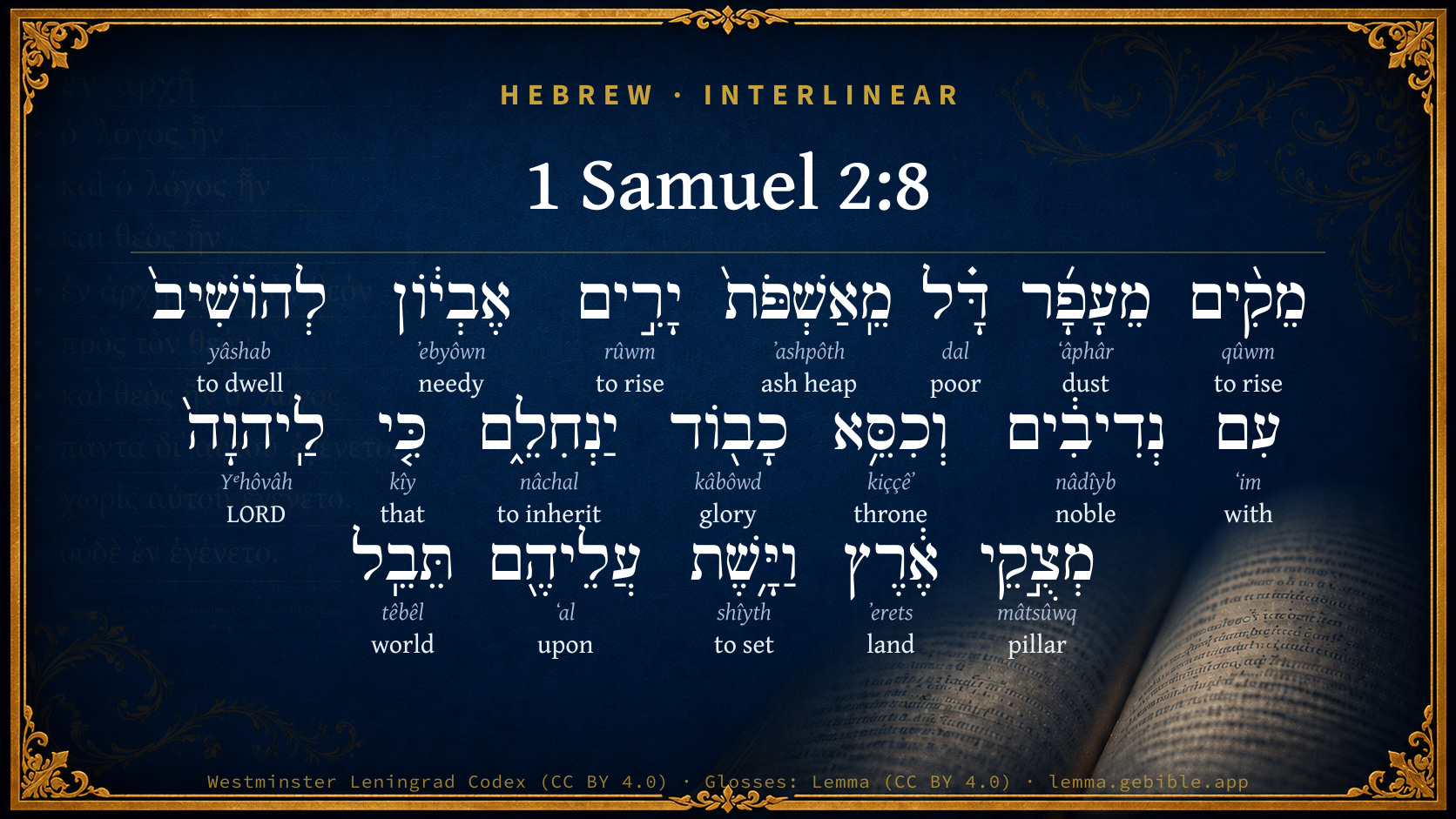
1 Samuel 2:8

Hebrew (Westminster Leningrad Codex) 1 Samuel 2:8 appears in the Hebrew Old Testament. The text above is from the Westminster Leningrad Codex. Each word links to its Strong’s number, a concise gloss, and parsing drawn from the Open Scriptures Hebrew Bible morphology. Click any word for its full Brown-Driver-Briggs (BDB) entry.
Download image
Cite this verse

1 Samuel 2:8 (World English Bible). Public Domain. Lemma interlinear Bible study tool, https://lemma.gebible.app/v/1-samuel/2/8.

Show BibTeX & RIS
BibTeX
RIS
English Translation
He raises up the poor out of the dust, He lifts up the needy from the dunghill, To make them sit with princes, Inherit the throne of glory: For the pillars of the earth are Yahweh's, He has set the world on them.
World English Bible · Public Domain
Highlights
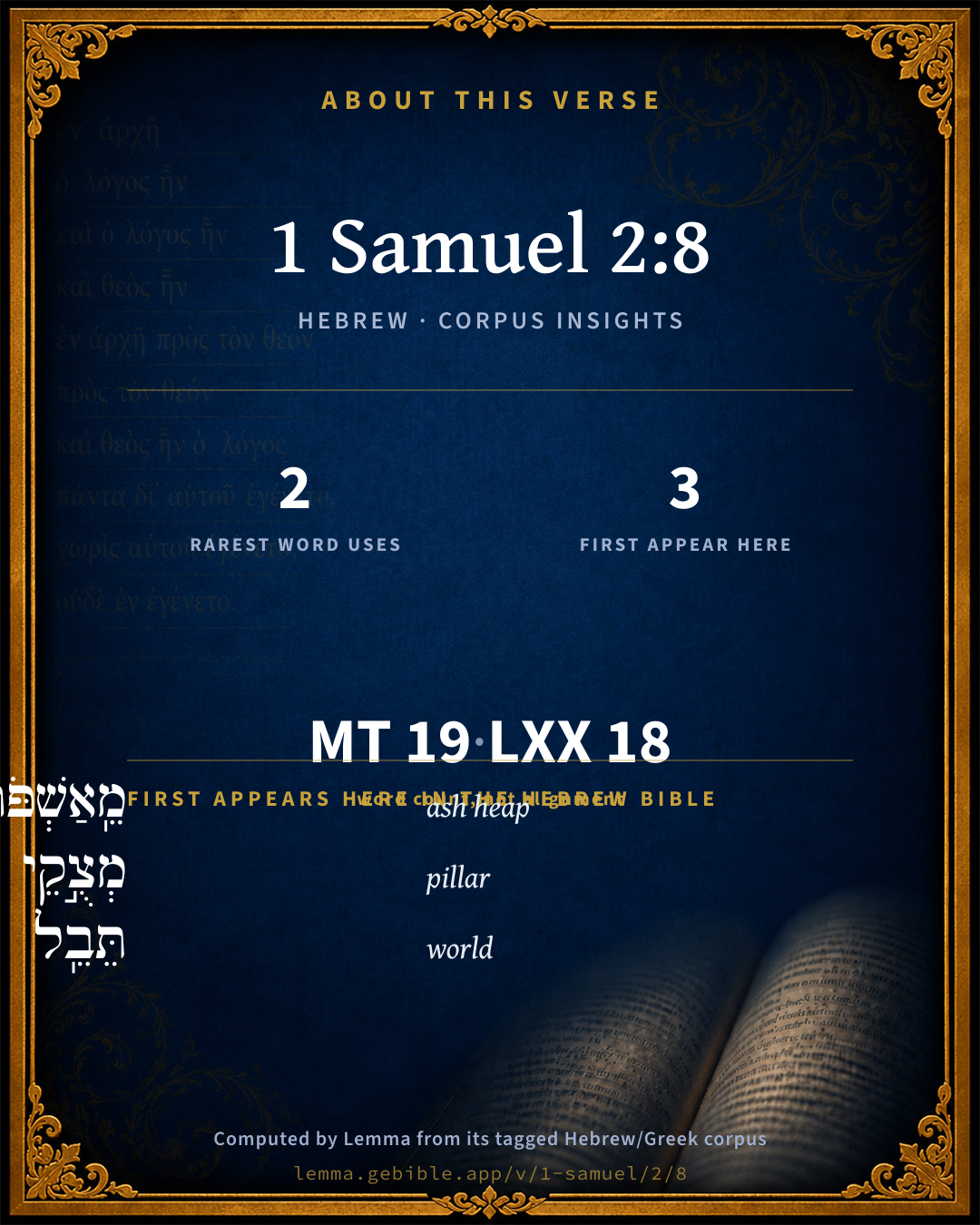
  • 3 first appearances in the Hebrew Bible
Full analysis ↓
Download a study sheet

One document with this verse’s original text, its word-by-word gloss line, the meaning frame, cross-references with their text, attributed commentary, and full source and license credits — printable, and it pastes into notes with its structure intact.

This verse Autodidact and up

Study sheet (.html) Plain text (.txt)

A passage Seminary Student

Up to 50 verses in one chapter. A passage sheet keeps up to 6 commentary sources and 12 cross-references per verse, in the order this page ranks them, and says so on the sheet whenever that leaves anything out. Ask for a single verse and you get the Autodidact verse sheet above.

Everything on this page stays free to read, with no account — the sheet is a download of what is already on screen, not access to it.

Want to remove ads? Support Godless Engineer
Compare translations 3

The same verse in 3 English versions, stacked beneath the original-language interlinear above. Click any original word for its lexicon entry.

Each is an independent rendering of the whole verse — the interlinear is not word-aligned to these translations.

Highlighted words mark where these versions differ — a whole-verse word diff, not a word-by-word alignment.

  • World English Bible Public Domain
    He raises up the poor out of the dust, He lifts up the needy from the dunghill, To make them sit with princes, Inherit the throne of glory: For the pillars of the earth are Yahweh's, He has set the world on them.
  • King James Version Public Domain
    He raiseth up the poor out of the dust, and lifteth up the beggar from the dunghill, to set them among princes, and to make them inherit the throne of glory: for the pillars of the earth are the LORD's, and he hath set the world upon them.
  • unfoldingWord Literal Text CC BY-SA 4.0
    Raising the poor from the dust, he lifts up the needy from the trash heap to make sit with nobles, and he makes them inherit a seat of honor. For the pillars of the earth to Yahweh, and he has set the world on them.

unfoldingWord Literal Text — © unfoldingWord, licensed CC BY-SA 4.0. Word-aligned USFM3 via Door43 (git.door43.org/unfoldingWord/en_ult).

Versions to compare (up to 4)

3 of 4 selected

Show all 18 translations

Every available English version of this verse, each an independent rendering of the whole verse.

  • World English Bible Public Domain
    He raises up the poor out of the dust, He lifts up the needy from the dunghill, To make them sit with princes, Inherit the throne of glory: For the pillars of the earth are Yahweh's, He has set the world on them.
  • Berean Standard Bible Public Domain
    He raises the poor from the dust and lifts the needy from the ash heap. He seats them among princes and bestows on them a throne of honor. For the foundations of the earth are the LORD’s, and upon them He has set the world.
  • Majority Standard Bible Public Domain
    He raises the poor from the dust and lifts the needy from the ash heap. He seats them among princes and bestows on them a throne of honor. For the foundations of the earth are the LORD’s, and upon them He has set the world.
  • King James Version Public Domain
    He raiseth up the poor out of the dust, and lifteth up the beggar from the dunghill, to set them among princes, and to make them inherit the throne of glory: for the pillars of the earth are the LORD's, and he hath set the world upon them.
  • American Standard Version (1901) Public Domain
    He raiseth up the poor out of the dust, He lifteth up the needy from the dunghill, To make them sit with princes, And inherit the throne of glory: For the pillars of the earth are Jehovah's, And he hath set the world upon them.
  • Revised Version (1885) Public Domain
    He raiseth up the poor out of the dust, he lifteth up the needy from the dunghill, to make them sit with princes, and inherit the throne of glory: for the pillars of the earth are the LORD’S, and he hath set the world upon them.
  • Geneva Bible (1599) Public Domain
    He raiseth vp ye poore out of the dust, and lifteth vp the begger from the dunghill, to set them among princes, and to make them inherite the seate of glory: for the pillars of the earth are the Lordes, and he hath set the world vpon them.
  • Douay-Rheims (1899) Public Domain
    He raiseth up the needy from the dust, and lifteth up the poor from the dunghill: that he may sit with princes, and hold the throne of glory. For the poles of the earth are the Lord's, and upon them he hath set the world.
  • Young's Literal Translation Public Domain
    He raiseth from the dust the poor, From a dunghill He lifteth up the needy, To cause `them' to sit with nobles, Yea, a throne of honour He doth cause them to inherit, For to Jehovah `are' the fixtures of earth, And He setteth on them the habitable world.
  • Literal Standard Version CC BY-SA 4.0
    He raises the poor from the dust, || He lifts up the needy from a dunghill, || To cause [them] to sit with nobles, || Indeed, He causes them to inherit a throne of glory, || For the fixtures of earth [are] of YHWH, || And He sets the habitable world on them.
  • Unlocked Literal Bible CC BY-SA 4.0
    He raises up the poor out of the dust. He lifts the needy from the ash heap to make them sit with princes and inherit the seat of honor. For the pillars of the earth are Yahweh's and he has set the world upon them.
  • unfoldingWord Literal Text CC BY-SA 4.0
    Raising the poor from the dust, he lifts up the needy from the trash heap to make sit with nobles, and he makes them inherit a seat of honor. For the pillars of the earth to Yahweh, and he has set the world on them.
  • Darby Bible Public Domain
    He raiseth up the poor out of the dust; from the dung-hill he lifteth up the needy, To set [him] among nobles; and he maketh them inherit a throne of glory; For the pillars of the earth are Jehovah's, and he hath set the world upon them.
  • World Messianic Bible Public Domain
    He raises up the poor out of the dust. He lifts up the needy from the dunghill to make them sit with princes and inherit the throne of glory. For the pillars of the earth are the LORD’s. He has set the world on them.
  • Webster's Bible Public Domain
    He raiseth the poor out of the dust, and lifteth the beggar from the dunghill, to set them among princes, and to make them inherit the throne of glory: for the pillars of the earth are the LORD'S, and he hath set the world upon them.
  • Free Bible Version CC BY-SA 4.0
    He helps the poor up from the dust; he raises the lowborn from the trash pile and seats them with the upper class in places of honor. For the foundations of the earth belong to the Lord, and he has placed the world on them.
  • Bible in Basic English Public Domain
    Lifting the poor out of the dust, and him who is in need out of the lowest place, to give them their place among rulers, and for their heritage the seat of glory: for the pillars of the earth are the Lord's and he has made them the base of the world.
  • JPS Tanakh (1917) Public Domain
    He raiseth up the poor out of the dust, He lifteth up the needy from the dung-hill, to make them sit with princes, and inherit the throne of glory; for the pillars of the earth are the LORD'S, and He hath set the world upon them.

Literal Standard Version (2020), Covenant Press — licensed CC BY-SA 4.0. Text via the HelloAO Bible API (eBible.org). Unlocked Literal Bible (unfoldingWord) — licensed CC BY-SA 4.0. Text via the HelloAO Bible API (eBible.org). unfoldingWord Literal Text — © unfoldingWord, licensed CC BY-SA 4.0. Word-aligned USFM3 via Door43 (git.door43.org/unfoldingWord/en_ult). Free Bible Version, Dr. Jonathan Gallagher — licensed CC BY-SA 4.0. Text via the HelloAO Bible API (eBible.org).

Word by word

More ways to search: Search by grammar → Find every occurrence → Compare this word →

Practice this passage: Drill this verse → Learn its vocabulary →

מְצֻ֣קֵי
mâtsûwq
H4690
“pillars of”
Noun, Common, Masculine, Plural, Construct
Part of Speech
Noun
Type
Common
Gender
Masculine
Number
Plural
State
Construct
Full BDB Definition

Origin: from H6693

TWOT: 1896a

molten support, pillar, column
  1. מֵקִ֨ים qûwm H6965 “rising” Verb, Hiphil, Participle Active, Masculine, Singular, Absolute
  2. מֵעָפָ֜ר ʻâphâr H6083 “from · dust” Preposition + Noun, Common, Masculine, Singular, Absolute
  3. דָּ֗ל dal H1800 “poor” Adjective, Adjective, Masculine, Singular, Absolute
  4. מֵֽאַשְׁפֹּת֙ ʼashpôth H830 “from · ash heap” Preposition + Noun, Common, Masculine, Singular, Absolute
  5. יָרִ֣ים rûwm H7311 “to rise” Verb, Hiphil, Imperfect, 3rd Person, Masculine, Singular
  6. אֶבְי֔וֹן ʼebyôwn H34 “needy” Adjective, Adjective, Masculine, Singular, Absolute
  7. לְהוֹשִׁיב֙ yâshab H3427 “to dwell” Preposition + Verb, Hiphil, Infinitive Construct
  8. עִם ʻim H5973 “with” Preposition
  9. נְדִיבִ֔ים nâdîyb H5081 “noble” Adjective, Adjective, Masculine, Plural, Absolute
  10. וְכִסֵּ֥א kiççêʼ H3678 “and · throne of” Conjunction + Noun, Common, Masculine, Singular, Construct
  11. כָב֖וֹד kâbôwd H3519 “glory” Noun, Common, Both, Singular, Absolute
  12. יַנְחִלֵ֑ם nâchal H5157 “to inherit · them” Verb, Hiphil, Imperfect, 3rd Person, Masculine, Singular + Suffix, Personal, 3rd Person, Masculine, Plural
  13. כִּ֤י kîy H3588 “that” Conjunction
  14. לַֽיהוָה֙ Yᵉhôvâh H3068 “to/for · LORD” Preposition + Noun, Proper
  15. אֶ֔רֶץ ʼerets H776 “land” Noun, Common, Both, Singular, Absolute
  16. וַיָּ֥שֶׁת shîyth H7896 “and · to set” Conjunction + Verb, Qal, Sequential Imperfect, 3rd Person, Masculine, Singular
  17. עֲלֵיהֶ֖ם ʻal H5921 “upon · them” Preposition + Suffix, Personal, 3rd Person, Masculine, Plural
  18. תֵּבֵֽל têbêl H8398 “world” Noun, Common, Feminine, Singular, Absolute

About this verse

These counts appear in no published source. They are computed here, from the morphology-tagged text and Lemma’s own curated glosses. What Lemma adds →

19
words
19
distinct lemmas
Historical
section

Notable vocabulary

The rarest word here is מְצֻ֣קֵי pillar H4690 — appearing just 2 times in the whole Hebrew Bible.

First appearance in Scripture

These words make their first canonical appearance in the Hebrew Bible here:

  • מֵֽאַשְׁפֹּת֙ ash heap H830
  • מְצֻ֣קֵי pillar H4690
  • תֵּבֵֽל world H8398

Shared distinctive vocabulary

מְצֻ֣קֵי pillar H4690 occurs in 2 verses of the Hebrew Bible. Also found in:

Grammatical profile

  • 5 verbs
  • 8 nouns
  • 3 adjectives
  • 2 prepositions
  • 1 conjunction

Verb forms

  • מֵקִ֨ים Hiphil · Participle Active
  • יָרִ֣ים Hiphil · Imperfect
  • לְהוֹשִׁיב֙ Hiphil · Infinitive Construct
  • יַנְחִלֵ֑ם Hiphil · Imperfect
  • וַיָּ֥שֶׁת Qal · Sequential Imperfect

Hebrew & Septuagint length

In English translation the verse runs 43 words from the Hebrew and 33 from the Septuagint (LXX English) — closely comparable.

A rough comparison of the two English renderings, which tokenize alike — not a word-level alignment.

Word counts can differ between the Hebrew and the Greek without any difference in meaning — e.g. the Hebrew direct-object marker אֵת has no separate Greek word, and Greek often adds the article ὁ.

In the original languages it is 19 Hebrew tokens and 18 Greek tokens — but the two are counted differently (Hebrew bundles its prefixes and suffixes into one token; the Greek is in lemma form), so that isn’t a like-for-like length.

Cross-references

23

Topical passages linked to 1 Samuel 2:8 in the Treasury of Scripture Knowledge — connected by theme and wording, ordered by reader-vote popularity; previews shown in the World English Bible.

  • Psalms 113:7–8 He raises up the poor out of the dust. Lifts up the needy from the ash heap;
  • Daniel 2:48 Then the king made Daniel great, and gave him many great gifts, and made him to rule over the whole province of Babylon, and to be chief governor over all the wise men of Babylon.
  • James 2:5 Listen, my beloved brothers. Didn't God choose those who are poor in this world to be rich in faith, and heirs of the Kingdom which he promised to those who love him?
  • Daniel 6:3 Then this Daniel was distinguished above the presidents and the satraps, because an excellent spirit was in him; and the king thought to set him over the whole realm.
  • 1 Samuel 15:17 Samuel said, "Though you were little in your own sight, weren't you made the head of the tribes of Israel? Yahweh anointed you king over Israel;
  • Ecclesiastes 4:14 For out of prison he came forth to be king; yes, even in his kingdom he was born poor.
  • Revelation 1:6 and he made us to be a Kingdom, priests to his God and Father; to him be the glory and the dominion forever and ever. Amen.
  • 2 Samuel 7:8 Now therefore thus shall you tell my servant David, Thus says Yahweh of Hosts, I took you from the sheep pen, from following the sheep, that you should be prince over my people, over Israel;
  • Revelation 5:10 And made them kings and priests to our God, And they reign on earth."
  • Revelation 22:5 There will be no night, and they need no lamp light; for the Lord God will illuminate them. They will reign forever and ever.
  • Job 42:10–12 Yahweh turned the captivity of Job, when he prayed for his friends. Yahweh gave Job twice as much as he had before.
  • Luke 1:51–52 He has shown strength with his arm. He has scattered the proud in the imagination of their heart.
  • Revelation 3:21 He who overcomes, I will give to him to sit down with me on my throne, as I also overcame, and sat down with my Father on his throne.
  • Genesis 41:14 Then Pharaoh sent and called Joseph, and they brought him hastily out of the dungeon. He shaved himself, changed his clothing, and came in to Pharaoh.
  • Job 36:6–7 He doesn't preserve the life of the wicked, But gives to the afflicted their right.
  • Job 38:4–6 "Where were you when I laid the foundations of the earth? Declare, if you have understanding.
  • Psalms 24:2 For he has founded it on the seas, And established it on the floods.
  • Psalms 102:25 Of old, you laid the foundation of the earth. The heavens are the work of your hands.
  • Psalms 104:5 He laid the foundations of the earth, That it should not be moved forever.
  • Hebrews 1:3 His Son is the radiance of his glory, the very image of his substance, and upholding all things by the word of his power, when he had by himself made purification for our sins, sat down on the right hand of the Majesty on high;
  • Genesis 41:40 You shall be over my house, and according to your word will all my people be ruled. Only in the throne I will be greater than you."
  • Job 2:8 He took for himself a potsherd to scrape himself with, and he sat among the ashes.
  • Daniel 4:17 The sentence is by the decree of the watchers, and the demand by the word of the holy ones; to the intent that the living may know that the Most High rules in the kingdom of men, and gives it to whoever he will, and sets up over it the lowest of men.

Cross-references courtesy of OpenBible.info (CC BY 4.0).

Hebrew and Greek witnesses Masoretic Hebrew ↔ Greek Septuagint

The same verse in the two great witnesses to the Old Testament, shown verse-for-verse.

These are two independent witnesses, not word-aligned to each other, and the Septuagint is shown in lemma (dictionary) form.

Hebrew 1 Samuel 2:8 Masoretic · Westminster Leningrad Codex

מֵקִ֨ים מֵעָפָ֜ר דָּ֗ל מֵֽאַשְׁפֹּת֙ יָרִ֣ים אֶבְי֔וֹן לְהוֹשִׁיב֙ עִם נְדִיבִ֔ים וְכִסֵּ֥א כָב֖וֹד יַנְחִלֵ֑ם כִּ֤י לַֽיהוָה֙ מְצֻ֣קֵי אֶ֔רֶץ וַיָּ֥שֶׁת עֲלֵיהֶ֖ם תֵּבֵֽל

He raises up the poor out of the dust, He lifts up the needy from the dunghill, To make them sit with princes, Inherit the throne of glory: For the pillars of the earth are Yahweh's, He has set the world on them.

World English Bible · Public Domain

Greek LXX 1 Samuel 2:8 Septuagint · lemma form

ἀναἵστημι ἀπό γῆ πένης καί ἀπό κοπρία ἐγείρω πτωχός καταἵζω μετά δυνάστης λαός καί θρόνος δόξα κατακληρονομέω αὐτός

He lifts up the poor from the earth, and raises the needy from the dunghill; to seat him with the princes of the people, and causing them to inherit the throne of glory:

LXX2012 (modern English Septuagint) · Public Domain

On this verse, Haydock's Catholic Bible Commentary discusses the Septuagint’s reading. Read the note in Commentary ↓

Hebrew: Westminster Leningrad Codex (CC BY 4.0). Greek: Septuagint (public domain); English from LXX2012 (modern English Septuagint) (Public Domain). How the Septuagint differs from the Hebrew →

Targum (Aramaic paraphrase)

1

The Targum is the ancient Jewish Aramaic paraphrase of the Hebrew Scriptures — an interpretive translation, not the Hebrew text itself. Onkelos (literal) and Pseudo-Jonathan (expansive) render the Torah, and Jonathan the Prophets. Coverage is partial: where no permissively-licensed English translation exists for a verse, only the Aramaic is shown. This is verse-level text, not a word-by-word alignment to the Hebrew.

  1. Targum Jonathan Prophets (Joshua–Malachi)
    מֵקִים מֵעַפְרָא מִסְכֵּינָא מִקִלְקַלְתָּא מֵרִים חֲשִׁיכָא לְאוֹתָבוּתְהוֹן עִם צַדִיקַיָא רַבְרְבֵי עַלְמָא וְכוּרְסֵי יְקָרָא מַחֲסִין לְהוֹן אֲרֵי קֳדָם יְיָ גְלָן עוֹבָדֵי בְּנֵי אֱנָשָׁא מִלְרַע אַתְקֵין גֵהִנָם לְרַשִׁיעַיָא עָבְרֵי עַל מֵימְרֵיהּ וְצַדִיקַיָא עַבְדֵי רְעוּתֵיהּ שַׁכְלֵיל לְהוֹן תֵּבֵל:

    (no public-domain English translation for this verse)

    Targum Jonathan — Aramaic: “Mikraot Gedolot” (public domain). English: “Sefaria Community Translation” (CC0 1.0 (public-domain dedication)); “London "Chaldee Paraphrase," 1871” (public domain). Text via Sefaria.

Commentary

Notes on 1 Samuel 2:8 from classic Christian and Jewish commentators (each source and its license shown beneath its notes). The classic Christian expositions comment on the surrounding passage and are grouped to its opening verse, so a note may address several verses; the Jewish commentaries on the Tanakh (Rashi and others) are per-verse, so they appear only where the commentator wrote on this verse.

Lemma curates 59 commentaries, every one of them public domain or Creative Commons licensed, each selected and text-cleaned for this edition rather than reprinted as found. About our sources →

The Cambridge Bible for Schools and Colleges

gen. ed. J. J. S. Perowne

8. out of the dust] “To sit in the dust” (Isa_47:1), or “on the dunghill” (Lam_4:5) are Oriental figures for a condition of extreme degradation and misery, derived probably from the practice of mourners (Job_2:8): to share the company of princes, and occupy a throne of honour (Job_36:7) are metaphors for advancement and prosperity. Psa_113:7-9 is copied almost verbatim from these verses. Cp. too Psa_75:6-7.

for the pillars of the earth are the Lord’s] The creation and maintenance of the natural framework of the earth by Jehovah are a guarantee for His moral government among men. Cp. Psa_75:3. The expression “pillars of the earth” (cp. Job_9:6) is a poetical metaphor derived from the construction of a house (see Jdg_16:26), and need not imply any theory as to the earth’s shape.

The Cambridge Bible for Schools and Colleges (gen. ed. J. J. S. Perowne; Cambridge University Press, 1878–1918) — public domain. Text from a community e-Sword module.

Trapp's Complete Commentary

John Trapp

1Sa 2:8 He raiseth up the poor out of the dust, [and] lifteth up the beggar from the dunghill, to set [them] among princes, and to make them inherit the throne of glory: for the pillars of the earth [are] the LORD’S, and he hath set the world upon them.

Ver. 8. He raiseth up the poor.] See Psa 75:6. {See Trapp on "Psa 75:6"}

To set them among princes.] As he did Agathocles, Marius, Maximinus, Claudius, who, hiding himself for fear of death in a hole, was pulled out by the heels and made emperor. Michael was condemned to death by the Emperor Leo; but before the execution the emperor died, and Michael was chosen in his stead.

For the pillars of the earth are the Lord’s.] He hath hanged it upon nothing; only it hangeth in the midst of the heaven, equally poised with its own weight, and serveth for pillars or foundations to the whole fabric of the universe.

John Trapp, A Commentary or Exposition upon All the Books of the Old and New Testament (1647–1656) — public domain. Text from a community e-Sword module.

The Biblical Illustrator

Joseph S. Exell

1Sa_2:8

He raiseth up the poor out of the dust, and lifteth up the beggar from the dunghill; to set them among princes.

The poor raised out of the dust

I. By these poor some understand those who are literally beggars. One cannot doubt but that Hannahs heart did bear on the remembrance of her own comparatively obscure condition; I cannot doubt for a moment, that she had in her mind the consciousness that this Samuel was to be a judge, and a prophet in Israel; I do not for one moment doubt, that she remembered Gideon taken from his threshing floor by the wine press to be a judge in Israel. It is not generally true that God takes the poor out of the dust, end lifts the beggar from the dunghill. The instances are rare in which He sets them among princes, and makes them inherit thrones of glory. And I think the next verse takes us something above the mere letter; He shall keep the feet of His saints Some understand by it the Church of God in its low and lost condition; as fallen children of a fallen father. No doubt there is great glory in that interpretation. A sinner is poor man; be is indeed one of the needy, in his poverty. A debtor? owing ten thousand talents. But there is an expression that will not allow me to think this to be the mind of God in this passage. He is spoken of, not only as poor, but as a beggar. It is one thing for a man to be in the dust, and on the dunghill; but it is another thing to know and feel it, and to cry to the Lord on account of it. A sense of beggary is wrought in the soul by the Holy Ghost only. This is the life appointed of God for His saints on earth; it is their vocation. A very painful life it is. The more a man begs, the more he has; the more he has, the more he wants; the more he wants, the more he receives; and the more he receives, the more he begs. But one may say, it is also a happy life. Oh! the relief of a throne of grape! Great is the blessing connected with it.

II. But observe now what is said of the Lord concerning His treatment of these poor, these beggars. Now before we consider what the Lord does, consider for a moment what the Lord is. He is described here as high above all nations, and His glory above the heavens. I believe God is Love; yet when one looks into the infinite, the eternal God centering His love in ones self, one so mean, so worthless, so below all His consideration, who that looks into it does not see there are lengths and depths and breadths and heights, that seem at once above the mind? In the consideration of all that God does, I would never desire to forget what God is. All that God does springs from what God is. His doings are great; but His nature is greater. The Lord looked on His poor suffering Israel in their Egypt state, and heard their cry; their miseries went up before Him and He remembered them. There is infinite pity, too, in it; for He raises up this poor man; we find, He raises him up. The Lord always goes beyond your desires; He never falls short of them But I see, not only infinite pity, but marvellous grace in it. When He takes these beggars, where doth He seat them? Is it amongst delivered beggars? He sets them in the midst of princes, and causes them to inherit a throne of glory. (J. H. Evans.)

The riches of humility

The rain runs off the mountains into the valleys and low-lying meadows. Elevated regions, therefore, do not profit by it so much as the lowlands. The natural fact suggests a spiritual truth. Gods sweet dews and showers of grace, says Leighton, slide off the mountains of pride and fall on the low valleys of humble hearts, and make them pleasant and fertile. This accounts for the fact that you occasionally see persons of high intellect and much culture destitute of the peace and contentment possessed by those of meaner attainments; lacking, too, in richness of moral nature, and usefulness of life. (W. Welters.)

Humility a source of honour

In the evening of the day that Sir Eardley Wilmot kissed the hand of his Sovereign, on being appointed Chief Justice, one of his sons, a youth, attended him to his bedside. Now, said the father, I will tell you, my son, a secret worth your knowing and remembering. The elevation I have met with in life, particularly this lash instance of it, has not been owing to any superior merit or abilities, but to my humility, to my not having set up myself above others, and to a uniform endeavour to pass through life void of offence towards God and man.

Elevation of the lowly

Edward Smith, in his most interesting book, Three Years in Central London, tells of a poor working man coming into the church exclaiming, Before the Mission started I was a nobody here; but now I am a somebody. Yes, it is the mission of Christianity to make the lowliest man feel his personal dignity and his great importance as one of the workers of the world. (W. L. Watkinson.)

Poor rising to distinction

So also it pleases God to give conspicuous proofs from time to time that qualities that in poor men are often associated with a hard-working, humble career are well-pleasing in His sight. For what qualities on the part of the poor are so valuable, in a social point of view, industry, self-denying diligence, systematic, unwearying devotion even to work which brings them scanty remuneration? By far the greater part of such men and women are called to work on, unnoticed and rewarded, and when their day is over to sink in an undistinguished grave. But from time to time some such persons rise to distinction. The class to which they belong is ennobled by their achievements. When God wished in the sixteenth century to achieve the great object of punishing the Church which had fallen into such miserable inefficiency and immorality, and wrenching half of Europe from its grasp, he found his principal agent in a poor miners cottage in Saxony. When he desired to summon sleeping Church to the great work of evangelising India, She man he called to She front was Carey, a poor cobbler of Northampton. When it was his purpose to present His Church with an unrivalled picture of the Christian pilgrimage, its dangers and trials, its joys, its sorrows, and its triumphs, the artist appointed to the task was John Bunyan, the tinker of Elstow. When the object was to provide a man that would open the great continent of Africa to civilisation and Christianity, and who needed, in order to do this, to face dangers and trials before which all ordinary men had shrunk, he found his agent in a poor spinner boy, who was working twelve hours a day in a cotton mill on She banks of the Clyde. In all such matters, in humbling the rich and exalting the poor, Gods object is not to punish the one because they are rich, or to exalt the other because they are poor. In the one case it is to punish vices bred from an improper use of wealth, and in the other to reward virtues that have sprung from the soil of poverty. Poor and pious parents, wrote David Livingstone on the tombstone of his parents at Hamilton, when he wished to record the grounds of his thankfulness for the position in life which they held. (W. G. Blaikie, D. D.)

For the pillars of the earth are the Lords, He has set the world upon them.

The God of nature also the God of Providence and of grace

Verse 6 sets forth that God has absolute power over human life. He it is who makes pale with mortal disease the once ruddy cheek of health and beauty. He it is, again, who snatches a man from the jaws of death, when his recovery seems beyond all hope. The seventh verse and the first part of the eighth set forth Gods absolute power over human circumstances. He it is who gives a fortune to one, and reduces another to beggary. He who brought Joseph out of the dungeon and made him ride in the second chariot which King Pharaoh had. All these are instances of Gods power in Providence--in the management of human affairs. And now observe how Hannah passes on to speak of the power of God in Nature; for, she adds, the pillars of the earth are the Lords, and he hath set the world upon them. The earth is spoken of as if it were a great temple or palace, held up by pillars like the house of Dagon--firm and settled, so long as those pillars remain unshaken, bus sure to fall into ruin the moment the pillars are thrown down. Now we may take Hannahs expression in the same way, as a figurative one, meaning not that the earth does literally stand upon pillars, but that the mighty God, who created it, upholds it every instant by an act of His will, and that, if that act of will were for a moment withdrawn, it would drop at once into that nothingness, out of which it was drawn by creation. Hannah, then, according to this view of her meaning, adds to the instances she has given of Gods power in Providence this wondrous instance of His power in Nature. Science since Hannahs time has taught us the way in which God does this--namely, by She law of gravitation, which, as the earth pursues its course in space, pulls it in every moment towards the sun; but assuredly the operation is not lees wonderful, because we happen to have found out the principle on which it is conducted. And now observe the force of the for in the words--for the pillars (the sustaining, preserving power) of the earth are the Lords, and he hath set the world upon them. No wonder, she means to say, that God does such great things, brings about such strange vicissitudes in the life and fortunes of feeble men. For only, see what tremendous irresistible forces He is always exerting in Nature. Now this gives rise to one or two edifying thoughts. The God of Providence, Hannah asserts, is the God of Nature also; and His ways in Nature, she implies, seem us to be more amazing and stupendous than His ways in Providence. I say seem to us to be--not that in reality they are so. Why do Gods works in Providence strike us with much less wonder than His works in Nature? I suppose because we are comparatively so familiar with His works of Providence; life and death, health and sickness, the rise in one mans fortunes and the fall in anothers, are around us on all sides; and, being matter of every days experience, make slight impressions. Another reason is that we ourselves have some part in bringing about results in Providence; a man can bring himself to the gates of the grave by carelessness of his health, or may recover by the skill of the physician--may make a fortune by assiduous industry, or may lose one by neglect of his accounts and wasteful expenditure; but no man can arrest the sun in his course, or shake the earth to its foundations. The lesson is that we should try more and more to regard the God of Nature and of Providence as one, and to throw those notions of magnificence and power, which we derive from Nature, into other spheres of Gods action--into the sphere of Gods Providence and also of His Grace. Do I see design on every side of me in Nature, wise contrivance for the well-being of the creatures? Let me be assured that in human affairs also this same wise design is contriving and arranging all things, with a moral aim, for the exaltation of the humble, the humiliation of the proud, and the highest good to them that love God. (Dean Goulburn.)

The Biblical Illustrator, edited by Joseph S. Exell (c. 1880s–1900s) — public domain. Text from a community e-Sword module.

Joseph Benson's Commentary

1Sa 2:8. He raiseth up the poor out of the dust, &c. — From the most mean estate and sordid place. To set them among princes — Instance Joseph, David, and Daniel. To make them inherit the throne of glory — That is, a glorious throne or kingdom; not only to possess it themselves, but to transmit it to their posterity, as the word inherit implies. For the pillars of the earth are the Lord’s — The foundations which God created and upholds, and wherewith he sustains the earth and all its inhabitants, as a house is supported with pillars. These words signify the reason of all that is contained in the five preceding verses. For the very earth being founded, upheld, and supported by the Lord, it is no wonder that all the inhabitants of it are in his power, so that he can dispose of them as he pleases.

Joseph Benson's Commentary on the Old and New Testaments (1811–1818) — public domain. Text from a community e-Sword module.

Tyndale Open Study Notes

Tyndale Open Resources

2:8 all the earth is the Lord’s: God, the creator and ruler of all things, is able to change circumstances (2:4-8), protect the faithful (2:9), judge the wicked, and empower his anointed king (2:10).

Tyndale Open Study Notes — © Tyndale Open Resources, licensed CC BY-SA 4.0. Text via the HelloAO Bible API.

Geneva Bible (1599)

Geneva Bible translators

He prefereth to honor, and putteth down according to his own will, though man’s judgment be contrary.

Therefore he may dispose all things according to his will.

Geneva Bible (1599) marginal notes — public domain. Text via Bolls.life.

Jamieson, Fausset & Brown

Robert Jamieson, A. R. Fausset & David Brown

He raiseth up the poor out of the dust, and lifteth up the beggar from the dunghill--The dunghill, a pile of horse, cow, or camel offal, heaped up to dry in the sun, and used as fuel, was, and is, one of the common haunts of the poorest mendicants; and the change that had been made in the social position of Hannah, appeared to her grateful heart as auspicious and as great as the elevation of a poor despised beggar to the highest and most dignified rank.

inherit the throne of glory--that is, possesses seats of honor.

Jamieson, Fausset & Brown — Commentary Critical and Explanatory on the Whole Bible (1871) — public domain (CC PDM 1.0). Text via the HelloAO Bible API.

Adam Clarke's Commentary

Verse 8. To set them among princes] There have been many cases where, in the course of God's providence, a person has been raised from the lowest and most abject estate to the highest; from the plough to the imperial dignity: from the dungeon to the throne; from the dunghill to nobility. The story of Cincinnatus is well known; so is that of the patriarch Joseph; but there is one not less in point, that of Roushen Akhter, who was brought out of a dungeon, and exalted to the throne of Hindustan. On this circumstance the following elegant couplet was made: -

[------Arabic------]

[------Arabic------]

"He was a bright star, but now is become a moon,

Joseph is taken from prison, and is become a king."

There is a play here on Roushen Akhter, which signifies a bright star; and there is an allusion to the history of the patriarch Joseph, because of the similarity of fortune between him and the Mohammedan prince.

For the pillars of the earth are the Lord's] He is almighty, and upholds all things by the word of his power.

Adam Clarke's Commentary on the Bible (1810–1826) — public domain. Text from a community e-Sword/MySword module.

Ellicott's Commentary for English Readers

(8) The pillars of the earth.—And the gracious All-Ruler does these things, for He is at once Creator and Upholder of the universe. The words of these Divine songs which treat of cosmogony are such as would be understood in the childhood of peoples. The quiet thinker, however, is tempted to ask whether after 3,000 or 4,000 years, now, with the light of modern science shining round us, we have made much real progress in our knowledge of the genesis and government of the universe.

The pillars.—Or columns—Jerome, in the Vulgate, translates this unusual word by “hinges”—cardines terrœ.

Gesenius prefers the rendering “foundations.” On the whole, the word used in the English Version, “pillars,” is the best.

A Bible Commentary for English Readers, edited by Charles John Ellicott (1878–1897) — public domain. Text from a community e-Sword module.

John Gill's Exposition

He will keep the feet of his saints,.... Now follow promises and prophecies of future things respecting the Israel of God, either in a literal or spiritual sense. By "his saints" are meant not angels, though they are his Holy Ones, but men, and a body of them; who though unholy in themselves, nor can they make themselves holy, yet are made so by the grace of God, in consequence of electing grace, by which they are chosen to be holy, from Christ the source and spring of all holiness, by the Holy Spirit of God, as the efficient cause, and which is done in the effectual calling; hence they live holy lives and conversations, though not altogether without sin in the present state. The word also signifies such to whom God has been kind and gracious, and on whom he has bestowed blessings of goodness, and who are bountiful and beneficent to others. These are the Lord's, whom he has set apart for himself, and has sanctified in Christ, and by his Spirit; and of these he is keeper, not angels, nor ministers of the word, nor themselves, but the Lord himself is the keeper of them; and who is an able, faithful, tender and compassionate, constant and everlasting keeper of them; and particularly he keeps their "feet"; he indeed keeps their whole persons, their bodies and souls; the members of their bodies, and the powers of their souls, their head, their heart, their affections, from turning aside from him; he guides, directs, and orders all their actions and goings; he keeps their feet in his own ways, where he has guided them; he keeps them in Christ the way, and in all the paths of faith, truth, righteousness, and holiness, and in the way everlasting: he keeps them from falling; for though they are liable to fall into sin, and by temptation, and from a lively exercise of grace, yet not totally and finally; they are secured from it by his love to them; the promises he has made them; his power exerted on their behalf; their being in the hands of Christ, and the glory of all the three Persons concerned herein:

and the wicked shall be silent in darkness; sin has spread darkness over all human nature; every man is born and brought up in darkness, and walks in it: a state of unregeneracy is a state of darkness, in which wicked men continue; and they are in the dark about God, the perfections of his nature, his mind and will, word and worship; about Christ, and the way of life, peace, and salvation by him; about their own state and condition by nature, and the danger they are in; about the nature and necessity of regeneration; and about the Scriptures, and the doctrines of the Gospel; and living and dying; in such a state, darkness, blackness of darkness, is their portion forever: so the Targum,"the wicked in hell in darkness shall be judged:''and it is said they shall be "silent" in it; they are quiet, easy, and content in the state of natural darkness in which they are; they neither do nor will understand; they do not care to come to the light, but shun the means of light and knowledge; they have nothing to say of God, of Christ, of the Spirit of God, or of divine things; they can talk enough of evil things, and pour them out in great plenty, but not of any good; and when their evils are charged upon them by the law, their mouths are stopped, and they pronounced guilty, and have nothing to say why justice and judgment should not take place; and so they will be silent and speechless at the great day of judgment. Some interpret it, they shall be "cut off in darkness"; so Kimchi and Ben Melech; that is, by death, by the hand of God, by the sword of justice:

for by strength shall no man prevail; which is a reason both why God will keep his saints, and why the wicked shall be silent, or cut off and perish: with respect to good men, they are not saved, kept, and preserved by their own strength; they are not saved without a righteousness, without regeneration, without repentance towards God, and faith in Christ; neither of which they can perform in their own strength: nor can a saint keep himself from, or prevail over his spiritual enemies of himself, not over sin, nor Satan, nor the world; but it is by the power of God that he is kept through faith unto salvation: and with respect to wicked men, these shall not prevail by their strength over good men, or the church, who are built upon a rock, against which the gates of hell cannot prevail; nor can the wicked so prevail by their strength as to hinder their being cut off, and cast into outer darkness; they have no power over the spirit to retain it in the day of death; and whether they will or not, they shall be cast into hell, and go into everlasting punishment.

John Gill's Exposition of the Whole Bible (1746–1763) — public domain (CC PDM 1.0). Text via the HelloAO Bible API.

Haydock's Catholic Bible Commentary

World. The Hebrews represented the earth as resting on a firm basis, or on pillars, or turning on poles, Psalm ciii. 5., and Proverbs viii. 25., &c. The magistrates of the earth may be also thus designated, as the world is entrusted to their care. God compares Jeremias to an iron pillar, Jeremias i. 18., and Apocalypse iii. 12. (Calmet) --- The last sentence is omitted in the Septuagint.

George Leo Haydock (1774–1849), Haydock's Catholic Family Bible and Commentary, 1859 edition — public domain. Excludes Psalms (Douay-Rheims chapter numbering differs from Protestant) and Deuterocanonical books (Catholic canon only).

Matthew Poole's English Annotations

Out of the dust, i.e. out of their low and miserable condition, as this phrase is used, 1Ki 16:2; Psa 113:7; Compare Job 16:15; Psa 22:15.

From the dunghill; from the most sordid place and mean estate. Compare 1Ki 16:2; Job 36:11; Psa 7:5.

Dunghill; which the poor are said to embrace, Lam 4:5.

To make them inherit; not only possess themselves, but transfer them to their posterity, as hath oft happened in the world; or, possess.

The throne of glory, i.e. a glorious throne or kingdom.

The pillars; either,

1. The foundations of the earth, which God created and upholds, and wherewith he sustains the earth find all its inhabitants, as a house is supported with pillars; and therefore it is not strange if he disposeth of persons and things therein as he pleaseth. Or,

2. The princes or governors of the earth, which are called the corners, or corner-stones, of a land or people, Jdg 20:2; 1Sa 14:38; Zep 3:6, and are fitly called pillars, because they uphold the world, and keep it from sinking into confusion. See Psa 74:2; Jer 1:18; Rev 3:12. And these are here said to be the Lord’s, by creation and constitution, because he advanceth them to their state, and preserves them in it, Pro 8:15,16, and puts the world, or the kingdoms of the world, upon them, as burdens upon their shoulders: see Isa 9:6.

Matthew Poole's English Annotations on the Holy Bible (1683–1685) — public domain. Text from a community e-Sword/MySword module.

Whedon's Commentary on the Bible

Daniel D. Whedon

8. Lifts from the dust the poor — Compare Psa_113:7-8, which is borrowed from this prayer of Hannah.

A throne of glory — A position of eminence and power. How many has God’s providence raised up from obscurity to thrones of honour! Joseph, Gideon, Saul, David, Daniel, and others are examples.

To Jehovah — Belonging to Jehovah; his work.

Pillars of the earth — Supporters of the earth, foundations on which the world is represented as resting. A metaphorical way of representing Jehovah as the Creator and Upholder of all things.

Daniel D. Whedon (gen. ed.), Commentary on the Old and New Testaments (1874–1909) — public domain. Text from a community e-Sword module.

John Wesley's Explanatory Notes

From the dunghill - From the most sordid place, and mean estate. Inherit - Not only possess it themselves, but transmit it to their posterity. Throne - That is, a glorious throne or kingdom. Pillars - The foundations of the earth, which God created, and upholds, and wherewith he sustains the earth, and all its inhabitants, as a house is supported with pillars; and therefore it is not strange if he disposeth of persons and things therein as he pleaseth.

John Wesley, Explanatory Notes Upon the Whole Bible (1754–1765) — public domain. Text via the GEBible commentary corpus.

unfoldingWord translationNotes

Door43 World Missions Community

Connecting Statement:

Hannah continues to recite a song to Yahweh. (See: Parallelism)

out of the dust ... from the ash heap

These are metaphors for the lowest position in society. (See: Metaphor)

the needy

people who do not have the things that they need

translationWords

raise

prince

inherit

honor

column

earth

world

unfoldingWord translationNotes — © Distant Shores Media and the Door43 World Missions Community, licensed CC BY-SA 4.0. Source: git.door43.org/Door43/en_tn.

Radak

Rabbi David Kimhi (Radak)

From the dunghill (ashpot): It is singular with the construct of achot (sister), which when it is complete (plural) is achiyot. And the gathering [of dunghills) is (like in Lamentations 4:5), "embraced the ashpatot," in exchange for the accent being soft.

The pillars (amudei) of the earth: The pedestals of the world. And likewise (Joshua 7:23), "and he planted them (yaamidum) before the Lord." And the pillars of the earth are the righteous ones. For the world is preserved in their merit. And likewise, it says (Proverbs 10:25), "the righteous one is a foundation of the world." Or its explanation is in the way of (Deuteronomy 33:27), "under the everlasting forearms" - meaning to say, He is the preservation of the world and its support. And the supports of man are His and everything stands from His power, [as] is the order of the settlement of the world, to support creatures upon it. And that is what it stated, "He has set the world upon them" - since the places of inhabitation are called the world.

Radak on the Tanakh — English translations: “Sefaria Community Translation” (CC0 1.0 (public-domain dedication)); “Eliyahu Munk, HaChut Hameshulash” (CC BY 4.0); “Rabbi Mike Feuer, Jerusalem Anthology” (CC BY 4.0); and “R. David Kimhi on the first book of Psalms, Translated by R.G. Finch, London, 1919” (public domain). Text via Sefaria.

Lesson kit

Teaching starters — assembled from the data on this page, not authored interpretation. Every prompt links to the verse data it draws on. Edit before teaching.

1 Samuel, in the Historical, opens this verse with 19 words (19 distinct Hebrew lemmas). Its most distinctive word is mâtsûwq (“pillar”). A historical commentator’s framing appears above. Read the whole chapter for the surrounding context.

Discussion questions

  1. The word mâtsûwq carries the sense “pillar.” How does it shape the verse?
  2. 3 words here appear for the first time in Scripture. What is being introduced at this debut?
  3. 1 Samuel 14:5 shares the word «pillar» with this verse. How do the two illuminate each other?
  4. The translations on this page render this verse differently — a whole-verse word diff, not a word-by-word alignment. What might account for the different wordings?
  5. The verb «מֵקִ֨ים» is Hiphil Participle Active. How does its form color the action?
  6. Reading how The Cambridge Bible for Schools and Colleges and Trapp's Complete Commentary read this verse, where do the two commentators agree and where do they part?

Things to notice

Reading settings

Reading text

Shown beneath each verse's original-language words.

Old Testament
Old Testament edition

Read the OT as the Masoretic Hebrew (MT) or the Greek Septuagint (LXX).

English shown for the Greek Septuagint (in the Hebrew ↔ Greek comparison).

Comparing translations? Open the Compare panel on any verse page to stack up to four side by side.