

Luke 6:30
Greek (Tischendorf 8th ed.) Luke 6:30 appears in the Greek New Testament. The text above is from the Tischendorf 8th edition. Each word links to its Strong’s number and a concise gloss. Click any word for its full Thayer’s Greek Lexicon entry.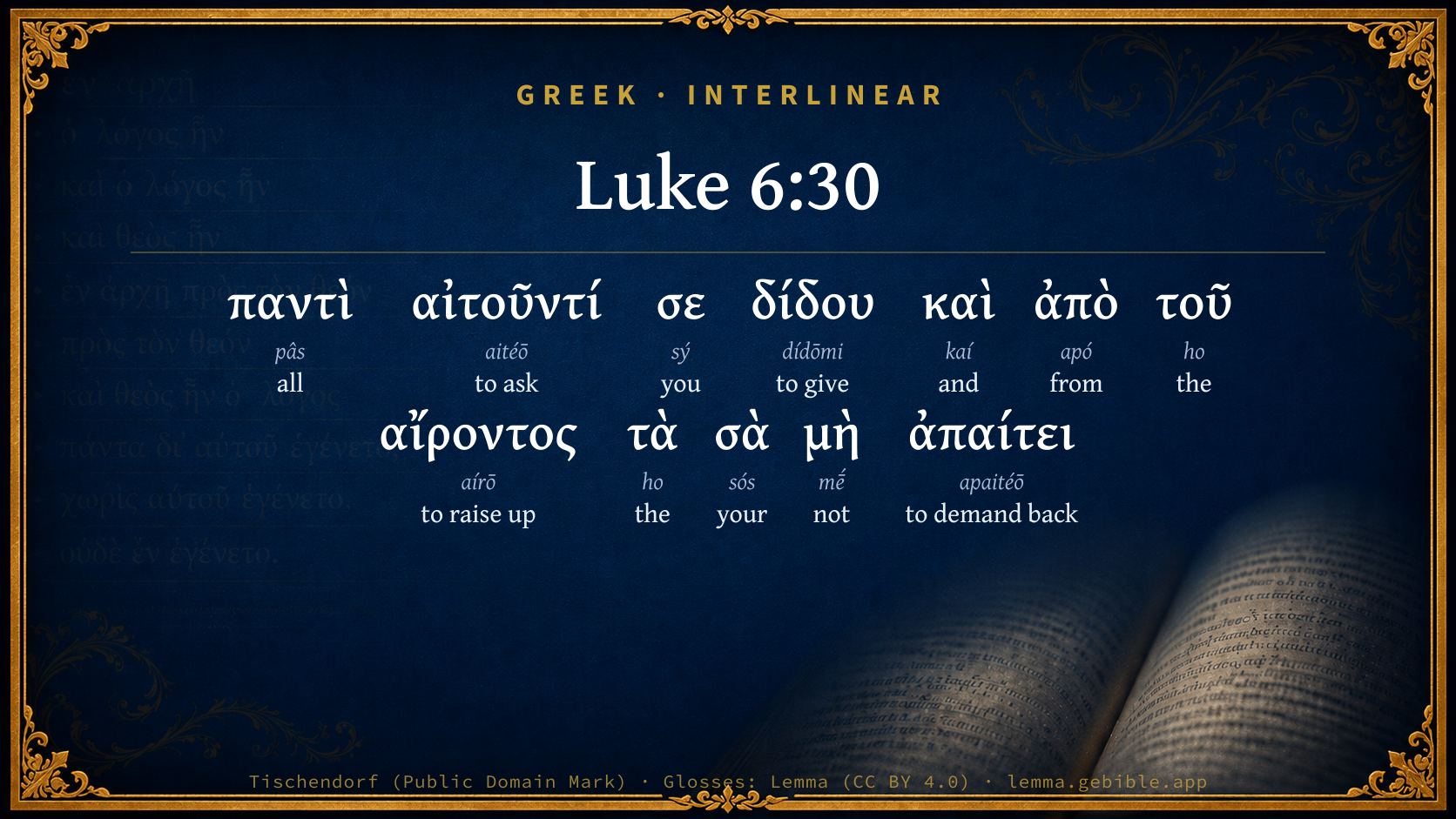
Give to everyone who asks you, and don't ask him who takes away your goods to give them back again.
Download a study sheet
One document with this verse’s original text, its word-by-word gloss line, the meaning frame, cross-references with their text, attributed commentary, and full source and license credits — printable, and it pastes into notes with its structure intact.
This verse Autodidact and up
A passage Seminary Student
Up to 50 verses in one chapter. A passage sheet keeps up to 6 commentary sources and 12 cross-references per verse, in the order this page ranks them, and says so on the sheet whenever that leaves anything out. Ask for a single verse and you get the Autodidact verse sheet above.
Everything on this page stays free to read, with no account — the sheet is a download of what is already on screen, not access to it.
Compare translations 3
The same verse in 3 English versions, stacked beneath the original-language interlinear above. Click any original word for its lexicon entry.
Each is an independent rendering of the whole verse — the interlinear is not word-aligned to these translations.
Highlighted words mark where these versions differ — a whole-verse word diff, not a word-by-word alignment.
-
World English Bible Public Domain
Give to everyone who asks you, and don't ask him who takes away your goods to give them back again.
-
King James Version Public Domain
Give to every man that asketh of thee; and of him that taketh away thy goods ask them not again.
-
unfoldingWord Literal Text CC BY-SA 4.0
Give to everyone asking you, and from the one taking away what yours, do not ask for it back.
unfoldingWord Literal Text — © unfoldingWord, licensed CC BY-SA 4.0. Word-aligned USFM3 via Door43 (git.door43.org/unfoldingWord/en_ult).
Show all 19 translations
Every available English version of this verse, each an independent rendering of the whole verse.
-
World English Bible Public Domain
Give to everyone who asks you, and don't ask him who takes away your goods to give them back again.
-
Berean Standard Bible Public Domain
Give to everyone who asks you, and if anyone takes what is yours, do not demand it back.
-
Majority Standard Bible Public Domain
Give to everyone who asks you, and if anyone takes what is yours, do not demand it back.
-
King James Version Public Domain
Give to every man that asketh of thee; and of him that taketh away thy goods ask them not again.
-
American Standard Version (1901) Public Domain
Give to every one that asketh thee; and of him that taketh away thy goods ask them not again.
-
Revised Version (1885) Public Domain
Give to every one that asketh thee; and of him that taketh away thy goods ask them not again.
-
Geneva Bible (1599) Public Domain
Giue to euery man that asketh of thee: and of him that taketh away the things that be thine, aske them not againe.
-
Douay-Rheims (1899) Public Domain
Give to every one that asketh thee, and of him that taketh away thy goods, ask them not again.
-
Young's Literal Translation Public Domain
`And to every one who is asking of thee, be giving; and from him who is taking away thy goods, be not asking again;
-
Literal Standard Version CC BY-SA 4.0
And to everyone who is asking of you, be giving; and from him who is taking away your goods, do not be asking again;
-
Unlocked Literal Bible CC BY-SA 4.0
Give to everyone who asks you. If someone takes away something that belongs to you, do not ask him to give it back to you.
-
unfoldingWord Literal Text CC BY-SA 4.0
Give to everyone asking you, and from the one taking away what yours, do not ask for it back.
-
Darby Bible Public Domain
To every one that asks of thee, give; and from him that takes away what is thine, ask it not back.
-
World Messianic Bible Public Domain
Give to everyone who asks you, and don’t ask him who takes away your goods to give them back again.
-
Webster's Bible Public Domain
Give to every man that asketh of thee; and of him that taketh away thy goods, ask them not again.
-
Free Bible Version CC BY-SA 4.0
Give to anyone who asks you. If someone takes something from you, don't ask for it back.
-
Bible in Basic English Public Domain
Give to everyone who comes with a request, and if a man takes away your property, make no attempt to get it back again.
-
Text-Critical English NT CC BY 4.0
Give to everyone who asks of yoʋ, and if anyone takes away yoʋr belongings, do not demand them back.
-
Tyndale New Testament (1534) Public Domain
Geve to every man that axeth of the. And of him that taketh awaye thy goodes axe them not agayne.
Literal Standard Version (2020), Covenant Press — licensed CC BY-SA 4.0. Text via the HelloAO Bible API (eBible.org). Unlocked Literal Bible (unfoldingWord) — licensed CC BY-SA 4.0. Text via the HelloAO Bible API (eBible.org). unfoldingWord Literal Text — © unfoldingWord, licensed CC BY-SA 4.0. Word-aligned USFM3 via Door43 (git.door43.org/unfoldingWord/en_ult). Free Bible Version, Dr. Jonathan Gallagher — licensed CC BY-SA 4.0. Text via the HelloAO Bible API (eBible.org).
Word by word
More ways to search: Search by grammar → Find every occurrence → Compare this word →
Practice this passage: Drill this verse → Learn its vocabulary →
- Appears 2× in the Greek New Testament
- First appears here
- Part of Speech
- Verb
- Tense
- Present
- Voice
- Active
- Mood
- Imperative
- Person
- 2nd person
- Number
- Singular
Full Thayer's Definition
- παντὶ pâs G3956 “all” Adjective, Dative, Singular, Masculine
- αἰτοῦντί aitéō G154 “to ask” Verb, Present, Active, Participle, Dative, Singular, Masculine
- σε sý G4771 “you” Personal pronoun, 2nd person, Accusative, Singular
- δίδου dídōmi G1325 “to give” Verb, Present, Active, Imperative, 2nd person, Singular
- καὶ kaí G2532 “and” Conjunction
- ἀπὸ apó G575 “from” Preposition
- τοῦ ho G3588 “the” Article, Genitive, Singular, Masculine
- αἴροντος aírō G142 “to raise up” Verb, Present, Active, Participle, Genitive, Singular, Masculine
- τὰ ho G3588 “the” Article, Accusative, Plural, Neuter
- σὰ sós G4674 “your” Possessive pronoun, 2nd person, Accusative, Plural, Neuter
- μὴ mḗ G3361 “not” Particle, Negative
- ἀπαίτει apaitéō G523 “to demand back” Verb, Present, Active, Imperative, 2nd person, Singular
About this verse
These counts appear in no published source. They are computed here, from the morphology-tagged text and Lemma’s own curated glosses. What Lemma adds →
- 12
- words
- 11
- distinct lemmas
- Gospels
- section
Notable vocabulary
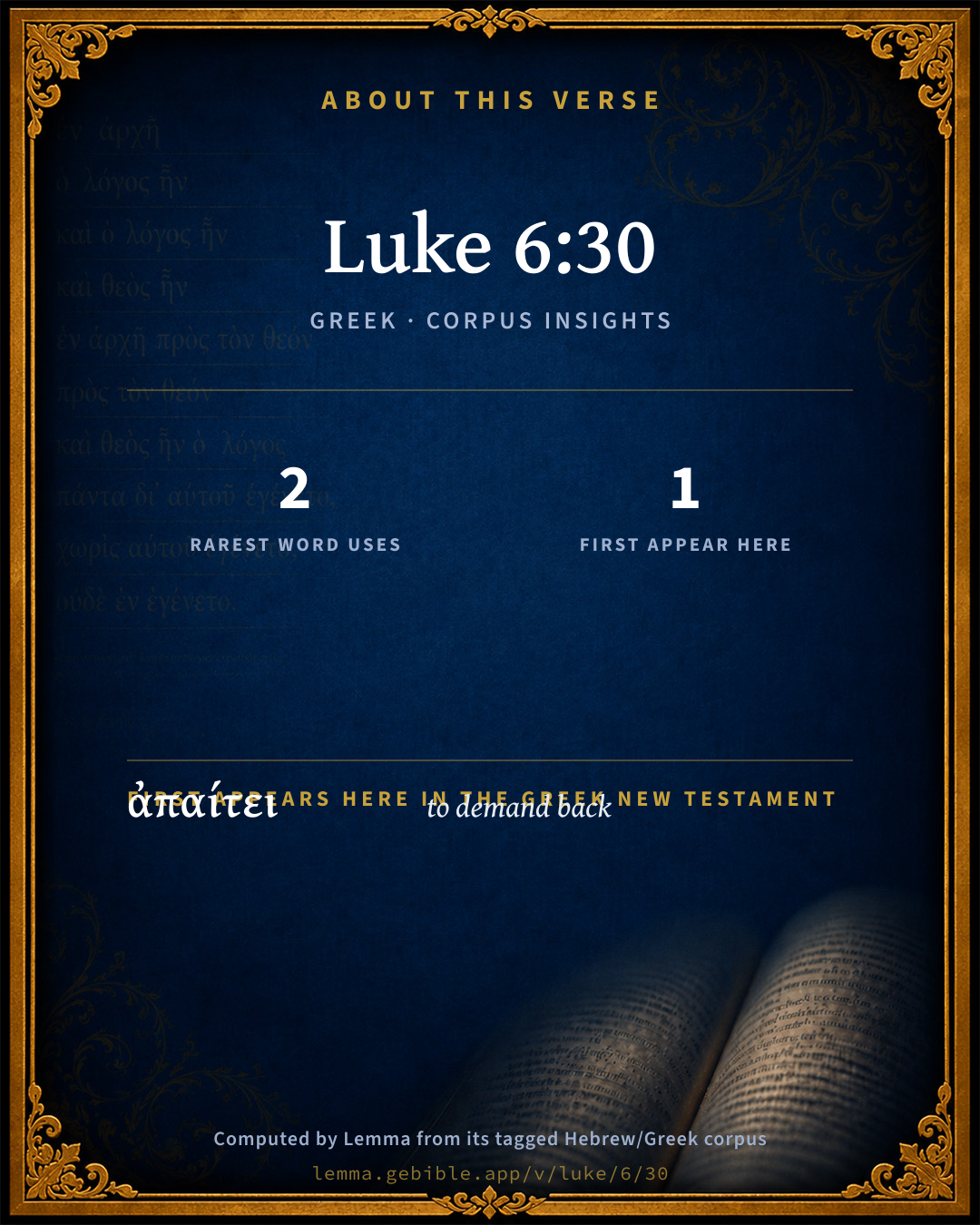
The rarest word here is ἀπαίτει to demand back G523 — appearing just 2 times in the whole Greek New Testament.
First appearance in Scripture
This word makes its first canonical appearance in the Greek New Testament here:
- ἀπαίτει to demand back G523
Shared distinctive vocabulary
ἀπαίτει to demand back G523 occurs in 2 verses of the Greek New Testament. Also found in:
Repetition
A word recurs within this verse:
- τοῦ the G3588 ×2
Cross-references
25Topical passages linked to Luke 6:30 in the Treasury of Scripture Knowledge — connected by theme and wording, ordered by reader-vote popularity; previews shown in the World English Bible.
- Deuteronomy 15:7–10 If there be with you a poor man, one of your brothers, within any of your gates in your land which Yahweh your God gives you, you shall not harden your heart, nor shut your hand from your poor brother;
- Acts 20:35 In all things I gave you an example, that so laboring you ought to help the weak, and to remember the words of the Lord Jesus, that he himself said, 'It is more blessed to give than to receive.'"
- Psalms 41:1 Blessed is he who considers the poor: Yahweh will deliver him in the day of evil.
- Isaiah 58:7–10 Isn't it to deal your bread to the hungry, and that you bring the poor who are cast out to your house? when you see the naked, that you cover him; and that you not hide yourself from your own flesh?
- Matthew 6:12 Forgive us our debts, as we also forgive our debtors.
- 2 Corinthians 8:9 For you know the grace of our Lord Jesus Christ, that, though he was rich, yet for your sakes he became poor, that you through his poverty might become rich.
- 2 Corinthians 9:6–14 Remember this: he who sows sparingly will also reap sparingly. He who sows bountifully will also reap bountifully.
- Proverbs 21:26 There are those who covet greedily all the day long; But the righteous give and don't withhold.
- Matthew 5:42–48 Give to him who asks you, and don't turn away him who desires to borrow from you.
- Luke 18:22 When Jesus heard these things, he said to him, "You still lack one thing. Sell all that you have, and distribute it to the poor. You will have treasure in heaven. Come, follow me."
- Proverbs 19:17 He who has pity on the poor lends to Yahweh; He will reward him.
- Matthew 18:27–30 The lord of that servant, being moved with compassion, released him, and forgave him the debt.
- Exodus 22:26–27 If you take your neighbor's garment as collateral, you shall restore it to him before the sun goes down,
- Nehemiah 5:1–19 Then there arose a great cry of the people and of their wives against their brothers the Jews.
- Psalms 112:9 He has dispersed, he has given to the poor. His righteousness endures forever. His horn will be exalted with honor.
- Proverbs 11:24–25 There is one who scatters, and increases yet more. There is one who withholds more than is appropriate, but gains poverty.
- Proverbs 22:9 He who has a generous eye will be blessed; For he shares his food with the poor.
- Ecclesiastes 8:16 When I applied my heart to know wisdom, and to see the business that is done on the earth (for also there is that neither day nor night sees sleep with his eyes),
- Ezekiel 11:1–2 Moreover the Spirit lifted me up, and brought me to the east gate of Yahweh's house, which looks eastward: and see, at the door of the gate twenty-five men; and I saw in the midst of them Jaazaniah the son of Azzur, and Pelatiah the son of Benaiah, princes of the people.
- Matthew 18:35 So my heavenly Father will also do to you, if you don't each forgive your brother from your hearts for his misdeeds."
- Luke 6:38 "Give, and it will be given to you: good measure, pressed down, shaken together, and running over, will be given to you. For with the same measure you measure it will be measured back to you."
- Luke 11:41 But give for gifts to the needy those things which are within, and behold, all things will be clean to you.
- Luke 12:33 Sell that which you have, and give gifts to the needy. Make for yourselves purses which don't grow old, a treasure in the heavens that doesn't fail, where no thief approaches, neither moth destroys.
- Proverbs 3:27–28 Don't withhold good from those to whom it is due, When it is in the power of your hand to do it.
- Ephesians 4:28 Let him who stole steal no more; but rather let him labor, working with his hands the thing that is good, that he may have something to give to him who has need.
Cross-references courtesy of OpenBible.info (CC BY 4.0).
Lesson kit
Teaching starters — assembled from the data on this page, not authored interpretation. Every prompt links to the verse data it draws on. Edit before teaching.
Luke, in the Gospels, opens this verse with 12 words (11 distinct Greek lemmas). Its most distinctive word is apaitéō (“to demand back”). A historical commentator’s framing appears above. Read the whole chapter for the surrounding context.
Discussion questions
- How does “to demand back” (apaitéō) shape what this verse is saying?
- The word “to demand back” first appears here in Scripture. What is being introduced at this debut?
- Luke 12:20 shares the word «to demand back» with this verse. How do the two illuminate each other?
- “the” occurs 2× in this one verse. What is the effect of the repetition?
- These translations render this verse differently. What is at stake in choosing one wording over another?
- Reading how Adam Clarke's Commentary and Tyndale Open Study Notes read this verse, where do the two commentators agree and where do they part?
Things to notice
- 1 word makes its first canonical appearance in Scripture here.
- These translations choose different wording for 20 words in this verse.
- “the” occurs 2× in this single verse.
- 11 distinct Greek lemmas span 12 words in this verse.
Commentary
Notes on Luke 6:30 from classic Christian and Jewish commentators (each source and its license shown beneath its notes). The classic Christian expositions comment on the surrounding passage and are grouped to its opening verse, so a note may address several verses; the Jewish commentaries on the Tanakh (Rashi and others) are per-verse, so they appear only where the commentator wrote on this verse.
Lemma curates 59 commentaries, every one of them public domain or Creative Commons licensed, each selected and text-cleaned for this edition rather than reprinted as found. About our sources →
Adam Clarke's Commentary
Adam Clarke's Commentary on the Bible (1810–1826) — public domain. Text from a community e-Sword/MySword module.
Tyndale Open Study Notes
Tyndale Open Resources
Tyndale Open Study Notes — © Tyndale Open Resources, licensed CC BY-SA 4.0. Text via the HelloAO Bible API.
Bengel's Gnomon
Johann Albrecht Bengel
Bengel's Gnomon of the New Testament — English translation (T&T Clark, Edinburgh, 1860) — public domain. Text from a community e-Sword module.
Meyer's Critical & Exegetical Commentary
Heinrich August Wilhelm Meyer
Meyer — Critical and Exegetical Commentary on the New Testament — English translation by Peter Christie, edited by Frederick Crombie (T&T Clark, 1880) — public domain. Text from a community e-Sword module.
Expositor's Greek Testament
ed. W. Robertson Nicoll
The Expositor's Greek Testament, edited by W. Robertson Nicoll (1897–1910) — public domain. Text from a community e-Sword module.
Ellicott's Commentary for English Readers
A Bible Commentary for English Readers, edited by Charles John Ellicott (1878–1897) — public domain. Text from a community e-Sword module.
The Cambridge Bible for Schools and Colleges
gen. ed. J. J. S. Perowne
The Cambridge Bible for Schools and Colleges (gen. ed. J. J. S. Perowne; Cambridge University Press, 1878–1918) — public domain. Text from a community e-Sword module.
John Gill's Exposition
John Gill's Exposition of the Whole Bible (1746–1763) — public domain (CC PDM 1.0). Text via the HelloAO Bible API.
Trapp's Complete Commentary
John Trapp
John Trapp, A Commentary or Exposition upon All the Books of the Old and New Testament (1647–1656) — public domain. Text from a community e-Sword module.
Haydock's Catholic Bible Commentary
George Leo Haydock (1774–1849), Haydock's Catholic Family Bible and Commentary, 1859 edition — public domain. Excludes Psalms (Douay-Rheims chapter numbering differs from Protestant) and Deuterocanonical books (Catholic canon only).
Matthew Poole's English Annotations
Matthew Poole's English Annotations on the Holy Bible (1683–1685) — public domain. Text from a community e-Sword/MySword module.
Whedon's Commentary on the Bible
Daniel D. Whedon
Daniel D. Whedon (gen. ed.), Commentary on the Old and New Testaments (1874–1909) — public domain. Text from a community e-Sword module.
The Pulpit Commentary
The Pulpit Commentary (1880–1919), ed. H.D.M. Spence-Jones & Joseph S. Exell — public domain. Text from a community e-Sword module.
John Wesley's Explanatory Notes
John Wesley, Explanatory Notes Upon the Whole Bible (1754–1765) — public domain. Text via the GEBible commentary corpus.
Burkitt's Expository Notes on the New Testament
William Burkitt
William Burkitt's Expository Notes on the New Testament (1700–1703) — public domain. Text from a community e-Sword module.
Cambridge Greek Testament for Schools and Colleges
Cambridge Greek Testament for Schools and Colleges (Cambridge University Press, 1896; 21 vols, various authors incl. Carr, Maclear, Plummer, Farrar, Lumby, Moule, M. R. James, Simcox) — public domain. Text from a community e-Sword module.
International Critical Commentary
International Critical Commentary — older volumes (1896–1929), various authors — public domain. Text from a community e-Sword module.
Vincent's Word Studies in the New Testament
Marvin R. Vincent
Marvin R. Vincent, Word Studies in the New Testament (1887–1900) — public domain. Text from a community e-Sword/MySword module.