Mark 15:38

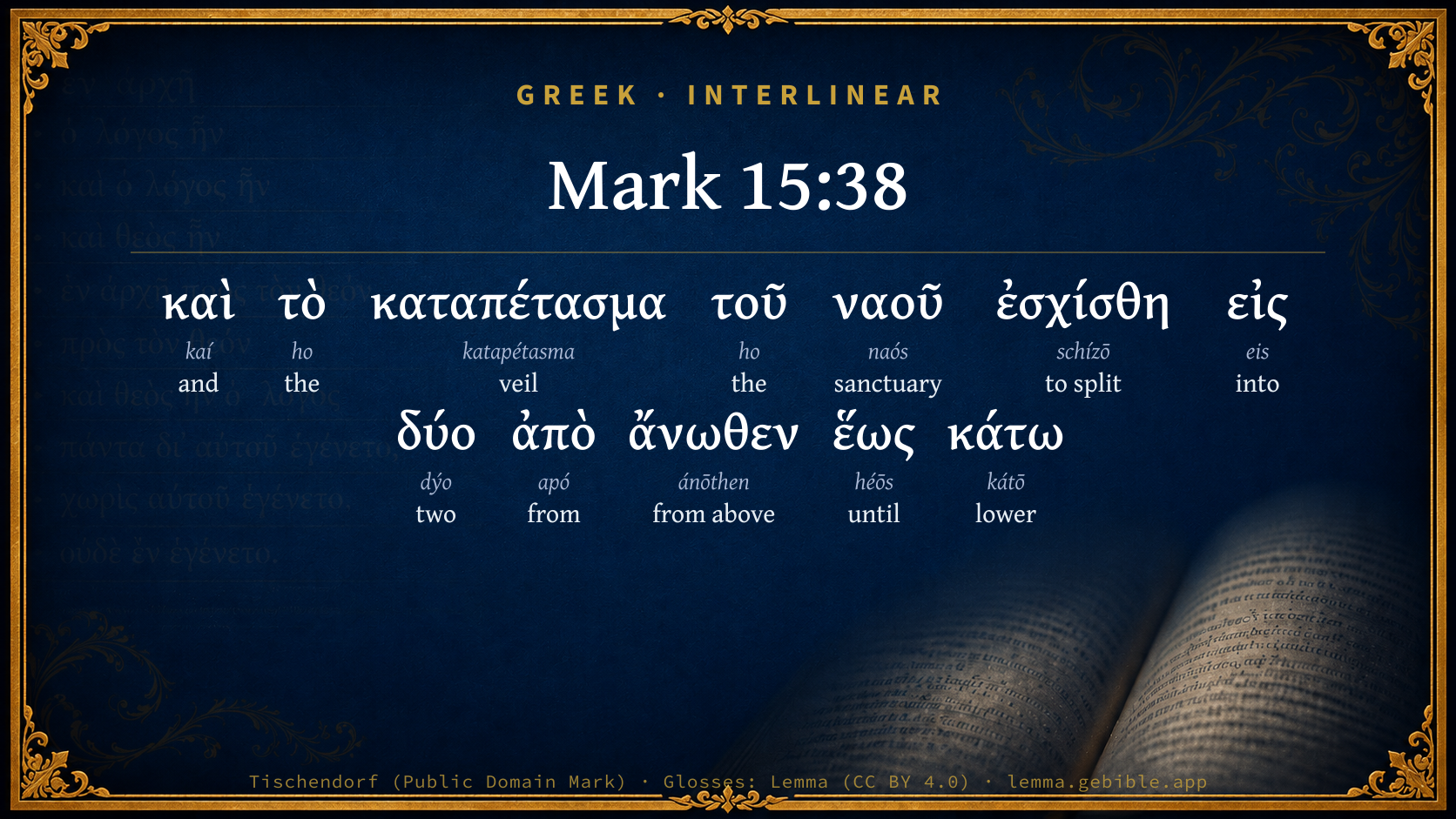
Greek (Tischendorf 8th ed.) Mark 15:38 appears in the Greek New Testament. The text above is from the Tischendorf 8th edition. Each word links to its Strong’s number and a concise gloss. Click any word for its full Thayer’s Greek Lexicon entry.
Download image
Cite this verse

Mark 15:38 (World English Bible). Public Domain. Lemma interlinear Bible study tool, https://lemma.gebible.app/v/mark/15/38.

Show BibTeX & RIS
BibTeX
RIS
English Translation
The veil of the temple was torn in two from the top to the bottom.
World English Bible · Public Domain
Download a study sheet

One document with this verse’s original text, its word-by-word gloss line, the meaning frame, cross-references with their text, attributed commentary, and full source and license credits — printable, and it pastes into notes with its structure intact.

This verse Autodidact and up

Study sheet (.html) Plain text (.txt)

A passage Seminary Student

Up to 50 verses in one chapter. A passage sheet keeps up to 6 commentary sources and 12 cross-references per verse, in the order this page ranks them, and says so on the sheet whenever that leaves anything out. Ask for a single verse and you get the Autodidact verse sheet above.

Everything on this page stays free to read, with no account — the sheet is a download of what is already on screen, not access to it.

Want to remove ads? Support Godless Engineer
Compare translations 3

The same verse in 3 English versions, stacked beneath the original-language interlinear above. Click any original word for its lexicon entry.

Each is an independent rendering of the whole verse — the interlinear is not word-aligned to these translations.

Highlighted words mark where these versions differ — a whole-verse word diff, not a word-by-word alignment.

  • World English Bible Public Domain
    The veil of the temple was torn in two from the top to the bottom.
  • King James Version Public Domain
    And the veil of the temple was rent in twain from the top to the bottom.
  • unfoldingWord Literal Text CC BY-SA 4.0
    And the curtain of the temple was split in two from top to bottom.

unfoldingWord Literal Text — © unfoldingWord, licensed CC BY-SA 4.0. Word-aligned USFM3 via Door43 (git.door43.org/unfoldingWord/en_ult).

Versions to compare (up to 4)

3 of 4 selected

Show all 19 translations

Every available English version of this verse, each an independent rendering of the whole verse.

  • World English Bible Public Domain
    The veil of the temple was torn in two from the top to the bottom.
  • Berean Standard Bible Public Domain
    And the veil of the temple was torn in two from top to bottom.
  • Majority Standard Bible Public Domain
    And the veil of the temple was torn in two from top to bottom.
  • King James Version Public Domain
    And the veil of the temple was rent in twain from the top to the bottom.
  • American Standard Version (1901) Public Domain
    And the veil of the temple was rent in two from the top to the bottom.
  • Revised Version (1885) Public Domain
    And the veil of the temple was rent in twain from the top to the bottom.
  • Geneva Bible (1599) Public Domain
    And the vaile of the Temple was rent in twaine, from the toppe to the bottome.
  • Douay-Rheims (1899) Public Domain
    And the veil of the temple was rent in two, from the top to the bottom.
  • Young's Literal Translation Public Domain
    and the veil of the sanctuary was rent in two, from top to bottom,
  • Literal Standard Version CC BY-SA 4.0
    and the veil of the temple was torn in two from top to bottom,
  • Unlocked Literal Bible CC BY-SA 4.0
    The curtain of the temple was split in two from the top to the bottom.
  • unfoldingWord Literal Text CC BY-SA 4.0
    And the curtain of the temple was split in two from top to bottom.
  • Darby Bible Public Domain
    And the veil of the temple was rent in two from the top to the bottom.
  • World Messianic Bible Public Domain
    The veil of the temple was torn in two from the top to the bottom.
  • Webster's Bible Public Domain
    And the vail of the temple was rent in two, from the top to the bottom.
  • Free Bible Version CC BY-SA 4.0
    The Temple veil was ripped in two from top to bottom.
  • Bible in Basic English Public Domain
    And the curtain of the Temple was parted in two from end to end.
  • Text-Critical English NT CC BY 4.0
    Then the veil of the temple was torn in two from top to bottom.
  • Tyndale New Testament (1534) Public Domain
    And the vayle of the temple dyd rent in two peces, from the toppe to the boottome.

Literal Standard Version (2020), Covenant Press — licensed CC BY-SA 4.0. Text via the HelloAO Bible API (eBible.org). Unlocked Literal Bible (unfoldingWord) — licensed CC BY-SA 4.0. Text via the HelloAO Bible API (eBible.org). unfoldingWord Literal Text — © unfoldingWord, licensed CC BY-SA 4.0. Word-aligned USFM3 via Door43 (git.door43.org/unfoldingWord/en_ult). Free Bible Version, Dr. Jonathan Gallagher — licensed CC BY-SA 4.0. Text via the HelloAO Bible API (eBible.org).

Word by word

More ways to search: Search by grammar → Find every occurrence → Compare this word →

Practice this passage: Drill this verse → Learn its vocabulary →

About this verse

These counts appear in no published source. They are computed here, from the morphology-tagged text and Lemma’s own curated glosses. What Lemma adds →

12
words
11
distinct lemmas
Gospels
section

Notable vocabulary

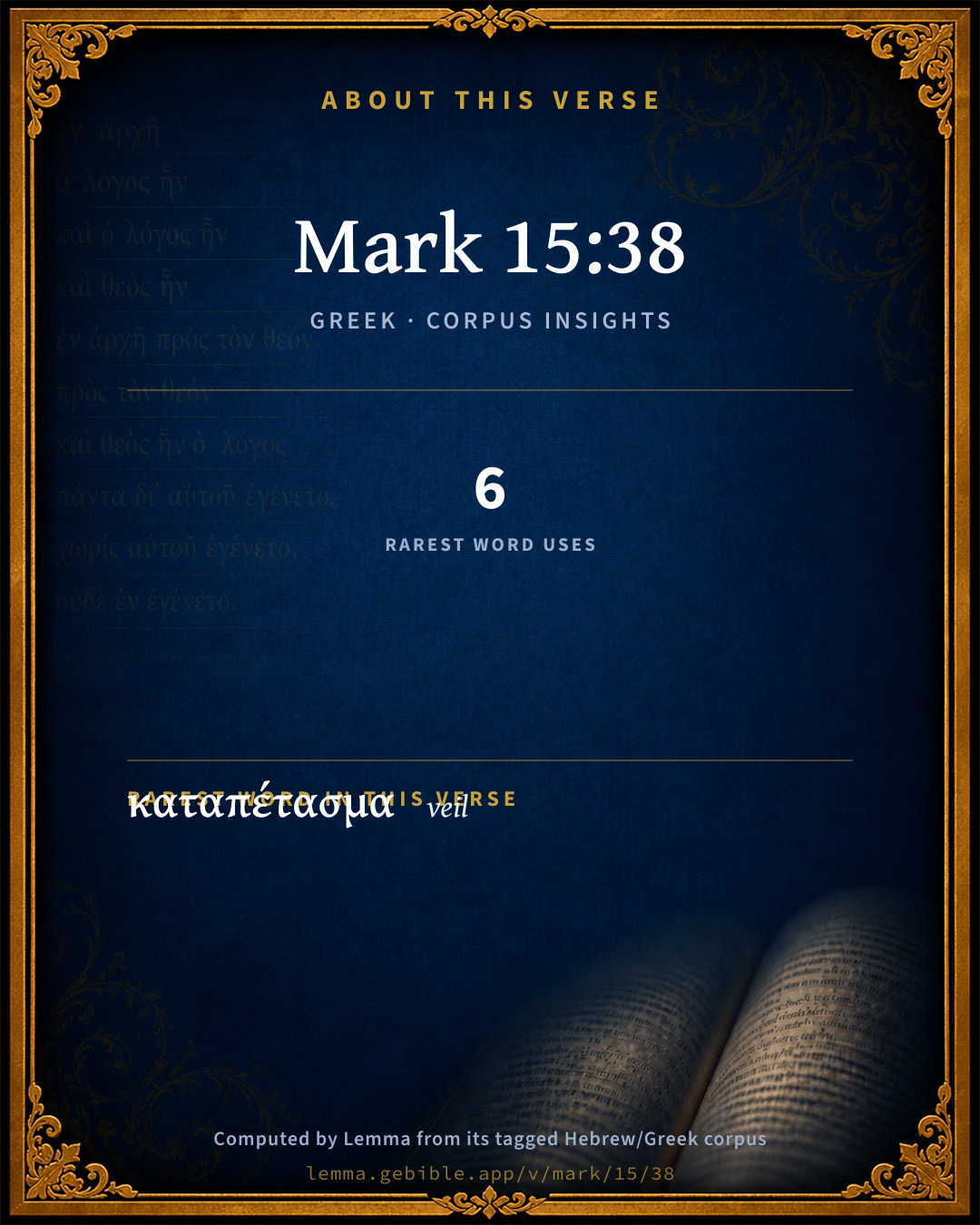
The rarest word here is καταπέτασμα veil G2665 — appearing just 6 times in the whole Greek New Testament.

Shared distinctive vocabulary

καταπέτασμα veil G2665 occurs in 6 verses of the Greek New Testament. Also found in:

Repetition

A word recurs within this verse:

Cross-references

10

Topical passages linked to Mark 15:38 in the Treasury of Scripture Knowledge — connected by theme and wording, ordered by reader-vote popularity; previews shown in the World English Bible.

  • Hebrews 10:19–23 Having therefore, brothers, boldness to enter into the holy place by the blood of Jesus,
  • Luke 23:45 The sun was darkened, and the veil of the temple was torn in two.
  • Matthew 27:51–53 Behold, the veil of the temple was torn in two from the top to the bottom. The earth quaked and the rocks were split.
  • Hebrews 9:3–12 After the second veil was the tabernacle which is called the Holy of Holies,
  • Leviticus 16:2–19 and Yahweh said to Moses, "Tell Aaron your brother, not to come at all times into the Most Holy Place within the veil, before the mercy seat which is on the ark; lest he die: for I will appear in the cloud on the mercy seat.
  • Exodus 26:31–34 "You shall make a veil of blue, and purple, and scarlet, and fine twined linen, with cherubim. The work of the skillful workman shall it be made.
  • Hebrews 4:14–16 Having then a great high priest, who has passed through the heavens, Jesus, the Son of God, let us hold tightly to our confession.
  • Hebrews 6:19 This hope we have as an anchor of the soul, a hope both sure and steadfast and entering into that which is within the veil;
  • Exodus 40:20–21 He took and put the testimony into the ark, and set the poles on the ark, and put the mercy seat above on the ark.
  • 2 Chronicles 3:8–14 He made the most holy house: the length of it, according to the breadth of the house, was twenty cubits, and the breadth of it twenty cubits; and he overlaid it with fine gold, amounting to six hundred talents.

Cross-references courtesy of OpenBible.info (CC BY 4.0).

Commentary

Notes on Mark 15:38 from classic Christian and Jewish commentators (each source and its license shown beneath its notes). The classic Christian expositions comment on the surrounding passage and are grouped to its opening verse, so a note may address several verses; the Jewish commentaries on the Tanakh (Rashi and others) are per-verse, so they appear only where the commentator wrote on this verse.

Lemma curates 59 commentaries, every one of them public domain or Creative Commons licensed, each selected and text-cleaned for this edition rather than reprinted as found. About our sources →

The Biblical Illustrator

Joseph S. Exell

Mar_15:38

And the veil of the temple was rent.

The rent veil

If you look into the account of the arrangements and furniture of the Jewish temple, you will find that there were two veils-the one at the entrance into the holy place; the other between the holy place, or the sanctuary, and the most holy, or the holy of holies. This latter is called by St. Paul, in his Epistle to the Hebrews, the second veil; and its position is thus described by him-After the second veil, the tabernacle which is called the holiest of all; for therein, as the apostle goes on to enumerate, were deposited the most sacred of those mystic articles, which were appropriated to the rites of the Jewish religion. The second veil is always considered to have been that which was rent in twain at the death of our Lord; so that the thing done through the rending, was the throwing open that heretofore invisible and inaccessible place, the holy of holies. Invisible and inaccessible, forasmuch as no one but the High Priest was ever permitted to pass the veil, and he but once in the year, on the great day of atonement. On that day-all whose ceremonies and sacrifices were so wondrously significative, representing as with the accuracy of history rather than of prophecy, the expiatory work of the Lord our Redeemer-it was ordered that the High Priest having slain certain victims, should carry the blood within the veil, that he might therewith sprinkle the mercy seat. There is no debate that in performing this, the High Priest was a type of Christ in His office of intercessor; for Christ after suffering without the camp, offering Himself up as a sin offering to the Almighty, was to pass within the veil-to enter, that is, into the immediate presence of God in heaven-carrying with Him His own blood, that He might plead its virtue on behalf of His church. Here is the office which Christ still discharges as Mediator-He died but once, for one offering sufficed to make expiation for the sins of the whole world, but He ever liveth to present the merits of His oblation, and through it to act in heaven as the advocate of those for whom He submitted to the death of the cross. But we can perhaps scarcely say, that the rending of the veil had reference to Christs entrance on His office of intercessor, except that He may thus have shown that He had opened the way into the holy of holies, and had obtained a right to enter as our advocate. Until He had completed on the cross the redemption of the world, He could not become an intercessor with the Father; He must have blood wherewith to sprinkle the mercy seat; and therefore as the rent rooks and opened graves proclaimed Him victorious in death, so may the river veil have declared that He had won for Himself an access into heavenly places, there to perpetuate the work which had been wrought out on Calvary. And there are other intimations which may, perhaps, have been conveyed by the occurrence in question. It is probable, for example, that the abolition of the Mosaic economy was hereby figuratively taught. What could be more significative of a change of dispensation, than that, at the moment of Christs death, there should have been miraculously destroyed the covering which had heretofore shrouded the golden censer, and the ark of the covenant, and the cherubim of glory shadowing the mercy seat; those majestic and mysterious things which looked upon by any but the High Priest, demanded the death of the presumptuous beholder? The priests may have been in the holy place, when suddenly an invisible hand tore in twain the veil, within which they had never dared to gaze, and revealed those symbols of divinity which gave an awful sacredness to the unapproached shrine. What thought they? How felt they? If the flashing light from characters traced by an unseen hand, spread consternation through the halls of the Assyrian, and caused the monarch to tremble, though girt round with guards, what effect should have been wrought on the ministering priests by the sudden shining of all that bright gold which had long been hidden from the human eye, and in whose deep rich lustres Deity might be said to have imaged His presence? Did they turn and flee, as if fearing that Jehovah was about to come forth from the tremendous solitude, and purify His temple; or did they dare to stand and look at the uncovered shrine, amazed that they might behold, and not be instantly struck dead? Nay, I know not what may have been the feelings of the officiating priests at this strange, this fearful visitation of the holy of holies; but they knew what was then transacting oh Calvary. Their voices had been loud in demanding the death of Jesus of Nazareth; and had they not been given up to a judicial blindness-a blindness justly awarded them for their long rejection of light-they could scarcely have resisted the surpassing evidence, that the Mosaic economy was now to pass by. Had, indeed, the expiring groan of Jesus of Nazareth rent asunder the veil of the temple, and thus made common things of those which for ages had been fearfully sacred? O, then, ye priests, ye ought to ]earn that your office is at an end; O quench the fires on your altars; O drive the sacrificial victims from your courts; and whilst the earth yet trembles, and appalling and portentous things tell out the majesty of your crucified King, fall down before Him whom ye have crucified and slain, and learn, as ye may learn, the most amazing thing of all, that He is compassionate enough to love His enemies, and powerful enough to save His murderers. Yes, learn that He has indeed come to destroy the law, but only that He might substitute for it a better covenant; for all that is taught you by the fact, that immediately on His giving up the ghost, the veil of the temple was rent in twain from the top to the bottom. But we do not thus exactly bring home to ourselves the type of the rent veil, or give it part in that continuous instruction which we look for in the prodigies which attended Christs death. You will remember that not only was there a very quick rending of the veil, but that the graves were opened, and many bodies of saints which slept arose and came out of their graves after His resurrection and appeared unto many. The leaking of the earth was as much as to tell us that Satans dominion was overthrown-that dominion of which the earth was the seat. The solid globe shook to its centre, indicating the falling to ruin of that empire of evil which had been erected upon it. And the rocks were rent; mountains had been piled up between God and man; the barrier was as that of the everlasting hills; but the Redeemer in dying broke into shivers the vast impediment, and reconciled the world to its Creator. But the parable was yet more explicit-the graves were opened. It had been through apostasy that death had entered the world; it was one of the most fearful and comprehensive of the consequences of sin; and, therefore was its abolition to be looked for, as one of the chief results of the interference of a surety. Hence the opening of the graves. In dying, Christ destroyed death; and therefore did the sepulchres at once throw open their gloomy doors, as though in confession that they had no longer right to hold fast their prey. And if the bars are loosened, and the prison gates opened, may not the captives march instantly forth? What can longer hinder the emancipation of the dead? Yet here there is a pause; a delay intervenes; and the evangelist specially notes that it was after the resurrection of Jesus, that many bodies of the saints which slept arose and came out of the graves. Does not this figuratively teach that Christ was to be raised again for our justification: that although the sacrifice of the cross had perfected our redemption, in respect of God shaking the earth, rending the rocks, opening the graves, there yet remained a further act to complete it towards us? Resurrection must follow on death, otherwise would the prison be opened, and yet the prisoner not discharged. As we gaze on the dying Redeemer, and listen to the piteous exclamation which marks how He is deserted of the Father, we are tempted to doubt whether it be indeed as a conqueror that He departs from this earth, whether He has indeed vanquished our enemies and those of God, as He hews His head and gives up the ghost. But soon is heard a sound as of victory. Proof after proof crowds in upon us, that whatsoever was undertaken has been accomplished, whatsoever we needed been obtained. First, there are general symbols-a trembling earth and riven rocks. Creation has recognized her Maker in the expiring man, and confesses by the dissolving of her most solid parts, that He has now effected a wondrous transformation, extracting good out of evil, converting the fall of man into an occasion of discomfiture to Satan and of glory to God, and thus virtually turning the rock into a standing water, the flint into a fountain of waters. But I seem to crave yet more specific testimony. I know that creation has before now been disquieted, when it was no message of comfort to man which was written in its struggles and uttered through its groans; and I have the more specific testimony. What shall I say to opened graves and quickened bodies? I remember the Saviour to have said, The hour is coming and now is, when the dead shall hear the voice of the Son of God, and they that hear shall live. And now the voice which they have heard, and on which they stirred in their narrow beds, is the voice which had exclaimed, It is finished. O beautiful token that in dying Christ hath indeed mastered death, and that what He finished on the cross is my rescue from the powers of darkness. But still I crave further testimony; I need a higher blessing; it is not enough for me to be emancipated from corruption; I long for admission into the world which is radiant with the presence of the Lord God Almighty; I long for companionship with angels; I would walk where they walk; I would wait with cherubim and seraphim in the court of the celestial King, gazing on His glories, and delighting to execute His will. Is this possible? A creature of dust-where are the wings with which I may soar, where the path which I may tread, and find that it conducts me within the veil? Within the veil! Why, whilst I look on the graves which Christ hath opened by the greatness of His might, and feel that though they tell me of a resurrection, they do not tell me of entrance into the celestial courts, there come tidings which announce that the veil of the temple has been rent in twain-that very veil which I have always regarded as being before the holy of holies, to show me that there is no admission for such as myself into the place where Deity is specially manifested. The veil is rent. Then with it should be rent away all doubt and all unbelief. The door of heaven, as well as the door of the grave, is thrown open through the work of mediation. I may not only rise from the dust; I may tread the firmament; I may enter by the gate of pearl, and I may walk the street of gold. There is a remarkable prophecy in the writings of Micah, which seems closely to bear upon the subject of our present discourse: it is this-The breaker is come up before them: they have broken up, and have passed through the gate, and are gone out of it; and their King shall pass before them, and the Lord at the head of them. Now, here is presented to us a magnificent procession, led by a chief under the expressive title of the breaker; He heads a vast company, He directs them through some gate, which He presses open by His own energy or labour; and they follow in triumph, and pass on like marching conquerors. Who is this but the Lord Jesus Christ, who, having vanquished death, and opened the closed gate of everlasting life, has gone before that He may prepare a place for His followers, who through faith and patience, shall inherit His promise. And do you observe how the title of the breaker, as applied to our Redeemer, is verified or vindicated by the prodigies which throng the crucifixion! The broken earth, the broken rocks, the broken graves, the broken veil of the temple-how do all these teem to correspond with the name of the breaker! Oh! that in our own case we might be able to add broken hearts to the list, and thus prove that Christ is still a breaker; but a breaker who breaks only with the gracious purpose of making whole. (H. Melvill, B. D.)

The Biblical Illustrator, edited by Joseph S. Exell (c. 1880s–1900s) — public domain. Text from a community e-Sword module.

Godbey's Commentary on the New Testament

William B. Godbey

CHAPTER 28

CONCURRENT MIRACLES

Luk 23:45-49; Mar 15:38-41; Mat 27:51-56. Our Lord has already expired on the cross, and now we proceed to consider the concurrent miracles so overwhelmingly attesting His Divinity, and pouring a cataract of conviction on the multitude, which rankled like Scythian arrows in their spiritual vitals, preparing them for the glorious Pentecostal revival which followed at the end of fifty days. “And, behold, the veil of the temple was rent in twain from the top to the bottom.” The old dispensation was on the plane of justification, which is symbolized by the outer court of the temple, in which the shewbread had to be renewed frequently, as it would get stale and moldy, while the lamps had to be supplied with oil and lighted, or they would go out, thus in constant need of human agency and attention. Not so with the inner court of the temple, the Holy of Holies. There the manna in the golden pot was always fresh and delicious, while Aaron’s rod constantly exhibited swelling buds, evolving leaves, blooming flowers, growing fruits, and ripe almonds, delicious to the taste and ready to be eaten. Meanwhile the Shekinah, the symbol of the Divine presence, kept the temple bright as cloudless noonday all the time, so no one could discriminate the night as it went by, as perennial noonday did there abide, so wonderfully illustrating the truly sanctified experience. The moment Jesus expired on the cross, the dispensation of Christian perfection was inaugurated, God with His own hand tearing down the veil, and admitting all the inmates of His temple into the Holy of Holies, the Old Testament saints being priests and the New Testament saints high priests unto God. You see this veil was rent from the top to the bottom, showing that the sanctifying power always comes from heaven. When you get it by priestcraft or carnal ordinances, it is always spurious.

“The earth did quake, and the rocks were rent.” During both of my tours in the Holy Land, as Calvary had more charms for me than any other spot, I spent much time praying and meditating on this holy mount, where Jesus laid down His life for me. I could have no idea as to the number of my visits to that hallowed summit, or the time I spent there. Though one thousand eight hundred and sixty-seven years have rolled away, the footprints of the old earthquake that visited the land are still obvious. I saw them in the irregular ruptures of the great rocks.

“The tombs were opened, and many bodies of the sleeping saints did rise, and coming out from the tombs after His resurrection, did come into the holy city, and were made manifest unto many.” There is an Oriental tradition that Abraham, Isaac, and Jacob, as well as other eminent prophets and saints, did rise at that time. We have no revelation as to what became of them. I doubt not but that they accompanied our Lord the ensuing forty days and ascended with Him to heaven. You see that though the great stone tombs were broken up by the earthquake, occurring at 3 P.M., Friday, when Jesus bowed His head and died, yet they did not come out of the tombs till after He arose at the early dawn the ensuing Sunday morning.

Good reasons for this: He was to be “the first fruits of them that slept,” the antecedent resurrections being abnormal and abortive, as the persons arose with their mortal bodies, and consequently died again. As these resurrections, above described, were subsequent to our Lord’s, they of course received their immortal bodies, no more subject to death, and consequently flew away to heaven, constituting a prelude of the glorious first resurrection, including all the members of the Bridehood, and taking place at the Lord’s premilennial coming. (Rev 20:4-6.)

Mar 15:39-41. “And the centurion, standing in front of Him, and thus crying out He expired, said, Truly this was the Son of God. And there were women from a distance looking on, among whom was Mary Magdalene, and Mary the mother of James the Less and Joses, and Salome; who , when He was in Galilee, were accustomed to follow Him, and minister unto Him; and many other women having come up along with Him to Jerusalem.” Luk 23:47-48 : “And the centurion seeing that which took place, glorified God, saying, Truly this was a righteous Man. And all the multitudes being present at this sight, seeing the things which took place, were going away, beating their breasts.” Mat 27:54 : “And the centurion, and those along with him, having charge of Jesus, seeing the earthquake and the events which took place, became alarmed exceedingly, saying, Truly this was the Son of God.” Thus you see, an awful pall fell on the vast multitude, so that even the heathen Roman soldiers, who, under the rigor of military law, had been forced to execute this bloody work — stalwart men, who never knew fear on the battle-field — tremble and quake with paralyzing trepidation and heart-convulsing terror, confessing outright, “Surely this was the Son of God.” Among the Jews, “beating the breast” denoted the deepest sorrow and most terrible anguish. Luke says the multitudes who were present at that awful scene went away beating their breasts. O what a volcano of conviction came upon the Jews, who were there from all parts of the world attending the Passover, and returning to their homes in all lands were thus so wonderfully prepared for the coming of the apostles and the preaching of Jesus! As these Roman soldiers were Gentiles, and the time had arrived for the evangelization of the Gentile world, I trow the convictions fastened on them transformed them into prolific seed-corn, soon to germinate in many countries throughout the world-wide Roman Empire.

William B. Godbey, Commentary on the New Testament (1896–1900) — public domain. Text from a community e-Sword module.

Tyndale Open Study Notes

Tyndale Open Resources

15:38 The curtain that was torn in two might have been the one that separated the sanctuary from the courtyard (a magnificent tapestry eighty feet tall) or the one that separated the Most Holy Place from the rest of the sanctuary. If it was the former, the tearing (like the darkness, 15:33) was visible to people; it would indicate that Jesus’ prediction of the sanctuary’s destruction (14:58; 15:29) was being fulfilled spiritually (see Rom 9–11) but awaited physical fulfillment in AD 70. If it was the interior curtain that tore, it was probably a sign that, just as the heavens were split for Jesus to reveal his direct access to God (see study note on Mark 1:10), his death now extended this access to his followers (see Heb 6:19-20; 9:3-14; 10:19-20).

Tyndale Open Study Notes — © Tyndale Open Resources, licensed CC BY-SA 4.0. Text via the HelloAO Bible API.

Expositor's Greek Testament

ed. W. Robertson Nicoll

Mar 15:38 . The fact of the rending of the veil stated as in Mt., with omission of Mt.’s favourite ἰδοὺ , and the introduction of another of Mk.’s characteristic pleonasms, ἀπʼ ἄνωθεν .

The Expositor's Greek Testament, edited by W. Robertson Nicoll (1897–1910) — public domain. Text from a community e-Sword module.

The Cambridge Bible for Schools and Colleges

gen. ed. J. J. S. Perowne

38. And the veil of the temple] the beautiful thick, costly veil of purple and gold, inwrought with figures of Cherubim, 20 feet long and 30 broad, which separated the Holy Place from the Most Holy,

was rent in twain] For the full symbolism of this see Heb_9:3; Heb_10:19. For the earthquake which now shook the city, see Mat_27:51. Such an event must have made a profound impression, and perhaps was the first step towards the change of feeling which afterwards led a great number of “the priests to become obedient to the faith” (Act_6:7).

The Cambridge Bible for Schools and Colleges (gen. ed. J. J. S. Perowne; Cambridge University Press, 1878–1918) — public domain. Text from a community e-Sword module.

John Gill's Exposition

And now when the even was come,.... "Of the preparation", as the Syriac version reads; or "the night of the sixth day":, as the Persic version renders it, "Friday" night:

because it was the preparation; of the passover, and of the sabbath, when they prepared their food, and got it ready for the ensuing sabbath, on which it was not lawful to dress any;

that is, the day before the sabbath; that is, Friday; on which day, it is clear, Christ suffered, died, and was buried.

John Gill's Exposition of the Whole Bible (1746–1763) — public domain (CC PDM 1.0). Text via the HelloAO Bible API.

Trapp's Complete Commentary

John Trapp

38 And the veil of the temple was rent in twain from the top to the bottom.

Ver. 38. {See Trapp on "Mat 27:51"}

John Trapp, A Commentary or Exposition upon All the Books of the Old and New Testament (1647–1656) — public domain. Text from a community e-Sword module.

Matthew Poole's English Annotations

The prodigies happening upon the death of our Saviour, and the passages happening between the time of his expiration and his burial, are more largely reported by the other evangelists than by Mark; we have put them all together, and considered the passages relating to them, in our notes on Mat 27:51-54.

See Poole on "Mat 27:51", and following verses to Mat 27:54.

Matthew Poole's English Annotations on the Holy Bible (1683–1685) — public domain. Text from a community e-Sword/MySword module.

The Pulpit Commentary

And the veil of the temple was rent in twain from the top to the bottom. There were two veils one before the holy place, and the other before the holy of holies. The holy place would correspond to what we call the nave of the church, in which the priests were continually present; the holy of holies would correspond to our chancel choir the holiest part of the building. This was always kept closed; nor might any one enter it but the high priest, and that only once in the year, on the day of expiation. The veil which was rent at our Lord"s death was that which was placed before the holy of holies; it was called the katapetasma . The outer veil was called kalumma . It was the duty of the officiating priest, on the evening of the day of preparation, at the hour of evening prayer, which would correspond to the time of our Lord"s death, to enter into the holy place, where he would of course be between the two curtains, or veils, the outer veil, or kalumma , and the inner veil, or katapetasma . It would then be his business to roll back the kalumma , or outer veil, thus exposing the holy place to the people, who would be in the. outer court. And then and there they would see, to their amazement, the karapetasma , the inner veil, rent asunder from the top to the bottom. These veils or curtains, according to Josephus, were each forty cubits in height and ten in breadth, of great substance, very massive, and richly embroidered with gold and purple. Now, this rending of the veil signified

(1) that the whole of the Jewish dispensation, with its rites and ceremonies, was now unfolded by Christ; and that thenceforth the middle wall of partition was broken down, so that now, not the Jews only, but the Gentiles also might draw nigh by the blood of Christ. But

(2) it further signified that the way to heaven was laid open by our Lord"s death. "When thou hadst overcome the sharpness of death, thou didst open the kingdom of heaven to all believers." The veil signified that heaven was closed to all, until Christ by his death rent this veil in twain, and laid open the way.

The Pulpit Commentary (1880–1919), ed. H.D.M. Spence-Jones & Joseph S. Exell — public domain. Text from a community e-Sword module.

Scofield Reference Notes

C. I. Scofield

top to

God rent it down; it was rent from the top. Christ having made atonement and glorified God, the way into the holiest was now made manifest. Cf. Heb 9:8; Heb 9:24; Heb 10:19-22.

The Scofield Reference Bible (1917 edition), notes by C. I. Scofield — public domain. Text from a community e-Sword module.

Kretzmann's Popular Commentary

Paul E. Kretzmann

The Burial of Jesus.

Immediate effects of Christ’s death:

v. 38. And the veil of the Temple was rent in twain from the top to the bottom.

v. 39. And when the centurion, which stood over against Him, saw that He so cried out and gave up the ghost, he said, Truly, this Man was the Son of God.

v. 40. There were also women looking on afar off; among whom was Mary Magdalene, and Mary, the mother of James the Less and of Joses, and Salome;

v. 41. (who also, when He was in Galilee, followed Him, and ministered unto Him;) and many other women which came up with Him unto Jerusalem.

As a great sign had accompanied Christ’s deepest suffering, so nature now signified its horror, at God’s command, over the blasphemous deed which had been done on Calvary. While the earth was rocking in quivering terror over the outrage done to the Son of God, the great veil in the Temple, which separated the Holy Place from the Most Holy Place, the room where the altar of incense stood from the room which the high priest entered but once in the year, on the great Day of Atonement, was torn into two parts, from the top to the bottom. That was a sign that sin, which till now had separated man from God, had now been taken away, done away with. No need of earthly mediators and priests to assure the believers of the mercy of God through the blood of calves and of goats, since our great Mediator and High Priest has entered into the most holy place of heaven and has perfected forever them that are sanctified. Every sinner may now, on the strength of Christ’s sacrifice, freely come to God and depend upon the full redemption through His blood. The Roman centurion that had charge of the soldiers guarding the cross was a witness of all the things that happened on and near Calvary. But the greatest impression was made upon him by the death of Jesus itself. Here was not a defeat, but a victory, as everyone could see. He and those that were with him may often have heard the accounts of the Messiah of the Jews, of the fact that He was to be the Son of God and that He should bring salvation to His people. This occurrence opened his eyes; he now realized and frankly confessed: Truly, this Man was the Son of God. His heart had accepted Jesus as his Savior. At some distance were also standing some of the women that had made it their business to serve the Lord with the ministry of their hands. There was Mary Magdalene, out of whom the Lord had driven seven devils, Mary, the mother of James the Smaller, or Younger, and of Josses, and Salome, the wife of Zebedee, and the mother of James and John. These women had quietly, but effectively served Jesus even when He was in Galilee, they had made the journey up to Jerusalem with Him, and were now the witnesses of His martyrdom. Note: When the called apostles flee from the Lord’s side and hide, for fear of the Jews, the women show the greater courage. Also: It pleases the Lord very well when such ministry is rendered to Him; He has recorded the names of these women to their everlasting honor. Christian women that follow in their footsteps, in all humility, will not lack recognition from Him at the proper time.

Paul E. Kretzmann, Popular Commentary of the Bible (1921–1924) — public domain. Text from a community e-Sword module.

Burkitt's Expository Notes on the New Testament

William Burkitt

Three circumstances are here observable; 1. A stupendous prodigy happening upon the death of our Saviour, The veil of the temple was rent in twain from the top to the bottom: The veil was a hanging which parted the most holy place from the holy sanctuary. By the rending of which, God testified that he was now about to forsake his temple; that the ceremonial law, was now abolished by the death of Christ, and that by the blood of Jesus we have access unto God, and may enter into the holy of holies. See the note on Mat 27:51.

Observe, 2. What influence the manner and circumstances of our Saviour’s death had upon the mind of the centurion, and the soldiers with him; they cry, Verily this was the Son of God.

Where observe, That the heathen soldiers were sooner convinced of the divinity of our Saviour than the unbelieving Jewish doctors. Obstinacy and unbelief filled their minds with an invincible prejudice against Christ, so that neither the miracles wrought by him in his life, or at his death, could convince them that Christ’s friends were witnesses of his death; they are the women that followed him, and ministered unto him; not one of his dear disciples came near him, except John, who stood by the virgin Mary.

O! what a shame was this, for the apostles to be absent from a spectacle upon which the salvation of the world did depend!

And what an honour was this to the female sex in general, and to these holy-women in particular, that they had the courage to follow Christ to his cross, when all his disciples forsook him and fled! God can make timorous and fearful women bold and courageous confessors of his truth, and fortify them against the fears of suffering, contrary to the natural timorousness of their temper; these women wait upon Christ’s cross when his apostles fly, and durst not come nigh it.

William Burkitt's Expository Notes on the New Testament (1700–1703) — public domain. Text from a community e-Sword module.

Cambridge Greek Testament for Schools and Colleges

38. τὸ καταπέτασμα κ.τ.λ. All three mention the portent of the rending of the Temple-veil, about which we have no further information. Possibly the Evangelist regards it as the Temple rending its clothes in grief for the death of the Messiah, a death which sealed its own doom, lamentans excidium loco imminens (Clem. Recog. i. 41). The Gospel of Peter has it, and there is a passage in the Testaments (Levi ix. 3) which predicts that “the veil of the Temple shall be rent, so as not to cover your shame”; but in the latter passage ἔνδυμα may be the true reading rather than καταπέτασμα. Jerome says that in the Gospel according to the Hebrews there was a statement that superliminare templi infinitae magnitudinis fractum esse atque divisum, which points to a tradition of some extraordinary occurrence. The veil in question is that between the Holy Place and the Holy of Holies, and it is mentioned nowhere else in N.T., for Heb 9:3 refers to the Tabernacle. Its rending might signify that by the death of Christ the exclusiveness of the Jewish religion was done away, and that even the Holy of Holies was now accessible to all who desired to enter.

ἀπʼ ἄνωθεν. Mt. omits the superfluous ἀπό. See on ἀπὸ μακρόθεν (Mar 5:6).

Cambridge Greek Testament for Schools and Colleges (Cambridge University Press, 1896; 21 vols, various authors incl. Carr, Maclear, Plummer, Farrar, Lumby, Moule, M. R. James, Simcox) — public domain. Text from a community e-Sword module.

Alford’s Greek Testament

Henry Alford

38-41.] Signs following his death. Mat 27:51-56. Luk 23:45, Luk 23:47-49. Omitted by John. See notes on Matt.

Henry Alford, The Greek Testament (1849–1861) — public domain. Text from a community e-Sword module.

International Critical Commentary

38. τὸ καταπέτασμα τοῦ ναοῦ—the vail, or curtain of the sanctuary. ναός is the shrine of a temple, and in the Jewish temple, the Holy of Holies, in which was the Ark of the Covenant. The curtain was that which separated this from the Holy Place. The ναός was the place where God manifested himself, into which the High Priest only had access once a year. The rending of the vail would signify therefore the removal of the separation between God and the people, and the access into his presence. It is narrated by all the Synoptists.

International Critical Commentary — older volumes (1896–1929), various authors — public domain. Text from a community e-Sword module.

Vincent's Word Studies in the New Testament

Marvin R. Vincent

The veil. See on Mt 27:51.

Marvin R. Vincent, Word Studies in the New Testament (1887–1900) — public domain. Text from a community e-Sword/MySword module.

Lesson kit

Teaching starters — assembled from the data on this page, not authored interpretation. Every prompt links to the verse data it draws on. Edit before teaching.

Mark, in the Gospels, opens this verse with 12 words (11 distinct Greek lemmas). Its most distinctive word is katapétasma (“veil”). A historical commentator’s framing appears above. Read the whole chapter for the surrounding context.

Discussion questions

  1. What does “veil” (katapétasma) contribute to the verse as a whole?
  2. Matthew 27:51 shares the word «veil» with this verse. How do the two illuminate each other?
  3. “the” occurs 2× in this one verse. What is the effect of the repetition?
  4. These translations render this verse differently. What is at stake in choosing one wording over another?
  5. Reading how The Biblical Illustrator and Godbey's Commentary on the New Testament read this verse, where do the two commentators agree and where do they part?

Things to notice

Reading settings

Reading text

Shown beneath each verse's original-language words.

Old Testament
Old Testament edition

Read the OT as the Masoretic Hebrew (MT) or the Greek Septuagint (LXX).

English shown for the Greek Septuagint (in the Hebrew ↔ Greek comparison).

Comparing translations? Open the Compare panel on any verse page to stack up to four side by side.