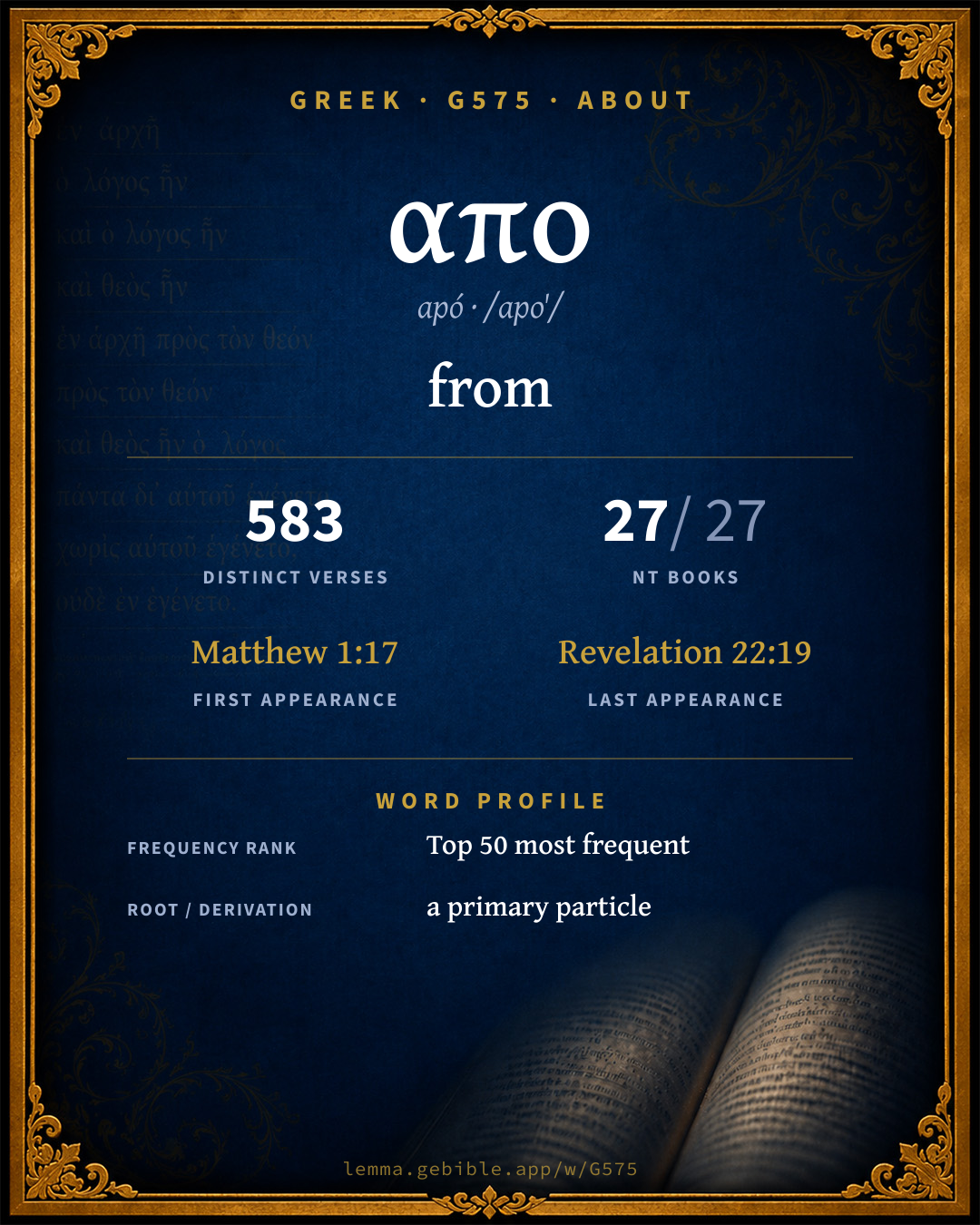
ἀπό
from
‘from’ is one of 6 main senses fuller range ↓
Full lexicon entry — Thayer's Greek Lexicon
From Thayer's Greek Lexicon
Where this word appears
Grammar key — what these labels mean
Part of speech
- Preposition
- A relational word governing a noun in a particular case.
Every verse where G575 appears in the Book of 2 Corinthians — 16 distinct verses. Click any verse to open its interlinear word-by-word view. Verse text shown in the World English Bible for context — . Each verse’s Greek form is shown with its reference; the English is not keyword-highlighted, since the data carries no word-level English alignment. Use “Compare translations” on any verse to read it across multiple English versions. This concordance covers the Greek New Testament; Septuagint (Greek Old Testament) occurrences of this word are not indexed here.
2 Corinthians
- 2 Corinthians 1:2 ἀπὸ prep Grace to you and peace from God our Father and the Lord Jesus Christ.
- 2 Corinthians 1:14 ἀπὸ prep as also you acknowledged us in part, that we are your boasting, even as you also are ours, in the day of our Lord Jesus.
- 2 Corinthians 1:16 ἀπὸ prep and by you to pass into Macedonia, and again from Macedonia to come to you, and to be sent forward by you on my journey to Judea.
- 2 Corinthians 2:3 ἀφ’ prep And I wrote this very thing to you, so that, when I came, I wouldn't have sorrow from them of whom I ought to rejoice; having confidence in you all, that my joy would be shared by all of you.
- 2 Corinthians 2:5 ἀπὸ prep But if any has caused sorrow, he has caused sorrow, not to me, but in part (that I not press too heavily) to you all.
- 2 Corinthians 3:5 ἀφ’ prep not that we are sufficient of ourselves, to account anything as from ourselves; but our sufficiency is from God;
- 2 Corinthians 3:18 ἀπὸ ἀπὸ prep prep But we all, with unveiled face beholding as in a mirror the glory of the Lord, are transformed into the same image from glory to glory, even as from the Lord, the Spirit.
- 2 Corinthians 5:6 ἀπὸ prep Being therefore always of good courage, and knowing that, while we are at home in the body, we are absent from the Lord;
- 2 Corinthians 5:16 ἀπὸ prep Therefore we know no one after the flesh from now on. Even though we have known Christ after the flesh, yet now we know him so no more.
- 2 Corinthians 7:1 ἀπὸ prep Having therefore these promises, beloved, let us cleanse ourselves from all defilement of flesh and spirit, perfecting holiness in the fear of God.
- 2 Corinthians 7:13 ἀπὸ prep Therefore we have been comforted. In our comfort we rejoiced the more exceedingly for the joy of Titus, because his spirit has been refreshed by you all.
- 2 Corinthians 8:10 ἀπὸ prep I give a judgment in this: for this is expedient for you, who were the first to start a year ago, not only to do, but also to be willing.
- 2 Corinthians 9:2 ἀπὸ prep for I know your readiness, of which I boast on your behalf to them of Macedonia, that Achaia has been prepared for a year past. Your zeal has stirred up very many of them.
- 2 Corinthians 11:3 ἀπὸ prep But I am afraid that somehow, as the serpent deceived Eve in his craftiness, so your minds might be corrupted from the simplicity that is in Christ.
- 2 Corinthians 11:9 ἀπὸ prep When I was present with you and was in need, I wasn't a burden on anyone, for the brothers, when they came from Macedonia, supplied the measure of my need. In everything I kept myself from being burdensome to you, and I will continue to do so.
- 2 Corinthians 12:8 ἀπ’ prep Concerning this thing, I begged the Lord three times that it might depart from me.
About this entry
At a glance — auto-summarized from this page’s data, not written by a person. Every figure links to its source below. This summary describes the numbers; it doesn’t interpret them.
“from” is the headline sense of the Greek word απο (apó). Catalogued under 6 senses, its meaning is not single-sense. With 583 verses in 27 books, it is one of the most common word in the Greek New Testament. Scripture first uses it in Matthew 1:17. From the same root come απαγγελλω, απαγχομαι and απαγω. See the sense tree, 583-verse concordance, and the renderings breakdown below.
Gloss history
Strong's 1890 vs modern scholarship

About this word
Strong's G575 catalogs a Greek word from the Greek New Testament.
These counts are not copied from any lexicon or concordance. They are computed here, from the morphology-tagged Greek New Testament. What Lemma adds →
- 583
- distinct verses
- The word appears in 583 distinct verses.
- 27 / 27
- NT books
- The word appears in 27 of 27 New Testament books.
- #30
- by frequency
- Top 50 most frequent Greek words (rank 30 of 5,347 Greek words by occurrence).
View all 583 occurrences in the concordance →
By section of the New Testament
By traditional corpus
Conventional, traditional groupings — biblical authorship is debated, so this is a traditional corpus grouping, not an authorship claim. Some books belong to more than one corpus (Luke is in both the Gospels and the Lukan corpus, and so on), so these shares overlap and need not total 100%. Each figure is a share of the word’s 583 distinct verses.
- Gospels 293 verses · 50%
- Lukan (Luke–Acts) 216 verses · 37%
- Pauline corpus 102 verses · 17%
- Johannine 84 verses · 14%
- General (Catholic) Epistles 35 verses · 6%
- Revelation 26 verses · 4%
- Hebrews 22 verses · 4%
How translations render this word
Counts come from each version’s own published word-to-Strong’s tagging or interlinear alignment — an approximate guide to how each version renders this word, not a word-level alignment the data otherwise carries. Because each total is that version’s own tagged count, the per-version totals vary from one another and need not match the appearance or distinct-verse counts above. These counts may also differ from a printed concordance because Lemma counts each distinctly tagged rendering and does not collapse phrase taggings into a single head-word total. This is a fixed set of word-tagged versions (KJV, ASV, BSB, ULT) and does not change with the reading translation you choose elsewhere. Each version’s license is shown beside its name below (and on Sources).
- King James Version: From 370×, Of 164×, For 10×
- American Standard Version: From 411×, Of 99×, For 14×
- Berean Standard Bible: From 363×, Of 61×, By 20×
- unfoldingWord Literal Text: From 561×, By 18×, Of 15×
King James Version Public Domain
Renders G575 across 648 tagged occurrences — most commonly:
Plus other, less common renderings. Plus 29 renderings that appear only once — usually multi-word phrases or single function words the recovered tagging swept in, not distinct renderings. Not rendered by a distinct English word in 9 further occurrences.
American Standard Version Public Domain
Renders G575 across 640 tagged occurrences — most commonly:
Plus other, less common renderings. Plus 48 renderings that appear only once — usually multi-word phrases or single function words the recovered tagging swept in, not distinct renderings.
Berean Standard Bible Public Domain
Renders G575 across 549 tagged occurrences — most commonly:
Plus other, less common renderings. Plus 18 renderings that appear only once — usually multi-word phrases or single function words the recovered tagging swept in, not distinct renderings. Not rendered by a distinct English word in 80 further occurrences.
unfoldingWord Literal Text CC BY-SA 4.0
Renders G575 across 644 tagged occurrences — most commonly:
Plus 12 renderings that appear only once — usually multi-word phrases or single function words the recovered tagging swept in, not distinct renderings.
Senses in Thayer's
The 6 senses Thayer's distinguishes for this word, in lexicon order (not ranked by frequency or importance). The full entry — with sub-senses — is in the Lexicon Entry tab.
- of local separation, after verbs of motion from a place i.e. of departing, of fleeing, ...
- of separation of a part from the whole
- of any kind of separation of one thing from another by which the union or fellowship of the two is destroyed
- of a state of separation, that is of distance
- of the place whence anything is, comes, befalls, is taken
- of origin of a cause
Word origin
Origin: a primary particle
A primary particle; off that is away (from something near) in various senses (of place time or relation; literally or figuratively): - (X here-) after ago at because of before by (the space of) for (-th) from in (out) of off (up-) on (-ce) since with. In composition (as a prefix) it usually denotes separation departure cessation completion reversal etc.
— Strong’s Exhaustive Concordance (1890), public domain.
Forms in the corpus
The 5 distinct written forms G575 takes in the Greek New Testament, most frequent first — each parse links to that case’s occurrences in the concordance.
| Form | Parsing | Example | Uses |
|---|---|---|---|
| ἀπὸ apò | Preposition | Matthew 1:17 | 468 |
| ἀπ’ ap | Preposition | Matthew 7:23 | 119 |
| ἀφ’ aph | Preposition | Matthew 21:43 | 44 |
| Ἀπὸ Apò | Preposition | Matthew 4:17 | 6 |
| ἀπό apó | Preposition | Acts 28:23 | 1 |
Same root — word family
Other Thayer's entries built from the same root as G575, grouped by Strong’s listed origin. These share a root / origin per the lexicon — not necessarily a shared meaning. Each links to that word’s own entry.
Derived from this word
- απαγγελλω apangéllō G518 to report
- απαγχομαι apánchomai G519 to strangle
- απαγω apágō G520 to lead away
- απαιρω apaírō G522 to take away
- απαιτεω apaitéō G523 to demand back
- απαλγεω apalgéō G524 to cease grieving
- απαλλασσω apallássō G525 to depart
- απαλλοτριοω apallotrióō G526 to estrange
- απανταω apantáō G528 to meet
- απαρνεομαι aparnéomai G533 to deny
- απαρτι apárti G534 henceforth
- απαρχη aparchḗ G536 to offer firstfruits
- απαυγασμα apaúgasma G541 brightness
- απειδω apeídō G542 to look away
- απειμι ápeimi G548 to depart
- απειμι ápeimi G549 to depart
- απειπομην apeipómēn G550 to declare
- απεκδεχομαι apekdéchomai G553 waiting for
- απεκδυομαι apekdýomai G554 to despoil
- απελαυνω apelaúnō G556 to drive away
- απελεγμος apelegmós G557 censure
- απελευθερος apeleútheros G558 freedman
- απελπιζω apelpízō G560 not despairing
- απεναντι apénanti G561 opposite
+86 more words derive from G575 (not shown).
Compare all same-root words → Showing 4 of 111 — not the complete family. They share a root, not necessarily a meaning.
Septuagint usage
The same Greek word απο appears 3,452 times in the Greek Old Testament (Septuagint), across 2,803 verses in 38 books.
- 3,452
- LXX occurrences
- Tagged occurrences of this Greek word in the Septuagint.
- 2,803
- verses
- Distinct Septuagint verses containing this word.
- 38 / 39
- OT books
- The word appears in 38 of the 39 Old Testament books.
Sample Septuagint occurrences
- Genesis 2:2 ἀπό
- Exodus 1:12 ἀπό
- Leviticus 1:2 ἀπό
- Numbers 1:3 ἀπό
- Deuteronomy 1:17 ἀπό
- Joshua 1:4 ἀπό
- Judges 1:14 ἀπό
- Ruth 1:1 ἀπό
- 1 Samuel 2:8 ἀπό
- 2 Samuel 1:22 ἀπό
- 1 Kings 1:50 ἀπό
- 2 Kings 1:4 ἀπό
Septuagint occurrences (same lexeme)
Every verse where the same Strong’s number (G575) appears in the Greek Septuagint — showing the first 50 of 2,803. Verse text shown in the World English Bible for context; the Greek form is the matched word — the English is not keyword-highlighted.
- Genesis 2:2 ἀπό On the seventh day God finished his work which he had made; and he rested on the seventh day from all his work which he had made.
- Genesis 2:3 ἀπό God blessed the seventh day, and made it holy, because he rested in it from all his work which he had created and made.
- Genesis 2:7 ἀπό Yahweh God formed man from the dust of the ground, and breathed into his nostrils the breath of life; and man became a living soul.
- Genesis 2:16 ἀπό Yahweh God commanded the man, saying, "Of every tree of the garden you may freely eat:
- Genesis 2:17 ἀπό but of the tree of the knowledge of good and evil, you shall not eat of it: for in the day that you eat of it you will surely die."
- Genesis 2:22 ἀπό He made the rib, which Yahweh God had taken from the man, into a woman, and brought her to the man.
- Genesis 3:1 ἀπό Now the serpent was more subtle than any animal of the field which Yahweh God had made. He said to the woman, "Yes, has God said, 'You shall not eat of any tree of the garden?'"
- Genesis 3:2 ἀπό The woman said to the serpent, "Of the fruit of the trees of the garden we may eat,
- Genesis 3:3 ἀπό but of the fruit of the tree which is in the midst of the garden, God has said, 'You shall not eat of it, neither shall you touch it, lest you die.'"
- Genesis 3:5 ἀπό for God knows that in the day you eat it, your eyes will be opened, and you will be like God, knowing good and evil."
- Genesis 3:8 ἀπό They heard the voice of Yahweh God walking in the garden in the cool of the day, and the man and his wife hid themselves from the presence of Yahweh God among the trees of the garden.
- Genesis 3:11 ἀπό God said, "Who told you that you were naked? Have you eaten from the tree that I commanded you not to eat from?"
- Genesis 3:12 ἀπό The man said, "The woman whom you gave to be with me, she gave me of the tree, and I ate."
- Genesis 3:14 ἀπό Yahweh God said to the serpent, "Because you have done this, cursed are you above all cattle, and above every animal of the field. On your belly shall you go, and you shall eat dust all the days of your life.
- Genesis 3:17 ἀπό To Adam he said, "Because you have listened to your wife's voice, and have eaten of the tree, of which I commanded you, saying, 'You shall not eat of it,' cursed is the ground for your sake. In toil you will eat of it all the days of your life.
- Genesis 4:3 ἀπό As time passed, it happened that Cain brought an offering to Yahweh from the fruit of the ground.
- Genesis 4:4 ἀπό Abel also brought some of the firstborn of his flock and of the fat of it. Yahweh respected Abel and his offering,
- Genesis 4:11 ἀπό Now you are cursed because of the ground, which has opened its mouth to receive your brother's blood from your hand.
- Genesis 4:14 ἀπό Behold, you have driven me out this day from the surface of the ground. I will be hidden from your face, and I will be a fugitive and a wanderer in the earth. It will happen that whoever finds me will kill me."
- Genesis 4:16 ἀπό Cain went out from Yahweh's presence, and dwelt in the land of Nod, on the east of Eden.
- Genesis 5:29 ἀπό and he named him Noah, saying, "This same will comfort us in our work and in the toil of our hands, because of the ground which Yahweh has cursed."
- Genesis 6:2 ἀπό that God's sons saw that men's daughters were beautiful, and they took for themselves wives of all that they chose.
- Genesis 6:4 ἀπό The Nephilim were in the earth in those days, and also after that, when God's sons came to men's daughters. They bore children to them: the same were the mighty men who were of old, men of renown.
- Genesis 6:7 ἀπό Yahweh said, "I will destroy man whom I have created from the surface of the ground; man, along with animals, creeping things, and birds of the sky; for I am sorry that I have made them."
- Genesis 6:13 ἀπό God said to Noah, "The end of all flesh has come before me, for the earth is filled with violence through them. Behold, I will destroy them with the earth.
- Genesis 6:19 ἀπό Of every living thing of all flesh, you shall bring two of every sort into the ark, to keep them alive with you. They shall be male and female.
- Genesis 6:20 ἀπό Of the birds after their kind, of the cattle after their kind, of every creeping thing of the ground after its kind, two of every sort shall come to you, to keep them alive.
- Genesis 6:21 ἀπό Take with you of all food that is eaten, and gather it to you; and it will be for food for you, and for them."
- Genesis 7:2 ἀπό You shall take seven pairs of every clean animal with you, the male and his female. Of the animals that are not clean, take two, the male and his female.
- Genesis 7:3 ἀπό Also of the birds of the sky, seven and seven, male and female, to keep seed alive on the surface of all the earth.
- Genesis 7:4 ἀπό In seven days, I will cause it to rain on the earth for forty days and forty nights. Every living thing that I have made, I will destroy from the surface of the ground."
- Genesis 7:8 ἀπό Clean animals, animals that are not clean, birds, and everything that creeps on the ground
- Genesis 7:15 ἀπό They went to Noah into the ark, by pairs of all flesh with the breath of life in them.
- Genesis 7:16 ἀπό Those who went in, went in male and female of all flesh, as God commanded him; and Yahweh shut him in.
- Genesis 7:17 ἀπό The flood was forty days on the earth. The waters increased, and lifted up the ark, and it was lifted up above the earth.
- Genesis 7:23 ἀπό Every living thing was destroyed that was on the surface of the ground, including man, cattle, creeping things, and birds of the sky. They were destroyed from the earth. Only Noah was left, and those who were with him in the ark.
- Genesis 8:2 ἀπό The deep's fountains and the sky's windows were also stopped, and the rain from the sky was restrained.
- Genesis 8:3 ἀπό The waters receded from off the earth continually. After the end of one hundred fifty days the waters decreased.
- Genesis 8:7 ἀπό and he sent forth a raven. It went back and forth, until the waters were dried up from off the earth.
- Genesis 8:8 ἀπό He sent forth a dove from him, to see if the waters were abated from off the surface of the ground,
- Genesis 8:11 ἀπό The dove came back to him at evening, and, behold, in her mouth was an olive leaf plucked off. So Noah knew that the waters were abated from off the earth.
- Genesis 8:13 ἀπό It happened in the six hundred first year, in the first month, the first day of the month, the waters were dried up from off the earth. Noah removed the covering of the ark, and looked. He saw that the surface of the ground was dried.
- Genesis 8:17 ἀπό Bring forth with you every living thing that is with you of all flesh, including birds, cattle, and every creeping thing that creeps on the earth; that they may breed abundantly in the earth, and be fruitful, and multiply on the earth."
- Genesis 8:20 ἀπό Noah built an altar to Yahweh, and took of every clean animal, and of every clean bird, and offered burnt offerings on the altar.
- Genesis 9:10 ἀπό and with every living creature that is with you: the birds, the cattle, and every animal of the earth with you. Of all that go out of the ark, even every animal of the earth.
- Genesis 9:11 ἀπό I will establish my covenant with you; neither will all flesh be cut off any more by the waters of the flood; neither will there any more be a flood to destroy the earth."
- Genesis 9:19 ἀπό These three were the sons of Noah, and from these, the whole earth was populated.
- Genesis 9:24 ἀπό Noah awoke from his wine, and knew what his youngest son had done to him.
- Genesis 10:19 ἀπό The border of the Canaanites was from Sidon, as you go toward Gerar, to Gaza; as you go toward Sodom, Gomorrah, Admah, and Zeboiim, to Lasha.
- Genesis 10:30 ἀπό Their dwelling was from Mesha, as you go toward Sephar, the mountain of the east.
These are occurrences of the same Greek lexeme (G575) in the Septuagint — not a translation of any one Hebrew word. The store carries no word-level Hebrew↔Greek alignment, so no Hebrew original is asserted here. Counts come from the recovered LXX Strong's tagging — high-frequency vocabulary is well covered, while rare or late forms may be untagged — so they reflect tagged occurrences and may slightly undercount.