
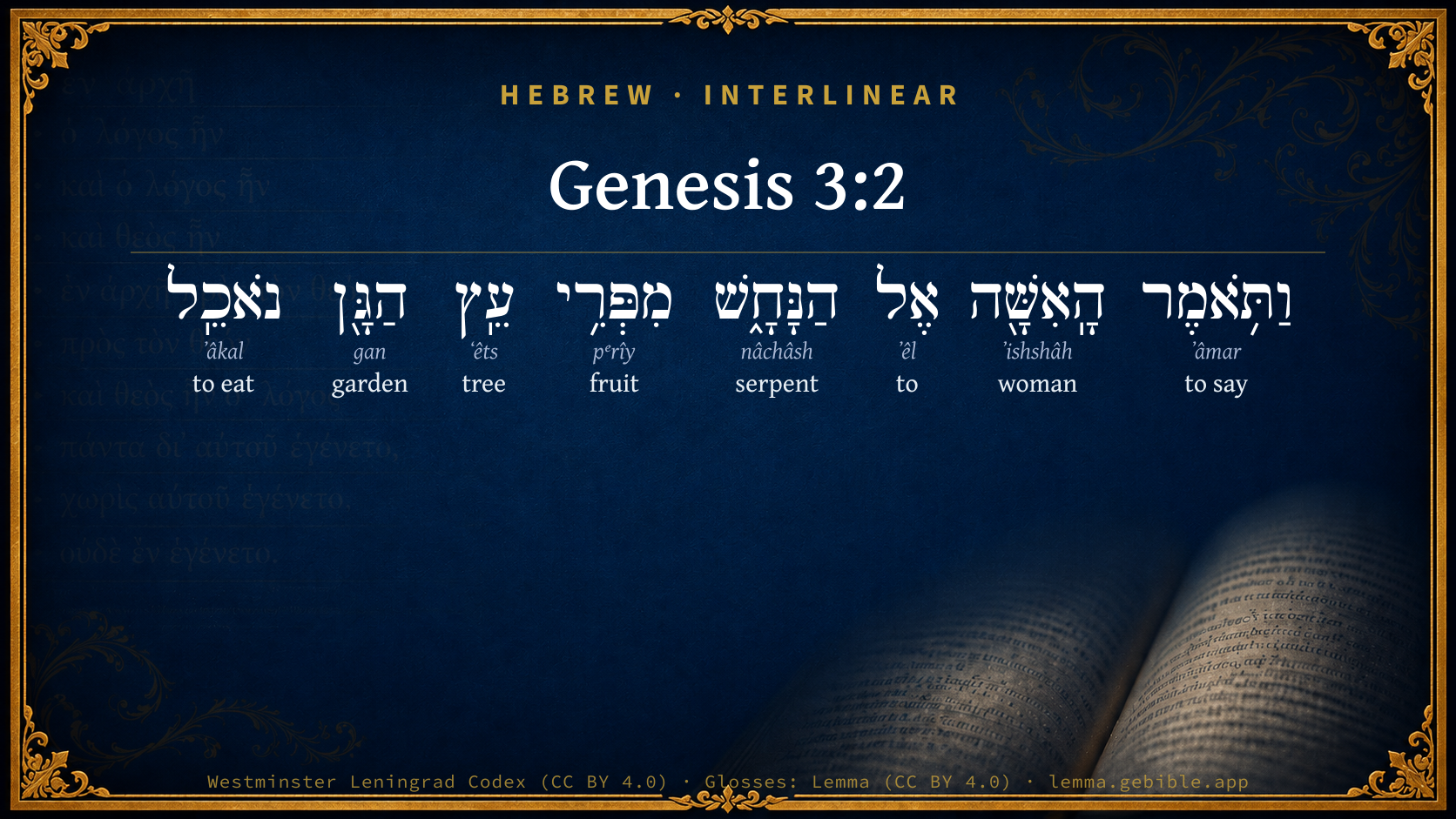
Genesis 3:2

Hebrew (Westminster Leningrad Codex) Genesis 3:2 appears in the Hebrew Old Testament. The text above is from the Westminster Leningrad Codex. Each word links to its Strong’s number, a concise gloss, and parsing drawn from the Open Scriptures Hebrew Bible morphology. Click any word for its full Brown-Driver-Briggs (BDB) entry.
Download image
Cite this verse

Genesis 3:2 (World English Bible). Public Domain. Lemma interlinear Bible study tool, https://lemma.gebible.app/v/genesis/3/2.

Show BibTeX & RIS
BibTeX
RIS
English Translation
The woman said to the serpent, "Of the fruit of the trees of the garden we may eat,
World English Bible · Public Domain
Download a study sheet

One document with this verse’s original text, its word-by-word gloss line, the meaning frame, cross-references with their text, attributed commentary, and full source and license credits — printable, and it pastes into notes with its structure intact.

This verse Autodidact and up

Study sheet (.html) Plain text (.txt)

A passage Seminary Student

Up to 50 verses in one chapter. A passage sheet keeps up to 6 commentary sources and 12 cross-references per verse, in the order this page ranks them, and says so on the sheet whenever that leaves anything out. Ask for a single verse and you get the Autodidact verse sheet above.

Everything on this page stays free to read, with no account — the sheet is a download of what is already on screen, not access to it.

Want to remove ads? Support Godless Engineer
Compare translations 3

The same verse in 3 English versions, stacked beneath the original-language interlinear above. Click any original word for its lexicon entry.

Each is an independent rendering of the whole verse — the interlinear is not word-aligned to these translations.

Highlighted words mark where these versions differ — a whole-verse word diff, not a word-by-word alignment.

  • World English Bible Public Domain
    The woman said to the serpent, "Of the fruit of the trees of the garden we may eat,
  • King James Version Public Domain
    And the woman said unto the serpent, We may eat of the fruit of the trees of the garden:
  • unfoldingWord Literal Text CC BY-SA 4.0
    Then the woman said to the serpent, “We may eat from the fruit of the tree of the garden,

unfoldingWord Literal Text — © unfoldingWord, licensed CC BY-SA 4.0. Word-aligned USFM3 via Door43 (git.door43.org/unfoldingWord/en_ult).

Versions to compare (up to 4)

3 of 4 selected

Show all 18 translations

Every available English version of this verse, each an independent rendering of the whole verse.

  • World English Bible Public Domain
    The woman said to the serpent, "Of the fruit of the trees of the garden we may eat,
  • Berean Standard Bible Public Domain
    The woman answered the serpent, “We may eat the fruit of the trees of the garden,
  • Majority Standard Bible Public Domain
    The woman answered the serpent, “We may eat the fruit of the trees of the garden,
  • King James Version Public Domain
    And the woman said unto the serpent, We may eat of the fruit of the trees of the garden:
  • American Standard Version (1901) Public Domain
    And the woman said unto the serpent, Of the fruit of the trees of the garden we may eat:
  • Revised Version (1885) Public Domain
    And the woman said unto the serpent, Of the fruit of the trees of the garden we may eat:
  • Geneva Bible (1599) Public Domain
    And the woman said vnto the serpent, We eate of the fruite of the trees of the garden,
  • Douay-Rheims (1899) Public Domain
    And the woman answered him, saying: Of the fruit of the trees that are in paradise we do eat:
  • Young's Literal Translation Public Domain
    And the woman saith unto the serpent, `Of the fruit of the trees of the garden we do eat,
  • Literal Standard Version CC BY-SA 4.0
    And the woman says to the serpent, “From the fruit of the trees of the garden we eat,
  • Unlocked Literal Bible CC BY-SA 4.0
    The woman said to the serpent, “We may eat the fruit from the trees of the garden,
  • unfoldingWord Literal Text CC BY-SA 4.0
    Then the woman said to the serpent, “We may eat from the fruit of the tree of the garden,
  • Darby Bible Public Domain
    And the woman said to the serpent, We may eat of the fruit of the trees of the garden;
  • World Messianic Bible Public Domain
    The woman said to the serpent, “We may eat fruit from the trees of the garden,
  • Webster's Bible Public Domain
    And the woman said to the serpent, We may eat of the fruit of the trees of the garden:
  • Free Bible Version CC BY-SA 4.0
    Eve replied to the serpent, “We can eat from the trees in the garden, but not the fruit from the tree in the middle of the garden.
  • Bible in Basic English Public Domain
    And the woman said, We may take of the fruit of the trees in the garden:
  • JPS Tanakh (1917) Public Domain
    And the woman said unto the serpent: 'Of the fruit of the trees of the garden we may eat;

Literal Standard Version (2020), Covenant Press — licensed CC BY-SA 4.0. Text via the HelloAO Bible API (eBible.org). Unlocked Literal Bible (unfoldingWord) — licensed CC BY-SA 4.0. Text via the HelloAO Bible API (eBible.org). unfoldingWord Literal Text — © unfoldingWord, licensed CC BY-SA 4.0. Word-aligned USFM3 via Door43 (git.door43.org/unfoldingWord/en_ult). Free Bible Version, Dr. Jonathan Gallagher — licensed CC BY-SA 4.0. Text via the HelloAO Bible API (eBible.org).

Word by word

More ways to search: Search by grammar → Find every occurrence → Compare this word →

Practice this passage: Drill this verse → Learn its vocabulary →

About this verse

These counts appear in no published source. They are computed here, from the morphology-tagged text and Lemma’s own curated glosses. What Lemma adds →

8
words
8
distinct lemmas
Pentateuch
section

Shared distinctive vocabulary

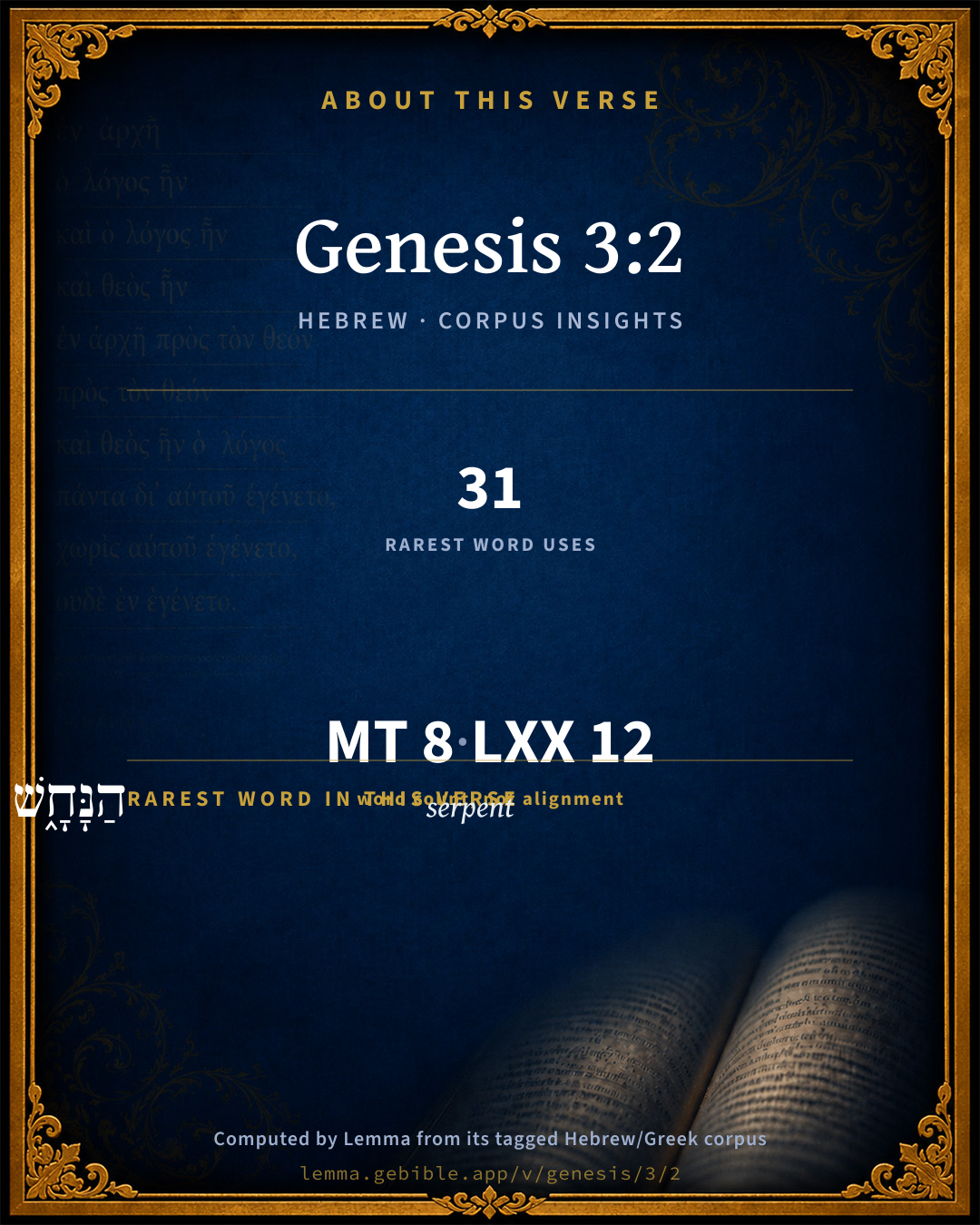
הַנָּחָ֑שׁ serpent H5175 occurs in 28 verses of the Hebrew Bible. Also found in:

Grammatical profile

  • 2 verbs
  • 5 nouns
  • 1 preposition

Verb forms

  • וַתֹּ֥אמֶר Qal · Sequential Imperfect
  • נֹאכֵֽל Qal · Imperfect

Hebrew & Septuagint length

In English translation the verse runs 18 words from the Hebrew and 19 from the Septuagint (LXX English) — closely comparable.

A rough comparison of the two English renderings, which tokenize alike — not a word-level alignment.

Word counts can differ between the Hebrew and the Greek without any difference in meaning — e.g. the Hebrew direct-object marker אֵת has no separate Greek word, and Greek often adds the article ὁ.

In the original languages it is 8 Hebrew tokens and 12 Greek tokens — but the two are counted differently (Hebrew bundles its prefixes and suffixes into one token; the Greek is in lemma form), so that isn’t a like-for-like length.

Cross-references

1

Topical passages linked to Genesis 3:2 in the Treasury of Scripture Knowledge — connected by theme and wording, ordered by reader-vote popularity; previews shown in the World English Bible.

  • Psalms 58:4 Their poison is like the poison of a snake; Like a deaf cobra that stops its ear,

Cross-references courtesy of OpenBible.info (CC BY 4.0).

Hebrew and Greek witnesses Masoretic Hebrew ↔ Greek Septuagint

The same verse in the two great witnesses to the Old Testament, shown verse-for-verse.

These are two independent witnesses, not word-aligned to each other, and the Septuagint is shown in lemma (dictionary) form.

Hebrew Genesis 3:2 Masoretic · Westminster Leningrad Codex

וַתֹּ֥אמֶר הָֽאִשָּׁ֖ה אֶל הַנָּחָ֑שׁ מִפְּרִ֥י עֵֽץ הַגָּ֖ן נֹאכֵֽל

The woman said to the serpent, "Of the fruit of the trees of the garden we may eat,

World English Bible · Public Domain

Greek LXX Genesis 3:2 Septuagint · lemma form

καί εἶπον ὁ γυνή ὁ ὄφις ἀπό καρπός ξύλον ὁ παράδεισος ἐσθίω

And the woman said to the serpent, We may eat of the fruit of the trees of the garden,

LXX2012 (modern English Septuagint) · Public Domain

Hebrew: Westminster Leningrad Codex (CC BY 4.0). Greek: Septuagint (public domain); English from LXX2012 (modern English Septuagint) (Public Domain). How the Septuagint differs from the Hebrew →

Targum (Aramaic paraphrase)

2

The Targum is the ancient Jewish Aramaic paraphrase of the Hebrew Scriptures — an interpretive translation, not the Hebrew text itself. Onkelos (literal) and Pseudo-Jonathan (expansive) render the Torah, and Jonathan the Prophets. Coverage is partial: where no permissively-licensed English translation exists for a verse, only the Aramaic is shown. This is verse-level text, not a word-by-word alignment to the Hebrew.

  1. Targum Onkelos Torah (Genesis–Deuteronomy)
    וַאֲמָרַת אִתְּתָא לְחִוְיָא מִפֵּירֵי אִילַן גִּינְתָא נֵיכוּל

    (no public-domain English translation for this verse)

    Targum Onkelos — Aramaic: “Onkelos Genesis” (public domain); “Onkelos Exodus” (public domain); “Onkelos Leviticus” (public domain); “Onkelos Numbers” (public domain); “Onkelos Deuteronomy” (public domain). English: “Sefaria Community Translation” (CC0 1.0 (public-domain dedication)); “J.W. Etheridge. The Targums of Onkelos and Jonathan Ben Uzziel on the Pentateuch. London: Longmans, Green, 1862” (public domain). Text via Sefaria.

  2. Targum Pseudo-Jonathan Torah (Genesis–Deuteronomy)
    וַאֲמָרַת אִתְּתָא לְחִיוְיָא מִשַׁאַר פֵּירֵי אִילַן גִינוּנִיתָא אִית לָן רְשׁוּ לְמֵיכַל

    And the woman said to the serpent, From the rest of the fruits of the trees of the garden we have power to eat;

    Targum Pseudo-Jonathan — Aramaic: “Targum Jonathan on Genesis” (public domain); “Targum Jonathan on Exodus” (public domain); “Targum Jonathan on Leviticus” (public domain); “Targum Jonathan on Numbers” (public domain); “Targum Jonathan on Deuteronomy” (public domain). English: “The Targum of Jonathan ben Uzziel, trans. J. W. Etheridge, London, 1862” (public domain). Text via Sefaria.

Commentary

Notes on Genesis 3:2 from classic Christian and Jewish commentators (each source and its license shown beneath its notes). The classic Christian expositions comment on the surrounding passage and are grouped to its opening verse, so a note may address several verses; the Jewish commentaries on the Tanakh (Rashi and others) are per-verse, so they appear only where the commentator wrote on this verse.

Lemma curates 59 commentaries, every one of them public domain or Creative Commons licensed, each selected and text-cleaned for this edition rather than reprinted as found. About our sources →

Trapp's Complete Commentary

John Trapp

Gen 3:2 And the woman said unto the serpent, We may eat of the fruit of the trees of the garden:

Ver. 2. And the woman said unto the serpent.] Our first parents were not, in the state of innocency, silly and witless, like young children, as Socinians make them; but very knowing, though but of small experience. But if they fell the same day {a} wherein they were created, as most hold, how sudden was the serpent’s seducing, the woman’s consenting, Adam’s yielding, and God’s executing!

{a} ημερα επλασθη και εξηλασθη

John Trapp, A Commentary or Exposition upon All the Books of the Old and New Testament (1647–1656) — public domain. Text from a community e-Sword module.

Joseph Benson's Commentary

Gen 3:2-3. The woman said — With a view to defend the conduct of her Maker toward them, against the insinuations of the tempter. We may eat of the trees of the garden — Of all the trees except one. It is only concerning one that God hath said, “Ye shall not eat of it.” But when she adds, Lest ye die, it is evident her faith begins to waver, and she inclines to doubt whether God would fulfil his threatening, which was not, “Lest ye die,”

but, “In dying ye shall die;” that is, “Ye shall surely die.” She seems also to have intended to intimate, that if they died, it would not be so much through any particular interference and severity of God in executing his threatening, as through the natural, pernicious effects of the fruit, against which God had only kindly warned them.

Joseph Benson's Commentary on the Old and New Testaments (1811–1818) — public domain. Text from a community e-Sword module.

Tyndale Open Study Notes

Tyndale Open Resources

3:2-3 The woman attempted to set the record straight; in the process, she belittled the privileges God had given her and her husband in several ways: (1) She reduced God’s “freely eat” (2:16) to may eat; (2) she downplayed God’s emphasis on the availability of fruit from every tree but one (2:17); (3) she added not touching to God’s prohibition against eating (2:17); and (4) she softened the certainty of death (2:17).

Tyndale Open Study Notes — © Tyndale Open Resources, licensed CC BY-SA 4.0. Text via the HelloAO Bible API.

Jamieson, Fausset & Brown

Robert Jamieson, A. R. Fausset & David Brown

the woman said, We may eat of the fruit of the trees of the garden--In her answer, Eve extolled the large extent of liberty they enjoyed in ranging at will amongst all the trees--one only excepted, with respect to which, she declared there was no doubt, either of the prohibition or the penalty. But there is reason to think that she had already received an injurious impression; for in using the words "lest ye die," instead of "ye shall surely die" [Gen 2:17], she spoke as if the tree had been forbidden because of some poisonous quality of its fruit. The tempter, perceiving this, became bolder in his assertions.

Jamieson, Fausset & Brown — Commentary Critical and Explanatory on the Whole Bible (1871) — public domain (CC PDM 1.0). Text via the HelloAO Bible API.

The Cambridge Bible for Schools and Colleges

gen. ed. J. J. S. Perowne

2. the woman, &c.] The woman is quick to correct the error into which she fancies the serpent has fallen, and to defend the generosity of the Lord.

The Cambridge Bible for Schools and Colleges (gen. ed. J. J. S. Perowne; Cambridge University Press, 1878–1918) — public domain. Text from a community e-Sword module.

John Gill's Exposition

And the woman said unto the serpent,.... Or to him that spoke in the serpent, which she might take to be a messenger from heaven, a holy angel: had she known who it was, she might be chargeable with imprudence in giving an answer, and carrying on a conversation with him; and yet even supposing this, she might have a good design in her answer; partly to set the matter in a true light, and assert what was truth; and partly to set forth the goodness and liberality of God, in the large provision he had made, and the generous grant he had given them: from this discourse of Eve and the serpent, no doubt Plato (g) had his notion of the first men discoursing with beasts:

we may eat of the fruit of the trees of the garden; of all and every one of them, which is to be understood, excepting the one after mentioned; so far are we from being debarred from eating of any, which the speech of the Serpent might imply, that they were allowed to eat of what they pleased, but one.

(g) In Politico, ut supra, (apud Euseb. Praepar. Evangel. l. 12.) c. 14.

John Gill's Exposition of the Whole Bible (1746–1763) — public domain (CC PDM 1.0). Text via the HelloAO Bible API.

Whedon's Commentary on the Bible

Daniel D. Whedon

2. The woman said — Her pausing to parley with so serious a temptation was a fearful mistake. To entertain the thoughts of an evil spirit is the sure way to become partaker of some measure of his nature.

Daniel D. Whedon (gen. ed.), Commentary on the Old and New Testaments (1874–1909) — public domain. Text from a community e-Sword module.

The Pulpit Commentary

Vers. 2, 3. And the woman said unto the serpent. Neither afraid of the reptile, there being not yet any enmity among the creatures; nor astonished at his speaking, perhaps as being not yet fully acquainted with the capabilities of the lower animals; nor suspicions of his designs, her innocence and inexperience not predisposing her to apprehend danger. Yet the tenor of the reptile"s interrogation was fitted to excite alarm; and if, as some conjecture, she understood that Satan was the speaker, she should at once have taken flight; while, if she knew nothing of him or his disposition, she should not have opened herself so freely to a person unknown. "The woman certainly discovers some uuadvisedness in entertaining conference with the serpent, in matters of so great importance, in so familiar a manner" (White). We may eat of the fruit of the trees of the garden.

(1) Omitting the Divine name when recording his liberality, though she remembers it when reciting his restraint;

(2) failing to do justice to the largeness and freeness of the Divine grant, (cf. with; which Gen_2:16) however, charity would do well not to press against the woman as symptoms of incipient rebellion. But of the fruit of the tree which is in the midst of the garden, God hath said, Ye shall not eat of it, neither shall ye touch it. An addition to the prohibitory enactment, which may have been simply an inaccuracy in her understanding of Adam"s report of its exact terms (Kalisch); or the result of a rising feeling of dissatisfaction with the too great strictness of the prohibition (Delitzsch), and so an indication "that her love and confidence towards God were already beginning to waver" (Keil); or a proof of her anxiety to observe the Divine precept (Calvin); or a statement of her understanding "that they were not to meddle with it as a forbidden thing" (Murphy). Lest ye die. Even Calvin here admits that Eve beans to give way, leading Aˆ p, as forte, with which Macdonald appears to agree, discovering doubt and hesitancy" in her language; but

(1) the conjunction may point to a consequence which is certain indeed this is its usual meaning. (of Gen_11:4 Gen_19:5; Psa_2:12)

(2) "Where there are so many real grounds for condemning Eve"s conduct, it is our duty to be cautious in giving those which are problematical" (Bush); and,

(3) "she would have represented the penalty in a worse rather than a softened form had she begun to think it unjust" (Inglis).

The Pulpit Commentary (1880–1919), ed. H.D.M. Spence-Jones & Joseph S. Exell — public domain. Text from a community e-Sword module.

Radak

Rabbi David Kimhi (Radak)

ותאמר, not so, said Chavah; G’d did not deny us the fruit of more than one single tree which is בתוך הגן שאמר לנו לא תאכלו מממנו ולא תגעו בו פן תמותון in the middle of the garden of which He has forbidden us to eat on pain of death. Perhaps it is in the nature of that tree that its fruit causes death to anyone eating from it. The meaning of the word פן in that verse is the same as אולי or שמא, “maybe.” G’d told Adam that he would certainly die if he ate from it, as the Torah wrote literally in 2,17 “on the day you will eat from it you will certainly die.” Seeing that she had not quoted the prohibition correctly as G’d had not said anything about maybe dying as a result of eating from the tree, we must assume that Chavah had invented this word meaning for it to apply to touching the tree, an addition which had been altogether her own. She meant to say that G’d so loves us that He denied us to touch the tree as a safeguard against eating from it. An alternate way of explaining the words פן תמותון is similar to פן תשיב את בני שמה which Avraham warned Eliezer about (Genesis 24,6) which meant “do not bring back!” or Genesis 30,24) פן תדבר עם יעקב, “do not speak to Yaakov, etc.,” G’d warning Lavan.

Radak on the Tanakh — English translations: “Sefaria Community Translation” (CC0 1.0 (public-domain dedication)); “Eliyahu Munk, HaChut Hameshulash” (CC BY 4.0); “Rabbi Mike Feuer, Jerusalem Anthology” (CC BY 4.0); and “R. David Kimhi on the first book of Psalms, Translated by R.G. Finch, London, 1919” (public domain). Text via Sefaria.

Lesson kit

Teaching starters — assembled from the data on this page, not authored interpretation. Every prompt links to the verse data it draws on. Edit before teaching.

Genesis, in the Pentateuch, opens this verse with 8 words (8 distinct Hebrew lemmas). Its most distinctive word is nâchâsh (“serpent”). A historical commentator’s framing appears above. Read the whole chapter for the surrounding context.

Discussion questions

  1. How does “serpent” (nâchâsh) shape what this verse is saying?
  2. How does Genesis 3:1, which shares the word «serpent», read alongside this verse?
  3. These translations render this verse differently; the difference is in the English rendering, not the original. What questions does that raise?
  4. «וַתֹּ֥אמֶר» is a Qal Sequential Imperfect verb. How does that grammatical form shape the action described?
  5. Compare how Trapp's Complete Commentary and Joseph Benson's Commentary read this verse. Where do they agree or differ?

Things to notice

Reading settings

Reading text

Shown beneath each verse's original-language words.

Old Testament
Old Testament edition

Read the OT as the Masoretic Hebrew (MT) or the Greek Septuagint (LXX).

English shown for the Greek Septuagint (in the Hebrew ↔ Greek comparison).

Comparing translations? Open the Compare panel on any verse page to stack up to four side by side.