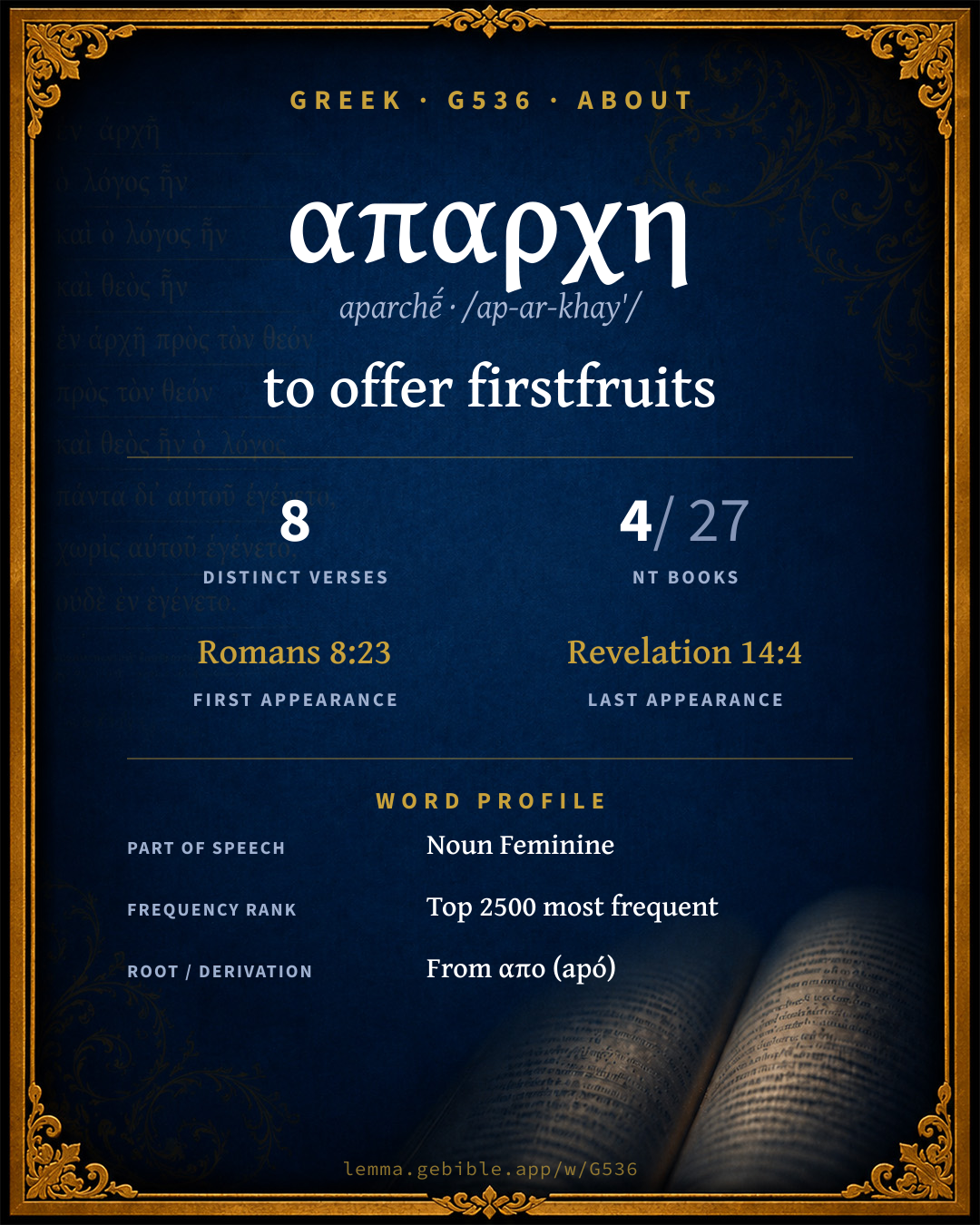
ἀπαρχή
to offer firstfruits
‘to offer firstfruits’ is one of 3 main senses fuller range ↓
Full lexicon entry — Thayer's Greek Lexicon
From Thayer's Greek Lexicon
Where this word appears
See every Nominative-case word in the Greek New Testament →
Grammar key — what these labels mean
Part of speech
- Noun
- A naming word — a person, place, thing, or idea.
Case
- Nominative
- The case of the subject (and the predicate nominative).
- Accusative
- The case of the direct object and of extent.
Gender
- Feminine
- Grammatically feminine.
Number
- Singular
- One.
Grammatical forms
- Noun, Nominative, Singular, Feminine 6 times (75%)
- Noun, Accusative, Singular, Feminine 2 times (25%)
Parsed forms decoded from the imported morphology (Robinson–Tischendorf, public domain), counted across 8 parsed occurrences — not distinct verses.
Every verse where G536 appears — 8 distinct verses across 4 books. Click any verse to open its interlinear word-by-word view. Verse text shown in the World English Bible for context — . Each verse’s Greek form is shown with its reference; the English is not keyword-highlighted, since the data carries no word-level English alignment. Use “Compare translations” on any verse to read it across multiple English versions. This concordance covers the Greek New Testament; Septuagint (Greek Old Testament) occurrences of this word are not indexed here.
Romans 3 verses
- Romans 8:23 ἀπαρχὴν n acc sg fem Not only so, but ourselves also, who have the first fruits of the Spirit, even we ourselves groan within ourselves, waiting for adoption, the redemption of our body.
- Romans 11:16 ἀπαρχὴ n nom sg fem If the first fruit is holy, so is the lump. If the root is holy, so are the branches.
- Romans 16:5 ἀπαρχὴ n nom sg fem Greet the assembly that is in their house. Greet Epaenetus, my beloved, who is the first fruits of Achaia to Christ.
1 Corinthians 3 verses
- 1 Corinthians 15:20 ἀπαρχὴ n nom sg fem But now Christ has been raised from the dead. He became the first fruits of those who are asleep.
- 1 Corinthians 15:23 ἀπαρχὴ n nom sg fem But each in his own order: Christ the first fruits, then those who are Christ's, at his coming.
- 1 Corinthians 16:15 ἀπαρχὴ n nom sg fem Now I beg you, brothers (you know the house of Stephanas, that it is the first fruits of Achaia, and that they have set themselves to minister to the saints),
James 1 verse
Revelation 1 verse
About this entry
At a glance — auto-summarized from this page’s data, not written by a person. Every figure links to its source below. This summary describes the numbers; it doesn’t interpret them.
απαρχη (aparchḗ) is a Greek noun most often rendered “to offer firstfruits.” It first appears in Romans 8:23. It turns up in 8 verses across 4 books, an uncommon footprint. It concentrates in Romans, which alone accounts for 38% of its uses. Its lexical range runs to 3 senses. The sections below give every sense, occurrence, and version rendering.
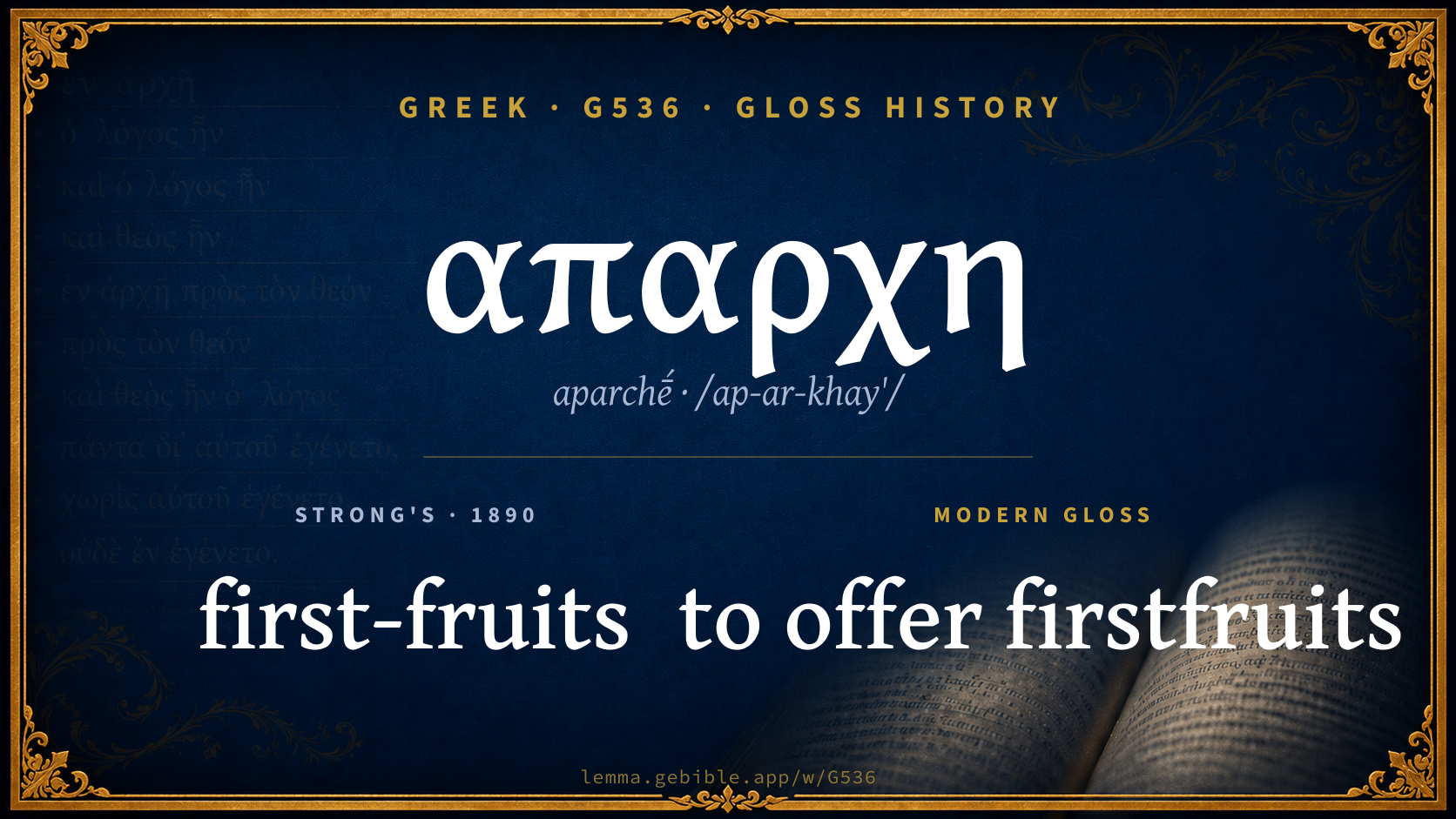
Gloss history
Strong's 1890 vs modern scholarship
About this word
Strong's G536 catalogs a Greek word from the Greek New Testament.
These counts are not copied from any lexicon or concordance. They are computed here, from the morphology-tagged Greek New Testament. What Lemma adds →
- 8
- distinct verses
- The word appears in 8 distinct verses.
- 4 / 27
- NT books
- The word appears in 4 of 27 New Testament books.
- #1,240
- by frequency
- Top 2500 most frequent Greek words (rank 1,240 of 5,347 Greek words by occurrence).
View all 8 occurrences in the concordance →
Most concentrated in
- Romans 3 verses 38%
- 1 Corinthians 3 verses 38%
- James 1 verse 13%
By section of the New Testament
By traditional corpus
Conventional, traditional groupings — biblical authorship is debated, so this is a traditional corpus grouping, not an authorship claim. Some books belong to more than one corpus (Luke is in both the Gospels and the Lukan corpus, and so on), so these shares overlap and need not total 100%. Each figure is a share of the word’s 8 distinct verses.
- Pauline corpus 6 verses · 75%
- Johannine 1 verse · 13%
- General (Catholic) Epistles 1 verse · 13%
- Revelation 1 verse · 13%
How translations render this word
Counts come from each version’s own published word-to-Strong’s tagging or interlinear alignment — an approximate guide to how each version renders this word, not a word-level alignment the data otherwise carries. Because each total is that version’s own tagged count, the per-version totals vary from one another and need not match the appearance or distinct-verse counts above. These counts may also differ from a printed concordance because Lemma counts each distinctly tagged rendering and does not collapse phrase taggings into a single head-word total. This is a fixed set of word-tagged versions (KJV, ASV, BSB, ULT) and does not change with the reading translation you choose elsewhere. Each version’s license is shown beside its name below (and on Sources).
- King James Version: Firstfruits 6×
- American Standard Version: Firstfruits 5×
- Berean Standard Bible: Firstfruits 5×
- unfoldingWord Literal Text: Firstfruits 8×
King James Version Public Domain
Renders G536 across 8 tagged occurrences — most commonly:
Plus 2 renderings that appear only once — usually multi-word phrases or single function words the recovered tagging swept in, not distinct renderings.
American Standard Version Public Domain
Renders G536 across 8 tagged occurrences — most commonly:
Plus 3 renderings that appear only once — usually multi-word phrases or single function words the recovered tagging swept in, not distinct renderings.
Berean Standard Bible Public Domain
Renders G536 across 8 tagged occurrences — most commonly:
Plus 3 renderings that appear only once — usually multi-word phrases or single function words the recovered tagging swept in, not distinct renderings.
unfoldingWord Literal Text CC BY-SA 4.0
Renders G536 across 9 tagged occurrences — most commonly:
Plus 1 rendering that appears only once — usually multi-word phrases or single function words the recovered tagging swept in, not distinct renderings.
Senses in Thayer's
The 3 senses Thayer's distinguishes for this word, in lexicon order (not ranked by frequency or importance). The full entry — with sub-senses — is in the Lexicon Entry tab.
- to offer firstlings or firstfruits
- to take away the firstfruits of the productions of the earth which was offered to God. The first portion of the dough…
- persons superior in excellence to others of the same class
Word origin
Derived from απο (apó) (G575) — from.
Forms in the corpus
The 3 distinct written forms G536 takes in the Greek New Testament, most frequent first — each parse links to that case’s occurrences in the concordance.
| Form | Parsing | Example | Uses |
|---|---|---|---|
| ἀπαρχὴ aparchḕ | Noun, Nominative, Singular, Feminine | Romans 11:16 | 6 |
| ἀπαρχήν aparchḗn | Noun, Accusative, Singular, Feminine | James 1:18 | 1 |
| ἀπαρχὴν aparchḕn | Noun, Accusative, Singular, Feminine | Romans 8:23 | 1 |
Same root — word family
Other Thayer's entries built from the same root as G536, grouped by Strong’s listed origin. These share a root / origin per the lexicon — not necessarily a shared meaning. Each links to that word’s own entry.
Derives from
Shares the same root
- απαγγελλω apangéllō G518 to report
- απαγχομαι apánchomai G519 to strangle
- απαγω apágō G520 to lead away
- απαιρω apaírō G522 to take away
- απαιτεω apaitéō G523 to demand back
- απαλγεω apalgéō G524 to cease grieving
- απαλλασσω apallássō G525 to depart
- απαλλοτριοω apallotrióō G526 to estrange
- απανταω apantáō G528 to meet
- απαρνεομαι aparnéomai G533 to deny
- απαρτι apárti G534 henceforth
- απαυγασμα apaúgasma G541 brightness
- απειδω apeídō G542 to look away
- απειμι ápeimi G548 to depart
- απειμι ápeimi G549 to depart
- απειπομην apeipómēn G550 to declare
- απεκδεχομαι apekdéchomai G553 waiting for
- απεκδυομαι apekdýomai G554 to despoil
- απελαυνω apelaúnō G556 to drive away
- απελεγμος apelegmós G557 censure
- απελευθερος apeleútheros G558 freedman
- απελπιζω apelpízō G560 not despairing
- απεναντι apénanti G561 opposite
- απερχομαι apérchomai G565 to depart
+85 more words share this root (not shown).
Compare all same-root words → Showing 4 of 111 — not the complete family. They share a root, not necessarily a meaning.
Septuagint usage
The same Greek word απαρχη appears 68 times in the Greek Old Testament (Septuagint), across 57 verses in 11 books.
- 68
- LXX occurrences
- Tagged occurrences of this Greek word in the Septuagint.
- 57
- verses
- Distinct Septuagint verses containing this word.
- 11 / 39
- OT books
- The word appears in 11 of the 39 Old Testament books.
Sample Septuagint occurrences
- Exodus 22:28 ἀπαρχή
- Leviticus 2:12 ἀπαρχή
- Numbers 5:9 ἀπαρχή
- Deuteronomy 12:6 ἀπαρχή
- 1 Samuel 2:29 ἀπαρχή
- 2 Samuel 1:21 ἀπαρχή
- 2 Chronicles 31:5 ἀπαρχή
- Ezra 8:25 ἀπαρχή
- Psalms 77:51 ἀπαρχή
- Ezekiel 20:31 ἀπαρχή
- Malachi 3:8 ἀπαρχή
Septuagint occurrences (same lexeme)
Every verse where the same Strong’s number (G536) appears in the Greek Septuagint — showing the first 50 of 57. Verse text shown in the World English Bible for context; the Greek form is the matched word — the English is not keyword-highlighted.
- Exodus 22:28 ἀπαρχή "You shall not blaspheme God, nor curse a ruler of your people.
- Exodus 23:19 ἀπαρχή The first of the first fruits of your ground you shall bring into the house of Yahweh your God. "You shall not boil a kid in its mother's milk.
- Exodus 25:2 ἀπαρχή "Speak to the children of Israel, that they take an offering for me. From everyone whose heart makes him willing you shall take my offering.
- Exodus 25:3 ἀπαρχή This is the offering which you shall take from them: gold, silver, brass,
- Exodus 35:5 ἀπαρχή 'Take from among you an offering to Yahweh. Whoever is of a willing heart, let him bring it, Yahweh's offering: gold, silver, brass,
- Exodus 36:6 ἀπαρχή Moses gave commandment, and they caused it to be proclaimed throughout the camp, saying, "Let neither man nor woman make anything else for the offering for the sanctuary." So the people were restrained from bringing.
- Exodus 39:1 ἀπαρχή Of the blue, purple, and scarlet, they made finely worked garments, for ministering in the holy place, and made the holy garments for Aaron; as Yahweh commanded Moses.
- Leviticus 2:12 ἀπαρχή As an offering of firstfruits you shall offer them to Yahweh: but they shall not come up for a sweet savor on the altar.
- Leviticus 22:12 ἀπαρχή If a priest's daughter is married to an outsider, she shall not eat of the heave offering of the holy things.
- Leviticus 23:10 ἀπαρχή "Speak to the children of Israel, and tell them, 'When you have come into the land which I give to you, and shall reap its the harvest, then you shall bring the sheaf of the first fruits of your harvest to the priest:
- Numbers 5:9 ἀπαρχή Every heave offering of all the holy things of the children of Israel, which they present to the priest, shall be his.
- Numbers 15:20 ἀπαρχή Of the first of your dough you shall offer up a cake for a heave-offering: as the heave-offering of the threshing floor, so shall you heave it.
- Numbers 15:21 ἀπαρχή Of the first of your dough you shall give to Yahweh a heave-offering throughout your generations.
- Numbers 18:8 ἀπαρχή Yahweh spoke to Aaron, I, behold, I have given you the charge of my heave-offerings, even all the holy things of the children of Israel; to you have I given them by reason of the anointing, and to your sons, as a portion forever.
- Numbers 18:11 ἀπαρχή This is your: the heave-offering of their gift, even all the wave-offerings of the children of Israel; I have given them to you, and to your sons and to your daughters with you, as a portion forever; everyone who is clean in your house shall eat of it.
- Numbers 18:12 ἀπαρχή All the best of the oil, and all the best of the vintage, and of the grain, the first fruits of them which they give to Yahweh, to you have I given them.
- Numbers 18:29 ἀπαρχή Out of all your gifts you shall offer every heave-offering of Yahweh, of all the best of it, even the holy part of it out of it.
- Numbers 18:30 ἀπαρχή Therefore you shall tell them, When you heave the best of it from it, then it shall be reckoned to the Levites as the increase of the threshing floor, and as the increase of the wine-press.
- Numbers 18:32 ἀπαρχή You shall bear no sin by reason of it, when you have heaved from it the best of it: and you shall not profane the holy things of the children of Israel, that you not die.
- Numbers 31:29 ἀπαρχή take it of their half, and give it to Eleazar the priest, for Yahweh's heave-offering.
- Deuteronomy 12:6 ἀπαρχή and there you shall bring your burnt offerings, and your sacrifices, and your tithes, and the heave-offering of your hand, and your vows, and your freewill-offerings, and the firstborn of your herd and of your flock:
- Deuteronomy 12:11 ἀπαρχή then it shall happen that to the place which Yahweh your God shall choose, to cause his name to dwell there, there shall you bring all that I command you: your burnt offerings, and your sacrifices, your tithes, and the heave-offering of your hand, and all your choice vows which you vow to Yahweh.
- Deuteronomy 12:17 ἀπαρχή You may not eat within your gates the tithe of your grain, or of your new wine, or of your oil, or the firstborn of your herd or of your flock, nor any of your vows which you vow, nor your freewill-offerings, nor the heave-offering of your hand;
- Deuteronomy 18:4 ἀπαρχή The first fruits of your grain, of your new wine, and of your oil, and the first of the fleece of your sheep, shall you give him.
- Deuteronomy 26:2 ἀπαρχή that you shall take of the first of all the fruit of the ground, which you shall bring in from your land that Yahweh your God gives you; and you shall put it in a basket, and shall go to the place which Yahweh your God shall choose, to cause his name to dwell there.
- Deuteronomy 26:10 ἀπαρχή Now, behold, I have brought the first of the fruit of the ground, which you, Yahweh, have given me. You shall set it down before Yahweh your God, and worship before Yahweh your God:
- Deuteronomy 33:21 ἀπαρχή He provided the first part for himself, For there was the lawgiver's portion reserved; He came [with] the heads of the people; He executed the righteousness of Yahweh, His ordinances with Israel.
- 1 Samuel 2:29 ἀπαρχή Why kick you at my sacrifice and at my offering, which I have commanded in [my] habitation, and honor your sons above me, to make yourselves fat with the best of all the offerings of Israel my people?
- 1 Samuel 10:4 ἀπαρχή and they will greet you, and give you two loaves of bread, which you shall receive of their hand.
- 2 Samuel 1:21 ἀπαρχή You mountains of Gilboa, Let there be no dew nor rain on you, neither fields of offerings: For there the shield of the mighty was vilely cast away, The shield of Saul, not anointed with oil.
- 2 Chronicles 31:5 ἀπαρχή As soon as the commandment came abroad, the children of Israel gave in abundance the first fruits of grain, new wine, and oil, and honey, and of all the increase of the field; and the tithe of all things brought they in abundantly.
- 2 Chronicles 31:10 ἀπαρχή Azariah the chief priest, of the house of Zadok, answered him and said, Since [the people] began to bring the offerings into the house of Yahweh, we have eaten and had enough, and have left plenty: for Yahweh has blessed his people; and that which is left is this great store.
- 2 Chronicles 31:12 ἀπαρχή They brought in the offerings and the tithes and the dedicated things faithfully: and over them Conaniah the Levite was ruler, and Shimei his brother was second.
- 2 Chronicles 31:14 ἀπαρχή Kore the son of Imnah the Levite, the porter at the east [gate], was over the freewill-offerings of God, to distribute the offerings of Yahweh, and the most holy things.
- Ezra 8:25 ἀπαρχή and weighed to them the silver, and the gold, and the vessels, even the offering for the house of our God, which the king, and his counselors, and his princes, and all Israel there present, had offered:
- Ezra 20:38 ἀπαρχή
- Ezra 20:40 ἀπαρχή
- Ezra 22:44 ἀπαρχή
- Ezra 23:5 ἀπαρχή
- Psalms 77:51 ἀπαρχή
- Psalms 104:36 ἀπαρχή
- Ezekiel 20:31 ἀπαρχή and when you offer your gifts, when you make your sons to pass through the fire, do you pollute yourselves with all your idols to this day? and shall I be inquired of by you, house of Israel? As I live, says the Lord Yahweh, I will not be inquired of by you;
- Ezekiel 20:40 ἀπαρχή For in my holy mountain, in the mountain of the height of Israel, says the Lord Yahweh, there shall all the house of Israel, all of them, serve me in the land: there will I accept them, and there will I require your offerings, and the first fruits of your offerings, with all your holy things.
- Ezekiel 44:30 ἀπαρχή The first of all the first fruits of every thing, and every offering of everything, of all your offerings, shall be for the priest: you shall also give to the priests the first of your dough, to cause a blessing to rest on your house.
- Ezekiel 45:1 ἀπαρχή Moreover, when you shall divide by lot the land for inheritance, you shall offer an offering to Yahweh, a holy portion of the land; the length shall be the length of twenty-five thousand [reeds], and the breadth shall be ten thousand: it shall be holy in all the border of it round about.
- Ezekiel 45:6 ἀπαρχή You shall appoint the possession of the city five thousand broad, and twenty-five thousand long, side by side with the offering of the holy portion: it shall be for the whole house of Israel.
- Ezekiel 45:7 ἀπαρχή [Whatever is] for the prince [shall be] on the one side and on the other side of the holy offering and of the possession of the city, in front of the holy offering and in front of the possession of the city, on the west side westward, and on the east side eastward; and in length answerable to one of the portions, from the west border to the east border.
- Ezekiel 45:13 ἀπαρχή This is the offering that you shall offer: the sixth part of an ephah from a homer of wheat; and you shall give the sixth part of an ephah from a homer of barley;
- Ezekiel 45:16 ἀπαρχή All the people of the land shall give to this offering for the prince in Israel.
- Ezekiel 48:8 ἀπαρχή By the border of Judah, from the east side to the west side, shall be the offering which you shall offer, twenty-five thousand [reeds] in breadth, and in length as one of the portions, from the east side to the west side: and the sanctuary shall be in the midst of it.
These are occurrences of the same Greek lexeme (G536) in the Septuagint — not a translation of any one Hebrew word. The store carries no word-level Hebrew↔Greek alignment, so no Hebrew original is asserted here. Counts come from the recovered LXX Strong's tagging — high-frequency vocabulary is well covered, while rare or late forms may be untagged — so they reflect tagged occurrences and may slightly undercount.