

Luke 9:39
Greek (Tischendorf 8th ed.) Luke 9:39 appears in the Greek New Testament. The text above is from the Tischendorf 8th edition. Each word links to its Strong’s number and a concise gloss. Click any word for its full Thayer’s Greek Lexicon entry.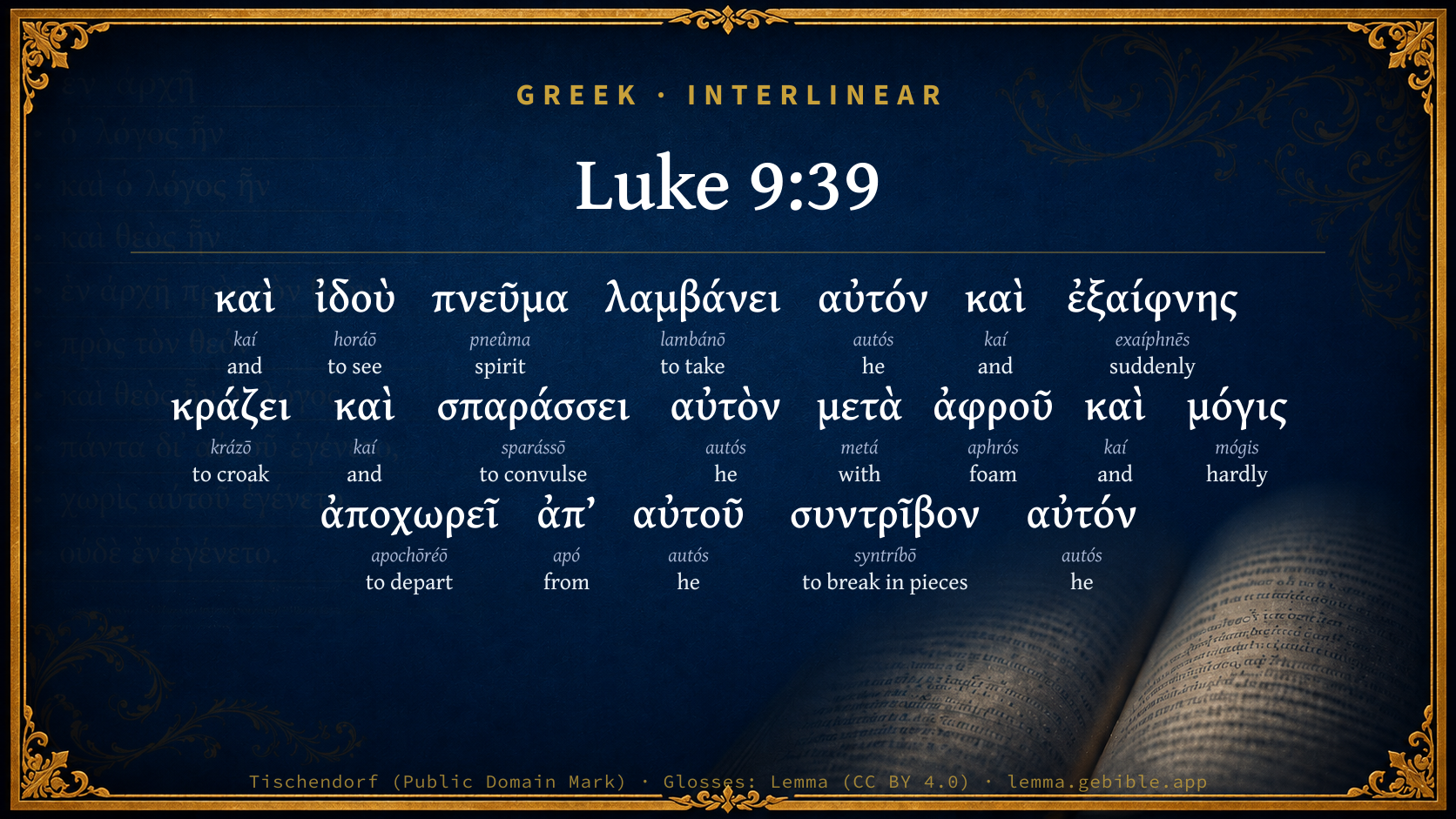
Behold, a spirit takes him, he suddenly cries out, and it convulses him so that he foams, and it hardly departs from him, bruising him severely.
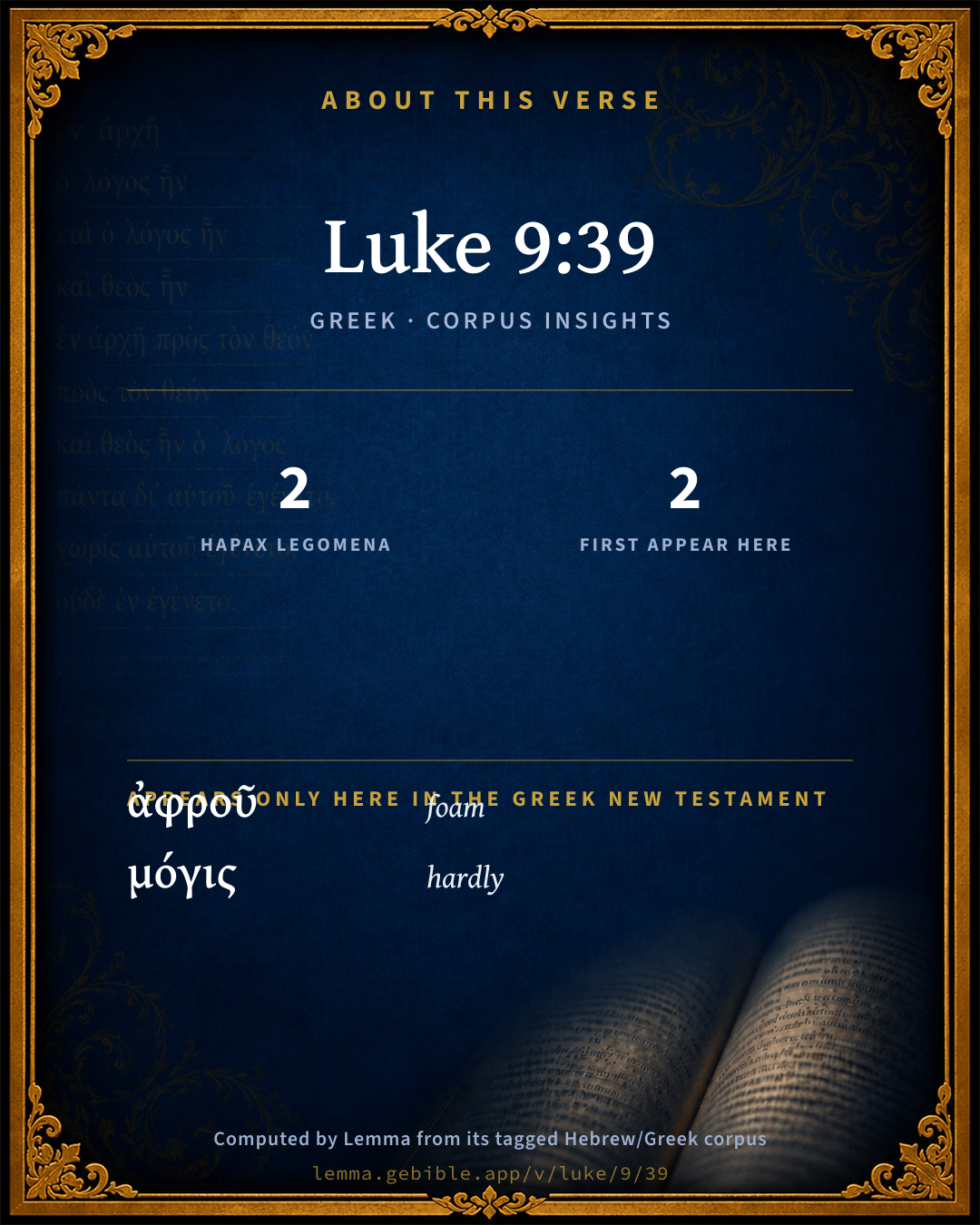
- 2 hapax legomena — only here in the Greek New Testament
- 2 first appearances in the Greek New Testament
Download a study sheet
One document with this verse’s original text, its word-by-word gloss line, the meaning frame, cross-references with their text, attributed commentary, and full source and license credits — printable, and it pastes into notes with its structure intact.
This verse Autodidact and up
A passage Seminary Student
Up to 50 verses in one chapter. A passage sheet keeps up to 6 commentary sources and 12 cross-references per verse, in the order this page ranks them, and says so on the sheet whenever that leaves anything out. Ask for a single verse and you get the Autodidact verse sheet above.
Everything on this page stays free to read, with no account — the sheet is a download of what is already on screen, not access to it.
Compare translations 3
The same verse in 3 English versions, stacked beneath the original-language interlinear above. Click any original word for its lexicon entry.
Each is an independent rendering of the whole verse — the interlinear is not word-aligned to these translations.
Highlighted words mark where these versions differ — a whole-verse word diff, not a word-by-word alignment.
-
World English Bible Public Domain
Behold, a spirit takes him, he suddenly cries out, and it convulses him so that he foams, and it hardly departs from him, bruising him severely.
-
King James Version Public Domain
And, lo, a spirit taketh him, and he suddenly crieth out; and it teareth him that he foameth again, and bruising him hardly departeth from him.
-
unfoldingWord Literal Text CC BY-SA 4.0
And behold, a spirit seizes him and he suddenly cries out, and it throws him into convulsions with foam. And it departs from him with difficulty, crushing him.
unfoldingWord Literal Text — © unfoldingWord, licensed CC BY-SA 4.0. Word-aligned USFM3 via Door43 (git.door43.org/unfoldingWord/en_ult).
Show all 19 translations
Every available English version of this verse, each an independent rendering of the whole verse.
-
World English Bible Public Domain
Behold, a spirit takes him, he suddenly cries out, and it convulses him so that he foams, and it hardly departs from him, bruising him severely.
-
Berean Standard Bible Public Domain
A spirit keeps seizing him, and he screams abruptly. It throws him into convulsions so that he foams at the mouth. It keeps mauling him and rarely departs from him.
-
Majority Standard Bible Public Domain
A spirit keeps seizing him, and he screams abruptly. It throws him into convulsions so that he foams at the mouth. It keeps mauling him and rarely departs from him.
-
King James Version Public Domain
And, lo, a spirit taketh him, and he suddenly crieth out; and it teareth him that he foameth again, and bruising him hardly departeth from him.
-
American Standard Version (1901) Public Domain
and behold, a spirit taketh him, and he suddenly crieth out; and it teareth him that he foameth, and it hardly departeth from him, bruising him sorely.
-
Revised Version (1885) Public Domain
and behold, a spirit taketh him, and he suddenly crieth out; and it teareth him that he foameth, and it hardly departeth from him, bruising him sorely.
-
Geneva Bible (1599) Public Domain
And loe, a spirit taketh him, and suddenly he crieth, and he teareth him, that he fometh, and hardly departeth from him, when he hath bruised him.
-
Douay-Rheims (1899) Public Domain
And lo, a spirit seizeth him, and he suddenly crieth out, and he throweth him down and teareth him, so that he foameth; and bruising him, he hardly departeth from him.
-
Young's Literal Translation Public Domain
and lo, a spirit doth take him, and suddenly he doth cry out, and it teareth him, with foaming, and it hardly departeth from him, bruising him,
-
Literal Standard Version CC BY-SA 4.0
and behold, a spirit takes him, and suddenly he cries out, and it convulses him, with foaming, and it hardly departs from him, bruising him,
-
Unlocked Literal Bible CC BY-SA 4.0
You see, a spirit takes control over him and he suddenly screams; it causes him to have convulsions so that he foams at the mouth. It hardly ever leaves him and it bruises him badly.
-
unfoldingWord Literal Text CC BY-SA 4.0
And behold, a spirit seizes him and he suddenly cries out, and it throws him into convulsions with foam. And it departs from him with difficulty, crushing him.
-
Darby Bible Public Domain
and behold, a spirit takes him, and suddenly he cries out, and it tears him with foaming, and with difficulty departs from him after crushing him.
-
World Messianic Bible Public Domain
Behold, a spirit takes him, he suddenly cries out, and it convulses him so that he foams; and it hardly departs from him, bruising him severely.
-
Webster's Bible Public Domain
And lo, a spirit taketh him, and he suddenly crieth out; and it teareth him that he foameth, and bruising him, hardly departeth from him.
-
Free Bible Version CC BY-SA 4.0
A spirit possesses him and he screams immediately. It sends him into convulsions and makes him foam at the mouth. It hardly ever leaves him alone and it causes him a lot of pain.
-
Bible in Basic English Public Domain
And see, a spirit takes him, and suddenly he gives a cry, twisted in pain and streaming at the lips, and when it goes away from him at last, he is marked as from blows.
-
Text-Critical English NT CC BY 4.0
A spirit seizes him, and he suddenly cries out; it convulses him so that he foams at the mouth. It hardly ever leaves him alone, bruising him severely.
-
Tyndale New Testament (1534) Public Domain
and se a sprete taketh him and sodenly he cryeth and he teareth him that he fometh agayne and with moche payne departeth from him when he hath rent him
Literal Standard Version (2020), Covenant Press — licensed CC BY-SA 4.0. Text via the HelloAO Bible API (eBible.org). Unlocked Literal Bible (unfoldingWord) — licensed CC BY-SA 4.0. Text via the HelloAO Bible API (eBible.org). unfoldingWord Literal Text — © unfoldingWord, licensed CC BY-SA 4.0. Word-aligned USFM3 via Door43 (git.door43.org/unfoldingWord/en_ult). Free Bible Version, Dr. Jonathan Gallagher — licensed CC BY-SA 4.0. Text via the HelloAO Bible API (eBible.org).
Word by word
More ways to search: Search by grammar → Find every occurrence → Compare this word →
Practice this passage: Drill this verse → Learn its vocabulary →
- Appears 1× in the Greek New Testament
- First appears here
- Part of Speech
- Noun
- Case
- Genitive
- Number
- Singular
- Gender
- Masculine
Full Thayer's Definition
- καὶ kaí G2532 “and” Conjunction
- ἰδοὺ horáō G3708 “to see” Verb, Aorist, Middle, Imperative, 2nd person, Singular
- πνεῦμα pneûma G4151 “spirit” Noun, Nominative, Singular, Neuter
- λαμβάνει lambánō G2983 “to take” Verb, Present, Active, Indicative, 3rd person, Singular
- αὐτόν autós G846 “he” Personal pronoun, Accusative, Singular, Masculine
- καὶ kaí G2532 “and” Conjunction
- ἐξαίφνης exaíphnēs G1810 “suddenly” Adverb
- κράζει krázō G2896 “to croak” Verb, Present, Active, Indicative, 3rd person, Singular
- καὶ kaí G2532 “and” Conjunction
- σπαράσσει sparássō G4682 “to convulse” Verb, Present, Active, Indicative, 3rd person, Singular
- αὐτὸν autós G846 “he” Personal pronoun, Accusative, Singular, Masculine
- μετὰ metá G3326 “with” Preposition
- ἀφροῦ aphrós G876 “foam” Noun, Genitive, Singular, Masculine
- καὶ kaí G2532 “and” Conjunction
- μόγις mógis G3425 “hardly” Adverb
- ἀποχωρεῖ apochōréō G672 “to depart” Verb, Present, Active, Indicative, 3rd person, Singular
- ἀπ’ apó G575 “from” Preposition
- αὐτοῦ autós G846 “he” Personal pronoun, Genitive, Singular, Masculine
- συντρῖβον syntríbō G4937 “to break in pieces” Verb, Present, Active, Participle, Nominative, Singular, Neuter
- αὐτόν autós G846 “he” Personal pronoun, Accusative, Singular, Masculine
About this verse
These counts appear in no published source. They are computed here, from the morphology-tagged text and Lemma’s own curated glosses. What Lemma adds →
- 20
- words
- 14
- distinct lemmas
- Gospels
- section
Notable vocabulary
2 hapax legomena — words that appear only here in the entire Greek New Testament:
First appearance in Scripture
These words make their first canonical appearance in the Greek New Testament here:
Shared distinctive vocabulary
σπαράσσει to convulse G4682 occurs in 3 verses of the Greek New Testament. Also found in:
Cross-references
5Topical passages linked to Luke 9:39 in the Treasury of Scripture Knowledge — connected by theme and wording, ordered by reader-vote popularity; previews shown in the World English Bible.
- Mark 9:20 They brought him to him, and when he saw him, immediately the spirit convulsed him, and he fell on the ground, wallowing and foaming at the mouth.
- Mark 5:4–5 because he had been often bound with fetters and chains, and the chains had been torn apart by him, and the fetters broken in pieces. Nobody had the strength to tame him.
- Mark 9:26 Having cried out, and convulsed greatly, it came out of him. The boy became like one dead; so much that most of them said, "He is dead."
- Luke 4:35 Jesus rebuked him, saying, "Be silent, and come out of him!" When the demon had thrown him down in their midst, he came out of him, having done him no harm.
- Luke 8:29 For Jesus was commanding the unclean spirit to come out of the man. For the unclean spirit had often seized the man. He was kept under guard, and bound with chains and fetters. Breaking the bands apart, he was driven by the demon into the desert.
Cross-references courtesy of OpenBible.info (CC BY 4.0).
Lesson kit
Teaching starters — assembled from the data on this page, not authored interpretation. Every prompt links to the verse data it draws on. Edit before teaching.
Luke, in the Gospels, opens this verse with 20 words (14 distinct Greek lemmas). Its most distinctive word is aphrós (“foam”). A historical commentator’s framing appears above. Read the whole chapter for the surrounding context.
Discussion questions
- How does “foam” (aphrós) shape what this verse is saying?
- This verse holds 2 words here found nowhere else in the Greek New Testament. What might the rare words draw attention to?
- 2 words here appear for the first time in Scripture. What is being introduced at this debut?
- Mark 1:26 shares the word «to convulse» with this verse. How do the two illuminate each other?
- “and” occurs 4× in this one verse. What is the effect of the repetition?
- These translations render this verse differently. What is at stake in choosing one wording over another?
- Reading how Tyndale Open Study Notes and Expositor's Greek Testament read this verse, where do the two commentators agree and where do they part?
Things to notice
- 2 words in this verse appear nowhere else in the Greek New Testament.
- 2 words make their first canonical appearance in Scripture here.
- These translations choose different wording for 23 words in this verse.
- “and” occurs 4× in this single verse.
- 14 distinct Greek lemmas span 20 words in this verse.
Commentary
Notes on Luke 9:39 from classic Christian and Jewish commentators (each source and its license shown beneath its notes). The classic Christian expositions comment on the surrounding passage and are grouped to its opening verse, so a note may address several verses; the Jewish commentaries on the Tanakh (Rashi and others) are per-verse, so they appear only where the commentator wrote on this verse.
Lemma curates 59 commentaries, every one of them public domain or Creative Commons licensed, each selected and text-cleaned for this edition rather than reprinted as found. About our sources →
Tyndale Open Study Notes
Tyndale Open Resources
Tyndale Open Study Notes — © Tyndale Open Resources, licensed CC BY-SA 4.0. Text via the HelloAO Bible API.
Expositor's Greek Testament
ed. W. Robertson Nicoll
The Expositor's Greek Testament, edited by W. Robertson Nicoll (1897–1910) — public domain. Text from a community e-Sword module.
Geneva Bible (1599)
Geneva Bible translators
Geneva Bible (1599) marginal notes — public domain. Text via Bolls.life.
Adam Clarke's Commentary
Adam Clarke's Commentary on the Bible (1810–1826) — public domain. Text from a community e-Sword/MySword module.
The Cambridge Bible for Schools and Colleges
gen. ed. J. J. S. Perowne
The Cambridge Bible for Schools and Colleges (gen. ed. J. J. S. Perowne; Cambridge University Press, 1878–1918) — public domain. Text from a community e-Sword module.
John Gill's Exposition
John Gill's Exposition of the Whole Bible (1746–1763) — public domain (CC PDM 1.0). Text via the HelloAO Bible API.
Trapp's Complete Commentary
John Trapp
John Trapp, A Commentary or Exposition upon All the Books of the Old and New Testament (1647–1656) — public domain. Text from a community e-Sword module.
Cambridge Greek Testament for Schools and Colleges
Cambridge Greek Testament for Schools and Colleges (Cambridge University Press, 1896; 21 vols, various authors incl. Carr, Maclear, Plummer, Farrar, Lumby, Moule, M. R. James, Simcox) — public domain. Text from a community e-Sword module.
Alford’s Greek Testament
Henry Alford
Henry Alford, The Greek Testament (1849–1861) — public domain. Text from a community e-Sword module.
International Critical Commentary
International Critical Commentary — older volumes (1896–1929), various authors — public domain. Text from a community e-Sword module.
Vincent's Word Studies in the New Testament
Marvin R. Vincent
Marvin R. Vincent, Word Studies in the New Testament (1887–1900) — public domain. Text from a community e-Sword/MySword module.