Luke 1:2

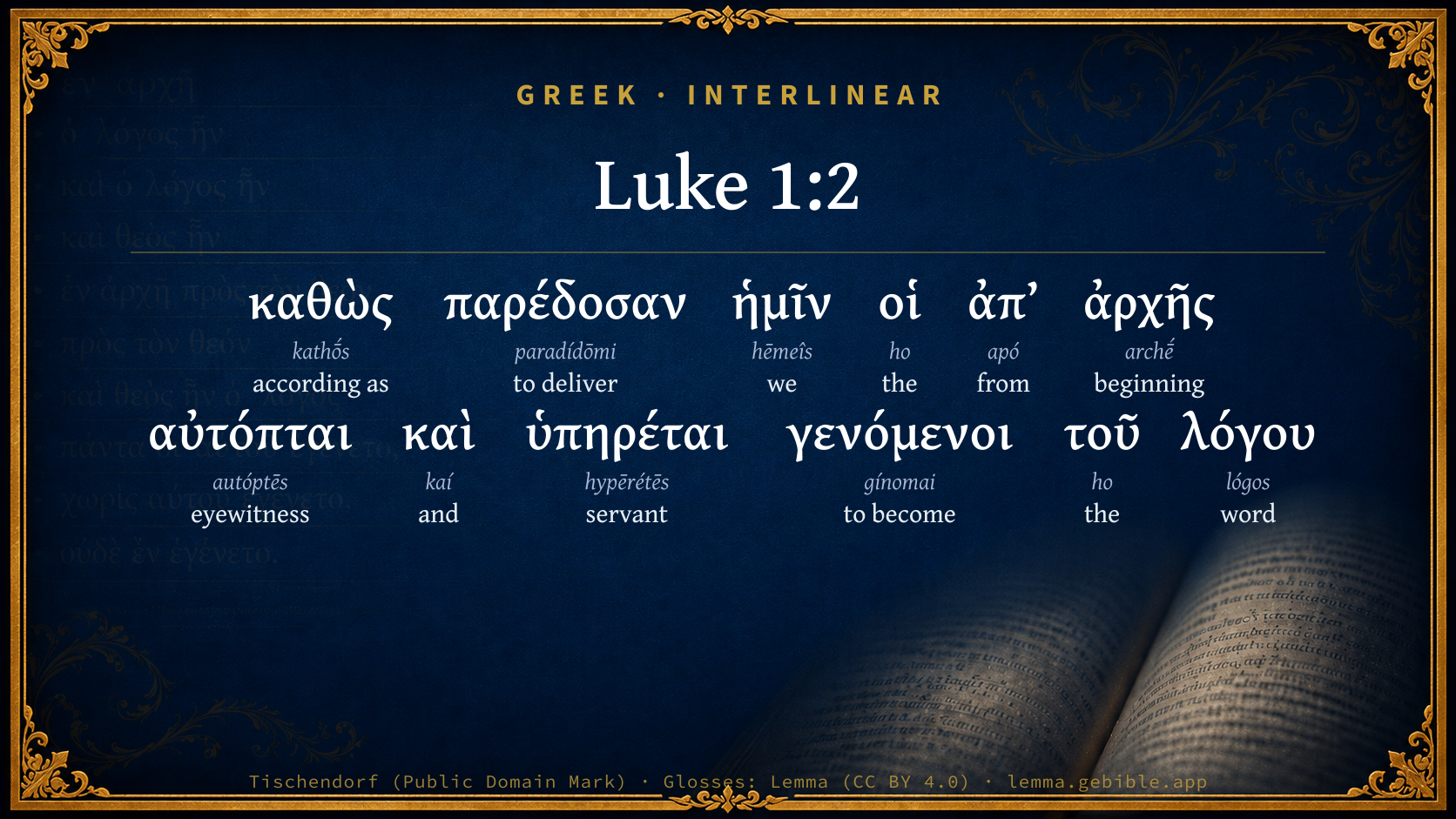
Greek (Tischendorf 8th ed.) Luke 1:2 appears in the Greek New Testament. The text above is from the Tischendorf 8th edition. Each word links to its Strong’s number and a concise gloss. Click any word for its full Thayer’s Greek Lexicon entry.
Download image
Cite this verse

Luke 1:2 (World English Bible). Public Domain. Lemma interlinear Bible study tool, https://lemma.gebible.app/v/luke/1/2.

Show BibTeX & RIS
BibTeX
RIS
English Translation
even as those who from the beginning were eyewitnesses and ministers of the word delivered them to us,
World English Bible · Public Domain
Highlights
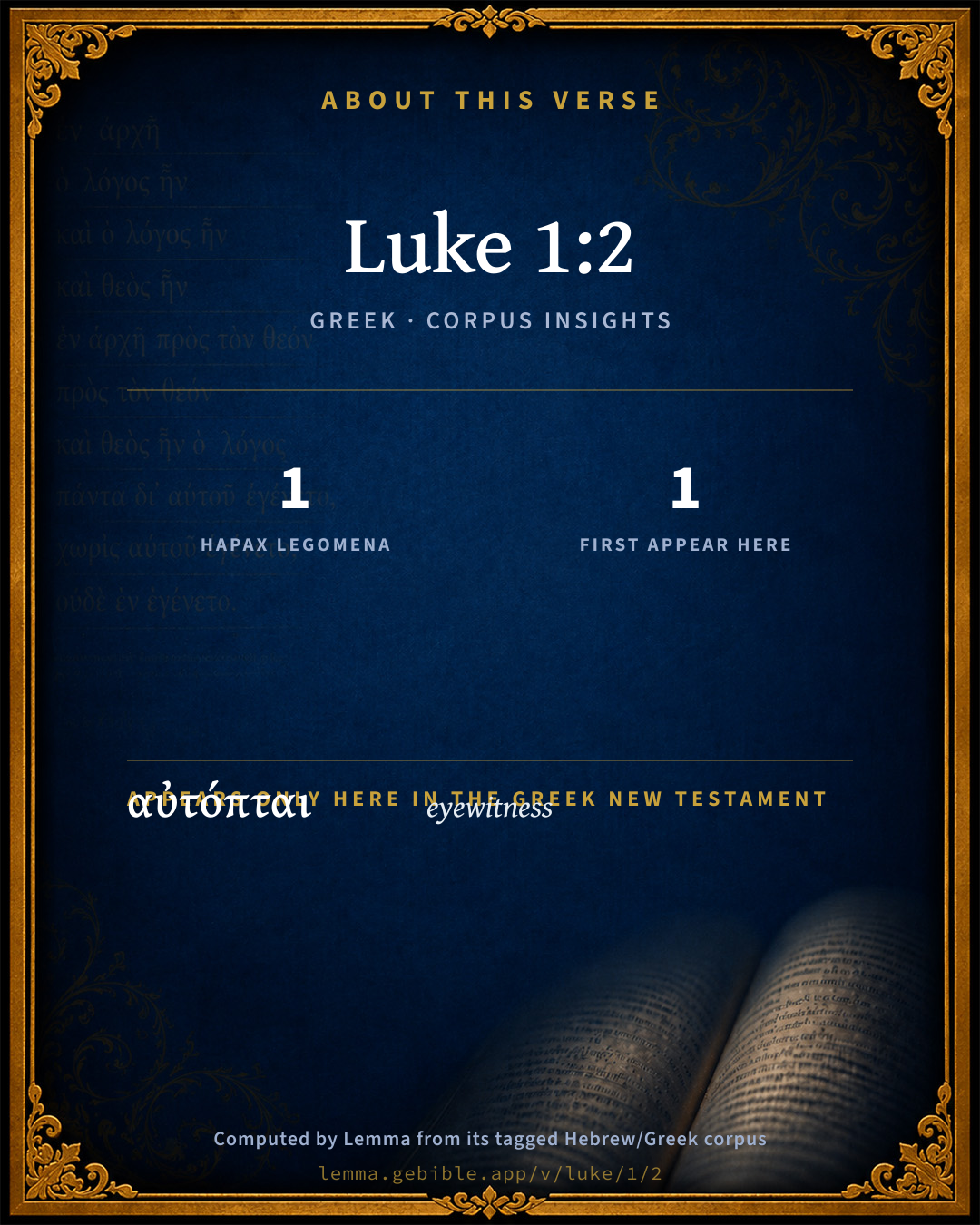
  • 1 hapax legomenon — only here in the Greek New Testament
  • 1 first appearance in the Greek New Testament
Full analysis ↓
Download a study sheet

One document with this verse’s original text, its word-by-word gloss line, the meaning frame, cross-references with their text, attributed commentary, and full source and license credits — printable, and it pastes into notes with its structure intact.

This verse Autodidact and up

Study sheet (.html) Plain text (.txt)

A passage Seminary Student

Up to 50 verses in one chapter. A passage sheet keeps up to 6 commentary sources and 12 cross-references per verse, in the order this page ranks them, and says so on the sheet whenever that leaves anything out. Ask for a single verse and you get the Autodidact verse sheet above.

Everything on this page stays free to read, with no account — the sheet is a download of what is already on screen, not access to it.

Want to remove ads? Support Godless Engineer
Compare translations 3

The same verse in 3 English versions, stacked beneath the original-language interlinear above. Click any original word for its lexicon entry.

Each is an independent rendering of the whole verse — the interlinear is not word-aligned to these translations.

Highlighted words mark where these versions differ — a whole-verse word diff, not a word-by-word alignment.

  • World English Bible Public Domain
    even as those who from the beginning were eyewitnesses and ministers of the word delivered them to us,
  • King James Version Public Domain
    Even as they delivered them unto us, which from the beginning were eyewitnesses, and ministers of the word;
  • unfoldingWord Literal Text CC BY-SA 4.0
    just as the ones having been from the beginning eyewitnesses and servants of the word handed them down to us,

unfoldingWord Literal Text — © unfoldingWord, licensed CC BY-SA 4.0. Word-aligned USFM3 via Door43 (git.door43.org/unfoldingWord/en_ult).

Versions to compare (up to 4)

3 of 4 selected

Show all 19 translations

Every available English version of this verse, each an independent rendering of the whole verse.

  • World English Bible Public Domain
    even as those who from the beginning were eyewitnesses and ministers of the word delivered them to us,
  • Berean Standard Bible Public Domain
    just as they were handed down to us by the initial eyewitnesses and servants of the word.
  • Majority Standard Bible Public Domain
    just as they were handed down to us by the initial eyewitnesses and servants of the word.
  • King James Version Public Domain
    Even as they delivered them unto us, which from the beginning were eyewitnesses, and ministers of the word;
  • American Standard Version (1901) Public Domain
    even as they delivered them unto us, who from the beginning wer eyewitnesses and ministers of the word,
  • Revised Version (1885) Public Domain
    even as they delivered them unto us, which from the beginning were eyewitnesses and ministers of the word,
  • Geneva Bible (1599) Public Domain
    As they haue deliuered them vnto vs, which from the beginning saw them their selues, and were ministers of ye word,
  • Douay-Rheims (1899) Public Domain
    According as they have delivered them unto us, who from the beginning were eyewitnesses and ministers of the word:
  • Young's Literal Translation Public Domain
    as they did deliver to us, who from the beginning became eye-witnesses, and officers of the Word, --
  • Literal Standard Version CC BY-SA 4.0
    as they delivered to us, who from the beginning became eyewitnesses, and officers of the word,
  • Unlocked Literal Bible CC BY-SA 4.0
    just as they were passed down to us by those who from the first were eyewitnesses and servants of the word.
  • unfoldingWord Literal Text CC BY-SA 4.0
    just as the ones having been from the beginning eyewitnesses and servants of the word handed them down to us,
  • Darby Bible Public Domain
    as those who from the beginning were eye-witnesses of and attendants on the Word have delivered them to us,
  • World Messianic Bible Public Domain
    even as those who from the beginning were eyewitnesses and servants of the word delivered them to us,
  • Webster's Bible Public Domain
    Even as they delivered them to us, who from the beginning were eye-witnesses, and ministers of the word;
  • Free Bible Version CC BY-SA 4.0
    They based their accounts on evidence from the earliest eyewitnesses and ministers of the Word,
  • Bible in Basic English Public Domain
    As they were handed down to us by those who saw them from the first and were preachers of the word,
  • Text-Critical English NT CC BY 4.0
    just as those who from the beginning were eyewitnesses and ministers of the word have delivered them to us,
  • Tyndale New Testament (1534) Public Domain
    even as they declared them vnto vs which from the beginnynge sawe them their selves and were ministers at the doyng:

Literal Standard Version (2020), Covenant Press — licensed CC BY-SA 4.0. Text via the HelloAO Bible API (eBible.org). Unlocked Literal Bible (unfoldingWord) — licensed CC BY-SA 4.0. Text via the HelloAO Bible API (eBible.org). unfoldingWord Literal Text — © unfoldingWord, licensed CC BY-SA 4.0. Word-aligned USFM3 via Door43 (git.door43.org/unfoldingWord/en_ult). Free Bible Version, Dr. Jonathan Gallagher — licensed CC BY-SA 4.0. Text via the HelloAO Bible API (eBible.org).

Word by word

More ways to search: Search by grammar → Find every occurrence → Compare this word →

Practice this passage: Drill this verse → Learn its vocabulary →

About this verse

These counts appear in no published source. They are computed here, from the morphology-tagged text and Lemma’s own curated glosses. What Lemma adds →

12
words
11
distinct lemmas
Gospels
section

Notable vocabulary

1 hapax legomenon — a word that appears only here in the entire Greek New Testament:

  • αὐτόπται eyewitness G845

First appearance in Scripture

This word makes its first canonical appearance in the Greek New Testament here:

  • αὐτόπται eyewitness G845

Shared distinctive vocabulary

ὑπηρέται servant G5257 occurs in 20 verses of the Greek New Testament. Also found in:

Repetition

A word recurs within this verse:

Cross-references

18

Topical passages linked to Luke 1:2 in the Treasury of Scripture Knowledge — connected by theme and wording, ordered by reader-vote popularity; previews shown in the World English Bible.

  • John 15:27 You will also testify, because you have been with me from the beginning.
  • Acts 26:16 But arise, and stand on your feet, for I have appeared to you for this purpose: to appoint you a servant and a witness both of the things which you have seen, and of the things which I will reveal to you;
  • Hebrews 2:3 how will we escape if we neglect so great a salvation-- which at the first having been spoken through the Lord, was confirmed to us by those who heard;
  • 2 Peter 1:16 For we did not follow cunningly devised fables, when we made known to you the power and coming of our Lord Jesus Christ, but we were eyewitnesses of his majesty.
  • 1 John 1:1–3 That which was from the beginning, that which we have heard, that which we have seen with our eyes, that which we saw, and our hands touched, concerning the Word of life
  • Acts 1:3 To these he also showed himself alive after he suffered, by many proofs, appearing to them over a period of forty days, and speaking about God's Kingdom.
  • Acts 1:21–22 Of the men therefore who have accompanied us all the time that the Lord Jesus went in and out among us,
  • Mark 1:1 The beginning of the Gospel of Jesus Christ, the Son of God.
  • Acts 10:39–41 We are witnesses of everything he did both in the country of the Jews, and in Jerusalem; whom they also killed, hanging him on a tree.
  • Colossians 1:23–25 if it is so that you continue in the faith, grounded and steadfast, and not moved away from the hope of the Gospel which you heard, which is being proclaimed in all creation under heaven; of which I, Paul, was made a servant.
  • 1 Peter 5:1 I exhort the elders among you, as a fellow elder, and a witness of the sufferings of Christ, and who will also share in the glory that will be revealed.
  • Luke 24:48 You are witnesses of these things.
  • Acts 1:8 But you will receive power when the Holy Spirit has come upon you. You will be witnesses to me in Jerusalem, in all Judea and Samaria, and to the uttermost parts of the earth."
  • Acts 4:20 for we can't help telling the things which we saw and heard."
  • 1 Corinthians 4:1 So let a man think of us as Christ's servants, and stewards of God's mysteries.
  • Ephesians 4:11–12 He gave some to be apostles; and some, prophets; and some, evangelists; and some, shepherds and teachers;
  • Mark 4:14 The farmer sows the word.
  • Ephesians 3:7–8 of which I was made a servant, according to the gift of that grace of God which was given me according to the working of his power.

Cross-references courtesy of OpenBible.info (CC BY 4.0).

Commentary

Notes on Luke 1:2 from classic Christian and Jewish commentators (each source and its license shown beneath its notes). The classic Christian expositions comment on the surrounding passage and are grouped to its opening verse, so a note may address several verses; the Jewish commentaries on the Tanakh (Rashi and others) are per-verse, so they appear only where the commentator wrote on this verse.

Lemma curates 59 commentaries, every one of them public domain or Creative Commons licensed, each selected and text-cleaned for this edition rather than reprinted as found. About our sources →

Bengel's Gnomon

Johann Albrecht Bengel

Luk 1:2. Παρέδοσαυ ἡυῖν, they have delivered to us) to me, and to the other companions of the apostles.—ἀπʼ ἀρχῆς, from the beginning) It was not from Paul alone, who was converted after the beginning, that Luke received his information.—αὐτόπται καὶ ὑπηρέται) They themselves saw [αὐτὸς ὄπτεσθαι being the components of αὐτόπτης], and, what is more, ministered. So also Paul was a minister and witness: Act 26:16; so also the mother of our Lord herself, Mary: Act 1:14. There were many such witnesses, advanced in years, and so of the highest authority [for instance, the twelve apostles, the seventy disciples, Mary Magdalene, and several more.—V. g.]: 1Co 15:6; Rom 16:7. It was such as these themselves, and the companions of such, who wrote the books of the New Testament. No room was left for doubting.—τοῦ λόγου, of the word) Act 10:36. This one ‘word’ embraces many ‘words,’ Luk 1:4 [ὧν κατηχήθης λόγων: subjects of instruction].

Bengel's Gnomon of the New Testament — English translation (T&T Clark, Edinburgh, 1860) — public domain. Text from a community e-Sword module.

Meyer's Critical & Exegetical Commentary

Heinrich August Wilhelm Meyer

Luk_1:2. Καθώς] neither quatenus, nor belonging to πεπληροφ. (in opposition, as respects both, to Kuinoel, as respects the latter also to Olshausen), but introducing the How, the modal definition of ἀνατάξ. διήγησιν.

παρέδοσαν] have delivered. It is equally erroneous to refer this merely to written (Königsm. de fontibus, etc., in Potts Sylloge, III. p. 231; Hug), or merely to oral communication, although in the historical circumstances the latter was by far the preponderating.[16] Holtzmann appropriately remarks: The subjects of ΠΑΡΈΔΟΣΑΝ and the ΠΟΛΛΟΊ are not distinguished from one another as respects the categories of the oral and written, but as respects those of primary and secondary authority. For the ΠΟΛΛΟΊ, as for Luke himself, who associates himself with them by ΚἈΜΟΊ, the ΠΑΡΆΔΟΣΙς of the ΑὐΤΌΠΤΑΙ was the proper source, in accordance with which therefore he must have critically sifted the attempts of those ΠΟΛΛΟΊ, so far as he knew them (Luk_1:3).

ἈΠʼ ἈΡΧῆς] namely, of those ΠΡΑΓΜΆΤΩΝ. But it is not the time of the birth of Jesus that is meant (so most commentators, including Kuinoel and Olshausen), but that of the entrance of Jesus on His ministry (Euthymius Zigabenus, de Wette); comp. Joh_15:27; Act_1:21 f., which explanation is not audacious (Olshausen), but necessary, because the αὐτόπται καὶ ὑπηρέται τοῦ λόγου are the same persons, and therefore under the αὐτόπται there are not to be understood, in addition to the first disciples, Mary also and other members of the family. ἈΠʼ ἈΡΧῆς therefore is not to be taken absolutely, but relatively.

ὙΠΗΡΈΤΑΙ ΤΟῦ ΛΌΓΟΥ] ministri evangelii (the doctrine κατʼ ἐξοχήν, comp. Act_8:7; Act_14:25; Act_16:6; Act_17:11). These were the Twelve and other ΜΑΘΗΤΑΊ of Christ (as according to Luke also the Seventy), who were in the service of the gospel for the purpose of announcing it. Comp. Luk_3:7; Act_6:4; Col_1:23; Act_26:16; 1Co_4:1. Others (Erasmus, Castalio, Beza, Grotius, Maldonatus, al., including Kuinoel) take τοῦ λόγου in the sense of the matter concerned, of the contents of the history spoken of (see on Act_8:21); but it would be just as inappropriate to ὑπηρέται as it would be quite superfluous, since ΤΟῦ ΛΌΓΟΥ must by no means be attached to ΑὐΤΌΠΤΑΙ also. Finally, it is a mistake to refer it to Christ in accordance with Joh_1:1. So Origen, Athanasius, Euthymius Zigabenus, Valla, Calovius, and others, including Stein (Kommentar, Halle 1830). It is only John that names Christ ὁ λόγος.

Theophylact, moreover, aptly observes: ἘΚ ΤΟΎΤΟΥ (namely, from ΚΑΘῺς ΠΑΡΈΔΟΣΑΝ ἩΜῖΝ Κ.Τ.Λ.) ΔῆΛΟΝ, ὍΤΙ ΟὐΚ ἮΝ Ὁ ΛΟΥΚᾶς ἈΠʼ ἈΡΧῆς ΜΑΘΗΤῊς, ἈΛΛʼ ὙΣΤΕΡΌΧΡΟΝΟς· ἌΛΛΟΙ ΓᾺΡ ἮΣΑΝ ΟἹ ἈΠʼ ἈΡΧῆς ΜΑΘΗΤΕΥΘΕΝΤΕς … ΟἻ ΚΑῚ ΠΑΡΈΔΟΣΑΝ ΑὐΤῷ Κ.Τ.Λ. By ἩΜῖΝ the writer places himself in the second generation; the first were the immediate disciples of Christ, οἱ ἀπʼ ἀρχῆς αὐτόπται καὶ ὑπηρέται. This ὙΠΗΡΈΤΑΙ, however, is not chosen for the sake of placing the Twelve on an equality with Paul (Act_26:16). As though the word were so characteristic for Paul in particular! Comp. Joh_18:36; 1Co_4:1.

[16] Of the written materials of this παράδοσις of the αὐτόπται we know with certainty only the λόγια of Matthew according to Papias.

Meyer — Critical and Exegetical Commentary on the New Testament — English translation by Peter Christie, edited by Frederick Crombie (T&T Clark, 1880) — public domain. Text from a community e-Sword module.

Expositor's Greek Testament

ed. W. Robertson Nicoll

Luk 1:2 . καθὼς implies that the basis of these many written narratives was the παράδοσις of the Apostles, which, by contrast, and by the usual meaning of the word, would be mainly though not necessarily exclusively oral (might include, e.g. , the Logia of Mt.). οἱ … τοῦ λόγου describes the Apostles, the ultimate source of information, as men “who had become, or been made, eye-witnesses and ministers of the word”. Both αὐτόπτ . and ὑπηρ . may be connected with τοῦ λόγου , understood to mean the burden of apostolic preaching = the facts of Christ’s earthly history. Eye-witnesses of the facts from the beginning ( ἀπʼ - ἀρχῆς ), therefore competent to state them with authority; servants of the word including the facts (= “all that Jesus began both to do and to teach”), whose very business it was to relate words and facts, and who therefore did it with some measure of fulness. Note that the ἡμῖν after παρέδοσαν implies that Lk. belonged to the second generation (Meyer, Schanz). Hahn infers from the ἡμῖν in Luk 1:1 that Lk. was himself an eye-witness of Christ’s public ministry, at least in its later stage.

The Expositor's Greek Testament, edited by W. Robertson Nicoll (1897–1910) — public domain. Text from a community e-Sword module.

Godet's Commentaries

Frédéric Louis Godet

Vers. 2-4. “Since, as is known, many have undertaken to compose a narrative of the events which have been accomplished amongst us, (2) in conformity with that which they have handed down to us who were eye-witnesses of them from the beginning, and who became ministers of the word, (3) I have thought good also myself, after carefully informing myself of all these facts from their commencement, to write a consecutive account of them for thee, most excellent Theophilus, (4) in order that thou mightest know the immoveable certainty of the instructions which thou hast received.”

This period, truly Greek in its style, has been composed with particular care. We do not find a style like it in all the New Testament, except at the end of the Acts and in the Epistle to the Hebrews. As to the thought of this prologue, it cannot be better summed up than in these lines of Tholuck: “Although not an immediate witness of the facts that took place, I have none the less undertaken, following the example of many others, to publish an account of them according to the information I have gathered.”

The conjunction ἐπειδήπερ is found nowhere else in the New Testament; it has a certain solemnity. To the idea of since (ἐπεί), δή adds that of notoriety: “since, as is well known;” περ draws attention to the relation between the great number of these writings and the importance of the events related: It is so (δή), and it could not be otherwise (περ).

The relation between the since thus defined and the principal verb, I have thought good, is easy to seize: If my numerous predecessors have not been blamed, why should I be blamed, who am only walking in their steps?

The term ἐπεχείρησαν, have undertaken, involves no blame of the skill of these predecessors, as several Fathers have thought; the I have thought good also myself is sufficient to exclude this supposition. This expression is suggested by the greatness of the task, and contains a slight allusion to the insufficiency of the attempts hitherto made to accomplish it.

The nature of these older writings is indicated by the term ἀνατάξασθαι διήγησιν, to set in order a narrative. It is a question, as Thiersch says, of an attempt at arrangement. Did this arrangement consist in the harmonizing of a number of separate writings into a single whole, so as to make a consecutive history of them? In this case, we should have to admit that the writers of whom Luke speaks had already found in the Church a number of short writings on particular events, which they had simply united: their work would thus constitute a second step in the development of the writing of the Gospel history. But the expression, in conformity with that which they have handed down to us, hardly leaves room for intermediate accounts between the apostolic tradition and the writings of which Luke speaks. The notion of arrangement, then, refers rather to the facts themselves which these authors had co-ordinated in such a way as to make a consecutive narrative of them. The term diegesis designates not, as Schleiermacher maintained, recitals of isolated facts, but a complete narrative.

What idea should we form of these writings, and are they to be ranked among the sources on which Luke has drawn?

Certain extra-canonical Gospels, which criticism has sometimes regarded as prior to Luke’s, may be thought of,—that of the Hebrews, for example, in which Lessing was disposed to find the common source of our three synoptics; or that of Marcion, which Ritschl and Baur regarded as the principal document reproduced by Luke. But does not tradition exhibit itself in these writings in a form already perceptibly altered, and very far removed from the primitive purity and freshness which characterize our canonical Gospels? They are then later than Luke.

Or does Luke allude to our Gospels of Matthew and Mark? This is maintained by those who think that Luke wrote after Matthew and Mark (Hug), or only after Matthew (Griesbach, etc.). But however little Luke shared in the traditional opinion which attributed the first Gospel to the Apostle Matthew, he could not speak of that writing as he speaks here; for he clearly opposes to the writers of the tradition (the πολλοί, Luk 1:1), the apostles who were the authors of it. It may be affirmed, from the connection of Luk 1:2 with Luk 1:1, that Luke was not acquainted with a single written Gospel emanating from an apostle. As to the collection of the Logia (discourses of the Lord), which some attribute to Matthew, it certainly would not be excluded by Luke’s expressions; for the term diegesis denotes a recital, a historical narrative. Hug, in his desire to save his hypothesis, according to which Luke made use of Matthew, explained Luk 1:1-2 in this sense: “Many have undertaken to compose written Gospels similar to those which the apostles bequeathed to us...” But this sense would require ὁποῖα (βιβλία) instead of καθώς, and has not been accepted by any one.

As to the Gospel of Mark, Luke’s expressions might certainly suit this writing. For, according to tradition, Mark made use in his narrative of the accounts of an eye-witness, St. Peter. But still it may be questioned whether Luke would have employed the term undertake in speaking of a work which was received in the Church as one of the essential documents of the life of Jesus. For the rest, exegesis alone can determine whether Luke really had Mark before him either in its present or in a more ancient form.

It appears probable, therefore, to me, that the works to which Luke alludes are writings really unknown and lost. Their incompleteness condemned them to extinction, in proportion as writings of superior value, such as our synoptics, spread through the Church.

As to whether Luke availed himself of these writings, and in any way embodied them in his own work, he does not inform us. But is it not probable, since he was acquainted with them, that he would make some use of them? Every aid would appear precious to him in a work the importance of which he so deeply felt.

The subject of these narratives is set forth in expressions that have a touch of solemnity: “the events which have been accomplished amongst us.” Πληροφορεῖν is a word analogous in composition and meaning to τελεσφορεῖν (to bring to an end, to maturity, Luk 8:14). It signifies, when it refers to a fact, to bring it to complete accomplishment (2Ti 4:5, to accomplish the ministry; Luk 1:17, to accomplish [to finish rendering] the testimony); and when it refers to a person, it means to cause him to attain inward fulness [of conviction], that is to say, a conviction which leaves no room for doubt (Rom 4:21; Rom 14:5; Heb 10:22, etc.). With a substantive such as πράγματα, the second sense is inadmissible. Nevertheless, it has been defended by some of the Fathers, by some modern interpreters, as Beza, Grotius, Olshausen, and by Meyer, who concludes from 2Ti 4:17 that πληροφεῖσθαι may also be applied to things in the sense of being believed. But when Paul says, “In order that the testimony might be accomplished, and that all the Gentiles might hear it,” the last words plainly show that accomplished signifies not fully believed, but fully rendered. This term, which has more weight than the simple πληροῦν, is designedly chosen here to indicate that these events were not simple accidents, but accomplished a preconceived plan; the divine thought carried into execution was, as it were, a measure which filled up itself.

Doubtless, what has led many interpreters to prefer the sense of fully believed, is the complement amongst us. This is said that the facts of the gospel were accomplished not only in the presence of believers, but before the Jewish people and the whole world. This is true; but was not Jesus from the beginning surrounded by a circle of disciples, chosen to be witnesses of His life? It is with this meaning that John says, Luk 20:30, “Jesus did many other miracles in the presence of His disciples;” and Luk 1:14, “He dwelt among us (ἐν ἡμῖν), and we saw His glory,”—a sentence in which the last words limit the us to the circle of believers. The meaning is the same here. In Luk 1:2 the sense of the word us is more limited still. Here us denotes the Church with the apostles; in Luk 1:2, the Church apart from the apostles. Bleek extends the meaning of the word us, in Luk 1:1, to the whole contemporary generation both within and without the Church. But Luke, writing for believers, could scarcely use us in such a general sense as this.

In this expression, “the events accomplished amongst us,” did the author include also the contents of the book of the Acts, and did he intend the preface to apply to the two books, so that the Acts would be just the second volume of the Gospel? The words amongst us would be more easily explained in this case, and the mention made of the apostles as ministers of the word (Luk 1:2) might lead us to this supposition. It is not probable, however, that Luke would have applied to the facts related in the Acts the expressions παράδοσις, tradition (Luk 1:2), and κατήχησις, instruction (Luk 1:4). The subject of apostolical tradition and catechetical instruction could only be the history and teaching of Jesus. It is impossible, therefore, to infer from this preface, that when Luke wrote his Gospel he had in view the composition of the book of the Acts.

Frédéric Louis Godet — Commentaries on Luke, John, Romans, and 1 Corinthians — English translation (T&T Clark, Edinburgh, 1870s–1890s) — public domain. Text from a community e-Sword module.

Geneva Bible (1599)

Geneva Bible translators

Luke was not an eyewitness, and therefore it was not he to whom the Lord appeared when Cleopas saw him: and he was taught not only by Paul, but by others of the Apostles also.

Geneva Bible (1599) marginal notes — public domain. Text via Bolls.life.

Jamieson, Fausset & Brown

Robert Jamieson, A. R. Fausset & David Brown

from the beginning--that is, of His public ministry, as is plain from what follows.

Jamieson, Fausset & Brown — Commentary Critical and Explanatory on the Whole Bible (1871) — public domain (CC PDM 1.0). Text via the HelloAO Bible API.

Adam Clarke's Commentary

Verse 2. Even as they delivered them unto us, which from the beginning were eye-witnesses] Probably this alludes to the Gospels of Matthew and Mark, which it is likely were written before St. Luke wrote his, and on the models of which he professes to write his own; and απ αρχης, from the beginning, must mean, from the time that Christ first began to proclaim the glad tidings of the kingdom; and αυτοπται, eye-witnesses, must necessarily signify, those who had been with him from the beginning, and consequently had the best opportunities of knowing the truth of every fact.

Ministers of the word] του λογου. Some suppose that our blessed Lord is meant by this phrase; as ὁ Λογος, the Word or Logos, is his essential character in Joh 1:1, c. but it does not appear that any of the inspired penmen ever use the word in this sense except John himself; for here it certainly means the doctrine of Christ; and in this sense λογος is frequently used both by the evangelists and apostles.

Adam Clarke's Commentary on the Bible (1810–1826) — public domain. Text from a community e-Sword/MySword module.

Ellicott's Commentary for English Readers

(2) Even as they delivered them unto us.—There is something noticeable in the candour with which the writer disclaims the character of an eyewitness. The word “delivered” is the same as that used by St. Paul when he speaks of the history of the Lord’s Supper (1Co_11:23-25) and of the Resurrection (1Co_15:3-7), and, with its cognate noun “tradition” (2Th_2:15), would seem to have been almost a technical term for the oral teaching which at least included an outline of our Lord’s life and teaching.

Ministers of the word.—The word used is that which describes the work of an attendant, something between a “slave” and a “minister,” in the later ecclesiastical use of the term as equivalent to “deacon” or “preacher.” It is used of St. Mark in Act_13:5. On the opportunities St. Luke enjoyed for converse with such as these, see Introduction. The “word” is used in its more general Pauline sense (as e.g., 1Co_1:18; 1Co_2:4), as equivalent to the “gospel,” not in the higher personal meaning which it acquired afterwards in St. John (1Jn_2:14).

A Bible Commentary for English Readers, edited by Charles John Ellicott (1878–1897) — public domain. Text from a community e-Sword module.

The Cambridge Bible for Schools and Colleges

gen. ed. J. J. S. Perowne

2. even as they delivered them unto us, which] The English version is here ambiguous; and the way in which it is often read shews how completely it is misunderstood. It does not mean ‘that the writers of these narratives delivered them to St Luke and others who were eyewitnesses, &c.,’ but that ‘since many undertook to rearrange the facts which have been delivered (1Co_11:23; 1Co_15:3; 2Th_2:15) as a sacred treasure or tradition (1Ti_6:20; 2Ti_1:14) to us Christians by those who became eyewitnesses’ (which St Luke does not claim to be) ‘and ministers of the word, I too determined, &c.’ The words imply that the narratives to which St Luke alludes were secondhand—that they were rearrangements of an oral tradition received from apostles and original disciples. Clearly therefore there can be no allusion to the Gospel of St Matthew, who wrote his own narrative and would have had no need to use one which had been ‘delivered’ and ‘handed down’ to him.

eyewitnesses, and ministers] Those who delivered to the Church the facts of the Saviour’s life had ‘personal knowledge and practical experience,’ which these narrators had not. (See Act_1:21-22.)

The Cambridge Bible for Schools and Colleges (gen. ed. J. J. S. Perowne; Cambridge University Press, 1878–1918) — public domain. Text from a community e-Sword module.

John Gill's Exposition

Even as they delivered them unto us,.... By whom the evangelist means, as appears from the after description of them, the twelve apostles, and seventy disciples; who handed down to others the accounts of the birth, life, and death of Christ; and according to which the above Christians proposed to write:

which from the beginning were eyewitnesses and ministers of the word; either of the Gospel, or rather of Christ himself, the eternal Word of God; for from the beginning of Christ's preaching the Gospel, or as soon as he entered upon his public ministry, he called his apostles, as Simon, Andrew, James, John, &c. and afterwards seventy disciples; who were eyewitnesses of him, of the truth of his incarnation, and of his ministry and miracles; saw, and conversed with him after his resurrection from the dead and beheld his ascension to heaven; and were ministers that were called, qualified, and sent out by him and waited on him, and served him. This shows, as is by some rightly observed, that Luke was not one of the seventy disciples, as some (i) have thought, and as the title of this Gospel, to the Arabic version of it, expresses; for then he would have been an eyewitness himself: nor did he take his account from the Apostle Paul; for he was not a minister of the word from the beginning, but was as one born out of due time,

(i) Epiphan. contra Haeres. l. 2. Haeres. 51. Theophylact. in Argument in Luc.

John Gill's Exposition of the Whole Bible (1746–1763) — public domain (CC PDM 1.0). Text via the HelloAO Bible API.

Trapp's Complete Commentary

John Trapp

2 Even as they delivered them unto us, which from the beginning were eyewitnesses, and ministers of the word;

Ver. 2. Which from the beginning were eyewitnesses] Therefore it may seem his Gospel was not dictated to him by Paul (who was no eyewitness), as some ancients have affirmed. But if we can believe Tacitus or Suetonius in things that happened long before they were born, because we are confident of their diligence in inquiring, how much more should we believe St Luke upon such doubted assurance? &c.

John Trapp, A Commentary or Exposition upon All the Books of the Old and New Testament (1647–1656) — public domain. Text from a community e-Sword module.

Albert Barnes' Notes on the Bible

As they delivered them - As they narrated them. As they gave an account of them.

From the beginning - From the commencement of these things - that is, from the birth of John, or perhaps from the beginning of the ministry of Jesus.

Eye-witnesses - Who had seen those things themselves, and who were therefore proper witnesses.

Ministers of the word - The term “word” here means the “gospel.” Luke never uses it, as John does, to denote the second Person of the Trinity. These eye-witnesses and ministers refer, doubtless, to the seventy disciples, to the apostles, and perhaps to other preachers who had gone forth to proclaim the same things.

Albert Barnes' Notes on the Bible (1834–1885) — public domain. Text from a community e-Sword/MySword module.

Whedon's Commentary on the Bible

Daniel D. Whedon

2. Delivered them unto us—This delivery being previous to writing must have been oral. The us to whom they were delivered must be the Church and people contemporaneous with the apostles, and to whom they preached. The phrase “handed down,” therefore, is not a proper translation of the Greek term; for that would imply that the receiver belonged to a later generation. Luke, though after the apostles in rank, was probably their coeval in time.

From the beginning—The beginning of the public ministry of Jesus.

Eyewitnesses—To be “witnesses chosen before of God” of the doings and sayings of Jesus was the very essence and object of the apostolic office. Act_10:41; Act_1:8; Act_1:22; Act_26:16. In accordance with this is the bold declaration of Peter at a later day: “We have not followed cunningly devised fables… but were eye-witnesses.” On equally strong grounds does John, near the close of the first century, later, in fact, than the publication of this gospel, place his own testimony: “That which was from the beginning, which we have HEARD, which we have SEEN with our EYES, which we have looked upon, and our hands have handled… declare we unto you.” 1Jn_1:1. Such declarations afford no room, no interval of time, no chance for the intervention of fabricators for forming traditions, legends, or myths. Our gospels are the plain records of the statements of actual spectators.

Ministers of the word—The terms eyewitnesses and ministers are epithets for the same persons. The apostles were to be eye-witnesses of the facts, in order to be official rehearsers of the history.

Daniel D. Whedon (gen. ed.), Commentary on the Old and New Testaments (1874–1909) — public domain. Text from a community e-Sword module.

The Pulpit Commentary

Even as they delivered them unto us, which from the beginning were eye-witnesses, and ministers of the Word. The general accuracy of the recitals contained in those early Gospels is here conceded, as the source of these primitive writings was the tradition delivered by the eye-witnesses of the acts of Jesus; among these eye-witnesses the apostles would, of course, hold the foremost place. The whole statement may be roughly paraphrased thus: "The narrative of the memorable events which have been accomplished in our midst many have undertaken to compose. These different narratives are in strict conformity with the apostles" tradition, which men who were themselves eye-witnesses of the great events, and subsequently ministers of the Word, handed down to us. Now, I have traced up all these traditions anew to their very sources, and propose rewriting them in consecutive order, that you, my lord Theophilus, may be fully convinced of the positive certainty of those great truths in which you have been instructed." Eye-witnesses, anal ministers of the Word; witnesses of the events of the public ministry of Jesus, from the baptism to the Ascension. These men, in great numbers, after Pentecost, became ministers and preachers of the Word.

The Pulpit Commentary (1880–1919), ed. H.D.M. Spence-Jones & Joseph S. Exell — public domain. Text from a community e-Sword module.

Cambridge Greek Testament for Schools and Colleges

2. καθὼς παρέδοσαν ἡμῖν. i.e. ‘of the things believed among us, as the original eye-witnesses delivered them to us.’ There is no necessity to render καθώς ‘even as.’ The even was introduced by Tyndale. By the word ἡμῖν St Luke ingenuously classes himself with the secondary witnesses, not with the immediate disciples. The English version is here ambiguous; and the way in which it is often read shews how completely it is misunderstood. It does not mean ‘that the writers of unaccredited narratives delivered them to St Luke and others who were eye-witnesses,’ &c.,—but that ‘since many undertook to rearrange the facts, which have been delivered (1Co 11:23; 1Co 15:3; 2Th 2:15) as a sacred treasure or tradition (1Ti 6:20; 2Ti 1:14) to us Christians by those who became eye-witnesses’ (which St Luke does not claim to be) ‘and ministers of the word, I too determined,’ &c. The words imply that the attempted Gospels to which St Luke alludes were secondhand—that they were rearrangements of a tradition received from apostles and original disciples. Clearly therefore there can be no allusion to the Gospel of St Matthew, who wrote his own narrative and would have had no need to use one which had been ‘delivered’ and ‘handed down’ to him.

αὐτόπται καὶ ὑπηρέται. Those who delivered authoritatively to the Church the facts of the Saviour’s life had ‘personal knowledge and practical experience,’ which these narrators had not. (See Act 1:21-22.) Of the Evangelists, only St Matthew and St John were eyewitnesses from the first; but St Mark may have been a partial witness and minister. Whether the form in which the Gospel had thus been originally ‘delivered’ was oral or written St Luke does not tell us. Ὑπηρέται originally meant ‘rowers,’—“remiges in navi sc. Ecclesiâ.” Valcken.

τοῦ λόγου. Of the doctrine, i.e. of the Gospel. Act 6:4; Col 1:23.

2. That to any one who believes in God there can therefore be no stumblingblock in the Angelic appearances and other marvellous incidents. They are thrown into the shade by the awfulness of the central fact that “The WORD became Flesh.”

Cambridge Greek Testament for Schools and Colleges (Cambridge University Press, 1896; 21 vols, various authors incl. Carr, Maclear, Plummer, Farrar, Lumby, Moule, M. R. James, Simcox) — public domain. Text from a community e-Sword module.

Alford’s Greek Testament

Henry Alford

2. καθὼς παρ.] The Apostles, &c., delivered these matters orally to the Churches in their teaching (see below on κατηχ.) and others drew up accounts from that catechetical instruction. It appears from this, that Luke was not aware of any διήγησις drawn up by an eye-witness or ὑπ. τ. λ. Their account of these matters was a παράδοσις, from which the διηγήσεις were drawn up. He cannot therefore have seen (or, having seen, not recognized as such, which is highly improbable) the Gospel of Matthew. Compare 1Jn 1:1-3.

ἀπʼ ἀρχῆς—not, ‘from the very beginning,’ i.e. the birth of the Lord, &c., but from the official beginning: see Act 1:21 f. It differs from ἄνωθεν below.

αὐτ. κ. ὑπηρ. τοῦ λ.] αὐτ. most probably stands alone: but it may well be taken with τ. λ. (see below.)

ὑπηρ.,—see reff.,—ministering servants—but in connexion with ἀπʼ ἀρχῆς. The fanciful idea of “remiges in navi, sc. ecclesia,” cited by Wordsw. from Valckn., is out of the question. ὑπηρέτης had long lost trace of its original derivation, in its more common meaning; and it would be abhorrent from good taste to suppose St. Luke to have used it with so pedantic an allusion.

τ. λόγου—not, ‘the Λόγος’ (i.e. Christ: so Orig., Athanasius, Cyril, ), which would be altogether alien from Luke’s usage (see on Heb 4:12. Bleek, in his posthumous “Erklärung der drei ersten Evv.,” Leipz. 1862, also objects to the personal sense as too precise and definite for the rhetorical generalities of St. Luke in this passage)—nor ‘the matter,’ so that ὑπ. τ. λ. would signify those who by their labours contributed to bring the matter about, ‘qui ipsi interfuerunt rebus, tanquam pars aliqua’—for this is alien from Luke’s usage of ὑπηρ.—see Act 26:16; but, the word,—‘the word preached:’—so that ὑπηρέτης τ. λόγ. = διάκονος τ. λόγ. Act 6:4.

Henry Alford, The Greek Testament (1849–1861) — public domain. Text from a community e-Sword module.

International Critical Commentary

2. καθὼς παρέδοσαν ἡμῖν. “Even as they delivered them to us.” The difference between ὡς, “as,” and καθώς, “just as,” should be marked in translation : the correspondence was exact. Lk. implies that he himself was among those who received the tradition. Like the πολλοί, he can only arrange afresh what has been handed down, working at second hand, not as an eye-witness. He gives no hint as to whether the facts were handed down orally or in writing. The difference between the πολλοί and these αὐτόπται is not that the πολλοί wrote their narratives while the αὐτόπται did not, but that the αὐτόπται were primary authorities, which the πολλοί were not.

ὑηρέται γενόμενοι τοῦ λόγου. They not only had personal knowledge of the facts (αὐτόπται) they also had practical experience of the effects. They had preached and taught, and had thus learned what elements in the Gospel were of most efficacy for the winning and saving of souls. That τοῦ λόγου belongs to ὑπηρέται only, not to αὐτόπται and means “the doctrine,” i.e. the Gospel (Act 6:4, Act 8:4, Act 14:25, Act 16:6, Act 17:11), is manifest from the context. Origen and Athanasius are wrong in making τοῦ λόγου mean the personal Word, the Son of God, a use which is peculiar to Jn. The ἀπʼ ἀρχῆς refers to the beginning of Christ’s ministry. (Joh 15:27, Joh 16:4). For ὑπηρέτης see on 4:20 and comp. Act 13:5.

International Critical Commentary — older volumes (1896–1929), various authors — public domain. Text from a community e-Sword module.

Vincent's Word Studies in the New Testament

Marvin R. Vincent

Even as. Referring to the composition of the narrative. Delivered [παρεδοσαν] . Not necessarily excluding written traditions, but referring mainly to oral tradition. Note the distinction between the many who attempted to draw up a narrative and the eye witnesses and ministers who handed down the facts.

From the beginning [απ αρχης] . The official beginning, the commencement of Jesus ' ministry. Compare Act 1:1, 21, 22; Joh 14:27. Eye witnesses and ministers. Personal knowledge and practical experience were necessary elements of an apostle. Eye witnesses [αυτοπται] . Only here in New Testament. Peter uses another word, ejpoptai (2Pe 1:16). Frequent in medical writers, of a personal examination of disease or of the parts of the body. Compare the modern medical term autopsy. Ministers [υπηρεται] . See on Mt 5:25. In medical language denoting the attendants or assistants of the principal physician.

Marvin R. Vincent, Word Studies in the New Testament (1887–1900) — public domain. Text from a community e-Sword/MySword module.

Lesson kit

Teaching starters — assembled from the data on this page, not authored interpretation. Every prompt links to the verse data it draws on. Edit before teaching.

Luke, in the Gospels, opens this verse with 12 words (11 distinct Greek lemmas). Its most distinctive word is autóptēs (“eyewitness”). A historical commentator’s framing appears above. Read the whole chapter for the surrounding context.

Discussion questions

  1. What does “eyewitness” (autóptēs) contribute to the verse as a whole?
  2. This verse holds 1 word here found nowhere else in the Greek New Testament. What might the rare word draw attention to?
  3. The word “eyewitness” first appears here in Scripture. What is being introduced at this debut?
  4. Matthew 5:25 shares the word «servant» with this verse. How do the two illuminate each other?
  5. “the” occurs 2× in this one verse. What is the effect of the repetition?
  6. These translations render this verse differently; the difference is in the English rendering, not the original. What questions does that raise?
  7. Reading how Bengel's Gnomon and Meyer's Critical & Exegetical Commentary read this verse, where do the two commentators agree and where do they part?

Things to notice

  • 1 word in this verse appears nowhere else in the Greek New Testament.
  • 1 word makes its first canonical appearance in Scripture here.
  • These translations choose different wording for 12 words in this verse.
  • “the” occurs 2× in this single verse.
  • 11 distinct Greek lemmas span 12 words in this verse.

Reading settings

Reading text

Shown beneath each verse's original-language words.

Old Testament
Old Testament edition

Read the OT as the Masoretic Hebrew (MT) or the Greek Septuagint (LXX).

English shown for the Greek Septuagint (in the Hebrew ↔ Greek comparison).

Comparing translations? Open the Compare panel on any verse page to stack up to four side by side.